GetProspect vs SMTP Ghost (2026): Which Tool Actually Wins?
One is a contact database with a finder attached. The other is a sending engine with a database bolted on. Here is how GetProspect and SMTP Ghost really compare on data quality, deliverability, and price.
TL;DR
- GetProspect is a lead database and email finder first. Its sequencing features exist, but you buy it for contacts, filters, and LinkedIn extraction.
- SMTP Ghost is a cold email sending platform first. You buy it for unlimited inboxes, rotation, and volume — the built-in lead data is a convenience layer, not the main event.
- They are not really the same product, which is why "GetProspect vs SMTP Ghost" is usually the wrong question. The right question is: which half of your stack is currently broken?
- If your reply rate is low because emails bounce, fix data. If your reply rate is low because messages land in spam, fix sending.
- Most teams that run both well end up separating the two: a dedicated finder/verifier for data quality, a dedicated sender for volume. That is where a focused tool like Tomba Email Finder slots in cleanly.
What are GetProspect and SMTP Ghost, exactly?#
Think of outbound as a plumbing system. One half is the water source — where the contact data comes from and how clean it is. The other half is the pipe — how much you can push through before pressure drops and things start leaking into spam folders.
GetProspect is the water source. It ships a B2B contact database with filters (title, headcount, industry, geography, tech stack), a Chrome extension that pulls contacts off LinkedIn search results, bulk enrichment from a CSV, and an email verifier that runs on the results. It has added light email sending over the years, but nobody buys GetProspect because they were shopping for a sending engine.
SMTP Ghost is the pipe. It is built for cold email at volume: connect many sending accounts, rotate across them, warm them, throttle sends, and run sequences with reply detection. Its pitch centers on removing the per-inbox pricing penalty that most sequencers charge — you pay for the platform, not for every mailbox you attach. It also bundles lead data and verification so you can start a campaign without leaving the tab.
So one tool optimizes for who you reach, the other for whether the message arrives. Both matter. They fail in different ways, and the failure modes look identical from the outside — a dead campaign.
How do GetProspect and SMTP Ghost compare feature by feature?#
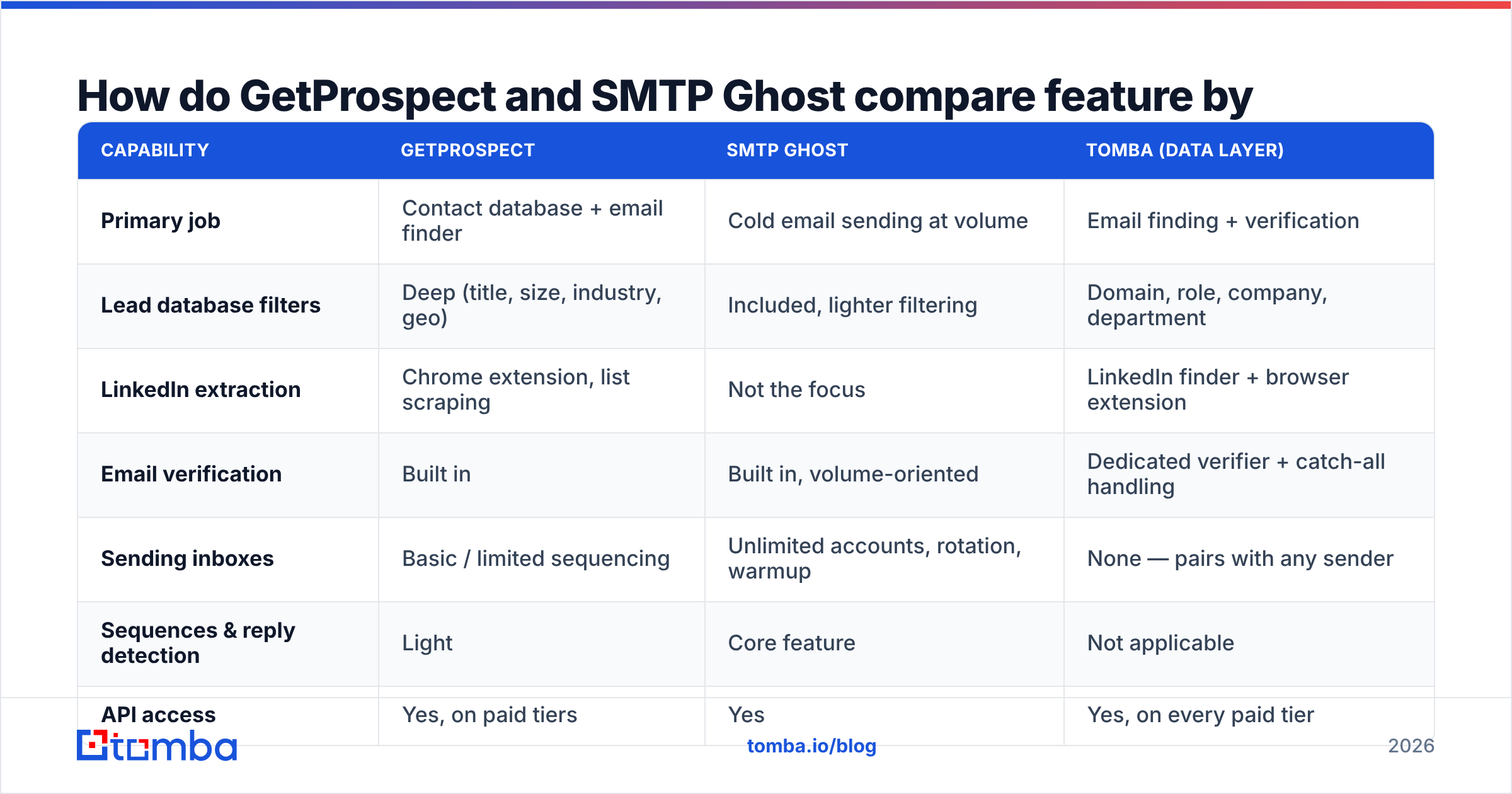
Here is the side-by-side, with a dedicated data layer included as a third column so you can see where a specialist tool differs from a bundle.
| Capability | GetProspect | SMTP Ghost | Tomba (data layer) |
|---|---|---|---|
| Primary job | Contact database + email finder | Cold email sending at volume | Email finding + verification |
| Lead database filters | Deep (title, size, industry, geo) | Included, lighter filtering | Domain, role, company, department |
| LinkedIn extraction | Chrome extension, list scraping | Not the focus | LinkedIn finder + browser extension |
| Email verification | Built in | Built in, volume-oriented | Dedicated verifier + catch-all handling |
| Sending inboxes | Basic / limited sequencing | Unlimited accounts, rotation, warmup | None — pairs with any sender |
| Sequences & reply detection | Light | Core feature | Not applicable |
| API access | Yes, on paid tiers | Yes | Yes, on every paid tier |
| Bulk CSV enrichment | Yes | Yes | Yes, plus Sheets/Excel/Airtable |
| Free tier | Limited monthly valid emails | Trial-based | 25 searches/mo |
| Best for | Building targeted lists | Scaling send volume | Accuracy-critical list hygiene |
Prices and limits move on both vendors. Treat the table as a shape-of-the-product map, then confirm the current numbers on each vendor's own pricing page before you commit.

Which one gives you better email data?#
GetProspect wins this one on paper, and it should — data is its product. You get a searchable database, LinkedIn-sourced contacts, and enrichment that fills firmographics alongside the email. SMTP Ghost's data is there so you can launch a campaign fast, not so you can build a surgical 400-account ABM list.
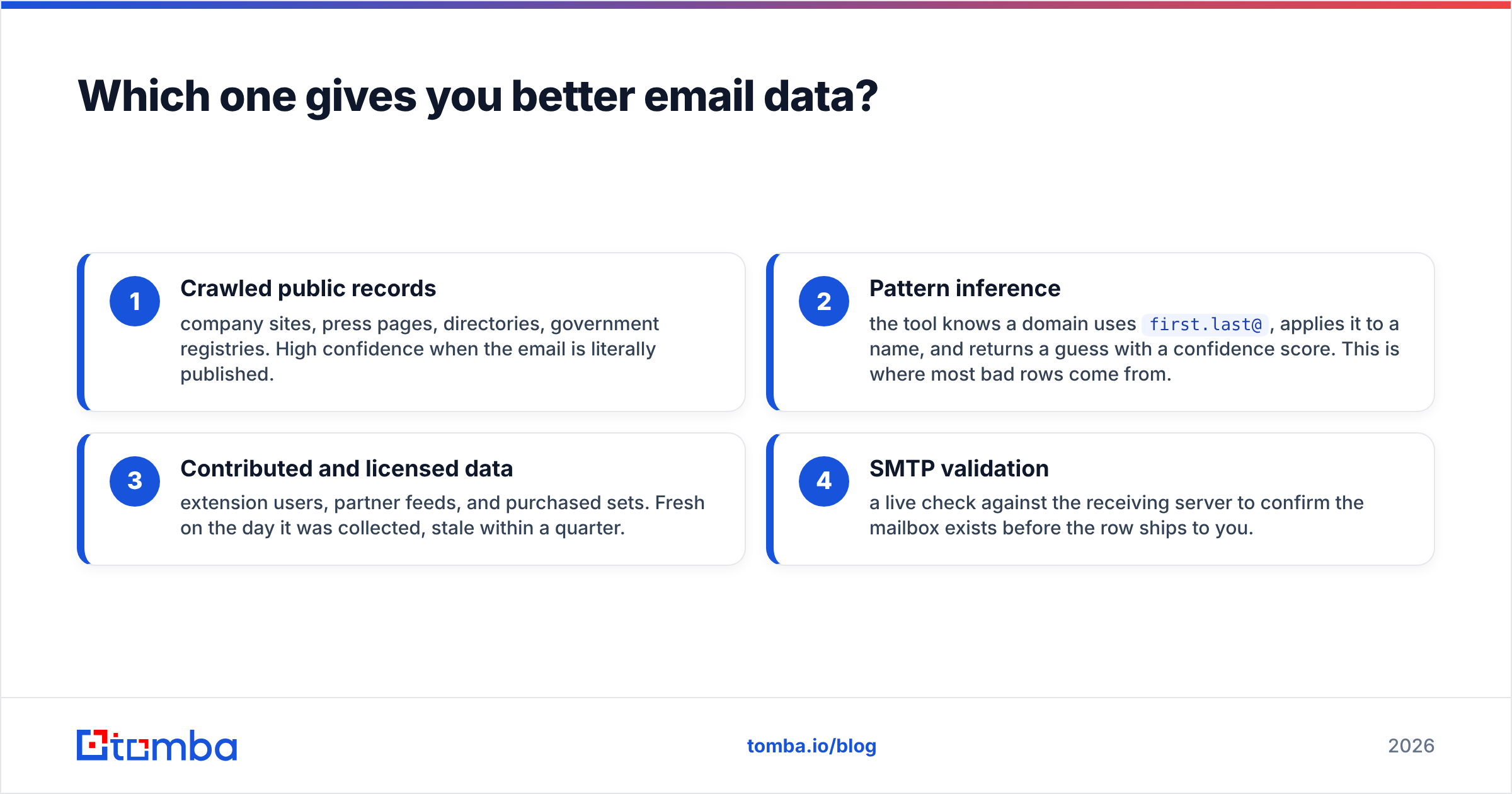
But "better database" and "better deliverable list" are different claims. Every provider in this category, including both of these, blends three sources:
- Crawled public records — company sites, press pages, directories, government registries. High confidence when the email is literally published.
- Pattern inference — the tool knows a domain uses
first.last@, applies it to a name, and returns a guess with a confidence score. This is where most bad rows come from. - Contributed and licensed data — extension users, partner feeds, and purchased sets. Fresh on the day it was collected, stale within a quarter.
- SMTP validation — a live check against the receiving server to confirm the mailbox exists before the row ships to you.
The fourth step is the one that decides your bounce rate. A database with 200 million contacts and weak verification will hurt you more than a smaller database that refuses to return a row it cannot confirm. That is why serious teams run a second pass through a dedicated email verifier before a list touches a sequencer, regardless of which vendor sourced it — and why catch-all domains deserve their own handling instead of being silently marked "valid."
A practical benchmark: pull 200 contacts from any provider, verify them independently, and count how many come back as risky or invalid. Anything over 5% and you are paying twice — once for the data, once in sender reputation.
Which one is better for sending cold email?#
SMTP Ghost, without much argument. Its whole architecture is built around the constraint that kills most outbound programs: per-inbox pricing. When a sequencer charges by mailbox, you ration inboxes, over-send from each one, and burn your domains. Unlimited-account pricing flips that — you spread 30 sends a day across many mailboxes instead of 300 a day across three.
What matters when you evaluate the sending half:
- Inbox rotation — sends distributed across accounts so no single mailbox spikes.
- Warmup — automated conversation traffic that builds sending history before real volume starts.
- Throttling and ramp — daily caps that increase gradually rather than in one jump.
- Reply and bounce handling — automatic sequence exit on reply, hard-bounce suppression, and list-level bounce alarms.
- Authentication checks — SPF, DKIM, and DMARC validated per sending domain before launch.
GetProspect's sending exists, but if your plan is 5,000 emails a month across a dozen domains, you will outgrow it fast. Conversely, if your plan is 300 highly targeted emails a month to VP-level contacts at 90 named accounts, SMTP Ghost's volume machinery is capacity you are not using.
One caution that applies to both: sending infrastructure cannot rescue a bad list. Google and Microsoft weight complaint rate and bounce rate heavily, and Google's published sender guidelines put spam complaint thresholds in plain terms. A rotation engine simply spreads a bad list across more domains — it distributes the damage rather than preventing it.

What do GetProspect and SMTP Ghost cost?#
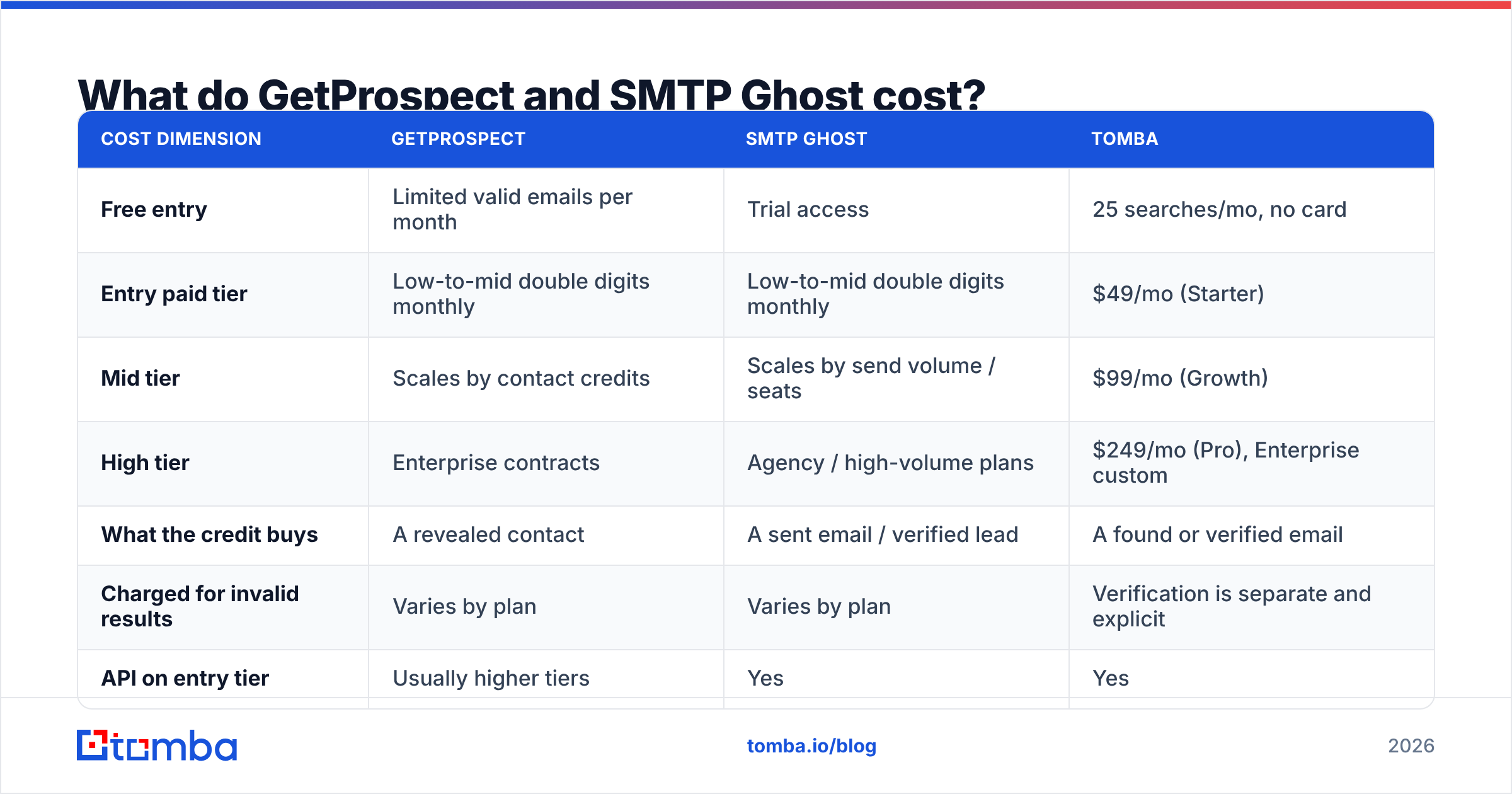
Both use credit-based pricing with tier jumps, and both have a free or trial entry point. The comparison that actually matters is cost per usable contact and cost per sent email, not sticker price.
| Cost dimension | GetProspect | SMTP Ghost | Tomba |
|---|---|---|---|
| Free entry | Limited valid emails per month | Trial access | 25 searches/mo, no card |
| Entry paid tier | Low-to-mid double digits monthly | Low-to-mid double digits monthly | $49/mo (Starter) |
| Mid tier | Scales by contact credits | Scales by send volume / seats | $99/mo (Growth) |
| High tier | Enterprise contracts | Agency / high-volume plans | $249/mo (Pro), Enterprise custom |
| What the credit buys | A revealed contact | A sent email / verified lead | A found or verified email |
| Charged for invalid results | Varies by plan | Varies by plan | Verification is separate and explicit |
| API on entry tier | Usually higher tiers | Yes | Yes |
Two things to check before you sign anything, on either vendor:
Does an unverified or "risky" result consume a credit? Some tools charge for every reveal regardless of confidence. On a 10,000-contact pull with a 12% invalid rate, that is 1,200 credits spent on rows you must throw away.
Do credits roll over? Seasonal outbound teams burn credits unevenly. A plan that resets to zero every month is effectively more expensive than its headline suggests.
Tomba publishes flat per-plan limits, and you can compare the tiers directly on the Tomba pricing page. The point is not that one number is smaller — it is that credit mechanics differ more between vendors than prices do.
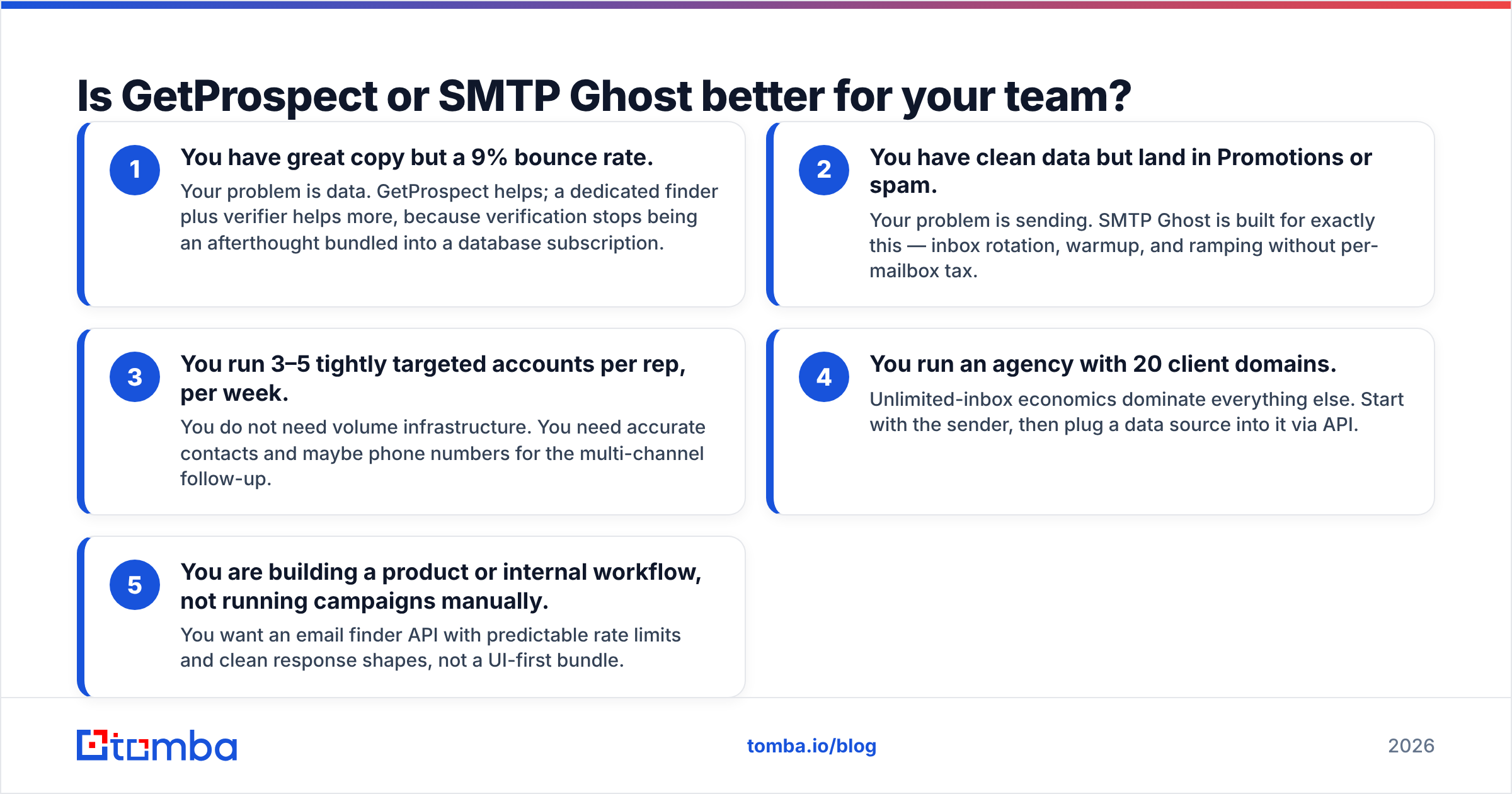
Is GetProspect or SMTP Ghost better for your team?#
Match the tool to the bottleneck, not to the feature list. Five common situations:
- You have great copy but a 9% bounce rate. Your problem is data. GetProspect helps; a dedicated finder plus verifier helps more, because verification stops being an afterthought bundled into a database subscription.
- You have clean data but land in Promotions or spam. Your problem is sending. SMTP Ghost is built for exactly this — inbox rotation, warmup, and ramping without per-mailbox tax.
- You run 3–5 tightly targeted accounts per rep, per week. You do not need volume infrastructure. You need accurate contacts and maybe phone numbers for the multi-channel follow-up.
- You run an agency with 20 client domains. Unlimited-inbox economics dominate everything else. Start with the sender, then plug a data source into it via API.
- You are building a product or internal workflow, not running campaigns manually. You want an email finder API with predictable rate limits and clean response shapes, not a UI-first bundle.
If you are still torn, read recent reviews on G2 with the date filter set to the last six months. Both categories churn quickly, and a 2023 review of a database's coverage tells you very little about 2026 coverage.
Should you just use both — or neither?#
Running both is legitimate and common: GetProspect (or another data source) builds the list, SMTP Ghost sends it. The friction is the handoff. You export a CSV, re-verify it, dedupe it, then import it — and that manual middle step is where lists go stale and duplicates creep in.
The cleaner architecture is a three-part stack with an API between each layer:
- Source layer — a finder that returns emails by domain, name, or company, plus enrichment fields you actually use for personalization.
- Hygiene layer — verification and catch-all handling that runs automatically before anything enters a sequence, not after bounces teach you a lesson.
- Send layer — the sequencer with rotation, warmup, and reply handling.
When those three are separate, you can swap any one of them without rebuilding the other two. When they are bundled, you inherit the weakest component. That is the real trade-off behind "GetProspect vs SMTP Ghost": bundles are convenient until the weak part is the part you depend on most.
It is also worth naming a third path. Providers like BookYourData sell verified contact lists outright, which suits teams that would rather buy a finished list than operate a search tool. Different buying model, same underlying requirement — the emails have to be real on the day you send.
What is the verdict for 2026?#
Pick SMTP Ghost if your constraint is volume and inbox economics. Pick GetProspect if your constraint is finding and filtering the right people. If you are honest and your constraint is both, do not resolve it by picking the bundle that is weaker at the thing you do most — resolve it by separating the layers.
Wherever the data comes from, verify before you send. The single highest-ROI change most outbound teams make is not a new sequencer or a new database; it is a hard rule that nothing enters a campaign without a verification pass, with catch-all domains treated as their own category rather than rounded up to "valid."
Ready to fix the data half of the stack? Tomba Email Finder returns verified professional emails by domain, name, or company, with a free tier at 25 searches a month, Starter at $49/mo, and API access on every paid plan — so you can plug it straight into SMTP Ghost, GetProspect, or whatever sequencer you land on. Start with 100 of your hardest-to-find contacts and compare the bounce rate against your current source. That test takes an afternoon and settles the argument better than any comparison table, including this one.
Related guides#
Ready to find emails that actually work?
Join 150,000+ professionals who stopped guessing and started sending. Free credits on signup — no credit card required.
Get the Tomba newsletter
Practical outbound tactics and product updates — once every two weeks.
About the author