GetProspect vs The Data City: Which B2B Data Tool Wins in 2026?
One tool hands you verified work emails. The other maps entire emerging sectors and never gives you a contact. Here is where GetProspect and The Data City actually overlap, where they don't, and which one your pipeline needs.
GetProspect vs The Data City is an odd matchup. One tool finds verified work emails. The other maps whole markets and never hands you a contact. Here is how the two differ, and which one your team should buy first.
TL;DR
- These tools are not substitutes. GetProspect finds and verifies work emails for named people. The Data City sorts companies into real-time sectors. Buying one and expecting the other is the classic mistake here.
- GetProspect wins on outbound. LinkedIn extension, bulk lookup, verification, list tools, and an API. Enough to fill a sequence this afternoon.
- The Data City wins on market definition. Ask "how many UK firms really do quantum computing, and who are they?" No email finder can answer that.
- Pricing is lopsided. GetProspect posts tiers you can buy with a card. The Data City quotes you, usually per year. Plan for a procurement cycle.
- Most teams need contact data first. If you already know your ICP, mapping sectors before you can reach anyone fixes the wrong end of the funnel.
What are GetProspect and The Data City, actually?#
GetProspect is a B2B email finder and prospecting database. Give it a name and a company domain, a LinkedIn profile, or a whole company list. It returns work email addresses with a verification status attached. It ships a Chrome extension for LinkedIn, a searchable contact database, light list and CRM features, and an API. The pitch is speed. You go from "this person looks interesting" to "this person is in my sequence" in under a minute.
The Data City solves a different problem. It is a UK-focused company data platform. It reads company websites and filings with machine learning, then sorts firms into Real-Time Industrial Classifications (RTICs). Those are living sector definitions. They update as companies change what they do.
Its users are economists, policy teams, universities, local growth agencies, investors, and corporate strategy teams. The output answers four questions: what is this sector, how big is it, where is it clustered, and who is in it?
Here is the analogy. GetProspect is a phone book with a very good fact-checker. The Data City is a satellite that photographs the whole city and shows you which neighbourhoods are growing. Both are useful. Neither replaces the other.
So "which tool should I buy" is usually the wrong question. Ask this instead: which layer of my data stack is broken right now — targeting or reach?
GetProspect vs The Data City: how do they compare head-to-head?#
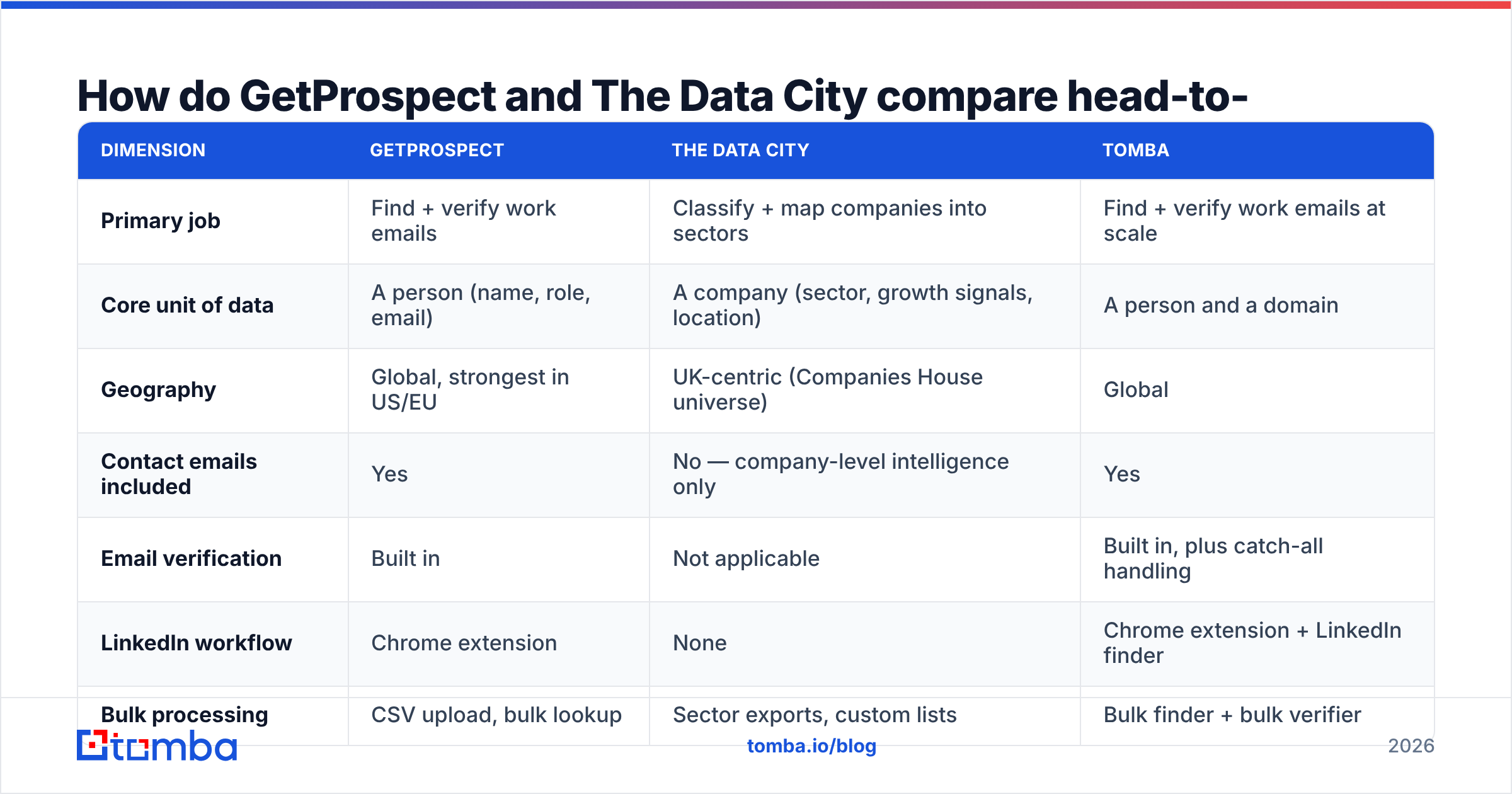
| Dimension | GetProspect | The Data City | Tomba |
|---|---|---|---|
| Primary job | Find + verify work emails | Classify + map companies into sectors | Find + verify work emails at scale |
| Core unit of data | A person (name, role, email) | A company (sector, growth signals, location) | A person and a domain |
| Geography | Global, strongest in US/EU | UK-centric (Companies House universe) | Global |
| Contact emails included | Yes | No — company-level intelligence only | Yes |
| Email verification | Built in | Not applicable | Built in, plus catch-all handling |
| LinkedIn workflow | Chrome extension | None | Chrome extension + LinkedIn finder |
| Bulk processing | CSV upload, bulk lookup | Sector exports, custom lists | Bulk finder + bulk verifier |
| API access | Yes, on paid plans | Yes, typically on higher tiers | Yes, on all paid plans |
| Typical buyer | SDR, founder, growth marketer | Analyst, policy team, investor, strategy | SDR, RevOps, developer |
| Pricing model | Self-serve monthly tiers | Quote-based, usually annual | Self-serve, from $49/mo |
| Time to first value | Minutes | Days to weeks (onboarding + scoping) | Minutes |
Read that table twice before you shortlist. The row that matters most is "contact emails included." Is your blocker that reps cannot reach people they have already identified? Then sector intelligence will not help this quarter.

What is GetProspect genuinely good at?#
Four things, honestly assessed:
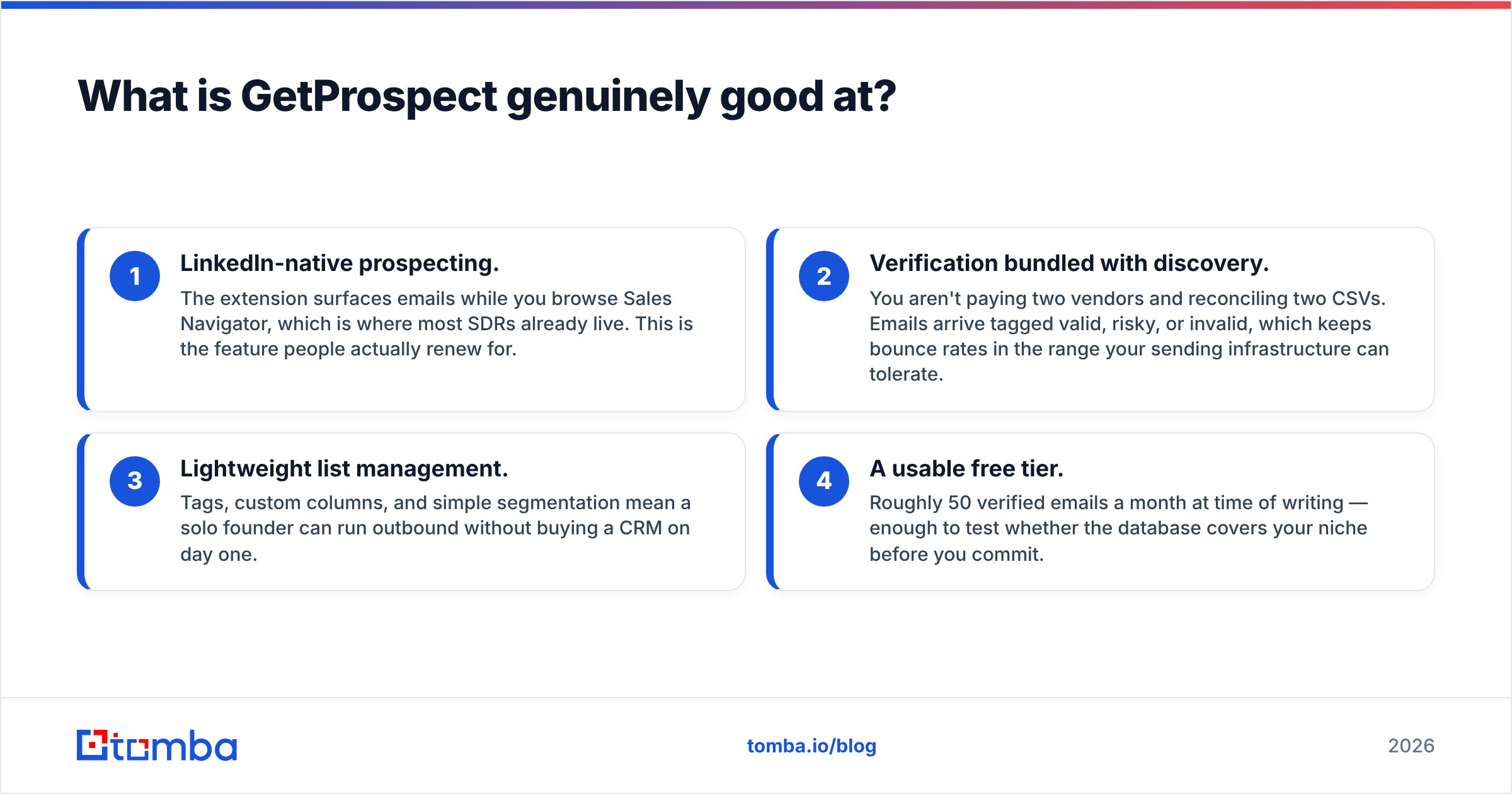
- LinkedIn-native prospecting. The extension shows emails while you browse Sales Navigator. That is where most SDRs already work. It is the feature people renew for.
- Verification built in. You do not pay two vendors or merge two CSVs. Each email arrives tagged valid, risky, or invalid. Bounce rates stay in a range your sending setup can handle.
- Light list management. Tags, custom columns, and simple segments. A solo founder can run outbound without buying a CRM on day one.
- A usable free tier. Roughly 50 verified emails a month at the time of writing. That is enough to test whether the database covers your niche.
Where it gets weaker: coverage thins out in smaller markets and non-English domains. Role and seniority data can lag reality. The database search feels basic next to full intelligence platforms. It is a finder that grew list features, not an intelligence platform that grew a finder.
What is The Data City genuinely good at?#
Also four things:
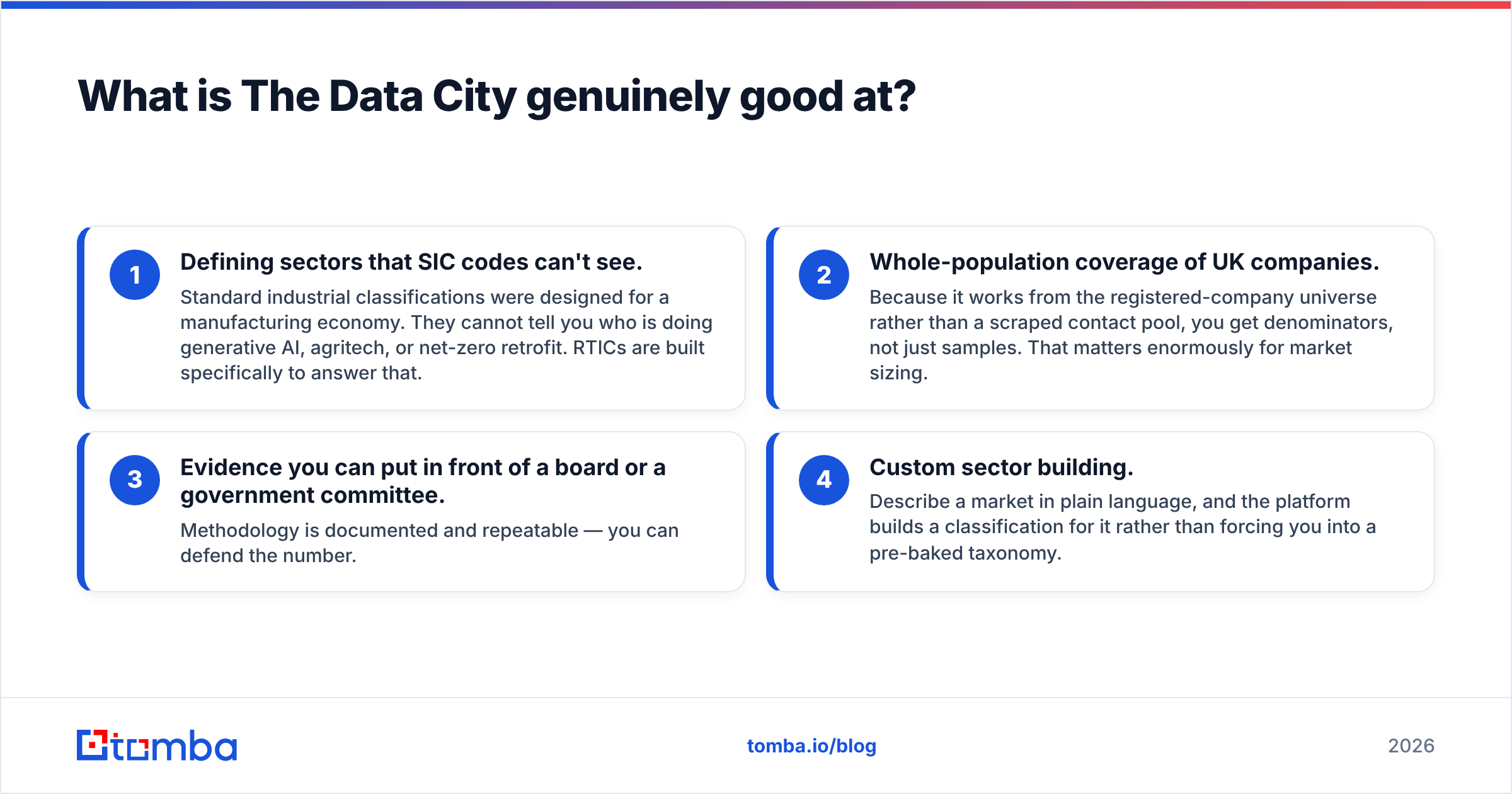
- Sectors that SIC codes miss. Standard industrial codes were built for a manufacturing economy. They cannot show you who does generative AI, agritech, or net-zero retrofit. RTICs are built for exactly that.
- Full coverage of UK companies. It starts from the registered-company list, not a scraped contact pool. So you get denominators, not just samples. That matters a lot for market sizing.
- Evidence you can put in front of a board. The method is documented and repeatable. You can defend the number.
- Custom sector building. Describe a market in plain words. The platform builds a classification for it. You are not forced into a fixed taxonomy.
Where it gets weaker for a sales audience: it is not a prospecting tool. You will not get named decision-makers with verified emails. The UK focus limits US-heavy GTM teams. And the buying process — quote, scoping, annual contract — suits institutional buyers, not a growth marketer with a $200 monthly tool budget.
How does the data quality actually differ?#
The two platforms fail in different directions. Knowing how saves you a bad renewal.
Contact databases like GetProspect decay from the person side. People change jobs. Industry consensus puts B2B contact decay near 25–30% a year. Restructures and domain migrations add more on top. A record that was perfect in January can be dead in June. So verification at send time beats raw database size. A 200-million-contact database that is 30% stale is really 140 million contacts plus a deliverability problem.
Company-intelligence platforms like The Data City fail from the classification side. A firm that pivots may be re-labelled late. A thin website gives the model less to read. But the underlying entity — the registered company — is stable. Firms rarely stop existing overnight.
The practical takeaway is simple. Buying contact data? Buy verification with it, and re-verify before every send. Buying sector data? Expect some drift, and check the refresh schedule during your trial. Running your list through an email verifier first is not optional hygiene. It is the difference between a warm domain and a burned one.
Then there are catch-all domains. They now cover a large slice of enterprise mail servers. Standard SMTP checks return "unknown" and most tools stop there. A dedicated catch-all verifier earns its keep here. An "unknown" left in a list is a bounce waiting to happen.
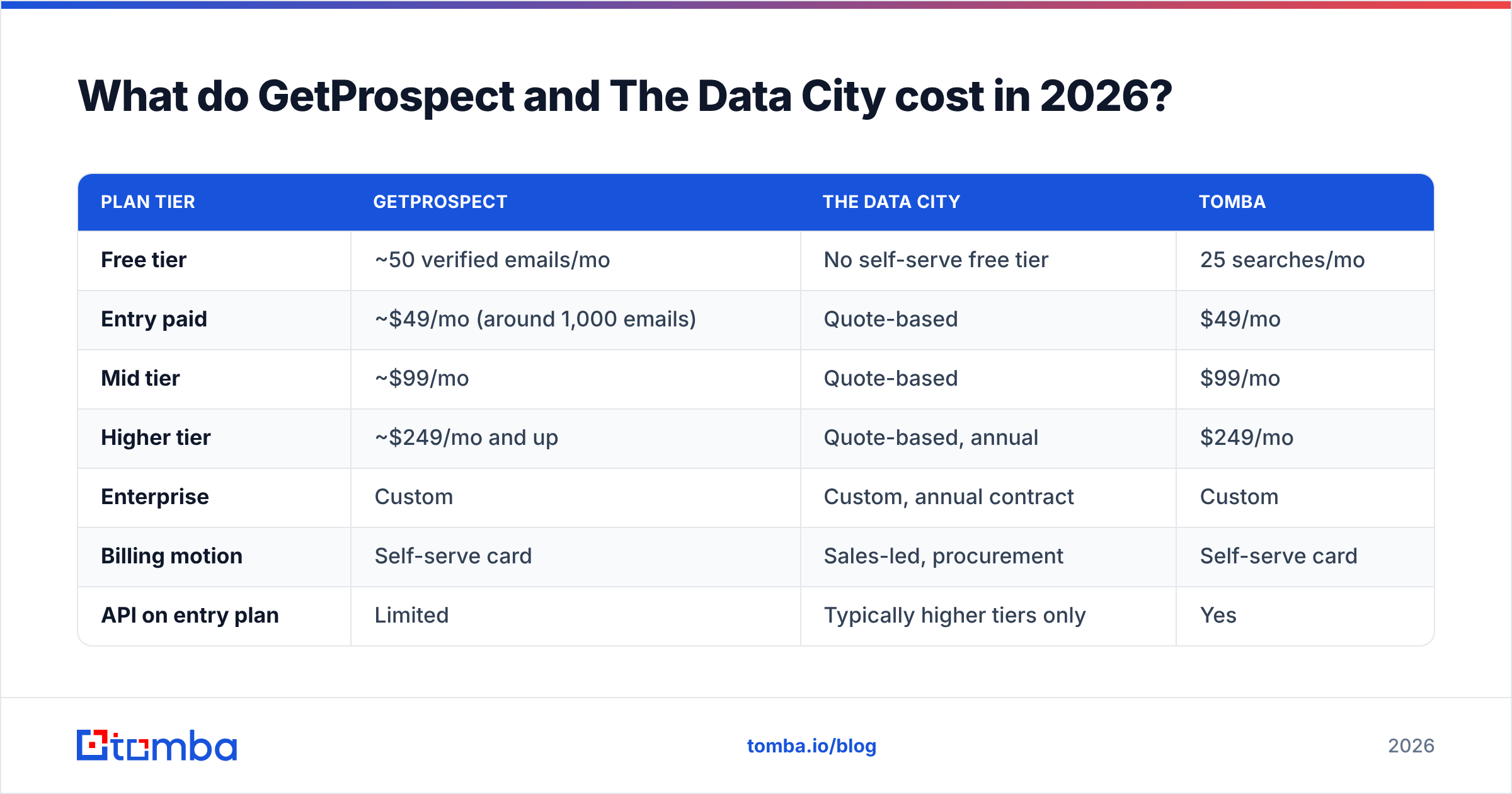
What do GetProspect and The Data City cost in 2026?#
Pricing changes, so treat this as a shape rather than a quote. Always confirm on the vendor's own page before you budget.
| Plan tier | GetProspect | The Data City | Tomba |
|---|---|---|---|
| Free tier | ~50 verified emails/mo | No self-serve free tier | 25 searches/mo |
| Entry paid | ~$49/mo (around 1,000 emails) | Quote-based | $49/mo |
| Mid tier | ~$99/mo | Quote-based | $99/mo |
| Higher tier | ~$249/mo and up | Quote-based, annual | $249/mo |
| Enterprise | Custom | Custom, annual contract | Custom |
| Billing motion | Self-serve card | Sales-led, procurement | Self-serve card |
| API on entry plan | Limited | Typically higher tiers only | Yes |
The surprise is not the headline number. It is the buying motion. You can be live on GetProspect or Tomba pricing tiers in ten minutes. The Data City is a considered purchase with scoping calls. That fits what it does. A research licence for a university department is not an impulse buy. Budget the calendar, not just the cash.

Which one should you pick for your GTM motion?#
Match the tool to the real bottleneck:
- You know who to sell to and cannot reach them. → Contact data. GetProspect, Tomba, or a comparable email finder. Sector intelligence solves nothing here.
- You are entering a market you cannot define yet. → The Data City, if that market is UK-based. No email finder will size a sector for you.
- You are an analyst, policy team, or investor. → The Data City, clearly. A defensible method beats contact volume when your output is a report.
- You are a founder sending your first 100 cold emails. → Start free. Test coverage in your niche before you pay anyone.
- You are RevOps wiring enrichment into a CRM. → Whichever API you can afford at your tier. Check whether API access is locked behind an enterprise plan. That detail kills more integrations than rate limits do.
- You need both targeting and reach. → Buy them separately and join them on domain. See below.
Can you use both together?#
Yes. For a UK-focused ABM programme, it is the strongest setup available.
The workflow has two stages. First, use The Data City to build your target account list. Say, every UK firm classified into "industrial decarbonisation" with 50+ staff and recent growth signals. You get company names and domains back.
Second, push those domains into a domain search to pull the people. Then run data enrichment to attach titles, seniority, and verified addresses before anything reaches your sequencer.
The domain is the join key, and that is the whole trick. Company intelligence platforms output domains. Email finders consume domains. Nobody sells this as an integration. It is a fifteen-minute CSV round trip, and it turns a research subscription into a pipeline source.
Running that step often? Do it programmatically. The Tomba API takes a domain and returns the contacts plus verification status in a single call. Enrichment becomes a scheduled job instead of a manual chore your ops person resents.
What do reviewers say about each?#
Check G2 before you sign anything. Read for the right signal, though. For contact-data tools, the useful reviews mention bounce rates and coverage in specific countries — not the UI. For intelligence platforms, look for reviews from buyers with your use case. A policy team and a corporate strategy team rate the same platform very differently.
Weight recent reviews heavily. A 2023 review of an email finder says almost nothing about 2026 data quality. The underlying sources and the verification stack have both changed since.
What is the honest verdict on GetProspect vs The Data City?#
There is no winner, because there is no shared contest. A more useful framing:
- For outbound sales teams: GetProspect is the relevant option of the two, and a solid one. Its real rivals are other email finders, including Tomba.
- For research, policy, and UK-focused strategy: The Data City has very few credible peers. Comparing it to an email finder undersells it.
- For teams that need both: Buy both. They cost different budgets, serve different users, and join cleanly on domain.
The failure mode to avoid is common. You buy the research platform because it sounds more sophisticated. Three weeks later your SDRs still have nobody to email. Get reach first. Refine targeting second. Sophistication that never produces a send is just an expensive slide deck.
Ready to turn account lists into contacts?#
If your accounts are already defined and reach is the gap, that problem is solved. Tomba's Email Finder takes a name and a domain, or a whole company list. It returns verified work emails with confidence scoring and catch-all handling built in.
The free tier gives you 25 searches a month to test coverage in your niche. Paid plans start at $49/mo, and API access is included rather than gated behind enterprise. Bulk processing turns a 2,000-row account list into one upload, not a week of manual lookups. Start free, check the hit rate against your own ICP, and pay once the data proves itself.
Related guides#
Ready to find emails that actually work?
Join 150,000+ professionals who stopped guessing and started sending. Free credits on signup — no credit card required.
Get the Tomba newsletter
Practical outbound tactics and product updates — once every two weeks.
About the author