GetProspect vs Zintlr: Which B2B Email Finder Wins in 2026
GetProspect and Zintlr both promise verified B2B contacts, but they solve different problems. Here is how they compare on accuracy, pricing, enrichment depth, and the workflows each one actually fits.
TL;DR
- GetProspect is a mature email finder with a LinkedIn extension, a large searchable B2B database, and a straightforward per-email credit model. It is the safer pick if your only job is "turn a company or a LinkedIn profile into a working email address."
- Zintlr is a newer, broader intelligence platform — contact data plus personality/behavioral profiling and buyer-intent style signals. It targets teams that want context, not just contacts.
- On raw email accuracy, both sit in the same broad band as most mid-tier providers. Neither publishes independently audited bounce rates, so you should run your own 100-contact test before committing.
- Pricing diverges sharply: GetProspect meters credits, Zintlr leans toward seat-plus-credit bundles. Your cost per usable email depends far more on your verification step than on the sticker price.
- If you need a verification-first workflow with an API and catch-all handling, neither tool is the obvious winner — that is where a dedicated finder/verifier stack earns its keep.
What are GetProspect and Zintlr?#
GetProspect launched as a LinkedIn email extractor and grew into a full prospecting suite: a searchable contact database, a Chrome extension that pulls emails off LinkedIn search results, bulk CSV enrichment, and a light CRM layer for organizing lists. Its centre of gravity is still the same — you have a person or a company, and you want their work email.
Zintlr came later and positioned itself differently. Alongside a B2B contact database, it sells "personality intelligence" — inferred behavioral profiles of your prospects — plus firmographic filters and signals designed to tell you when to reach out, not just who to reach. It is closer in spirit to a sales-intelligence platform than to a pure email finder.
That difference matters more than any feature checklist. Comparing GetProspect vs Zintlr on email-finding alone flatters GetProspect. Comparing them on "does this tell me something my CRM doesn't" flatters Zintlr. Pick the axis that matches your actual bottleneck.

How do GetProspect and Zintlr compare head-to-head?#
Here is the practical side-by-side. Vendor plans change often — treat the pricing rows as directional and confirm on each vendor's page before you buy.
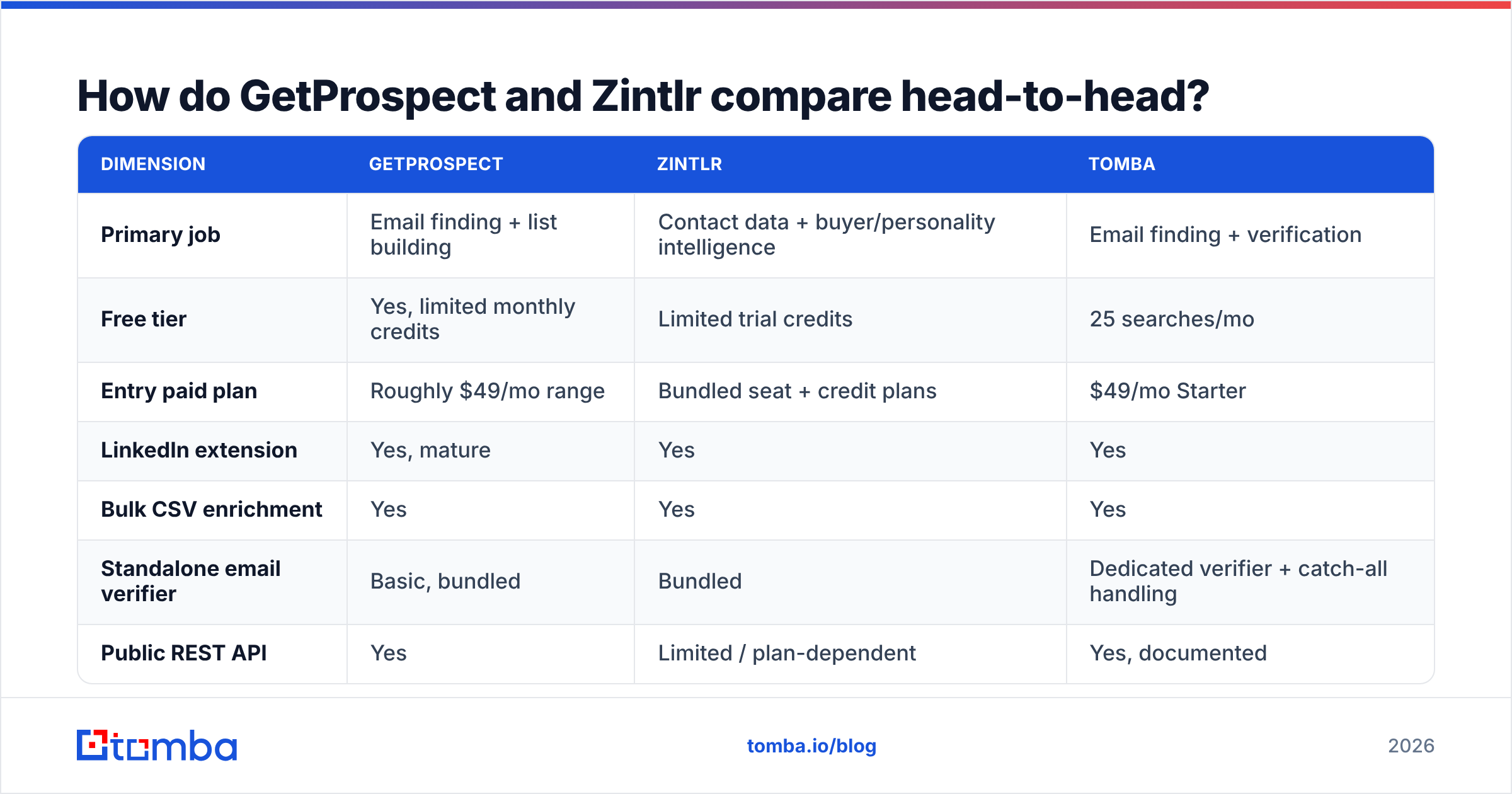
| Dimension | GetProspect | Zintlr | Tomba |
|---|---|---|---|
| Primary job | Email finding + list building | Contact data + buyer/personality intelligence | Email finding + verification |
| Free tier | Yes, limited monthly credits | Limited trial credits | 25 searches/mo |
| Entry paid plan | Roughly $49/mo range | Bundled seat + credit plans | $49/mo Starter |
| LinkedIn extension | Yes, mature | Yes | Yes |
| Bulk CSV enrichment | Yes | Yes | Yes |
| Standalone email verifier | Basic, bundled | Bundled | Dedicated verifier + catch-all handling |
| Public REST API | Yes | Limited / plan-dependent | Yes, documented |
| Phone numbers | Limited | Yes | Yes |
| Personality / intent signals | No | Yes — core differentiator | No |
| Best for | Volume list building | Context-rich, low-volume ABM | Accuracy-first outbound at scale |
The honest read: GetProspect and Zintlr overlap on maybe 60% of what they do. The remaining 40% is where your decision lives.
Which one finds more valid emails?#
Neither vendor publishes third-party-audited accuracy numbers, and both quote figures in the "95%+" range that every provider in this category quotes. That number is almost always measured on deliverable, syntactically valid, SMTP-accepting addresses — which is not the same as "the right person at the right company."

What actually moves your bounce rate:
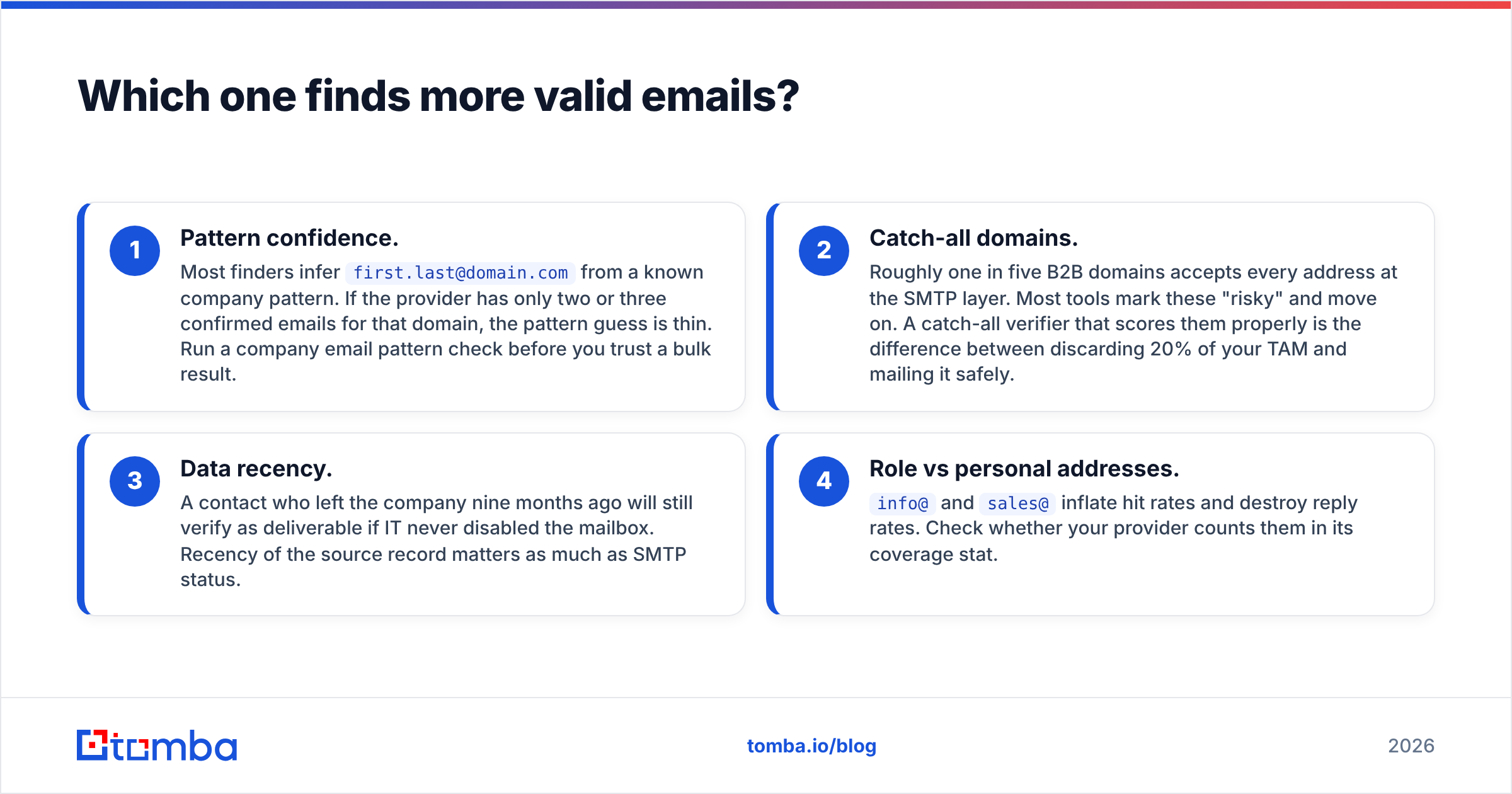
- Pattern confidence. Most finders infer
first.last@domain.comfrom a known company pattern. If the provider has only two or three confirmed emails for that domain, the pattern guess is thin. Run a company email pattern check before you trust a bulk result. - Catch-all domains. Roughly one in five B2B domains accepts every address at the SMTP layer. Most tools mark these "risky" and move on. A catch-all verifier that scores them properly is the difference between discarding 20% of your TAM and mailing it safely.
- Data recency. A contact who left the company nine months ago will still verify as deliverable if IT never disabled the mailbox. Recency of the source record matters as much as SMTP status.
- Role vs personal addresses.
info@andsales@inflate hit rates and destroy reply rates. Check whether your provider counts them in its coverage stat.
The practical test: pull 100 contacts from the same target segment in both tools, push both lists through an independent email verifier, and compare (a) match rate, (b) verified-valid rate, and (c) overlap. In most head-to-heads we have seen run this way, GetProspect and Zintlr each surface contacts the other misses. That overlap gap is the argument for a waterfall approach rather than a single vendor.
How does pricing actually work for each?#
Sticker price is the least useful comparison metric in this category. What you care about is cost per verified, usable email — and that number is set by three things the pricing page does not show you.
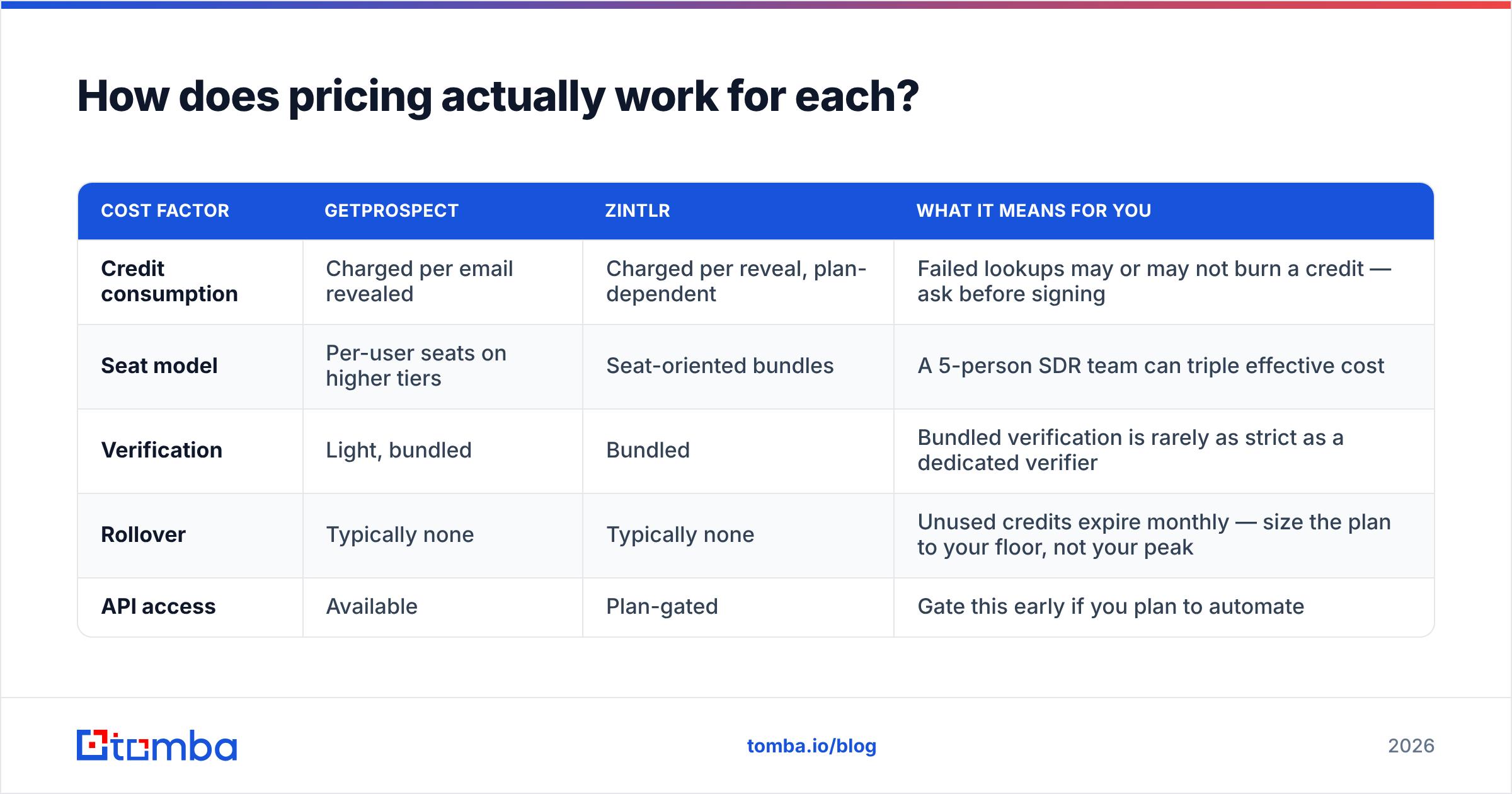
| Cost factor | GetProspect | Zintlr | What it means for you |
|---|---|---|---|
| Credit consumption | Charged per email revealed | Charged per reveal, plan-dependent | Failed lookups may or may not burn a credit — ask before signing |
| Seat model | Per-user seats on higher tiers | Seat-oriented bundles | A 5-person SDR team can triple effective cost |
| Verification | Light, bundled | Bundled | Bundled verification is rarely as strict as a dedicated verifier |
| Rollover | Typically none | Typically none | Unused credits expire monthly — size the plan to your floor, not your peak |
| API access | Available | Plan-gated | Gate this early if you plan to automate |
For reference, Tomba pricing runs a free tier at 25 searches/mo, Starter at $49/mo, Growth at $99/mo, and Pro at $249/mo, with the verifier included rather than sold as a separate line item. The point is not that one number beats another — it is that you should normalize all three vendors to dollars per verified contact you actually mailed, then compare.
A quick way to do that: take last quarter's real outbound volume, add your historical bounce rate, and divide. Teams routinely discover the "cheap" tool costs more per usable record because 18% of its output never survives verification.
What does Zintlr do that GetProspect doesn't?#
Three things, and whether they matter depends entirely on your motion.
- Personality and behavioral profiling. Zintlr infers communication style from public signals and surfaces it next to the contact. For a 40-account ABM list where each email is hand-written, that is genuinely useful context. For a 4,000-contact sequence, it is decoration.
- Signal-led targeting. Firmographic and activity filters designed to answer "who is in-market now," rather than "who matches this title." This is the feature set that positions Zintlr against sales-intelligence platforms rather than against pure finders.
- Wider record breadth per contact. Phone coverage and adjacent attributes tend to be deeper, which matters if your team runs a genuine multi-channel motion rather than email-only.
If none of those three lines describe your week, the extra platform surface is cost you are not using.
What does GetProspect do better?#
- Focus. The LinkedIn-to-email path is well-worn, fast, and predictable. Extensions that do one job well beat platforms that do eight jobs adequately.
- List hygiene workflow. Built-in list management, dedupe, and CSV round-tripping are mature. If your process is "build list → enrich → export to sequencer," this is a shorter path.
- Predictable credit math. Simpler metering makes forecasting spend easier, which finance appreciates more than an intent dashboard.
- Larger public review footprint. You can read hundreds of real user accounts on G2 before committing — Zintlr's review volume is thinner, which makes due diligence harder.
Where do both tools fall short?#
Both share the structural weaknesses of bundled-verification platforms:
- Verification is a feature, not a product. Bundled checks catch syntax errors and hard-dead mailboxes. They rarely handle catch-all scoring, greylisting, or role-address filtering with the strictness a cold-email program needs in 2026, when Google and Microsoft both enforce tighter sender thresholds.
- No true waterfall. When the primary source misses, neither tool falls through to a second and third source the way a dedicated enrichment layer does. You eat the miss.
- API depth varies. If you want to enrich inside your own product or CRM sync job, check the rate limits and endpoint coverage before you architect around either. A documented email finder API with predictable limits removes a whole class of engineering surprise.
- Credit expiry. Monthly reset punishes lumpy prospecting cycles. Buy for your quiet months, top up for your loud ones.

Worth naming honestly: neither GetProspect nor Zintlr is a bad tool. Both clear the bar for a small team running a normal outbound motion. The gap opens at scale and at the edges — catch-all domains, API automation, and verification strictness.
Which one should you choose?#
Match the tool to the constraint you actually have:
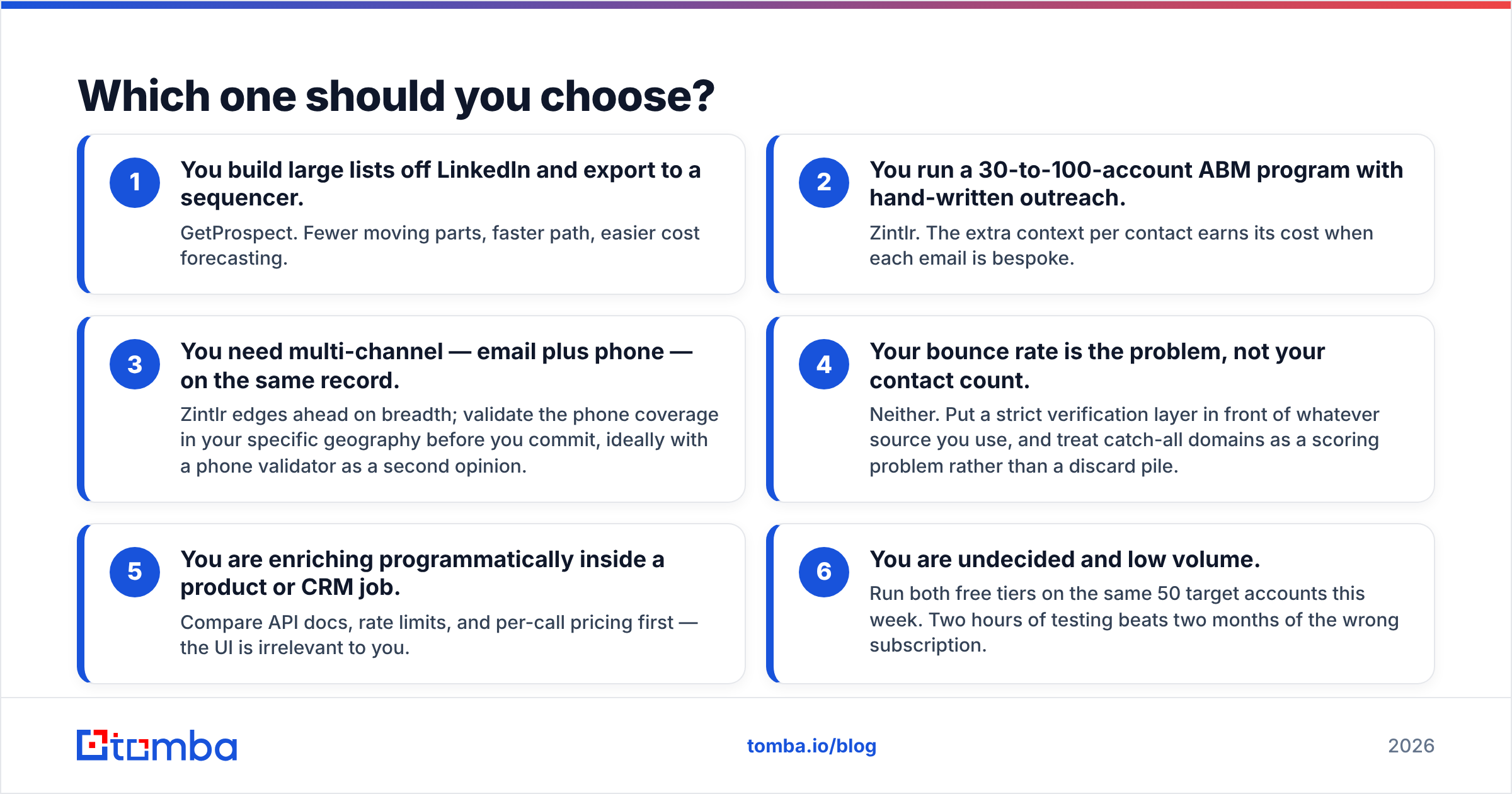
- You build large lists off LinkedIn and export to a sequencer. GetProspect. Fewer moving parts, faster path, easier cost forecasting.
- You run a 30-to-100-account ABM program with hand-written outreach. Zintlr. The extra context per contact earns its cost when each email is bespoke.
- You need multi-channel — email plus phone — on the same record. Zintlr edges ahead on breadth; validate the phone coverage in your specific geography before you commit, ideally with a phone validator as a second opinion.
- Your bounce rate is the problem, not your contact count. Neither. Put a strict verification layer in front of whatever source you use, and treat catch-all domains as a scoring problem rather than a discard pile.
- You are enriching programmatically inside a product or CRM job. Compare API docs, rate limits, and per-call pricing first — the UI is irrelevant to you.
- You are undecided and low volume. Run both free tiers on the same 50 target accounts this week. Two hours of testing beats two months of the wrong subscription.
One more option worth putting on the table: BookYourData takes a different approach again, selling pay-as-you-go, pre-verified list access rather than a seat-based platform. If your buying pattern is occasional bulk purchases rather than daily prospecting, that model can be a cleaner fit than either subscription here.
How do you test them properly in one week?#
Do not evaluate on the demo data. Run this:
- Day 1 — Define one segment: 100 accounts, one title band, one geography. Same list for every tool.
- Day 2 — Pull contacts from GetProspect and Zintlr. Record match rate and credits burned per successful reveal.
- Day 3 — Push both outputs through an independent verifier. Record verified-valid, catch-all, and invalid counts. Use bulk verify so the test finishes in minutes, not hours.
- Day 4 — Measure overlap. High overlap means pick one on price. Low overlap means your real answer is a waterfall.
- Day 5 — Send 50 emails from each verified set. Compare actual bounce rate against each vendor's claimed accuracy.
That last step is the only one that produces a number you can trust. Everything before it is a proxy.
The verdict#
GetProspect wins on focus; Zintlr wins on context. If your job is volume email discovery from LinkedIn, GetProspect is the shorter, cheaper, more predictable path. If your job is understanding a small set of accounts deeply before you write to them, Zintlr gives you something GetProspect structurally does not.
But if the thing keeping you up at night is bounce rate, domain reputation, or catch-all coverage — the problems that actually kill outbound programs — then the finder is not your bottleneck. The verification layer is.
That is where Tomba fits. The Tomba Email Finder pairs domain-level discovery with a strict verifier and dedicated catch-all handling in the same workflow, so the address you export is the address that lands. Start on the free tier with 25 searches a month, run it against the same 100-contact test you use for GetProspect and Zintlr, and let the bounce rate pick the winner.
Related guides#
Ready to find emails that actually work?
Join 150,000+ professionals who stopped guessing and started sending. Free credits on signup — no credit card required.
Get the Tomba newsletter
Practical outbound tactics and product updates — once every two weeks.
About the author