Getro Pricing Reviews Pros and Cons: 2026 Buyer's Guide
Getro powers job boards and talent networks for VC funds and accelerators, but the pricing is quote-only. Here's what it really costs, what reviewers complain about, and when a cheaper stack wins.
Getro pricing reviews pros and cons: that is the search most VC platform leads run before the demo call. Getro runs job boards and talent networks for funds and accelerators. The catch is that pricing is quote-only. This guide covers what buyers report paying, what they praise, and where the product falls short.
TL;DR
- Getro is a job board and talent network built for VC funds, accelerators, and communities that help portfolio companies hire. It is not a sales prospecting tool.
- Getro does not publish a full price list. Expect an annual deal in the low-to-mid four figures for a basic board. The number climbs once you add the talent network and extra seats. Get a written quote.
- Reviews praise the automatic job sync from portfolio ATS accounts. Upkeep is low. Founders actually use the talent network.
- The common gripes: quote-only pricing, limited design control on low tiers, thin candidate data, and annual terms that feel heavy under 20 portfolio companies.
- Do you mainly need contact data? Then a job board is the wrong line item. Pair a light board with a dedicated data tool.
What is Getro, and who buys it?#
Getro is a talent platform for groups that do not hire the people they place. Think of it as a shared job noticeboard for a portfolio. A fund runs it. Dozens of portfolio companies post to it. Candidates browse one page instead of thirty career sites.
The product has two parts:
- GetroJobs — an embedded job board. It pulls open roles from your portfolio companies' career pages and ATS accounts. Roles show up on your own domain, with filters for role, location, and company.
- GetroNetwork — a talent network layer. Candidates opt in and build a profile. Hiring managers search that pool instead of paying for a job ad. It works as a light candidate CRM for the community.
The typical buyer is a platform lead or talent partner at a venture fund. Accelerator program managers, economic development agencies, and large professional communities buy it too. Sales teams hunting for a prospecting tool should skip to the alternatives section.
You can check the current product scope on Getro's own site. What follows is a neutral read on cost and trade-offs, not a vendor summary.
How does Getro pricing work in 2026?#
Getro sells annual contracts and quotes each one. There is no public checkout. There is no free tier you can start with a credit card. You book a demo, share your portfolio size, and wait for a proposal.
That setup matters more than the number itself. Quote-only pricing means your cost tracks what the vendor thinks you can pay. It also means renewal turns into a yearly negotiation.

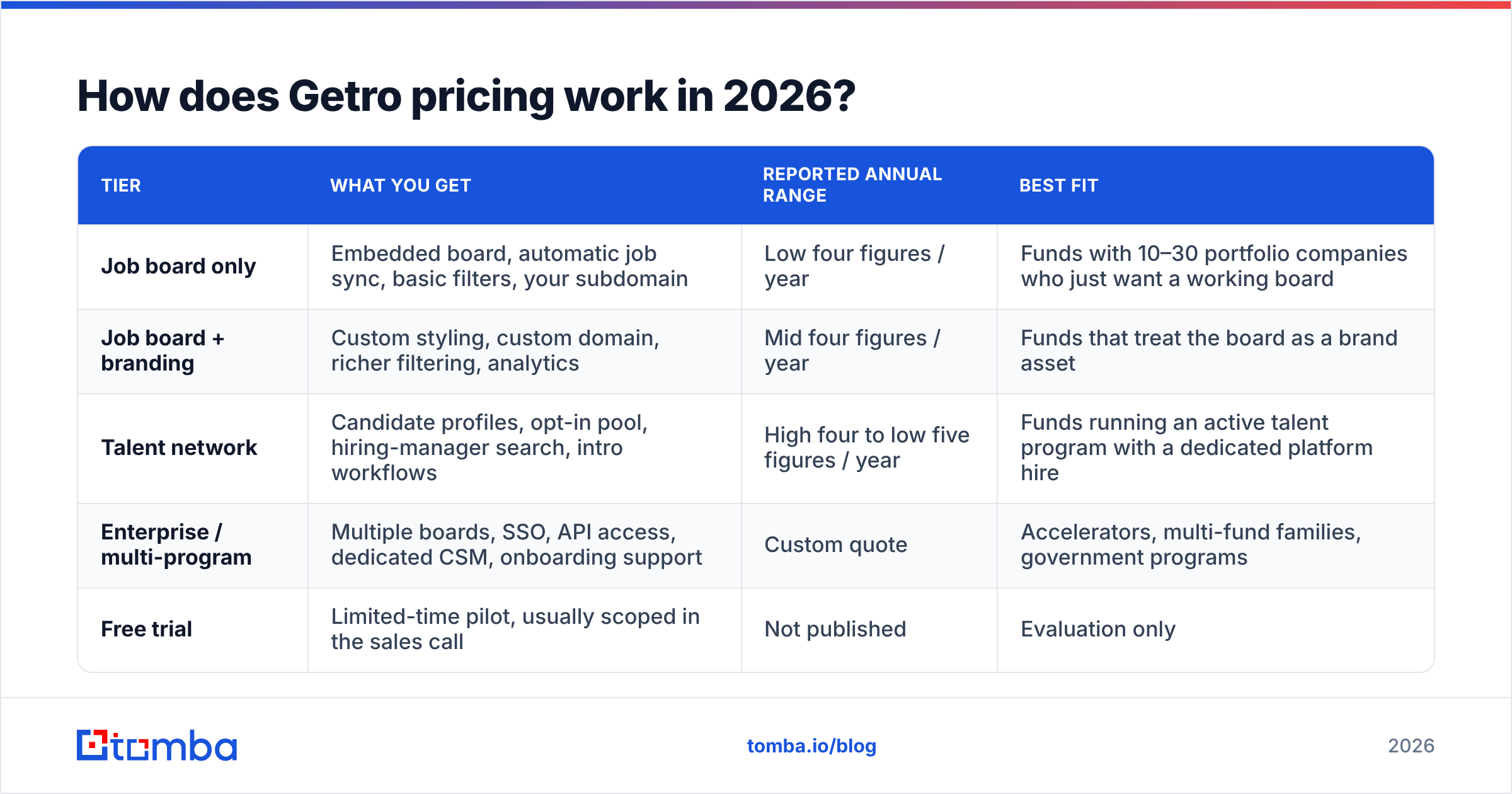
Here is how the plans tend to stack up. These are reported ranges from buyer conversations and public chatter, not quotes. Use them as a starting point for talks. Then get every number in writing, and check Getro's pricing page too.
| Tier | What you get | Reported annual range | Best fit |
|---|---|---|---|
| Job board only | Embedded board, automatic job sync, basic filters, your subdomain | Low four figures / year | Funds with 10–30 portfolio companies who just want a working board |
| Job board + branding | Custom styling, custom domain, richer filtering, analytics | Mid four figures / year | Funds that treat the board as a brand asset |
| Talent network | Candidate profiles, opt-in pool, hiring-manager search, intro workflows | High four to low five figures / year | Funds running an active talent program with a dedicated platform hire |
| Enterprise / multi-program | Multiple boards, SSO, API access, dedicated CSM, onboarding support | Custom quote | Accelerators, multi-fund families, government programs |
| Free trial | Limited-time pilot, usually scoped in the sales call | Not published | Evaluation only |
Three cost drivers come up again and again:
- Portfolio size. More synced companies usually means a higher tier. Growth can trigger a mid-term upgrade talk.
- Module stacking. The talent network is the pricey half. A board alone is cheap. The network is where the contract value sits.
- Contract length. Annual prepay is the norm. Monthly deals, when offered at all, cost more.
What do Getro reviews say about the product?#
Review volume for Getro is thin next to mainstream HR software. This is a niche category, so scores on sites like G2 rest on a small sample. Read single reviews, not the star average. Weight the ones written by funds your size.
The pattern is steady across public reviews and buyer conversations.
What reviewers praise
- Automatic job syncing. The board pulls roles from portfolio ATS accounts and career pages. Nobody pastes listings by hand. This is the top reason people renew.
- Low upkeep after setup. Once the integrations are mapped, the board runs itself. Teams report minutes per month, not hours.
- Founder-visible value. Founders see their roles on the fund board. That makes platform work easy to point at, in a way a Notion doc never is.
- Onboarding support. Setup help gets good marks, above all on odd ATS mappings.
- Candidate experience. One searchable page beats thirty career sites. The filters work well on mobile.
What reviewers criticize
- Opaque pricing. You cannot budget without a sales call. Buyers report wide swings in quotes for similar portfolios.
- Design limits on low tiers. If your brand team has opinions, you will need the upgrade.
- Shallow candidate data. Profiles hold only what candidates share. Contact detail past an application form is thin.
- Sync gaps. Odd or homegrown ATS setups may need manual work. Stale roles can linger.
- Annual lock-in. A small fund hires in bursts. Twelve months of committed spend for a board that is busy four months a year is a hard sell.
Why does ATS integration quality drive so much of this? The applicant tracking system market is split across dozens of vendors. No platform syncs with all of them.
Is Getro worth it for your fund size?#
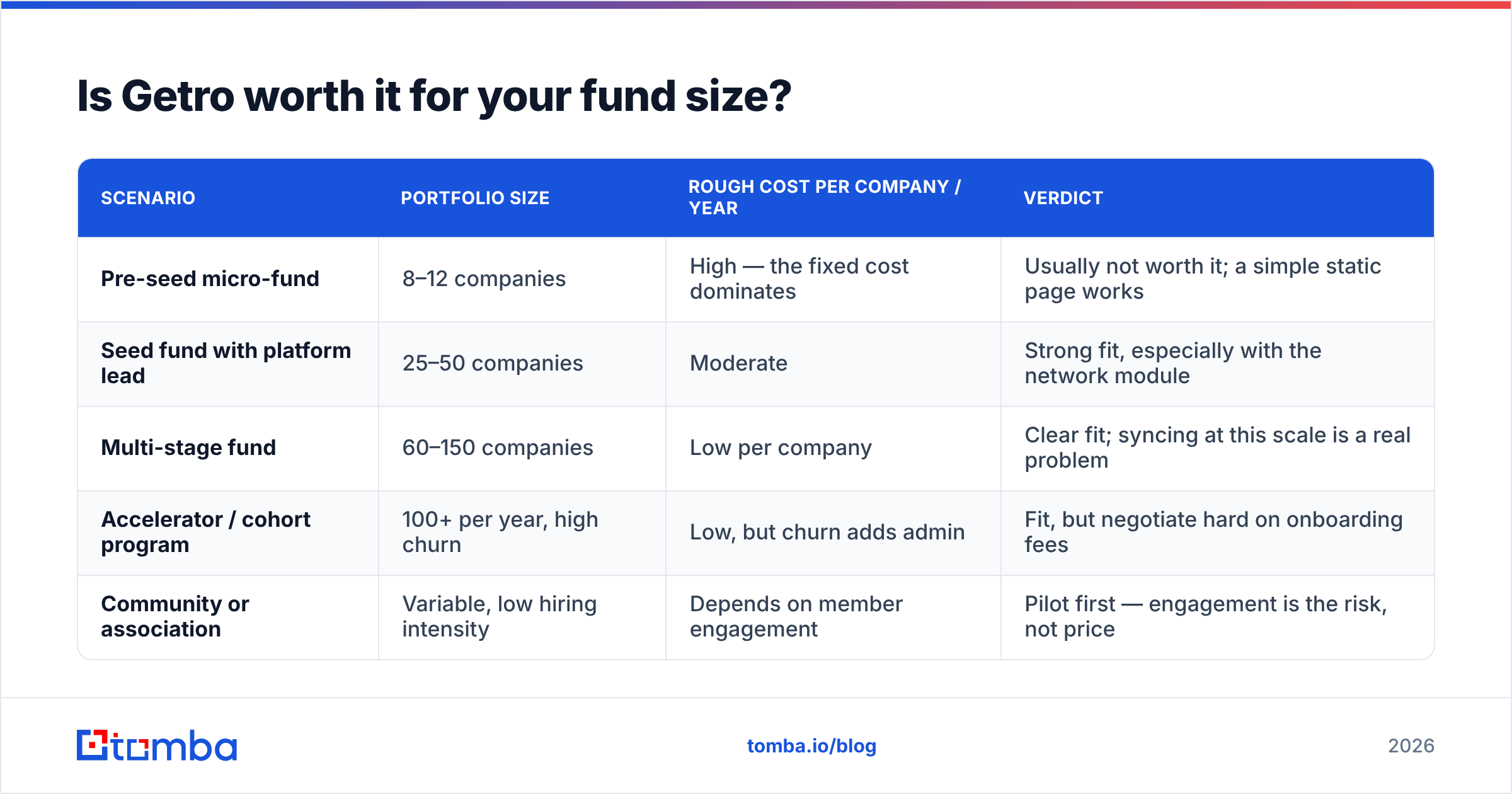
Cost per portfolio company decides this. Spread a four-figure deal across 40 companies and it is trivial. Spread the same deal across 8 and someone will question the line item.
| Scenario | Portfolio size | Rough cost per company / year | Verdict |
|---|---|---|---|
| Pre-seed micro-fund | 8–12 companies | High — the fixed cost dominates | Usually not worth it; a simple static page works |
| Seed fund with platform lead | 25–50 companies | Moderate | Strong fit, especially with the network module |
| Multi-stage fund | 60–150 companies | Low per company | Clear fit; syncing at this scale is a real problem |
| Accelerator / cohort program | 100+ per year, high churn | Low, but churn adds admin | Fit, but negotiate hard on onboarding fees |
| Community or association | Variable, low hiring intensity | Depends on member engagement | Pilot first — engagement is the risk, not price |
Here is the honest test. If nobody on your team owns the board, no tier is worth buying. Getro removes upkeep. It does not create candidate demand. Funds that launch a board and forget it report the worst return, whatever they paid.
What are the main alternatives to Getro?#
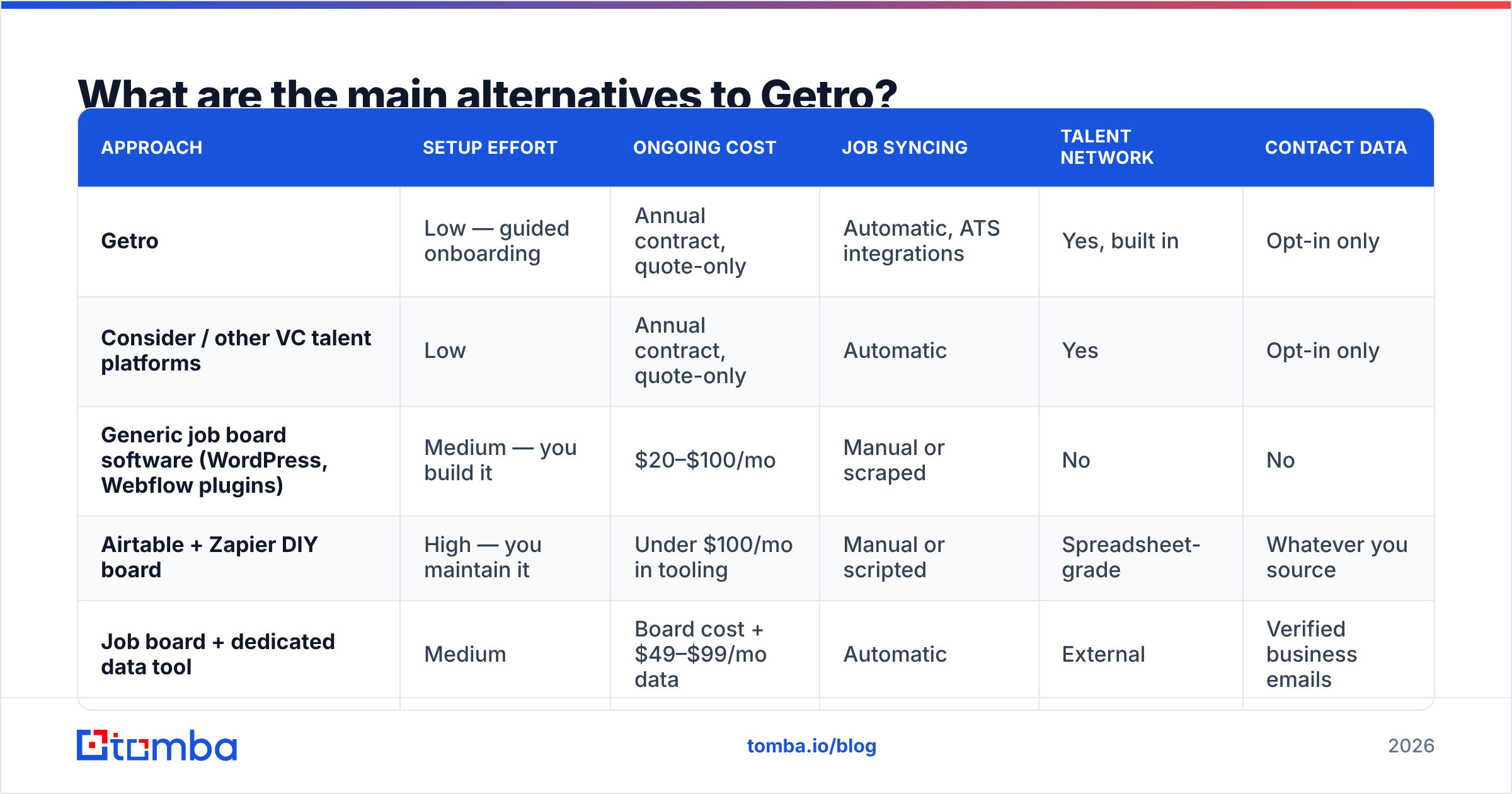
The right alternative depends on the job you hired the tool for. Three jobs get mixed up all the time.
| Approach | Setup effort | Ongoing cost | Job syncing | Talent network | Contact data |
|---|---|---|---|---|---|
| Getro | Low — guided onboarding | Annual contract, quote-only | Automatic, ATS integrations | Yes, built in | Opt-in only |
| Consider / other VC talent platforms | Low | Annual contract, quote-only | Automatic | Yes | Opt-in only |
| Generic job board software (WordPress, Webflow plugins) | Medium — you build it | $20–$100/mo | Manual or scraped | No | No |
| Airtable + Zapier DIY board | High — you maintain it | Under $100/mo in tooling | Manual or scripted | Spreadsheet-grade | Whatever you source |
| Job board + dedicated data tool | Medium | Board cost + $49–$99/mo data | Automatic | External | Verified business emails |
The last row is the one buyers skip. A board solves distribution. It does not solve outbound. Most platform teams spend more time emailing candidates, founders, and hiring managers than they spend on listings.

Where does contact data fit into a talent stack?#
Job boards are inbound tools. Your work turns outbound the moment you source a VP of Engineering, warm up a hiring manager, or reach a candidate who never opted in. That calls for a different kind of tool.
Budgets leak in that gap. Teams pay for a talent platform, then buy a scraper, then still guess email formats by hand. A cleaner split looks like this:
- Board and network: Getro or a peer platform, for inbound listings and opt-in candidates.
- Contact discovery: a dedicated email finder for verified addresses of founders, hiring managers, and passive candidates who will never fill out a form.
- List hygiene: an email verifier run before any campaign, so your sender score survives a 300-person push.
- Company sweeps: domain search when you need every contact at a portfolio company or a target employer, not just one name.
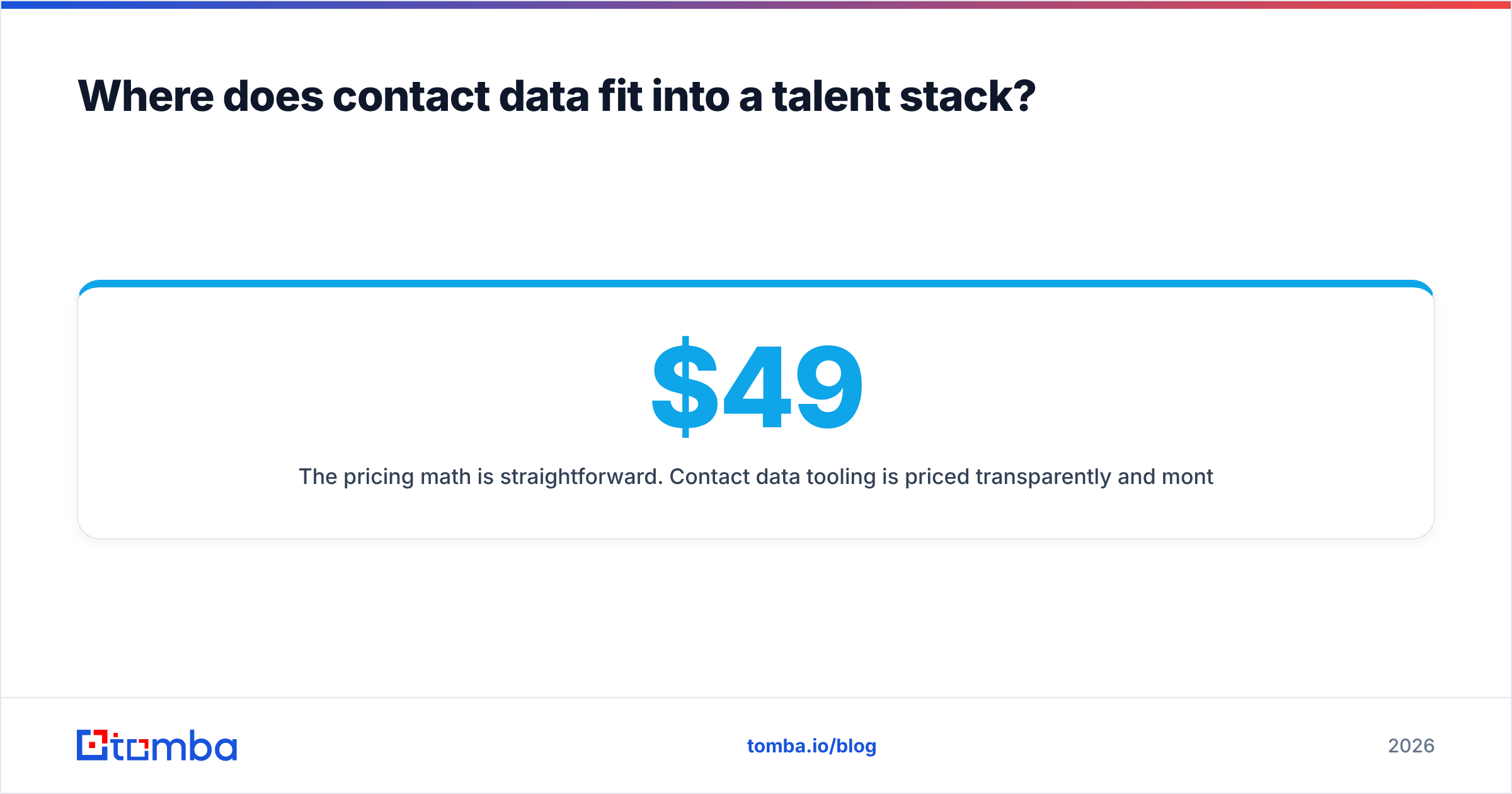
The math here is simple. Contact data is priced in the open and billed monthly. Tomba pricing starts free at 25 searches a month. Starter is $49/mo, Growth is $99/mo, and Pro is $249/mo. You can start it, test it on your own list, and cancel it inside a quarter. An annual quote-only contract gives you none of that.
How should you negotiate a Getro contract?#
Treat the first quote as an opening bid.
- Ask for the price per portfolio company. It reframes the talk and exposes tier inflation.
- Request a written renewal cap. Ask for 5–7% before you sign. Vendors rarely refuse.
- Unbundle the modules. Buy the board now. Add the network at renewal, once you can show candidate volume. Vendors resist this. Do it anyway.
- Get onboarding fees waived or itemized. Setup charges are the easiest line to discount.
- Pilot with real data. A demo board seeded with sample jobs proves nothing. Sync five of your own companies, including your oddest ATS.
- Define the exit. Ask what data you can export, and in what format, if you leave. Answers vary a lot across this category.
Getro pricing reviews pros and cons: the verdict#
Getro does one dull job well. It keeps a portfolio job board current with almost no human effort. For funds with 25 or more portfolio companies, and someone who owns talent, the annual cost is easy to defend. For a micro-fund, it is a costly way to buy a page nobody visits.
The pros are real: automatic syncing, a clean candidate experience, low upkeep. So are the cons: quote-only pricing, annual lock-in, thin contact data, and design limits on entry tiers. Most of the cons only surface after the demo. Go in knowing both sides.
Keep one boundary in mind. A talent platform tells you which roles are open. It does not tell you how to reach the person who can fill them. Does your week go to hunting email addresses at portfolio companies? Start with the Tomba Email Finder. Find verified work emails by name, company, or domain. Test it free at 25 searches a month, and save your platform budget for the tools that need a contract.
Related guides#
Ready to find emails that actually work?
Join 150,000+ professionals who stopped guessing and started sending. Free credits on signup — no credit card required.
Get the Tomba newsletter
Practical outbound tactics and product updates — once every two weeks.
About the author