Getro vs Kipplo (2026): Which Talent Network Tool Wins?
Getro is the established talent-network platform for VC firms; Kipplo is the scrappier newcomer. Here is how they compare on job-board reach, network data, pricing transparency, and the contact-data gap neither one fully closes.
Getro vs Kipplo is a common shortlist for talent-network teams in 2026. Getro is the incumbent. Kipplo is the cheaper newcomer. This guide compares both on job-board reach, network data, pricing, and the one gap they share.
TL;DR
- Getro — the incumbent. Portfolio-wide job aggregation, a branded board, and a network layer. Built for VC firms, accelerators, and PE portfolios.
- Kipplo — newer and lighter. Public proof is thin, so ask for a live demo and written pricing.
- Choose Getro for scale and track record. Choose Kipplo only if a trial proves it fits at a much lower price.
- Neither tool is a contact-data provider. They show you open roles, not the hiring manager's verified email.
- Best stack: a talent-network platform up front, plus a dedicated email finder for outreach.
Getro vs Kipplo: what are these tools?#
Both sit in the same category — talent network software. They solve the problem at different levels of maturity.
Getro has been building here since the mid-2010s. It sells three core things. A job board that plugs into your website. An engine that pulls open roles from every company in your portfolio. And a network layer that maps the people around your organization. The typical buyer is a venture firm that wants portfolio jobs to be a real hiring channel, not a stale spreadsheet.
Kipplo plays in the same lane. It offers hosted job boards and community hiring, with fewer features and a smaller price tag. Here is the honest caveat. As of early 2026, Kipplo's public docs, reviews, and customer references are thin next to Getro's. That is not a red flag on its own. Every vendor starts somewhere. But it changes how you should test it. With Getro you can read reviews on G2 and call customers. With Kipplo, your homework happens on the demo call.
So the real question in Getro vs Kipplo is not which tool has more features. It is this: how much vendor risk will you trade for a smaller invoice?
The four jobs a talent-network platform is hired to do#
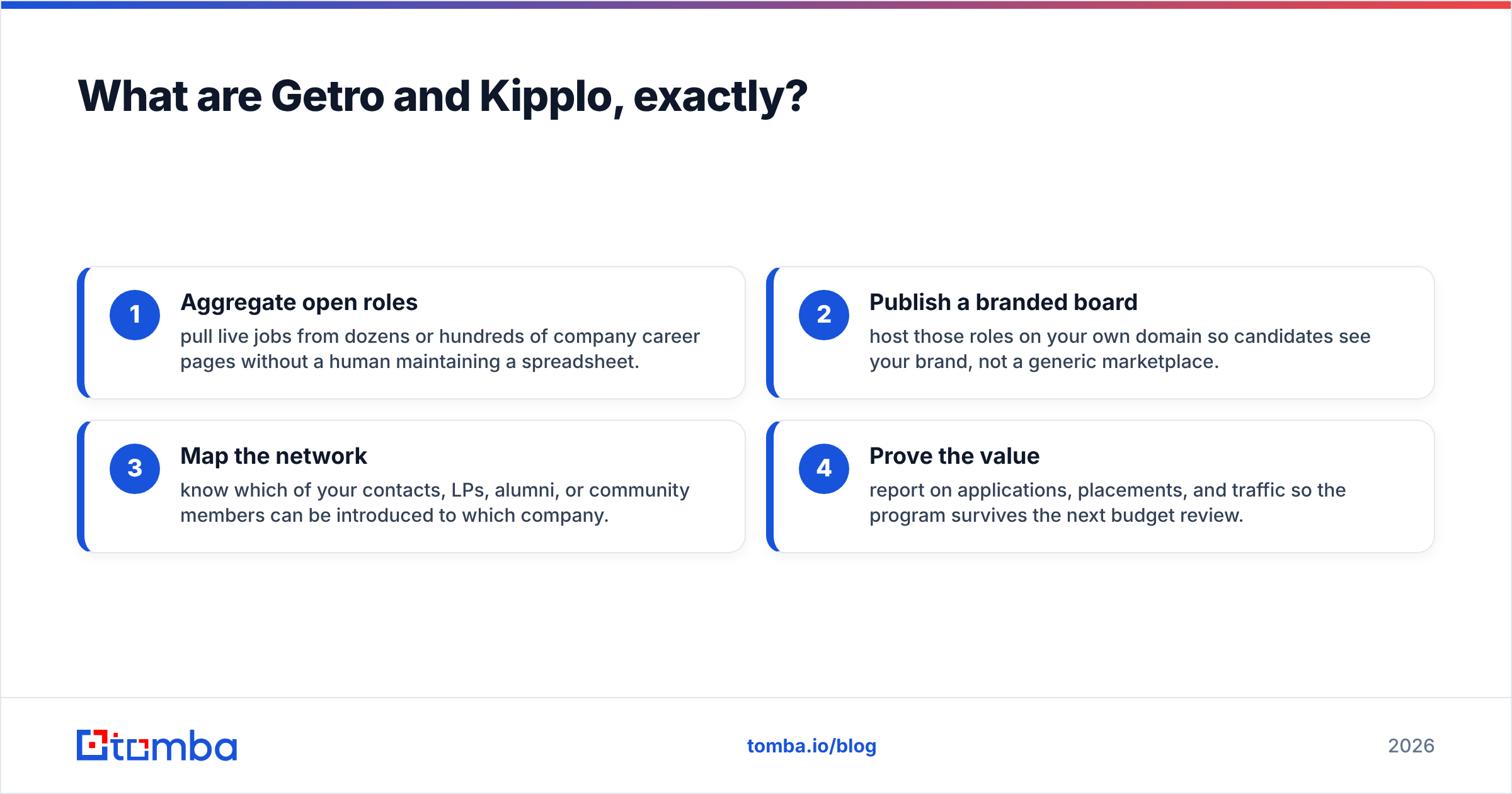
- Aggregate open roles. Pull live jobs from dozens of career pages, with no one editing a spreadsheet.
- Publish a branded board. Host those roles on your own domain, so candidates see your brand.
- Map the network. Know which contacts, LPs, alumni, or members can be introduced to which company.
- Prove the value. Report on applications, placements, and traffic, so the program survives budget season.
Score every vendor against those four jobs. Feature checklists are noise. These four are the signal.

Getro vs Kipplo: the feature-by-feature comparison#
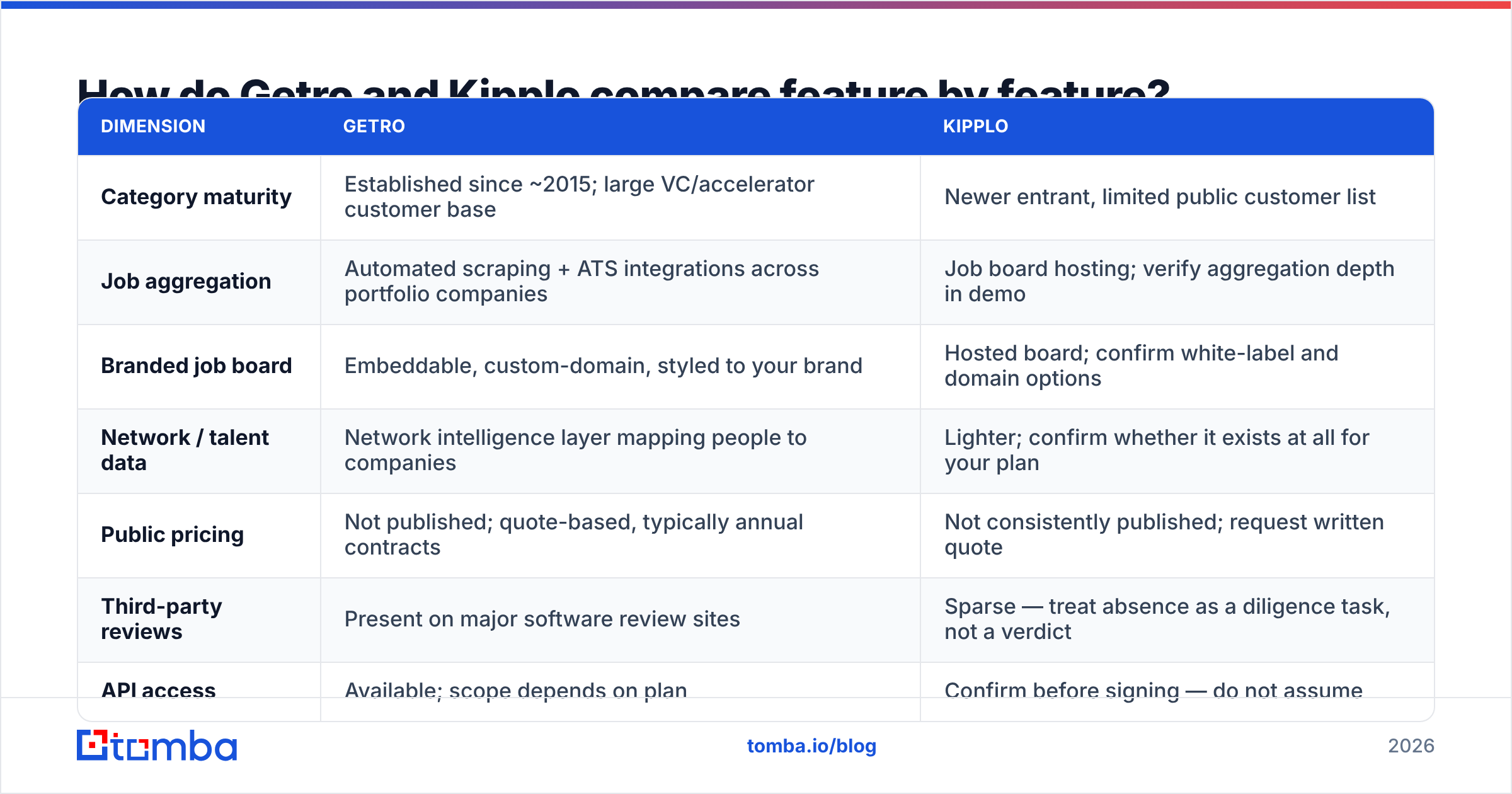
| Dimension | Getro | Kipplo |
|---|---|---|
| Category maturity | Established since ~2015; large VC/accelerator customer base | Newer entrant, limited public customer list |
| Job aggregation | Automated scraping + ATS integrations across portfolio companies | Job board hosting; verify aggregation depth in demo |
| Branded job board | Embeddable, custom-domain, styled to your brand | Hosted board; confirm white-label and domain options |
| Network / talent data | Network intelligence layer mapping people to companies | Lighter; confirm whether it exists at all for your plan |
| Public pricing | Not published; quote-based, typically annual contracts | Not consistently published; request written quote |
| Third-party reviews | Present on major software review sites | Sparse — treat absence as a diligence task, not a verdict |
| API access | Available; scope depends on plan | Confirm before signing — do not assume |
| Best fit | Multi-company portfolios, 20+ companies | Single community or small board on a tight budget |
Two rows matter more than the rest.
Job aggregation depth. Hosting a board is easy. Keeping 80 companies' roles accurate is hard. One of them switched ATS vendors last quarter. Another posts jobs only on Notion. This is where Getro has spent the most engineering effort. It is also the feature most likely to break quietly at a newer vendor. Ask both vendors the same question. What share of our roles will you capture, and how fast do you notice when a job closes? Get the answer in writing.
API access. Do you plan to push job data into a CRM, a Slack digest, or your own site? Then an API is not a nice-to-have. Confirm that it exists. Confirm it is included in your tier. Confirm the rate limits before you sign. The same rule applies to any data vendor, including a Tomba API integration.
Getro vs Kipplo for a VC or PE portfolio#
Getro, in most cases. The math is simple. Say you manage 40 companies and each posts eight roles a year. That is 320 job records to keep current. Manual upkeep costs at least a person-week per quarter. A tool that automates it pays for itself, even at enterprise pricing.
The value also compounds in a way that is specific to venture. A working portfolio board is a founder perk you can raise in a term sheet talk. It is a hiring channel LPs can see. And the network layer is hard to copy with spreadsheets. Knowing that a former operator at Company A is exactly who Company B needs — that is the part you cannot fake.
Kipplo gets interesting at the other end. Do you run one accelerator cohort, an alumni group, or a niche trade body with a dozen hiring firms? Then Getro's enterprise motion may be more than you need. A lighter tool at a fraction of the cost is a fair call, as long as you test it properly.
Getro vs Kipplo for a community, accelerator, or association#
Here the choice turns into a budget question. The honest answer rests on three variables.
- Company count. Under ~15 hiring firms, manual curation plus a cheap board works. Over ~30, automated aggregation stops being optional.
- Refresh frequency. A board full of dead roles is worse than no board. Continuous hiring needs automation. Two hiring bursts a year does not.
- Who owns it internally. A dedicated talent partner can wring value from a rich platform. A community manager doing this at 10% time needs the simplest tool that works.
Be skeptical of your own optimism on the third one. The common failure here is not picking the wrong vendor. It is buying a capable platform that nobody owns. A half-maintained board creates candidate frustration and zero placements.
Where Getro vs Kipplo both leave a gap#
Both tools answer who is hiring and what roles are open. Neither answers how do I reach this person today. That gap kills most talent-network programs in practice.
Three scenarios show it:
- You are a talent partner. You found a great candidate for Portfolio Company C. The board lists a generic careers@ address, not the VP of Engineering who is hiring.
- You are sourcing companies for your board and need the Head of People at 200 firms.
- You are an operator who wants to warm up hiring managers before your next demo day.
In all three, the missing input is a verified work email. Talent platforms are not built for that. They aggregate and display. Their fields come from public career pages, which rarely name a person.
That is a separate tool category. A domain search takes a company domain and returns the people and email patterns behind it. A bulk email finder does the same across 500 domains in one pass. An email verifier checks deliverability before you send, so your outreach does not burn your sender reputation.

The workflow that actually works looks like this:
- Step 1 — Aggregate. Getro or Kipplo pulls open roles from your portfolio or community.
- Step 2 — Identify. You pick the hiring manager or people leader who owns each role.
- Step 3 — Find. An email finder returns that person's verified work address.
- Step 4 — Verify. You check deliverability before the send, not after the bounce report.
- Step 5 — Enrich. Data enrichment adds title, seniority, and company context.
Steps 1 and 2 belong to your talent platform. Steps 3 to 5 do not. No amount of haggling will change that.
Getro vs Kipplo demo calls: what to ask#
Run the same script with both vendors. Score the answers, not the energy in the room. Start with these four:
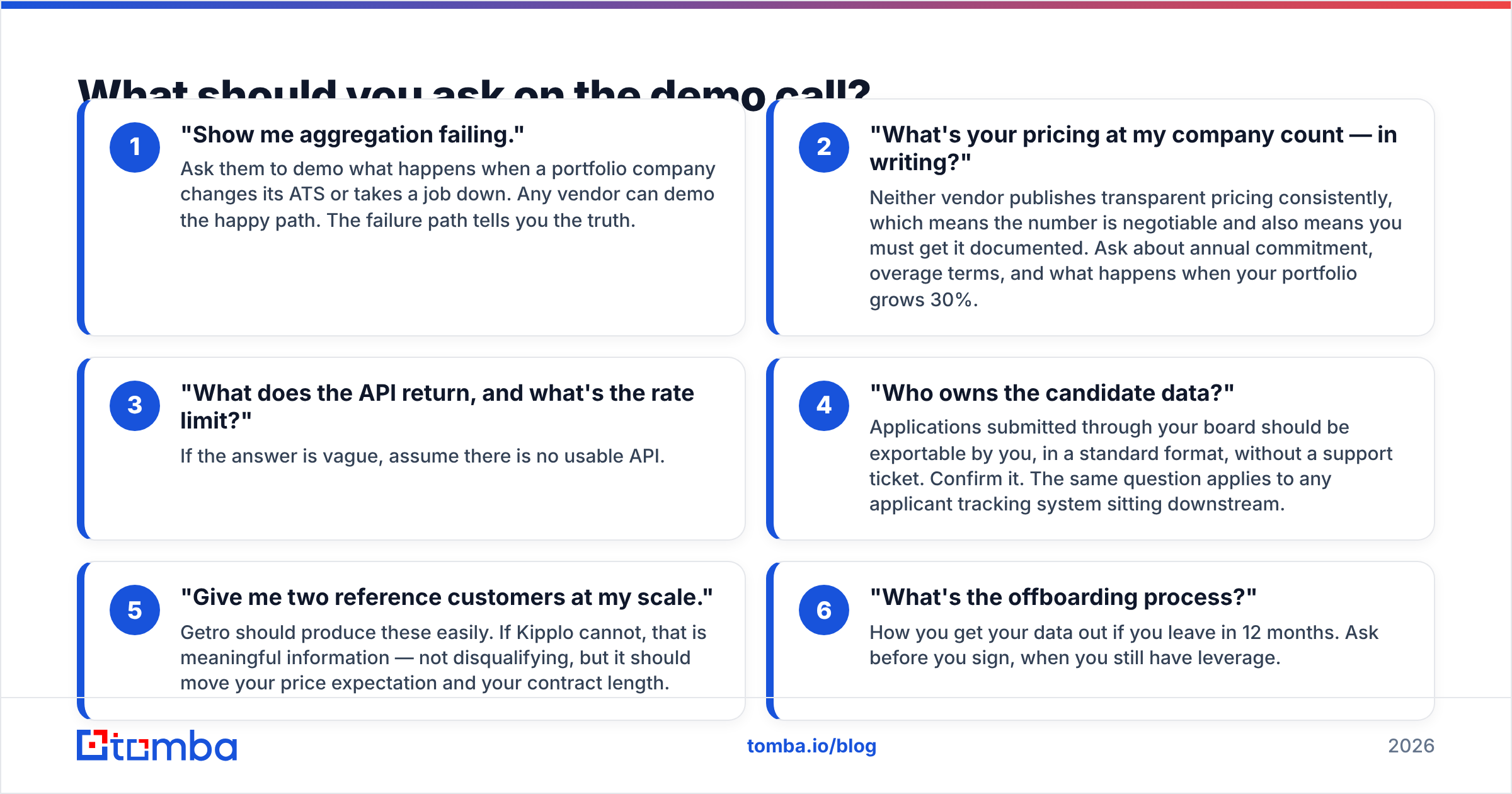
- "Show me aggregation failing." Ask what happens when a company switches ATS or pulls a job down. Any vendor can demo the happy path. The failure path tells you the truth.
- "What is the price at my company count, in writing?" Neither vendor posts clear pricing. So the number is negotiable, and you need it documented. Ask about term, overage, and portfolio growth.
- "What does the API return, and what is the rate limit?" A vague answer means there is no usable API.
- "Who owns the candidate data?" You should be able to export applications yourself, in a standard format, with no support ticket. The same applies to any applicant tracking system downstream.
Then ask two more before you sign anything:
- "Give me two reference customers at my scale." Getro should do this easily. If Kipplo cannot, lower your price expectation and shorten the term.
- "What is the offboarding process?" Ask how you get your data out while you still have leverage.
A cheaper alternative to Getro vs Kipplo#
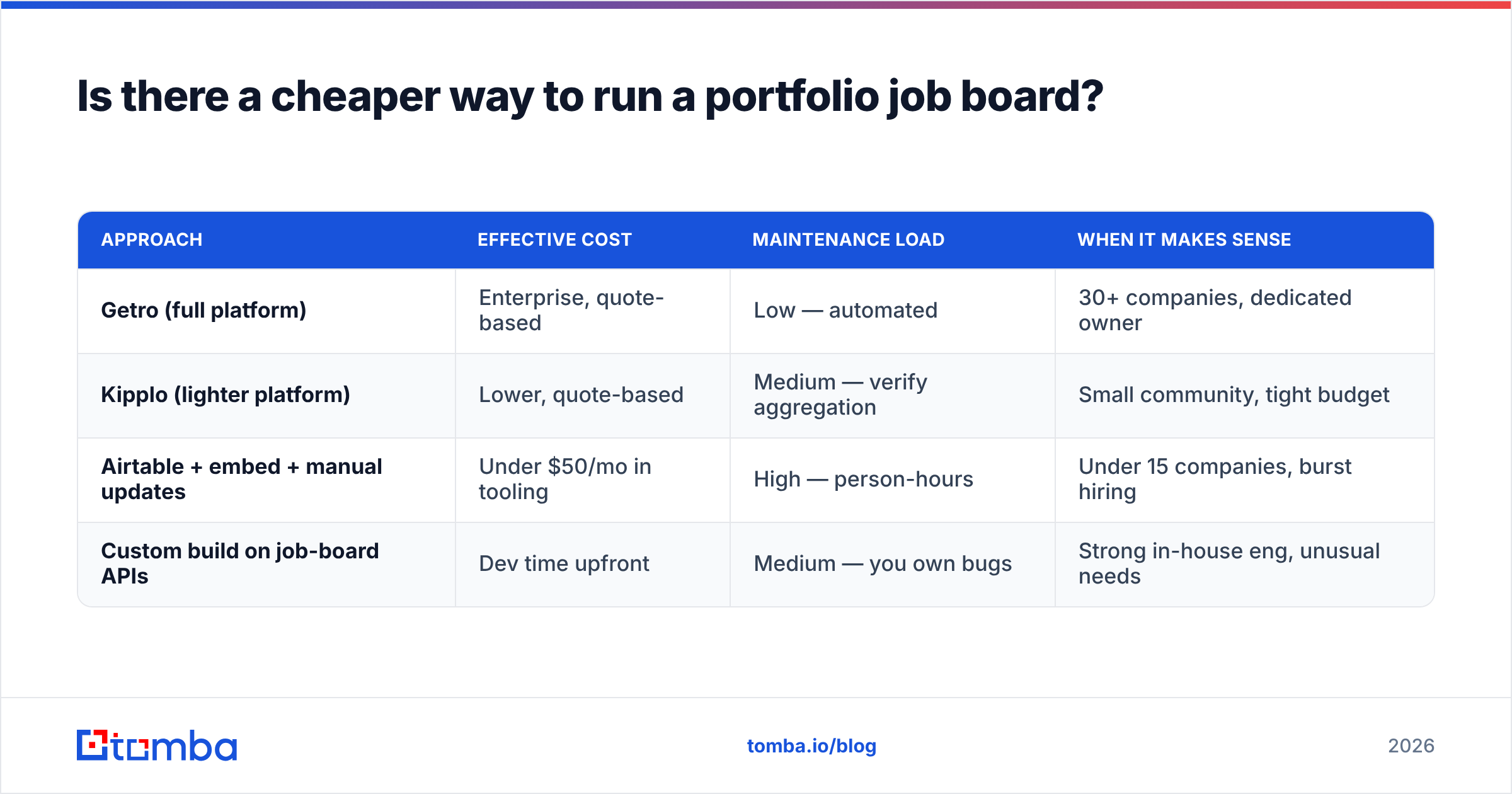
Yes, there is one. Price it out honestly before you buy either tool.
| Approach | Effective cost | Maintenance load | When it makes sense |
|---|---|---|---|
| Getro (full platform) | Enterprise, quote-based | Low — automated | 30+ companies, dedicated owner |
| Kipplo (lighter platform) | Lower, quote-based | Medium — verify aggregation | Small community, tight budget |
| Airtable + embed + manual updates | Under $50/mo in tooling | High — person-hours | Under 15 companies, burst hiring |
| Custom build on job-board APIs | Dev time upfront | Medium — you own bugs | Strong in-house eng, unusual needs |
The DIY row is not a joke. Plenty of firms run a fine portfolio board on an Airtable base with a public embed. An analyst updates it once a month. It scales badly. But if you have under fifteen companies and hiring is seasonal, that is a problem for future you.
What DIY cannot give you is the network layer — the graph of people tied to your organization. That is the piece worth paying an incumbent for. It is also the piece to press hardest on in a Kipplo demo.
The Getro vs Kipplo verdict#
Getro wins on defensibility. Kipplo wins on price, if it clears your diligence bar.
Choose Getro if you run a real portfolio program with a named owner and more than about 25 hiring companies. You need aggregation that does not break quietly. You are paying for maturity, and in this category maturity is the product.
Choose Kipplo if your scope is truly smaller and your budget is real. A hands-on trial, not a slide deck, has to prove it covers aggregation, branding, and export. Negotiate a shorter first term than the vendor offers. Put data portability in the contract.
Choose neither if you have under fifteen companies and hire now and then. Build the spreadsheet version first. Prove the channel produces placements. Then buy a platform with evidence in hand. Vendors respect a buyer who has already run the manual version.
Whichever way the Getro vs Kipplo call goes, budget for the contact-data layer too. Your platform tells you a role exists at a company in your network. It will not tell you the verified email of the person who owns that role. Outreach to careers@ converts at close to zero.
That last mile is where Tomba's Email Finder fits. Give it a name and a company domain. It returns a verified professional email with a confidence score. Your intros to portfolio hiring managers land in a real inbox. So does your outreach to prospective member companies. The free tier covers 25 searches a month, so you can test it on your own portfolio first. Paid plans start at $49/mo, and Growth is $99/mo for teams sourcing all year. Full Tomba pricing is public — which, after two quote-only vendor calls, may feel refreshing.
Related guides#
Ready to find emails that actually work?
Join 150,000+ professionals who stopped guessing and started sending. Free credits on signup — no credit card required.
Get the Tomba newsletter
Practical outbound tactics and product updates — once every two weeks.
About the author