Getro vs Seamless.AI: Talent Network or Sales Database?
Getro and Seamless.AI both promise "more of the right people," but one builds hiring networks and the other sells contact data. Here's the honest breakdown of pricing, data quality, and which one your team actually needs.
TL;DR
- Getro vs Seamless.AI is not a fair fight, because the two tools solve different jobs. Getro runs talent networks and job boards for VC firms, accelerators, and communities. Seamless.AI is a B2B contact database with an AI search layer for sales teams.
- Want to help your portfolio companies hire? Getro is the right pick, and Seamless.AI will not do that job.
- Need emails and direct dials for 12 SDRs? Seamless.AI is the right category. Just budget for a demo call, credit limits, and a verify step on every export.
- Neither vendor posts clean self-serve pricing. Getro quotes by network size each year. Seamless.AI gates paid tiers behind sales. Compare that with tools that publish rates, like Tomba pricing at $49/mo for Starter.
- Most GTM teams need three things: one system of record for contacts, one finder and verifier for email accuracy, and Getro only if they truly run a talent network.
Why are people comparing Getro vs Seamless.AI at all?#
Both tools rank for the same fuzzy intent. People want software that puts them in front of more relevant people. That is where the overlap stops.
Getro sells software for talent networks. Its buyers are venture capital firms, accelerators, private equity platform teams, and community operators. They pull open roles from dozens or hundreds of portfolio companies. Then they publish those roles on a branded board and route candidates to the right company.
Seamless.AI sells sales leads. You search by title, industry, headcount, or technology. It returns contact records: work emails, mobile numbers, and company firmographics. You push those records into a CRM or a sequencer.
The Getro vs Seamless.AI question still lands in budget meetings. Someone asks whether the Getro contract can cover outbound. Or whether Seamless can source candidates, since it has everyone's email. The answer is no both times. Knowing why saves you a wasted contract year.

What does Getro actually do?#
Getro covers two jobs. It runs a job board that pulls roles from a set of companies you control. It also runs a talent network layer, so candidates opt in and your companies can search them.
A typical Getro setup includes:
- Automated job scraping — Getro checks your portfolio companies' career pages on a schedule. The board stays current with no manual work.
- Branded job board — a hosted board on your own domain (jobs.yourfund.com). Filters cover role, location, remote status, and company stage.
- Talent network — candidates build profiles. Hiring managers inside your network search that pool instead of paying for outside sourcing.
- Company and contact directory — a light CRM view of the companies in your network, plus who to contact at each one.
- Reporting for the platform team — placements, board traffic, and applications. Platform leads use those numbers at LP meetings.
The value is aggregation and distribution. Any fund can claim it supports portfolio hiring. Getro turns that claim into a system you can measure.
Getro is not a prospecting database. You cannot search the open market for a VP of Engineering at German fintech firms with 200-500 staff. You will not get direct-dial numbers either. The data stops at your network.
What does Seamless.AI actually do?#
Seamless.AI is a contact search engine. You define an ideal customer profile and run a search. It returns people with contact details attached. The pitch is real-time verification. Instead of serving a static list bought years ago, it tries to build and confirm the contact when you search.
A normal workflow looks like this:
- Build a search — filter by title, seniority, industry, location, company size, revenue, and technologies used.
- Enrich or import — paste in a company list, or use the Chrome extension while you browse LinkedIn.
- Spend credits — every revealed contact burns credits. Credit policy is the top complaint in G2 reviews.
- Push to CRM — native links to Salesforce, HubSpot, Outreach, Salesloft, and similar tools.
- Sequence and call — the data leaves the platform and lives in your sending tool.
Here is the honest read. Coverage is broad, and the mobile-number layer is genuinely useful. It is fast for high-volume SDR teams that value reach over precision.
The trade-offs are real too. Credit math confuses people. The sales motion is pushy. Bounce rates mean you must verify before you send. That last point is true of every large aggregated database, not just this one. Plenty of teams skip the step. Then they wonder why their domain reputation tanked.
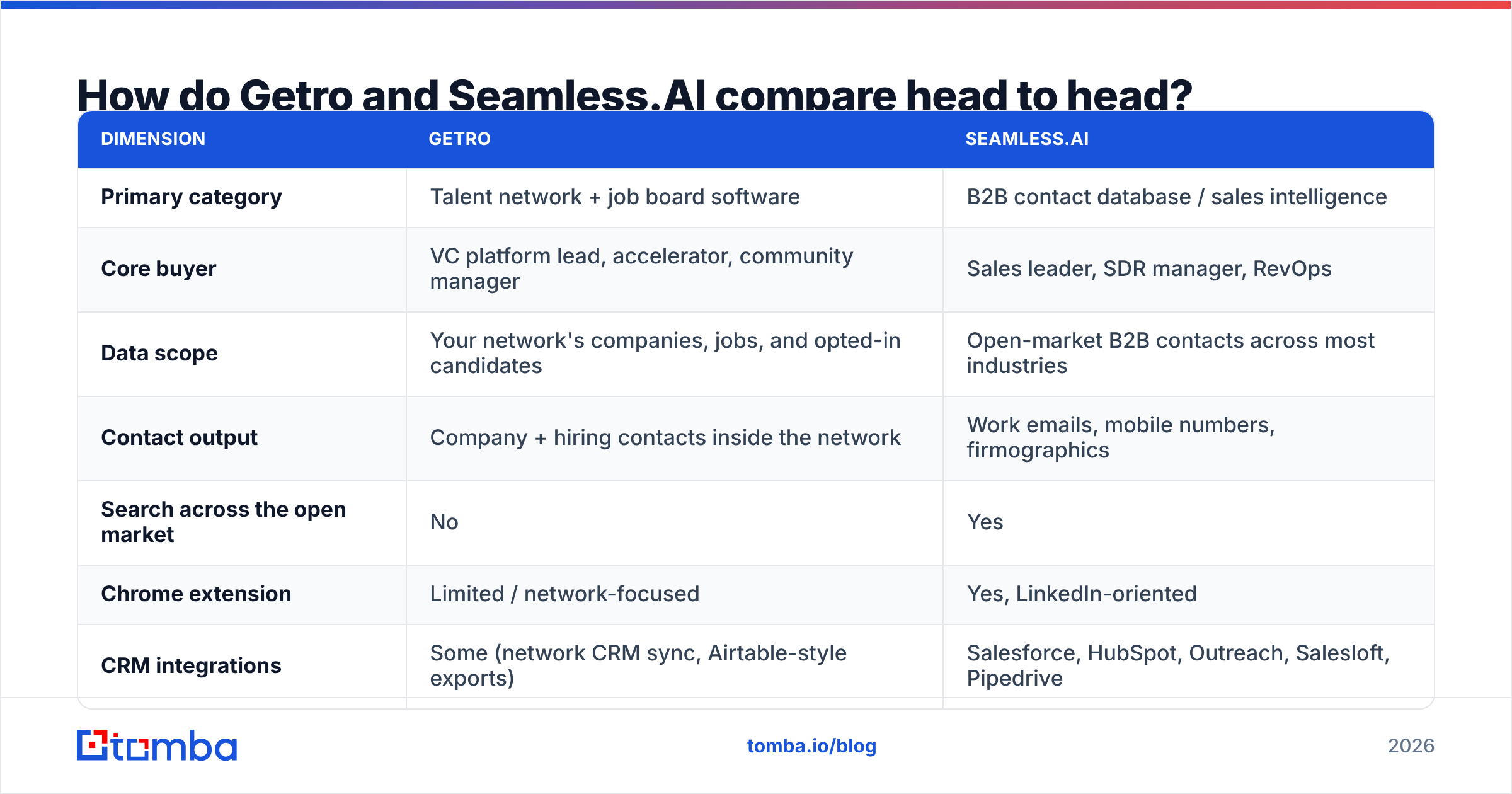
How do Getro and Seamless.AI compare head to head?#
| Dimension | Getro | Seamless.AI |
|---|---|---|
| Primary category | Talent network + job board software | B2B contact database / sales intelligence |
| Core buyer | VC platform lead, accelerator, community manager | Sales leader, SDR manager, RevOps |
| Data scope | Your network's companies, jobs, and opted-in candidates | Open-market B2B contacts across most industries |
| Contact output | Company + hiring contacts inside the network | Work emails, mobile numbers, firmographics |
| Search across the open market | No | Yes |
| Chrome extension | Limited / network-focused | Yes, LinkedIn-oriented |
| CRM integrations | Some (network CRM sync, Airtable-style exports) | Salesforce, HubSpot, Outreach, Salesloft, Pipedrive |
| Credit model | Seat/network-based subscription | Credit-based, per revealed contact |
| Public self-serve pricing | No — quoted | Free tier public; paid tiers quoted |
| Typical contract | Annual | Annual, often multi-seat |
| Best at | Making portfolio hiring visible and measurable | Volume prospecting for outbound teams |
The Getro vs Seamless.AI table makes the verdict obvious. These are not substitutes. When a comparison looks this lopsided, stop asking which tool is better. Ask which problem you need to solve this quarter.
What does Getro vs Seamless.AI pricing look like in 2026?#
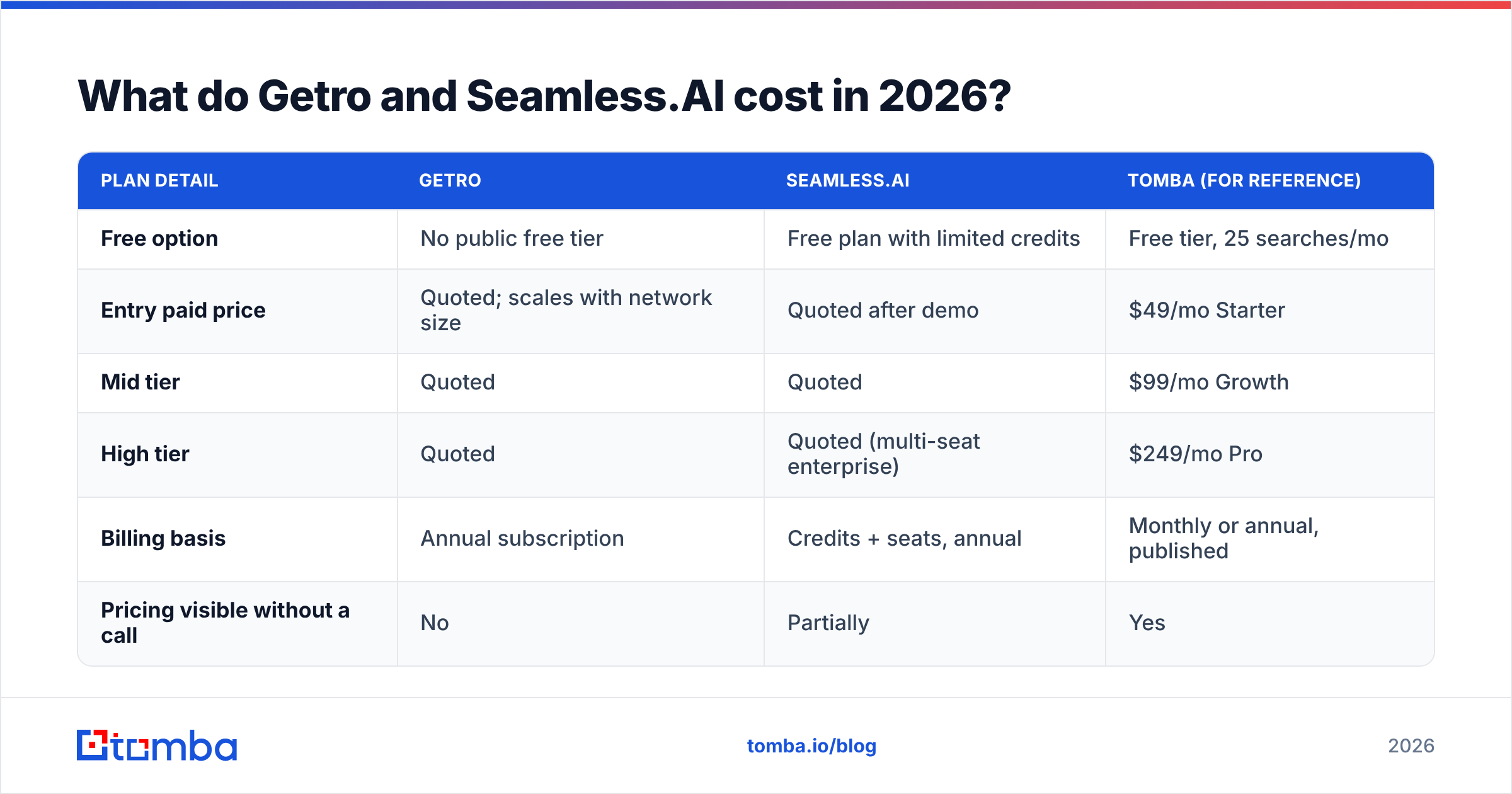
Both vendors want a demo call before they show a number. That is the most common gripe in this comparison.
| Plan detail | Getro | Seamless.AI | Tomba (for reference) |
|---|---|---|---|
| Free option | No public free tier | Free plan with limited credits | Free tier, 25 searches/mo |
| Entry paid price | Quoted; scales with network size | Quoted after demo | $49/mo Starter |
| Mid tier | Quoted | Quoted | $99/mo Growth |
| High tier | Quoted | Quoted (multi-seat enterprise) | $249/mo Pro |
| Billing basis | Annual subscription | Credits + seats, annual | Monthly or annual, published |
| Pricing visible without a call | No | Partially | Yes |
I will not invent numbers for either vendor's paid tiers. Prices change, get negotiated, and vary by region and seat count. Check each vendor's own pricing page before you budget.
You can still plan around the shape. Getro is a platform-team line item, renewed each year. Seamless.AI is a per-seat sales tool, and credit use drives the real cost.
Pricing opacity may be a dealbreaker for you. That is a fair way to choose, not a nitpick. Published rates let you model cost per verified contact before you sign. Hidden rates make you model it after.

Which one has better contact data accuracy?#
Accuracy is where most Getro vs Seamless.AI comparisons go sideways. Judging them on the same scale is close to a category error. There is still a useful answer inside it.
Getro's contact data is narrow and high-trust. It covers companies you already work with. The hiring contacts inside them are usually confirmed by the company itself. You are not guessing at an email pattern. Someone at the portfolio company told you who the recruiter is. Accuracy runs high, and coverage stays tiny by design.
Seamless.AI's data is broad and probabilistic. It builds contacts from public sources, partner data, and live checks. Coverage is very wide, but accuracy swings by segment. Enterprise tech in North America performs well. Small businesses, non-English markets, and recent job changes perform worse. Reviewers and practitioners keep finding that big databases land well below their marketed accuracy once you actually send.
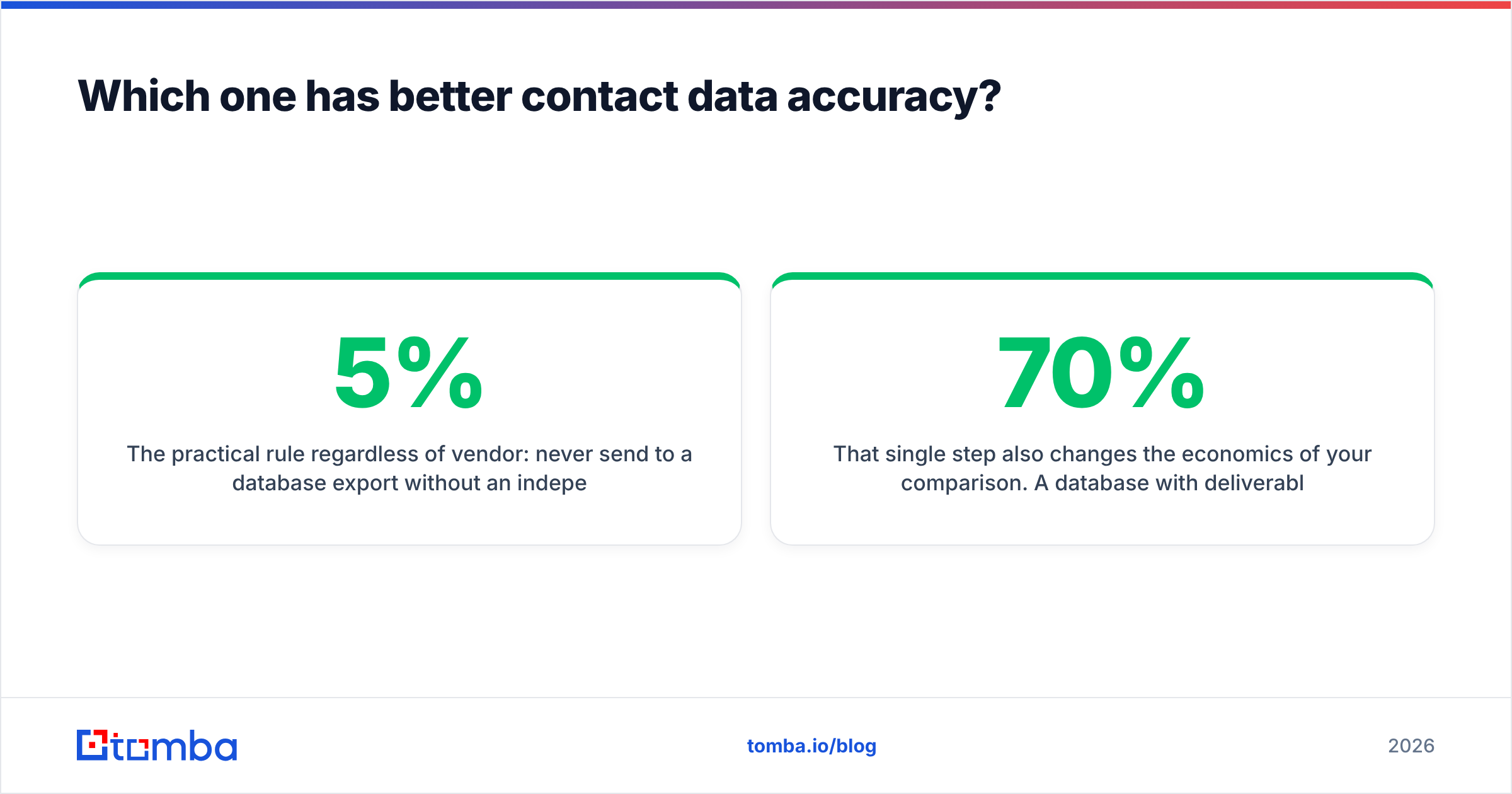
One rule holds for every vendor. Never send to a raw database export. Run it through an email verifier first. It checks syntax, MX records, mailbox existence, and catch-all status. Even a 5% invalid rate can drag your domain toward the spam folder. The fix costs far less than the recovery. If a chunk of your list resolves to catch-all domains, a catch-all verifier turns a risky send into a safe one.
That one step also changes the math of Getro vs Seamless.AI, and of every other data tool. A database with 70% deliverable data plus verification beats one with 78% and no verification. You control what enters the sequencer.
When should you choose Getro?#
Choose Getro when helping your companies hire is a real operating goal with a budget. Specifically:
- You run a fund or accelerator platform function. Getro is built for this, and few rivals match it.
- You need a public job board that maintains itself. Nobody wants to collect roles from 80 companies by hand. Auto-scraping is the whole pitch.
- Your LPs or founders ask for hiring metrics. Getro gives you numbers to report.
- You want a candidate pool your companies can search. The talent network turns a board into an asset.
Skip Getro if what you need is outbound pipeline. It will not create cold leads. No amount of setup turns it into a prospecting tool. In a Getro vs Seamless.AI split, that half belongs to Seamless.
When should you choose Seamless.AI — and when should you not?#
Choose Seamless.AI for a high-volume outbound motion. It fits when you need phone numbers as much as emails. Your team also has to stay disciplined about credits. SDRs who live in LinkedIn get the most from the one-click reveal.
Be more careful when:
- Your budget is small and predictable. Credits plus annual seats are rough for a two-person team.
- You send high volumes on a young domain. Verify and warm up first. Start with an email warmup calculator and ramp slowly.
- You target non-US markets or SMBs. Coverage thins out fast outside enterprise North America.
- You want month-to-month flexibility. Read the renewal terms closely. Lock-in is the top complaint for this whole category, not just this vendor.
Still weighing Getro vs Seamless.AI at this tier? Read a structured Seamless.AI alternative breakdown before you sign anything annual.
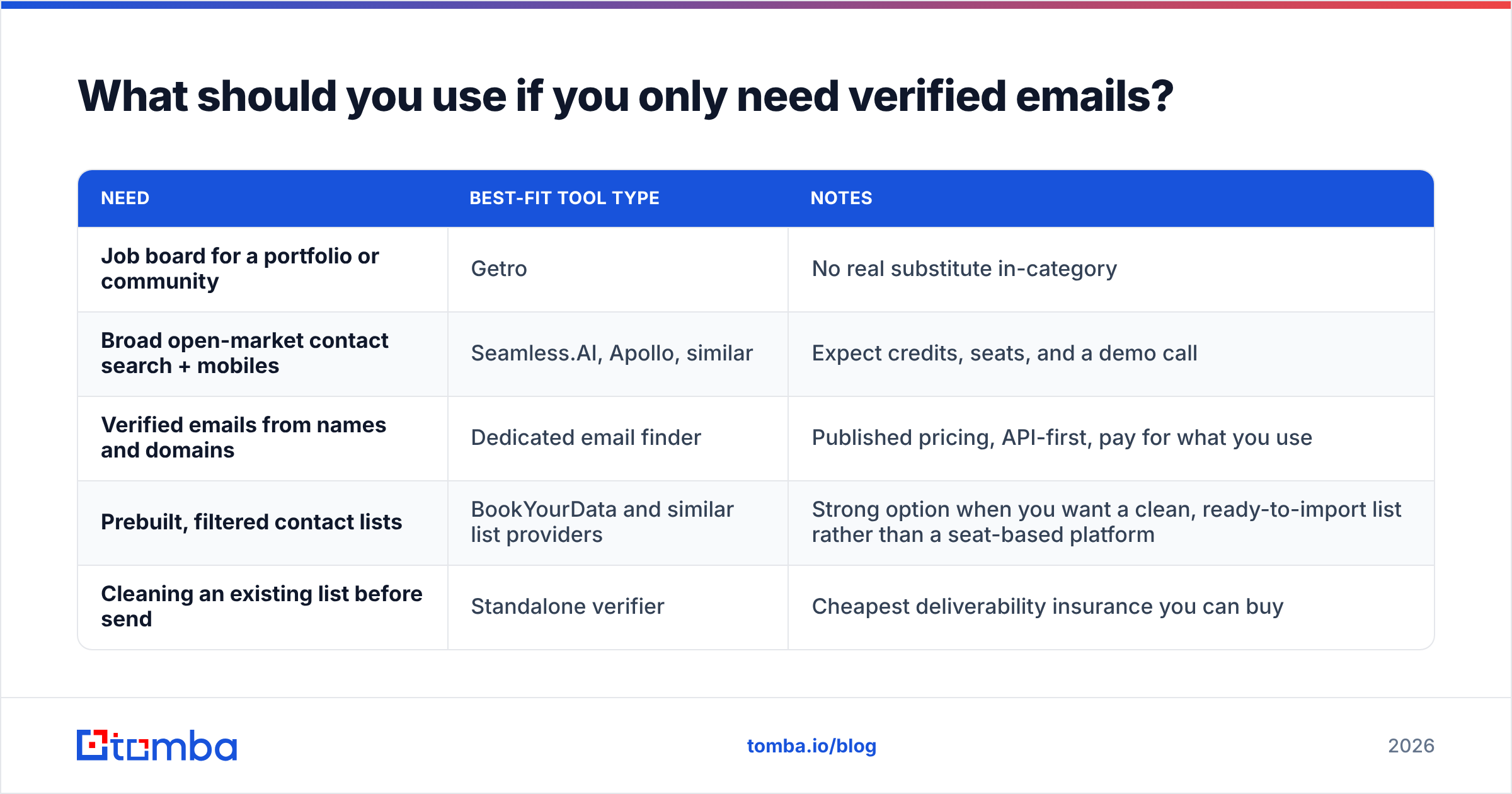
What should you use if you only need verified emails?#
Most teams comparing Getro vs Seamless.AI want one narrow thing. They want to turn a name and a company into a deliverable email address. That is a different, cheaper product category.
| Need | Best-fit tool type | Notes |
|---|---|---|
| Job board for a portfolio or community | Getro | No real substitute in-category |
| Broad open-market contact search + mobiles | Seamless.AI, Apollo, similar | Expect credits, seats, and a demo call |
| Verified emails from names and domains | Dedicated email finder | Published pricing, API-first, pay for what you use |
| Prebuilt, filtered contact lists | BookYourData and similar list providers | Strong option when you want a clean, ready-to-import list rather than a seat-based platform |
| Cleaning an existing list before send | Standalone verifier | Cheapest deliverability insurance you can buy |
For the third row, a focused email finder does one job well. Give it a name and a domain. Get a verified address with a confidence score. Pair it with domain search to pull every public address at a company. Use the Tomba API to bake enrichment into your own workflows instead of exporting CSVs by hand.
What's the final verdict on Getro vs Seamless.AI?#
Pick Getro if you operate a talent network. It is the right tool for portfolio hiring, community job boards, and candidate pools. Seamless.AI cannot replace it.
Pick Seamless.AI if you need open-market contact data at volume. Go in clear-eyed about credits, annual terms, and the verify step before anything gets sent.
Pick neither if your real problem is email accuracy. A $10k/year sales platform is an expensive way to answer one small question: which of these six address formats is real?
That last case is where a purpose-built finder wins on cost and clarity. Tomba Email Finder starts free with 25 searches a month. It moves to $49/mo when you outgrow it. Every rate is published, so you can model cost per verified contact before you commit. No demo call, and no credit roulette. Point it at the companies you already care about, verify what comes back, and spend the rest of your budget on outreach.
Related guides#
Ready to find emails that actually work?
Join 150,000+ professionals who stopped guessing and started sending. Free credits on signup — no credit card required.
Get the Tomba newsletter
Practical outbound tactics and product updates — once every two weeks.
About the author