Getro vs Wiza (2026): Which Tool Fits Your Pipeline?
Getro builds talent networks and job boards for communities. Wiza turns LinkedIn searches into verified emails. They get compared constantly and they solve almost nothing in common. Here is the honest breakdown.
TL;DR
- Getro and Wiza are not competitors in any strict sense. Getro is talent-network and job-board infrastructure for VCs, accelerators, and communities. Wiza is a LinkedIn-to-email export tool for outbound teams.
- Pick Getro if your job is connecting a portfolio or member base to candidates, and you need a branded job board plus a searchable talent pool.
- Pick Wiza if your job is turning a LinkedIn Sales Navigator search into a list of contactable people this afternoon.
- Both leave the same gap: neither is built to enrich and verify contact data at scale outside its own walled workflow. That is where a dedicated email finder and verification layer earns its seat.
- Budget reality: Wiza is self-serve and starts free. Getro is quote-based with annual contracts. You will not compare them on a price-per-credit basis, because they do not sell the same unit.
What are Getro and Wiza, actually?#
The reason people search "Getro vs Wiza" is almost never that they evaluated both in a bake-off. It is that someone told them "we need better contact data" and both tools showed up in the same Google session.
Getro is community infrastructure. Its two main products are a hosted job board (GetroJobs) that automatically pulls open roles from a set of companies you define, and a talent network (GetroConnect) where candidates opt in, build a profile, and become searchable by the companies in your network. Venture firms use it so their portfolio companies can hire from a shared candidate pool. Accelerators, universities, and professional communities use it the same way. The buyer is usually a platform lead or community manager, not a sales rep.
Wiza is prospecting plumbing. You run a search in LinkedIn Sales Navigator, Wiza exports the results, and it appends work emails and phone numbers to each row. It runs as a Chrome extension plus a web app, and it charges per credit for the contact data it finds. The buyer is an SDR, a founder doing their own outbound, or a growth marketer building a list.
One assembles inbound-ish talent supply. The other manufactures outbound contact lists. Comparing them is like comparing a job fair to a phone book — both put you in front of people, and that is where the resemblance ends.
How do Getro and Wiza compare head-to-head?#
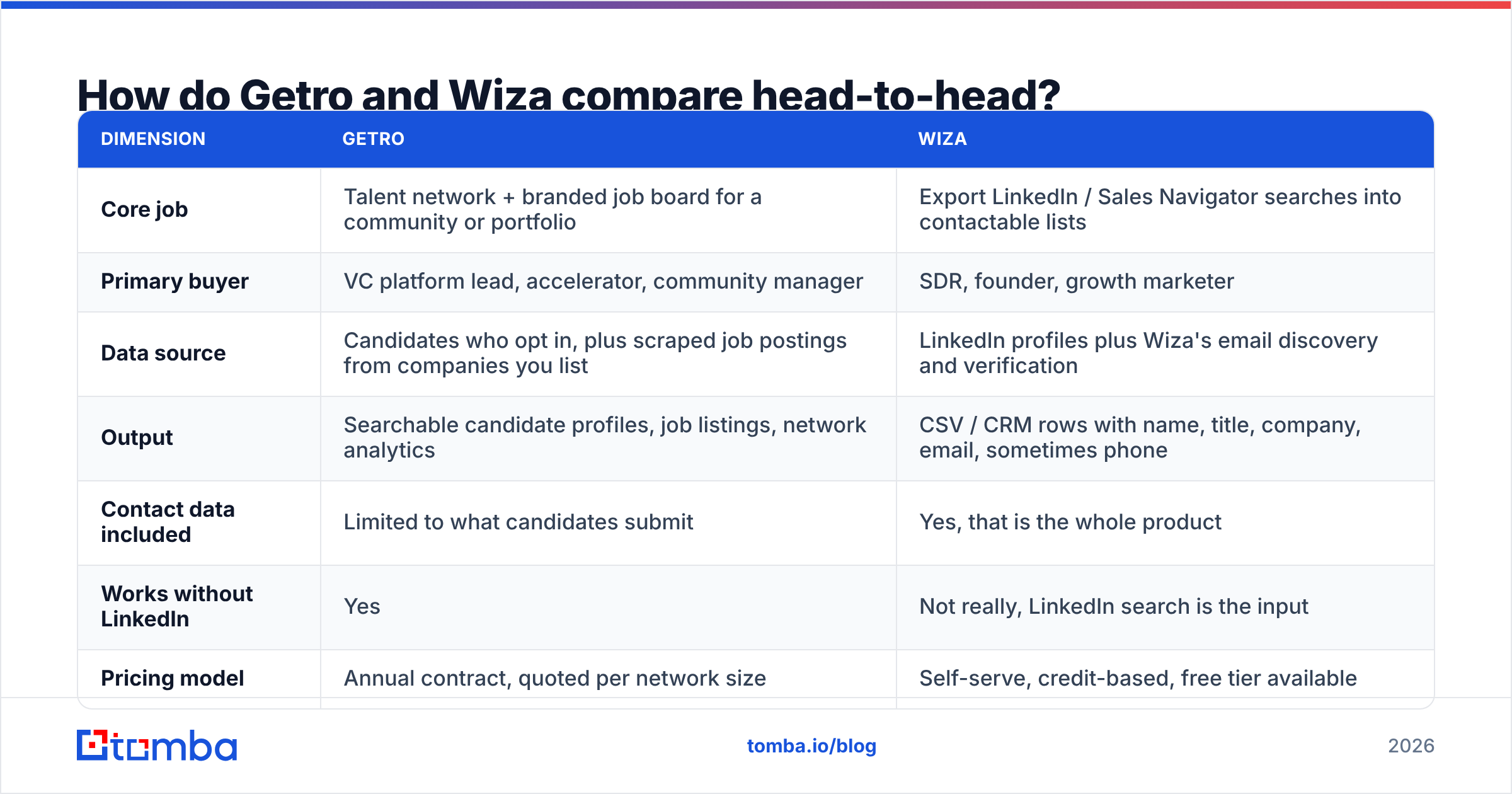
| Dimension | Getro | Wiza |
|---|---|---|
| Core job | Talent network + branded job board for a community or portfolio | Export LinkedIn / Sales Navigator searches into contactable lists |
| Primary buyer | VC platform lead, accelerator, community manager | SDR, founder, growth marketer |
| Data source | Candidates who opt in, plus scraped job postings from companies you list | LinkedIn profiles plus Wiza's email discovery and verification |
| Output | Searchable candidate profiles, job listings, network analytics | CSV / CRM rows with name, title, company, email, sometimes phone |
| Contact data included | Limited to what candidates submit | Yes, that is the whole product |
| Works without LinkedIn | Yes | Not really, LinkedIn search is the input |
| Pricing model | Annual contract, quoted per network size | Self-serve, credit-based, free tier available |
| Learning curve | Setup-heavy, then low-touch | Ten minutes |
| API access | Limited, mostly for job feeds and embeds | Yes, for enrichment and search |
| Best-case outcome | Portfolio companies hire faster from a warm pool | 500 verified contacts before lunch |
Read that table twice before you shortlist either one. If your row-by-row needs land mostly in the left column, Wiza will feel useless. If they land in the right column, Getro will feel like buying a stadium to host a coffee chat.
What does Getro do well?#
It removes manual job-board maintenance. Getro crawls the career pages of companies in your network and refreshes listings automatically. If you have ever tried to keep a portfolio job board current with a spreadsheet and a monthly nudge email, you know exactly how much labor that removes.
It gives a network a real front door. A branded, searchable board with hundreds of live roles is a genuine recruiting asset for a fund. Founders notice. Candidates bookmark it. It compounds.
Talent pooling is the actual moat. Candidates who opt into GetroConnect are pre-filtered for interest in your ecosystem. That is a warmer pool than any cold export, and it is the part of the product that competitors have the hardest time cloning, because it depends on your community's gravity, not Getro's software.
Analytics that a platform lead can show an LP. Views, applications, companies hiring, roles filled. It is reporting built for the person who has to justify the line item.
Where it gets thin: Getro's value is downstream of your community. If you have 15 portfolio companies and a mailing list of 400 people, the network effect is not there yet, and you are paying for infrastructure that needs volume to pay off.
What does Wiza do well?#
Speed from search to CSV. Filter in Sales Navigator, hit export, get rows back with emails attached. For a founder validating an ICP or an SDR building this week's sequence list, that loop is hard to beat.
Verification is bundled, not bolted on. Wiza classifies emails as valid, risky, or catch-all before you download, and most plans only charge you for the ones it actually finds. That pricing model is genuinely user-friendly compared to tools that bill on every lookup attempt.
Low switching cost. No implementation project, no annual commitment, no onboarding call required. You can test it against a known list in an hour and decide.
Where it gets thin: everything depends on LinkedIn. If your target segment has weak LinkedIn presence — local services, manufacturing, public sector, much of APAC and LATAM — the input is thin, so the output is thin. And because Sales Navigator scraping sits in a permanently gray zone with LinkedIn's terms of service, teams operating at real volume tend to build a second, non-LinkedIn data path as insurance. Check current reviews on G2 before you standardize a whole team on any single scrape-dependent workflow.

How much do Getro and Wiza cost in 2026?#
This is where the comparison breaks down completely, because the two vendors do not sell the same unit. Getro sells seats in an ecosystem product on an annual contract, quoted against the size of your network and which modules you turn on. Wiza sells credits.
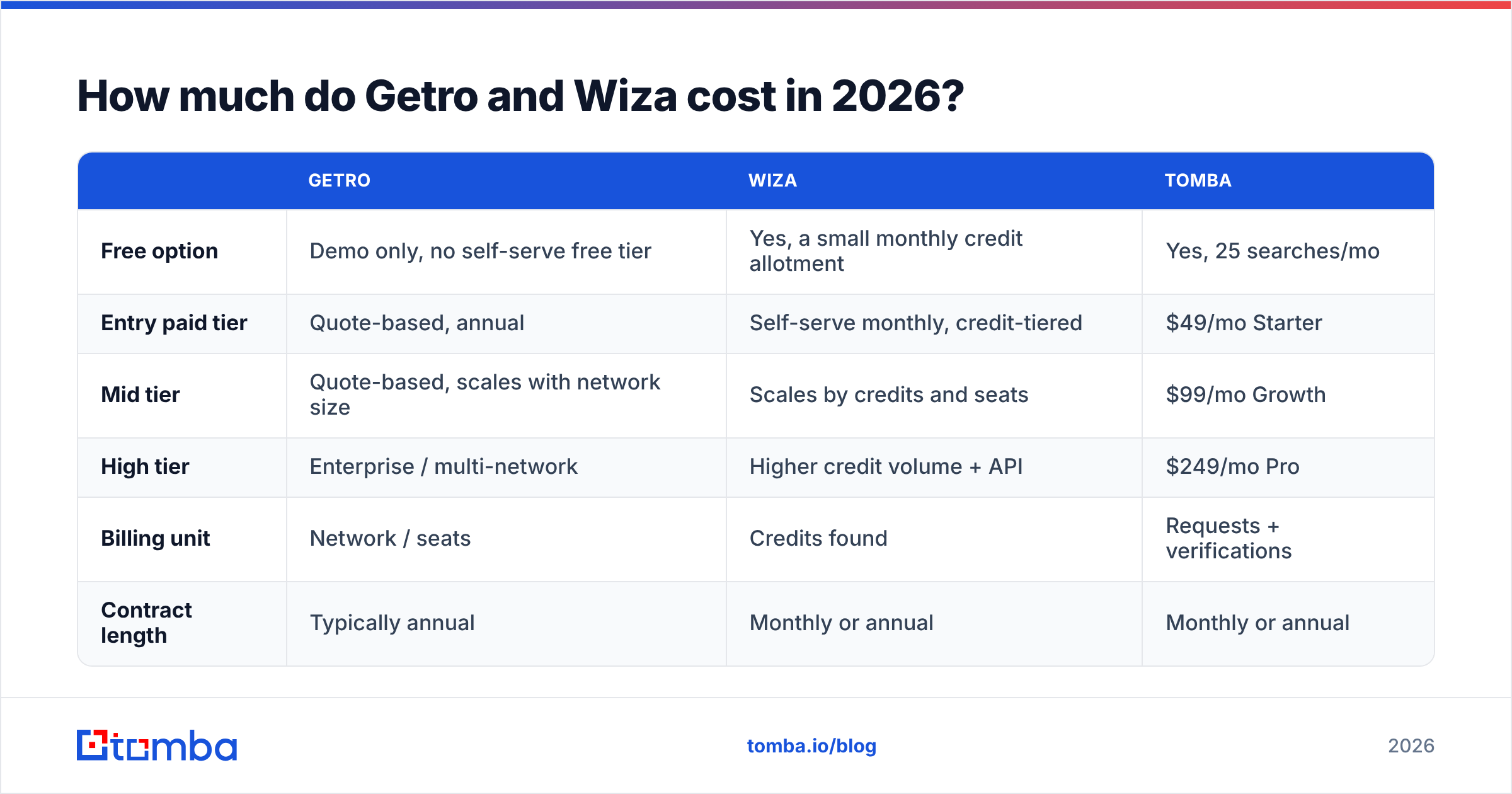
| Getro | Wiza | Tomba | |
|---|---|---|---|
| Free option | Demo only, no self-serve free tier | Yes, a small monthly credit allotment | Yes, 25 searches/mo |
| Entry paid tier | Quote-based, annual | Self-serve monthly, credit-tiered | $49/mo Starter |
| Mid tier | Quote-based, scales with network size | Scales by credits and seats | $99/mo Growth |
| High tier | Enterprise / multi-network | Higher credit volume + API | $249/mo Pro |
| Billing unit | Network / seats | Credits found | Requests + verifications |
| Contract length | Typically annual | Monthly or annual | Monthly or annual |
Two honest caveats. First, published SaaS pricing changes often — confirm current numbers on each vendor's own pricing page rather than trusting any comparison post, including this one. Second, Wiza's "only pay for emails we find" model looks cheaper per row than flat-rate lookup pricing, but the effective cost depends entirely on hit rate in your segment. Run the same 200-contact test list through any tool you are evaluating and compute your own cost per usable contact. That number is the only one that matters, and it is never the one on the pricing page. You can sanity-check the math against Tomba pricing as a fixed-rate baseline.
Which one should you pick?#
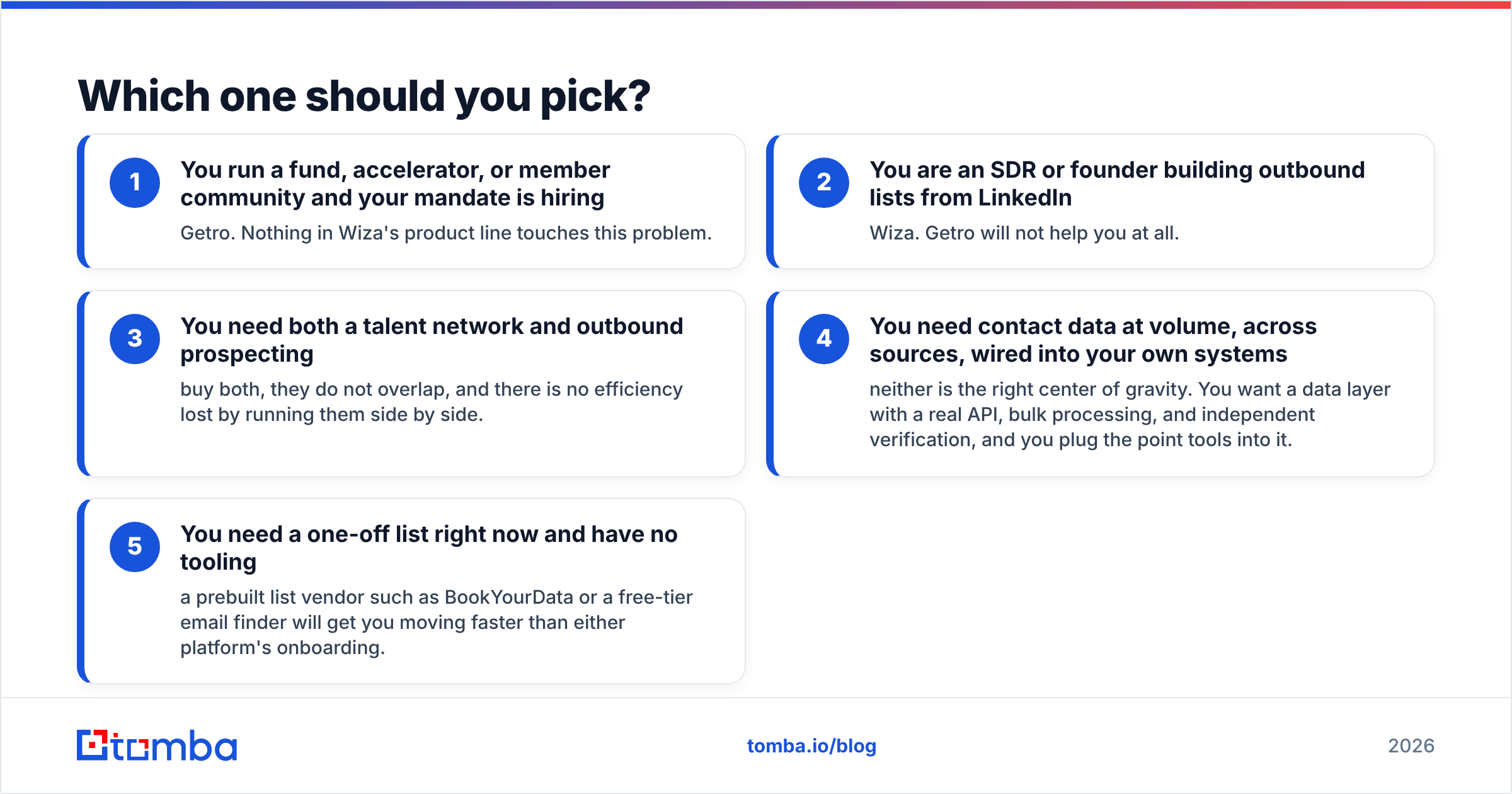
Match the tool to the job, in this order:
- You run a fund, accelerator, or member community and your mandate is hiring — Getro. Nothing in Wiza's product line touches this problem.
- You are an SDR or founder building outbound lists from LinkedIn — Wiza. Getro will not help you at all.
- You need both a talent network and outbound prospecting — buy both, they do not overlap, and there is no efficiency lost by running them side by side.
- You need contact data at volume, across sources, wired into your own systems — neither is the right center of gravity. You want a data layer with a real API, bulk processing, and independent verification, and you plug the point tools into it.
- You need a one-off list right now and have no tooling — a prebuilt list vendor such as BookYourData or a free-tier email finder will get you moving faster than either platform's onboarding.
Case four is the one most teams underestimate. Both Getro and Wiza are excellent inside their lane and neither is designed to be the system of record for contact data across your company.
Where do both tools leave a gap?#
Neither one covers people who are not in their source. Getro only knows candidates who opted in. Wiza only knows people who show up in a LinkedIn search. Your actual buyer list contains people in neither bucket — the ops manager with a dormant profile, the founder whose company page is three years stale, the entire long tail of firms under 50 employees.
Verification decays and neither tool re-runs it. An email that verified clean in March is a bounce risk by September. Roughly a quarter of B2B contact records go stale each year through job changes alone. Unless you re-verify on a schedule with a standalone email verifier, your CRM quietly rots and your sender reputation goes with it.
Catch-all domains get handed back as a shrug. Both categories of tool tend to return "accept-all, we cannot say" and let you decide. That is honest, but it is not an answer. A dedicated catch-all verifier is the difference between skipping a whole enterprise domain and safely mailing it.
Programmatic access is an afterthought outside prospecting tools. If you want to enrich on form submission, on CRM record creation, or inside a nightly job, you need an email finder API with predictable rate limits, not a Chrome extension that a human has to click.

Is there a workflow that uses all three?#
Yes, and it is the setup most mature teams converge on.
Getro sits on the talent side and stays there. It runs your job board and candidate pool, and it never touches sales data. No integration required, no overlap to manage.
Wiza sits on the LinkedIn side. Your reps use it exactly the way they already do, for opportunistic list building off a Sales Navigator search they just ran.
Underneath both, a contact-data layer handles anything that needs to be systematic: bulk email finding for a target account list you built from a market map rather than a LinkedIn filter, re-verification on a schedule for records already in your CRM, and API enrichment for inbound leads before they hit a rep's queue. Because that layer is not tied to LinkedIn as an input, it keeps working in segments where scraping returns nothing.
The failure mode to avoid is buying a second prospecting tool to solve a data-quality problem. If Wiza returns 40% coverage on your ICP, a different scraper pointed at the same LinkedIn index will return roughly the same 40%. The fix is a different source, not a different UI.
Frequently asked questions#
Is Getro an email finder? No. Getro surfaces candidate profiles that people voluntarily submitted, and job listings crawled from company career pages. It is not built to discover business email addresses for a target account list, and it does not price itself that way.
Can Wiza replace Sales Navigator? No, it depends on it. Wiza takes a Sales Navigator search as its input, so budget for both. That is a real line item people miss when they compare Wiza's monthly price against an all-in-one platform.
Which is better for a VC firm? Getro, for the platform function. But VC firms also run outbound for deal sourcing, and Getro does nothing there. Most funds end up with Getro for talent plus a separate contact-data stack for sourcing.
Do I need a verifier if my finder already verifies? For a small volume, no. Once you are mailing thousands per month or holding records for more than a quarter, yes — verification is a recurring hygiene job, not a one-time step at import.
What about accuracy differences? Ask any vendor for a test on your own list rather than trusting a published accuracy figure. Hit rates swing enormously by geography, company size, and industry. A tool that is excellent on US SaaS can be mediocre on European manufacturing.
The bottom line#
Getro vs Wiza is a false matchup that keeps getting made because both promise "access to people." Getro gives a community a hiring engine. Wiza gives a rep a list. Buy whichever matches the job in front of you, and do not expect either to cover the other's ground.
What both assume, and neither guarantees, is that the contact data underneath is complete and still true. If that is the actual problem you are trying to solve — coverage outside LinkedIn, verification that reruns on a schedule, enrichment you can call from code — start with the Tomba Email Finder. The free tier gives you 25 searches a month, enough to run your own test list against whatever you are already using and see the hit-rate difference for yourself before you commit a budget line.
Related guides#
Ready to find emails that actually work?
Join 150,000+ professionals who stopped guessing and started sending. Free credits on signup — no credit card required.
Get the Tomba newsletter
Practical outbound tactics and product updates — once every two weeks.
About the author