Gigasheet vs ReachStream: Which B2B Data Tool Wins in 2026?
One is a browser-based spreadsheet built for billion-row files. The other sells you the contacts in the first place. Here is where each one earns its money, where it fails, and which order to buy them in.
TL;DR
- They are not actually competitors. Gigasheet is a browser-based spreadsheet for files too big for Excel. ReachStream is a B2B contact database you buy records from. Comparing them is comparing a blender to a grocery store.
- Pick Gigasheet if your problem is "I have a 40M-row export and Excel died." Pick ReachStream if your problem is "I have no contacts at all and need a cheap starter list."
- Neither one verifies deliverability at send time. Gigasheet doesn't claim to. ReachStream, like every static database, ages roughly 2-2.5% per month as people change jobs.
- The realistic 2026 stack is three layers: a source of contacts, a verification layer, and a place to clean at scale. Most teams overpay for layer one and skip layer two.
- Cheapest honest path: source targeted contacts on demand with an email finder, verify before send, and only reach for a big-data spreadsheet when your row count genuinely breaks normal tools.
What are Gigasheet and ReachStream, actually?#
The reason gigasheet vs reachstream shows up as a search query is that both get filed under "B2B data tools" in software directories, and both get pitched to the same RevOps person in the same week. They solve completely different problems.
Gigasheet is a big-data spreadsheet that runs in your browser. You upload a CSV, Parquet, or JSON file that would freeze Excel — tens of millions of rows — and you get a familiar grid with filters, group-bys, pivots, joins, and dedupe that execute server-side in seconds. It is closer to "SQL for people who refuse to write SQL" than to anything in the prospecting category. Gigasheet does not sell you contacts. It has an enrichment marketplace where you can call third-party providers, but the core product is the engine, not the data.
ReachStream is the opposite. It is a B2B contact and company database — you buy access to records, filter by industry, job title, geography, company size, and revenue, then export what matches. You get names, business emails, phone numbers, company firmographics. The product is the data. There is no billion-row analysis engine underneath it.
So the honest framing is not "which one wins." It is: which layer of your data stack is currently broken?
How do Gigasheet and ReachStream compare head-to-head?#
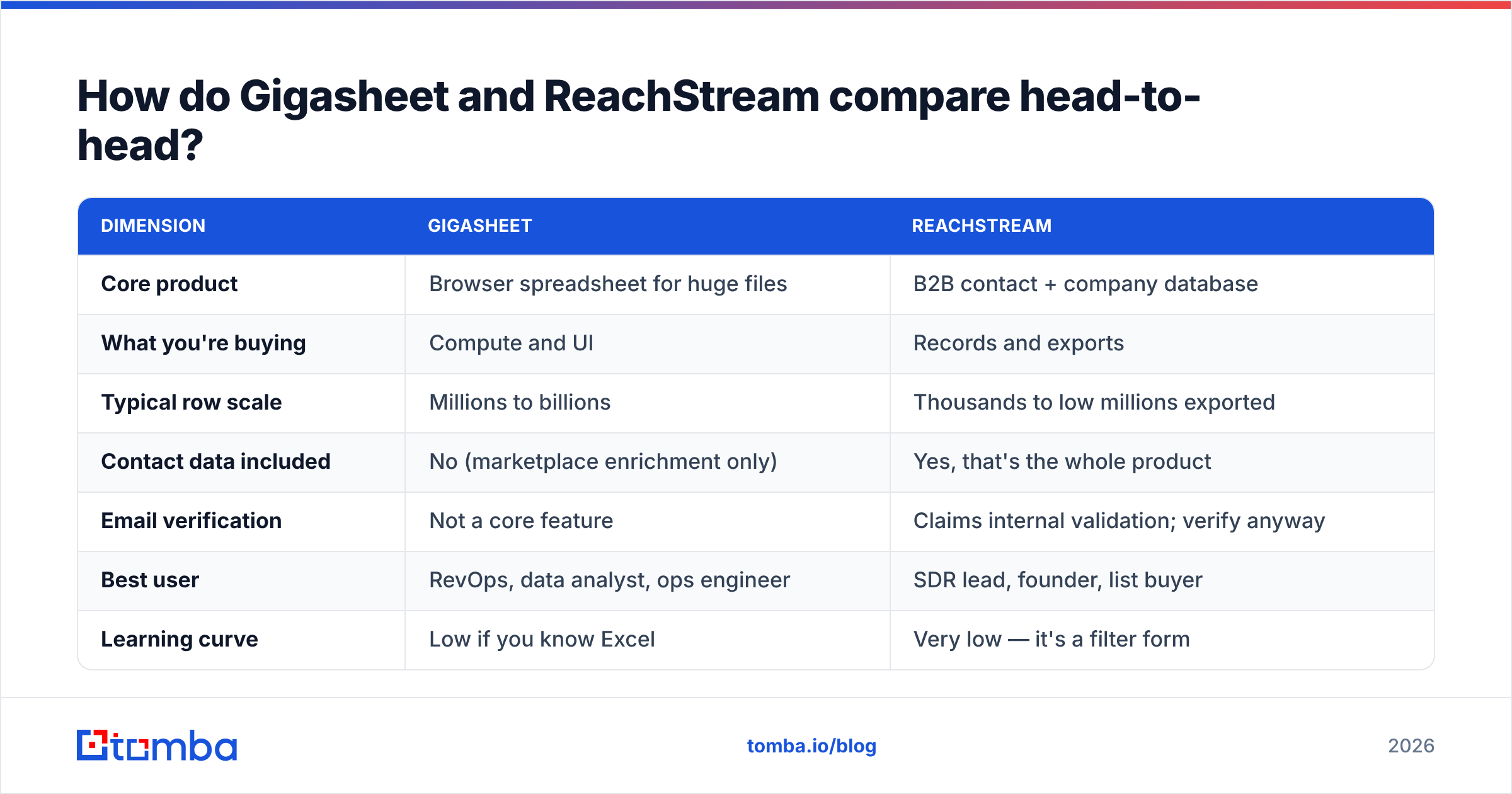
| Dimension | Gigasheet | ReachStream |
|---|---|---|
| Core product | Browser spreadsheet for huge files | B2B contact + company database |
| What you're buying | Compute and UI | Records and exports |
| Typical row scale | Millions to billions | Thousands to low millions exported |
| Contact data included | No (marketplace enrichment only) | Yes, that's the whole product |
| Email verification | Not a core feature | Claims internal validation; verify anyway |
| Best user | RevOps, data analyst, ops engineer | SDR lead, founder, list buyer |
| Learning curve | Low if you know Excel | Very low — it's a filter form |
| Free option | Yes, capped free tier | Free sample records / trial |
| Where it fails | Empty without a data source | Data decays; coverage is uneven by region |
Read that table twice. If you buy ReachStream expecting analysis tooling, you will be disappointed. If you buy Gigasheet expecting leads, you will have a very fast spreadsheet with nothing in it.

What does Gigasheet actually do well?#
Four things, and it does them better than the generic alternatives most teams reach for first.
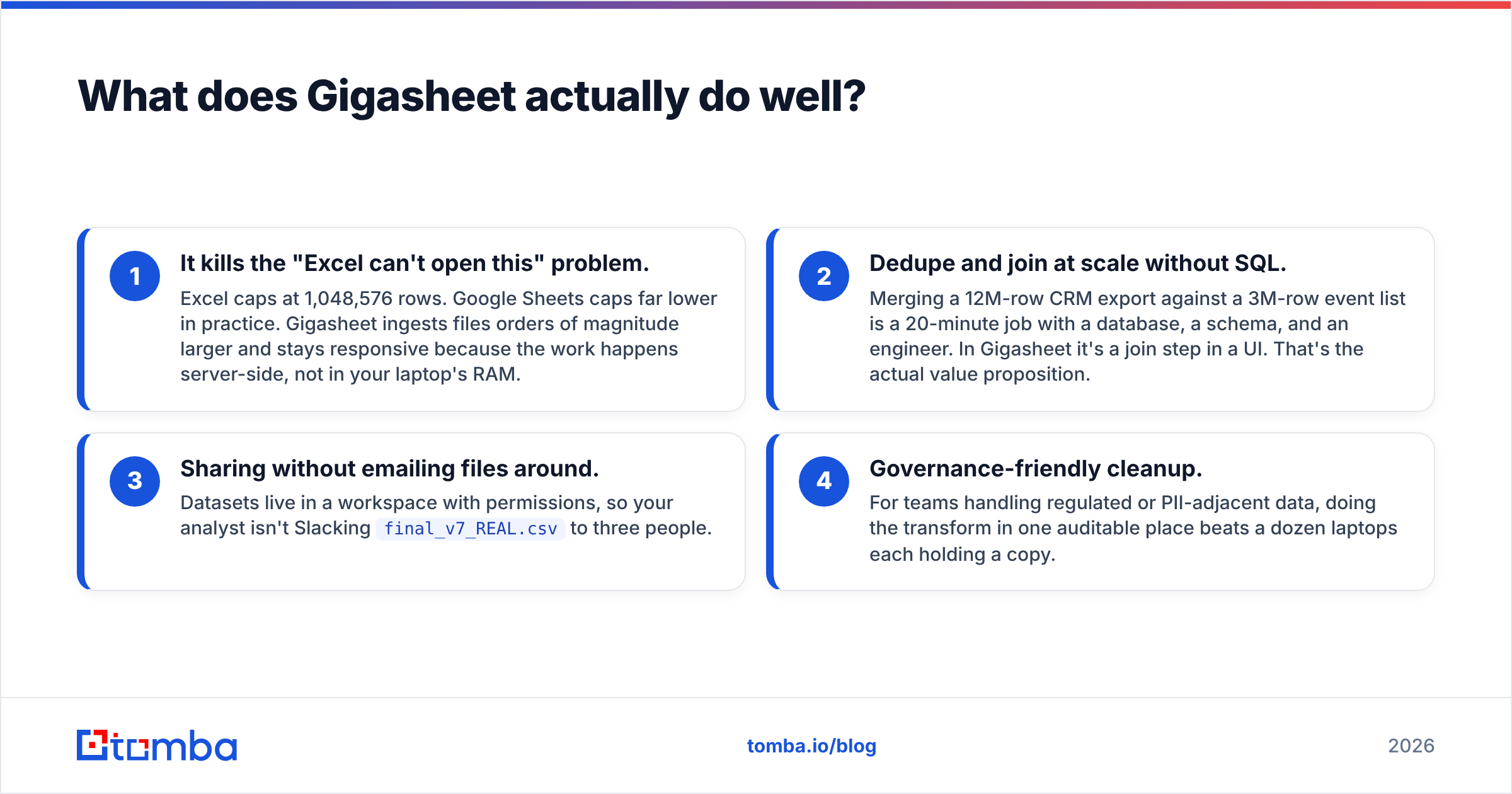
- It kills the "Excel can't open this" problem. Excel caps at 1,048,576 rows. Google Sheets caps far lower in practice. Gigasheet ingests files orders of magnitude larger and stays responsive because the work happens server-side, not in your laptop's RAM.
- Dedupe and join at scale without SQL. Merging a 12M-row CRM export against a 3M-row event list is a 20-minute job with a database, a schema, and an engineer. In Gigasheet it's a join step in a UI. That's the actual value proposition.
- Sharing without emailing files around. Datasets live in a workspace with permissions, so your analyst isn't Slacking
final_v7_REAL.csvto three people. - Governance-friendly cleanup. For teams handling regulated or PII-adjacent data, doing the transform in one auditable place beats a dozen laptops each holding a copy.
Where it falls down for sales teams: it is a destination, not a source. Nothing about Gigasheet tells you which 400 companies to call this quarter. It tells you what's already in the file.
Where does ReachStream fit?#
ReachStream sits in the crowded "affordable contact database" tier alongside a dozen similar vendors. Its pitch is volume-per-dollar: a broad international database with self-serve filters and straightforward exports, priced under the enterprise data platforms.
That's a real niche. If you are pre-revenue, testing three ICPs at once, and need 5,000 rows to find out whether manufacturing ops managers in the Midwest reply to anything, a cheap bulk database is a rational purchase. You are buying a hypothesis test, not a permanent asset.
The limits are the same limits every static database has, and you should price them in before you buy:
- Decay. B2B contact data goes stale at roughly 2-2.5% per month as people change roles, companies rebrand, and mailboxes get deactivated. A list bought in January is meaningfully worse by June.
- Coverage is lumpy. Every provider is strong in some regions and verticals and thin in others. Test your exact ICP with a sample before committing to an annual plan — not a generic "tech companies in the US" sample.
- "Verified" is a marketing word. Providers verify at ingest time or on a rolling schedule. That is not the same as verified at the moment you press send. Run the export through an independent email verifier regardless of what the vendor claims.
- Catch-all domains distort the numbers. A large share of B2B domains accept everything at the SMTP layer, which makes naive validators report a clean list that bounces anyway. A dedicated catch-all verifier is the only way to get a real read on those.
None of this is a knock on ReachStream specifically. It's the physics of the category. Anyone selling you a static file is selling you a depreciating asset.
Is Gigasheet better than ReachStream for B2B prospecting?#
No — and it isn't trying to be. But there's a more useful version of that question: which one removes more friction from your current week?
Answer it with your actual bottleneck:
- "My list is huge and unusable." → Gigasheet. Dedupe, normalize, split by segment, export clean.
- "I have no list." → ReachStream or a comparable source. Gigasheet cannot help you.
- "My list is fine but bouncing." → Neither. You need verification, not storage or sourcing.
- "I need 50 specific people at 50 specific target accounts." → Neither. Bulk databases oversell you 40,000 records to get the 50 you wanted, and a spreadsheet engine is overkill for 50 rows. Use domain search against your named account list instead.
That fourth case is the one people get wrong most often. If you have a named-account motion, buying a broad database is a category error — you are paying for coverage you will never touch, then paying again in reputation damage when you email the stale 30%.
What does each one cost in 2026?#
Pricing at this tier moves constantly, so treat these as shape-of-the-model rather than a quote. Check both vendor pages before you commit.
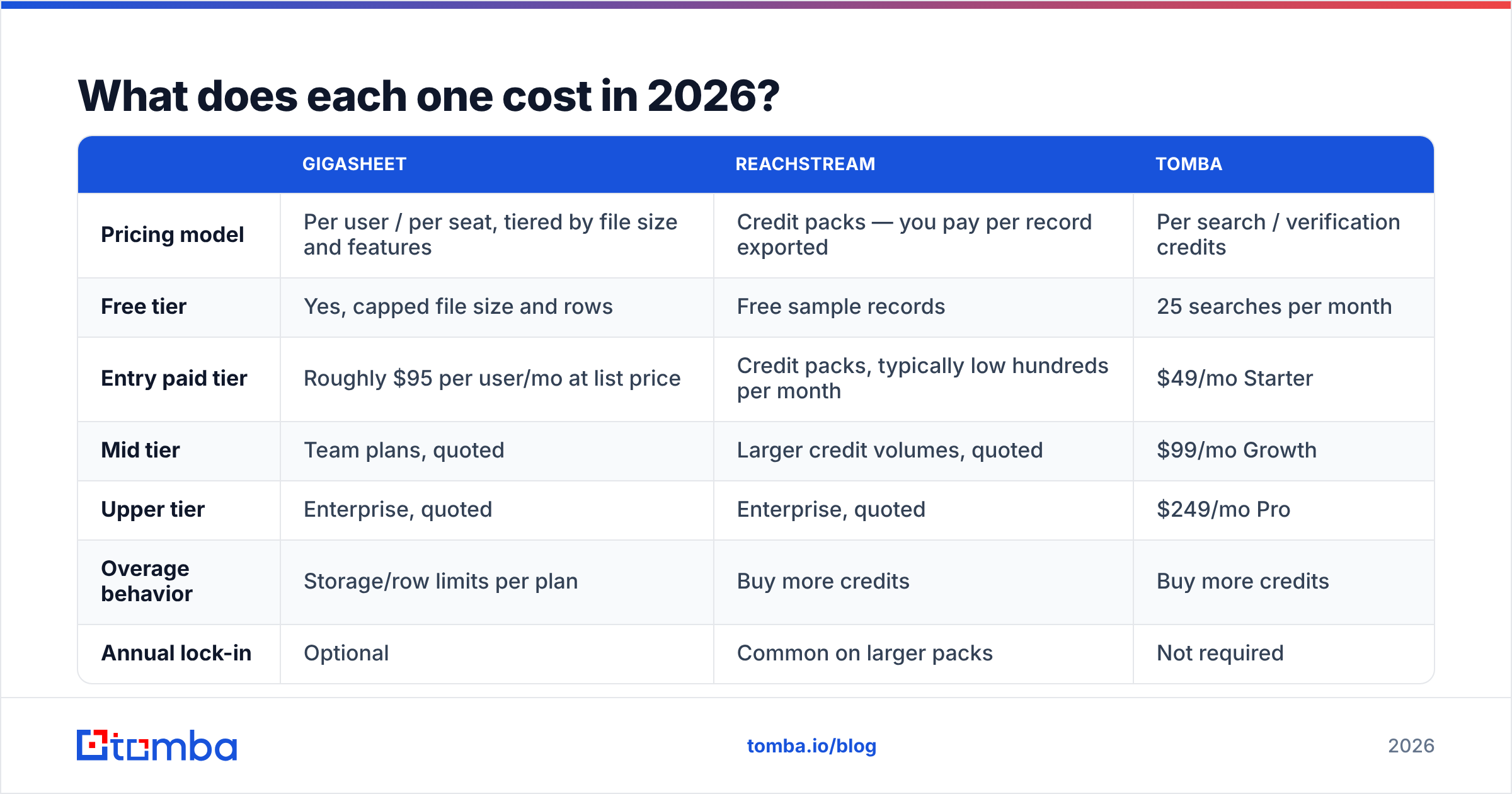
| Gigasheet | ReachStream | Tomba | |
|---|---|---|---|
| Pricing model | Per user / per seat, tiered by file size and features | Credit packs — you pay per record exported | Per search / verification credits |
| Free tier | Yes, capped file size and rows | Free sample records | 25 searches per month |
| Entry paid tier | Roughly $95 per user/mo at list price | Credit packs, typically low hundreds per month | $49/mo Starter |
| Mid tier | Team plans, quoted | Larger credit volumes, quoted | $99/mo Growth |
| Upper tier | Enterprise, quoted | Enterprise, quoted | $249/mo Pro |
| Overage behavior | Storage/row limits per plan | Buy more credits | Buy more credits |
| Annual lock-in | Optional | Common on larger packs | Not required |
The important structural difference: Gigasheet charges for capability, ReachStream charges for volume. A five-person team that occasionally cleans a giant file pays Gigasheet five seats even if they run four jobs a year. A team that needs 200 precise contacts pays ReachStream for a credit pack sized far above 200 because that's how packs are sold.
Credit-based, pay-for-what-you-use sourcing avoids both traps. That's the model behind Tomba pricing — you're charged for the lookups you actually run, and the free tier is enough to sanity-check coverage on your own domains before spending anything.
How accurate is the data you actually end up with?#
This is the only metric that survives contact with a real campaign, and it is not the number on anyone's homepage.
Vendor-published accuracy figures are measured under favorable conditions: at ingest, on well-covered domains, often excluding catch-alls. Your realistic deliverable rate depends on three things stacked together:
- Source freshness. How recently was the record touched? A database refreshed quarterly and a live SMTP-and-pattern lookup run this morning are different products with the same label.
- Verification depth. Syntax check, MX check, SMTP probe, and catch-all handling are four separate levels. Most "validated" claims stop at level two.
- Your own hygiene. Deduping across sources, suppressing prior bounces, and removing role accounts (
info@,sales@) moves bounce rate more than switching vendors does.
A practical benchmark: if your bounce rate on a fresh purchased list is above 5%, the list is the problem. Above 8%, stop sending — you are actively damaging sender reputation, and recovering it costs more than the list did. Independent user reviews on directories like G2 are more useful than vendor pages here, but read the 3-star reviews, not the 5-star ones.

Which should you pick for your use case?#
Pick Gigasheet if: you regularly handle files above a million rows, you have data but not clarity, and your team's current workflow involves someone saying "let me just open this in Python." It's a genuine time-saver and there's no real substitute at its price point.
Pick ReachStream if: you need volume cheaply, your ICP is broad, you're testing multiple segments, and you accept that a meaningful slice of any bulk export will be dead on arrival. Budget for verification on top of the purchase price — not as an optional extra.
Pick neither if: your motion is named-account outbound, your list is under a few thousand contacts, or you're targeting specific roles at specific companies. In that case you want targeted lookup, not bulk purchase. Pull emails per-domain or per-person, verify each one, and push them straight into your CRM through a HubSpot integration or the Tomba API. You'll spend less and bounce less, because nothing sits in a file long enough to rot.
Use two of them if: you're at real scale. Source contacts from a database, verify them independently, and use a big-data spreadsheet for the merge-dedupe-segment work. Those are three tools because they're three jobs.
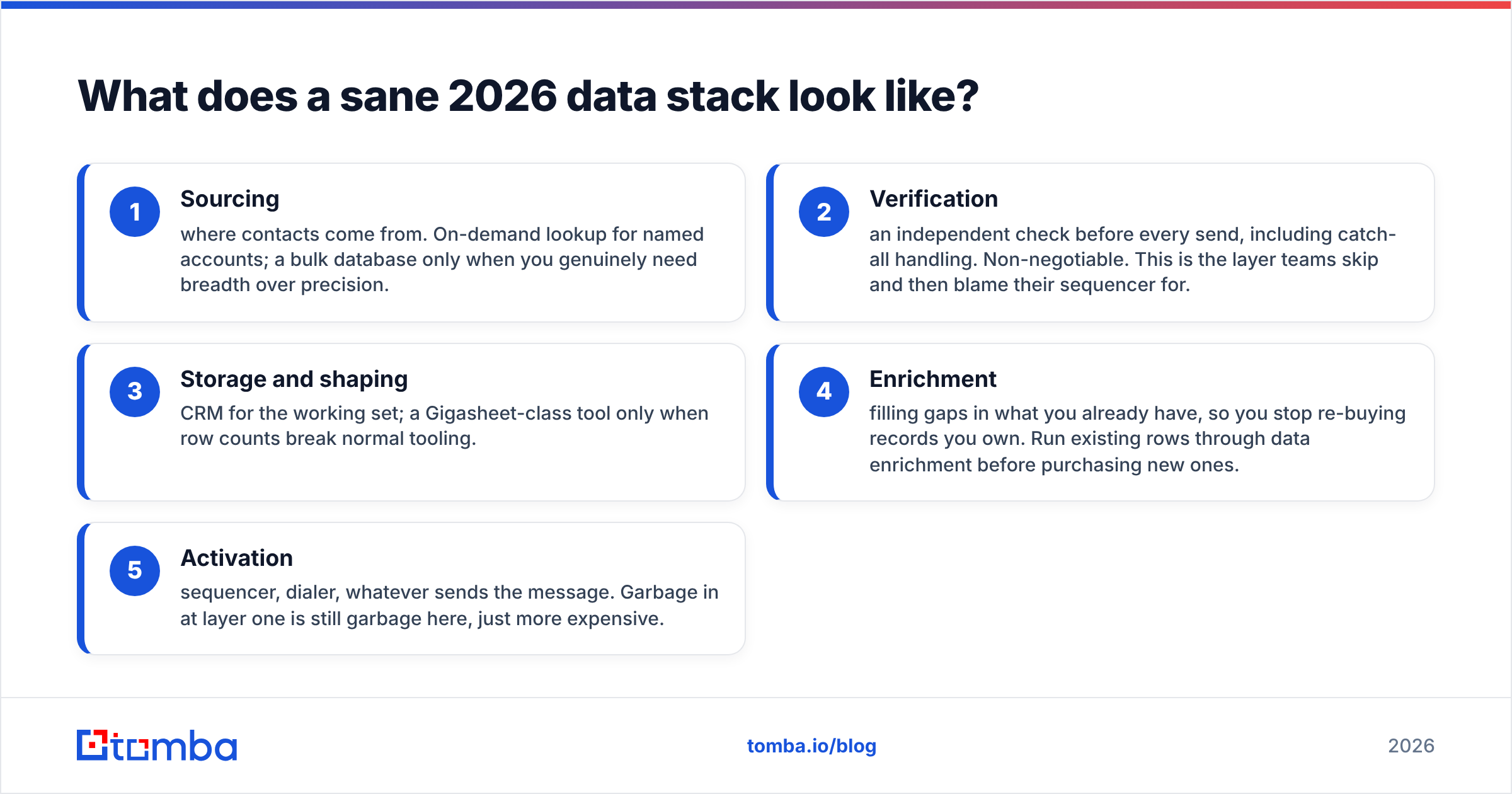
What does a sane 2026 data stack look like?#
Layer it, and be honest about which layer is actually broken:
- Sourcing — where contacts come from. On-demand lookup for named accounts; a bulk database only when you genuinely need breadth over precision.
- Verification — an independent check before every send, including catch-all handling. Non-negotiable. This is the layer teams skip and then blame their sequencer for.
- Storage and shaping — CRM for the working set; a Gigasheet-class tool only when row counts break normal tooling.
- Enrichment — filling gaps in what you already have, so you stop re-buying records you own. Run existing rows through data enrichment before purchasing new ones.
- Activation — sequencer, dialer, whatever sends the message. Garbage in at layer one is still garbage here, just more expensive.
Most teams asking about gigasheet vs reachstream are trying to solve a layer-two problem by buying a layer-one or layer-three tool. More records won't fix a bounce rate. A faster spreadsheet won't fix a bounce rate. Verification fixes a bounce rate.
Frequently asked questions#
Can Gigasheet replace a contact database? No. It has enrichment integrations, but the core product has no contact data of its own. You still need a source.
Can ReachStream replace an email verifier? Treat the answer as no. Any static database benefits from an independent verification pass immediately before send, regardless of internal validation claims.
Is either GDPR-safe for European outreach? Both operate under the usual B2B legitimate-interest framing, but compliance depends on your process — opt-out handling, data minimization, and record-keeping — not on the vendor's badge. Get your own legal read before running EU campaigns.
What's the fastest way to test a provider's coverage? Take 50 companies you already know well, with people you can verify independently. Run those through the provider's filters. If coverage on accounts you know is thin, coverage on accounts you don't know is worse.
Start with contacts you can actually reach#
The uncomfortable conclusion of any gigasheet vs reachstream comparison is that both tools assume the hard part is already solved. Gigasheet assumes you have data. ReachStream assumes stale data is good enough. Neither assumption survives a real quarter of outbound.
Fix the source first. The Tomba Email Finder pulls verified business emails by domain, name, or company at the moment you need them — not from a file that was accurate last spring. Free tier gives you 25 searches a month to test coverage on your own target accounts, Starter is $49/mo, and there's no credit pack you have to buy your way through. Run your next 50 target accounts through it, verify the results, and compare the bounce rate against whatever list you're sitting on now. That comparison will settle the question faster than any feature table.
Related guides#
Ready to find emails that actually work?
Join 150,000+ professionals who stopped guessing and started sending. Free credits on signup — no credit card required.
Get the Tomba newsletter
Practical outbound tactics and product updates — once every two weeks.
About the author