GigRadar Pricing, Reviews, Pros and Cons (2026 Guide)
GigRadar automates Upwork bidding, but the sticker price is only part of the bill. Here is what the tiers really cost once Connects are counted, what reviewers praise and complain about, and when a plain outbound stack wins.
TL;DR
- GigRadar is an Upwork bidding automation tool: it watches new job posts, filters them, writes AI proposals, and submits them for you — mostly used by dev, design, and marketing agencies.
- The subscription is not the real cost. Upwork Connects are billed separately at roughly $0.15 each, and a high-volume auto-bidding setup can quietly add $200–$600/month on top of your plan.
- Reviews cluster around two themes: it genuinely produces more first-call bookings, and it burns budget fast if your filters, portfolio, and profile are weak.
- It only makes sense if your average Upwork contract is worth several thousand dollars and you have capacity to take the work. Below that, the math stops working.
- If your growth plan is not Upwork-dependent, a direct outbound stack — verified emails, enrichment, sequenced follow-up — usually costs less per booked meeting and you own the pipeline.
What is GigRadar and who actually uses it?#
GigRadar is a bidding automation layer that sits on top of Upwork. You connect your Upwork account, define what a good job looks like (keywords, budget floor, client spend history, country, hire rate), and the tool monitors the job feed in near real time. When a post matches, it generates a proposal from your templates plus AI, and submits it — often within minutes of the job going live.
The core bet is speed. On Upwork, proposal position matters: clients frequently read the first handful and stop. A human bidder checking the feed three times a day loses to a system watching it continuously.
Typical buyers are agency owners running 5–40 person shops in web development, mobile, design, video editing, and performance marketing — teams whose entire lead flow is marketplace-based. Solo freelancers do use it, but the economics are harsher, and we will get to why.
The product surface usually includes:
- Real-time job monitoring — a filtered feed scanning Upwork posts continuously instead of on a manual refresh.
- AI proposal generation — templates blended with job-post context so each cover letter is not a copy-paste block.
- Auto-submit rules — thresholds that decide which matched jobs get bid on automatically versus queued for human approval.
- Slack and CRM notifications — new bids, client replies, and interview invites pushed to the channel your team already lives in.
- Analytics — bid-to-reply rate, reply-to-interview rate, cost per interview, and spend per Connect.
- Multi-account management — one dashboard across several agency Upwork profiles or seats.
Nothing here is impossible manually. What you are buying is response latency and volume consistency, which is exactly the kind of thing software beats humans at.

How does GigRadar pricing work in 2026?#
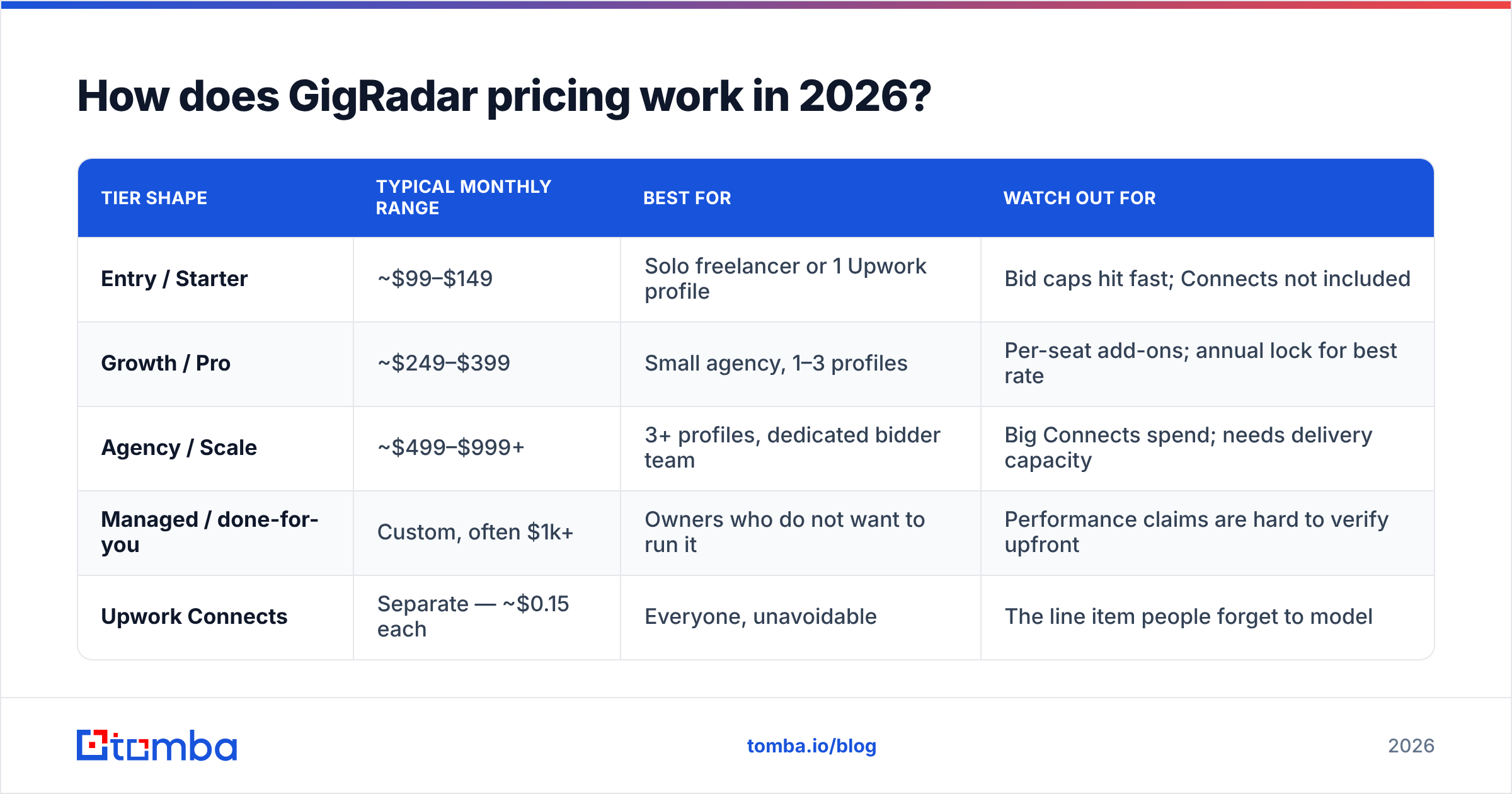
GigRadar sells tiered monthly subscriptions scaled by bid volume and seats, with agency plans well into the several-hundred-dollars-per-month range. Public pricing on tools in this category moves often, so treat the table below as the shape of the offer and confirm current numbers on gigradar.io before you commit.
| Tier shape | Typical monthly range | Best for | Watch out for |
|---|---|---|---|
| Entry / Starter | ~$99–$149 | Solo freelancer or 1 Upwork profile | Bid caps hit fast; Connects not included |
| Growth / Pro | ~$249–$399 | Small agency, 1–3 profiles | Per-seat add-ons; annual lock for best rate |
| Agency / Scale | ~$499–$999+ | 3+ profiles, dedicated bidder team | Big Connects spend; needs delivery capacity |
| Managed / done-for-you | Custom, often $1k+ | Owners who do not want to run it | Performance claims are hard to verify upfront |
| Upwork Connects | Separate — ~$0.15 each | Everyone, unavoidable | The line item people forget to model |
Two structural things matter more than the exact number on the pricing page.
First, pricing is volume-anchored. The plan you need is determined by how many bids you want to fire per month, not by how many people are on your team. If your filters are loose, you get pushed up a tier for reasons that have nothing to do with lead quality.
Second, the subscription is not the spend. That belongs in its own section.
What are the hidden costs nobody models?#
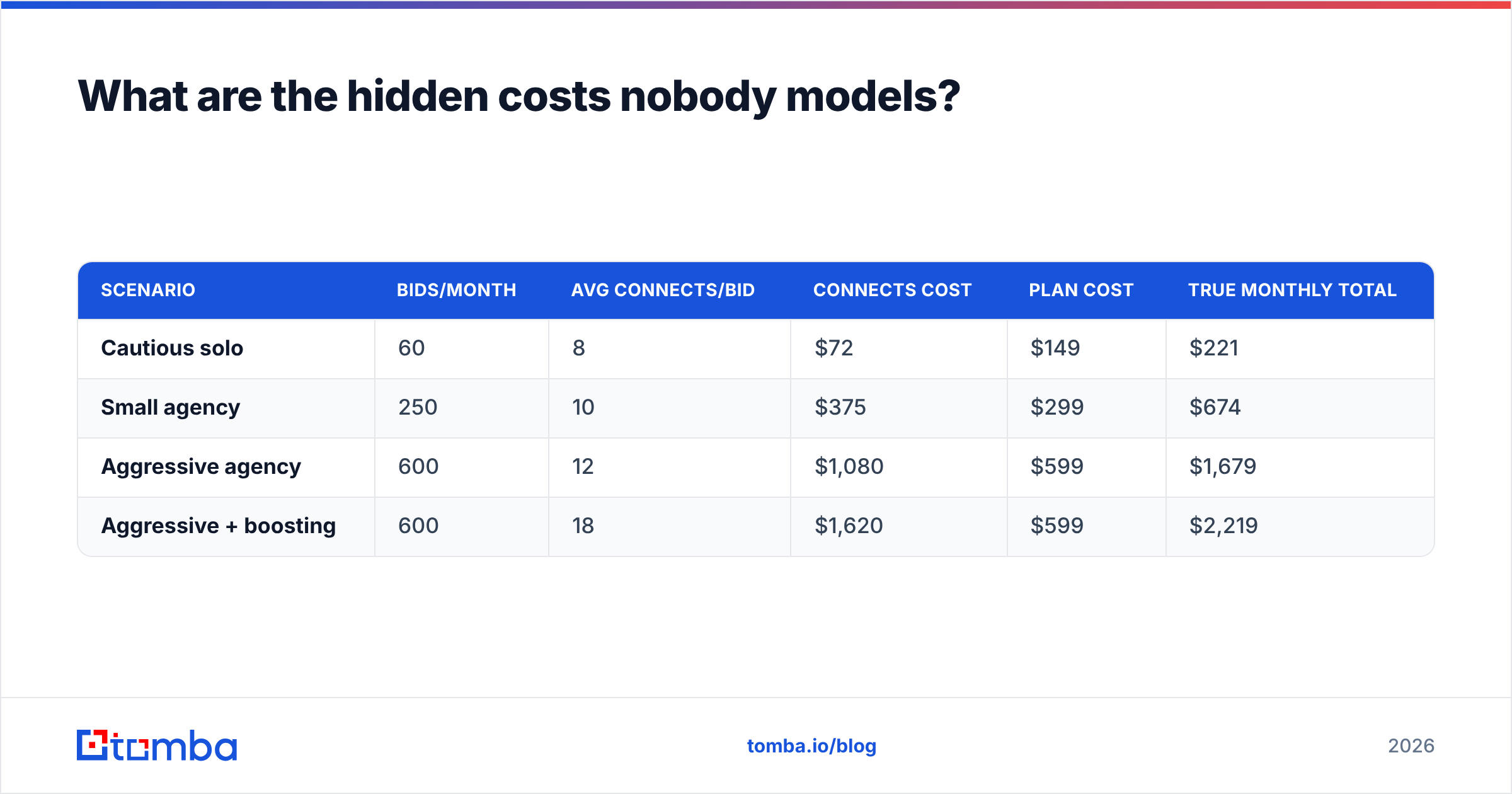
Upwork charges Connects to submit proposals. Connects cost about $0.15 each, and a single proposal costs anywhere from 4 to 16 Connects depending on job competitiveness — with the higher end concentrated exactly where the good budgets are. Boosted proposals cost more still, because boosting is an auction.
Run the arithmetic on a normal agency setup:
| Scenario | Bids/month | Avg Connects/bid | Connects cost | Plan cost | True monthly total |
|---|---|---|---|---|---|
| Cautious solo | 60 | 8 | $72 | $149 | $221 |
| Small agency | 250 | 10 | $375 | $299 | $674 |
| Aggressive agency | 600 | 12 | $1,080 | $599 | $1,679 |
| Aggressive + boosting | 600 | 18 | $1,620 | $599 | $2,219 |
That last row is where the "GigRadar is expensive" reviews come from. The tool did what it was told. The filters were too wide, so it bought a very large number of lottery tickets.
The other costs are softer but real: someone has to maintain proposal templates, review the reply queue daily, and prune filters weekly. Automation moves the labor, it does not delete it. Budget a few hours a week of an experienced person's time, or the reply rate decays inside two months.
What do GigRadar reviews actually say?#
Read enough agency-owner threads, G2 entries, and Upwork community posts and the feedback sorts into a consistent pattern.
What reviewers consistently praise:
- Speed to first proposal. Being in the first five submissions changes reply rates materially, and this is the single most repeated positive.
- Volume without headcount. Agencies that were paying a full-time bidder report replacing or repurposing that role.
- Analytics that expose bad assumptions. Seeing cost-per-interview by job category kills pet niches quickly, which is uncomfortable and useful.
- Onboarding and Slack-native workflows. Support responsiveness comes up more often than it does for most tools this size.
What reviewers consistently complain about:
- Spend surprises. Connects burn is the number one refund-request trigger.
- Generic AI proposals. If you accept the default templates, clients notice. The people getting results rewrite templates per service line and per client tier.
- Weak profiles get worse results, not better. Automation amplifies whatever your Job Success Score and portfolio already say. A thin profile bidding 500 times produces 500 rejections at $0.15 a piece.
- Upwork policy nerves. Automated submission sits in a gray zone that makes some owners uneasy. Read Upwork's terms yourself and decide your own risk tolerance — that is not a decision to outsource to a vendor's FAQ.
- Attribution ambiguity. Managed offerings that quote a cost-per-qualified-lead are hard to audit from the outside.
The honest summary: reviews are strongly bimodal. Agencies with a 90%+ Job Success Score, real case studies, and delivery capacity like it. Everyone else describes it as an expensive way to learn their positioning is weak.
Is GigRadar worth it for your agency?#
Do the break-even before the trial, not after.
Take your average Upwork contract value and your historical bid-to-close rate. If your average closed contract is $8,000 and you close 1 in 60 bids, then 250 bids per month should produce roughly four contracts — about $32,000 in booked work against roughly $674 in true monthly cost. That is trivially worth it, assuming you can deliver four new projects.
Flip the inputs. Average contract $900, close rate 1 in 90. Those same 250 bids yield under $2,500 in work against the same $674 — before delivery cost. Now you are running a business that exists to buy Connects.
The three conditions that need to be true together:
- Average contract value above roughly $3,000. Below that, Connects economics get thin fast.
- A profile that already converts. Fix Job Success Score, reviews, and portfolio first. Automation is a multiplier, and multiplying a weak number keeps it weak.
- Delivery capacity you are not already using. Winning work you cannot staff produces bad reviews, which destroys the asset the whole system depends on.
If any one of those is false, the tool is not the problem to solve this quarter.
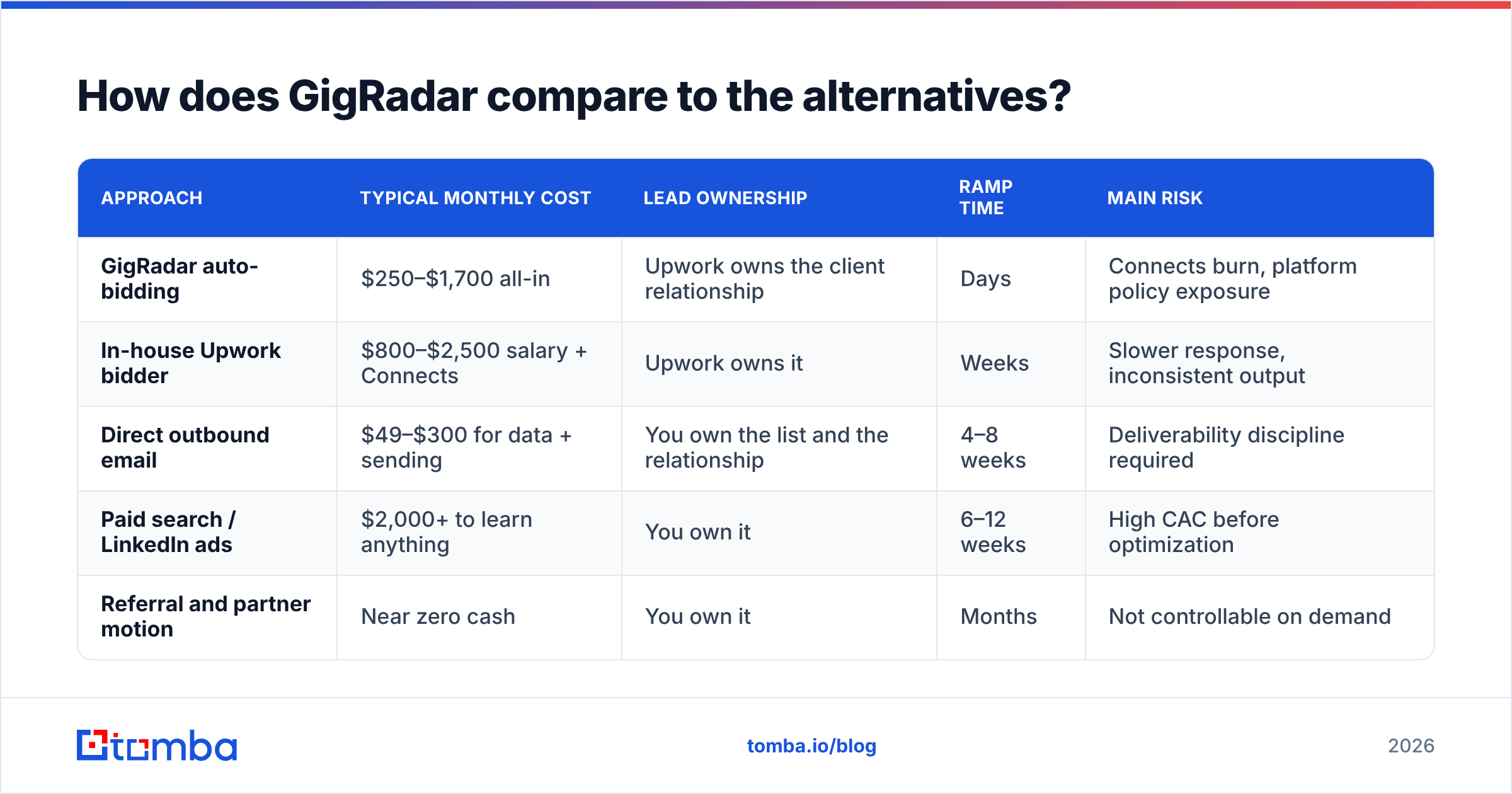
How does GigRadar compare to the alternatives?#
Marketplace automation is one channel, not a strategy. Here is how the realistic options stack against each other for an agency trying to add predictable pipeline.
| Approach | Typical monthly cost | Lead ownership | Ramp time | Main risk |
|---|---|---|---|---|
| GigRadar auto-bidding | $250–$1,700 all-in | Upwork owns the client relationship | Days | Connects burn, platform policy exposure |
| In-house Upwork bidder | $800–$2,500 salary + Connects | Upwork owns it | Weeks | Slower response, inconsistent output |
| Direct outbound email | $49–$300 for data + sending | You own the list and the relationship | 4–8 weeks | Deliverability discipline required |
| Paid search / LinkedIn ads | $2,000+ to learn anything | You own it | 6–12 weeks | High CAC before optimization |
| Referral and partner motion | Near zero cash | You own it | Months | Not controllable on demand |
The comparison people skip is the third row. A direct outbound stack — a verified contact list, enrichment, and a sequencing tool — typically runs a fraction of an aggressive auto-bidding budget and produces relationships that do not have a 10% platform fee attached or a policy change waiting to break them.
Building that stack is less exotic than it sounds. You define the account list, use a domain search to pull the right roles at each company, run everything through an email verifier before it touches a sending domain, and layer in data enrichment so the first line of each email is actually about the recipient. For list-building at volume, a bulk email finder turns a spreadsheet of companies into a contactable list in one pass.
If you would rather buy a prebuilt list than assemble one, established providers like BookYourData are a reasonable route for verified B2B contacts, and they pair well with a verification step of your own before send.
The point is not that outbound replaces marketplaces. Plenty of strong agencies run both — Upwork for velocity and cash flow, outbound for the accounts they actually want. The point is that if your only channel is a marketplace, your pricing power is capped by that marketplace forever.
What should you check before you buy?#
A short due-diligence list that takes an hour and saves a quarter:
- Ask for the Connects forecast, not the plan price. Any vendor that cannot model your expected monthly Connects burn from your filters is not ready to sell you the tier.
- Confirm the cancellation and annual-commitment terms in writing. Discounted annual pricing is where buyer's remorse lives.
- Test with narrow filters for 30 days. High budget floor, high client spend history, one service line. Expensive, precise bids beat cheap, broad ones every time.
- Track cost per interview, not cost per bid. Bids are vanity. Interviews are the only number that maps to revenue.
- Rewrite every default template. If the proposal could have been sent by any of your competitors, it will perform like any of your competitors.
- Read Upwork's current terms on automated activity yourself. Your account, your risk.
Also set a hard monthly Connects budget in Upwork before you turn automation on. It is a five-minute control that caps the single most common failure mode.
What is the verdict on GigRadar pricing?#
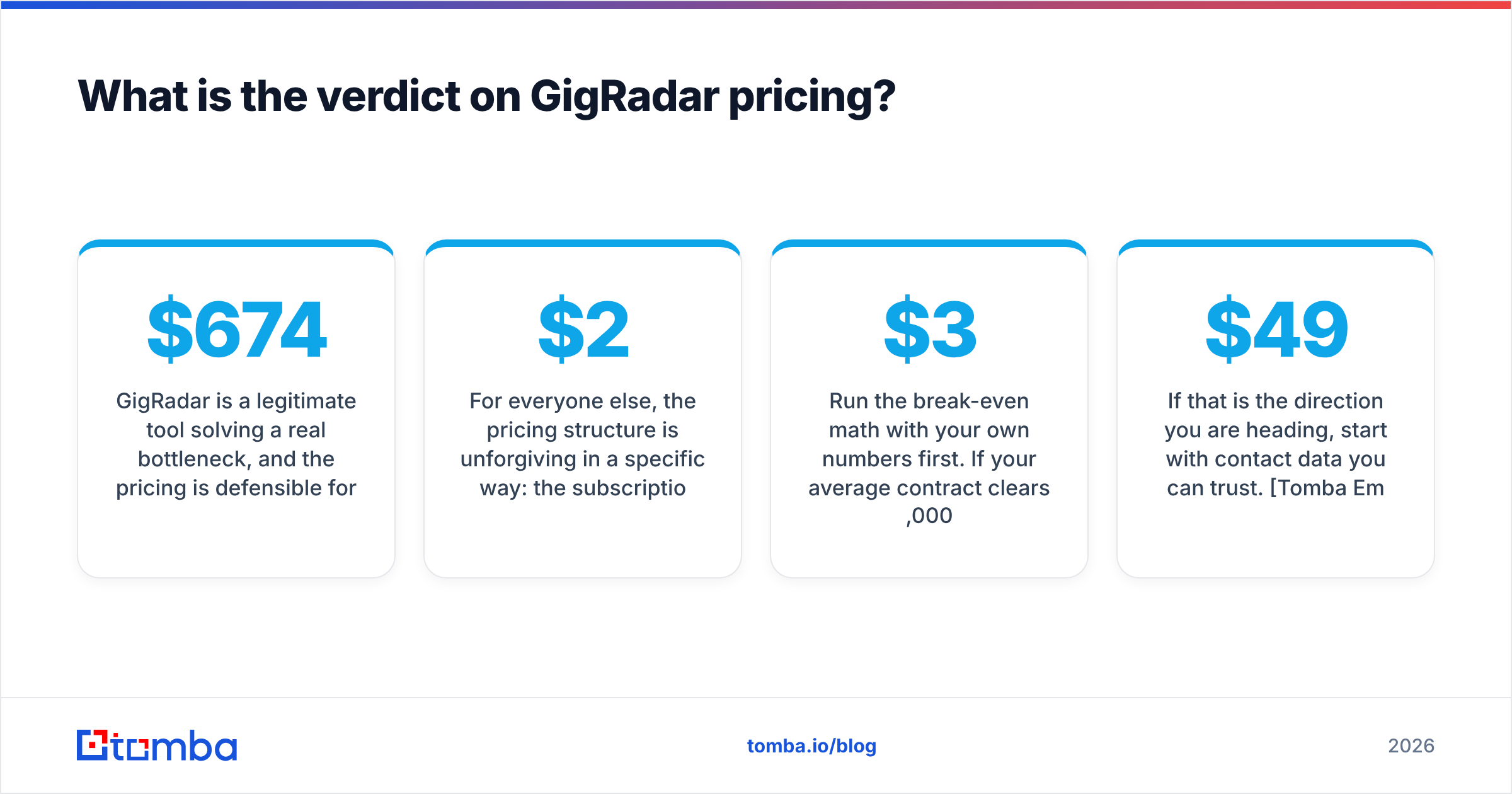
GigRadar is a legitimate tool solving a real bottleneck, and the pricing is defensible for the agencies it is built for — high average contract value, strong profile, spare delivery capacity. For those teams, a $674/month all-in spend against $30k in booked work is not a debate.
For everyone else, the pricing structure is unforgiving in a specific way: the subscription is fixed and visible, the Connects are variable and invisible until the statement arrives. That asymmetry is why the reviews split so cleanly between "transformed our pipeline" and "burned $2,000 for nothing."
Run the break-even math with your own numbers first. If your average contract clears $3,000 and your profile converts, trial it with tight filters. If it does not, spend the same money building a channel you own.
If that is the direction you are heading, start with contact data you can trust. Tomba Email Finder locates verified professional email addresses by name, company, or domain, so your first outbound sequence lands in inboxes instead of bouncing. The free tier covers 25 searches a month, Starter runs $49/mo, and Growth is $99/mo — full Tomba pricing is public, with no per-message surcharge waiting at the end of the month. Build the list, verify it, and own the pipeline you are paying for.
Related guides#
Ready to find emails that actually work?
Join 150,000+ professionals who stopped guessing and started sending. Free credits on signup — no credit card required.
Get the Tomba newsletter
Practical outbound tactics and product updates — once every two weeks.
About the author