Global B2B Marketing in 2026: Strategy, Data, and Playbooks
Most global B2B marketing programs fail on data and localization, not creative. Here is how expansion-stage teams actually pick markets, build lists, and stay compliant across regions.
TL;DR
- Global B2B marketing fails on three things far more often than creative: bad regional data, unclear market sequencing, and compliance shortcuts that kill deliverability.
- Pick two or three markets, not ten. The teams that win expansion usually run a Tier 1 / Tier 2 / Tier 3 localization model instead of translating everything equally.
- Regional email data decays faster than domestic data — European and APAC contact records go stale roughly twice as fast as US records in most B2B datasets.
- GDPR, PIPEDA, PDPA, and LGPD all permit B2B outreach, but under different legal bases. "We're B2B so we're exempt" is wrong in the EU.
- Budget roughly 60% of expansion spend on data, localization, and local proof — not paid media. Paid without proof burns cash in a market that has never heard of you.
What is global B2B marketing, really?#
Global B2B marketing is the practice of generating and converting demand across multiple countries where buying behavior, language, procurement rules, and data law all differ — using one operating model instead of a dozen disconnected local teams.
The word doing the heavy lifting is one operating model. Anyone can hire a contractor in Munich and run German ads. The hard part is running Germany, Japan, and Brazil off shared positioning, shared data infrastructure, and shared reporting, while allowing each market enough autonomy that the messaging does not read as translated American copy.
Three structural models dominate:
Centralized (hub) — HQ owns strategy, budget, creative, and tooling. Local markets execute. Fast, cheap, consistent. Weak on local nuance. Best under $20M ARR.
Hub-and-spoke — HQ owns brand, positioning, and the data/RevOps stack. Regional marketers own campaign execution, local events, and partner relationships. The default for most scaling B2B SaaS.
Federated — Regions own P&L, hire independently, and pick their own tools. Highest local relevance, worst data consistency. Usually a post-$100M or acquisition-driven structure.
Partner-led — A reseller or distributor fronts the market entirely. Cheapest entry, thinnest data. You learn almost nothing about the buyer because the partner owns the relationship.
Most failures I see are model mismatches: a $12M ARR company trying to run federated because a regional hire demanded autonomy, then discovering nobody can answer "what is our pipeline in EMEA?" because three CRMs disagree.
How do you choose which markets to enter first?#
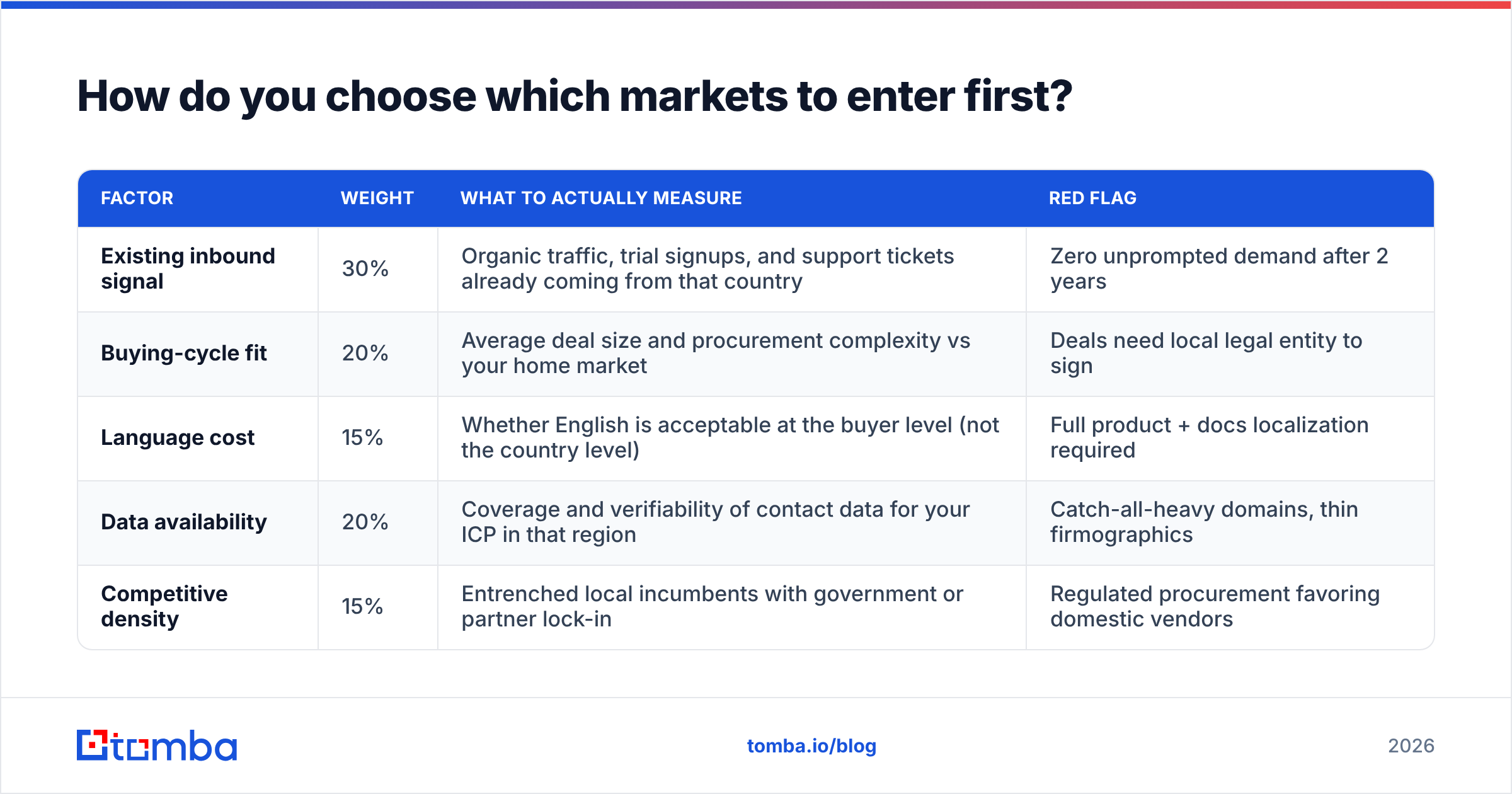
Score markets on five weighted factors rather than gut feel. The common mistake is optimizing for TAM alone, which sends everyone to Germany and Japan — the two hardest markets for a first international move.
| Factor | Weight | What to actually measure | Red flag |
|---|---|---|---|
| Existing inbound signal | 30% | Organic traffic, trial signups, and support tickets already coming from that country | Zero unprompted demand after 2 years |
| Buying-cycle fit | 20% | Average deal size and procurement complexity vs your home market | Deals need local legal entity to sign |
| Language cost | 15% | Whether English is acceptable at the buyer level (not the country level) | Full product + docs localization required |
| Data availability | 20% | Coverage and verifiability of contact data for your ICP in that region | Catch-all-heavy domains, thin firmographics |
| Competitive density | 15% | Entrenched local incumbents with government or partner lock-in | Regulated procurement favoring domestic vendors |
Run this scoring on eight to twelve candidate markets, then commit to the top two. The Netherlands, Nordics, Ireland, Australia, and Singapore consistently over-index for US and UK companies expanding: high English fluency at the buyer level, low localization cost, and clean data availability.
Germany, France, Japan, and Korea are high-value but high-friction. They demand localized product, local-language support, and usually a local hire before pipeline moves. Enter them second or third, with real budget, not as a test.

Is localization just translation?#
No — and treating it that way is the single most expensive error in global B2B marketing.
Translation converts words. Localization converts proof. A German procurement lead does not care that your homepage is in German if every logo on it is an American company they have never heard of, your pricing is in dollars, and your case studies reference sales structures that do not exist in the DACH market.
Use a three-tier model so you spend localization budget where it converts:
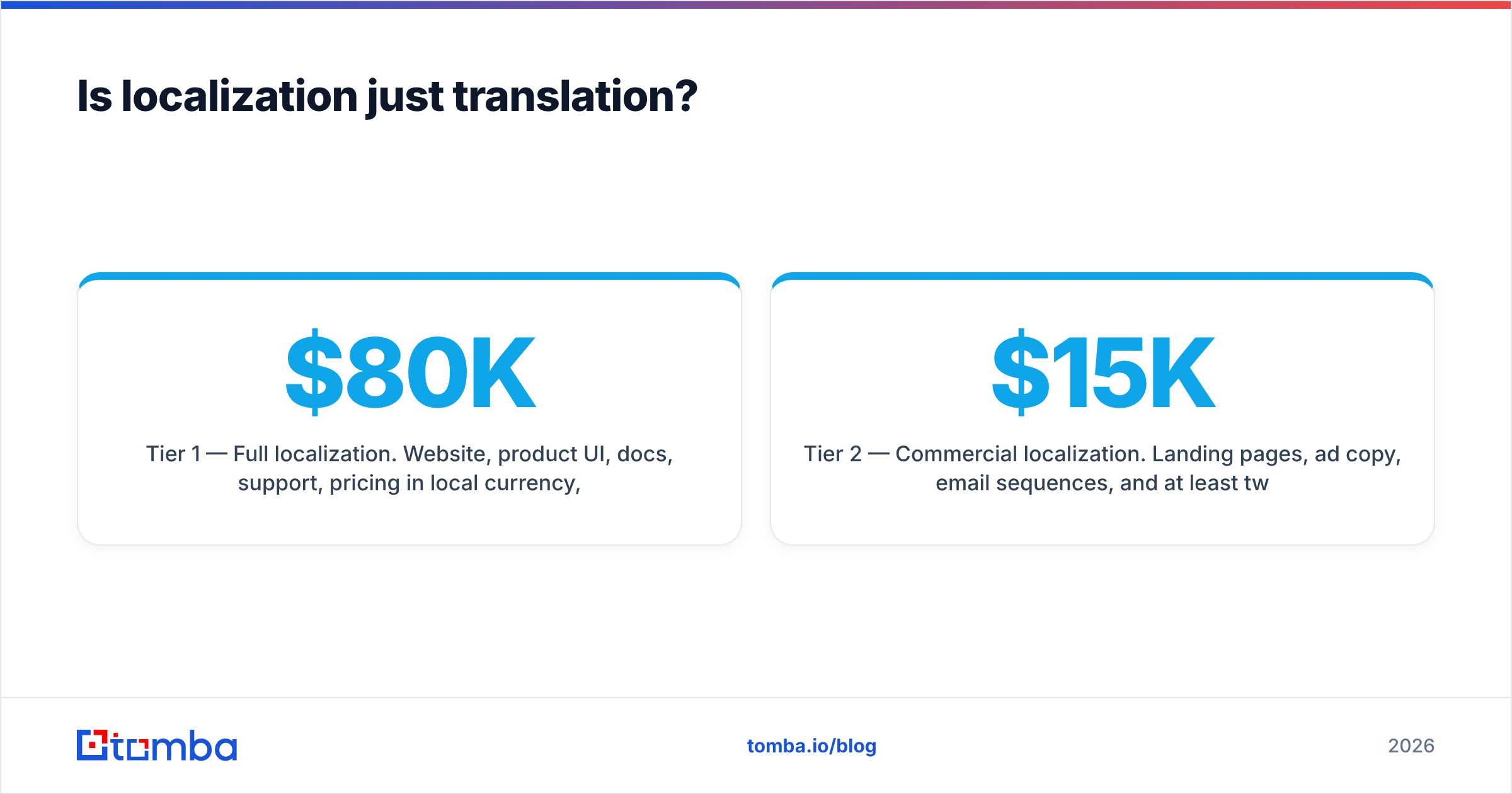
Tier 1 — Full localization. Website, product UI, docs, support, pricing in local currency, local case studies, local entity for invoicing. Reserved for markets where you are committing headcount. Expect $80K–$250K per market in year one.
Tier 2 — Commercial localization. Landing pages, ad copy, email sequences, and at least two regional case studies translated and culturally adapted. Product stays in English. Pricing shows local currency. This covers most European and LATAM entries at roughly $15K–$40K per market.
Tier 3 — Light touch. English content with local currency display, local timezone booking links, and regionally relevant social proof surfaced in the sequence. Good enough for Nordics, Netherlands, Israel, Singapore, Australia. Costs almost nothing beyond ops time.
The cultural adaptation matters more than the language. Direct benefit claims that work in US copy ("triple your pipeline in 90 days") read as untrustworthy in German and Japanese B2B contexts, where specificity and understatement build credibility. Meanwhile, Brazilian and Mexican B2B buyers respond well to relationship-forward, warmer openers that would feel unprofessional in Helsinki.
HubSpot's research on international marketing and vendor reviews on G2 are useful for benchmarking which competitors have actually localized versus which have run a translation plugin over the site.
What breaks first when you go global? (Data.)#
Your contact data. Every time.
Domestic B2B data providers are optimized for their home market. A US-centric database that shows 92% coverage of American SaaS companies routinely drops to 40–55% coverage for German Mittelstand firms or Japanese enterprises. Worse, it fails silently — you get results back, they just have a much higher bounce rate.
Four failure modes to watch:
- Coverage collapse — the provider returns fewer contacts per company outside its home region, and the ones it returns skew toward whoever has an English LinkedIn profile. That biases you toward junior, international-facing staff instead of local decision-makers.
- Format-pattern errors — email pattern inference trained on
first.last@breaks against European conventions that use initials, hyphenated surnames, or umlaut transliteration (müller→muellervsmuller). Guess wrong and you bounce. - Catch-all domains — far more common in EMEA and APAC enterprise. A catch-all accepts everything at SMTP time, so naive verification marks bad addresses as valid. You need a dedicated catch-all verifier rather than a standard syntax-plus-MX check.
- Faster decay — regional records go stale quicker, partly because of higher job mobility in some markets and partly because providers refresh non-US data less often. Re-verify quarterly, not annually.
Practical fix: separate finding from verifying, and run verification against every regional list immediately before send, not at import time. Use a domain search to map the actual email pattern in use at each target company rather than assuming a global default, then confirm each address with an email verifier before it enters a sequence.
How do compliance rules differ by region?#
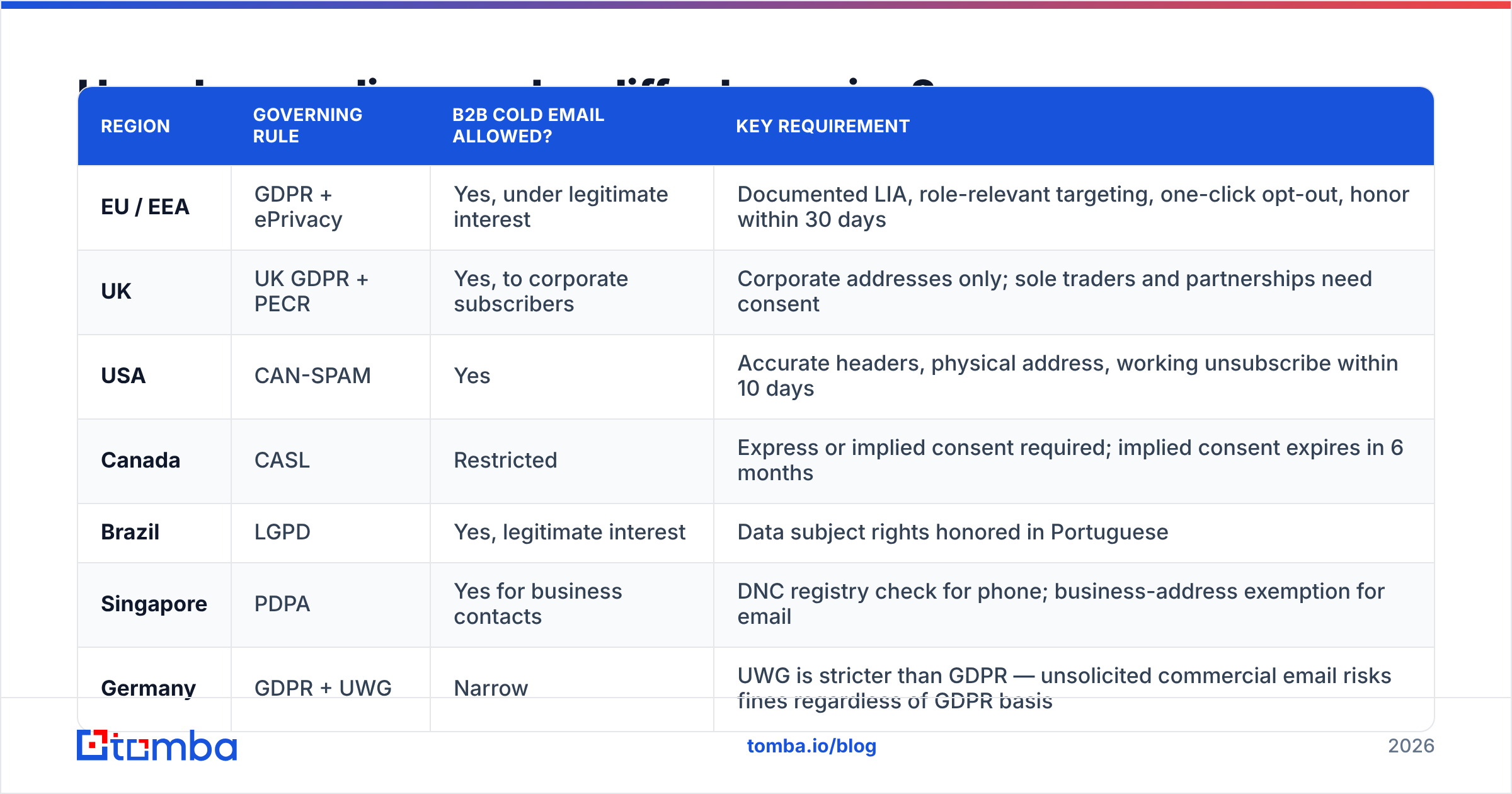
B2B outreach is legal in every major market. The legal basis differs, and that changes what you must be able to prove.
| Region | Governing rule | B2B cold email allowed? | Key requirement |
|---|---|---|---|
| EU / EEA | GDPR + ePrivacy | Yes, under legitimate interest | Documented LIA, role-relevant targeting, one-click opt-out, honor within 30 days |
| UK | UK GDPR + PECR | Yes, to corporate subscribers | Corporate addresses only; sole traders and partnerships need consent |
| USA | CAN-SPAM | Yes | Accurate headers, physical address, working unsubscribe within 10 days |
| Canada | CASL | Restricted | Express or implied consent required; implied consent expires in 6 months |
| Brazil | LGPD | Yes, legitimate interest | Data subject rights honored in Portuguese |
| Singapore | PDPA | Yes for business contacts | DNC registry check for phone; business-address exemption for email |
| Germany | GDPR + UWG | Narrow | UWG is stricter than GDPR — unsolicited commercial email risks fines regardless of GDPR basis |
Two things trip teams up repeatedly.
First, Canada is not the US. CASL is consent-based, not opt-out-based, and implied consent from a published business address expires. Running your US playbook into Canada is a genuine legal exposure, not a gray area.
Second, Germany's UWG sits on top of GDPR. You can have a defensible legitimate-interest assessment and still be non-compliant under German unfair-competition law. Most experienced DACH teams lead with LinkedIn, events, and partner referrals, then use email for follow-up on an existing conversation.
The operational takeaway: keep provenance. For every contact, store where it came from, when it was sourced, and when it was verified. Providers that publish their data sources make this dramatically easier to defend than scraped lists of unknown origin. The European Commission's GDPR portal is the primary source worth reading rather than a vendor summary.

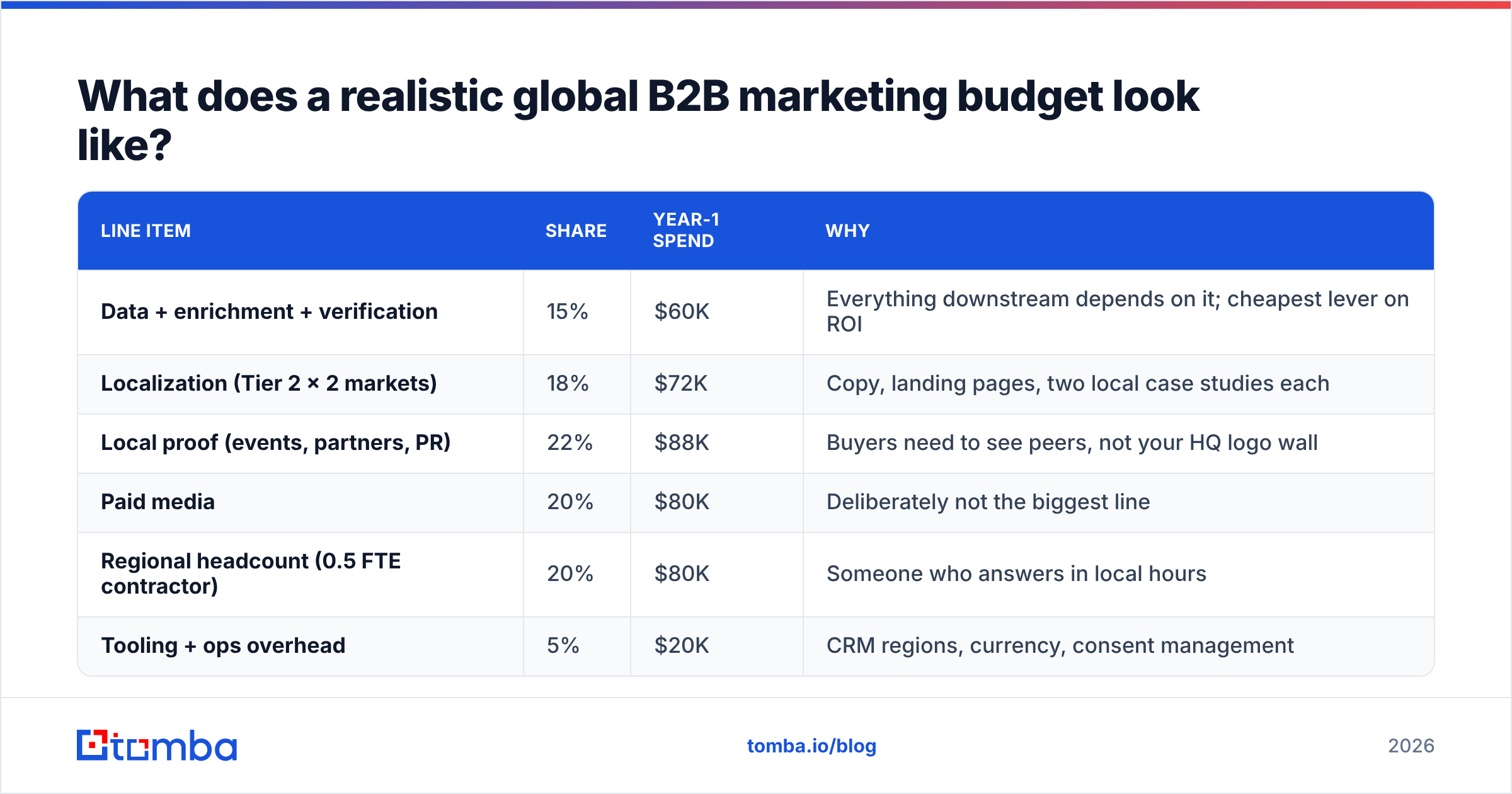
What does a realistic global B2B marketing budget look like?#
Here is the split I would defend for a company entering two new markets on roughly $400K of incremental annual budget:
| Line item | Share | Year-1 spend | Why |
|---|---|---|---|
| Data + enrichment + verification | 15% | $60K | Everything downstream depends on it; cheapest lever on ROI |
| Localization (Tier 2 × 2 markets) | 18% | $72K | Copy, landing pages, two local case studies each |
| Local proof (events, partners, PR) | 22% | $88K | Buyers need to see peers, not your HQ logo wall |
| Paid media | 20% | $80K | Deliberately not the biggest line |
| Regional headcount (0.5 FTE contractor) | 20% | $80K | Someone who answers in local hours |
| Tooling + ops overhead | 5% | $20K | CRM regions, currency, consent management |
Compare that with the default expansion budget most teams actually run: 55% paid media, 20% headcount, 15% localization, 10% everything else. That allocation assumes brand awareness you do not have. Paid in a cold market converts at a fraction of home-market rates because nobody recognizes the name in the ad.
On tooling costs specifically, the data layer is where teams overpay hardest. A full-suite sales-intelligence platform can run $1,000–$2,000 per seat annually before credit overages, while focused finder-and-verify tooling covers the same core job for far less. Tomba pricing starts at $49/mo on Starter, $99/mo on Growth, and $249/mo on Pro, with a free tier at 25 searches a month for testing regional coverage before you commit. BookYourData is a solid pay-as-you-go option when you want to buy a defined regional list outright rather than run searches, and it is worth pricing both models against your actual volume.
How do you measure global B2B marketing performance?#
Do not roll every region into one dashboard number. A blended global MQL count hides the market that is working and the market that is quietly burning $8K a month.
Track these per market, always separately:
- Time-to-first-meeting — how many days from campaign launch to first qualified conversation. The best early signal of market fit. Under 30 days is healthy; past 90 days you have a positioning problem, not a volume problem.
- Bounce rate by country — above 4% means your data layer is failing in that region, full stop. Fix data before you touch copy.
- Reply-to-meeting ratio — measures whether the replies you get are the right people. High replies with low meetings usually means you are reaching junior international staff instead of local buyers.
- Cost per qualified meeting, in local currency — currency swings of 10% will otherwise look like performance changes.
- Pipeline velocity delta vs home market — European enterprise cycles commonly run 1.4–1.8× longer than US equivalents. If you forecast on home-market velocity, you will miss every regional number for four quarters and conclude the market failed.
Set a 12-month evaluation window per market, with a 6-month checkpoint on leading indicators only. Killing a market at month four because pipeline lags is the most common self-inflicted expansion wound — you paid the setup cost and left before the return.
For deeper benchmarking on regional cycle length and buying-committee size, Gartner's B2B buying research remains the most-cited neutral source.
What does a 90-day global expansion plan look like?#
Days 1–30: Foundation. Score markets, pick two. Audit data coverage in each — pull 200 sample contacts from your ICP in that country and measure real verification pass rates before you commit budget. Set up region fields in CRM, local currency, and consent tracking. Draft your legitimate-interest assessment.
Days 31–60: Proof and pipes. Build Tier 2 localized assets. Land two regional reference customers, even at a discount — local proof is worth more than the ACV you give up. Build and verify your first 1,000-contact regional list using bulk email finder workflows, verifying immediately before send. Run a small paid test, capped, purely to learn message-market fit.
Days 61–90: Scale what replied. Double down on the channel that produced first meetings fastest. Add the regional contractor. Set the 12-month scorecard. Report per market, never blended.
Where should you start?#
Start with the data layer, because it is the cheapest thing to fix and the most expensive thing to get wrong. A localized campaign sent to a list with a 9% bounce rate does not just underperform — it damages your sending domain reputation globally, taking your home-market campaigns down with it.
Run a coverage test before you write a single line of localized copy: take 200 target accounts in your candidate market, run them through a domain search to find the real email patterns, then verify. If pass rates hold above 85%, the market is operationally viable. If they crater, you have just saved yourself a quarter of wasted spend for the cost of a test.
The Tomba Email Finder is built for exactly this kind of multi-region sourcing — pattern detection per domain, verification built into the same workflow, and a free tier of 25 searches so you can benchmark regional coverage before you pay for anything. Test your two candidate markets side by side, then spend your localization budget on the one where the data actually holds up.
Related guides#
Ready to find emails that actually work?
Join 150,000+ professionals who stopped guessing and started sending. Free credits on signup — no credit card required.
Get the Tomba newsletter
Practical outbound tactics and product updates — once every two weeks.
About the author