Global Call Forwarding Pricing 2026: Reviews, Pros and Cons
Global Call Forwarding sells international numbers by the minute, and the sticker price is only half the story. Here is what the plans actually cost, where the fees hide, and when a cheaper stack wins.
TL;DR
- Global Call Forwarding sells international virtual numbers (toll-free, local, UIFN) on a monthly-rental-plus-per-minute model. Entry plans start around $7.95/month for basic local numbers; toll-free numbers in expensive countries can run $50–$100+/month before a single call connects.
- The published number is a rental price. Inbound minutes, outbound (call-back) minutes, SMS, IVR add-ons, and country-specific regulatory fees are all separate line items.
- It is genuinely strong at one thing: getting you a working, compliant local presence number in 150+ countries fast, with real documentation requirements handled for you.
- It is a poor fit if you want a full phone system, a dialer, CRM-native calling, or unlimited-minute economics for high-volume outbound.
- The bigger cost in outbound calling is rarely the carrier. It is dialing bad numbers. Fixing contact data quality moves cost-per-conversation more than shaving $0.01/minute.
What is Global Call Forwarding and who actually buys it?#
Global Call Forwarding is a virtual number provider. You rent a phone number in a country you do not have an office in, and calls to that number get forwarded to wherever you actually pick up — a mobile, a SIP trunk, a call center queue, a softphone.
Think of it like a mail-forwarding address for voice. The number lives in Frankfurt; you answer in Austin. The caller pays a domestic rate and sees a domestic number, which is the entire point.
The company has been around since the mid-1990s (originally under United World Telecom) and sells four broad number types:
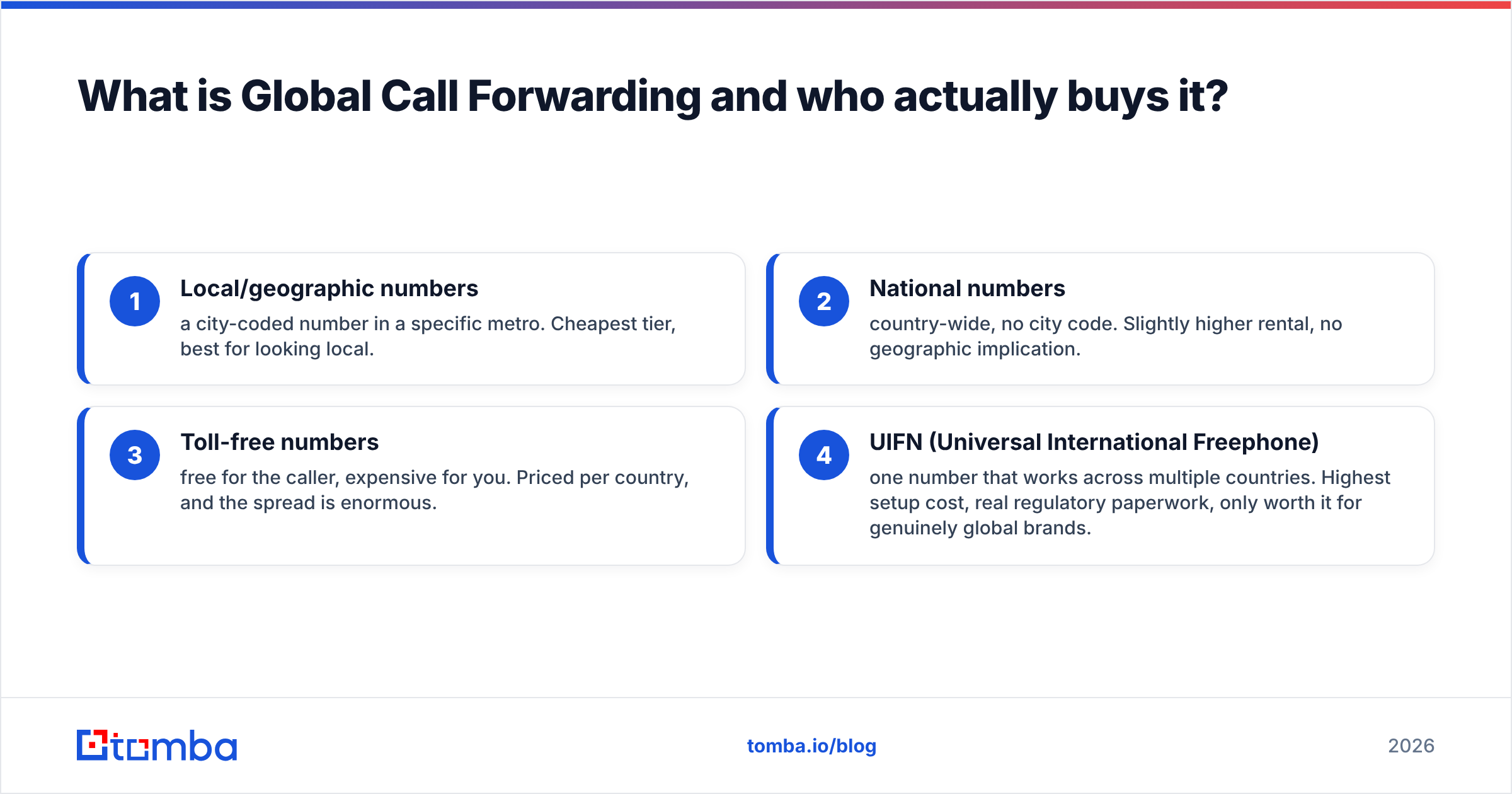
- Local/geographic numbers — a city-coded number in a specific metro. Cheapest tier, best for looking local.
- National numbers — country-wide, no city code. Slightly higher rental, no geographic implication.
- Toll-free numbers — free for the caller, expensive for you. Priced per country, and the spread is enormous.
- UIFN (Universal International Freephone) — one number that works across multiple countries. Highest setup cost, real regulatory paperwork, only worth it for genuinely global brands.
The typical buyer is one of three profiles: a support team that needs a local-looking inbound line in a market they just entered, an outbound sales team that wants a local caller ID so pickup rates do not collapse, or a company running a call-center BPO arrangement that needs numbers in a dozen countries without a dozen carrier contracts.
If you are in that third bucket, you probably already know the drill. If you are in the second — an SDR team buying local presence for outbound — read the cost section carefully, because that is where the model gets expensive fastest.

How does Global Call Forwarding pricing actually work?#
Three components, and vendors of this type rarely show all three on the same screen.
Component 1 — the monthly number rental. This is the advertised price. It varies by country and number type. A local number in a common market sits in the $7.95–$25/month range. A toll-free number in a high-cost country (parts of Latin America, Africa, and some APAC markets) can exceed $100/month on its own.
Component 2 — per-minute usage. Every forwarded minute is billed. Rates depend on the origin country, the destination you forward to, and whether the caller reached a toll-free or local number. Forwarding to a mobile costs more than forwarding to a landline or SIP endpoint. Forwarding to a SIP address is almost always the cheapest destination, and if you have any technical capacity at all, that is the setting to change first.
Component 3 — everything else. Setup fees on some number types, IVR and call-recording add-ons, SMS capability where available, outbound calling (call-back) as a separately enabled feature, and regulatory or address-verification requirements in countries that demand a local presence document.
Here is the honest shape of the pricing model against the alternatives you are probably also evaluating:
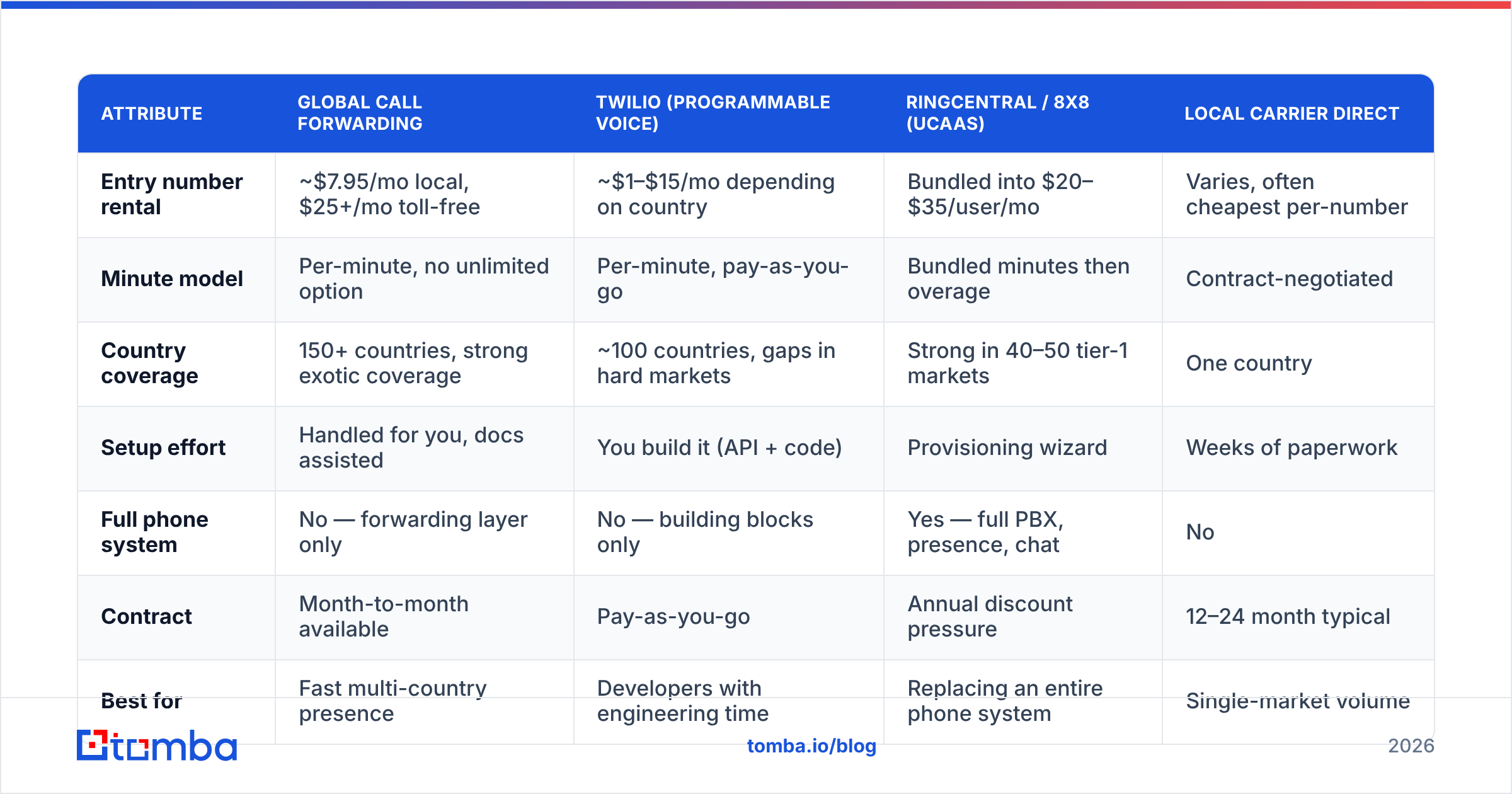
| Attribute | Global Call Forwarding | Twilio (programmable voice) | RingCentral / 8x8 (UCaaS) | Local carrier direct |
|---|---|---|---|---|
| Entry number rental | ~$7.95/mo local, $25+/mo toll-free | ~$1–$15/mo depending on country | Bundled into $20–$35/user/mo | Varies, often cheapest per-number |
| Minute model | Per-minute, no unlimited option | Per-minute, pay-as-you-go | Bundled minutes then overage | Contract-negotiated |
| Country coverage | 150+ countries, strong exotic coverage | ~100 countries, gaps in hard markets | Strong in 40–50 tier-1 markets | One country |
| Setup effort | Handled for you, docs assisted | You build it (API + code) | Provisioning wizard | Weeks of paperwork |
| Full phone system | No — forwarding layer only | No — building blocks only | Yes — full PBX, presence, chat | No |
| Contract | Month-to-month available | Pay-as-you-go | Annual discount pressure | 12–24 month typical |
| Best for | Fast multi-country presence | Developers with engineering time | Replacing an entire phone system | Single-market volume |
The pattern is clear once you lay it out. Global Call Forwarding is not competing on price per minute. It is competing on time to a working number in an awkward country, and it charges a premium for removing that friction.
What are the real pros of Global Call Forwarding?#
Coverage in markets nobody else bothers with. This is the strongest argument. If you need a number in a market where the big UCaaS vendors shrug, this is a provider that can usually deliver. Coverage breadth is a real moat and it is why the company survives against much larger competitors.
No engineering required. Twilio is cheaper per minute and infinitely more flexible, but you need a developer. Global Call Forwarding is a control panel. A revenue operations lead can provision a number, set forwarding rules, and be live in a day.
Regulatory handling. Many countries require proof of local address or business registration before issuing a number. The provider walks you through it. That is not glamorous, but it is the thing that turns a two-week project into a two-day one.
Month-to-month flexibility. No mandatory annual lock-in on standard numbers. If you are testing a market, you can turn a number on for a quarter and drop it. That flexibility has real option value when your market-entry hypothesis is unproven.
Call-forwarding intelligence that actually works. Time-of-day routing, failover to a second destination, simultaneous ring, black/white listing, and IVR are all available. These are table stakes in the US market but genuinely useful when you are stitching together a 12-country routing map.
What are the cons you should price in before buying?#
Per-minute economics punish volume. There is no unlimited tier. If your team makes thousands of connected minutes a month, the bill scales linearly and unpleasantly. Model a realistic month at your actual minute volume — not the demo volume — before you commit.
It is not a phone system. No presence, no team chat, no shared inbox, no meaningful analytics dashboard, no native CRM sync worth the name. If you want a phone platform, you want a different category of product entirely.
Add-on creep. Recording, IVR, SMS, and outbound calling each carry incremental cost. Users on review sites consistently report the effective bill running above the quoted rental. That is not a scam; it is the model. Just make sure the quote you approve is the all-in quote.
Toll-free pricing in expensive countries is brutal. A toll-free number in certain markets can cost more per month than an entire seat of a UCaaS product. If the caller-pays-nothing property is not strictly required, a local number is dramatically cheaper.
Support is business-hours-shaped. Reviews on G2 and similar directories are generally positive on responsiveness but note that complex porting and regulatory cases can stretch out. Porting an existing number is never fast anywhere, but set expectations accordingly.
No native prospecting data. Obvious, but worth stating: this is a carrier layer, not a data layer. It gives you a number to call from, not numbers to call to.
Is Global Call Forwarding worth it for outbound sales teams?#
Conditionally yes — and the condition is narrower than the marketing suggests.
The argument for local presence dialing is real. Prospects answer local numbers at meaningfully higher rates than unknown international ones. If you are calling into Germany from a US number, your connect rate is going to be miserable regardless of how good your pitch is.
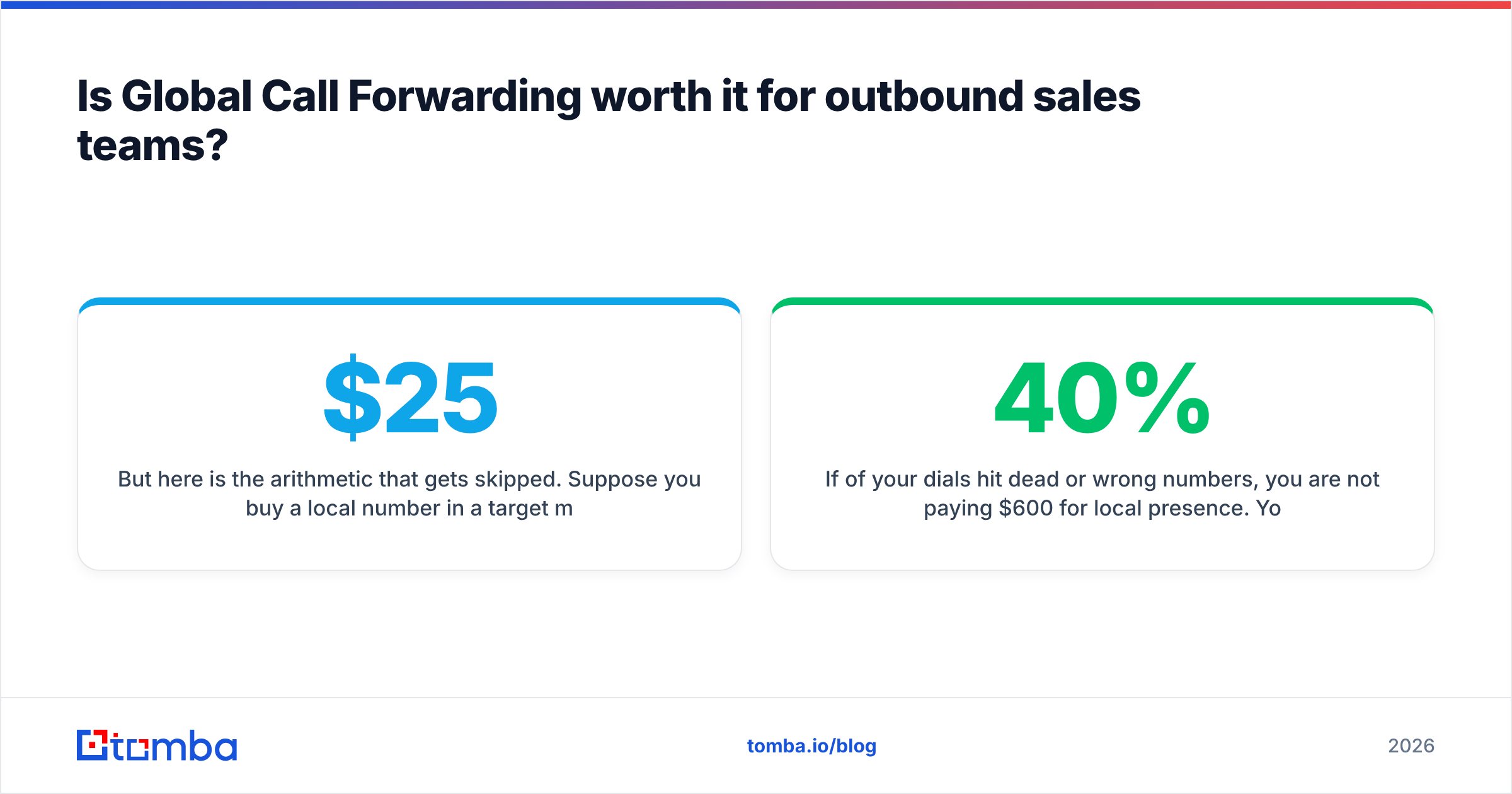
But here is the arithmetic that gets skipped. Suppose you buy a $25/month local number in a target market and burn 800 minutes at roughly $0.06–$0.12 per minute. Call it $70–$120/month all-in for one market. Multiply by six markets and you are at $600/month for the privilege of dialing.
Now ask: what percentage of the numbers your reps are dialing are actually correct, current, and attached to a person who still works there? In most B2B databases, mobile and direct-dial accuracy degrades fast — people change jobs, companies churn phone systems, and scraped numbers rot within months.
If 40% of your dials hit dead or wrong numbers, you are not paying $600/month for local presence. You are paying $600/month and wasting 40% of your reps' calling hours. The carrier bill is the small line item. The wasted rep hours are the big one.
That is the reframe worth taking away: optimize contact data quality first, carrier cost second. Running dial lists through a phone validator before a campaign, and enriching thin records with a phone finder that returns verified B2B direct dials, has a larger effect on cost-per-conversation than any per-minute negotiation you will ever win.
How does the total cost compare against a data-first stack?#
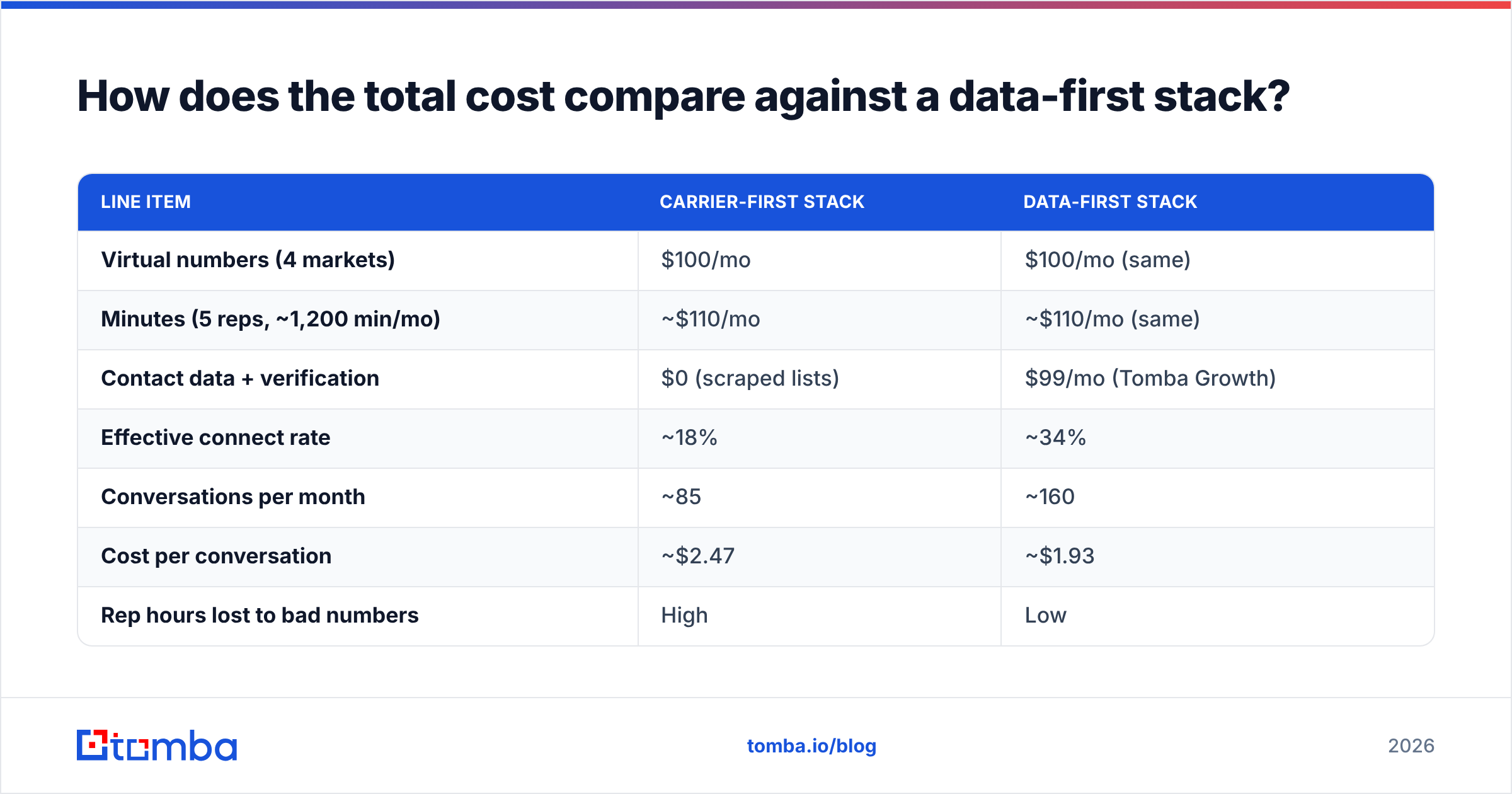
Let us build two hypothetical stacks for a five-rep team selling into four European markets, and compare where the money goes.
| Line item | Carrier-first stack | Data-first stack |
|---|---|---|
| Virtual numbers (4 markets) | $100/mo | $100/mo (same) |
| Minutes (5 reps, ~1,200 min/mo) | ~$110/mo | ~$110/mo (same) |
| Contact data + verification | $0 (scraped lists) | $99/mo (Tomba Growth) |
| Effective connect rate | ~18% | ~34% |
| Conversations per month | ~85 | ~160 |
| Cost per conversation | ~$2.47 | ~$1.93 |
| Rep hours lost to bad numbers | High | Low |
The numbers are illustrative, but the direction is not controversial. Doubling the share of dials that reach a real, current human is worth far more than a 15% discount on minutes. This is the same logic that drives email teams to verify before sending rather than negotiating harder with their ESP.
The other half of the equation is that phone should rarely be the only channel. Multi-threading a prospect across email and phone consistently outperforms either alone, and pairing a validated direct dial with a verified work email means you can sequence properly instead of hammering one channel. Running your target accounts through a domain search to map the full buying committee, then verifying each address, gives you the second channel at a fraction of per-minute cost.
What are the best alternatives to Global Call Forwarding?#
Twilio — if you have engineering capacity, Twilio is cheaper per minute and endlessly programmable. You are trading money for developer time. For teams with a technical resource, this is usually the better economics.
RingCentral / 8x8 / Dialpad — if you want a real phone system with numbers included, go UCaaS. Per-seat pricing bundles minutes and gives you the analytics, recording, and CRM integrations that a forwarding layer will never have.
Aircall / JustCall — sales-native calling platforms with local numbers in 40–100 countries plus power-dialer features and CRM sync. Fewer exotic countries, far better sales workflow.
Local carrier direct — if 90% of your volume is one country, negotiating with a domestic carrier will beat any aggregator on price. It costs you setup time and a contract.
Keep Global Call Forwarding — when you need numbers in genuinely hard markets, need them this week, and do not want to explain SIP trunking to anyone. That combination is a real use case and no amount of spreadsheet math makes it go away.
How should you decide? A five-step evaluation#
- Count your actual minutes. Pull last quarter's connected-minute volume per market. Per-minute providers look cheap at low volume and expensive at high volume. Find your break-even against a bundled-minute seat price.
- Separate presence from platform. If you only need a local caller ID, a forwarding provider is right-sized. If you need queues, recording, coaching, and reporting, you need a platform and should not buy both.
- Demand the all-in quote. Rental plus estimated minutes plus every add-on you will realistically enable. Compare all-in against all-in, never sticker against sticker.
- Audit your dial list before you audit your carrier. Sample 200 numbers from your current list and check how many are valid and current. If the answer is under 70%, fix data before you optimize telephony spend.
- Plan the exit. Check portability terms on day one. Numbers you cannot port are numbers you cannot leave, and that asymmetry is where renewals get expensive.
Frequently asked questions#
Does Global Call Forwarding have a free trial? There is generally a trial or money-back window on standard numbers, but terms vary by country and number type. Confirm in writing before provisioning anything with a setup fee.
Can you send and receive SMS? On some numbers in some countries. SMS capability is not universal across virtual numbers, and toll-free SMS in particular is restricted in many markets. Verify per-number, not per-plan.
Is it good for outbound dialing? It supports outbound as an added capability, but it is not a dialer. If outbound volume is your primary use case, a sales-native calling platform will serve you better.
How does it compare to buying a number from a local carrier? Local carriers usually win on price and lose on speed and paperwork. Aggregators charge a convenience premium. Whether that premium is worth it depends entirely on how many countries you need and how fast.
Where should you spend the next dollar?#
The verdict: Global Call Forwarding is a well-run, narrowly-scoped tool that solves the "I need a working number in a difficult country, quickly" problem better than almost anyone. Pay the premium when that is your problem. Do not pay it when your problem is actually a phone system, a dialer, or high-volume domestic minutes — those are cheaper elsewhere.
And if you are buying international numbers to power outbound sales, the highest-leverage dollar is not the one you spend on telephony. It is the one you spend making sure the contacts on the other end of the line are real. Dead numbers and bounced emails cost you rep hours, which cost far more than minutes ever will.
Start by fixing the list. Use the Tomba Email Finder to build verified, current contact records for your target accounts — work emails, direct dials, and enrichment data in one pass — so every call and every follow-up email lands somewhere that actually exists. The free tier gives you 25 searches a month to test accuracy on your own accounts; paid plans start at $49/month, with full Tomba pricing laid out per credit tier. Get the data right, then argue about minutes.
Related guides#
Ready to find emails that actually work?
Join 150,000+ professionals who stopped guessing and started sending. Free credits on signup — no credit card required.
Get the Tomba newsletter
Practical outbound tactics and product updates — once every two weeks.
About the author