Global Database vs Warpleads: Which B2B Data Tool Wins in 2026?
Global Database sells deep firmographic intelligence. Warpleads sells unlimited export volume. They solve opposite problems — and picking wrong costs you a year of bad pipeline. Here's the honest breakdown.
TL;DR
- Global Database is a firmographic intelligence platform — company financials, filings, credit data, and org structure across roughly 30M+ companies. You buy it for research depth, not for raw email volume.
- Warpleads is an export-volume play — unlimited-export B2B lead lists at a flat monthly rate, built for teams that burn thousands of contacts a month in cold email sequences.
- They are not really competitors. One answers "who is this company and should we sell to them?", the other answers "give me 20,000 rows by Friday."
- Neither is a strong email verification layer. Both need a dedicated verifier in front of your sending tool or you will eat bounce rates in the 15–35% range on stale rows.
- Best practical stack for most SMB and mid-market outbound teams: a volume or intelligence source for discovery, plus a purpose-built email finder and email verifier for the contact layer.
If you searched global database vs warpleads, you probably landed on both in the same week and could not tell why their pricing pages look nothing alike. That is because they are built on different assumptions about what "B2B data" means. This breakdown covers what each one actually stores, how they price, where the accuracy falls apart, and which one belongs in your stack.
What is Global Database and who is it for?#
Global Database is a company-intelligence provider. Its core asset is structured firmographic and financial data: registered company records, filed accounts, credit scores, shareholder and director structures, industry codes, employee bands, and technology signals. Contact records exist, but they sit on top of the company record rather than being the product itself.
The people who get real value from it tend to be:
- Enterprise sales and RevOps teams running account-based motions where you must justify why an account is in-territory before a rep touches it.
- Credit, risk, and procurement teams that need filed financials and company-health signals — a use case almost no email-finder tool serves.
- Market researchers and analysts sizing a segment across multiple countries, where registry coverage in the UK and EU matters more than US contact density.
- Compliance-sensitive orgs that want documented data provenance for GDPR reviews.
The trade-off is speed and cost. Global Database is a considered purchase with annual contracts and sales-assisted onboarding in most cases. You are not signing up on a Tuesday afternoon and exporting a list by lunch.
What is Warpleads and what problem does it solve?#
Warpleads attacks the opposite end. Its pitch is unlimited exports: pay a flat monthly fee, filter a large B2B contact database, and pull as many rows as you want without per-credit metering. It also markets on-demand enrichment and integrations aimed at cold-email tooling like Instantly and Smartlead.
That model exists because credit-based pricing punishes high-volume senders. If you send 30,000 emails a month, a tool charging per export credit becomes the largest line item in your outbound budget. Warpleads removes the meter and, in exchange, gives you a dataset that is broad rather than deep — job title, company, email, sometimes phone, and standard firmographic filters.
The honest caveat: unlimited export volume and high data freshness rarely coexist. When you can pull 50,000 rows for a fixed fee, some of those rows will be 18 months old. That is a math problem, not a marketing complaint — you handle it downstream with verification, not by hoping the source is perfect.
How do Global Database and Warpleads compare head to head?#
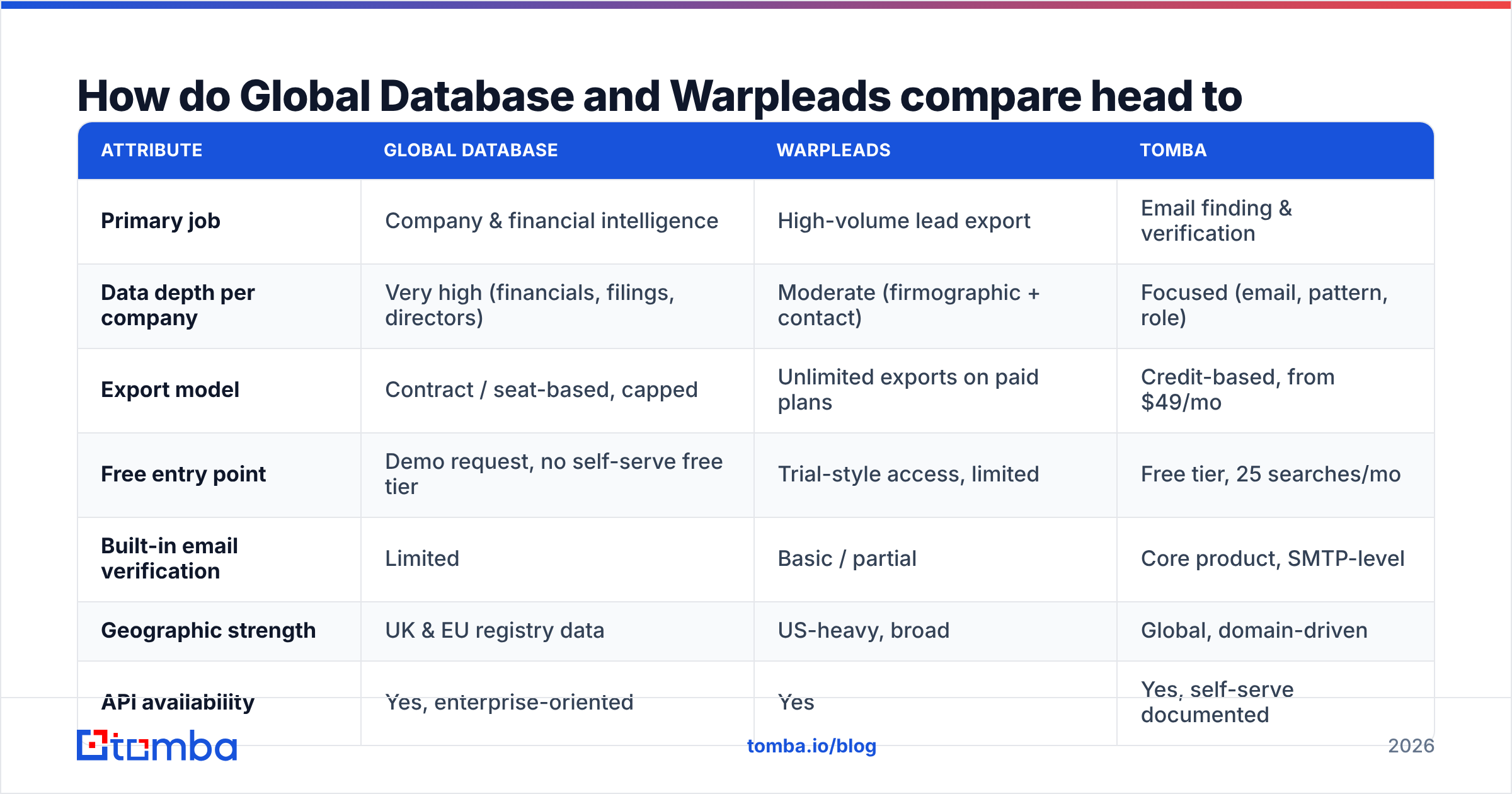
| Attribute | Global Database | Warpleads | Tomba |
|---|---|---|---|
| Primary job | Company & financial intelligence | High-volume lead export | Email finding & verification |
| Data depth per company | Very high (financials, filings, directors) | Moderate (firmographic + contact) | Focused (email, pattern, role) |
| Export model | Contract / seat-based, capped | Unlimited exports on paid plans | Credit-based, from $49/mo |
| Free entry point | Demo request, no self-serve free tier | Trial-style access, limited | Free tier, 25 searches/mo |
| Built-in email verification | Limited | Basic / partial | Core product, SMTP-level |
| Geographic strength | UK & EU registry data | US-heavy, broad | Global, domain-driven |
| API availability | Yes, enterprise-oriented | Yes | Yes, self-serve documented |
| Best for | ABM, risk, market research | Cold-email volume teams | Accurate contact layer |
| Time to first list | Days (sales cycle) | Same day | Minutes |
| Typical entry price | Custom, four figures annually | Flat monthly, mid three figures | $49/mo Starter |
Read that table by column, not by row. Global Database wins depth. Warpleads wins throughput per dollar. Neither wins the contact-accuracy column, which is where most outbound programs actually break.
Which one has better data accuracy?#
Accuracy means different things for each tool, and conflating them is the most common mistake buyers make.
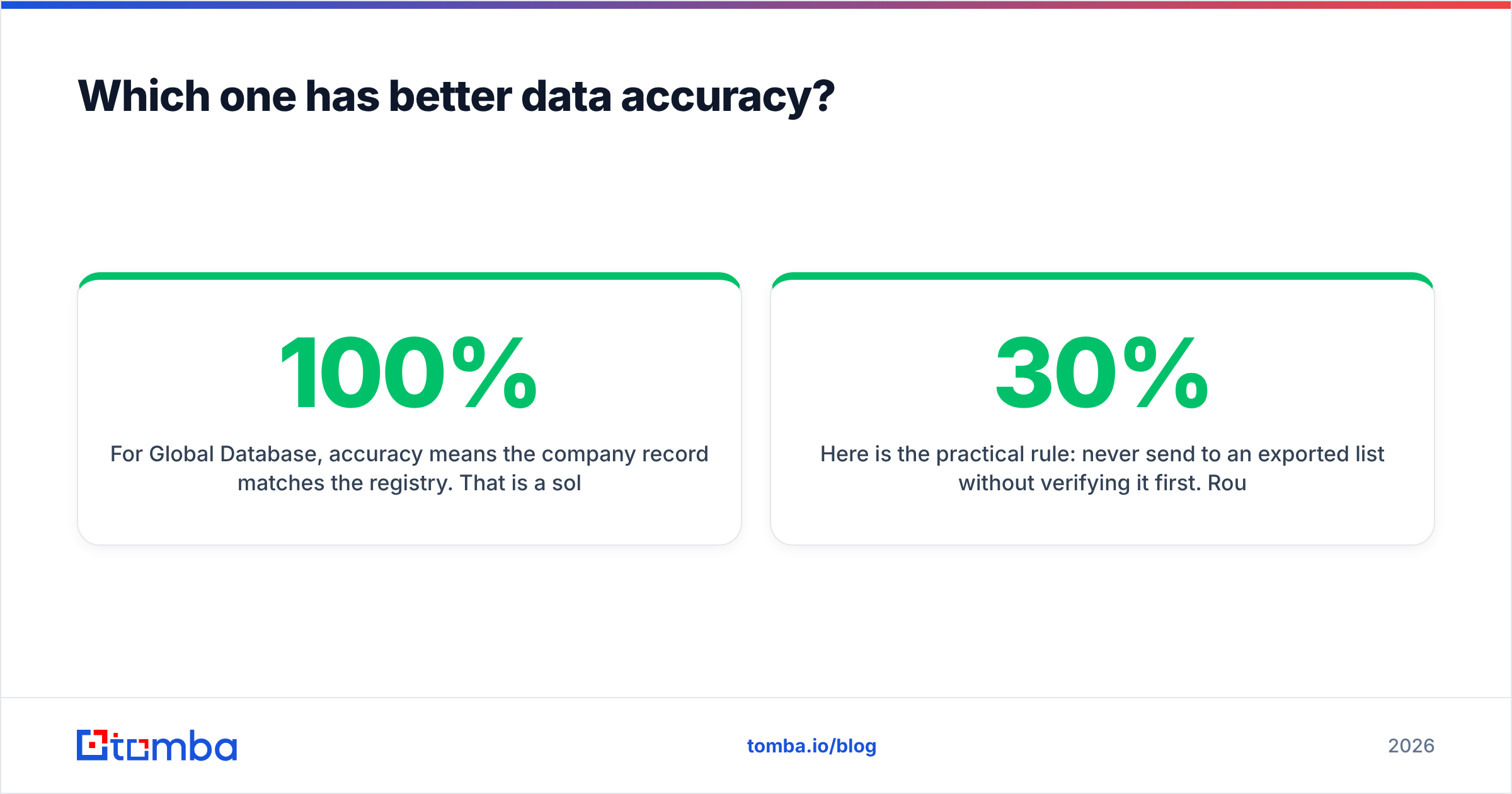
For Global Database, accuracy means the company record matches the registry. That is a solvable problem — official filings are the source of truth, and a provider that ingests Companies House or equivalent registries can be genuinely close to 100% on financials and directors. Where it degrades is contact-level data: a CFO listed in a 2024 filing may have left in 2025, and registry data does not track email addresses.
For Warpleads, accuracy means the email deliverability of exported rows. Unlimited-export databases are typically assembled from crawled, contributed, and licensed sources. Freshness varies by segment — tech and SaaS contacts churn fast, while manufacturing and logistics rows age more slowly. Expect meaningful decay on any row older than a year.
Here is the practical rule: never send to an exported list without verifying it first. Roughly 22–30% of B2B contact data decays annually according to widely cited industry benchmarks, and Google and Yahoo's bulk-sender requirements now enforce a spam-complaint rate below 0.3%, which a dirty list will blow past in one send. Google's own sender guidelines spell out the thresholds.
That is why a verification layer is non-negotiable regardless of which source you buy. Running exports through a catch-all verifier before import catches the rows that generic checkers mark as "unknown" and let through.
How does pricing actually compare?#
Pricing philosophy diverges more than the price tags.
Global Database uses enterprise contracting: annual commitment, seat count, module selection (financials, credit reports, contacts), and geography. There is no meaningful self-serve tier. Budget accordingly — this is a line item you defend in a procurement meeting, and the ROI case usually rests on risk avoidance or account prioritization rather than on cost-per-lead.
Warpleads uses flat-rate SaaS pricing with unlimited exports on paid tiers. Your effective cost-per-contact drops as volume rises, which is genuinely compelling if you run a large sending operation across many mailboxes. If you only need 500 contacts a month, the flat fee is poor value and a credit-based tool is cheaper.
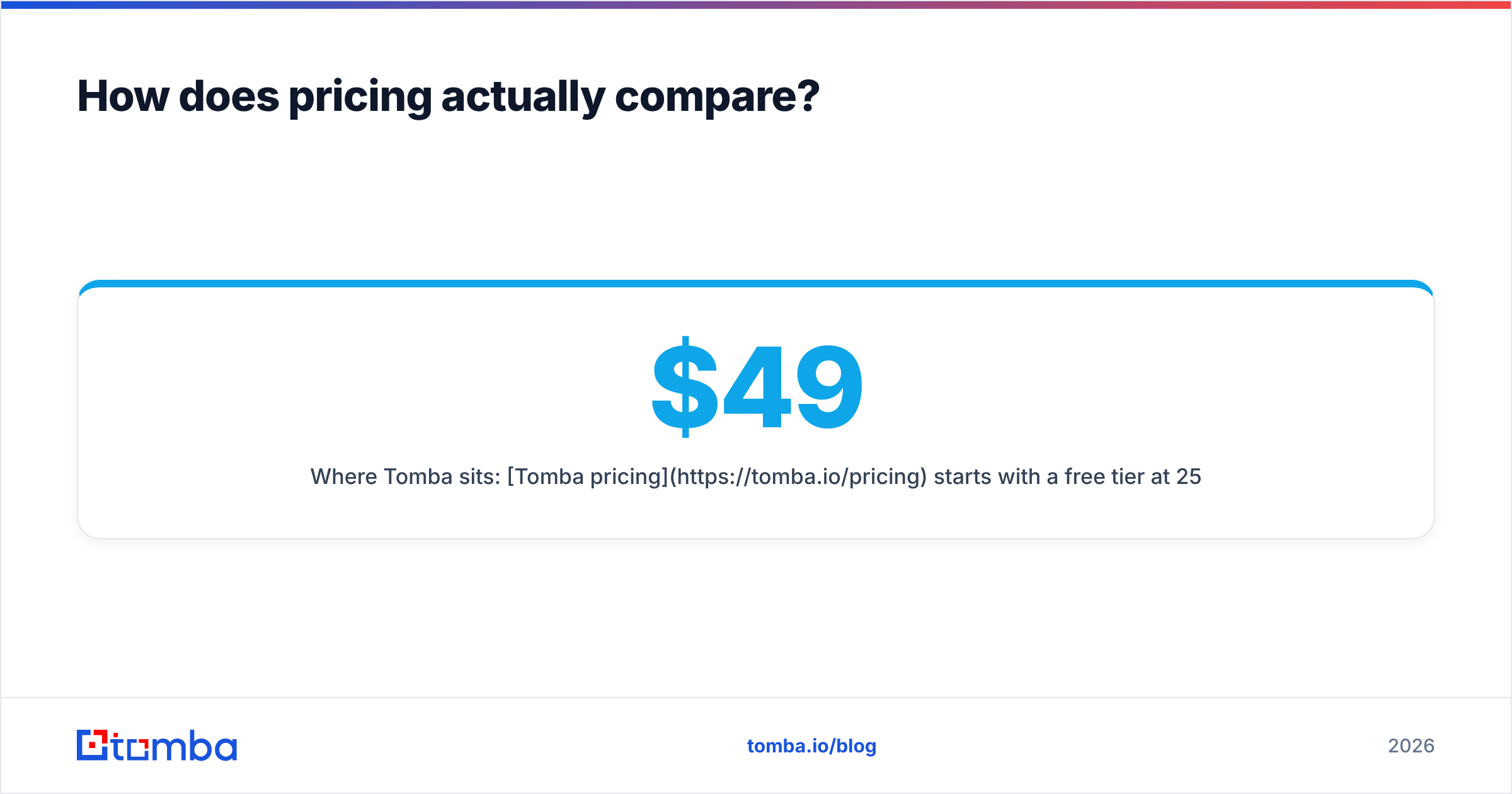
Where Tomba sits: Tomba pricing starts with a free tier at 25 searches per month, then Starter at $49/mo, Growth at $99/mo, Pro at $249/mo, and custom Enterprise. That is a different unit of value again — you are paying for verified contact discovery, not for a database subscription or an export firehose.
A rough decision frame:
- Under 1,000 contacts/month, precision matters — credit-based finder plus verifier. Cheapest correct answer.
- 5,000+ contacts/month, volume matters — flat-rate export tool, then verify everything before it touches a sequence.
- Account research drives the motion — intelligence platform for targeting, finder tool for the actual email addresses.
- Regulated or risk-adjacent selling — intelligence platform is close to mandatory; the contact tool is the add-on.
- Mixed motion — most teams end up with two tools, and that is fine as long as you know which one owns which job.
Do you actually have to choose between them?#
No, and framing it as either/or is why teams overspend.
The realistic architecture for a mid-market outbound team has three separable layers:
- Targeting layer — decide which accounts deserve attention. Global Database is strong here. So are ABM platforms and intent vendors. Warpleads is weaker here because its filters are shallower.
- Contact layer — get the right person's email and phone at those accounts. This is where a dedicated domain search or finder tool beats a general database, because it queries live signals per domain rather than serving a cached row.
- Hygiene layer — verify, dedupe, suppress. Non-optional. A bulk email finder workflow that finds and verifies in the same pass removes a manual export-import cycle.
Teams that buy one tool and expect it to cover all three end up with either great targeting and undeliverable emails, or huge volume and a burned sending domain. Both failure modes are expensive; the second is worse because domain reputation takes months to repair.

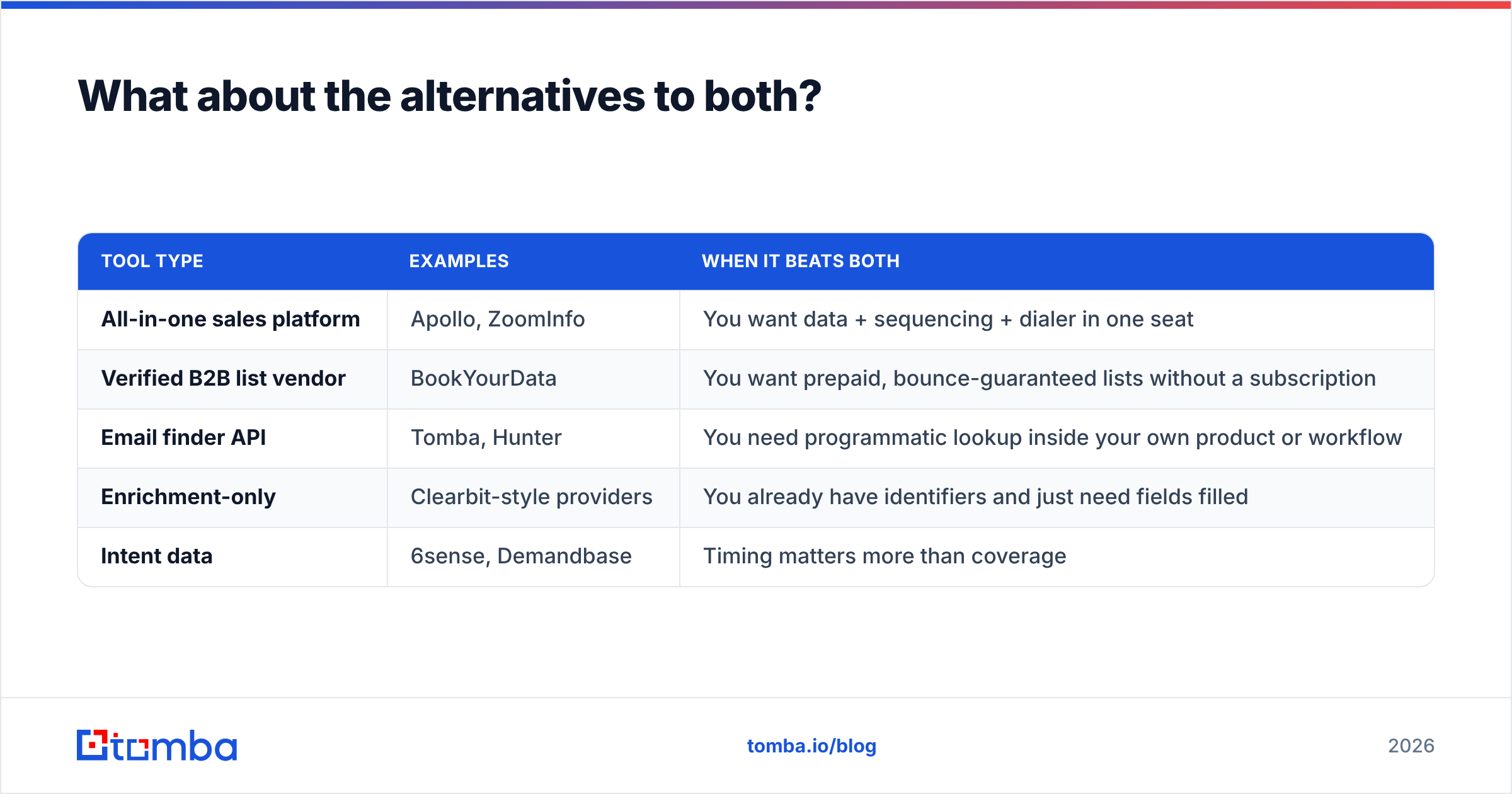
What about the alternatives to both?#
Worth knowing the wider field before committing budget:
| Tool type | Examples | When it beats both |
|---|---|---|
| All-in-one sales platform | Apollo, ZoomInfo | You want data + sequencing + dialer in one seat |
| Verified B2B list vendor | BookYourData | You want prepaid, bounce-guaranteed lists without a subscription |
| Email finder API | Tomba, Hunter | You need programmatic lookup inside your own product or workflow |
| Enrichment-only | Clearbit-style providers | You already have identifiers and just need fields filled |
| Intent data | 6sense, Demandbase | Timing matters more than coverage |
BookYourData deserves a specific mention in this comparison because it occupies a genuinely useful middle position: pay-as-you-go verified contact lists with a bounce guarantee, which suits teams that dislike both annual contracts and unlimited-export uncertainty. If your objection to Global Database is the contract and your objection to Warpleads is data freshness, that model resolves both.
For teams evaluating platform consolidation, our Apollo alternative breakdown covers the all-in-one trade-off in detail — mainly that bundled data quality tends to trail specialist tools, but the workflow savings are real.
How should you run a fair test before buying?#
Do not trust any vendor's accuracy claim, including ours. Run this in an afternoon:
- Build a 100-row control set from accounts you already sell to, where you know the correct contact and email. Mix industries and company sizes.
- Run the same set through each tool. Record match rate (did it return anything?) and accuracy rate (was it correct?). These are different numbers and vendors love to quote the first.
- Verify every returned email with an independent checker so you are not grading a tool with its own homework. A free email checker works for spot checks.
- Send a small warm-up batch — 50 addresses from each source, from a throwaway-but-warmed domain. Measure hard bounces at 48 hours.
- Calculate true cost per usable contact: total monthly fee ÷ (rows returned × verified-valid rate). A tool with unlimited exports and a 60% valid rate can easily cost more per usable contact than a metered tool at 95%.
Step 5 is the one nearly everyone skips, and it flips the answer more often than not. Unlimited is only cheap if the rows work.
What is the verdict for 2026?#
Pick Global Database if your bottleneck is knowing which accounts to pursue, you sell into the UK and EU, or you need financial and risk data that contact tools simply do not carry. Accept the contract and the sales cycle as the price of depth.
Pick Warpleads if your bottleneck is list volume, you already have a validated ICP, and you run multi-mailbox cold email at scale where per-credit pricing would be punishing. Budget for verification on top — treat it as part of the tool's real cost.
Pick neither as your contact source if your priority is deliverability. Both are discovery tools. The email addresses that land in inboxes come from a system that checks them at the moment you ask, not from a row cached six months ago.
Most teams land on a two-tool stack: one source for discovery, one specialist for the contact layer. That is not indecision — it is how the category actually works in 2026, because no single vendor is simultaneously the deepest, the cheapest per row, and the most accurate.
Ready to fix the layer that actually breaks? Discovery tools give you companies; you still need the right person's address to reach an inbox. Tomba Email Finder returns verified professional emails by name, domain, or company, with SMTP-level checks built in — free tier at 25 searches per month, Starter at $49/mo, and an email finder API when you're ready to wire it into your own workflow. Test it against whichever database you pick and compare the verified-valid rate yourself.
Related guides#
Ready to find emails that actually work?
Join 150,000+ professionals who stopped guessing and started sending. Free credits on signup — no credit card required.
Get the Tomba newsletter
Practical outbound tactics and product updates — once every two weeks.
About the author