Go For Close: When to Ask for the Deal in B2B Sales
Most reps ask for the close too late, not too early. Here's a signal-based framework for deciding when to go for close, which closing techniques still work in 2026, and how to avoid the pressure tactics buyers now punish.
TL;DR
- "Go for close" means making an explicit, direct ask for the buying decision — not hinting, not "circling back," not sending one more deck.
- The most expensive closing mistake is not asking too early. It's asking too late, after the deal has quietly died in a Slack thread you were never in.
- Close-readiness is measurable: budget confirmed, decision process mapped, economic buyer engaged, a compelling event dated, and mutual next steps agreed. Three or fewer of those and you're guessing.
- The techniques that still work in 2026 are summary, alternative, and next-step closes. The ones that get you ghosted are urgency theater, artificial discounts, and the "puppy dog" trial that never ends.
- Closing rate is a downstream metric. Bad contact data and unqualified pipeline cap your win rate before the demo ever happens.
What Does "Go For Close" Actually Mean?#
Going for the close means you stop describing value and start requesting a decision. That's it. It's the moment you say "Do you want to move forward?" instead of "Let me know if you have questions."
Think of it like a waiter at a busy restaurant. The bad waiter hovers, refills your water, asks how everything is, and never brings the check — so you sit there for 40 minutes past the point you wanted to leave. The good waiter reads that you've pushed your plate away and puts the bill on the table. Neither is pushy. One reads the signal; one doesn't.
In B2B, "the check" is a specific, binary ask. Some versions that qualify:
- The direct ask — "Based on everything we've covered, are you ready to move forward with the Growth plan?"
- The alternative close — "Do you want to start with a 20-seat pilot, or roll out to the full 60-seat team from day one?"
- The summary close — restate the three problems they named, the impact number they gave you, then ask for the signature.
- The next-step close — "I'll send the order form today. Can you and Priya review it before Thursday's steering call?"
- The negative-reverse close — "It sounds like this isn't a priority this quarter. Should we pick this up in Q1 instead?"
What does not count as going for the close: "Let me know your thoughts," "Just checking in," "Happy to answer any questions," or a calendar invite titled "Next Steps" with no agenda. Those are hope, not asks.
When Should You Go For The Close?#
When five conditions are true — not when your quarter ends.
Ending your quarter is your problem, not the buyer's. The reason "end of quarter" pressure works so poorly in 2026 is that procurement teams have been trained on it. Every enterprise buyer knows a discount appears on the 28th of the last month. Manufacturing urgency around your fiscal calendar is a tell that you have no leverage.
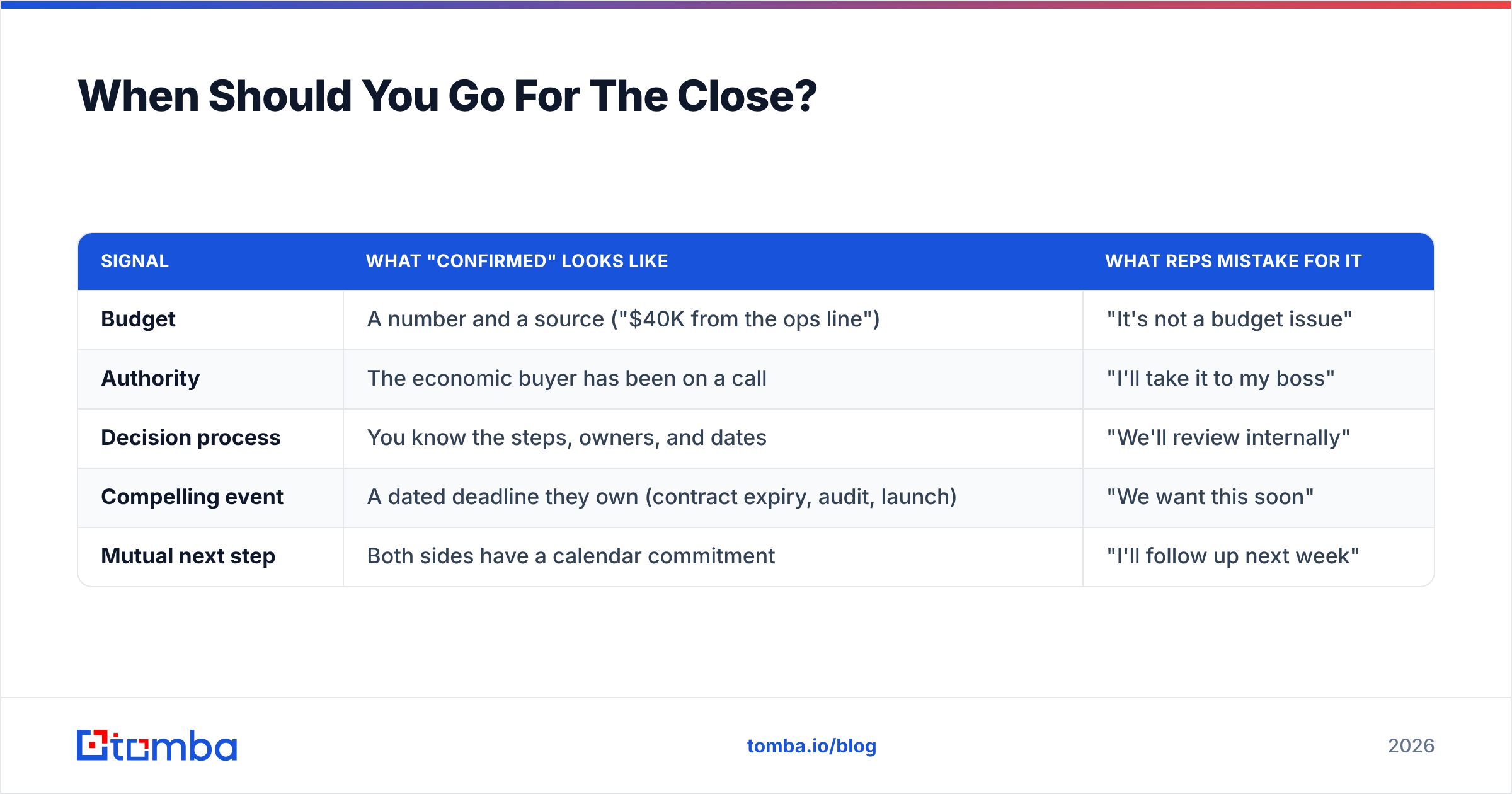
Here's the readiness checklist. Score one point each:
| Signal | What "confirmed" looks like | What reps mistake for it |
|---|---|---|
| Budget | A number and a source ("$40K from the ops line") | "It's not a budget issue" |
| Authority | The economic buyer has been on a call | "I'll take it to my boss" |
| Decision process | You know the steps, owners, and dates | "We'll review internally" |
| Compelling event | A dated deadline they own (contract expiry, audit, launch) | "We want this soon" |
| Mutual next step | Both sides have a calendar commitment | "I'll follow up next week" |
Score 4-5 and you should have gone for the close already. Score 3 and you close on the next step, not the contract. Score 0-2 and closing is malpractice — you'd be asking someone to marry you after two coffees.
The counterintuitive part: asking early is cheap. A premature ask that gets a "no, because X" hands you the objection for free. A late ask gets you silence, and silence has no diagnostic value at all. Gartner's B2B buying research has repeatedly found that buyers spend the majority of their journey without a supplier in the room. Every week you don't ask is a week they're deciding without you.
What Buying Signals Tell You It's Time?#
Verbal signals are the weakest ones. Buyers are polite. "This looks great" costs them nothing.
Rank the signals by how much effort the buyer had to spend to send them:
- Highest value (costly signals): They loop in legal or security unprompted. They ask for a redlined MSA. They forward your pricing to a name you haven't met. They ask about implementation timelines in specific weeks. They ask what happens if they cancel.
- Medium value: They ask about integrations with tools they actually run. They request a second demo with a different team. They ask for a reference customer in their vertical.
- Low value (cheap signals): "Send me a proposal." "Love the product." "Let me socialize this internally." A thumbs-up emoji.
The pattern: anything that costs the buyer internal political capital is real. Anything that costs them ten seconds is noise. When you see two or more costly signals in a single week, that's your window — go for the close in that same conversation, not in a follow-up email three days later.
Watch the negative signals too. Slower reply times, a champion who stops using "we" and starts using "they," and meetings that get rescheduled twice all mean the deal has lost internal sponsorship. That's not a reason to wait. It's a reason to ask a hard question: "Has something changed on your side about the priority of this?"
Which Closing Techniques Still Work In 2026?#
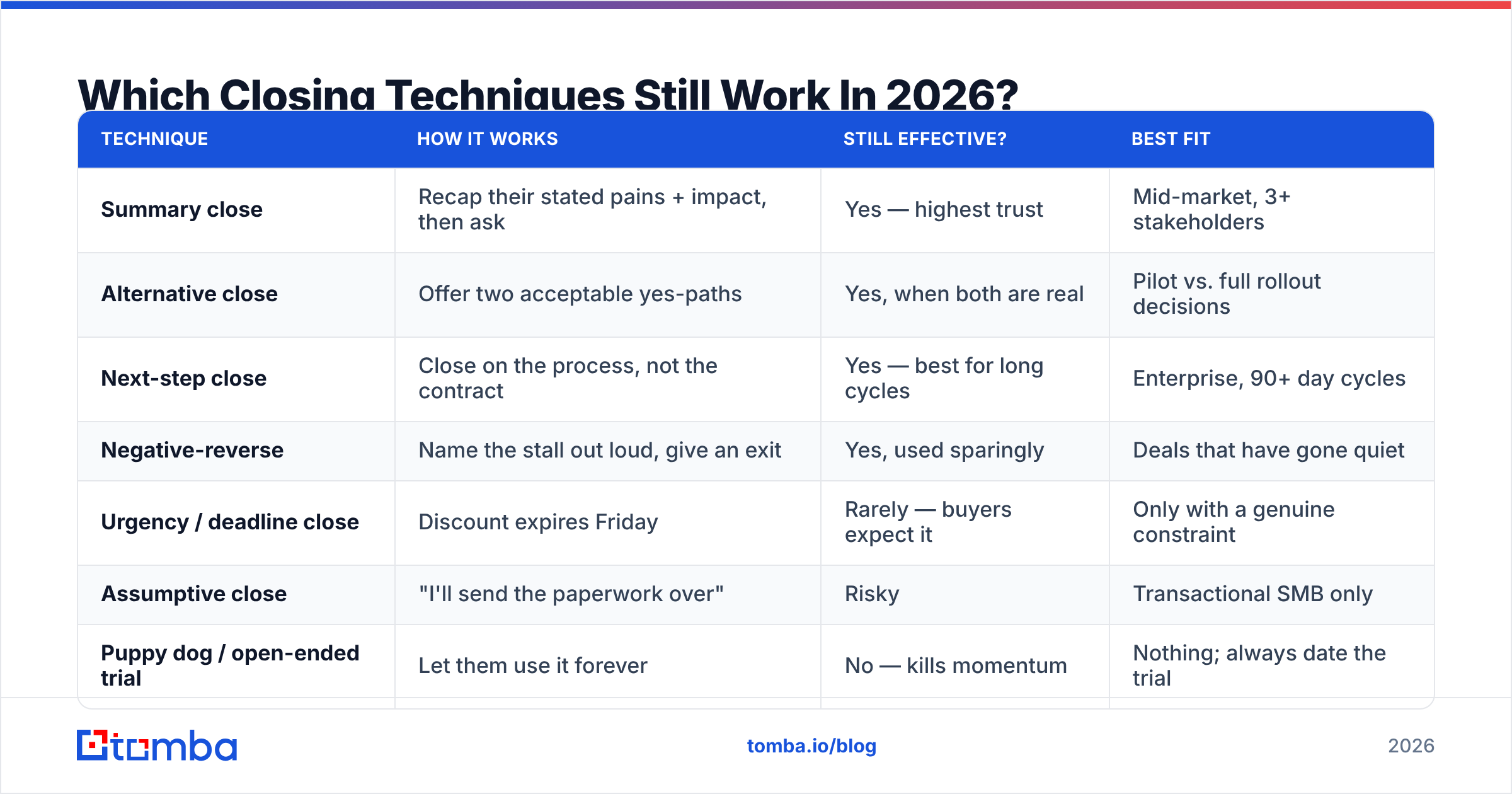
The classic list is mostly a museum. Here's what survives contact with a modern buying committee, and what doesn't.
| Technique | How it works | Still effective? | Best fit |
|---|---|---|---|
| Summary close | Recap their stated pains + impact, then ask | Yes — highest trust | Mid-market, 3+ stakeholders |
| Alternative close | Offer two acceptable yes-paths | Yes, when both are real | Pilot vs. full rollout decisions |
| Next-step close | Close on the process, not the contract | Yes — best for long cycles | Enterprise, 90+ day cycles |
| Negative-reverse | Name the stall out loud, give an exit | Yes, used sparingly | Deals that have gone quiet |
| Urgency / deadline close | Discount expires Friday | Rarely — buyers expect it | Only with a genuine constraint |
| Assumptive close | "I'll send the paperwork over" | Risky | Transactional SMB only |
| Puppy dog / open-ended trial | Let them use it forever | No — kills momentum | Nothing; always date the trial |
Two rules make all of these land better.
Rule one: ask, then shut up. The silence after a closing question feels physically uncomfortable. It's supposed to. If you fill it, you've just negotiated against yourself before they answered. Reps who talk through the pause routinely discount deals nobody asked them to discount.
Rule two: close on the smallest real commitment. In a 90-day enterprise cycle, "sign this" is often the wrong ask on call three. "Can we get 30 minutes with your security lead before the 14th?" is a close. It's a commitment with a date and an owner, and it advances the sales process materially. Chaining five small closes beats one dramatic one.
How Do You Handle The Objections That Come Right After?#
Expect three. Plan for three.
"It's too expensive." Almost never about the absolute number. It's about the number relative to a value case they can't articulate to their CFO. Your response is arithmetic, not persuasion: "You told me the manual list-building costs 12 hours a week across four reps. At a loaded rate, that's roughly $6,200 a month. The plan is $249. What am I missing in that math?" If they can't answer, the price objection dissolves. If they can, you've found the real objection.
"We need to think about it." This is a process objection wearing a costume. The correct move is to ask what specifically needs thinking about, and who else is in the room when the thinking happens. "Totally fair — when you say think about it, is that a fit question, a budget question, or a timing question?" Three options force a specific answer.
"Send me something in writing." Fine, but not free. Trade it: "I'll have it to you by 2pm. Can we hold 15 minutes Thursday so I can walk you through the assumptions instead of you guessing at them?" A proposal without a scheduled review call is a proposal that dies in an inbox.
None of these work if the underlying qualification is weak. HubSpot's sales research consistently shows that the deals reps describe as "objection-heavy" are usually deals that were never qualified, not deals that were badly closed.
Why Does Your Close Rate Depend On Data You Collected Weeks Earlier?#
Because your closing skill has a ceiling set by pipeline quality, and pipeline quality is set by targeting and contact accuracy.
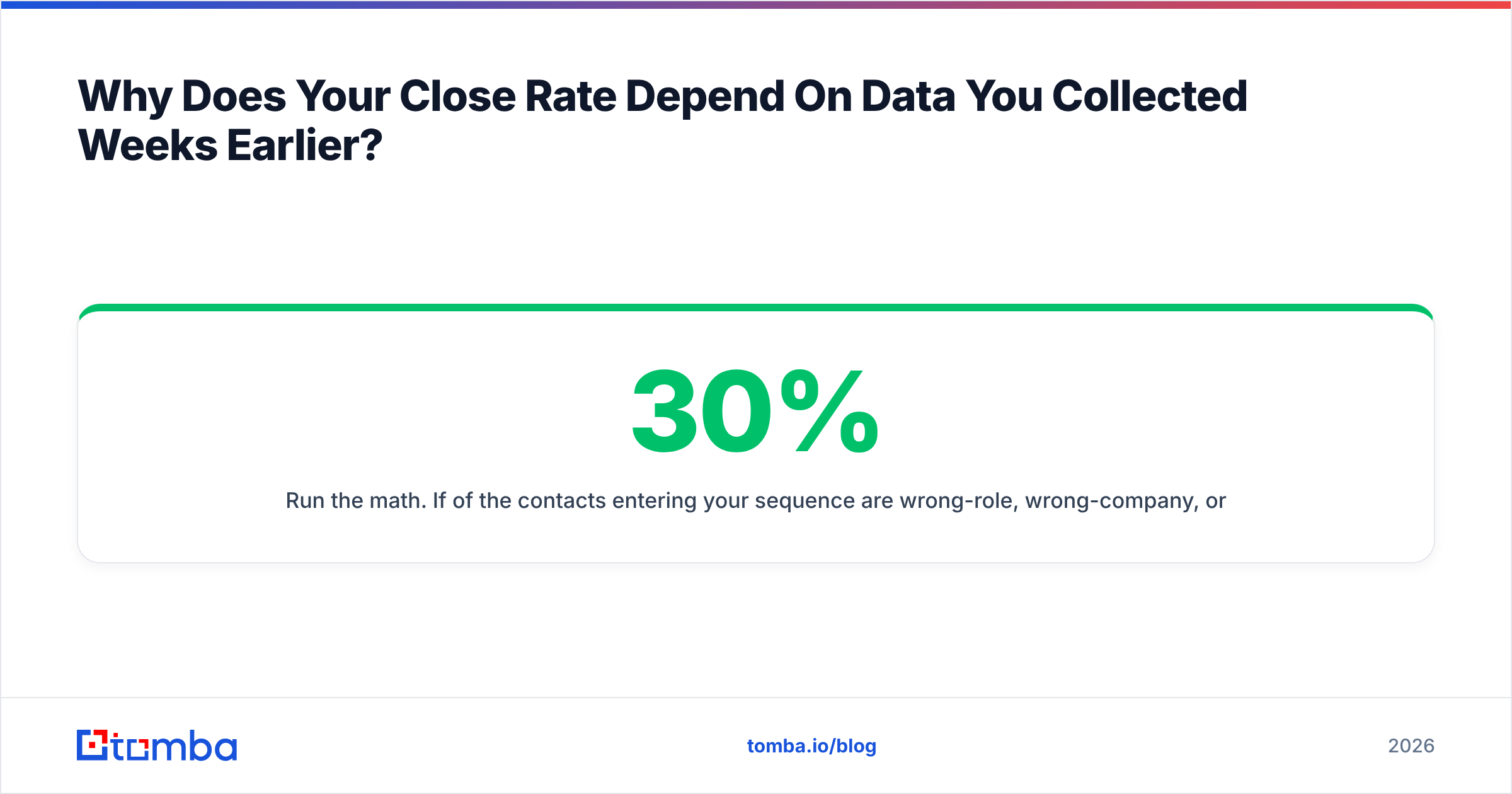
Run the math. If 30% of the contacts entering your sequence are wrong-role, wrong-company, or bouncing, you're not just losing those 30% — you're spending your best selling hours on conversations that were never closeable. The rep who closes 22% on clean pipeline and the rep who closes 22% on dirty pipeline have very different quotas at year end.
Three data problems that quietly cap close rates:
- You're closing the wrong person. You found a contact at the account, not the one who owns the budget line. A domain search that returns the full org structure by department is the difference between pitching an analyst and pitching a VP.
- Your outreach never landed. Bounced or catch-all addresses mean your "no response" data is corrupted. You think the message failed; the message never arrived. Running lists through an email verifier before the sequence separates the two.
- Your CRM says one thing, reality says another. Job changes hit B2B contact records hard every year. Data enrichment on the accounts already in your pipeline finds the champion who moved and the new decision-maker who replaced them — often before your competitor notices.
The practical version: before you obsess over closing scripts, audit the last 20 deals you lost. Count how many died because of a closing failure versus how many died because you were talking to the wrong person, at the wrong company, at the wrong time. In most teams the second number is bigger.
How Should Managers Coach The Close?#
Stop reviewing closed-lost deals in isolation. Review the ask itself.
Pull five recorded calls from stage-three or later. For each one, timestamp the exact moment the rep made a direct ask. In most reviews, two of the five have no such timestamp at all — the call ended with "I'll send some info." That's your coaching finding, and it's more actionable than any deck on objection handling.
A workable coaching rubric:
- Did the rep ask? Binary. Timestamp it or mark it absent.
- Was the ask specific? A close names a plan, a date, or a person. "Move forward" alone is not specific.
- Did the rep stay silent afterward? Measure the pause in seconds. Under two seconds means they flinched.
- Was the ask earned? Check the readiness scorecard from earlier. Asking with a score of 1 isn't brave, it's noise.
- What happened next? A calendar hold created on the call is the only outcome that counts.
Track "asks per opportunity" as a leading indicator alongside win rate. Teams that measure it usually discover their average is around one — one direct ask across an entire multi-month cycle. Pushing that to three or four moves win rate more than any script rewrite. G2's sales software category data shows the same theme in reviews: teams don't churn from CRM and engagement tools because of features, they churn because activity never converted to committed next steps.
One more manager note: don't let "go for close" become a culture of pressure. Buyers now compare notes publicly. A rep who manufactures urgency on three deals in a territory will be flagged by the fourth prospect before the first call. The goal is directness, not force. Directness respects the buyer's time. Force wastes it and costs you the account for years.
What's The Simplest Framework To Use Tomorrow?#
Five steps, usable on your next call.
- Score readiness before the call using the five-signal table. Write the score in your notes.
- Open by confirming the decision process, not by recapping features. "Last time you mentioned legal review takes two weeks — is that still the path?"
- Make one direct ask in the last third of the call. Name a plan, a date, or a person.
- Stay silent for a full four seconds. Count them.
- Leave with a dated commitment on both calendars, or an explicit no. Both are wins. "Maybe" is the only losing outcome.
Run that for two weeks and your pipeline will shrink. That's the point — the deals that vanish were never deals, and you get those hours back for accounts that can actually sign.
Ready To Close More Of The Right Deals?#
Better closing starts with better targets. If half your pipeline is built on stale contacts and guessed email formats, no closing technique saves it.
Tomba's Email Finder gets you to the actual decision-maker — verified, department-mapped, and ready for outreach — so the conversations you fight to close are with people who can say yes. Start free with 25 searches a month, or move to Starter at $49/mo when you're ready to scale; see full Tomba pricing for Growth ($99/mo) and Pro ($249/mo) tiers. Fix the top of the funnel, and the close takes care of a lot more of itself.
Related guides#
Ready to find emails that actually work?
Join 150,000+ professionals who stopped guessing and started sending. Free credits on signup — no credit card required.
Get the Tomba newsletter
Practical outbound tactics and product updates — once every two weeks.
About the author