Go To Market Strategy For Product Launch: 2026 Playbook
Most product launches fail on distribution, not product. Here is the full GTM sequence — ICP, positioning, channel selection, pricing, and the launch-week checklist — with real numbers you can budget against.
TL;DR
- A go to market strategy for product launch is a distribution plan, not a launch-day announcement. If you can't name the buyer, the channel, and the first 100 accounts, you don't have one yet.
- Most launches die on channel math. Pick two channels you can measure in 90 days, not seven you can't staff.
- Pricing is part of GTM, not an afterthought. Decide the packaging before launch week — repricing after acquiring users costs you churn and trust.
- Your outbound motion is only as good as your contact data. A 60% deliverable list turns a $12k channel test into a $12k inbox-reputation problem.
- Measure a launch with leading indicators (activation, reply rate, demo-to-close) for the first 90 days. Revenue lags too much to steer by.
What is a go to market strategy for product launch?#
A go to market strategy for product launch is the documented answer to five questions: who buys this, why they switch, where you reach them, what they pay, and how you'll know it's working. Everything else — the launch video, the Product Hunt post, the press embargo — is execution detail hanging off those five answers.
Think of it like opening a restaurant. The recipe is your product. The GTM strategy is the neighborhood you picked, the price on the menu, the sign on the street, and the reservations system. Great food in the wrong neighborhood at the wrong price still closes in nine months.
The failure pattern is consistent across company sizes. Teams spend 14 months on the build and three weeks on the distribution plan, then treat launch day as the finish line. The launch is the starting gun. What matters is whether you have a repeatable motion 90 days later.
Here's the split most teams get wrong:
- Product launch — the announcement, the changelog, the demo video. One day of work, one day of attention.
- Go-to-market strategy — segment, positioning, pricing, channels, sales motion, enablement, metrics. Six to ten weeks of work before launch day, and the thing you iterate on for the next year.
- Product marketing — the messaging layer that translates GTM into copy, decks, and objection handling.
- Demand generation — the paid and organic machine that fills the top of the funnel once positioning is locked.
- Sales motion — self-serve, PLG-with-sales-assist, or full enterprise cycle. This choice determines your headcount plan.
Which GTM motion fits your product?#
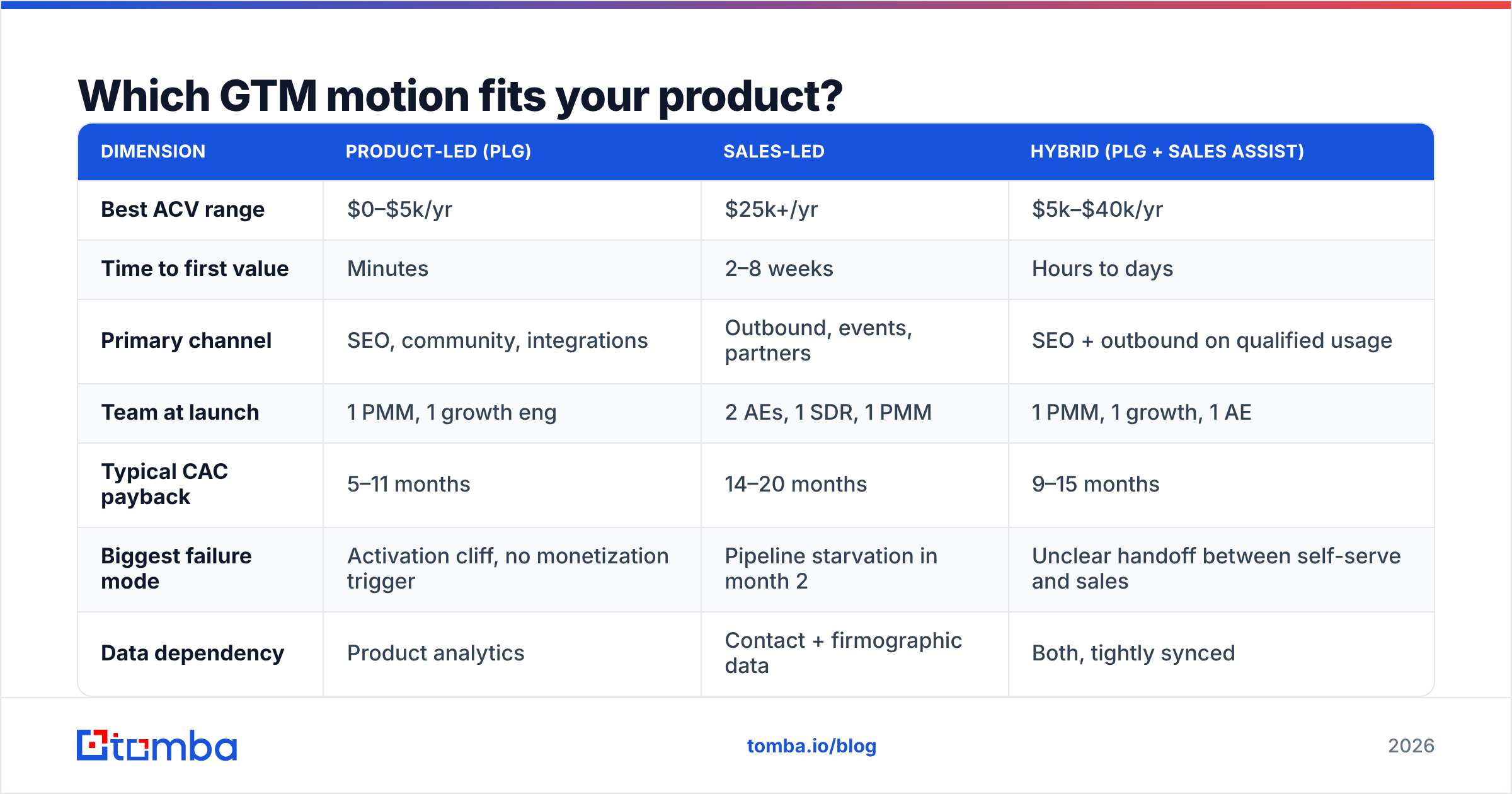
Pick the motion before you pick the tactics. The motion determines your CAC ceiling, your hiring plan, and what "good" looks like in week 12.
| Dimension | Product-led (PLG) | Sales-led | Hybrid (PLG + sales assist) |
|---|---|---|---|
| Best ACV range | $0–$5k/yr | $25k+/yr | $5k–$40k/yr |
| Time to first value | Minutes | 2–8 weeks | Hours to days |
| Primary channel | SEO, community, integrations | Outbound, events, partners | SEO + outbound on qualified usage |
| Team at launch | 1 PMM, 1 growth eng | 2 AEs, 1 SDR, 1 PMM | 1 PMM, 1 growth, 1 AE |
| Typical CAC payback | 5–11 months | 14–20 months | 9–15 months |
| Biggest failure mode | Activation cliff, no monetization trigger | Pipeline starvation in month 2 | Unclear handoff between self-serve and sales |
| Data dependency | Product analytics | Contact + firmographic data | Both, tightly synced |
A useful heuristic: if a single user can get value without asking permission from anyone in their org, PLG is viable. If value requires an integration, a security review, or someone else's budget, you're sales-led whether you like it or not. Hybrid works when the user and the buyer are different people but the user can still try it alone.
Most B2B tools in 2026 land in hybrid. The user finds you through search or a peer, tries the free tier, and a rep steps in when usage crosses a threshold. That structure only works if your revenue operations layer can actually see the usage signal and route it. If your CRM can't tell an AE that account #4412 just hit 80% of its free credits, the hybrid motion collapses into "PLG with a sad outbound team."
How do you define the ICP before launch?#
Write the ICP as a filterable query, not a persona doc. "Ambitious VP of Marketing at a scaling company" is not an ICP. This is:
- Firmographic: 50–500 employees, B2B SaaS or fintech, US/UK/DE, Series A–C
- Technographic: Uses HubSpot or Salesforce, running paid search, has a careers page hiring for demand gen
- Trigger: Hired a head of growth in the last 90 days, or announced a funding round in the last 6 months
- Buyer: VP Marketing or Head of Growth, with CRO sign-off above $30k
- Anti-ICP: Agencies (they resell, they churn), sub-20-employee startups (no budget), regulated healthcare (procurement cycle kills you)
The anti-ICP line matters more than people expect. Naming who you will not sell to protects your first 12 months of data. Ten agency logos in your customer base will teach your product team the wrong lessons and your churn model the wrong baseline.
Once the ICP is filterable, build the list. Pull the company set from your data source, then resolve the actual humans and their contact points. This is where a lot of launch plans quietly stall — teams have 4,000 target companies and 200 verified emails. Running domain search across your target account list converts a company list into a contact list in one pass, and a bulk email finder handles the volume when your list runs into the thousands.
Validate the ICP with 25–40 discovery calls before launch. Not surveys — calls. You're listening for the language they use to describe the problem, because that language becomes your homepage headline. If four separate buyers say "we're flying blind on pipeline," you don't write "unlock actionable visibility." You write "stop flying blind on pipeline."
How do you pick launch channels without burning budget?#
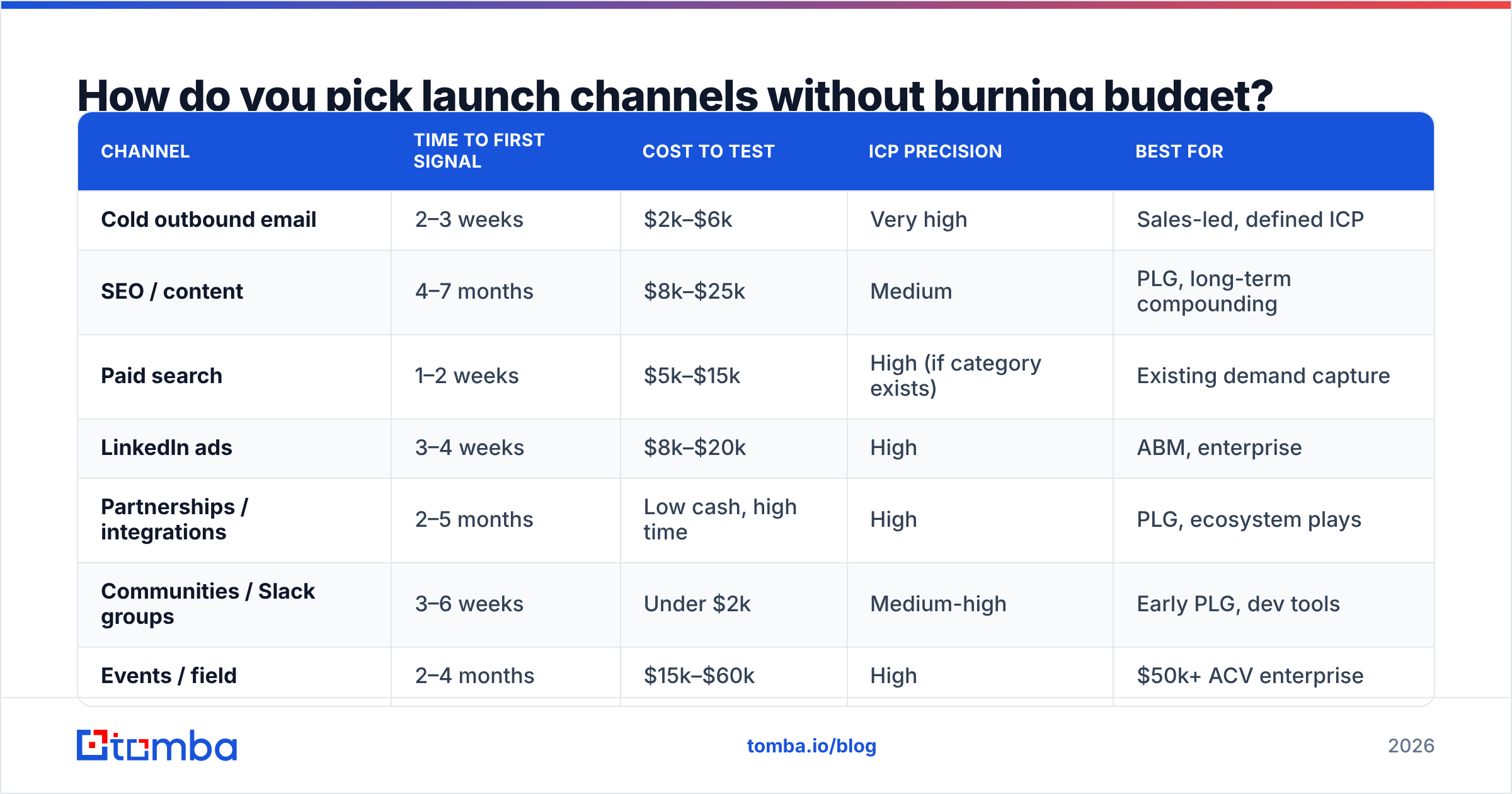
Score channels on three axes: reach into your ICP, time to signal, and cost to test. Then pick two. Not five.
| Channel | Time to first signal | Cost to test | ICP precision | Best for |
|---|---|---|---|---|
| Cold outbound email | 2–3 weeks | $2k–$6k | Very high | Sales-led, defined ICP |
| SEO / content | 4–7 months | $8k–$25k | Medium | PLG, long-term compounding |
| Paid search | 1–2 weeks | $5k–$15k | High (if category exists) | Existing demand capture |
| LinkedIn ads | 3–4 weeks | $8k–$20k | High | ABM, enterprise |
| Partnerships / integrations | 2–5 months | Low cash, high time | High | PLG, ecosystem plays |
| Communities / Slack groups | 3–6 weeks | Under $2k | Medium-high | Early PLG, dev tools |
| Events / field | 2–4 months | $15k–$60k | High | $50k+ ACV enterprise |
Two rules for channel selection. First, at least one channel must produce signal inside 30 days, or you'll be flying blind through your most important quarter. Outbound and paid search both qualify. SEO does not — it's a compounding asset, not a launch channel, and you should be building it in parallel without expecting it to carry launch quarter.
Second, don't test a channel you can't staff for 90 days. A half-run outbound test with 400 sends and no follow-up sequence tells you nothing except that you don't have process discipline. According to G2's buyer behavior research, B2B buyers now consult multiple channels before contacting a vendor, which means single-touch attribution will consistently undercount your best channel. Budget for that ambiguity instead of pretending you'll resolve it.
If outbound is one of your two, the input quality determines the ceiling. A list at 60% deliverability doesn't just waste 40% of sends — it damages the domain reputation that makes the other 60% land. Run every list through an email verifier before the first send, and treat anything above a 3% bounce rate as a stop-the-line event. Google's bulk sender requirements put the enforced spam-complaint threshold at 0.3%, which is a much tighter budget than most launch teams plan for.
What does the 90-day launch sequence look like?#
Work backwards from launch day. Here's the sequence that survives contact with reality:
T-8 weeks: Foundation Lock positioning and the one-sentence value prop. Finalize pricing and packaging. Complete 25+ discovery calls. Build the target account list and verify contact data. Set up tracking — if you can't attribute a signup to a channel on day one, you'll never untangle it later.
T-4 weeks: Assets and enablement Website and pricing page live behind a flag. Sales deck, one-pager, objection-handling doc, demo script. Outbound sequences written and loaded. Email infrastructure warmed — a fresh sending domain needs 3–4 weeks of ramp before it can carry volume, so this cannot start at T-1.
T-2 weeks: Soft launch Ship to 20–50 friendly accounts. Watch activation, not applause. Fix the top three onboarding drop-offs. Get two customer quotes and one case study in draft.
Launch week Announcement across owned channels, outbound sequence goes live at ~30% of planned volume, paid campaigns live at low budget for signal. Daily standup on three numbers: signups, activation rate, reply rate.
T+30 days: First read You now have enough data to kill or scale each channel. Cut anything with CAC more than 2x your target. Double the budget on your best channel rather than adding a third.
T+90 days: Motion or pivot By now you know your response rate benchmarks, your activation cliff, and your real sales cycle length. This is when you decide whether you have a repeatable motion or a positioning problem. Repeatable means a new rep can hit 70% of ramped quota using the same playbook.

How should you price a new product at launch?#
Price on value metric first, number second. The value metric is the unit that scales with the customer's benefit — seats, credits, contacts, API calls, GB. Get this wrong and no amount of price optimization saves you, because the customer's cost grows out of step with their value.
Three practical rules for launch pricing:
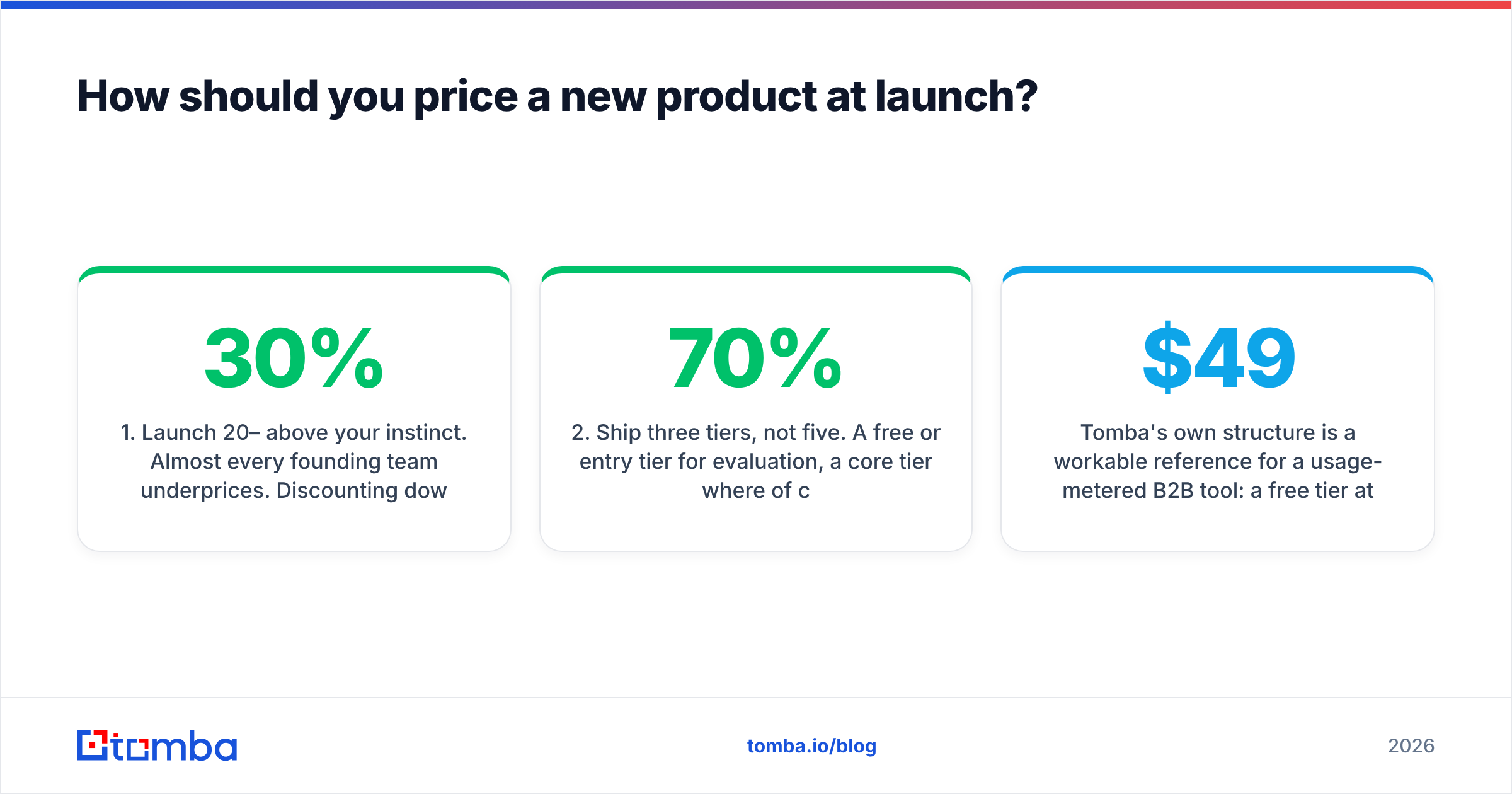
- Launch 20–30% above your instinct. Almost every founding team underprices. Discounting down is easy; raising price on an installed base is a churn event.
- Ship three tiers, not five. A free or entry tier for evaluation, a core tier where 70% of customers land, and a higher tier that exists partly to make the core tier look reasonable. Enterprise stays "contact us."
- Put a credit or usage cap on the entry tier, not a feature wall. Feature walls make the product feel broken during evaluation. Usage caps make it feel finished but finite — which is the emotion that drives upgrades.
Tomba's own structure is a workable reference for a usage-metered B2B tool: a free tier at 25 searches/month for evaluation, Starter at $49/mo, Growth at $99/mo, Pro at $249/mo, and custom Enterprise. The free tier is generous enough to prove the product works but small enough that any real workflow forces a decision within a week. You can see the full breakdown on the Tomba pricing page.
Run a willingness-to-pay test before you commit. Twenty ICP-matched interviews with the Van Westendorp four-question battery costs you a week and will move your price point more than a quarter of A/B testing after launch. Forrester's B2B research has repeatedly found that buyers rank pricing transparency among their top vendor evaluation criteria, which argues against hiding all numbers behind a demo request — at minimum, publish a starting price.
What metrics prove the launch is working?#
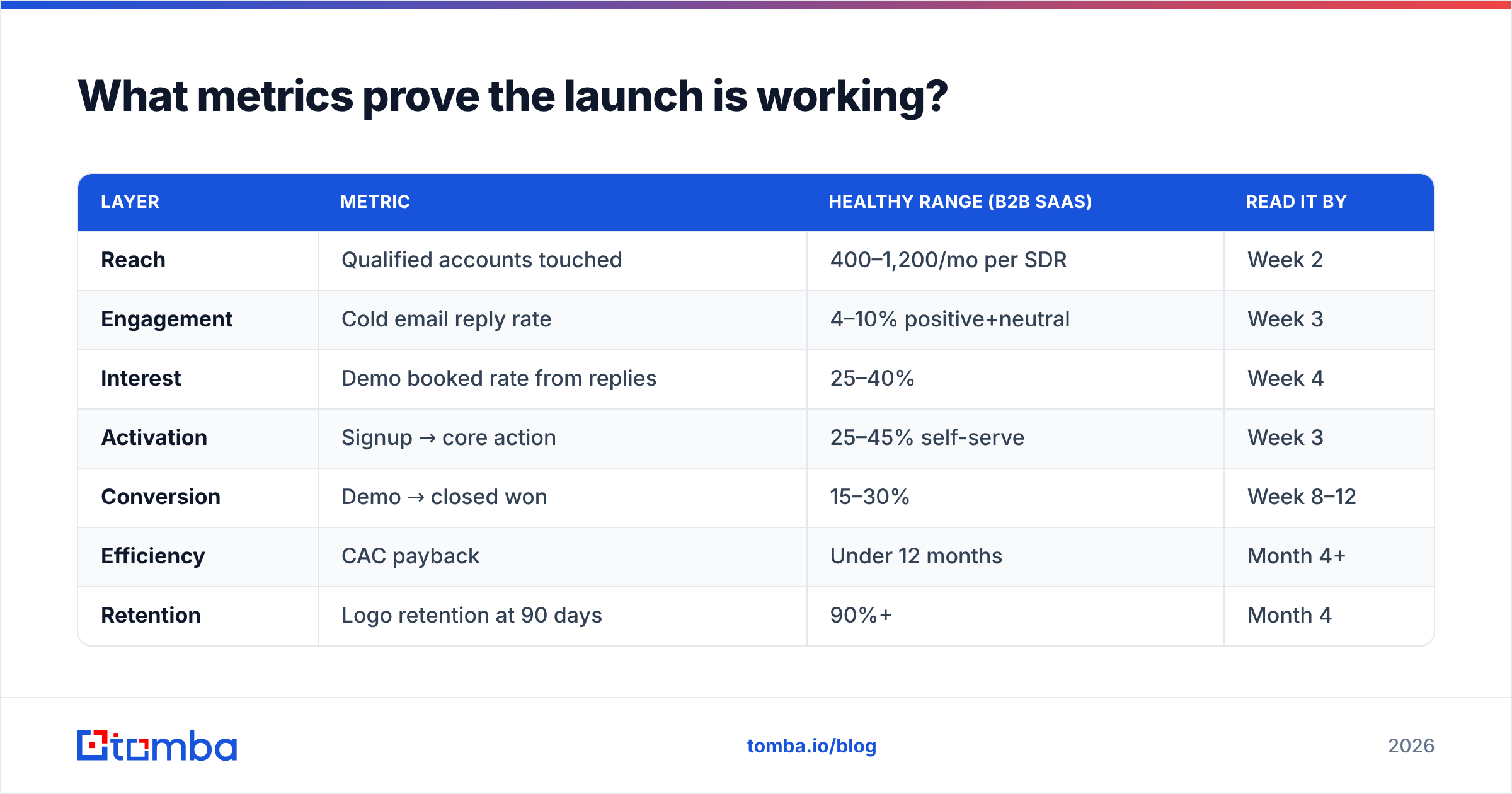
Revenue is a lagging indicator with a 3–9 month delay in B2B. Steering by it during launch quarter is like driving by looking in the mirror. Use a layered set instead:
| Layer | Metric | Healthy range (B2B SaaS) | Read it by |
|---|---|---|---|
| Reach | Qualified accounts touched | 400–1,200/mo per SDR | Week 2 |
| Engagement | Cold email reply rate | 4–10% positive+neutral | Week 3 |
| Interest | Demo booked rate from replies | 25–40% | Week 4 |
| Activation | Signup → core action | 25–45% self-serve | Week 3 |
| Conversion | Demo → closed won | 15–30% | Week 8–12 |
| Efficiency | CAC payback | Under 12 months | Month 4+ |
| Retention | Logo retention at 90 days | 90%+ | Month 4 |
Two of these deserve extra attention during a launch. Activation rate tells you whether the product delivers on the promise your marketing made — a gap between strong signups and weak activation is a positioning problem, not an onboarding problem. And reply rate on outbound is your fastest read on message-market fit; if a well-targeted, well-verified list returns under 2% positive replies across 500 sends, the message is wrong, not the channel.
Track cohort behavior, not just aggregates. Your launch-week cohort will behave differently from month-three, because early adopters have higher tolerance for rough edges. Blending them hides the moment your product stopped working for the mainstream buyer.
What are the most common GTM mistakes at launch?#
- Launching to everyone. Broad positioning converts nobody. A narrow wedge — one segment, one use case — gets you reference customers who actually refer. Expand after you own the wedge.
- Treating launch day as the deliverable. The press hit is a spike. The motion is the asset. Plan 12 weeks past launch, not 12 hours.
- Building outbound on unverified data. Bounce rates above 3% degrade sender reputation fast, and reputation recovery takes weeks. This is the single most avoidable launch failure.
- No anti-ICP. Saying yes to every early deal poisons your roadmap and your retention math.
- Skipping enablement. If the AE can't handle the top five objections without escalating, the pipeline you build converts at half the rate it should.
- Changing the message weekly. You need 3–4 weeks of consistent messaging at volume before you have enough signal to judge it. Swapping copy every Tuesday guarantees you learn nothing.
- Not warming the sending domain. A cold domain sending 500 emails on launch day lands in spam and takes your whole quarter's outbound with it.
The through-line on most of these is impatience. GTM is a measurement problem, and measurement needs stable inputs for long enough to produce signal. Change one variable at a time, hold it for three weeks, then read.
Getting the contact layer right before launch day#
Every GTM motion above — outbound, ABM, partner co-sell, even PLG with sales assist — bottoms out in the same requirement: you need to reach a specific human at a specific company, and the address has to be correct. That's the least glamorous part of a launch plan and the one that quietly caps every other decision you made.
If your launch depends on outbound, build the contact layer first. Use the Tomba Email Finder to turn your ICP account list into verified, deliverable contacts before you write a single sequence — start on the free tier at 25 searches a month to validate the workflow, then scale into Starter at $49/mo once your list volume justifies it. A launch built on a clean list is a launch you can actually measure.
Related guides#
Ready to find emails that actually work?
Join 150,000+ professionals who stopped guessing and started sending. Free credits on signup — no credit card required.
Get the Tomba newsletter
Practical outbound tactics and product updates — once every two weeks.
About the author