Go4Database vs LeadZen.ai (2026): Which B2B Data Tool Wins?
One sells you a static list, the other sells you live lookups. We compare Go4Database vs LeadZen.ai on data sourcing, accuracy, pricing and deliverability risk — plus what to do before you send a single email.
Go4Database vs LeadZen.ai is a choice between two shapes of B2B data. One sells you a static list. The other sells you live lookups. Here is how the two compare on data sourcing, accuracy, pricing, and bounce risk.
TL;DR
- Go4Database sells pre-built B2B mailing lists. You pick an industry, technology, or geography segment and receive a one-time file.
- LeadZen.ai is a live lead-intelligence platform: a searchable database, a Chrome extension, and per-lookup credits.
- Need a list today for one vertical, and happy to own the cleanup? Go4Database is the faster path. Need data that reflects who works there this month? LeadZen.ai is the safer one.
The rest of the Go4Database vs LeadZen.ai decision comes down to three things:
- Neither vendor publishes independently audited accuracy figures. Treat any “95% accurate” claim from a list seller as marketing until your own verification pass proves it.
- The pricing models do not line up. Go4Database quotes per list. LeadZen.ai sells credits and subscription tiers. Cost per usable contact is the only number that matters.
- Budget a verification step either way. A purchased list that bounces at 12% costs you more in sender reputation than you saved on the file.
What are Go4Database and LeadZen.ai?#
Both solve the same problem: getting B2B contact records into your outbound motion. They come at it from opposite ends of the market.
Go4Database is a B2B data list provider. You tell them the segment you want. They quote you. You receive a file. A typical ask: “IT decision-makers at US manufacturing companies with 200+ employees.” The catalogue is built around pre-packaged lists — industry, technology users, healthcare, geography, and job title. It is a data supply business, and the buying process is sales-led rather than self-serve.
LeadZen.ai is a lead-intelligence platform. You search a database in a web app and pull contacts by filter. A browser extension reveals contact details while you sit on a company site or a LinkedIn profile. It runs on credits: each reveal costs, and your tier sets how many you get. Coverage skews toward India and APAC, but it carries global records too.
The practical difference: Go4Database is a purchase, LeadZen.ai is a subscription. One hands you a snapshot you own forever. The other gives you access to a dataset that keeps changing under you. That churn is a feature, not a bug. B2B contact data decays at roughly 2-3% per month as people change jobs.
Where does each platform actually get its data?#
This question decides everything downstream. It is also the one both vendors answer least clearly.
Go4Database describes its sources the way most list compilers do: public directories, trade shows, business registrations, surveys, opt-in forms, and partner data. Compiled-list vendors usually refresh every quarter. So the record you buy in March may have been last touched in January. For stable fields — company name, industry, HQ address — that is fine. For the volatile ones — job title, direct email, mobile number — a quarter is a long time.
LeadZen.ai leans on crawled public web data, user-contributed signals, and pattern-based derivation. It refreshes continuously, because lookups happen on demand. The extension model helps as well: the record you pull is built close to the moment you need it.
Neither company publishes a source-by-source breakdown, and a compliance team will want one. If you work under GDPR and prospect into the EU, ask both vendors for their lawful basis documentation in writing before you sign. That means legitimate interest assessments, suppression list handling, and deletion SLAs. This is not a formality. The G2 category reviews for lead-data tools are full of buyers who found their compliance gap after the invoice cleared.
Transparency here is achievable. Vendors can and do document where their data comes from at the source level. Use that as your benchmark question for any provider.
Which one has better data accuracy?#
Short answer: LeadZen.ai’s model is structurally more accurate. Trust neither one without your own verification pass.
Accuracy in B2B data breaks into three separate things people conflate:
- Syntax validity — is it a well-formed address? Nearly everyone passes this.
- Mailbox existence — does the inbox accept mail today? Compiled lists fail here, because the person left in November.
- Person-role match — is this still the VP of Engineering, or did they get promoted out of your ICP?
A static list is only accurate as of its last refresh. A live-lookup tool rebuilds the record when you ask. That is the structural advantage, and it is why per-lookup pricing exists.

Do this whatever you buy: run a sample. Pull 500 records, push them through an independent email verifier, and measure the real deliverable rate. If a vendor claims 95% and your sample returns 78%, you now have a pricing negotiation and a data-quality conversation, both backed by evidence. A vendor who refuses a small paid pilot is telling you something.
Also watch for catch-all domains. Many enterprise domains accept everything at the SMTP layer. A naive verifier marks them “valid”, and your bounce rate finds the truth later. A dedicated catch-all verifier is the only way to score that risk up front.
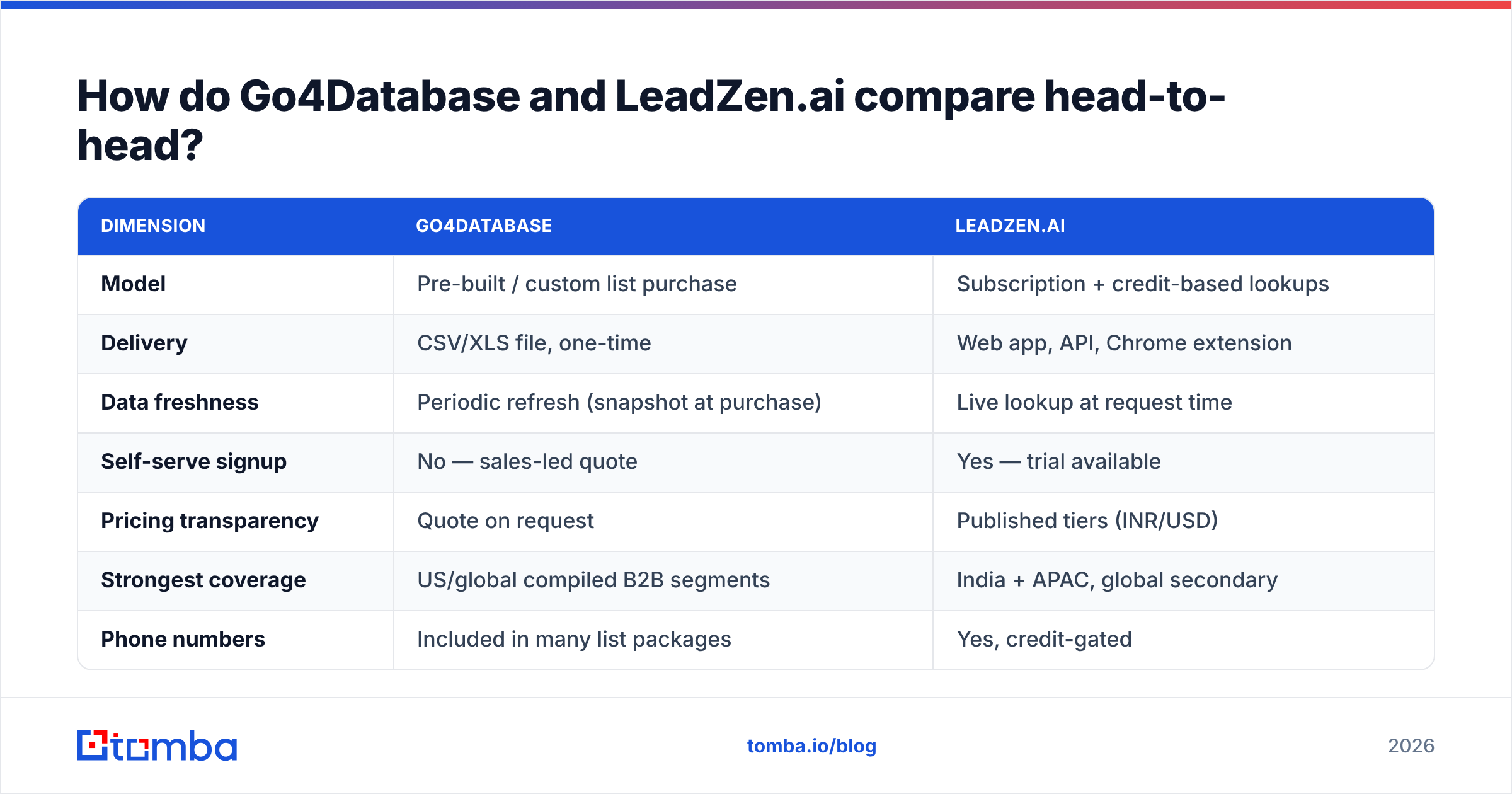
Go4Database vs LeadZen.ai: the head-to-head comparison#
| Dimension | Go4Database | LeadZen.ai |
|---|---|---|
| Model | Pre-built / custom list purchase | Subscription + credit-based lookups |
| Delivery | CSV/XLS file, one-time | Web app, API, Chrome extension |
| Data freshness | Periodic refresh (snapshot at purchase) | Live lookup at request time |
| Self-serve signup | No — sales-led quote | Yes — trial available |
| Pricing transparency | Quote on request | Published tiers (INR/USD) |
| Strongest coverage | US/global compiled B2B segments | India + APAC, global secondary |
| Phone numbers | Included in many list packages | Yes, credit-gated |
| Built-in verification | Limited / vendor-claimed | Basic validation on reveal |
| Best for | One-off campaigns into a fixed vertical | Ongoing SDR prospecting workflows |
| Main risk | Decay + no recourse after delivery | Credit burn on low-fill searches |

The table hides one thing worth saying plainly: these tools are not really substitutes. A team sending 3,000 emails a month into a fixed vertical — say, dental practices in three states — has a different problem than five SDRs doing account-based prospecting, where every lead is picked by hand. Buying the wrong shape of product costs more than picking the weaker of two vendors in the right shape.
How does pricing compare in 2026?#
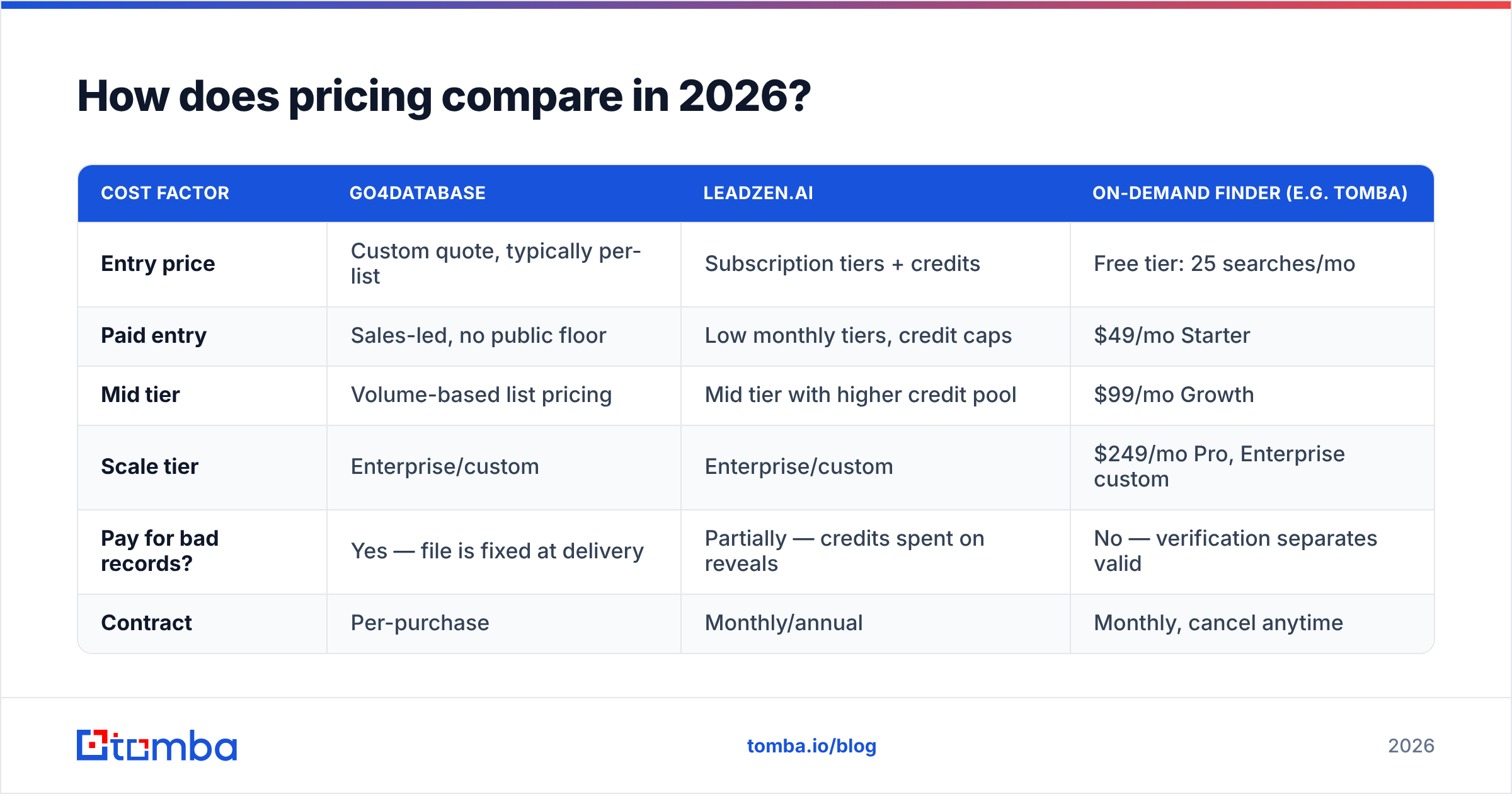
Neither vendor makes an apples-to-apples comparison easy. Translate both into cost per verified, deliverable contact.
| Cost factor | Go4Database | LeadZen.ai | On-demand finder (e.g. Tomba) |
|---|---|---|---|
| Entry price | Custom quote, typically per-list | Subscription tiers + credits | Free tier: 25 searches/mo |
| Paid entry | Sales-led, no public floor | Low monthly tiers, credit caps | $49/mo Starter |
| Mid tier | Volume-based list pricing | Mid tier with higher credit pool | $99/mo Growth |
| Scale tier | Enterprise/custom | Enterprise/custom | $249/mo Pro, Enterprise custom |
| Pay for bad records? | Yes — file is fixed at delivery | Partially — credits spent on reveals | No — verification separates valid |
| Contract | Per-purchase | Monthly/annual | Monthly, cancel anytime |
Run the arithmetic honestly. A 10,000-record list at a low headline price looks great, until a verification pass says only 6,200 are safely sendable. Your effective cost per usable contact just went up 61%, and it took a week to find out. A credit model can cost more per record and still land cheaper, because you only pay for a successful reveal. It also never leaves you sitting on 3,800 dead addresses that quietly damage your domain when someone imports them by mistake.
Want a public reference point for transparent, self-serve pricing in this category? Tomba’s pricing is listed openly, with a free tier to test against before you commit.

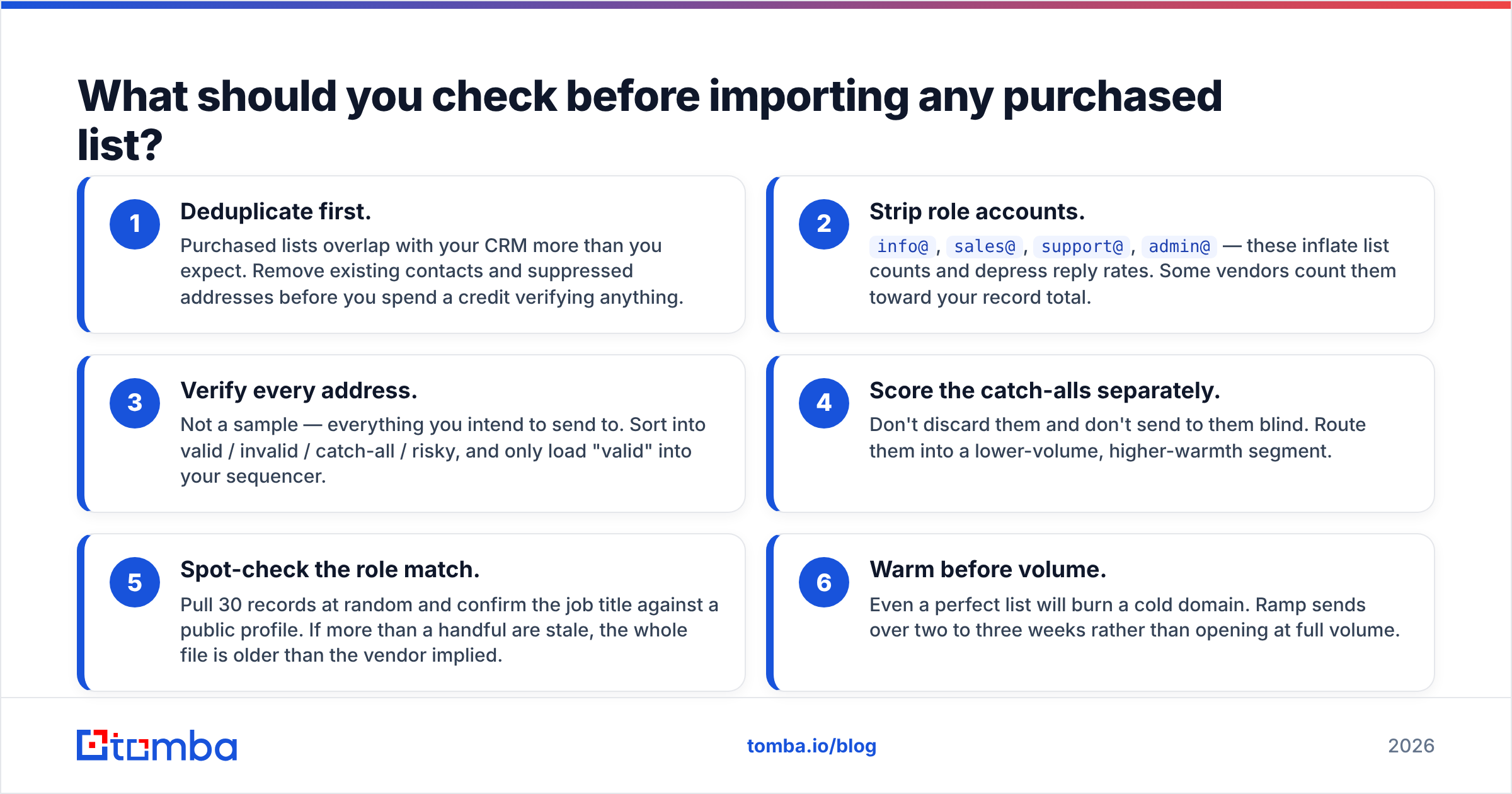
What should you check before importing any purchased list?#
Run this sequence every time, whatever you buy. It takes an afternoon, and it protects the asset that actually matters: your sending domain.
Clean the file first:
- Deduplicate. Purchased lists overlap with your CRM more than you expect. Remove existing contacts and suppressed addresses before you spend a credit on anything.
- Strip role accounts.
info@,sales@,support@,admin@— these inflate list counts and depress reply rates. Some vendors count them toward your record total. - Verify every address. Not a sample. Everything you intend to send to. Sort into valid, invalid, catch-all, and risky, then load only the valid ones into your sequencer.
Then protect the domain:
- Score the catch-alls separately. Do not discard them, and do not send to them blind. Route them into a lower-volume, higher-warmth segment.
- Spot-check the role match. Pull 30 records at random and confirm each job title against a public profile. If more than a handful are stale, the whole file is older than the vendor implied.
- Warm before volume. Even a perfect list will burn a cold domain. Ramp sends over two to three weeks rather than opening at full volume.
Steps 1-4 are mechanical, so automate them. A bulk email finder and verifier run handles them in one pass instead of five spreadsheet operations.
Who should choose Go4Database?#
Pick Go4Database when all of these are true:
- You need a defined vertical segment and you know exactly what it looks like — industry code, company size, geography, title band.
- Your campaign is one-off or seasonal, not a continuous prospecting motion, so a snapshot is acceptable.
- You have verification capacity in-house and you have priced the cleanup into the deal.
- You want file ownership, not seat-based access — for example, feeding a direct-mail or telemarketing program alongside email.
Negotiate a sample before the full purchase. Make replacement terms explicit for records that fail verification. Reputable list vendors will engage with that. The wider pre-built list market has matured on this point — providers like BookYourData compete on verification guarantees and published bounce SLAs. Hold any list seller to that bar.
Who should choose LeadZen.ai?#
Pick LeadZen.ai when:
- Your team prospects continuously and each lead is chosen, not bulk-imported.
- You work LinkedIn and company sites as your main discovery surface, so a browser extension fits the real workflow.
- India and APAC coverage matters to your territory. This is where LeadZen’s dataset is strongest.
- You want to avoid a large upfront commitment and would rather scale credits with pipeline.
The failure mode to watch is credit burn. Searches that return partial fills still spend budget. Set a rule for when an SDR stops digging on an account and moves on. Track credits per meeting booked, not credits per contact found.
Is there a third option worth considering?#
Yes. For most teams weighing these two, it is the honest recommendation: decouple finding from buying.
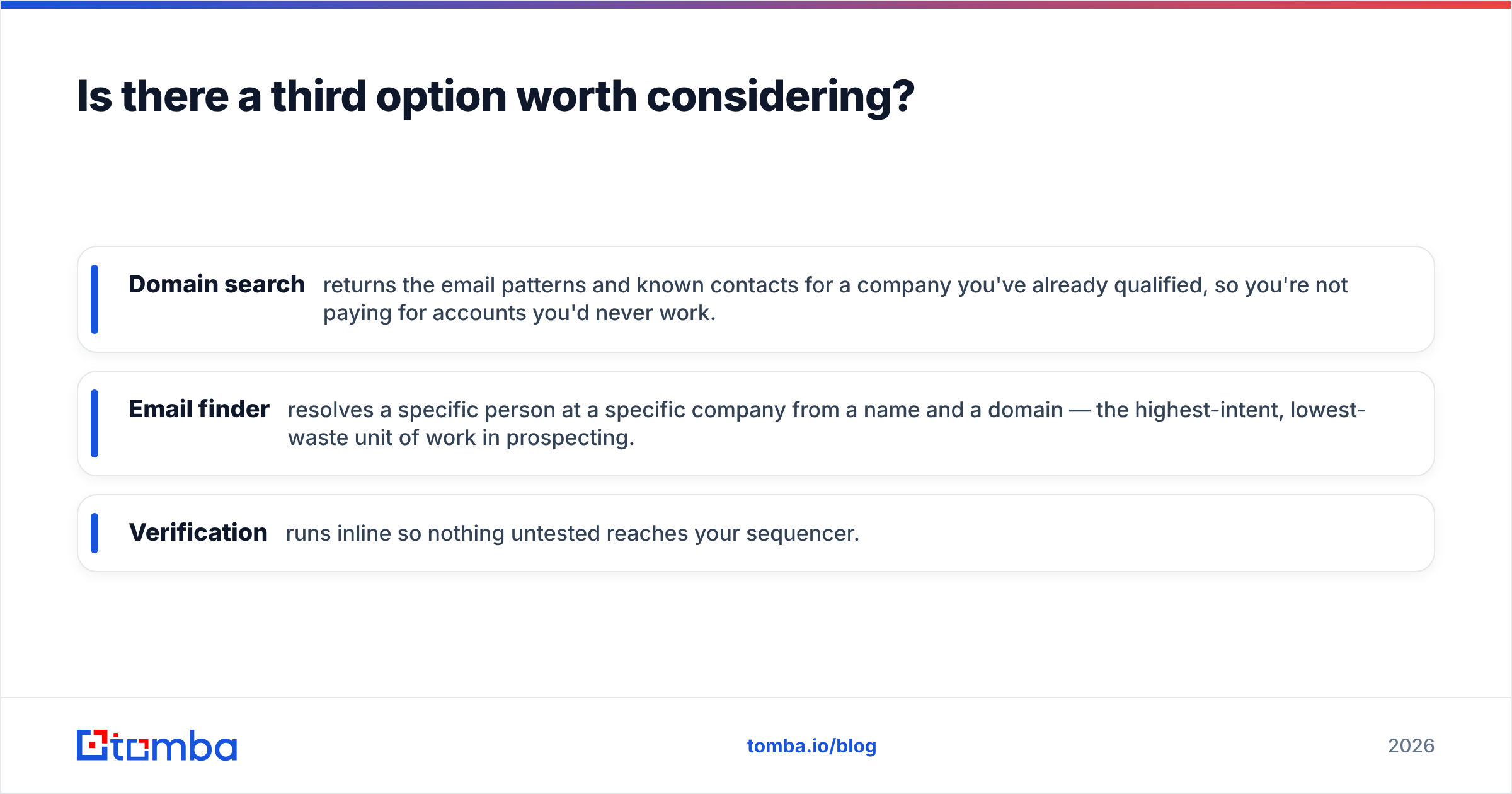
Instead of buying a list or subscribing to a database you hope covers your market, start from the accounts you already want. Build the target account list from your own ICP research, then resolve contacts on demand:
- Domain search returns the email patterns and known contacts for a company you have already qualified. You never pay for accounts you would not work.
- Email finder resolves a specific person at a specific company from a name and a domain. It is the lowest-waste unit of work in prospecting.
- Verification runs inline, so nothing untested reaches your sequencer.
This approach costs more per contact and far less per meeting, because every record you pay for is one you actually want. It also sidesteps the compliance grey area of compiled lists. You are resolving business contact details for companies you identified yourself.
The trade-off is real. This model will not hand you 10,000 rows on Monday morning. If your go-to-market genuinely needs volume — high frequency, low ticket, broad vertical — a list purchase still makes sense. Just verify it first.
Which one actually wins?#
Here is the Go4Database vs LeadZen.ai verdict, one line per scenario:
For continuous SDR prospecting: LeadZen.ai. Live lookups beat a decaying snapshot, and the extension matches how reps actually work.
For a defined, one-off vertical campaign where you want file ownership: Go4Database. Negotiate a sample, verify everything, and price the cleanup honestly.
For teams that want cost per meeting to fall rather than cost per record: neither alone. Pair account-level targeting with on-demand contact resolution and a verification gate.
Whichever way you go, do not let a vendor’s accuracy claim be the last word. Test it. A 500-record sample and one verification pass will tell you more than any comparison post, including this one.
Ready to test the on-demand approach? Start with the Tomba Email Finder. Resolve contacts by name and domain, verify them in the same workflow, and pay only for what you use. The free tier gives you 25 searches a month, and paid plans start at $49/mo. Run your Go4Database vs LeadZen.ai samples through it side by side, then let the deliverable rate decide.
Related guides#
Ready to find emails that actually work?
Join 150,000+ professionals who stopped guessing and started sending. Free credits on signup — no credit card required.
Get the Tomba newsletter
Practical outbound tactics and product updates — once every two weeks.
About the author