Go4Database vs Seamlessai (2026): Which B2B Data Wins?
Go4Database vs Seamlessai: one sells a static contact file, the other an AI search engine on a per-seat contract. We compare accuracy, pricing traps, and refresh rates — plus a cheaper third path.
Go4Database vs Seamlessai is a choice between two business models. One sells you a file you own forever. The other rents you a search engine, priced per seat. Here is the short version.
TL;DR
- Go4Database sells lists. You buy a static file of contacts by industry, geography, or job title. It is cheap per record. It also starts decaying the day it lands in your inbox.
- Seamless.AI sells a search engine. Per-seat licences, AI lookup in real time, opaque pricing. Credits are seat-bound. Auto-renewal is the top complaint in public reviews.
- Neither is verification-first. Go4Database is thin on refresh cadence. Seamless.AI verifies at query time, yet users still report bounces on stale roles.
- Accuracy beats price. A 30% bad list at $0.02 a record costs more in domain reputation than a clean list at $0.10.
- The third path: pull contacts on demand via an API-first email finder and verify before send. Tomba starts free (25 searches/mo) and runs $49/mo on Starter.
Go4Database vs Seamlessai: what are they, exactly?#
They solve the same problem from opposite ends of the market.
Go4Database is a B2B list vendor. You tell them the segment — "US healthcare CFOs, companies 200-1000 employees" — and they deliver a downloadable file: name, title, company, email, sometimes phone and mailing address. It is the modern version of the direct-mail list business. There is no app to log into daily, no seat count, no sequencer. You buy data, you own the file.
Seamless.AI is a sales intelligence platform. You log in and search for people or companies. The system then builds a contact record in real time by crawling public sources. It sells per user per year and bundles a Chrome extension and CRM integrations. It positions itself against Apollo, ZoomInfo, and Lusha. You are renting access, not buying a file.
That structural difference drives every downstream trade-off in this comparison:
- Ownership model — Go4Database transfers a file you keep forever; Seamless.AI gives you time-boxed access to credits that expire.
- Freshness model — a purchased list is a snapshot; a search engine re-resolves at query time, which is better in theory and inconsistent in practice.
- Cost curve — list vendors get cheaper per record as volume rises; seat-based tools get more expensive as your team grows, regardless of usage.
- Compliance surface — bulk list purchases carry heavier GDPR and CAN-SPAM scrutiny than targeted, on-demand lookups you can justify per contact.
- Integration depth — Seamless.AI pushes directly into your CRM; Go4Database hands you a CSV and wishes you luck.
How does the pricing actually compare?#
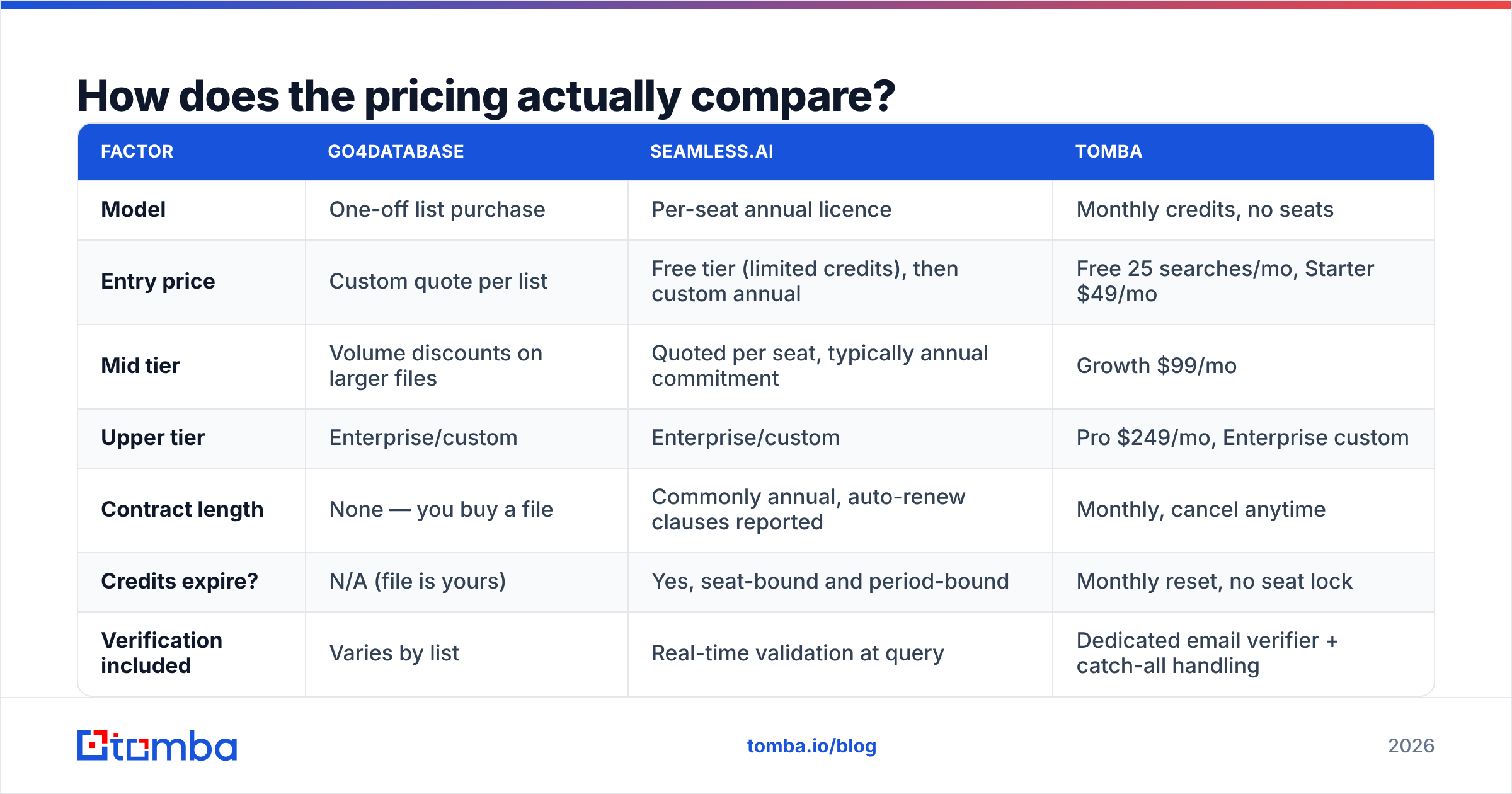
Go4Database quotes per project. Seamless.AI quotes per seat per year and does not publish rates. That is itself a data point: you will sit through a demo before you see a number. Public buyer reports on G2 and Capterra consistently put Seamless.AI in the low-to-mid four figures per seat annually once you get past the limited free tier.
| Factor | Go4Database | Seamless.AI | Tomba |
|---|---|---|---|
| Model | One-off list purchase | Per-seat annual licence | Monthly credits, no seats |
| Entry price | Custom quote per list | Free tier (limited credits), then custom annual | Free 25 searches/mo, Starter $49/mo |
| Mid tier | Volume discounts on larger files | Quoted per seat, typically annual commitment | Growth $99/mo |
| Upper tier | Enterprise/custom | Enterprise/custom | Pro $249/mo, Enterprise custom |
| Contract length | None — you buy a file | Commonly annual, auto-renew clauses reported | Monthly, cancel anytime |
| Credits expire? | N/A (file is yours) | Yes, seat-bound and period-bound | Monthly reset, no seat lock |
| Verification included | Varies by list | Real-time validation at query | Dedicated email verifier + catch-all handling |
| API access | Limited / file delivery | Available on higher tiers | Full Tomba API on all paid plans |
The number that trips teams up is not the sticker price. It is the cost per usable contact.
Run the math honestly. Say a Go4Database file costs $0.03 per record and 32% of the emails are dead. Your real cost is $0.044 per deliverable contact, and you burned a chunk of sender reputation finding that out. Now say a Seamless.AI seat costs $2,400 a year and a rep pulls 6,000 usable contacts. That is $0.40 each, and the seat is dead weight during a hiring gap.

Which one has better data accuracy?#
Neither publishes an independently audited accuracy figure. Treat every vendor-stated percentage as marketing until you test it.
Here is what the structural differences predict, and what buyers report:
Go4Database's failure mode is decay. A compiled list is accurate on the day it was compiled. B2B contact data degrades at roughly 2-2.5% per month through job changes, restructures, and domain migrations. A list built 14 months ago is about a third wrong before you send anything. If the vendor cannot tell you the build date and last-verified date of the specific file you are buying, assume the worst.
Seamless.AI's failure mode is confident guessing. Real-time resolution beats a stale file. But AI-assisted pattern inference will happily produce first.last@company.com for a domain that uses flast@, then mark it plausible. Reviewers repeatedly flag emails for people who left the company. Phone numbers often route to switchboards rather than direct lines.
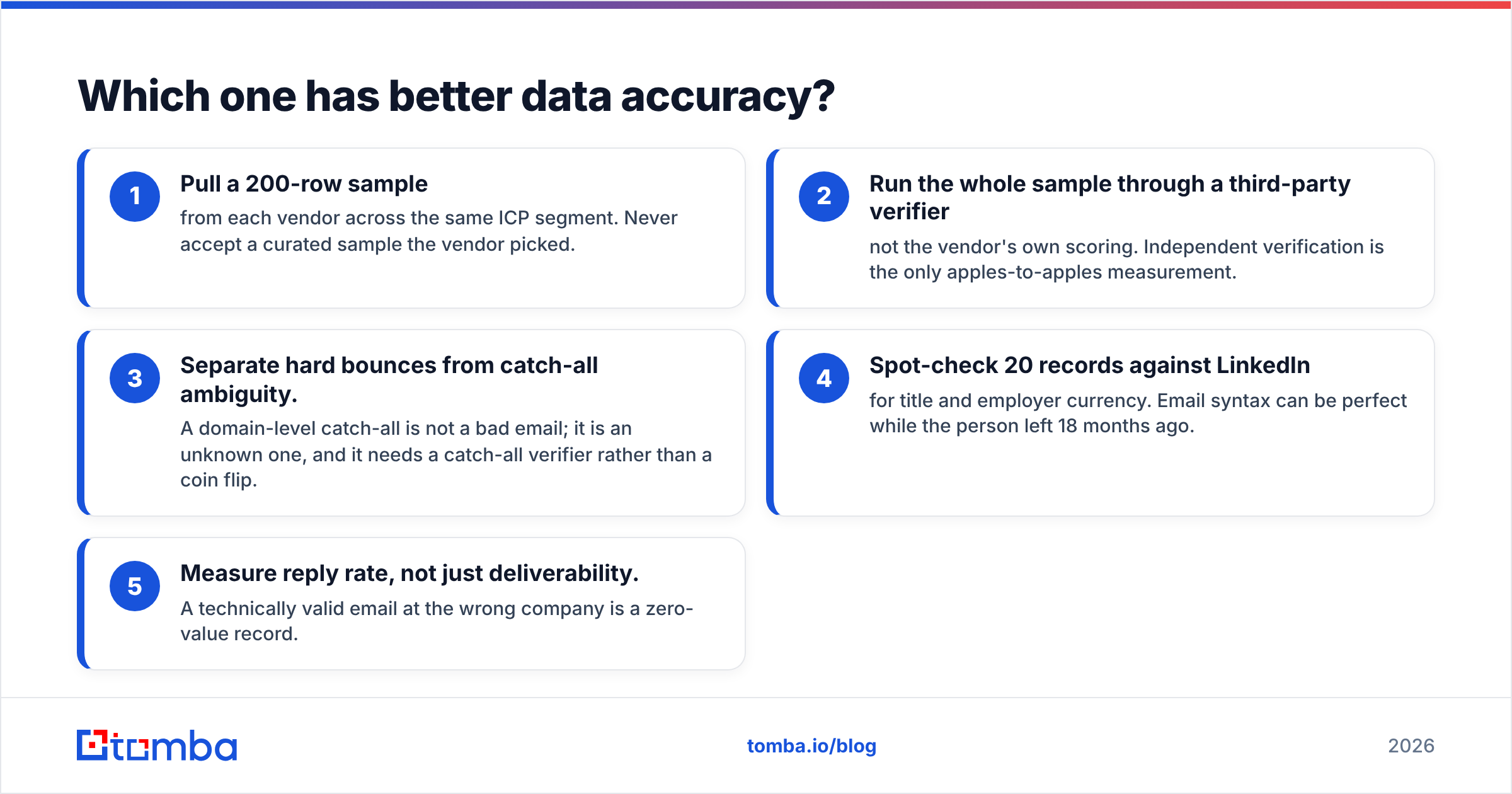
How to test both before you commit:
- Pull a 200-row sample from each vendor across the same ICP segment. Never accept a curated sample the vendor picked.
- Run the whole sample through a third-party verifier — not the vendor's own scoring. Independent verification is the only apples-to-apples measurement.
- Separate hard bounces from catch-all ambiguity. A domain-level catch-all is not a bad email; it is an unknown one, and it needs a catch-all verifier rather than a coin flip.
- Spot-check 20 records against LinkedIn for title and employer currency. Email syntax can be perfect while the person left 18 months ago.
- Measure reply rate, not just deliverability. A technically valid email at the wrong company is a zero-value record.
Most teams that run this test find the same thing. The gap between the two vendors is smaller than the gap between raw vendor output and verified vendor output. That second gap is where your budget actually leaks.
Is Go4Database better than Seamless.AI for cold outreach?#
Depends entirely on how you send.
Go4Database wins when:
- You are running high-volume, low-personalisation campaigns where the segment matters more than the individual — event invites, regional webinars, channel recruitment.
- You need postal or firmographic fields alongside email, for multi-channel or ABM plays.
- Your team is two people and a seat-based tool would be pure overhead.
- You want to own the data permanently and enrich it yourself over time.
Seamless.AI wins when:
- Reps prospect interactively — they find a company, need the buying committee now, and want it pushed into the CRM without a CSV round-trip.
- You have a dedicated SDR team where per-seat economics make sense and the seats are genuinely used.
- Your motion depends on the Chrome extension workflow while browsing LinkedIn or company sites.
- You need phone numbers alongside email as a first-class field.
Neither wins when your bottleneck is deliverability. If you are landing in spam, buying more contacts accelerates the problem. Fix warmup, SPF/DKIM/DMARC, and list hygiene first — check your SPF record and run your domain through a blacklist checker before you spend another dollar on data.
What do the contract terms look like?#
This is the part buyers skip and regret.
| Term | Go4Database | Seamless.AI |
|---|---|---|
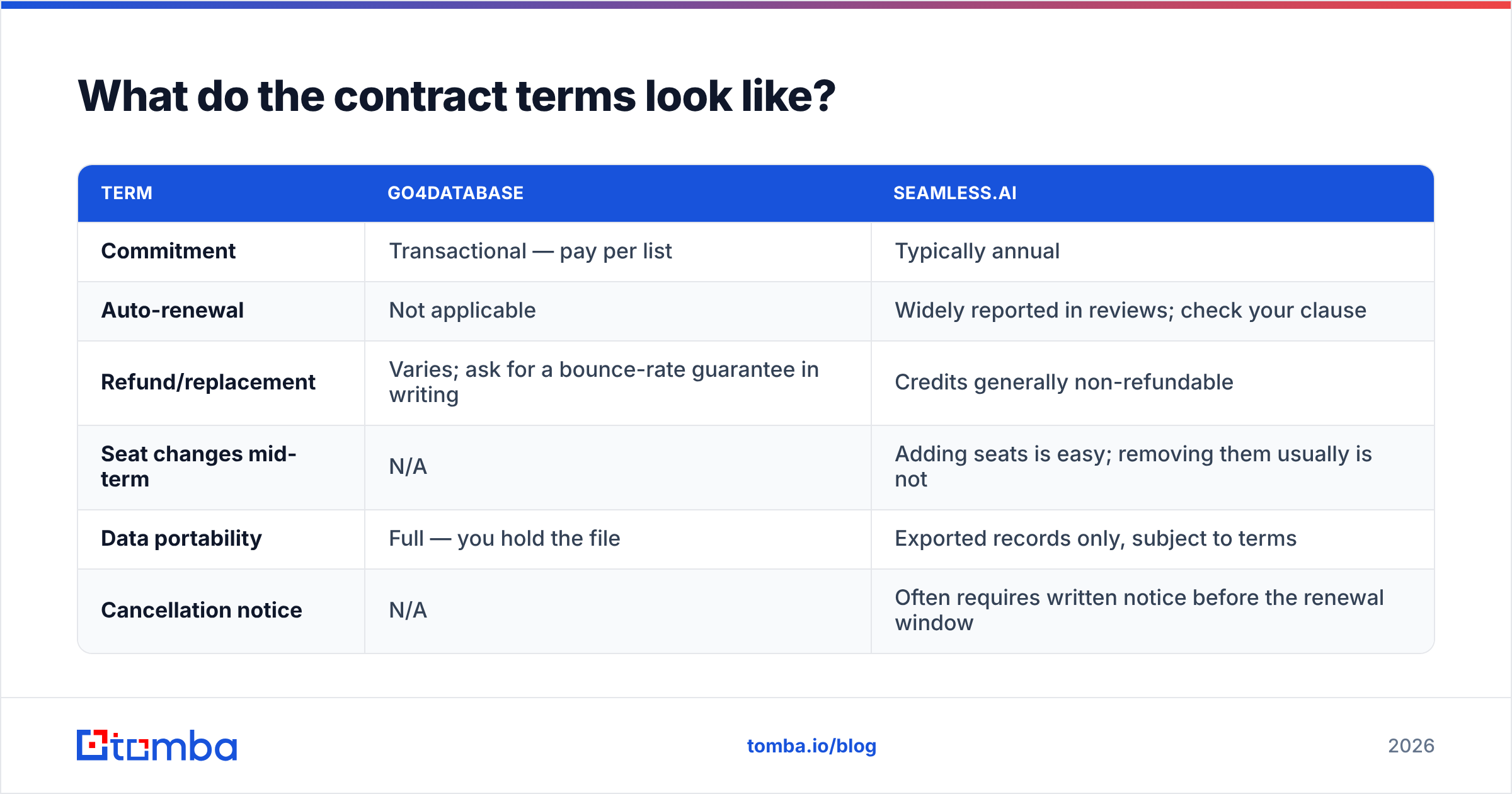
| Commitment | Transactional — pay per list | Typically annual |
| Auto-renewal | Not applicable | Widely reported in reviews; check your clause |
| Refund/replacement | Varies; ask for a bounce-rate guarantee in writing | Credits generally non-refundable |
| Seat changes mid-term | N/A | Adding seats is easy; removing them usually is not |
| Data portability | Full — you hold the file | Exported records only, subject to terms |
| Cancellation notice | N/A | Often requires written notice before the renewal window |
Two practical demands to make of any list vendor, Go4Database included:
- A written bounce-rate threshold with a replacement clause. "Under 5% hard bounces or we replace the failed records" is a reasonable ask. If the vendor refuses, they know something about the file that you do not.
- The build date and last-verified date per file. Not "we refresh continuously" — an actual date.
For any seat-based platform, Seamless.AI included, get the cancellation notice window in writing. Then put a calendar reminder 45 days before it. The most common complaint pattern in public reviews is not data quality. It is discovering the renewal after it processed.
Is there a cheaper third option?#
Yes — decouple finding from storing.
The list-vs-platform framing assumes you must either buy a big static file or rent a big search index. A third architecture has quietly become the default for lean teams. You keep a small, tightly-targeted account list, then resolve contacts on demand through an API at the moment you need them.
That looks like this in practice:
- Build the account list first from your own criteria — customer lookalikes, funding signals, hiring signals, tech stack. Tools like BookYourData do this well if you want a curated, verified list to start from, and it is a solid option for teams who genuinely prefer a purchased file over a search UI.
- Resolve the people on demand. Run domain search against each account to pull the current people and email patterns, rather than trusting a snapshot from last year.
- Verify before send, every time. Even a fresh find goes through the email verifier so catch-alls and role accounts get flagged, not guessed.
- Enrich only what converts. Push phone numbers and firmographics onto the accounts that actually engage, using data enrichment — not across 50,000 rows you will never touch.
The economics change sharply. You pay for the contacts you actually work, not the ones sitting in a file. There are no seats to true up at renewal. On Tomba pricing, Starter is $49/mo, Growth is $99/mo, and Pro is $249/mo. The free tier gives you 25 searches a month, enough to run the sample test above before you spend anything.
| Approach | Best for | Main risk | Typical monthly cost |
|---|---|---|---|
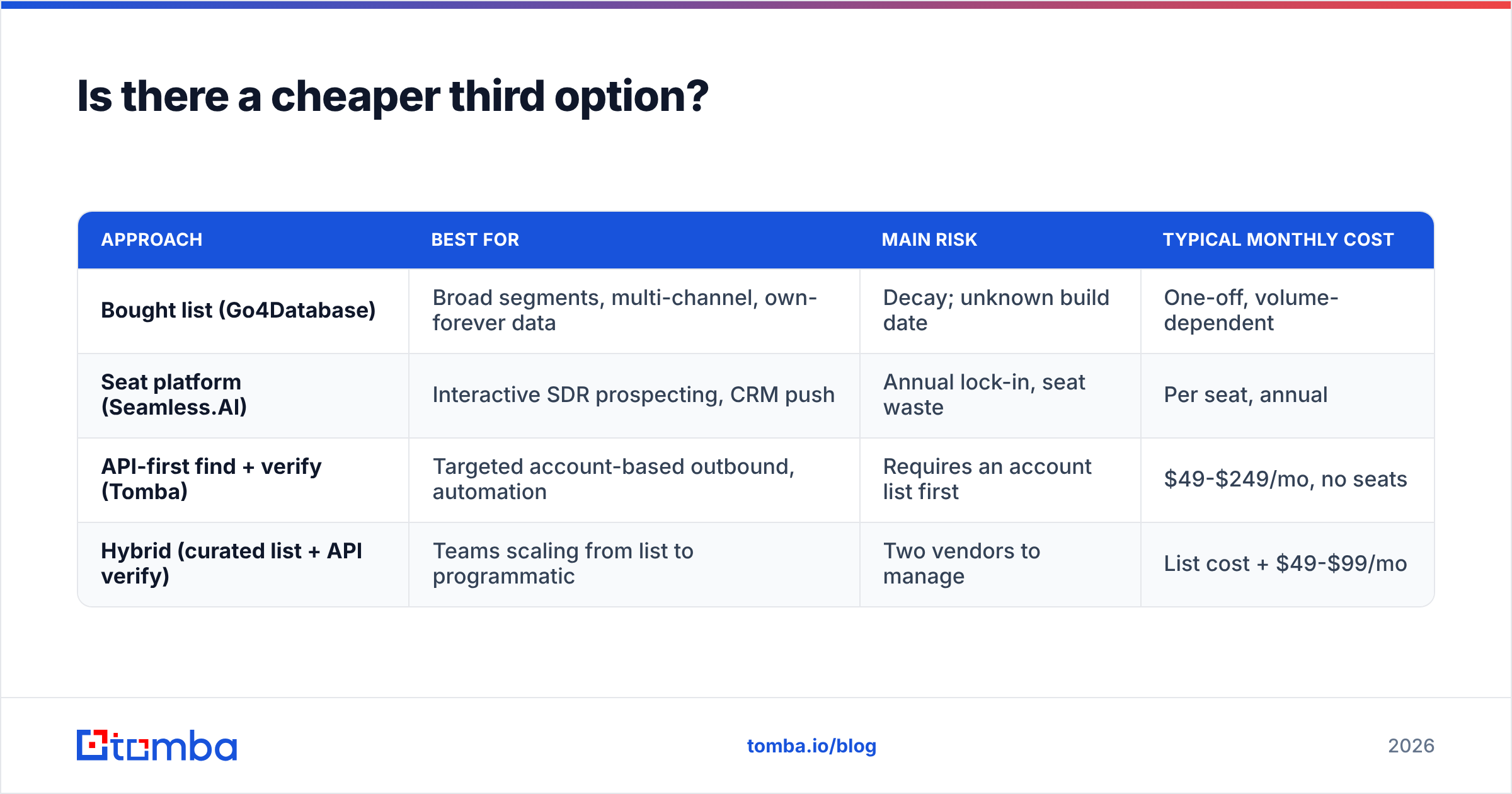
| Bought list (Go4Database) | Broad segments, multi-channel, own-forever data | Decay; unknown build date | One-off, volume-dependent |
| Seat platform (Seamless.AI) | Interactive SDR prospecting, CRM push | Annual lock-in, seat waste | Per seat, annual |
| API-first find + verify (Tomba) | Targeted account-based outbound, automation | Requires an account list first | $49-$249/mo, no seats |
| Hybrid (curated list + API verify) | Teams scaling from list to programmatic | Two vendors to manage | List cost + $49-$99/mo |
How should you run the evaluation?#
Give yourself two weeks and a scorecard. Settle Go4Database vs Seamlessai on your own data, not on a demo.
- Week 1 — sample. Get 200 records from each candidate covering the same segment. Use Go4Database's sample file and Seamless.AI's free tier credits. Do not tell them which segment you plan to buy at scale.
- Run independent verification on all samples with the same verifier so the comparison is fair. A free email checker handles spot checks; use bulk verification for the full sample.
- Week 2 — send. Take the verified subset from each and run an identical 100-contact sequence. Same copy, same sender, same times. Compare bounce rate, open rate, and reply rate side by side.
- Score on cost per reply, not cost per record. That single metric collapses accuracy, freshness, and price into one honest number.
- Then negotiate. You now have data. Vendors move on price when you can quote their own bounce rate back to them.
The verdict#
Go4Database vs Seamlessai has no single winner. It comes down to how you sell.
Go4Database is the better buy if you want to own data outright, work broad segments, and avoid subscriptions entirely — provided you extract a build date and a bounce-rate guarantee in writing, and verify the file yourself before the first send.
Seamless.AI is the better buy if you have funded SDR seats doing interactive, account-by-account prospecting with CRM push, and you can live with annual commitment terms. Read the renewal clause twice.
Neither is the right buy if your outbound is targeted rather than broad. If your total addressable market is 3,000 accounts rather than 300,000, you do not need a list or a seat licence. You need accurate contacts on demand and rigorous verification. That is exactly what an API-first stack gives you, at a fraction of both.
Start with the Tomba Email Finder — 25 free searches a month, no card, no seat minimum. Run your 200-record accuracy test against whatever Go4Database or Seamless.AI quote you, and let the bounce rates pick the winner. If Tomba loses the test, you have lost nothing but an afternoon. If it wins, you have just cut your data line item by an order of magnitude.
Related guides#
Ready to find emails that actually work?
Join 150,000+ professionals who stopped guessing and started sending. Free credits on signup — no credit card required.
Get the Tomba newsletter
Practical outbound tactics and product updates — once every two weeks.
About the author