Go4database vs UpLead 2026: Which B2B Data Source Wins?
One sells you a static prospect list. The other sells you seat-based access to a searchable database with verification on export. Here's how Go4database and UpLead actually compare on price, accuracy, and cost per usable contact.
TL;DR
- Go4database sells packaged and custom B2B contact lists — you pay once, get a CSV, and own the file. UpLead sells subscription access to a searchable contact database with per-contact credits and verification at export time.
- Price per record looks cheaper with a bought list, but the number that matters is cost per usable contact after verification. That flips the math often enough that you should run it before signing either contract.
- UpLead's real advantage is the search-and-filter workflow plus a documented accuracy guarantee. Go4database's real advantage is volume: you can buy 50,000 records in one purchase order without a per-seat subscription.
- Neither tool solves the freshness problem on its own. Any list — bought or exported — decays roughly 2–2.5% per month as people change jobs.
- If your ICP is narrow and you need emails for named companies rather than bulk volume, an on-demand email finder plus a verification step is usually cheaper than either.
What are Go4database and UpLead?#
They are two different business models that happen to sell the same raw material.
Go4database is a B2B data vendor in the list-brokerage tradition. You tell them the segment — industry, job title, geography, technology, company size — and they quote you a file. Delivery is a CSV or Excel export. Pricing is negotiated per project rather than published as a self-serve tier, and volume discounts are the norm. The company positions itself around pre-built industry lists (healthcare, technology, manufacturing) plus custom builds.
UpLead is a self-serve prospecting platform. You log in, apply filters across roughly 50+ attributes, preview matching companies and people, and spend credits to reveal contact details. The pitch that shows up in almost every UpLead review on G2 is the 95% data accuracy guarantee: emails are verified in real time at the moment you reveal them, and invalid ones aren't supposed to consume a credit.
The distinction sounds academic until you look at what happens after purchase. With Go4database, the file's accuracy was fixed at the moment of delivery. With UpLead, verification happens when you export — which is later, and therefore fresher.
How does Go4database's pricing model work?#
Go4database does not publish standard self-serve tiers. You submit a segment request, they run counts, and you get a quote. In practice, list vendors in this category price somewhere between roughly $0.05 and $0.40 per record depending on volume, targeting depth, and whether you want phone numbers attached.
What to nail down in writing before you pay:
- Verification date, not verification claim. "Verified" is meaningless without a timestamp. Ask when each record was last validated and what method was used — SMTP check, human confirmation, or activity signal.
- Bounce guarantee mechanics. Most vendors offer a replacement credit above a bounce threshold (often 5–10%). Replacement credits are worth far less than a refund, because you already burned domain reputation on the bad sends.
- Licence terms. Single-use, multi-use, or perpetual? Some list licences restrict you to one campaign, and they seed the file with trap addresses to detect reuse.
- Suppression handling. You need the vendor to honour your existing suppression list, and you need a documented opt-out flow for GDPR and CAN-SPAM compliance.
- Sample before purchase. Insist on 100 random records from the actual segment — not a curated demo file — and verify them yourself.
That last point is non-negotiable. Run the sample through an independent email verifier before you spend anything. A 100-record sample costs you almost nothing and tells you the real deliverable rate.
How does UpLead's pricing model work?#
UpLead publishes tiers, which is a meaningful transparency advantage. At the time of writing, the structure is roughly: a free trial with a handful of credits, an Essentials plan around $99/month, a Plus plan around $199/month, and a custom Professional tier for teams needing API access, higher credit volumes, and advanced enrichment. Credits are consumed per revealed contact, and annual billing knocks the effective monthly rate down. Check uplead.com for current numbers — SaaS pricing moves.
The credit model has two consequences most buyers underestimate:
- Unused credits usually expire. If you buy for a quarter of aggressive prospecting and then get pulled into a product launch, that budget evaporates.
- Enrichment fields can cost extra credits. Revealing an email and revealing a direct dial are often separate charges. Model your blended cost, not the headline per-credit price.
Go4database vs UpLead: how do they compare feature by feature?#
| Attribute | Go4database | UpLead |
|---|---|---|
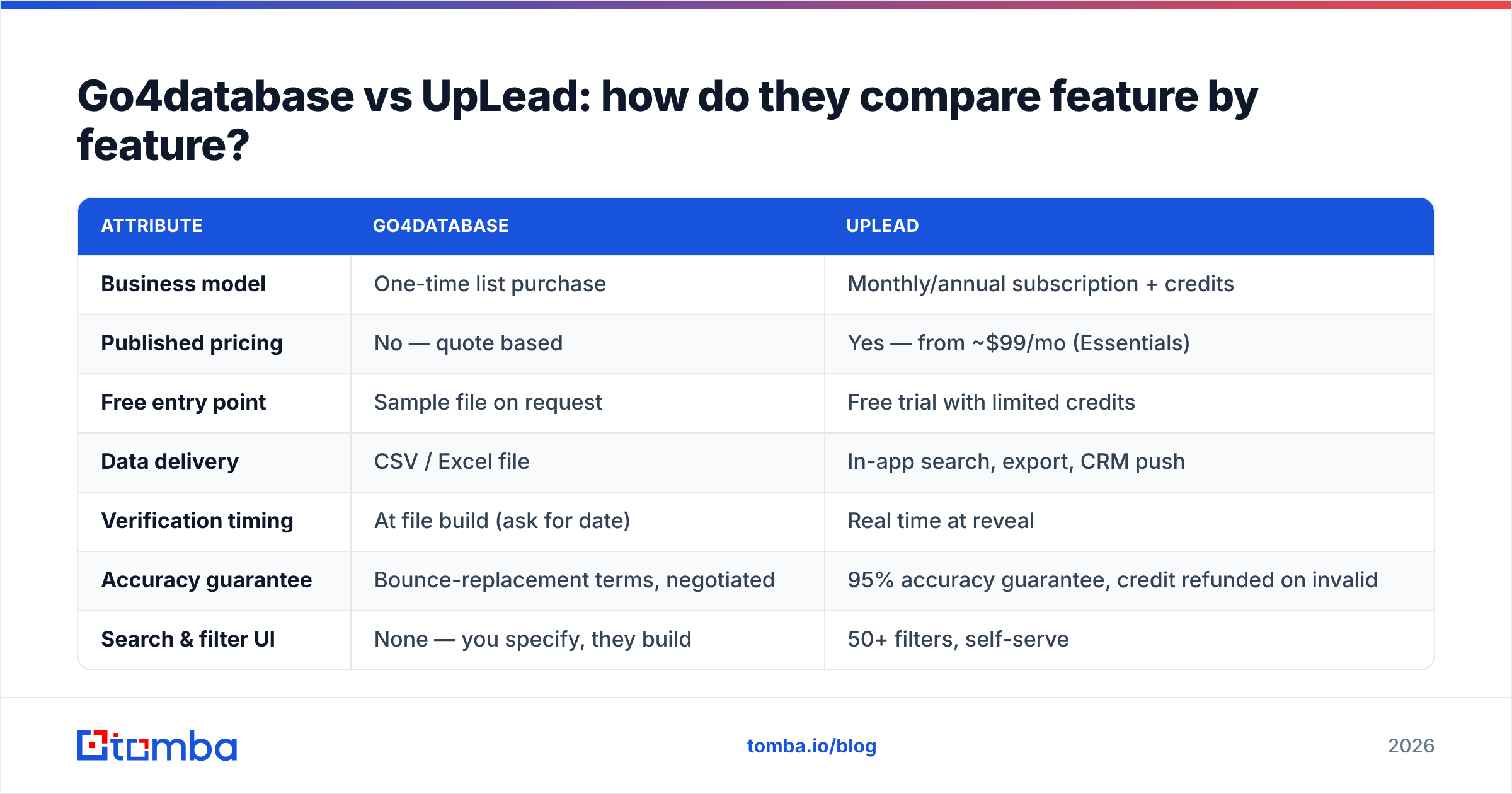
| Business model | One-time list purchase | Monthly/annual subscription + credits |
| Published pricing | No — quote based | Yes — from ~$99/mo (Essentials) |
| Free entry point | Sample file on request | Free trial with limited credits |
| Data delivery | CSV / Excel file | In-app search, export, CRM push |
| Verification timing | At file build (ask for date) | Real time at reveal |
| Accuracy guarantee | Bounce-replacement terms, negotiated | 95% accuracy guarantee, credit refunded on invalid |
| Search & filter UI | None — you specify, they build | 50+ filters, self-serve |
| Phone numbers | Available as add-on | Included on higher tiers |
| Intent data | Not a core offering | Available on upper tiers |
| API access | Limited / not core | Yes, on higher plans |
| Best for | High-volume single-segment buys | Iterative, narrow ICP prospecting |
| Worst for | Narrow ICPs, iterative testing | Cheap bulk volume |
The pattern is clear: Go4database wins on unit economics at volume; UpLead wins on control, iteration, and recency.

Which one actually delivers better data accuracy?#
UpLead, on the evidence available — but with a caveat that matters more than the headline.
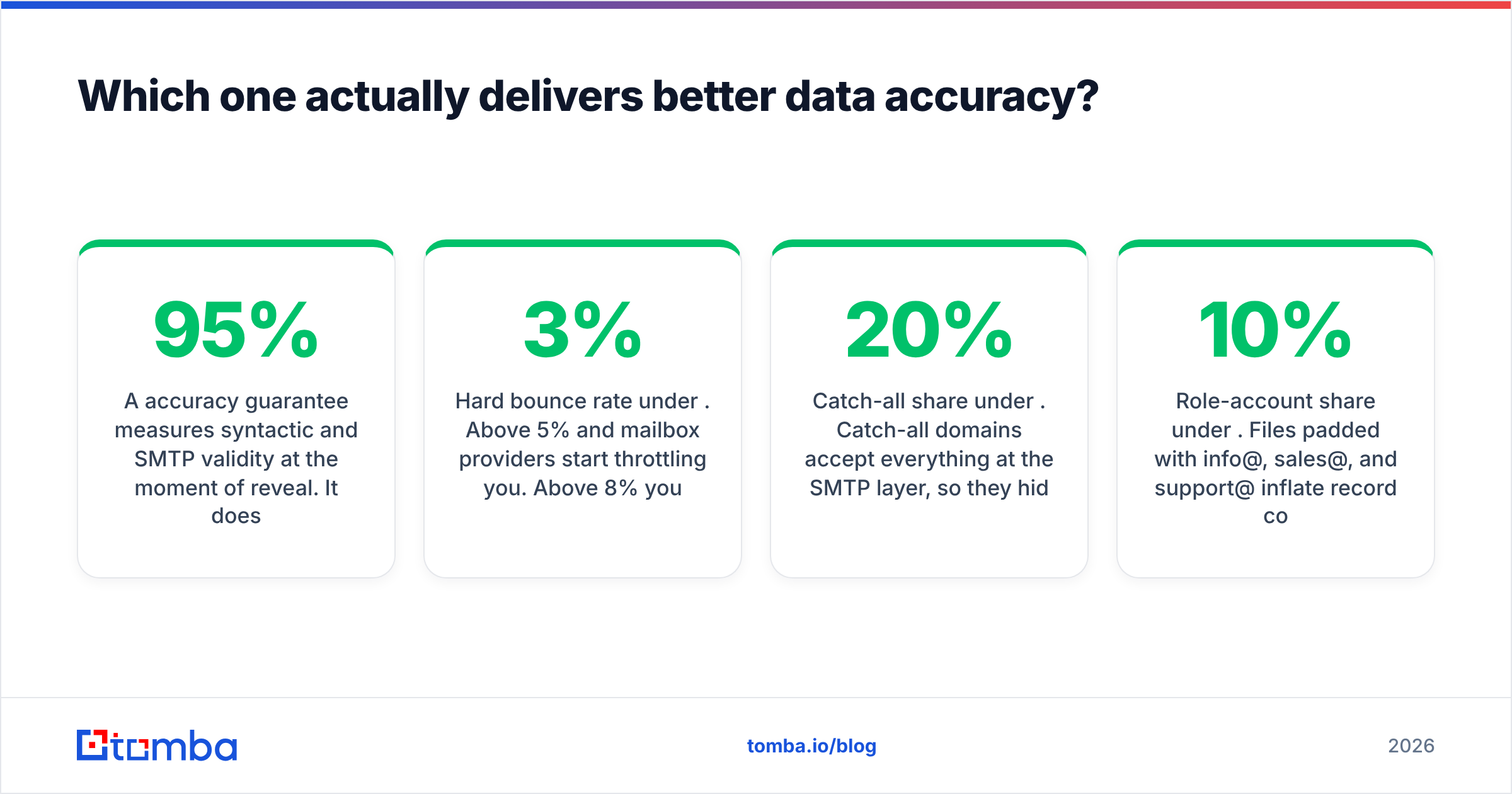
A 95% accuracy guarantee measures syntactic and SMTP validity at the moment of reveal. It does not measure whether the person still works there, whether the address is monitored, or whether the mailbox is a shared alias that nobody reads. You can have a technically valid email that produces zero replies because it belongs to someone who left eight months ago and whose account forwards into a black hole.
Bought lists fail on a different axis. Their problem isn't usually syntax — it's age. A file assembled 14 months ago against a mid-market SaaS segment has lost roughly a quarter of its accuracy to job changes alone, before you account for company closures and domain migrations.
Practical benchmarks to hold both vendors to:
- Hard bounce rate under 3%. Above 5% and mailbox providers start throttling you. Above 8% you have a sender reputation problem that outlives the campaign.
- Catch-all share under 20%. Catch-all domains accept everything at the SMTP layer, so they hide bad addresses inside a "valid" verdict. Route them through a dedicated catch-all verifier instead of trusting the vendor's status column.
- Role-account share under 10%. Files padded with info@, sales@, and support@ inflate record counts and depress reply rates.
- Duplicate rate under 2%. Ask for the deduplication method. Some vendors count the same person at two email variants as two records.
Whichever vendor you pick, do your own verification pass on delivery. It costs a fraction of a percent of the data spend and it is the only number you can defend in a QBR.
What does each option really cost per usable contact?#
This is where the comparison stops being about features.
Take a 10,000-record buy. Assume Go4database quotes $0.12 per record — $1,200 total — and the file verifies at 72% deliverable after you strip bounces, role accounts, and unverifiable catch-alls. Your real cost is $1,200 ÷ 7,200 = $0.167 per usable contact.
Now take UpLead at the Plus tier: roughly $199/month for around 400 credits. Assume 94% of revealed emails are deliverable. That's $199 ÷ 376 = $0.53 per usable contact — over three times more per record.
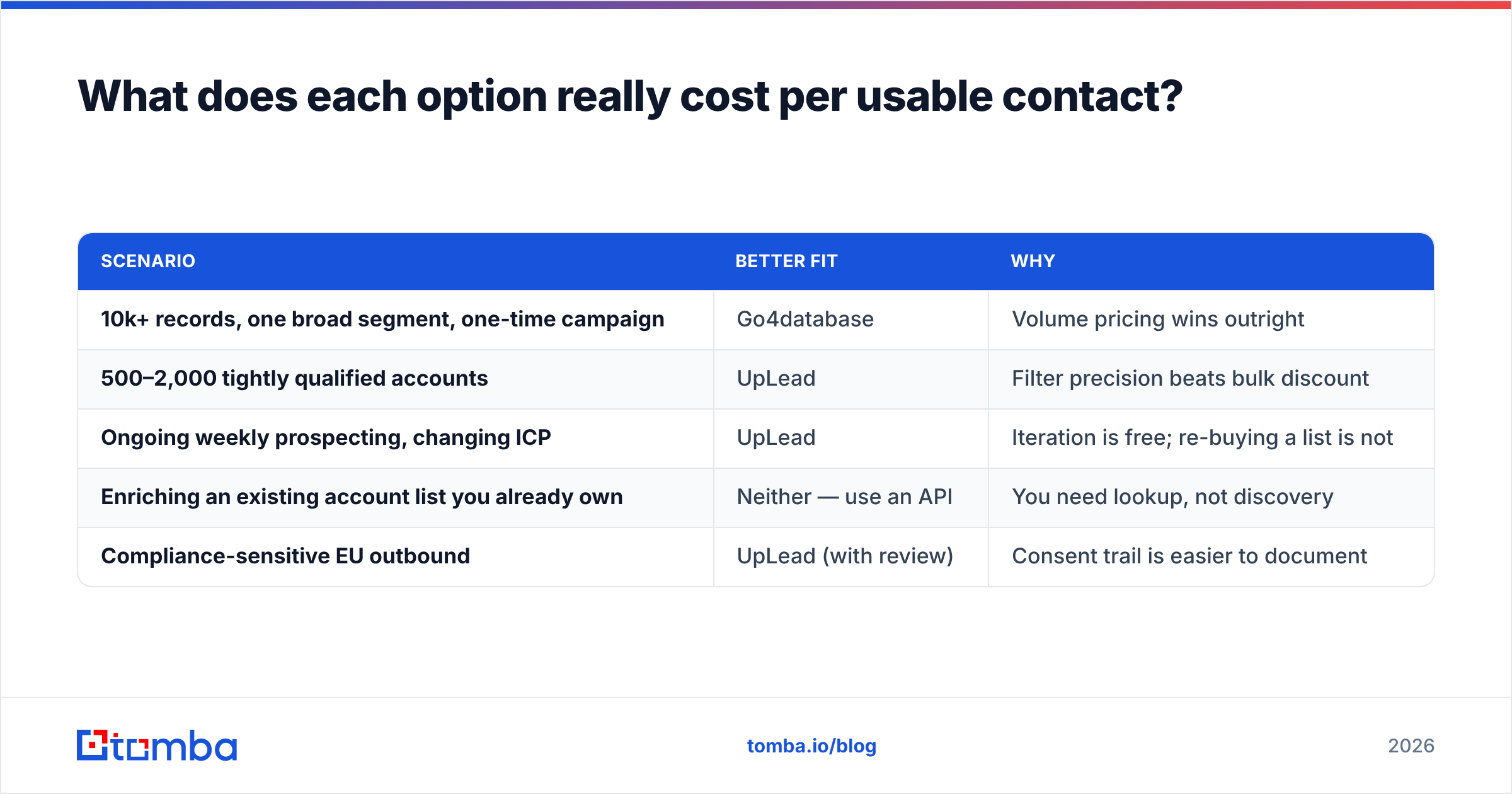
So Go4database wins? Only if you actually need 10,000 contacts in that segment. Most B2B teams do not. If your total addressable list is 1,200 accounts with two personas each, buying 10,000 records means paying to acquire 7,600 people you will never contact. The cheap-per-record option becomes the expensive-per-relevant-record option.
| Scenario | Better fit | Why |
|---|---|---|
| 10k+ records, one broad segment, one-time campaign | Go4database | Volume pricing wins outright |
| 500–2,000 tightly qualified accounts | UpLead | Filter precision beats bulk discount |
| Ongoing weekly prospecting, changing ICP | UpLead | Iteration is free; re-buying a list is not |
| Enriching an existing account list you already own | Neither — use an API | You need lookup, not discovery |
| Compliance-sensitive EU outbound | UpLead (with review) | Consent trail is easier to document |

What are the best alternatives to both?#
The Go4database vs UpLead framing assumes you need a database. Often you need a lookup service instead.
If you already know which companies you want — from a conference attendee list, a funding announcement, a competitor's customer page, or your own website traffic — you don't need to pay for search. You need to convert known companies and names into verified contact details on demand.

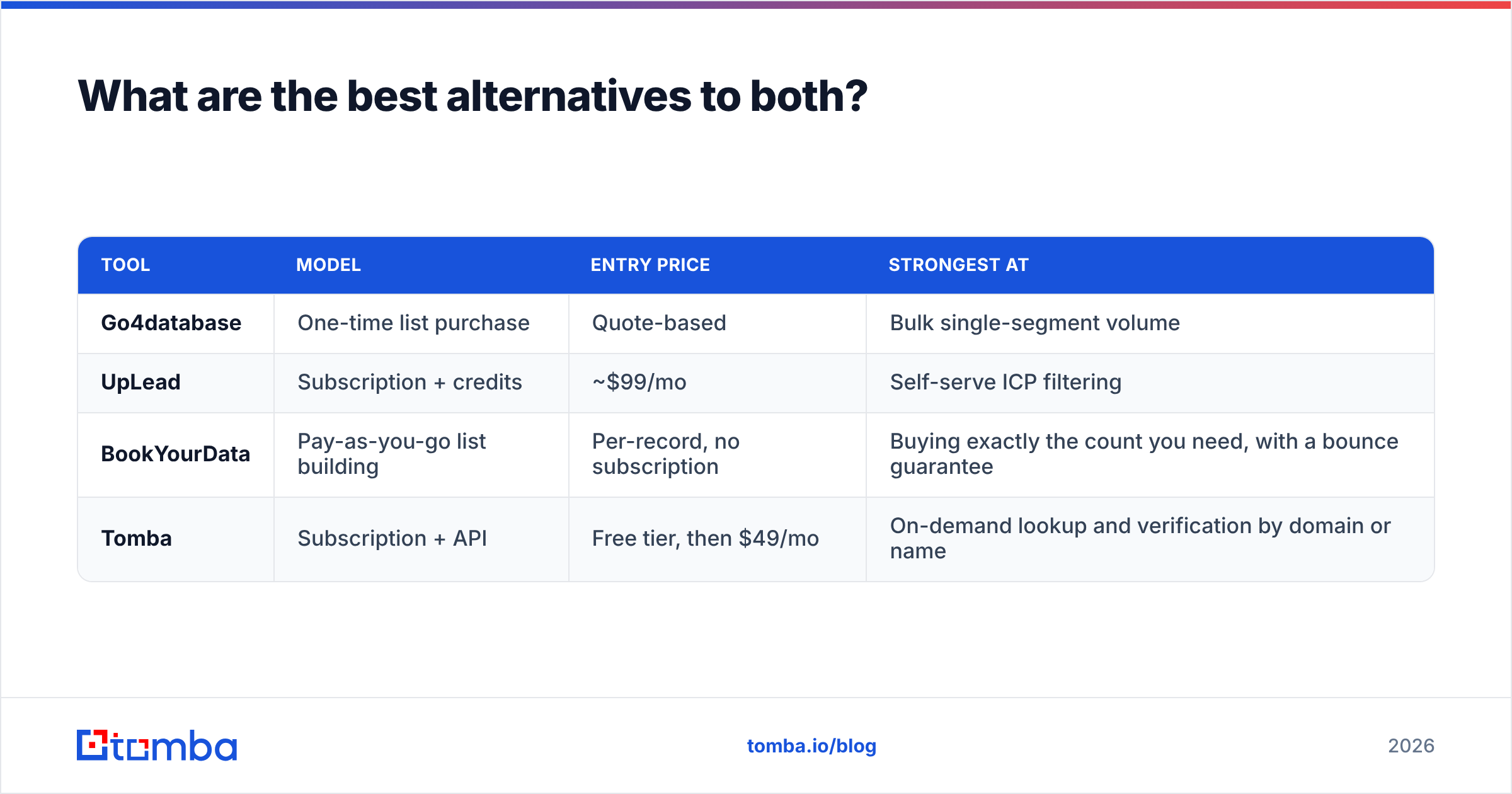
| Tool | Model | Entry price | Strongest at |
|---|---|---|---|
| Go4database | One-time list purchase | Quote-based | Bulk single-segment volume |
| UpLead | Subscription + credits | ~$99/mo | Self-serve ICP filtering |
| BookYourData | Pay-as-you-go list building | Per-record, no subscription | Buying exactly the count you need, with a bounce guarantee |
| Tomba | Subscription + API | Free tier, then $49/mo | On-demand lookup and verification by domain or name |
BookYourData is worth a look specifically because it removes the subscription commitment — you buy the records you need and stop, which suits teams running two or three campaigns a year rather than a continuous outbound motion. It sits between the two models in this post rather than competing directly with either.
Tomba approaches the problem from the lookup side. Domain search returns the contacts published at a company domain along with the detected email pattern; the email finder resolves a specific first name, last name, and domain into a verified address; and verification runs on the same platform so you're not stitching two vendors together. Tomba pricing starts with a free tier of 25 searches per month, then Starter at $49/mo, Growth at $99/mo, and Pro at $249/mo. For teams whose prospecting is triggered by events — a job change, a funding round, a website visit — that on-demand model costs a fraction of maintaining a database subscription you query twice a week.
How should you run the evaluation?#
Do not decide from pricing pages. Run a controlled bake-off:
- Define one narrow segment you know well — say, VP Marketing at 50–200 employee SaaS companies in the UK. You need to be able to eyeball results and spot nonsense.
- Request 100 records from each vendor. Go4database will provide a sample; UpLead's trial credits cover it; Tomba's free tier covers 25.
- Verify all three files with the same third-party tool so the measurement is neutral. Record hard bounces, catch-alls, role accounts, and duplicates separately.
- Spot-check 20 records manually against LinkedIn and company sites. This catches the failure verification can't see: right email, wrong employer.
- Send a small campaign — 50 contacts per source, identical copy and sequence. Compare bounce rate, reply rate, and positive reply rate.
- Compute cost per positive reply, not cost per record. That is the only metric your pipeline actually cares about.
The whole exercise takes about a week and routinely changes the answer people were sure of at the start.
Which should you buy?#
Buy Go4database if you need a large one-time file in a single well-defined segment, you have negotiating leverage on price and bounce terms, and you can accept a fixed snapshot. Get the verification date, a real sample, and replacement terms in writing.
Buy UpLead if your prospecting is continuous, your ICP shifts, and you value filtering and export control more than raw volume. The published pricing and accuracy guarantee make it the lower-risk choice for a team that hasn't run a data bake-off before.
Buy neither if your outbound is triggered by events rather than segments. When you already know the account, paying for a database is paying for a search you don't need.
That last case is where Tomba fits. Point the Tomba Email Finder at a name and a domain and get back a verified address with a confidence score and the sources it was found in — no per-seat contract, no expiring credits, no 10,000-row file where 7,600 rows were never your buyer. Start on the free tier, verify 25 contacts against whatever list you're currently paying for, and let the bounce rate decide.
Related guides#
Ready to find emails that actually work?
Join 150,000+ professionals who stopped guessing and started sending. Free credits on signup — no credit card required.
Get the Tomba newsletter
Practical outbound tactics and product updates — once every two weeks.
About the author