GoAgentic Pricing in 2026: Real Costs, Limits, and Alternatives
GoAgentic sells AI outbound agents, not seats — which makes the invoice harder to predict than it looks. Here is how the pricing model actually works, what drives the number up, and when a cheaper data-first stack wins.
TL;DR
- GoAgentic sells "AI outbound agents" rather than seats, so the price you pay depends on volume and workflow scope, not headcount — and most of the real numbers arrive after a demo call, not from a public price page.
- Budget for the platform fee plus data, mailboxes, warmup, and enrichment. In agentic outbound, the license is rarely more than 50–60% of the true monthly spend.
- The category benchmark for AI SDR / agentic outbound platforms in 2026 sits roughly between $500 and $2,000/month for a small team, with enterprise contracts well past that. Anything cheaper is usually a sequencer with an LLM bolted on.
- If your bottleneck is contact data quality, not message generation, a data-first stack (finder + verifier + your existing sequencer) costs a fraction and fixes the actual problem.
- Run the same 500-contact list through both approaches before you sign anything annual. Bounce rate and reply rate will decide it faster than a feature matrix.
What is GoAgentic and what are you paying for?#
GoAgentic positions itself in the agentic outbound category: software that doesn't just send sequences but researches accounts, drafts personalized messaging, and executes multi-step outreach with minimal human input. You can review its current positioning and plan structure directly on the official GoAgentic site.
That framing matters for pricing, because it changes the unit you're billed on. Traditional sales engagement tools (Outreach, Salesloft, Apollo) charge per seat — five reps, five licenses, predictable invoice. Agentic platforms charge for work performed: accounts researched, messages generated, sequences executed, agents running. Think of it as the difference between hiring a salaried assistant and paying a contractor by the task. The salaried cost is boring and predictable. The contractor cost scales with how much you actually ask for, which is great when volume is low and alarming when it isn't.
So "GoAgentic pricing" is not really one number. It's a formula with three inputs: how many agents you run, how much volume each one processes, and how much data you feed them.
How does GoAgentic pricing actually work?#
Like most vendors in this category, GoAgentic gates its detailed commercial terms behind a demo or a quote rather than publishing a full self-serve price list with every limit spelled out. That is a deliberate sales motion, not an accident — quote-gating lets a vendor price by company size, and it means two buyers with identical usage can pay very different amounts.
Practically, here's what determines your line item:
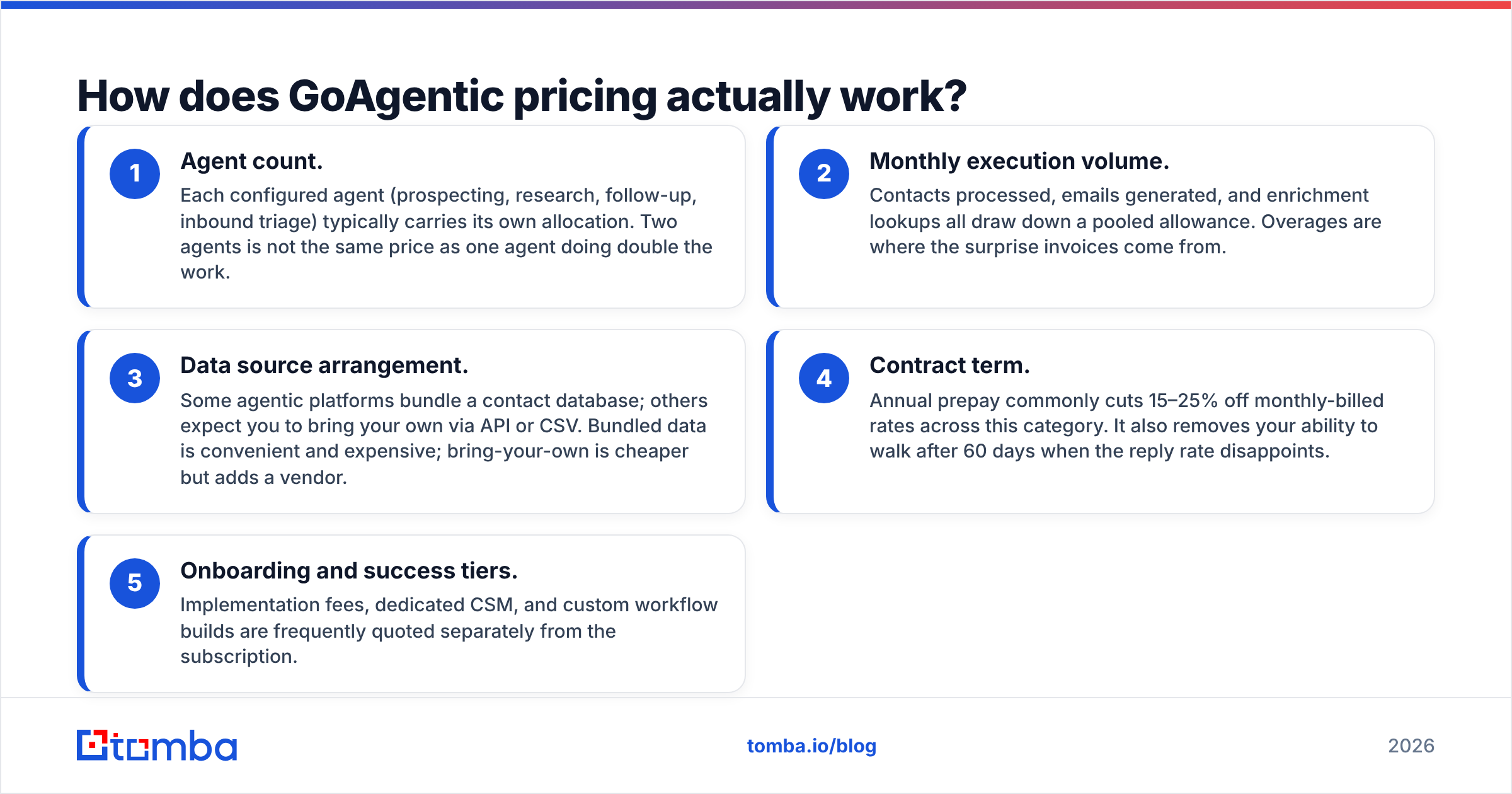
- Agent count. Each configured agent (prospecting, research, follow-up, inbound triage) typically carries its own allocation. Two agents is not the same price as one agent doing double the work.
- Monthly execution volume. Contacts processed, emails generated, and enrichment lookups all draw down a pooled allowance. Overages are where the surprise invoices come from.
- Data source arrangement. Some agentic platforms bundle a contact database; others expect you to bring your own via API or CSV. Bundled data is convenient and expensive; bring-your-own is cheaper but adds a vendor.
- Contract term. Annual prepay commonly cuts 15–25% off monthly-billed rates across this category. It also removes your ability to walk after 60 days when the reply rate disappoints.
- Onboarding and success tiers. Implementation fees, dedicated CSM, and custom workflow builds are frequently quoted separately from the subscription.
Ask for all five in writing before you compare GoAgentic to anything else. A quote that only shows the platform fee is not a quote.

What does agentic outbound really cost per month?#
Here's the part vendors don't put on the pricing page: the software license is the smallest predictable piece of a working outbound program. Model the whole stack.
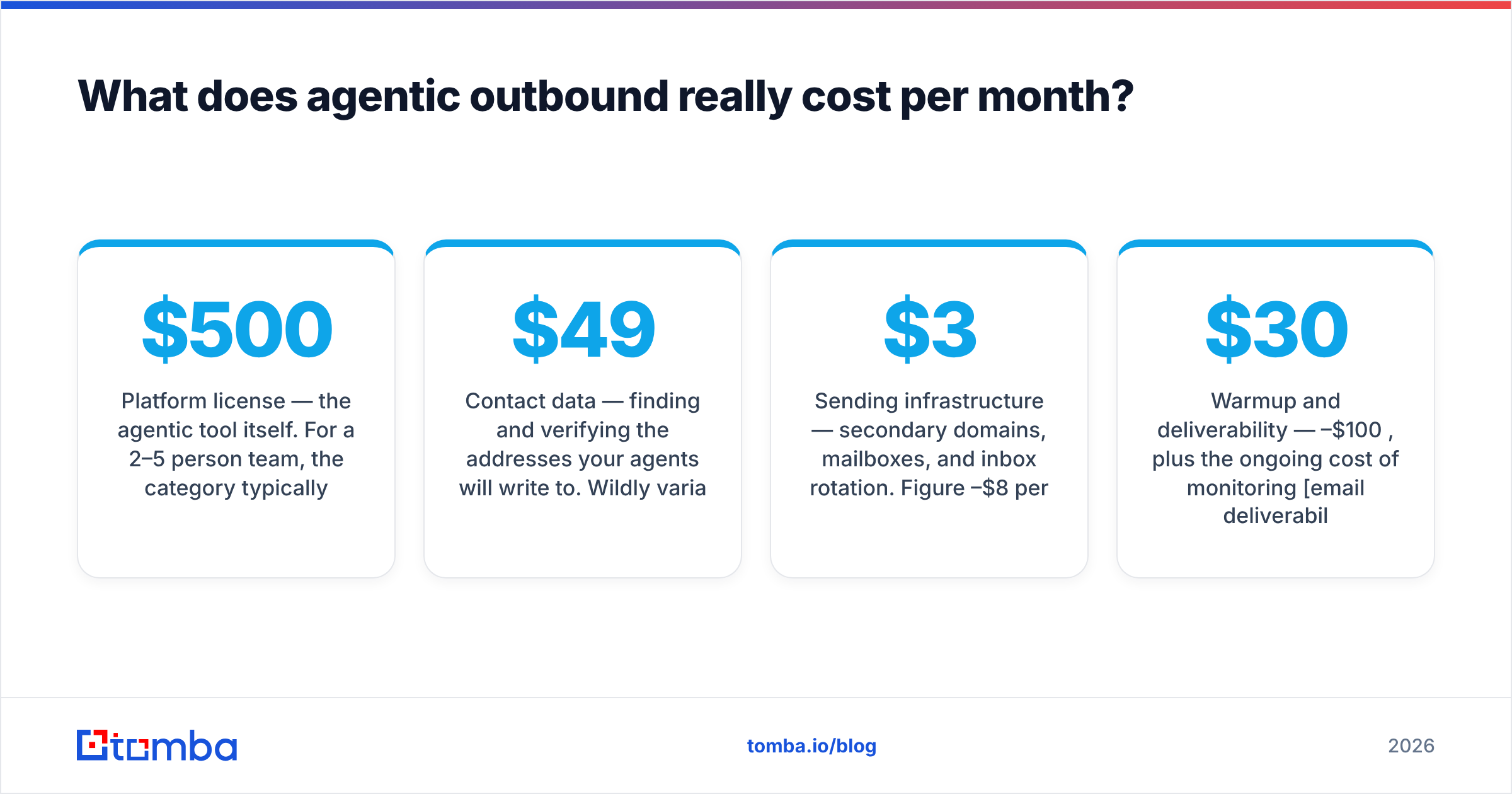
- Platform license — the agentic tool itself. For a 2–5 person team, the category typically lands in the $500–$2,000/month range depending on volume tier and contract length.
- Contact data — finding and verifying the addresses your agents will write to. Wildly variable: from $49/month for a focused email finder to $1,000+/month for a full B2B database seat.
- Sending infrastructure — secondary domains, mailboxes, and inbox rotation. Figure $3–$8 per mailbox per month, and you'll want 10–30 of them at any real volume.
- Warmup and deliverability — $30–$100/month, plus the ongoing cost of monitoring email deliverability so your agents aren't writing beautiful copy into a spam folder.
- Human review time — the honest one. Even "autonomous" agents need a human approving copy and handling replies for the first 60–90 days. Price that at whatever an SDR hour costs you.
Add it up. A team quoted $900/month for the platform is usually running a $1,600–$2,200/month program. That's not a criticism of GoAgentic specifically — it's true of every tool in the category, and buyers who model only the license line always feel misled later.
How does GoAgentic pricing compare to other stacks?#
Two things are being compared here, and they aren't the same product. Agentic platforms sell execution. Data tools sell accuracy. Sequencers sell delivery. Below is a like-for-like view of what a small team actually pays per month, using publicly listed prices where vendors publish them.
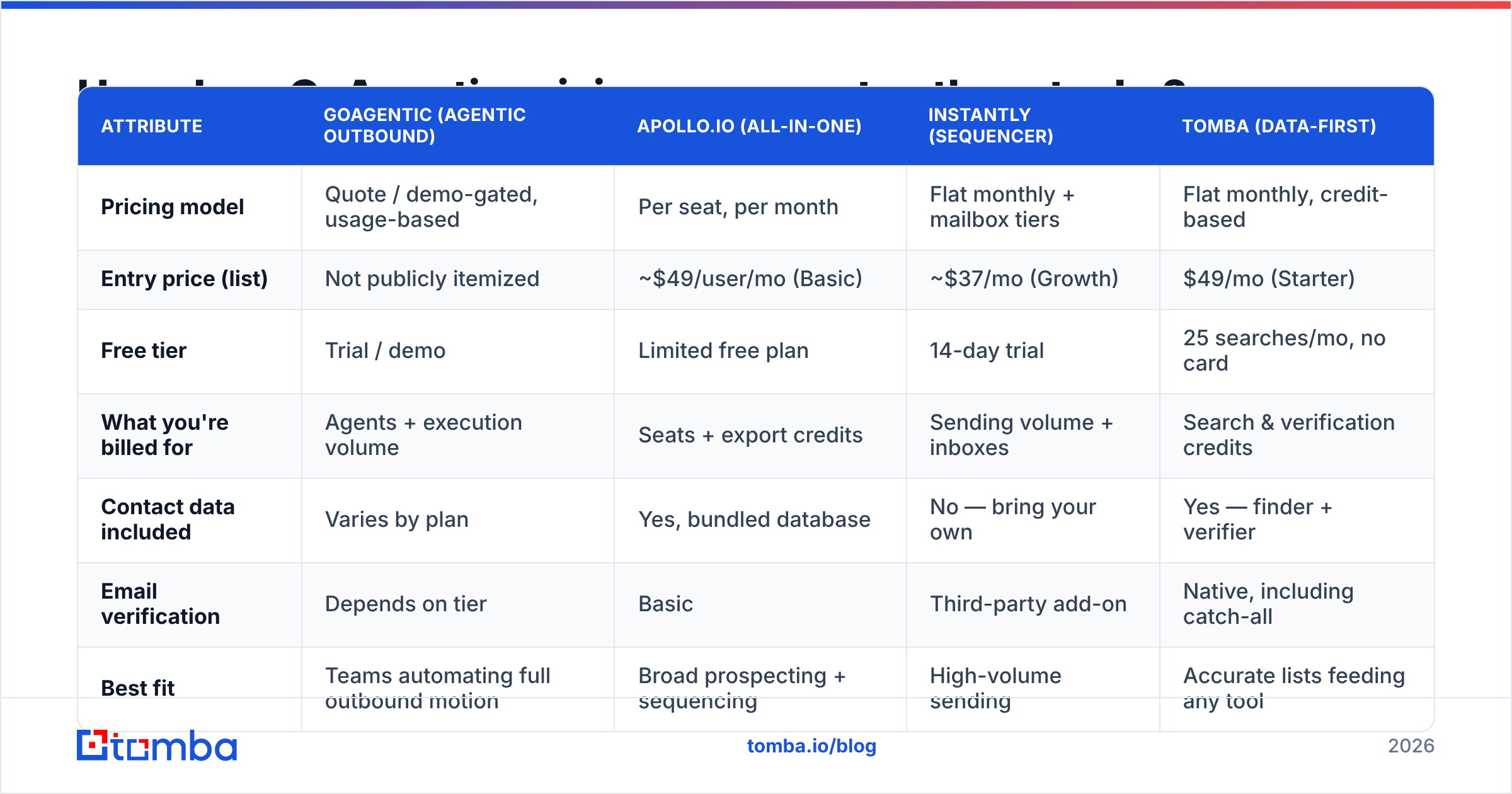
| Attribute | GoAgentic (agentic outbound) | Apollo.io (all-in-one) | Instantly (sequencer) | Tomba (data-first) |
|---|---|---|---|---|
| Pricing model | Quote / demo-gated, usage-based | Per seat, per month | Flat monthly + mailbox tiers | Flat monthly, credit-based |
| Entry price (list) | Not publicly itemized | ~$49/user/mo (Basic) | ~$37/mo (Growth) | $49/mo (Starter) |
| Free tier | Trial / demo | Limited free plan | 14-day trial | 25 searches/mo, no card |
| What you're billed for | Agents + execution volume | Seats + export credits | Sending volume + inboxes | Search & verification credits |
| Contact data included | Varies by plan | Yes, bundled database | No — bring your own | Yes — finder + verifier |
| Email verification | Depends on tier | Basic | Third-party add-on | Native, including catch-all |
| Best fit | Teams automating full outbound motion | Broad prospecting + sequencing | High-volume sending | Accurate lists feeding any tool |
| Annual discount | Typical 15–25% (negotiable) | ~20% | ~20% | See Tomba pricing |
List prices are the vendors' published rates at the time of writing and change often — confirm on each vendor's own page before budgeting. Peer reviews on G2 are the fastest way to sanity-check whether the quoted tier matches what customers actually use.
The takeaway isn't "GoAgentic is expensive." It's that the four columns solve different bottlenecks. If your reps write good emails but can't find valid addresses, buying an agentic platform is paying a premium to automate the part that already works.
What are the hidden costs nobody quotes you?#
Overage rates. Ask what happens on the day you exceed your monthly execution allowance. Hard stop, auto-upgrade, or per-unit overage? The third option has produced more angry renewal calls in this category than any other clause.
Bounce waste. If a platform bills per contact processed, every dead address is billed work that produced nothing — and it damages your sender reputation on the way out. A 12% bounce rate on 10,000 contacts a month isn't just 1,200 wasted credits; it's a deliverability tax on the other 8,800. Running lists through an email verifier before they enter any usage-billed platform is the single highest-ROI habit in this whole stack.
Seat creep on "seatless" pricing. Usage-based plans usually still cap admin users, workspaces, or connected mailboxes. Growth from three reps to eight can trigger a tier change even though nobody is buying seats.
Data re-purchase. If the platform bundles contact data and you later leave, check the export terms. Some contracts restrict retention of enriched records after cancellation, meaning you rebuild the list from scratch at the next vendor.
Integration work. Native CRM sync is table stakes; bidirectional custom field mapping usually isn't. Budget engineering hours or a professional services line if your Salesforce instance is heavily customized. Gartner's research on sales technology consolidation has been consistent on this for years: integration cost is the most underestimated component of GTM software TCO.

Is GoAgentic worth it for your team?#
Yes, if: you have proven product-market fit, a repeatable ICP, and a message that already converts — and your constraint is purely execution capacity. Agentic outbound genuinely compresses the research-and-draft step that eats an SDR's morning. If your team can name the exact segment and the exact pain, an agent will scale it.
Probably not yet, if: you're still testing positioning. Agents amplify whatever you point them at. Pointing them at an unvalidated message just makes you wrong faster, at volume, on domains you'll later need.
Definitely not, if: your bounce rate is above 5%. No amount of AI personalization survives bad contact data. Fix the input before you automate the output — that's not a philosophical point, it's arithmetic. A 25% reply lift on a list where a quarter of addresses are dead nets you less than a clean list with mediocre copy.
The diagnostic question: over your last 1,000 sends, what percentage bounced, and what percentage of the delivered ones got read? If the bounce number is the ugly one, buy data. If the read number is the ugly one, buy copy help. If both are fine and you simply can't send enough, buy agents.
What are the cheaper alternatives to GoAgentic?#
You have three honest paths, and the right one depends on which cost you're trying to avoid.
1. Unbundle the stack. Pair a dedicated data layer with a sequencer you already pay for. A Starter plan at $49/month for finding and verifying contacts, plus your existing outreach tool, plus a $30/month warmup service, gets you a functional outbound motion for well under $150/month. You lose the autonomous research agent; you keep 80% of the outcome. Use the bulk email finder to process lists in batches instead of paying per-contact execution fees.
2. Buy the database, not the agent. Platforms like Apollo or BookYourData sell contact data with solid coverage and transparent per-seat or per-record pricing. BookYourData in particular is a reasonable pick when you want to purchase a defined, verified list outright rather than subscribe to a usage meter — a genuinely different commercial model that suits campaign-based teams.
3. Build it on an API. If you have any engineering capacity, an email finder API plus an LLM call in your own workflow reproduces most of what agentic platforms package, at marginal cost. This is more work up front and dramatically cheaper at scale. It's the right answer for RevOps teams that already run their own enrichment pipeline.
None of these replace GoAgentic feature-for-feature. They replace the outcome — qualified conversations — at a lower monthly number, which is the comparison your CFO is actually making.
How should you run the evaluation?#
Don't compare feature lists. Run a 500-contact bake-off.
- Pick one segment. Same ICP, same job titles, same company size band, split into two matched halves.
- Run half through the agentic platform on its trial or pilot terms. Let it research, draft, and send with your normal review.
- Run the other half through the cheap stack — verified data, your own template, your existing sequencer.
- Measure four numbers only: bounce rate, open rate, reply rate, and meetings booked. Ignore everything else for 30 days.
- Divide by cost. Cost per meeting is the only metric that survives a budget review.
If the agentic side wins on cost per meeting, sign — and negotiate the overage clause hard. If it doesn't, you just saved yourself a five-figure annual commitment and learned that your bottleneck was data all along. Most teams that run this test honestly discover the second outcome.
Where to start if data is your bottleneck#
If the bake-off tells you your problem is dead addresses rather than message volume, start at the source. Tomba's Email Finder locates verified professional addresses by domain, name, or company, with a free tier of 25 searches a month so you can test coverage on your own ICP before spending anything. Starter is $49/month, Growth $99/month, and every plan includes native verification — including catch-all handling — so the list you hand to your sequencer or your AI agents is clean before it costs you a single credit downstream.
Run 100 of your current prospects through it. Compare the bounce rate to what you're getting today. That five-minute test will tell you more about your outbound economics than any vendor demo.
Related guides#
Ready to find emails that actually work?
Join 150,000+ professionals who stopped guessing and started sending. Free credits on signup — no credit card required.
Get the Tomba newsletter
Practical outbound tactics and product updates — once every two weeks.
About the author