Goava Pricing Reviews Pros and Cons: 2026 Buyer Guide
Goava sells Nordic sales intelligence on a quote-only model, which makes budgeting hard. Here's how the pricing actually works, what reviewers praise and complain about, and when a cheaper stack beats it.
This Goava pricing reviews pros and cons guide covers what the tool costs, what users say about it, and who it fits. The short version: Goava is Nordic sales intelligence sold by quote, so the price is never public.
TL;DR
- Goava is a Nordic-focused sales intelligence platform (Sweden, Norway, Denmark, Finland) built around company data, buying signals, and AI lead recommendations that push into your CRM.
- Goava does not publish a public price list. Pricing is quote-only, per-seat, and almost always annual — expect a discovery call before you see a number.
- Reviewers consistently praise the Nordic company data depth and CRM sync; the recurring complaints are contract rigidity, thin coverage outside the Nordics, and contact-level (person + email) gaps.
- It is a strong fit if you sell into Nordic mid-market accounts and already run HubSpot, Salesforce, Upsales, Lime, or SuperOffice. It is a poor fit if you need global contact data or transparent per-credit pricing.
- If your real bottleneck is "I have the company, I need the person's email," a dedicated email finder at $49/mo solves that for a fraction of a seat-based intelligence contract.
What is Goava and who is it actually for?#
Goava is a Swedish sales intelligence platform. The core promise is simple. You stop building account lists by hand. The system scores and ranks companies that look like the ones you already win. Then it shows you why: growth, hiring, tech stack changes, news events, ownership structure.
The product sits in the "who should I call next" layer. It does not sit in the "how do I send the email" layer. That gap matters more than most vendor comparisons admit. It also drives almost every complaint you will read about the tool.
Goava's data foundation is Nordic registry data. Swedish, Norwegian, Danish, and Finnish company records are unusually rich. Official financials, board members, employee counts, and industry codes are all public. Goava pulls these in, adds web-derived signals, and turns the result into filters, lists, and recommendations. You can read the vendor's own framing on goava.com.
Realistically, three buyer profiles get value:
- Nordic B2B sales teams (5–100 reps) selling services, SaaS, or industrial products into Swedish or pan-Nordic mid-market accounts.
- RevOps teams standardizing account data who want a single enrichment source writing into their CRM rather than five browser extensions.
- Agencies and consultancies running territory planning for Nordic clients where firmographic accuracy beats volume.
If you are running global outbound into the US, UK, DACH, or APAC, Goava is the wrong center of gravity. That is not a knock on the product — it is a scope statement the vendor is fairly upfront about.
How does Goava pricing work in 2026?#
Short answer: it is quote-only, seat-based, and annual. There is no self-serve checkout, no published tier table, and no advertised credit pack.
That model has real consequences for how you budget:
- You cannot benchmark before a call. Every number you find in blog roundups is second-hand and unverified. Treat any specific figure — including ranges quoted elsewhere — as directional, not contractual.
- Price scales with seats, modules, and data scope. Adding markets (Norway, Denmark, Finland on top of Sweden), CRM write-back, or API access typically moves the quote.
- Annual commitment is the default. Monthly rolling contracts are the exception, not the norm, in this category.
- Onboarding and implementation may be separate. Ask explicitly whether CRM mapping and training are bundled or billed once.

Here is the practical way to handle a quote-only vendor without wasting three weeks:
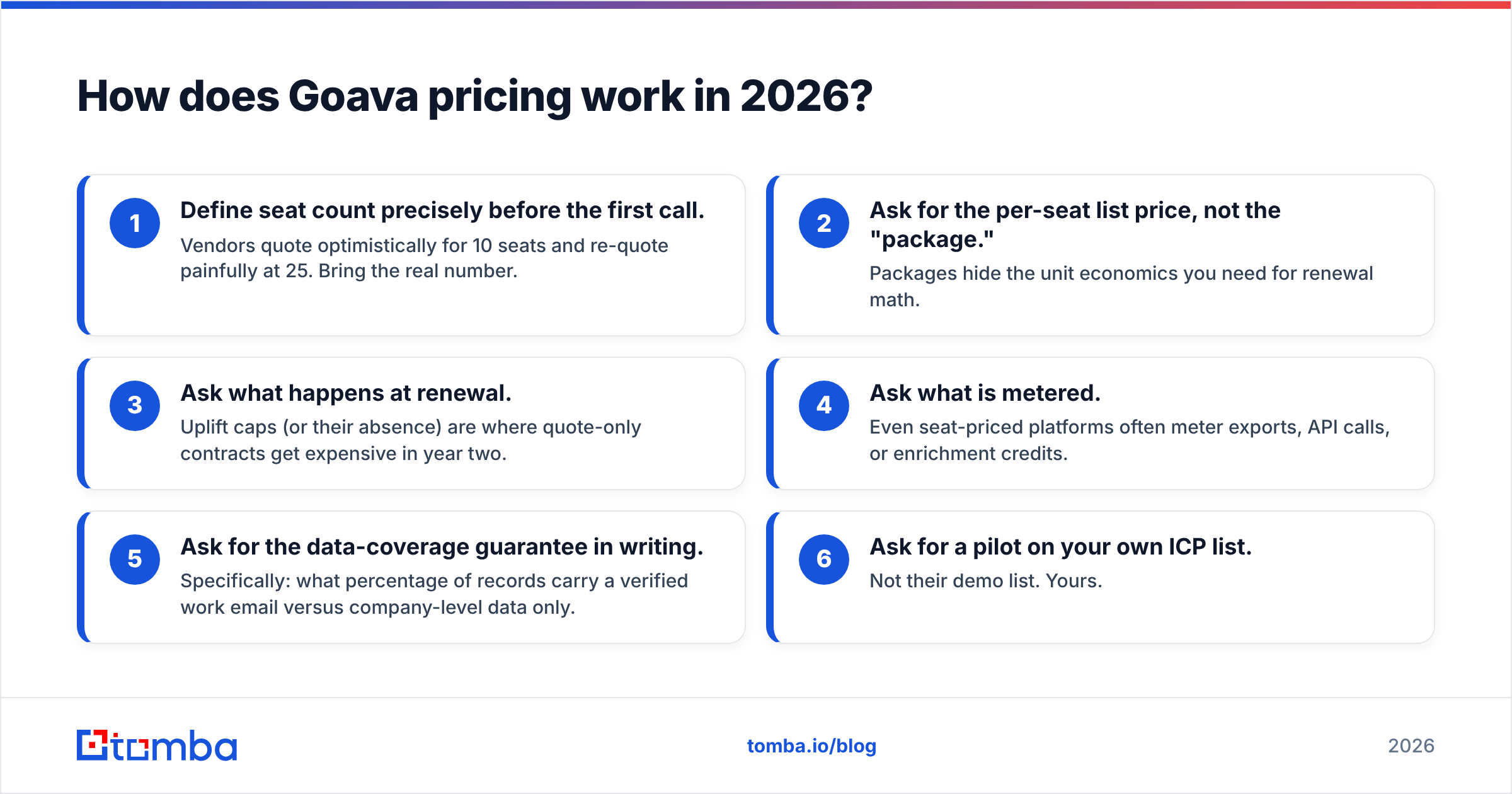
- Define seat count precisely before the first call. Vendors quote optimistically for 10 seats and re-quote painfully at 25. Bring the real number.
- Ask for the per-seat list price, not the "package." Packages hide the unit economics you need for renewal math.
- Ask what happens at renewal. Uplift caps (or their absence) are where quote-only contracts get expensive in year two.
- Ask what is metered. Even seat-priced platforms often meter exports, API calls, or enrichment credits.
- Ask for the data-coverage guarantee in writing. Specifically: what percentage of records carry a verified work email versus company-level data only.
- Ask for a pilot on your own ICP list. Not their demo list. Yours.
If a vendor cannot answer 1–5 in a single call, that is signal about how the rest of the relationship will run.
What do Goava reviews actually say?#
Most Goava pricing reviews pros and cons roundups lean on the same handful of public scores. Read the pattern instead. Aggregate sentiment for Nordic sales intelligence tools — Goava included — clusters in a predictable way. You can sanity-check current scores yourself in the G2 sales intelligence category, which is the least biased public source for this segment.
What reviewers reliably praise:
- Nordic company data depth. Financials, ownership, and org structure that US-first platforms simply do not carry for Swedish or Finnish SMBs.
- Recommendation quality after training. Once the model has enough closed-won history, the "companies like your best customers" feed genuinely reduces list-building time.
- CRM integration. Native sync with HubSpot, Salesforce, Pipedrive, Upsales, Lime, SuperOffice, and Dynamics is a real differentiator versus CSV-first competitors. If you are standardizing on HubSpot CRM, that sync is a meaningful time saver.
- Support responsiveness. Nordic-timezone support in Swedish and English gets mentioned often and positively.
What reviewers reliably complain about:
- Contract rigidity. Annual lock-in with limited mid-term seat reduction is the single most common grievance in this category.
- Contact-level thinness. Company data is strong; named-person data with verified direct emails is the weaker layer. Teams routinely bolt on a separate email finder.
- Coverage cliff outside the Nordics. Expand into Germany or the US and the value proposition drops sharply.
- Learning curve on scoring setup. The AI recommendations need configuration and clean CRM history to be useful. Garbage in, generic recommendations out.
- Price opacity. Not being able to self-qualify on budget frustrates smaller teams.
None of this makes Goava a bad product. It makes it a specific product with a defensible niche and a clear ceiling.
What are the pros and cons of Goava?#
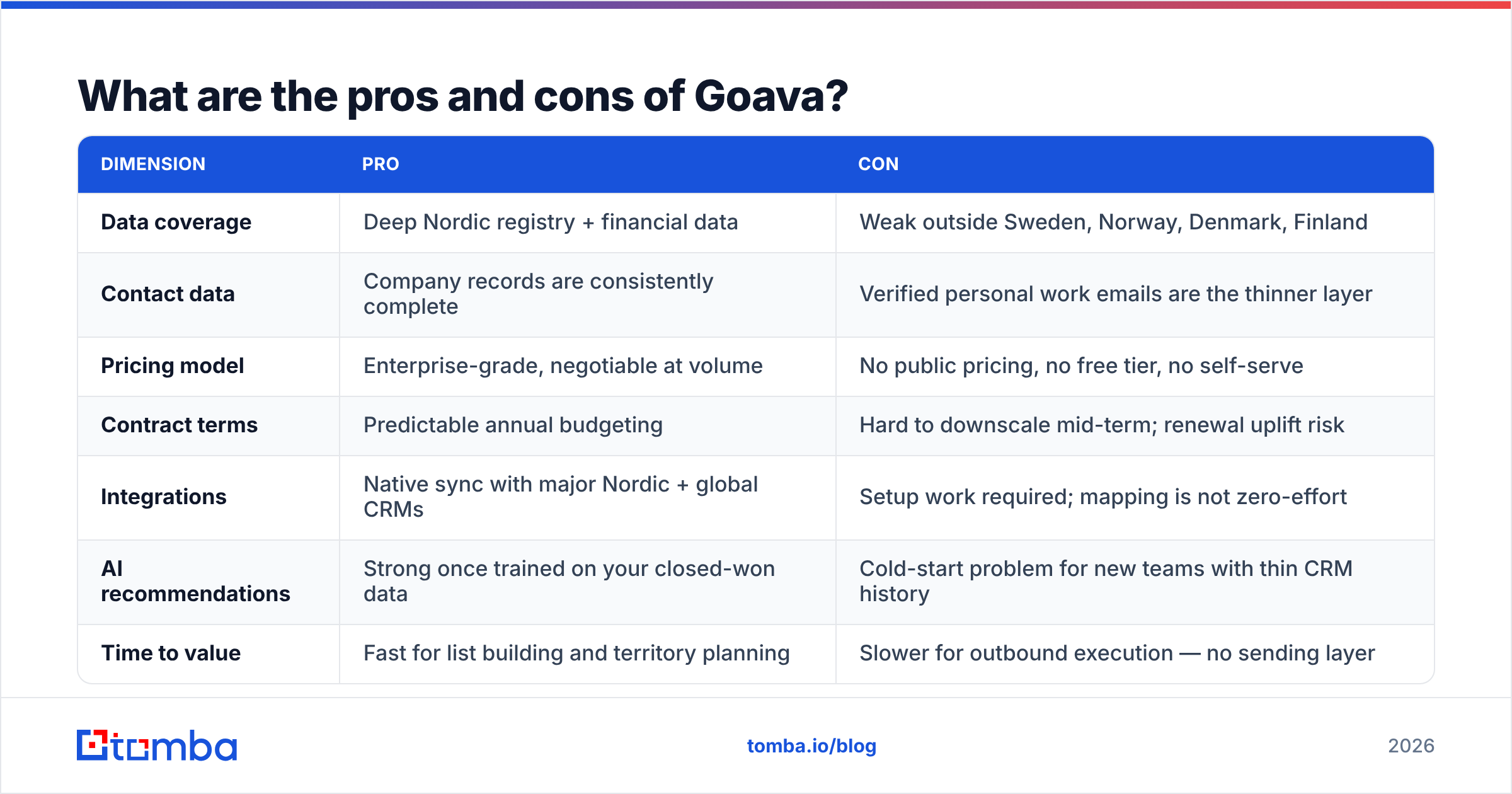
| Dimension | Pro | Con |
|---|---|---|
| Data coverage | Deep Nordic registry + financial data | Weak outside Sweden, Norway, Denmark, Finland |
| Contact data | Company records are consistently complete | Verified personal work emails are the thinner layer |
| Pricing model | Enterprise-grade, negotiable at volume | No public pricing, no free tier, no self-serve |
| Contract terms | Predictable annual budgeting | Hard to downscale mid-term; renewal uplift risk |
| Integrations | Native sync with major Nordic + global CRMs | Setup work required; mapping is not zero-effort |
| AI recommendations | Strong once trained on your closed-won data | Cold-start problem for new teams with thin CRM history |
| Time to value | Fast for list building and territory planning | Slower for outbound execution — no sending layer |
The honest summary: Goava is a targeting tool, not an outbound engine. It tells you which 200 Nordic companies to work. It does not reliably hand you the CFO's direct email and then send the sequence.
How does Goava compare to other prospecting tools?#
Different tools solve different halves of the problem. Comparing a sales intelligence suite to an email finder on price alone is a category error — but comparing what you actually get per dollar is fair game.
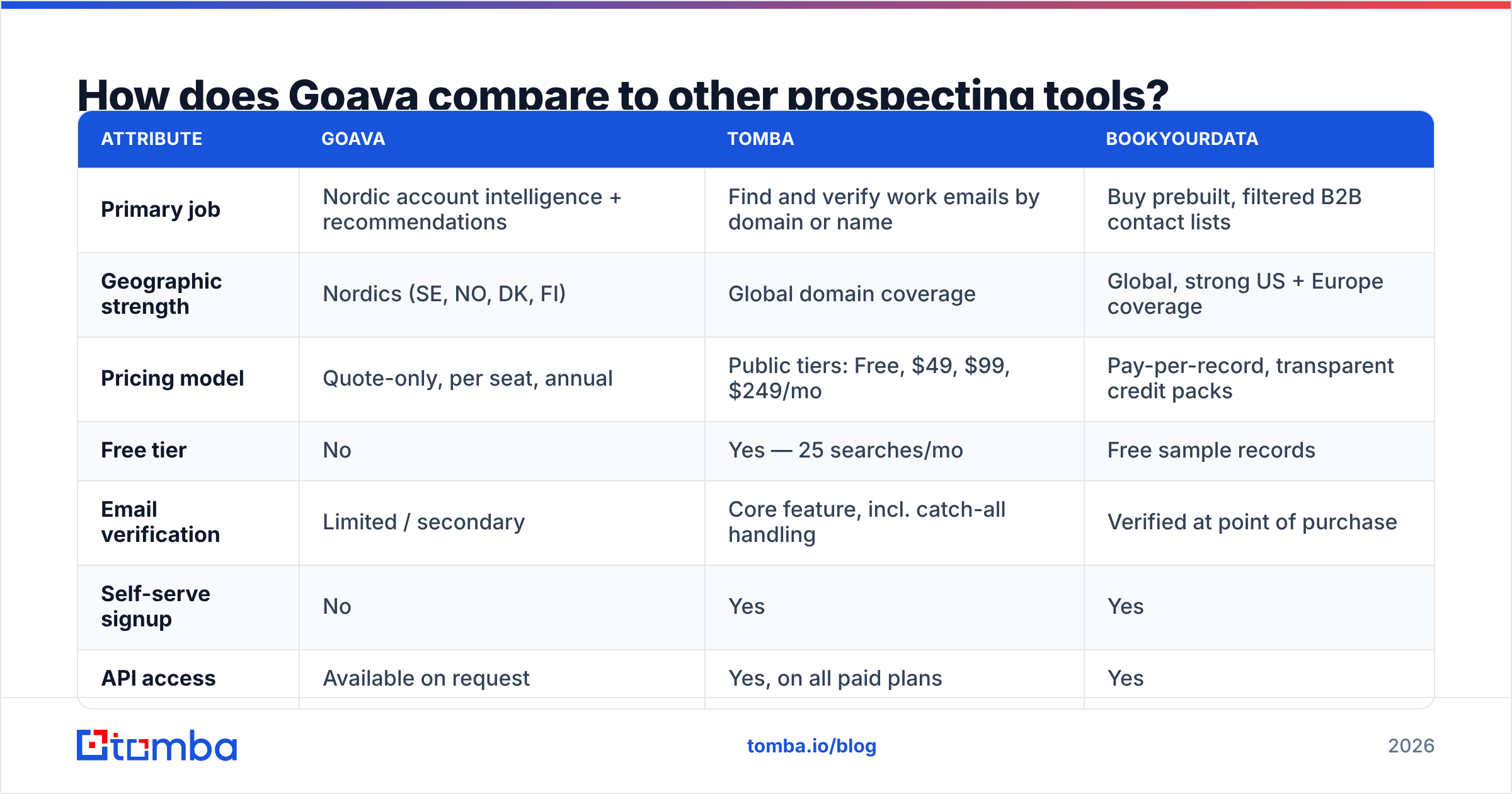
| Attribute | Goava | Tomba | BookYourData |
|---|---|---|---|
| Primary job | Nordic account intelligence + recommendations | Find and verify work emails by domain or name | Buy prebuilt, filtered B2B contact lists |
| Geographic strength | Nordics (SE, NO, DK, FI) | Global domain coverage | Global, strong US + Europe coverage |
| Pricing model | Quote-only, per seat, annual | Public tiers: Free, $49, $99, $249/mo | Pay-per-record, transparent credit packs |
| Free tier | No | Yes — 25 searches/mo | Free sample records |
| Email verification | Limited / secondary | Core feature, incl. catch-all handling | Verified at point of purchase |
| Self-serve signup | No | Yes | Yes |
| API access | Available on request | Yes, on all paid plans | Yes |
| Best for | Nordic mid-market territory planning | Turning a company or name into a valid email | Fast list acquisition without research time |
BookYourData deserves a fair note here: if your constraint is "I need 3,000 verified contacts in a defined segment by Friday," a per-record list purchase is a legitimately faster path than either research tooling or a seat-based intelligence contract. Different job, different tool.
Where Tomba fits is narrower and cheaper: you already know the company — from Goava, from a list, from a conference badge — and you need the right person's address to actually be deliverable. That is a $49/mo problem, not a five-figure annual contract problem.

Is Goava worth it for your team?#
Run these five checks honestly.
- Is 70%+ of your pipeline Nordic? If yes, Goava's data advantage is real and hard to replicate. If no, you are paying a premium for coverage you will not use.
- Do you have 12+ months of clean closed-won CRM data? The recommendation engine is only as good as its training set. New teams should expect a slower ramp.
- Is your bottleneck targeting or execution? If reps have a good list and still send 40 emails a week, targeting is not your problem. Tooling will not fix a throughput issue.
- Can you commit annually? If your headcount plan is uncertain, seat-based annual contracts are the wrong risk shape.
- Do you have a separate contact-data layer? Assume you will need one. Budget for it up front instead of discovering it in month two.
Score 4–5 yes answers and Goava is likely worth the quote. Score 2 or fewer and you are better served by a lighter stack: a list source, an email verifier, and a sequencer.
What hidden costs should you check before signing?#
Quote-only pricing hides costs in structure, not in the headline number. Before you sign anything:
- Seat minimums. Some contracts enforce a floor well above your current team size.
- Export limits. Ask whether bulk export of your own enriched records is capped or billed.
- API metering. "API access included" and "unlimited API calls" are very different sentences.
- Auto-renewal windows. A 90-day notice period on an annual contract effectively makes it a 15-month decision.
- Market add-ons. Confirm whether all four Nordic markets are in your base quote or priced separately.
- Data refresh cadence. Stale firmographics look identical to fresh ones in the UI. Ask how often records update.
- The second tool. If you need verified personal emails, add that line item to the total cost of ownership before comparing quotes.
That last point is the one most teams miss. A sales intelligence contract plus a separate contact-data tool is the normal end state, not an edge case. Pricing the stack — not the platform — is how you avoid a surprise in Q2.
How do you fill the contact-data gap cheaply?#
Once Goava (or any account intelligence tool) hands you a target list, the remaining work is mechanical: turn company + person into a verified, deliverable address.
That workflow runs cleanly at low cost:
- Start from the domain. Domain search returns the known email patterns and published addresses for a company in one call.
- Resolve the specific person. Feed first name, last name, and domain to an email finder to get the most probable address with a confidence score.
- Verify before sending. Run every address through verification, including catch-all domains, so your bounce rate stays under the thresholds that protect sender reputation.
- Enrich in bulk, not one by one. Push the whole Goava export through a bulk job instead of having reps do manual lookups.
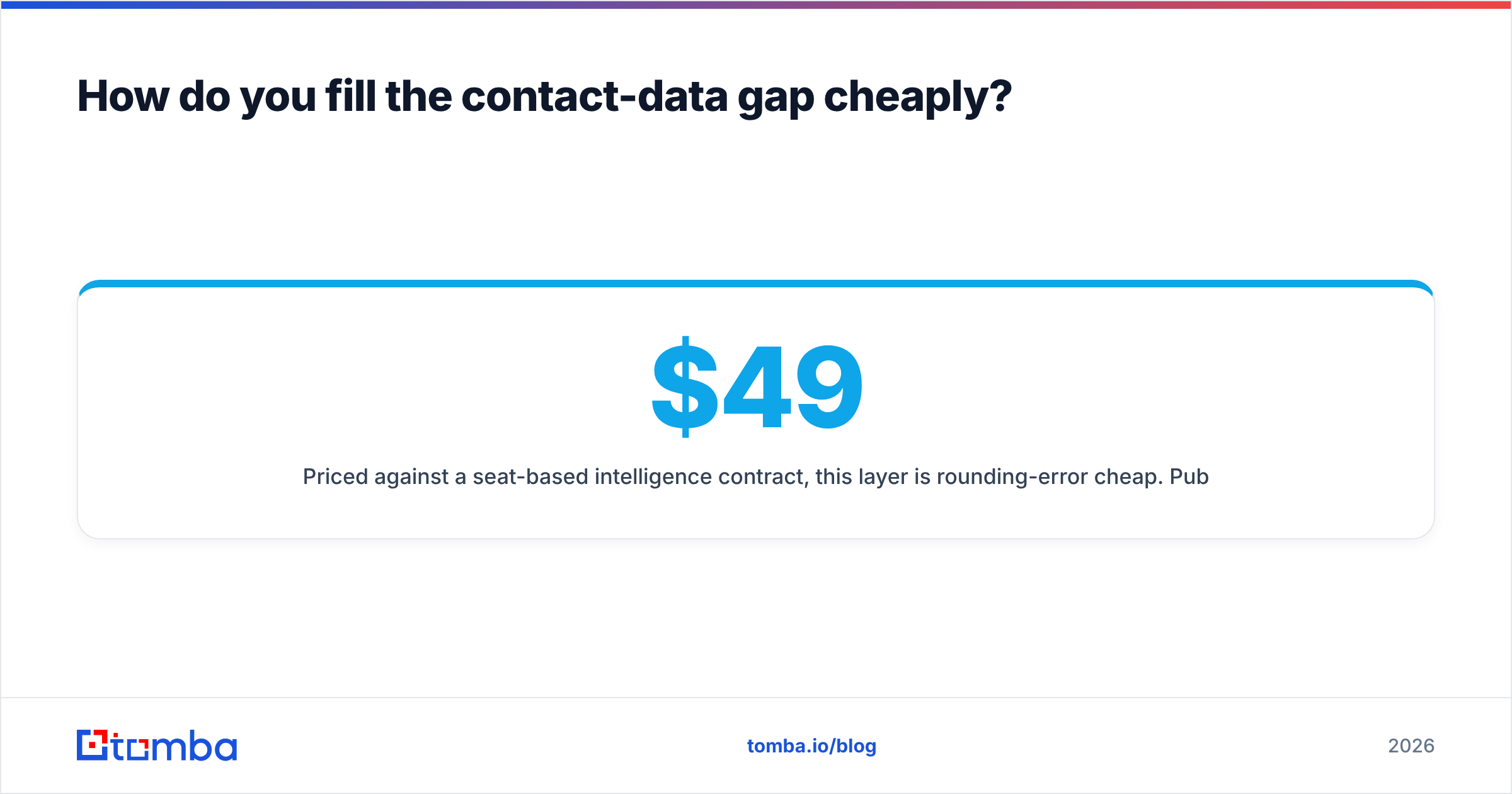
Priced against a seat-based intelligence contract, this layer is rounding-error cheap. Public Tomba pricing starts with a free tier at 25 searches per month, then $49/mo Starter, $99/mo Growth, and $249/mo Pro — no discovery call required to see the number.
The bottom line on Goava pricing reviews pros and cons#
Goava earns its place for Nordic-focused teams with real CRM hygiene and an annual budget. The account intelligence is genuinely differentiated in Sweden, Norway, Denmark, and Finland. The CRM sync is better than most. The recommendation engine works once it has data to learn from. The trade-offs are structural, not fixable by negotiation: quote-only pricing, annual lock-in, thin contact-level coverage, and a hard geographic ceiling. That is the honest Goava pricing reviews pros and cons verdict.
Do the math on the whole stack before you commit. And if the specific gap you keep hitting is "I have the account, I need the person's email," fix that first and cheaply: Tomba Email Finder turns a name and a domain into a verified, deliverable work address, with a free tier to test on your own list and $49/mo pricing you can read without booking a call.
Related guides#
Ready to find emails that actually work?
Join 150,000+ professionals who stopped guessing and started sending. Free credits on signup — no credit card required.
Get the Tomba newsletter
Practical outbound tactics and product updates — once every two weeks.
About the author