Goava vs Apollo.io: Which B2B Sales Data Tool Wins in 2026?
Goava sells Nordic sales intelligence with signal-based recommendations. Apollo.io sells global contact volume plus a sequencer. We compare coverage, email accuracy, pricing, and who each one actually fits.
Goava vs Apollo.io is a common shortlist, but the two tools do different jobs. Goava ranks Nordic accounts for you. Apollo.io hands you global contacts and a sequencer. Here is how they compare on data, accuracy, and price.
TL;DR
- Goava is a Nordic sales intelligence tool, not a global contact database. It is strong on company signals: financials, hiring, tech stack, and registry data. Outside the Nordics, coverage thins out fast.
- Apollo.io is a volume play. You get a huge global contact database plus sequences, a dialer, and light CRM features. Breadth is excellent; per-record accuracy swings by region.
- They are not really competitors. Goava answers "which accounts should I call this quarter?" Apollo answers "give me 5,000 contacts and a sequence to send them."
- Pricing is not equally open. Apollo publishes per-seat tiers and a free plan. Goava is quote-only, which usually means a sales call and an annual contract.
- Most teams add a third tool anyway. They use a dedicated email finder and verifier to clean each export before it hits a sending domain.
What is Goava and who actually uses it?#
Goava is a Swedish sales intelligence platform built on one idea: your best next customer looks like your current best customers. It does not hand you a search bar and 200 million rows. Instead it reads your CRM, learns which company profiles convert, and pushes ranked account picks back to your reps.
The data underneath is heavily Nordic. Goava pulls from official company registries, filed financial statements, employee counts, hiring activity, website tech, and news mentions. That kind of public data is unusually rich in Sweden, Norway, Denmark, and Finland, because those registries are open and standardized. It is a real moat in the region — and a real limit outside it.
Typical Goava buyers are Nordic SaaS, staffing, logistics, and professional services teams with 5–50 reps selling at home. They already run Upsales, HubSpot, Salesforce, Pipedrive, or Lime. They want priorities, not raw volume. If you sell into Stockholm, Oslo, Copenhagen, and Helsinki, and your ICP is set by revenue bands and growth signals, Goava's account scoring earns its keep. A generic global database will not do that job.
What Goava is not: a cold-email machine. It does not sell itself as a mass contact-extraction tool. Its contact-level email coverage is thinner than its company-level data. You get the account and the reason to call. Finding the right person's verified inbox is often a separate step.
What is Apollo.io and what does it actually include?#
Apollo.io makes the opposite bet: maximum breadth, bundled execution. It pairs a contact and company database with sequences, an email sender, a dialer, meeting scheduling, a LinkedIn extension, enrichment, and light CRM objects. Apollo publicly claims figures near 200M+ contacts and 35M+ companies.
For a small team, the appeal is obvious. One login, one invoice, and a path from prospect to reply without stitching four tools together. Apollo also runs an aggressive free tier, which is how most people first meet it.
The tradeoff is uneven data quality. Apollo's database is partly community-contributed and partly scraped and modeled. So a US VP of Sales at a 500-person SaaS company is usually right. A mid-market operations lead in Munich, São Paulo, or Malmö is a coin flip. Reviews on G2 repeat the same pattern every year: great coverage, uneven verification, and bounce rates that punish you if you export and send without cleaning.
One structural issue is worth naming. When your database vendor is also your sending tool, bad data costs you twice. You burn credits, and you burn sender reputation. Nobody at Apollo is paid to tell you that 18% of your list should not be mailed.

Goava vs Apollo.io: how do the features compare?#
Here is the honest side-by-side. Pricing reflects public rates at the time of writing. Always confirm on the vendor's own page before you budget.
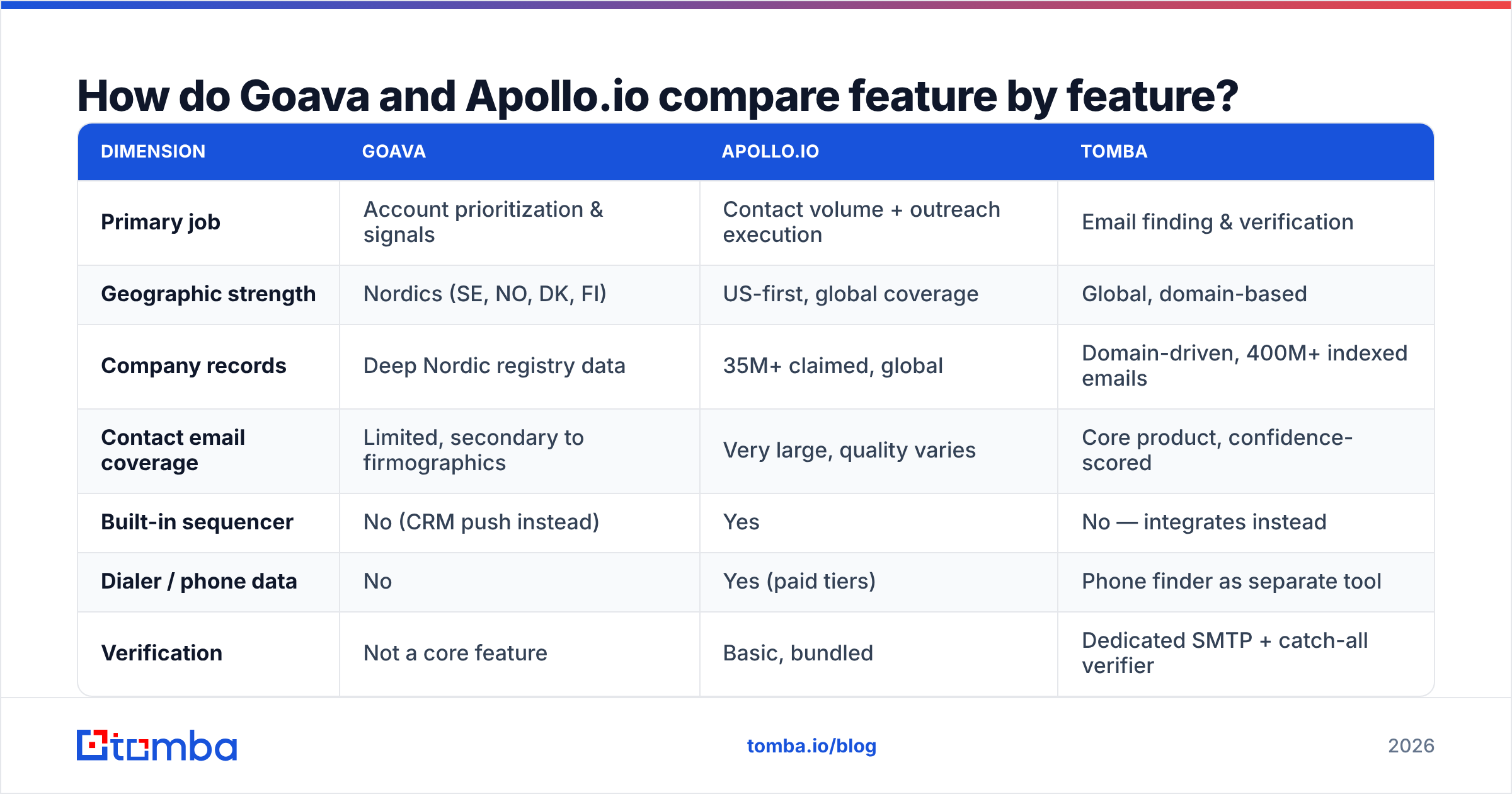
| Dimension | Goava | Apollo.io | Tomba |
|---|---|---|---|
| Primary job | Account prioritization & signals | Contact volume + outreach execution | Email finding & verification |
| Geographic strength | Nordics (SE, NO, DK, FI) | US-first, global coverage | Global, domain-based |
| Company records | Deep Nordic registry data | 35M+ claimed, global | Domain-driven, 400M+ indexed emails |
| Contact email coverage | Limited, secondary to firmographics | Very large, quality varies | Core product, confidence-scored |
| Built-in sequencer | No (CRM push instead) | Yes | No — integrates instead |
| Dialer / phone data | No | Yes (paid tiers) | Phone finder as separate tool |
| Verification | Not a core feature | Basic, bundled | Dedicated SMTP + catch-all verifier |
| Free tier | No — demo only | Yes, limited credits | Yes — 25 searches/month |
| Entry paid price | Quote only | ~$49/user/mo (annual) | $49/mo, not per seat |
| Pricing model | Annual contract, seat-based | Per seat, credit-gated features | Credit-based, seat-agnostic |
| API access | Available on request | Yes, higher tiers | Yes, all paid plans |
| Best for | Nordic ABM & account planning | High-volume outbound teams | Clean, verified contact data |
Two things jump out of that table.
First, the geographic split is the real decision. If 80% of your pipeline is Nordic, Apollo's global scale buys you little. Goava's registry depth buys you a lot. If you sell into North America, or run multi-region campaigns, Goava will not cover your territory.
Second, neither tool is a verification tool. Goava does not claim to be. Apollo bundles verification, but treats it as a checkbox rather than a discipline. That gap is why so many teams add a third layer.
Which one has better data accuracy?#
Accuracy decides whether your domain survives a quarter of outbound. So it deserves more than a marketing claim.

The measurable differences break down like this.
- Company data and contact data are different problems. Goava's company records are strong, because they come from official registries. Revenue, employee count, and legal status are filed, not guessed. Apollo models company records from web signals, so headcount and revenue are often a quarter out of date.
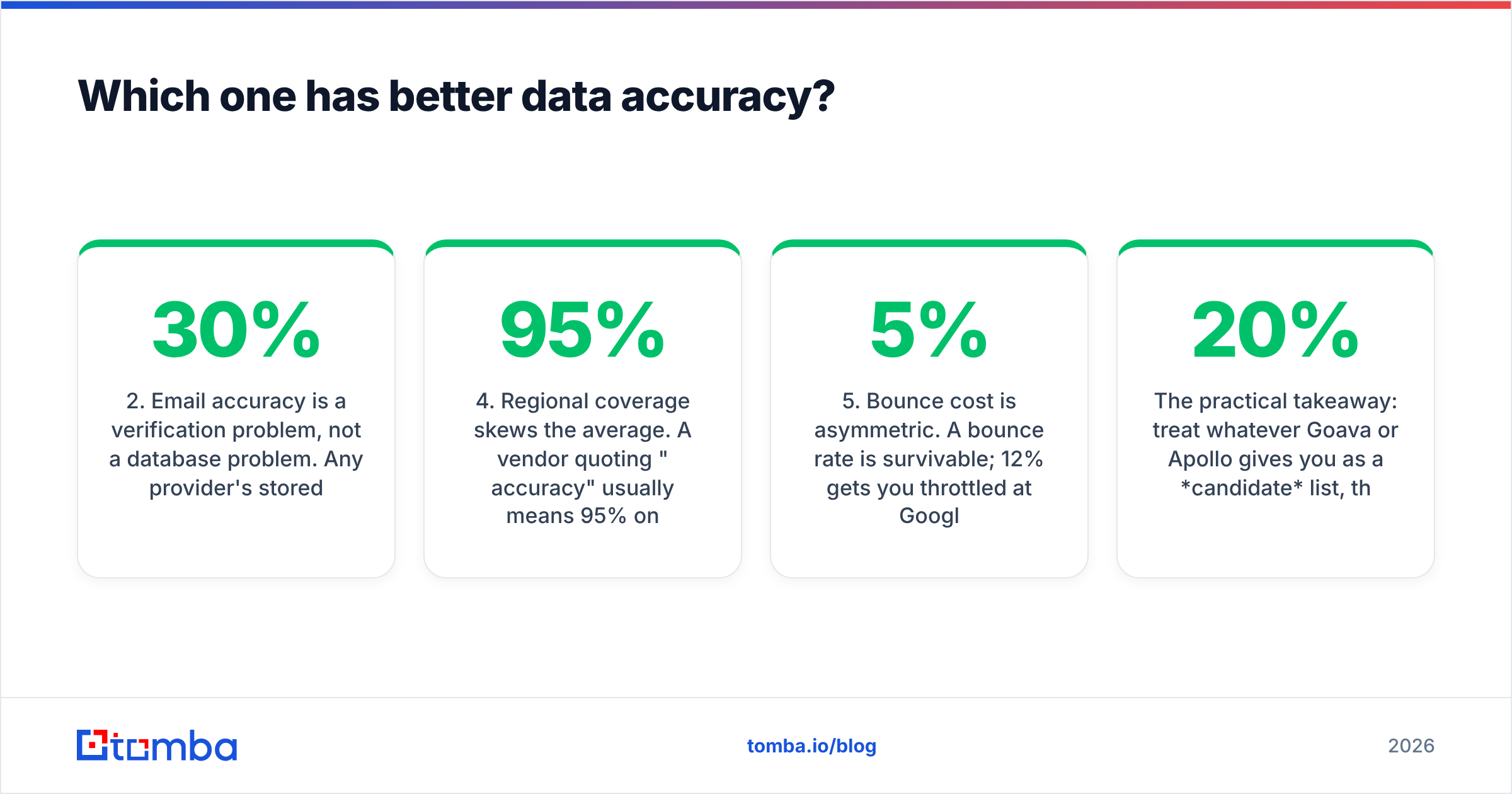
- Email accuracy is a verification problem, not a database problem. Any stored email decays by roughly 22–30% a year as people change jobs. What matters is whether the record is re-checked at the moment you export it. Apollo checks some of the time. Goava mostly does not offer this at all.
The next three points are about how vendors report their numbers.
- Catch-all domains distort every vendor's stats. A large share of B2B domains accept all mail. An SMTP check then returns "unknown," not "valid." Vendors that count unknowns as valid post inflated accuracy numbers. A dedicated catch-all verifier settles these with pattern confidence instead of a guess.
- Regional coverage skews the average. A vendor quoting "95% accuracy" usually means 95% on US tech contacts. Test the same tool on Nordic mid-market or DACH manufacturing, and the number drops hard. Always benchmark on your ICP, not the vendor's sample.
- Bounce cost is lopsided. A 5% bounce rate is survivable. A 12% rate gets you throttled at Google and Microsoft. The gap between a 90% and a 97% valid list is not 7% more meetings. It is the difference between a live domain and a burned one.
The practical takeaway: treat whatever Goava or Apollo gives you as a candidate list, then verify before you send. Running exports through an email verifier usually strips 8–20% of records from a raw Apollo export. That single step has the highest ROI in the whole workflow.
How does pricing really compare?#
Pricing is where Goava vs Apollo.io stops being an even match, because only one vendor shows you a number.
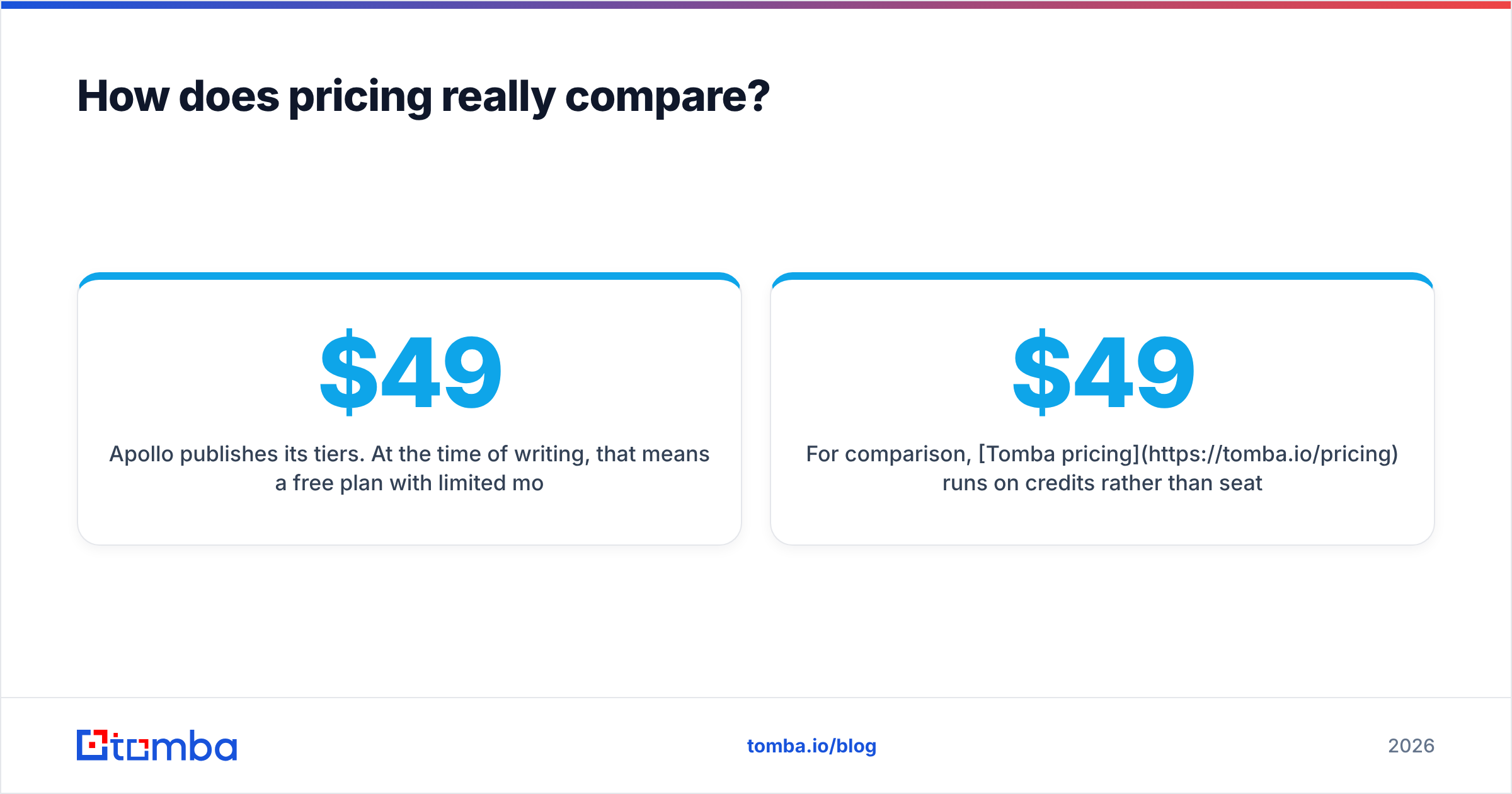
Apollo publishes its tiers. At the time of writing there is a free plan with limited monthly credits. Basic runs about $49 per user per month on annual billing, Professional about $79, and Organization about $119 with a seat minimum. Some features sit behind the upper tiers: advanced filters, API volume, dialer minutes, and intent data. So the sticker price and the working price split apart once a team of six needs exports and API access.
Goava does not publish pricing. Nordic sales intelligence tools in this bracket usually land between €400 and €1,500 a month for a small team on an annual deal. You will only learn your number after a demo. That is not automatically bad, because the product really does need setup against your CRM. It does mean you cannot pilot it on a Tuesday afternoon.
Tomba pricing runs on credits instead of seats. There is a free tier with 25 searches a month, Starter at $49/mo, Growth at $99/mo, Pro at $249/mo, and custom Enterprise. The model matters more than the number. With per-seat pricing, a fifth SDR raises your data bill by 25%, whether or not they use more records. With credit pricing, five reps sharing one pool cost the same as one rep doing all the searching.

Is there a better setup than picking one?#
For most teams, yes. The two tools solve different halves of the problem, and neither solves the verification half well.
Here is the stack pattern that holds up in practice.
- Targeting layer. Use Goava if you sell in the Nordics, or Apollo's filters if you sell globally. This layer decides which accounts deserve attention, using signals, firmographics, and intent.
- Contact layer. Use a dedicated finder for the decision-makers at those accounts. Domain search returns every known address at a company, with role labels and confidence scores. That beats paging through database filters when you already know the account.
- Verification layer. Run SMTP checks and catch-all resolution before anything reaches your sending tool. This is non-negotiable if you care about email deliverability.
- Execution layer. Pick your sequencer — Instantly, Smartlead, Lemlist, Salesloft, or Apollo's own — and feed it verified records only.
- Enrichment loop. Push results back into the CRM, so tomorrow's targeting learns from today's outcomes.
Splitting these layers costs a little more in tool count and a lot less in wasted sends. You can also swap one layer without rebuilding the whole motion. If Goava's coverage stops matching your new market, you replace one part, not your entire GTM stack.
Thinking of leaving Apollo? The honest framing is that you are replacing three things at once: database, verification, and sequencing. The swap rarely maps one to one. Teams comparing Apollo alternatives tend to keep the sequencer they already like and change only the data layer. That is the cheapest version of the move.
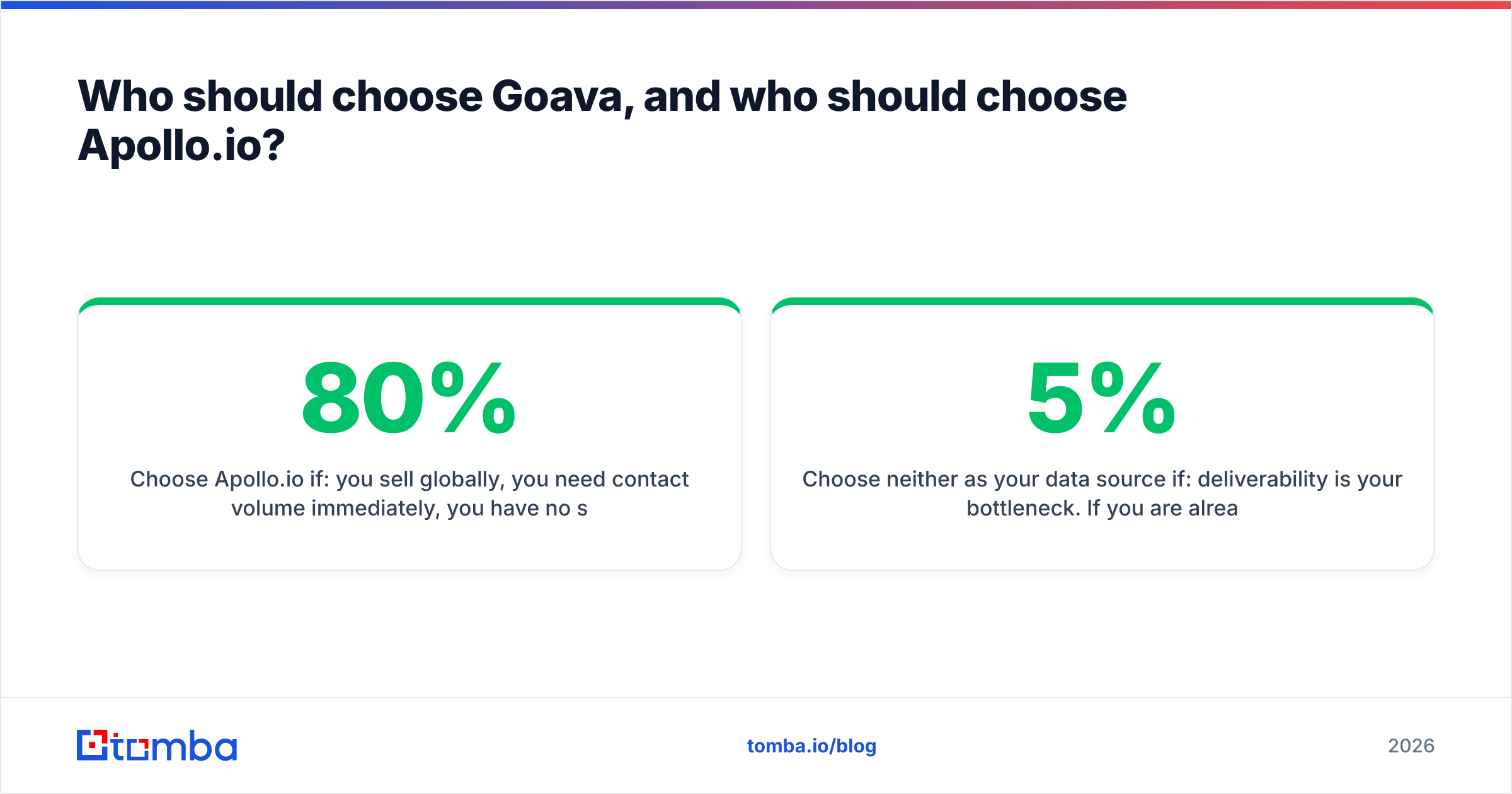
Who should choose Goava, and who should choose Apollo.io?#
Choose Goava if your revenue comes from Sweden, Norway, Denmark, or Finland. It fits when your ICP is set by financial and growth signals rather than job titles, and when your CRM holds enough closed-won history for the model to learn from. It also suits account-based selling more than spray-and-pray. Goava is the better answer when your reps spend more time picking targets than writing emails.
Choose Apollo.io if you sell globally and need contact volume right away. It suits teams with no sequencer yet, who would rather have one tool at 80% quality than four tools at 95%. It is a fair default for a two-person startup running its first outbound test, and the free tier makes it easy to start.
Choose neither as your data source if deliverability is your bottleneck. If you already bounce above 5%, more raw records only make it worse. Fix verification first, then scale volume.
One caution on method: do not judge either platform on a demo dataset. Pull 200 records that match your real ICP from each tool. Verify them yourself, then compare valid rates and bounce results on a live send. Vendor accuracy claims are averages across everyone's use case. Yours is the only one that pays your salary.

What should you do next?#
Run the benchmark before you sign anything. Take 100 target accounts from your pipeline. Pull contacts for them in Goava, Apollo, and one dedicated finder. Verify all three lists with the same verifier, then compare valid rate and reply rate. It takes an afternoon, and it settles the Goava vs Apollo.io argument better than any comparison article — including this one.
When you reach the contact layer, the Tomba Email Finder is built for that exact step. Give it a name and a domain, or just a domain, and get back confidence-scored work addresses. SMTP verification and catch-all handling are included. It starts free at 25 searches a month with no card, and paid plans begin at $49/mo on credits rather than seats. So you can benchmark it against your Goava or Apollo exports today, and only pay once the valid-rate gain shows up in your reply numbers.
Related guides#
Ready to find emails that actually work?
Join 150,000+ professionals who stopped guessing and started sending. Free credits on signup — no credit card required.
Get the Tomba newsletter
Practical outbound tactics and product updates — once every two weeks.
About the author