Goava vs GrowMeOrganic: Which B2B Prospecting Tool Wins in 2026?
Goava sells Nordic sales intelligence with AI recommendations. GrowMeOrganic sells unlimited-seat LinkedIn scraping and cold email. They barely overlap — here's which one actually fits your pipeline, and where both leave gaps.
Goava vs GrowMeOrganic is an odd matchup. One tool finds Nordic accounts. The other sends cold email at volume. Here is how the two compare, and where both leave a gap.
TL;DR
- Goava is a Nordic sales intelligence tool. It covers Swedish, Norwegian, Danish and Finnish company data. It adds AI account picks and CRM sync. It finds accounts. It does not send email.
- GrowMeOrganic is an all-in-one prospecting suite. It scrapes LinkedIn, holds a large email database, and runs drip campaigns. Seats are unlimited. Plans start near $49 a month.
- They only compete if your brief is vague. Look closer and they solve different halves of the funnel.
- Both share one weak spot: email accuracy at the contact level. Goava is strong on firmographics. GrowMeOrganic is strong on workflow. Neither one verifies email well.
- Our pick: Goava if you sell in the Nordics. GrowMeOrganic if you need cheap seats and built-in sending. Pair either one with a dedicated email verifier before you send.
Goava vs GrowMeOrganic: what does each tool do?#
Goava is a Swedish sales intelligence platform. It runs on one idea: your best next customer looks like your best current ones. It pulls company registry data, financials, web tech signals and news across the Nordics. Then it scores accounts and hands the list to your reps. It syncs with HubSpot, Salesforce, Pipedrive, Upsales and SuperOffice. The picks land where your team already works.
GrowMeOrganic came from a different place. It is an India-based growth suite. You scrape LinkedIn and Sales Navigator. You pull contacts from a claimed 575M+ B2B database. You find emails. Then you run drip sequences from your own mailbox. It all sits under one login, and paid plans include unlimited seats.
Here is the split that matters. Goava tells you who to chase. GrowMeOrganic helps you reach them at volume. One is a targeting layer. The other is an execution layer.
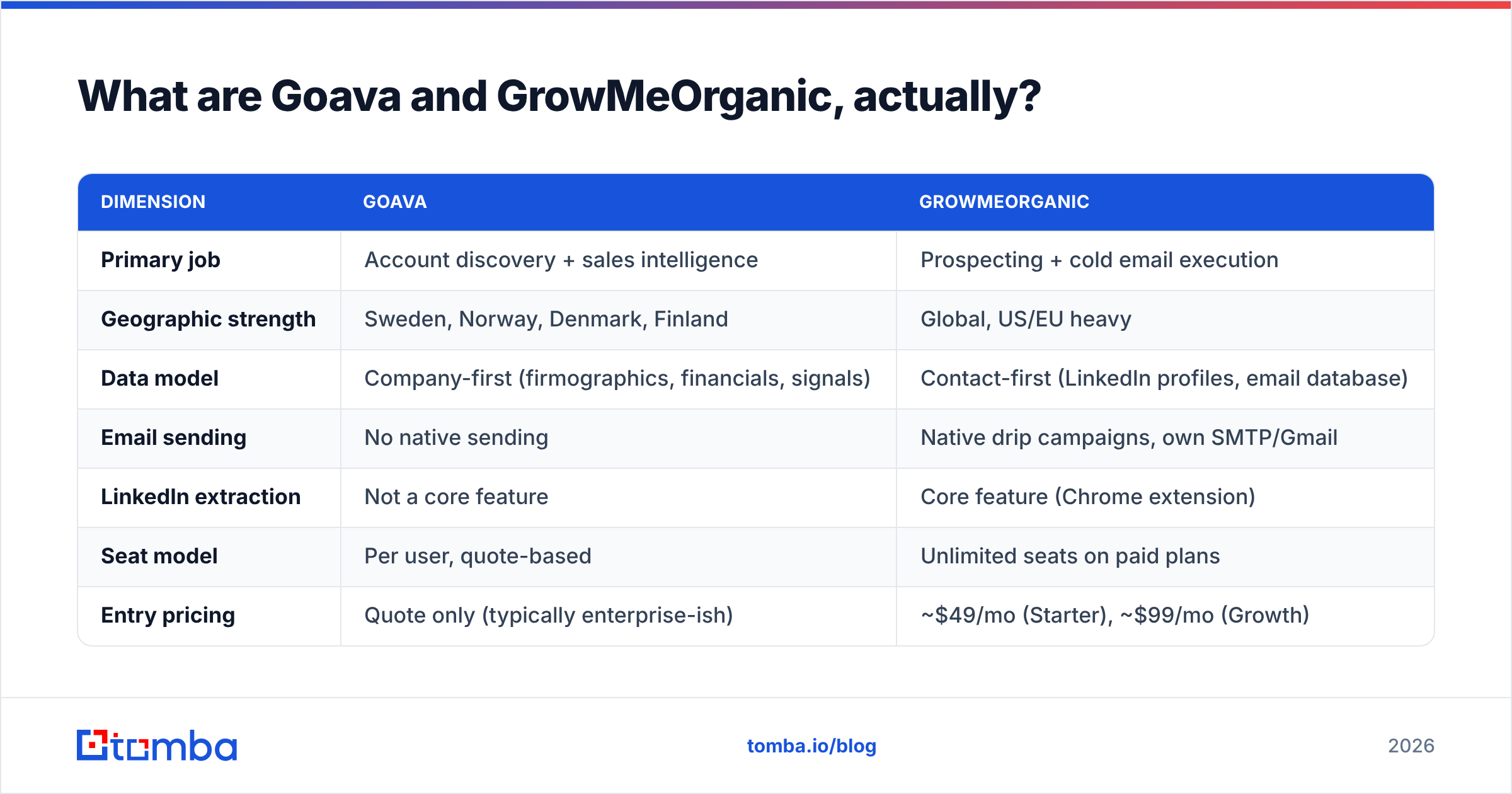
The table below breaks the two down on the points buyers actually weigh:
| Dimension | Goava | GrowMeOrganic |
|---|---|---|
| Primary job | Account discovery + sales intelligence | Prospecting + cold email execution |
| Geographic strength | Sweden, Norway, Denmark, Finland | Global, US/EU heavy |
| Data model | Company-first (firmographics, financials, signals) | Contact-first (LinkedIn profiles, email database) |
| Email sending | No native sending | Native drip campaigns, own SMTP/Gmail |
| LinkedIn extraction | Not a core feature | Core feature (Chrome extension) |
| Seat model | Per user, quote-based | Unlimited seats on paid plans |
| Entry pricing | Quote only (typically enterprise-ish) | ~$49/mo (Starter), ~$99/mo (Growth) |
| Free option | Demo / trial on request | Free tier with limited credits |
| CRM sync | Deep (HubSpot, Salesforce, Pipedrive, Upsales, SuperOffice) | Lighter, plus Zapier |
| Best for | Nordic mid-market and enterprise sales teams | Agencies, SMBs, high-volume outbound |

Goava vs GrowMeOrganic: which has better data coverage?#
It depends on your territory. There is no single winner here.
Goava wins on depth in the Nordics. It builds on official registries and financial filings. So Swedish and Norwegian records carry revenue, headcount, board members, credit signals and owners. That data is hard to buy elsewhere. Say your ICP is "Swedish makers with 50-200 staff, growing revenue, running a set ERP." Goava can build that list with real confidence.
GrowMeOrganic wins on raw breadth. It pairs a 575M+ contact database with live LinkedIn scraping. That covers markets Goava never touches. Selling into the US or worldwide? Goava is not even a candidate.
But breadth is not accuracy. Big aggregated B2B databases go stale fast. Industry consensus puts B2B data decay near 25-30% a year. People change jobs. Firms rebrand. Domains move. A 575M-record file that is never re-checked is a file full of bounces.
Most head-to-head posts stop here. The better question is not who holds more records. It is how many of your exported emails actually land. Neither tool is built to verify. Both bundle finding and checking into one credit. So you often pay for a result you cannot trust.
How to test coverage before you buy#
Ignore the stated database size. Run this test instead:
- Build a 100-account sample from your last 12 months of closed-won deals. Use real accounts, not a wish list.
- Run that list through both trials. Record the match rate by company first, then by contact.
- Export the emails and check them yourself with a third-party email verification tool. Count hard bounces, catch-alls and unknowns apart.
- Check role coverage too. Finding a company is easy. Finding the VP of Operations there is the real job.
- Time the whole workflow. Forty seconds per contact will not scale to 500 contacts a week.
- Re-run the same 20 records two weeks later. See if anything refreshed. Static databases stay static.
Goava vs GrowMeOrganic pricing: what will you pay?#
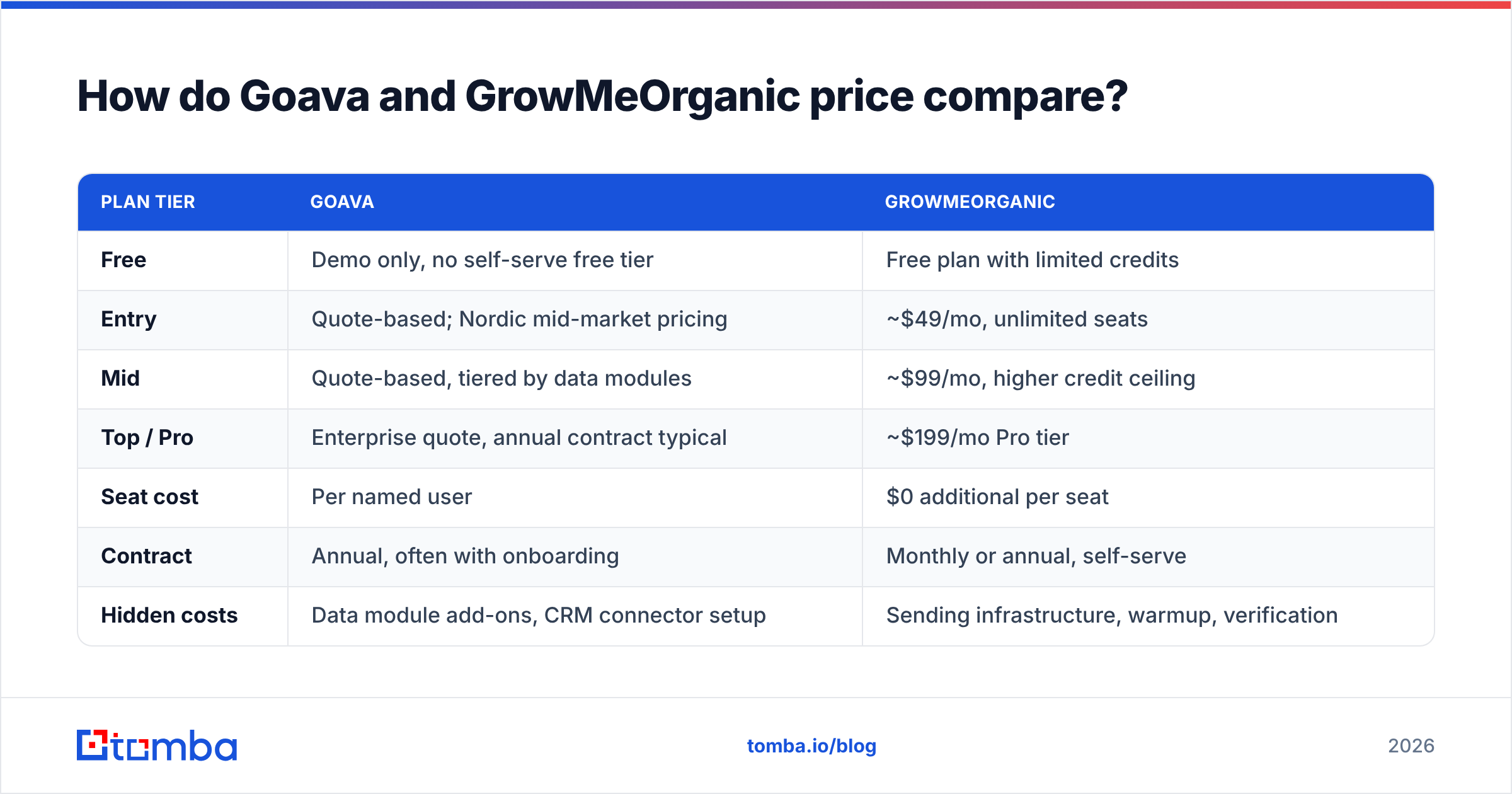
GrowMeOrganic publishes prices. Goava does not. That gap tells you who each one sells to.
| Plan tier | Goava | GrowMeOrganic |
|---|---|---|
| Free | Demo only, no self-serve free tier | Free plan with limited credits |
| Entry | Quote-based; Nordic mid-market pricing | ~$49/mo, unlimited seats |
| Mid | Quote-based, tiered by data modules | ~$99/mo, higher credit ceiling |
| Top / Pro | Enterprise quote, annual contract typical | ~$199/mo Pro tier |
| Seat cost | Per named user | $0 additional per seat |
| Contract | Annual, often with onboarding | Monthly or annual, self-serve |
| Hidden costs | Data module add-ons, CRM connector setup | Sending infrastructure, warmup, verification |
The unlimited-seat model is a real edge. Run a 12-person agency and per-seat tools like Apollo or ZoomInfo get painful fast. One flat fee for the whole team changes the math. That is the strongest case for GrowMeOrganic, and it is a fair one.
Goava quotes on request. You will not see a number until you talk to sales. Nordic sales intelligence tools usually start well above $500 a month for a small team. You pay for data no one else holds in that region. Onboarding and CRM setup are part of the bill.
Buyers forget the downstream cost. Neither price covers deliverability. Send from an unchecked list and you burn your domain. Rebuilding sender reputation takes weeks. Budget for verification and warmup on top, whichever tool you pick.
Is the all-in-one approach better than a specialist stack?#
All-in-one is an advantage right up to the point it becomes a liability.
Where it wins: one login, one bill, no Zapier tax. Campaign data sits next to prospect data. A two-person agency running five client campaigns will value that more than any single best-in-class feature. Fewer tools mean fewer failure points and fewer bills to justify.
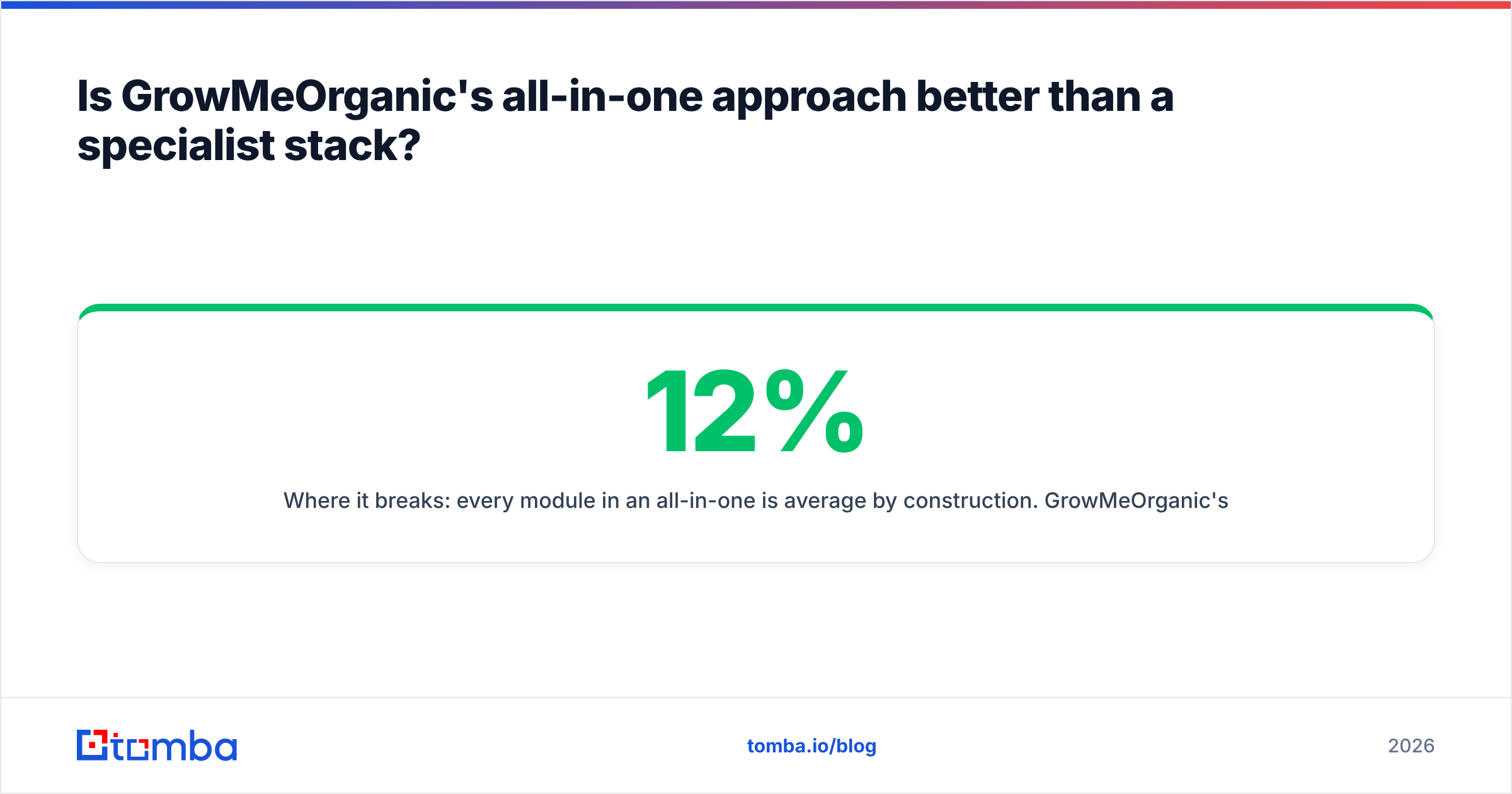
Where it breaks: every module in an all-in-one is average by design. The GrowMeOrganic email finder is fine. The sequencer is fine. The database is fine. None of them leads its category. In outbound, the weakest link sets your results. A 12% bounce rate does not just waste 12% of your list. It also drags inbox placement for the other 88%.
The specialist case is simple. Use a dedicated email finder with published accuracy. Add a sequencer built for deliverability. Wire them together by API. You pay more and lose some convenience. In return, each layer is genuinely good.
Goava sits outside this debate. It never claimed to be all-in-one. It is a targeting specialist, and it assumes you already own a sequencer.

What do real users say about each?#
Review volume is thin for both. That is a data point on its own. Neither leads the category by market share.
GrowMeOrganic reviews on G2 and Capterra repeat the same themes. Price is the top-rated trait. The LinkedIn extractor works well. Support replies fast. The complaints are steady too: weak email accuracy at small firms, and a dated UI. Credits burning on failed lookups comes up often, so plan for it.
Goava has fewer reviews, and most are Nordic. Fans praise the Swedish company data and the AI picks. Reps say it surfaces accounts they would have missed. Critics point to price against team size. Others note it is useless outside its home region. That is expected, not a flaw.
Neither tool matches the review depth of Apollo, ZoomInfo or Lusha. Weigh that if review volume shapes your risk call.
Which one should you choose for your use case?#
Match the tool to the job, not to the shortlist:
- Selling into Sweden, Norway, Denmark or Finland with a clear ICP → Goava. Nothing else pairs registry-grade Nordic data with CRM sync.
- Running an agency of 5+ people on a tight budget → GrowMeOrganic. Unlimited seats at $49-$99 a month is hard to beat.
- Doing global outbound where email accuracy drives results → neither one alone. Pair a targeting source with a dedicated finder and verifier.
- Needing phone numbers as well as emails → neither is strong here. Look at a dedicated phone finder.
- Working from a list of domains, not people → use domain search. Pull every public address at a company, then filter by role.
- Enriching a CRM instead of building lists from zero → Goava if Nordic. Otherwise use a data enrichment layer that maps to your schema.
What does a stack that actually works look like?#
The best outbound teams we see do not run one tool. They run three layers and keep them apart on purpose.
Layer 1 — Targeting. Pick who to contact before you look for a single email. Goava does this in the Nordics. Sales Navigator plus a scoring model does it elsewhere. Skip this layer and outbound underperforms. Most teams tune send volume before they tune account choice.
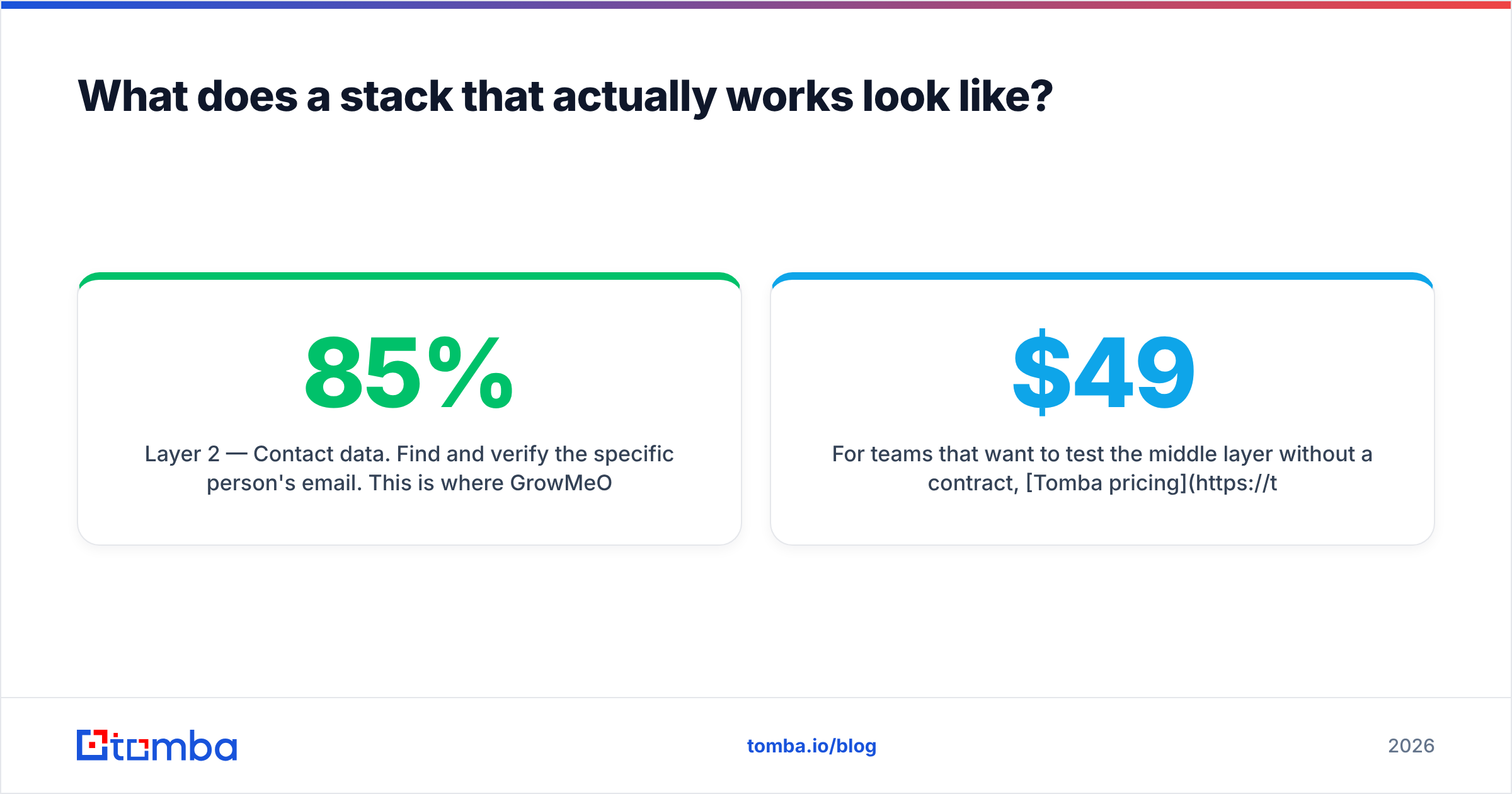
Layer 2 — Contact data. Find and verify the person's email. This is where GrowMeOrganic plays, and where accuracy gaps compound. One finder returns 85% valid addresses. Another returns 96%. Over a 10,000-contact quarter, that is a 60%+ swing in wasted sends.
Layer 3 — Execution. Sequencing, warmup, inbox rotation, replies. Deliverability lives here, and it is not forgiving. Read up on email deliverability basics before you scale. Get it wrong and you burn a domain, not just a week.
Separate layers let you swap one part at a time. If the GrowMeOrganic database goes stale on your segment, replace layer 2 and keep your sequences. With a true all-in-one, replacing one piece means replacing the lot.
Want to test the middle layer without a contract? Tomba pricing opens with a free tier of 25 searches a month. Paid plans run $49 Starter, $99 Growth and $249 Pro. That maps closely to GrowMeOrganic's tiers, but the tool does one thing instead of five. Shopping wider? BookYourData suits teams who would rather buy pay-as-you-go lists than run searches.
Goava vs GrowMeOrganic: the verdict#
Goava wins if you sell in the Nordics. No caveat needed. The regional data depth is real. The AI picks surface accounts your reps would miss. The CRM links are true integrations, not CSV dumps. Budget for it, and expect a sales call before you see a price.
GrowMeOrganic wins on cost per seat. Small teams and agencies doing volume outbound get a better structural deal. Unlimited seats at $49-$99 a month beats per-seat rivals. Accept that each module is adequate, not excellent. Then add a verification step before every send.
Neither wins on email accuracy — and that metric decides whether campaigns work. Goava barely tries, because it is an account tool. GrowMeOrganic buries its finder inside a suite where it fights four other features for attention.
The practical build: choose your targeting layer by geography. Choose your execution layer by deliverability. Do not let either one own your contact data quality.
Ready to fix the layer that actually breaks?#
Is your bounce rate above 3%? Then the problem is not targeting, and it is not your sequencer. It is the email data in between.
Tomba Email Finder does one job. It returns work email addresses you can send to, by domain, name or company. Verification is built into the same call. Start free with 25 searches a month. Run your last export through it. Compare the valid count against whatever built that list. If the numbers match, keep your stack. If they do not, you just found the leak.
Related guides#
Ready to find emails that actually work?
Join 150,000+ professionals who stopped guessing and started sending. Free credits on signup — no credit card required.
Get the Tomba newsletter
Practical outbound tactics and product updates — once every two weeks.
About the author