Goava vs Kipplo (2026): Which B2B Sales Data Tool Wins?
Goava and Kipplo both promise better prospect lists, but they solve different problems. Here is an honest breakdown of data coverage, CRM fit, pricing transparency, and where each one leaves a gap you still have to fill.
TL;DR
- Goava is a Nordic-focused sales intelligence platform: company-level data, ICP scoring, trigger signals, and deep CRM push. It is strongest if your territory is Sweden, Norway, Denmark, or Finland.
- Kipplo positions itself as a leaner, faster prospecting and outreach layer — cheaper to start with, less depth on firmographic enrichment, more focused on getting a list into a sequence.
- Neither tool publishes fully transparent self-serve pricing at the enterprise end, so budget comparisons require a demo call. Assume quote-based negotiation for Goava.
- Both are account-first tools. Neither is a dedicated email finder, so verified contact-level email coverage is the gap most teams end up patching with a separate provider.
- If your bottleneck is "which accounts should I call," pick Goava. If it is "get me contactable people this week," pick Kipplo plus a verification layer.
What are Goava and Kipplo, exactly?#
Start with the honest answer: these two tools are not really competitors in the way "Apollo vs Lusha" are competitors. They overlap on the surface and diverge underneath.
Goava is a Swedish sales intelligence platform built around the idea that most B2B sellers waste time on accounts that were never going to buy. Its core loop is: connect your CRM, let the platform learn what your closed-won accounts look like, then score and recommend lookalike companies. It layers on financial data, company hierarchies, and buying signals — funding events, hiring spikes, leadership changes, registry filings. In the Nordics specifically, that registry-level data is unusually rich because Swedish, Norwegian, and Danish company filings are public and structured.
Kipplo sits in a different lane. It is a newer, lighter B2B prospecting and outreach tool aimed at small sales teams and founders who want to build a list and start sending without a six-week onboarding. The pitch is speed and simplicity: search, filter, export or sequence, done. Where Goava wants to be the intelligence brain behind your CRM, Kipplo wants to be the thing you open on Monday morning to fill this week's pipeline.
One caveat worth stating up front: Goava has a longer public track record, more reviews on directories like G2, and more documented enterprise deployments. Kipplo publishes less public detail about database size, refresh cadence, and coverage by region. Treat any coverage claim from either vendor — but especially the younger one — as something to test on your own account list during a trial, not something to take on faith.
How do Goava and Kipplo compare head-to-head?#
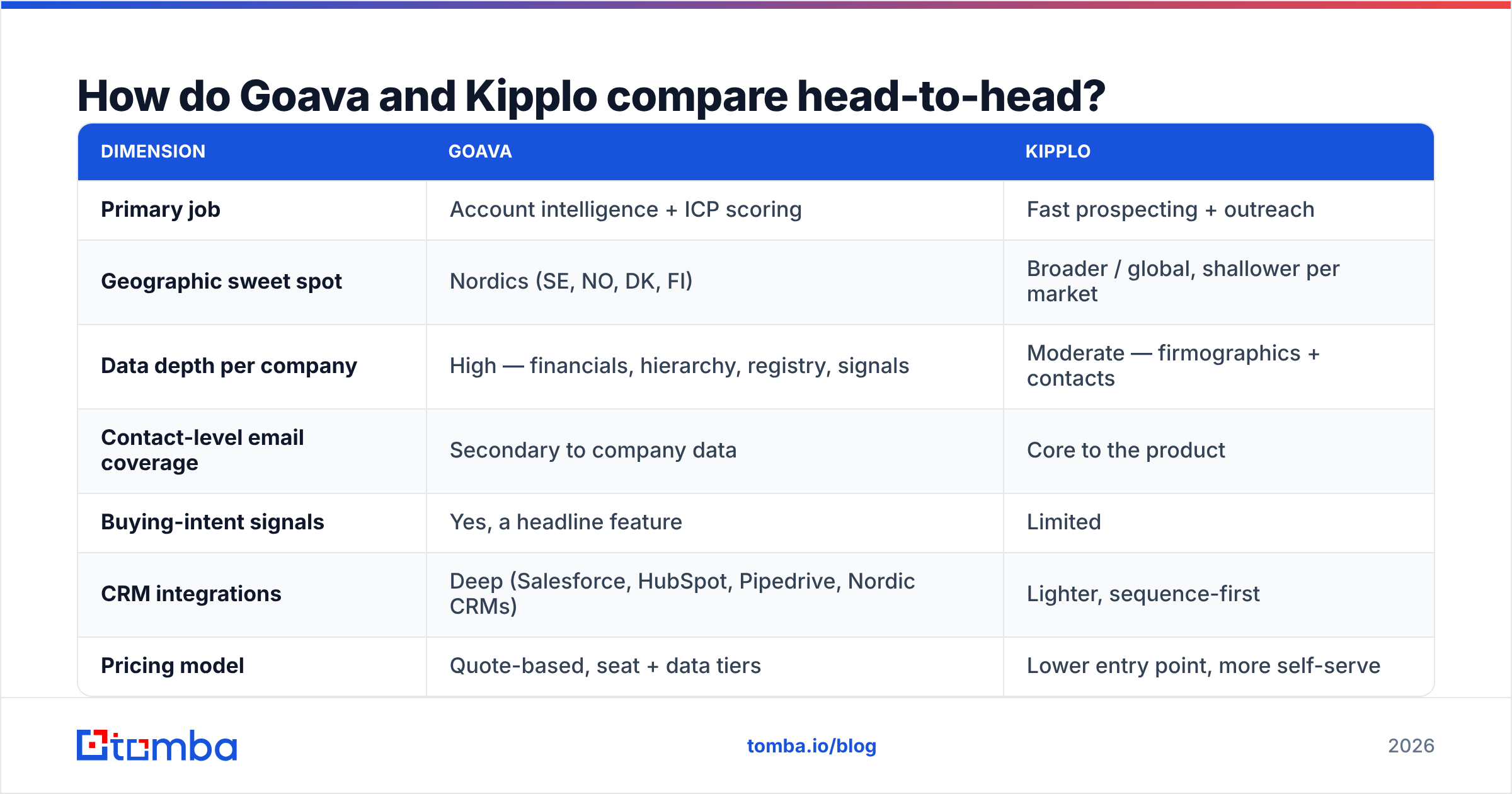
| Dimension | Goava | Kipplo |
|---|---|---|
| Primary job | Account intelligence + ICP scoring | Fast prospecting + outreach |
| Geographic sweet spot | Nordics (SE, NO, DK, FI) | Broader / global, shallower per market |
| Data depth per company | High — financials, hierarchy, registry, signals | Moderate — firmographics + contacts |
| Contact-level email coverage | Secondary to company data | Core to the product |
| Buying-intent signals | Yes, a headline feature | Limited |
| CRM integrations | Deep (Salesforce, HubSpot, Pipedrive, Nordic CRMs) | Lighter, sequence-first |
| Pricing model | Quote-based, seat + data tiers | Lower entry point, more self-serve |
| Time to first list | Days (onboarding + ICP setup) | Under an hour |
| Best for | Nordic mid-market and enterprise sales teams | Founders, SDR pods, agencies |
| Weakest at | Cost and speed for a 2-person team | Depth for complex ABM motions |
The table makes the trade-off obvious. Goava buys you judgement — it tells you who is worth your time. Kipplo buys you velocity — it tells you who to email next. Teams that confuse those two jobs end up paying enterprise money for a list they could have built in an afternoon, or paying startup money for a tool that cannot support a real account-based motion.

Which one has better data coverage?#
It depends entirely on your territory, and this is where most comparison posts get lazy.
In the Nordics, Goava wins and it is not close. Swedish and Norwegian business registries publish revenue, employee counts, board members, and filing history in machine-readable form. Goava ingests that and joins it to group structures, so you can see that the 12-person subsidiary you are calling belongs to a 900-person parent. For anyone selling into Nordic mid-market, that hierarchy view alone changes territory planning.
Outside the Nordics, the gap narrows sharply. Goava's non-Nordic coverage is real but thinner, and the signal layer that makes it special becomes less differentiated when the underlying registry data is weaker. If your ICP is US SaaS companies or UK agencies, you are paying for infrastructure you will not fully use.
Kipplo's coverage is broader but flatter. You will find companies in most markets, but with fewer attributes per record and less certainty about refresh cadence. For a founder doing 200 emails a week to a loosely defined ICP, flat and broad is fine. For an ABM team building a 150-account target list with tiering, flat and broad is not fine.
The bigger shared weakness: contact-level email accuracy. Account intelligence platforms are optimised to be right about companies. Being right about firstname.lastname@company.com for a specific VP of Operations is a different engineering problem — it needs pattern detection per domain, SMTP-level checks, catch-all handling, and continuous re-verification as people change jobs. Most account-first tools treat contacts as a bolt-on, and bounce rates show it.
That is why a lot of teams run a two-layer stack: the intelligence platform decides which accounts, and a dedicated email finder resolves which humans, at which verified address. It is less elegant than one vendor doing everything, and it works considerably better.
What does each one actually cost?#
Neither vendor makes this easy, so here is the honest framing rather than invented numbers.
Goava is quote-based. Expect a per-seat licence plus a data tier, an annual commitment, and an onboarding component. Nordic sales intelligence platforms in this category typically land in the four-figure-per-month range for a small team, and negotiation is normal. Ask specifically about: how many seats are included, whether CRM sync is metered, and what happens to your enriched records if you churn.
Kipplo is positioned as the lower-commitment option with a more self-serve entry point and credit-style consumption. That makes it easier to trial and easier to abandon, which is a genuine advantage when you are still figuring out your ICP.
For reference, here is how a contact-data layer prices against that, using published numbers:
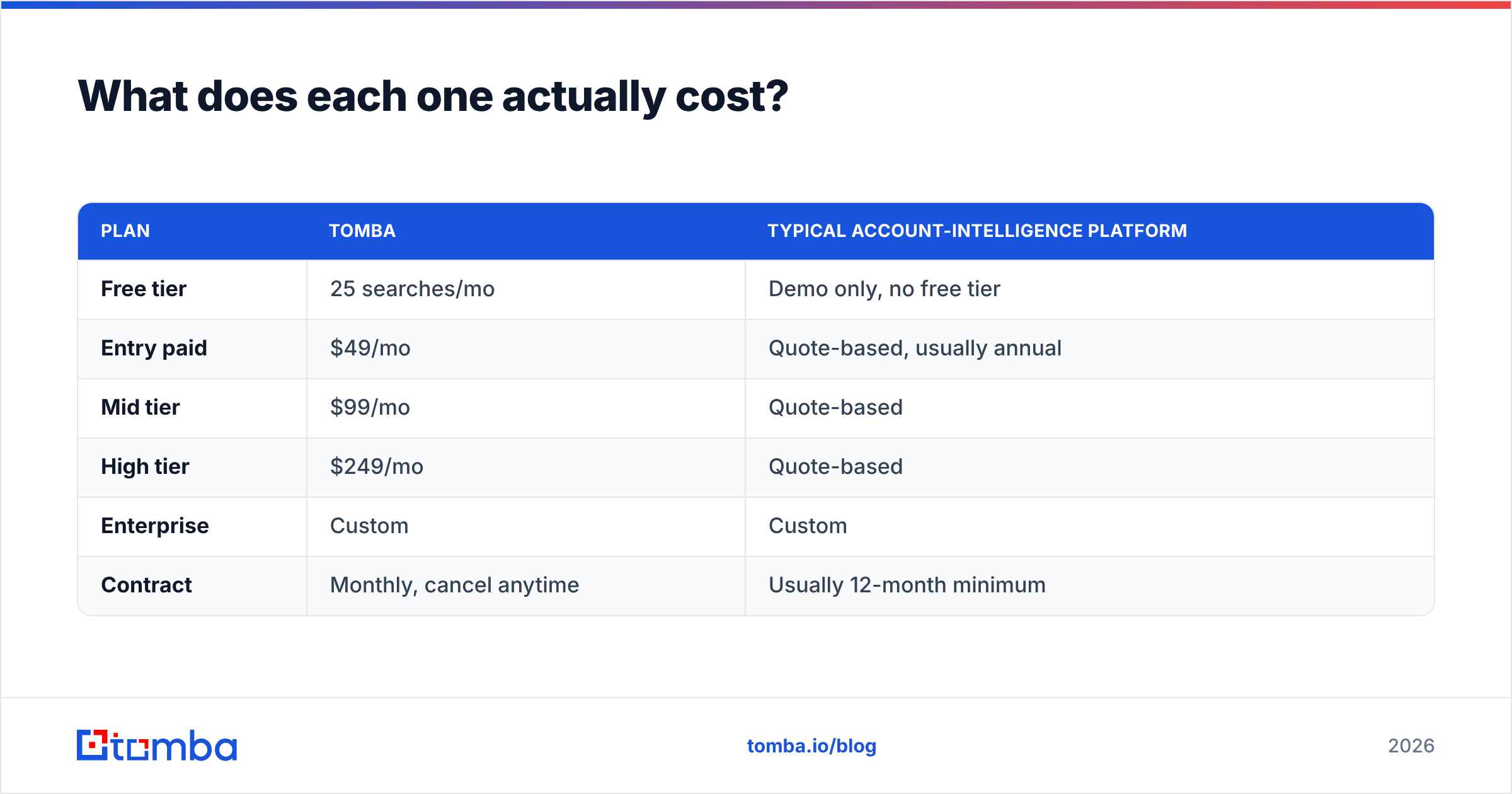
| Plan | Tomba | Typical account-intelligence platform |
|---|---|---|
| Free tier | 25 searches/mo | Demo only, no free tier |
| Entry paid | $49/mo | Quote-based, usually annual |
| Mid tier | $99/mo | Quote-based |
| High tier | $249/mo | Quote-based |
| Enterprise | Custom | Custom |
| Contract | Monthly, cancel anytime | Usually 12-month minimum |
Full Tomba pricing is public, which is the point of including it. When you are budgeting a stack, the predictable line item lets you negotiate harder on the unpredictable one.
Which tool fits your team?#
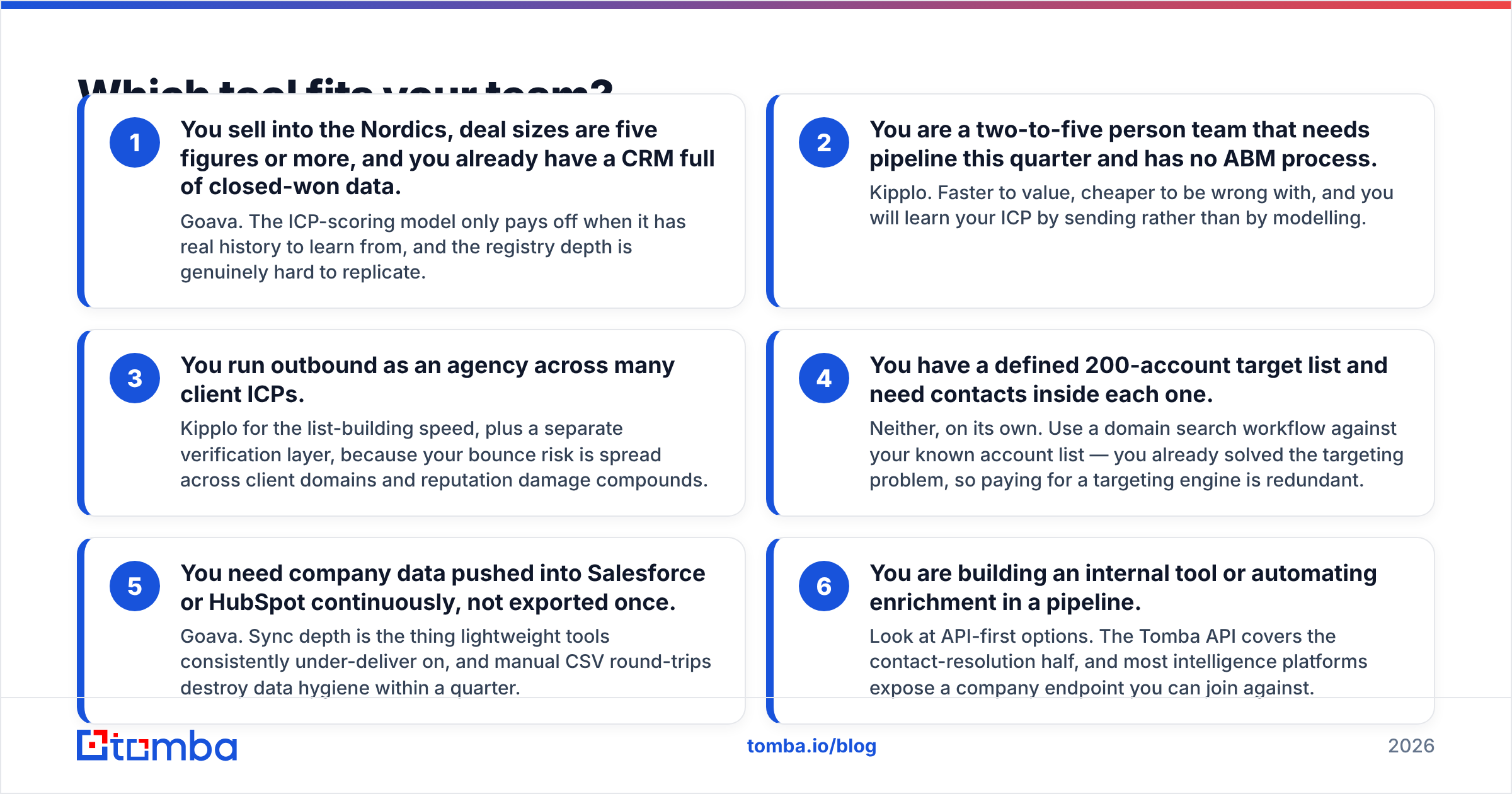
Run through these in order. The first one that describes you is your answer.
- You sell into the Nordics, deal sizes are five figures or more, and you already have a CRM full of closed-won data. Goava. The ICP-scoring model only pays off when it has real history to learn from, and the registry depth is genuinely hard to replicate.
- You are a two-to-five person team that needs pipeline this quarter and has no ABM process. Kipplo. Faster to value, cheaper to be wrong with, and you will learn your ICP by sending rather than by modelling.
- You run outbound as an agency across many client ICPs. Kipplo for the list-building speed, plus a separate verification layer, because your bounce risk is spread across client domains and reputation damage compounds.
- You have a defined 200-account target list and need contacts inside each one. Neither, on its own. Use a domain search workflow against your known account list — you already solved the targeting problem, so paying for a targeting engine is redundant.
- You need company data pushed into Salesforce or HubSpot continuously, not exported once. Goava. Sync depth is the thing lightweight tools consistently under-deliver on, and manual CSV round-trips destroy data hygiene within a quarter.
- You are building an internal tool or automating enrichment in a pipeline. Look at API-first options. The Tomba API covers the contact-resolution half, and most intelligence platforms expose a company endpoint you can join against.

Is Goava better than Kipplo for outbound?#
For targeting, yes. For executing, no.
Goava will hand you a ranked list of accounts with a defensible reason for each one — revenue trajectory, recent hire, group structure change. That reasoning is what turns a cold email into a relevant one, and relevance is the only lever that still reliably moves response rate in 2026.
But Goava does not want to be your sending tool. It wants to feed your CRM and your sequencer. Kipplo is closer to the sending motion — build, filter, sequence — which is why small teams like it. The trade-off is that a fast-built list is usually a less-qualified list, and a less-qualified list is where deliverability problems begin. Spam complaints and bounces are downstream of bad targeting far more often than they are downstream of bad copy. HubSpot's research on outbound benchmarks makes the same point repeatedly: list quality outperforms volume.
If you go the Kipplo route, budget for a verification step before every send. Running any list through an email verifier before it hits your sequencer costs cents per contact and protects the sending domain you have spent months warming. Catch-all domains deserve special handling — they will pass a naive syntax check and still bounce, which is why catch-all-specific validation exists as a separate product category.
What do you still have to build yourself?#
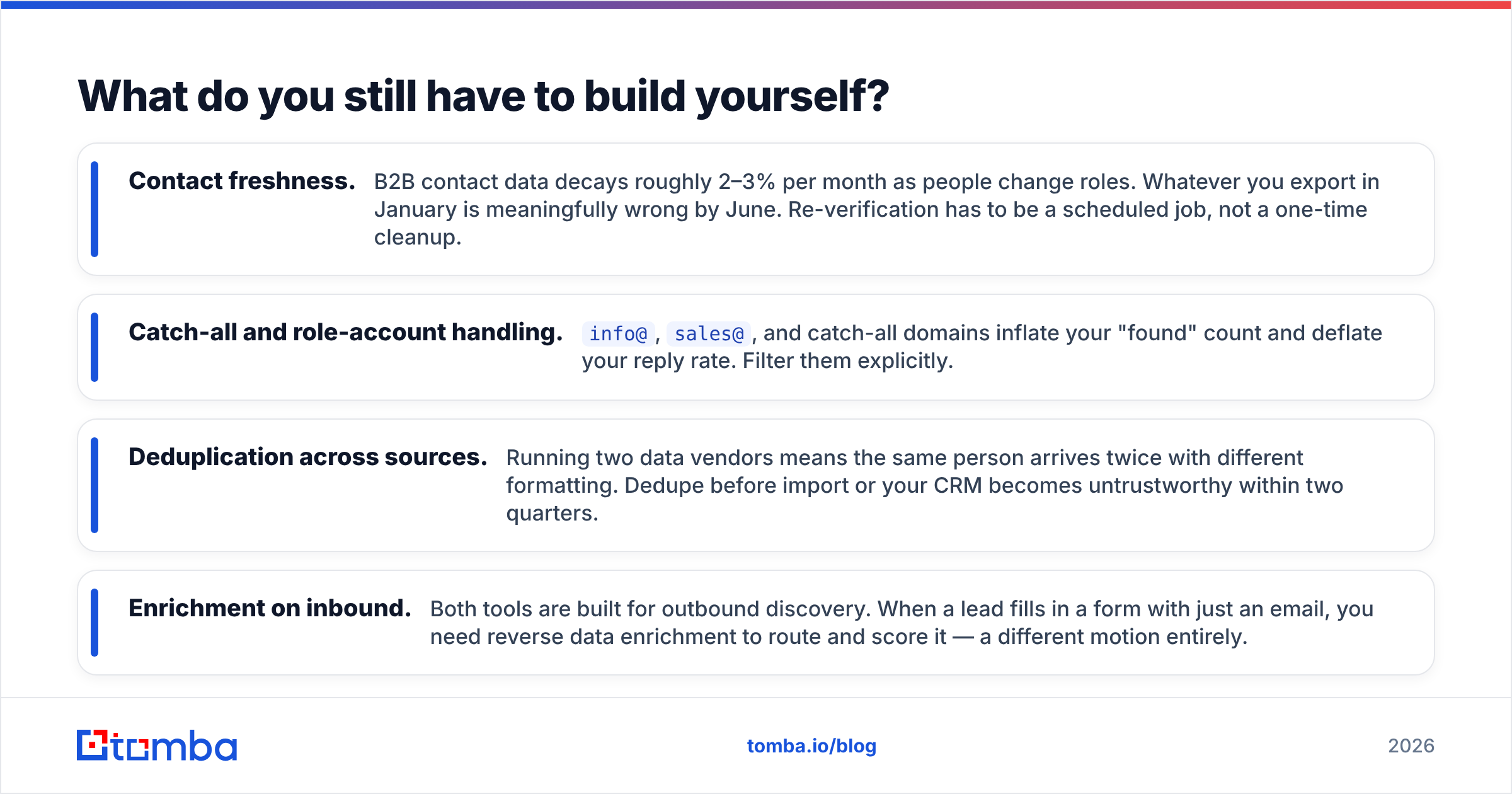
Neither platform closes the loop end to end. Plan for these gaps:
- Contact freshness. B2B contact data decays roughly 2–3% per month as people change roles. Whatever you export in January is meaningfully wrong by June. Re-verification has to be a scheduled job, not a one-time cleanup.
- Catch-all and role-account handling.
info@,sales@, and catch-all domains inflate your "found" count and deflate your reply rate. Filter them explicitly. - Deduplication across sources. Running two data vendors means the same person arrives twice with different formatting. Dedupe before import or your CRM becomes untrustworthy within two quarters.
- Enrichment on inbound. Both tools are built for outbound discovery. When a lead fills in a form with just an email, you need reverse data enrichment to route and score it — a different motion entirely.
Goava vs Kipplo: what is the actual verdict?#
Pick Goava if your problem is prioritisation. Nordic territory, real CRM history, deals worth the licence cost, and a team that will actually change behaviour based on account scores. If nobody on your team will act on a score, do not buy a scoring platform.
Pick Kipplo if your problem is throughput. Small team, undefined or broad ICP, need to send this week, want to keep the monthly cost small enough that switching later is painless.
Pick neither as your complete stack. Both are account-layer tools. The contact layer — finding the right person, resolving their verified work email, and keeping it accurate — is a separate discipline, and running it on a tool that treats it as a side feature is how teams end up with 8% bounce rates and a burned domain.
The stack that works for most B2B teams in 2026 is boring: one intelligence source to decide where to spend attention, one dedicated contact-data source to make outreach possible, one sequencer to send, and a verification step wired between the last two.
Fill the contact gap without a sales call. Whichever platform you choose for account intelligence, you still need verified work emails for the people inside those accounts. Tomba Email Finder resolves professional email addresses by domain, name, or company, with verification built in and public pricing that starts free at 25 searches per month and $49/mo on Starter. Test it against 50 accounts from your current list and compare the bounce rate before you commit to anything with an annual contract.
Related guides#
Ready to find emails that actually work?
Join 150,000+ professionals who stopped guessing and started sending. Free credits on signup — no credit card required.
Get the Tomba newsletter
Practical outbound tactics and product updates — once every two weeks.
About the author