Goava vs SignalHire (2026): Which Sales Data Tool Wins?
Goava maps Nordic accounts and tells you who to call next. SignalHire pulls emails and phone numbers from profiles. They solve different halves of the same problem — here is which one your team actually needs.
Goava vs SignalHire is not the head-to-head it looks like. One tool picks your accounts. The other finds the people inside them. Here is what each does, what they cost, and when you need a third tool instead.
TL;DR
- They are not really competitors. Goava is Nordic account intelligence. It scores and recommends which companies to target. SignalHire is a contact finder. It reveals which humans to email and call.
- Pick Goava if you sell into Sweden, Norway, Denmark, or Finland and your bottleneck is picking accounts, not finding contacts.
- Pick SignalHire if you already know your target accounts and need emails plus mobile numbers, largely sourced from public profiles, on a credit-based plan.
- Pricing is lopsided. SignalHire publishes tiers. Goava is quote-only, with annual contracts and seat minimums. That is a real budget problem for teams under 10 reps.
- Most teams add a third tool anyway — a domain-level email finder and verifier. Neither product covers verified work emails at bulk-list scale cheaply.
Goava vs SignalHire: what does each tool do?#
Goava is a Swedish sales intelligence platform. It answers one question: of the thousands of companies in your market, which 50 should a rep call this week?
It pulls in Nordic company registry data, financials, tech stacks, hiring signals, and news. Then it ranks accounts and pushes the list into your CRM. Goava Discover handles search and filtering. The recommendation engine handles the "who's next" prompt inside HubSpot, Salesforce, Pipedrive, Upsales, or Lime.
SignalHire sits at the other end of the funnel. It is a contact-reveal tool. Install the browser extension, open a professional profile or a candidate list, and SignalHire tries to return that person's work email, personal email, and phone number.
It was built for recruiters, so it ships with ATS-style features like candidate pipelines and bulk profile processing. Sales teams use it the same way: as a per-contact reveal engine.
So the honest framing for Goava vs SignalHire is not "which is better." It is simpler. Which half of the prospecting problem costs you more money right now?
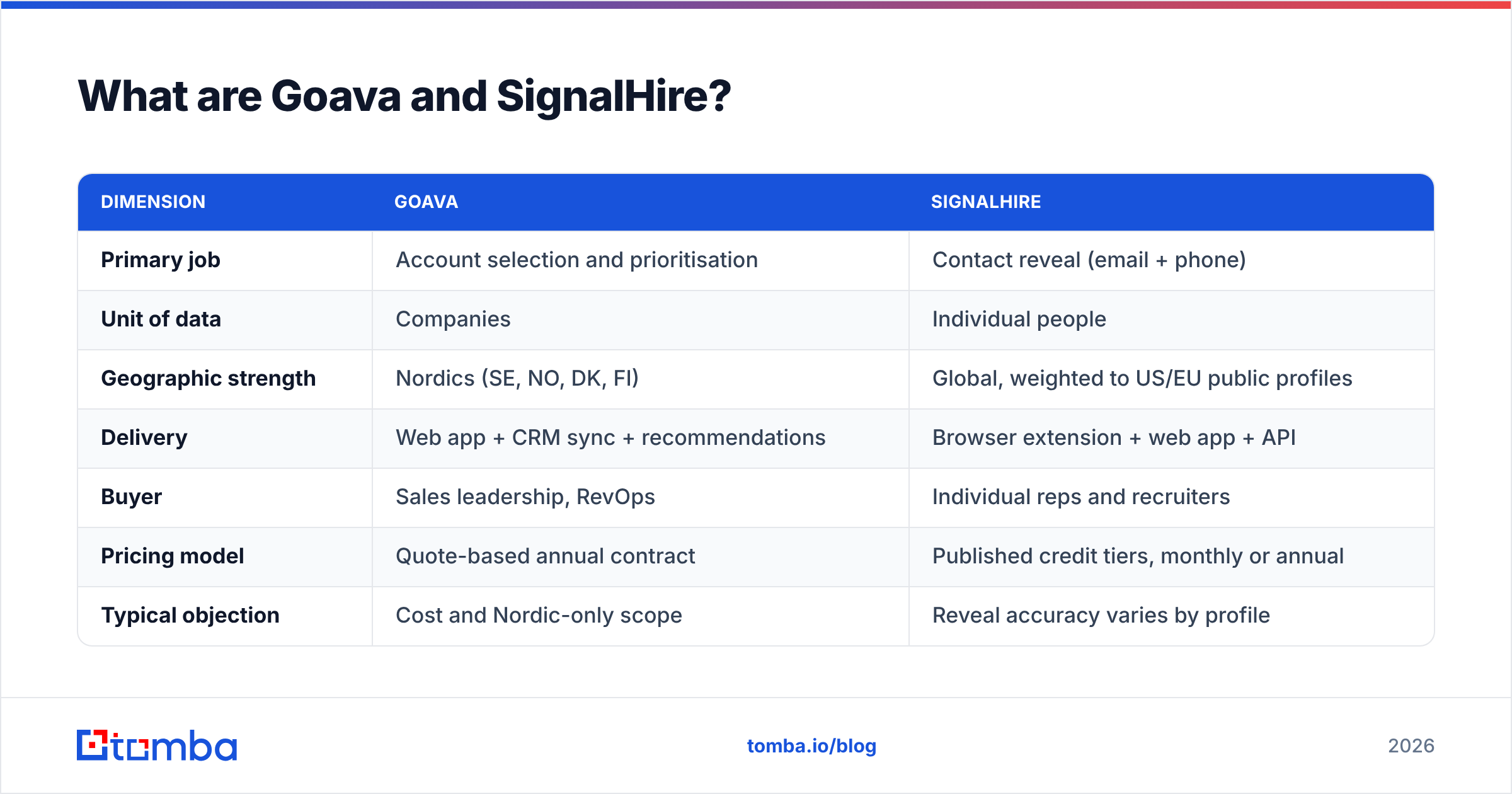
| Dimension | Goava | SignalHire |
|---|---|---|
| Primary job | Account selection and prioritisation | Contact reveal (email + phone) |
| Unit of data | Companies | Individual people |
| Geographic strength | Nordics (SE, NO, DK, FI) | Global, weighted to US/EU public profiles |
| Delivery | Web app + CRM sync + recommendations | Browser extension + web app + API |
| Buyer | Sales leadership, RevOps | Individual reps and recruiters |
| Pricing model | Quote-based annual contract | Published credit tiers, monthly or annual |
| Typical objection | Cost and Nordic-only scope | Reveal accuracy varies by profile |
Is Goava better than SignalHire for prospecting?#
For the first 20 minutes of prospecting, yes. For the next 20, no.
Goava saves research time. A rep would otherwise open six tabs: company registry, LinkedIn, the careers page, a news search, a tech-stack checker. Goava returns one scored card instead.
It works because Nordic registry data is genuinely rich. Revenue, headcount, ownership, and filing history are public and structured in Sweden and Norway. In most markets they are not. Goava mines that edge hard.
But Goava will not hand you a verified work email for the CFO of the account it just recommended. That is not its job. If your sequence needs firstname.lastname@company.se, and it needs to bounce under 2%, you still need a dedicated email finder or a verification layer.
SignalHire is the mirror image. It has no view on which accounts deserve your time. Give it a person, and it gives you contact details. That is a narrow job at a fair price. It also gets expensive fast if you work through a 2,000-row list one profile at a time.

How do Goava and SignalHire differ in practice?#
Six differences decide most Goava vs SignalHire evaluations.
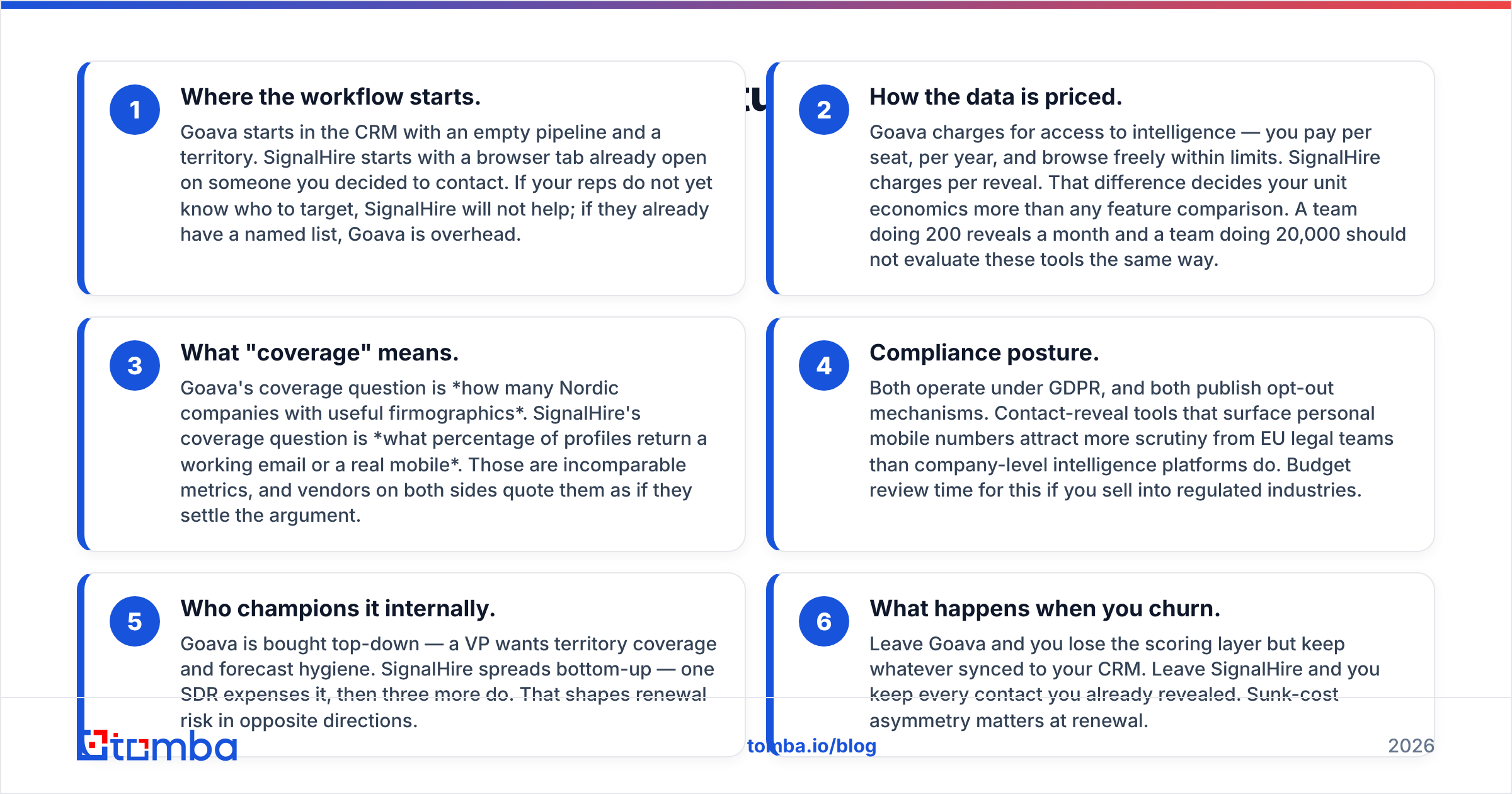
- Where the workflow starts. Goava starts in the CRM with a territory and an empty pipeline. SignalHire starts with a browser tab open on someone you already chose. If your reps do not know who to target, SignalHire will not help. If they already have a named list, Goava is overhead.
- How the data is priced. Goava charges for access: per seat, per year, browse freely within limits. SignalHire charges per reveal. That one difference drives your unit costs more than any feature comparison. A team doing 200 reveals a month and a team doing 20,000 should not judge these tools the same way.
- What "coverage" means. For Goava, coverage means how many Nordic companies come with useful firmographics. For SignalHire, it means what share of profiles return a working email or a real mobile. The two numbers are not comparable, yet both sides quote them as if they end the argument.
- Compliance posture. Both operate under GDPR, and both publish opt-out steps. Tools that surface personal mobile numbers draw more scrutiny from EU legal teams than company-level data does. Budget review time for this if you sell into regulated industries.
- Who champions it internally. Goava is bought top-down. A VP wants territory coverage and clean forecasts. SignalHire spreads bottom-up. One SDR expenses it, then three more do. Renewal risk runs in opposite directions.
- What happens when you churn. Leave Goava and you lose the scoring layer, but you keep whatever synced to your CRM. Leave SignalHire and you keep every contact you already revealed.
What does the Goava vs SignalHire pricing comparison look like?#
This is the least comfortable section for Goava. SignalHire publishes its tiers. Goava publishes nothing and routes you to a demo form.
Treat every number below as directional. Confirm current figures on the vendor's own page before you sign, because pricing moves on both sides.
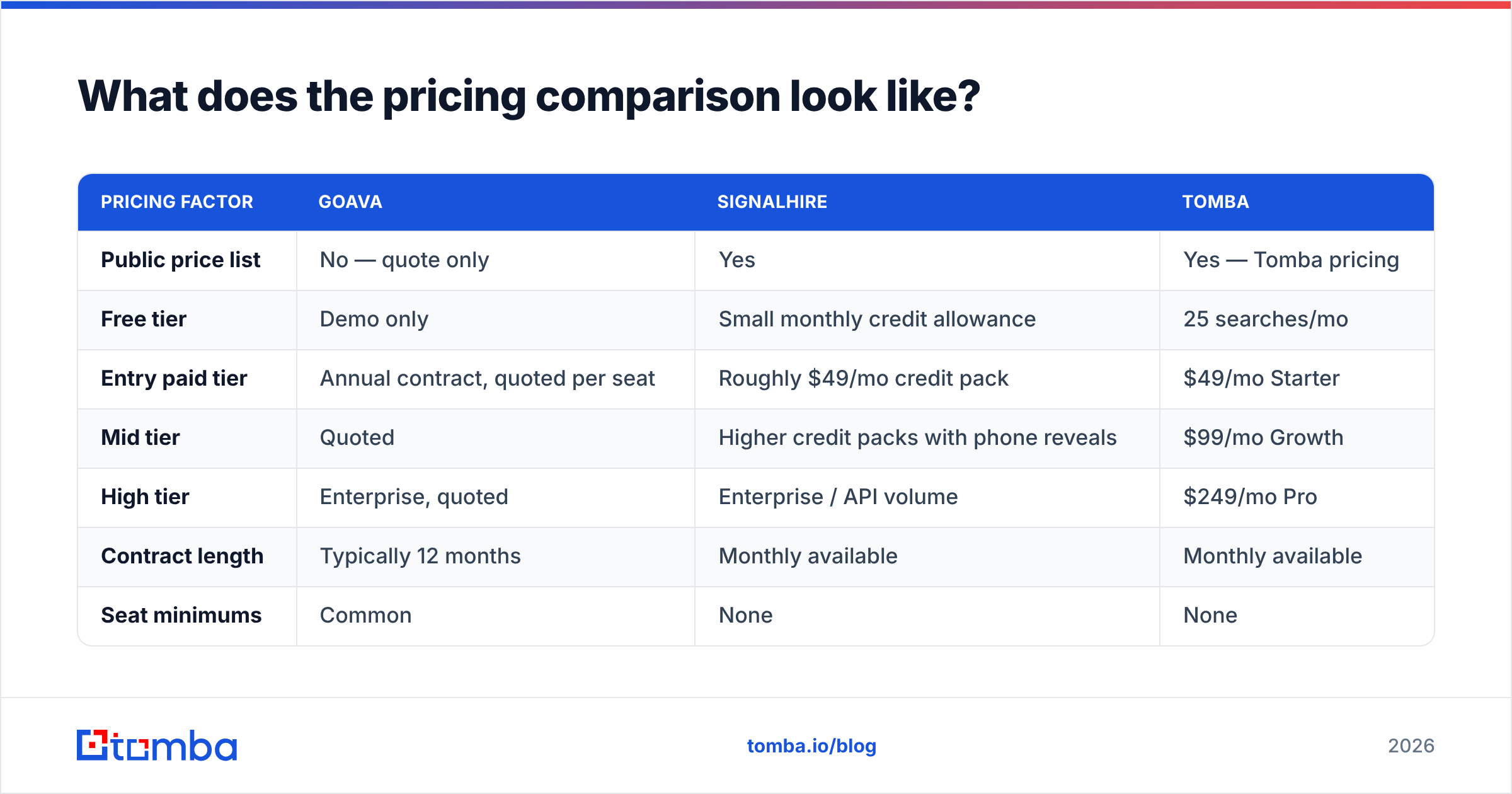
| Pricing factor | Goava | SignalHire | Tomba |
|---|---|---|---|
| Public price list | No — quote only | Yes | Yes — Tomba pricing |
| Free tier | Demo only | Small monthly credit allowance | 25 searches/mo |
| Entry paid tier | Annual contract, quoted per seat | Roughly $49/mo credit pack | $49/mo Starter |
| Mid tier | Quoted | Higher credit packs with phone reveals | $99/mo Growth |
| High tier | Enterprise, quoted | Enterprise / API volume | $249/mo Pro |
| Contract length | Typically 12 months | Monthly available | Monthly available |
| Seat minimums | Common | None | None |
| Credits roll over | N/A (access model) | Varies by plan | Plan-dependent |
Two takeaways. First, a five-person team often gets priced out of Goava before the demo ends. The annual contract and the seat minimum do that, not the product quality. Goava is built for firms with a defined Nordic territory and a sales ops function to run it.
Second, SignalHire's credit model looks cheap at the entry tier. It stops looking cheap the moment someone enriches a conference attendee list. Per-reveal pricing punishes volume.

Goava vs SignalHire: which one has better data quality?#
They fail in different ways, so judge them separately.
Goava's failure mode is stale, narrow data. Registry data updates on filing cycles, so headcount and revenue figures can lag by quarters. And if much of your pipeline sits in Germany, the UK, or the US, the Nordic edge disappears. You end up paying specialist prices for generalist coverage.
SignalHire's failure mode is the missed reveal. Profile-based contact data is uneven. Locked-down executive profiles, catch-all mail servers, and anyone who changed jobs last quarter all cut the hit rate. User reviews on G2 describe the same pattern across this whole tool category: strong on some segments, thin on others, with phone numbers less reliable than emails.
The fix for both is the same, and it is boring. Verify before you send. A revealed address is not the same as an address that accepts mail.
Run everything you pull through an email verifier. Handle catch-all domains on purpose with a catch-all verifier, rather than letting them sit in your list as "valid." Nordic B2B is full of catch-all setups. They swallow a campaign in silence and hand you a beautiful, meaningless 0% bounce rate.
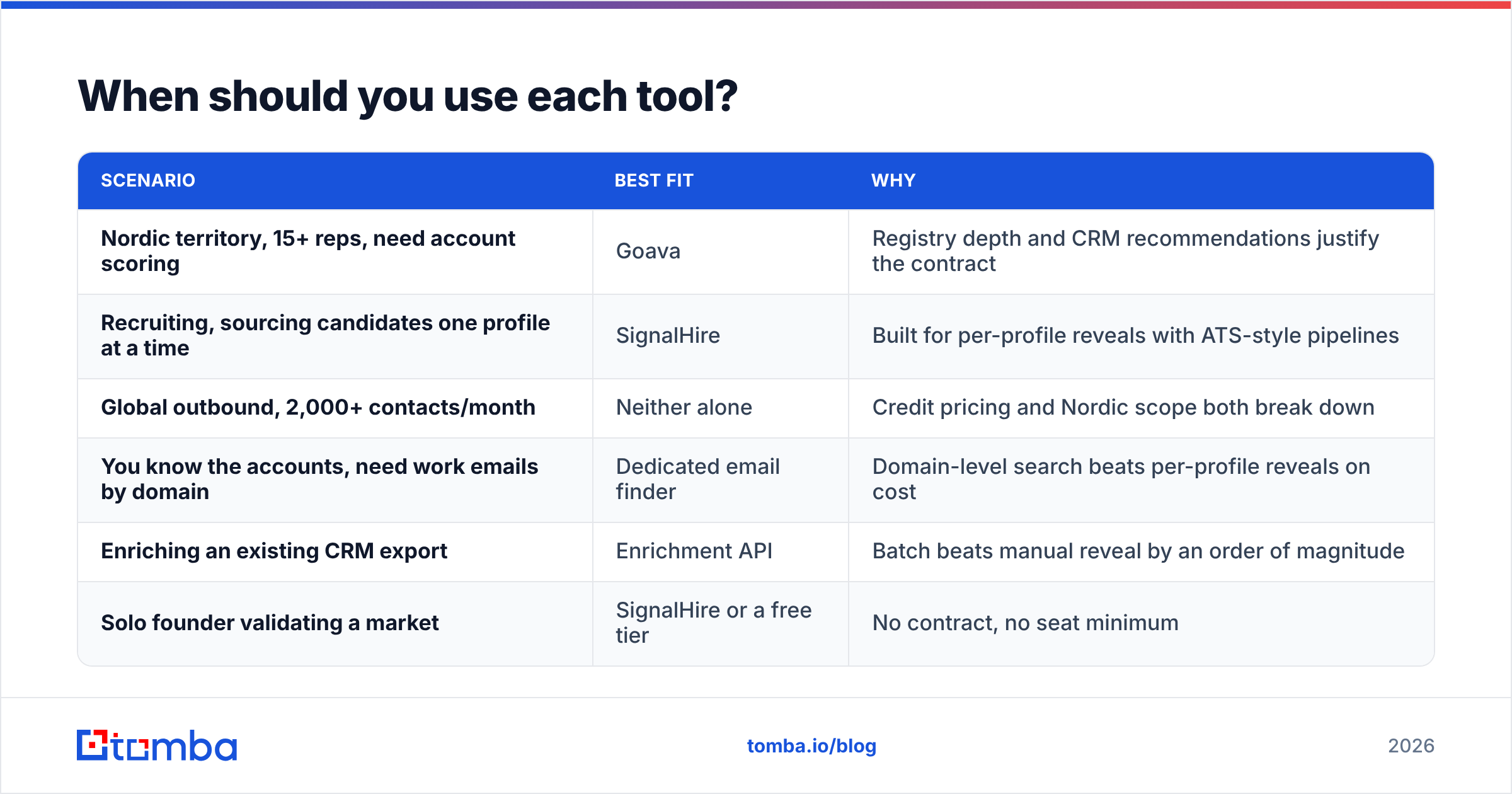
When should you use each tool?#
| Scenario | Best fit | Why |
|---|---|---|
| Nordic territory, 15+ reps, need account scoring | Goava | Registry depth and CRM recommendations justify the contract |
| Recruiting, sourcing candidates one profile at a time | SignalHire | Built for per-profile reveals with ATS-style pipelines |
| Global outbound, 2,000+ contacts/month | Neither alone | Credit pricing and Nordic scope both break down |
| You know the accounts, need work emails by domain | Dedicated email finder | Domain-level search beats per-profile reveals on cost |
| Enriching an existing CRM export | Enrichment API | Batch beats manual reveal by an order of magnitude |
| Solo founder validating a market | SignalHire or a free tier | No contract, no seat minimum |
Most teams underestimate the fourth row. If you have already picked your target accounts — true for almost any ABM motion — the efficient move is domain search.
Give the tool company.se and get back the people you can reach there, with pattern confidence attached. No credit burns for every profile you open by hand. That is a cheaper unit of work, and it scales to a whole target list through bulk email finder processing.
What are the main alternatives to both?#
If the Goava vs SignalHire match-up leaves you unconvinced, the shortlist splits three ways:
- Nordic account intelligence: Vainu is the closest match to Goava, with similar registry-driven Nordic coverage and a comparable CRM-sync model.
- Global contact reveal: Apollo, RocketReach, ContactOut, and Lusha all compete with SignalHire on per-contact reveals. Phone coverage and credit accounting vary a lot.
- Verified email infrastructure: Tomba, Hunter, and Findymail sit in the "deliverable work emails at scale, by API or bulk upload" lane. Teams land here once cost per usable contact becomes the metric leadership tracks.
Many mature stacks run one tool from column A and one from column C, and skip column B. Intelligence picks the accounts. A domain-level finder plus verification builds the contact layer.
Check how a provider sources and refreshes its records before you trust it. Tomba's is at data sources. Read the same page from whichever vendor you shortlist.
Goava vs SignalHire: which should you actually buy?#
Buy Goava if three things are true. Your revenue comes mostly from the Nordics. You have enough reps that territory priority is a real problem. And someone in RevOps will own the CRM integration. Outside that box, the annual commitment is hard to defend.
Buy SignalHire if your work is profile by profile — recruiting, executive search, or low-volume, high-value outbound — and you would rather skip a contract than chase the lowest cost per contact.
Buy neither, yet, if your real bottleneck is different. You have a list of 500 target domains and no reliable way to get deliverable work emails for them. That is a third product category. Paying account-intelligence prices or per-reveal prices to solve it is how prospecting budgets quietly double.
For that case, start with the Tomba Email Finder. Search by domain, or by name plus company. You get confidence-scored results with sources attached, and verification in the same pass, so nothing hits your sequence unchecked. The free tier gives you 25 searches a month to test hit rate against your own target list. That is the only benchmark that matters. Starter is $49/mo if it works, with no seat minimum and no annual contract to negotiate.
Related guides#
Ready to find emails that actually work?
Join 150,000+ professionals who stopped guessing and started sending. Free credits on signup — no credit card required.
Get the Tomba newsletter
Practical outbound tactics and product updates — once every two weeks.
About the author