Goava vs Tami AI: Which B2B Sales Intelligence Tool Wins in 2026?
Two Nordic sales intelligence platforms, two very different bets. We break down data coverage, AI scoring, CRM fit, pricing opacity, and the contact-data gap both leave behind.
TL;DR
- Goava is a Nordic sales intelligence and recommendation platform built to tell an account executive which company to call next, using registry data, buying signals, and CRM sync.
- Tami AI is an AI classification layer over company websites. Instead of trusting static industry codes, it reads what a company actually does and lets you build an ICP from that.
- They overlap less than the "sales intelligence" label suggests: Goava is a workflow tool for reps, Tami is a data-modelling tool for RevOps and marketing.
- Both publish pricing on request only. Budget for a sales call, a demo, and a seat-based annual contract in both cases.
- Neither is an email-finding engine. If your bottleneck is reaching the contacts you identified, you will still need a dedicated email finder alongside either platform.
What are Goava and Tami AI?#
Goava is a Stockholm-built sales intelligence platform aimed squarely at Nordic B2B sales teams. Its core promise is prioritisation: pull in official company registry data across Sweden, Norway, Denmark, and Finland, layer on financials, tech stack, hiring activity, and news triggers, then rank which accounts a rep should touch first. It plugs into the CRM the rep already lives in — HubSpot, Salesforce, Pipedrive, Upsales, Lime, SuperOffice — and pushes recommendations into that workflow rather than asking anyone to learn a new tab.
Tami comes at the same market from a completely different direction. Its founding observation is that standard industry classification codes are close to useless for modern B2B targeting. A company registered under "other business support activities" might be a fintech, a staffing agency, or a robotics manufacturer. Tami crawls company websites and applies AI-based text classification to describe what the business genuinely sells, then makes that description searchable. You describe your ideal customer in plain language or by feeding it existing customers, and it returns lookalikes.
That difference matters more than any feature checklist. Goava answers "who should I call today?" Tami answers "what does my real addressable market look like, and who is in it?"
How do Goava and Tami AI compare head-to-head?#
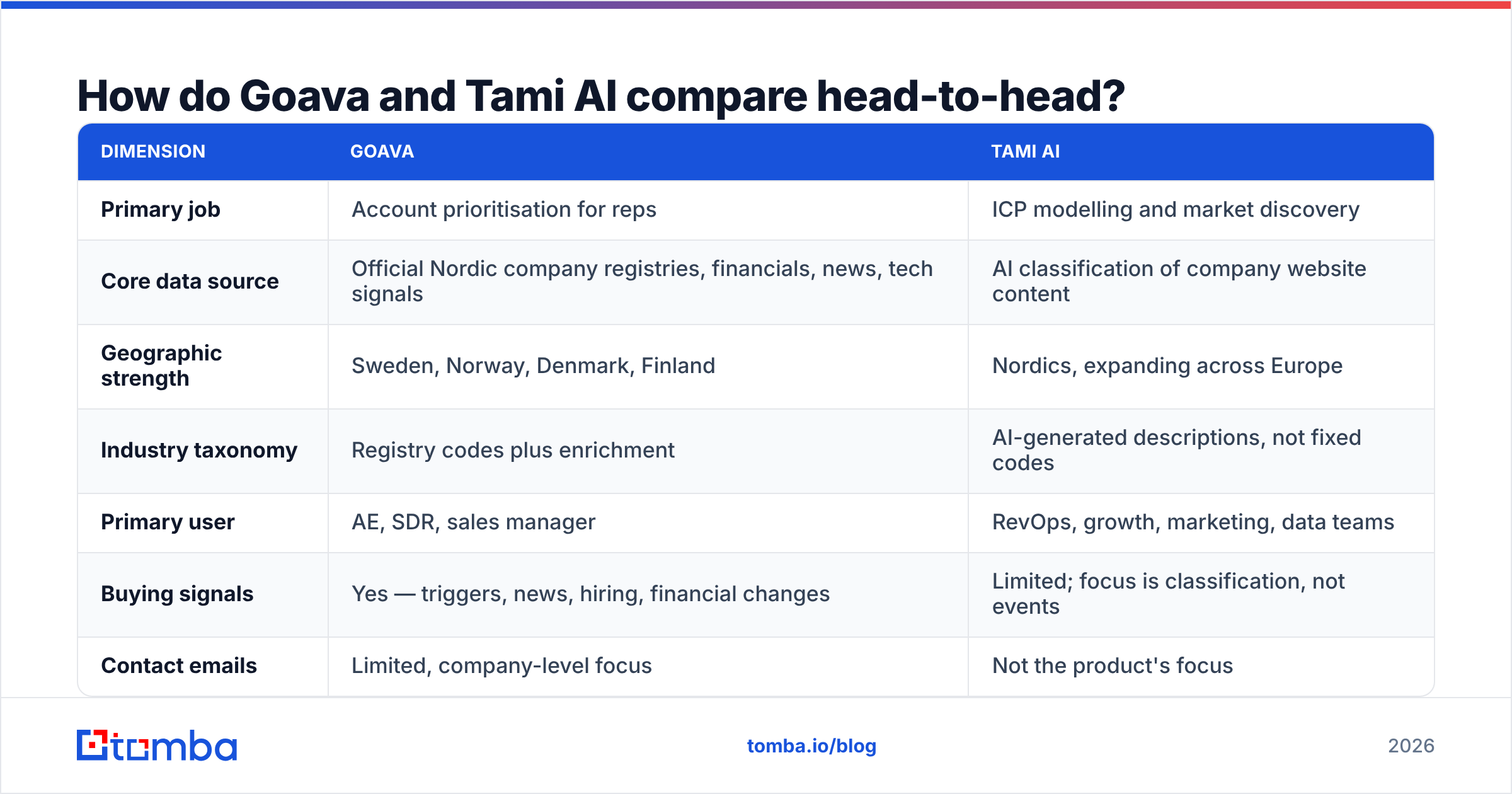
Here is the honest side-by-side. Where a vendor does not publish a figure, this table says so rather than guessing.
| Dimension | Goava | Tami AI |
|---|---|---|
| Primary job | Account prioritisation for reps | ICP modelling and market discovery |
| Core data source | Official Nordic company registries, financials, news, tech signals | AI classification of company website content |
| Geographic strength | Sweden, Norway, Denmark, Finland | Nordics, expanding across Europe |
| Industry taxonomy | Registry codes plus enrichment | AI-generated descriptions, not fixed codes |
| Primary user | AE, SDR, sales manager | RevOps, growth, marketing, data teams |
| Buying signals | Yes — triggers, news, hiring, financial changes | Limited; focus is classification, not events |
| Contact emails | Limited, company-level focus | Not the product's focus |
| API access | Available on higher tiers | API-first positioning |
| Pricing transparency | Quote only | Quote only |
| Typical contract | Annual, per seat | Annual, usage or seat based |
Neither company publishes a public price list, so treat any number you see in a third-party listicle as unverified. Check G2's sales intelligence category for current user reviews before you commit to either — the review volume there is a reasonable proxy for how much traction each has outside its home market.
What data does each platform actually give you?#
Strip away the marketing and you are buying four distinct data layers. Here is how each vendor stacks up on them:
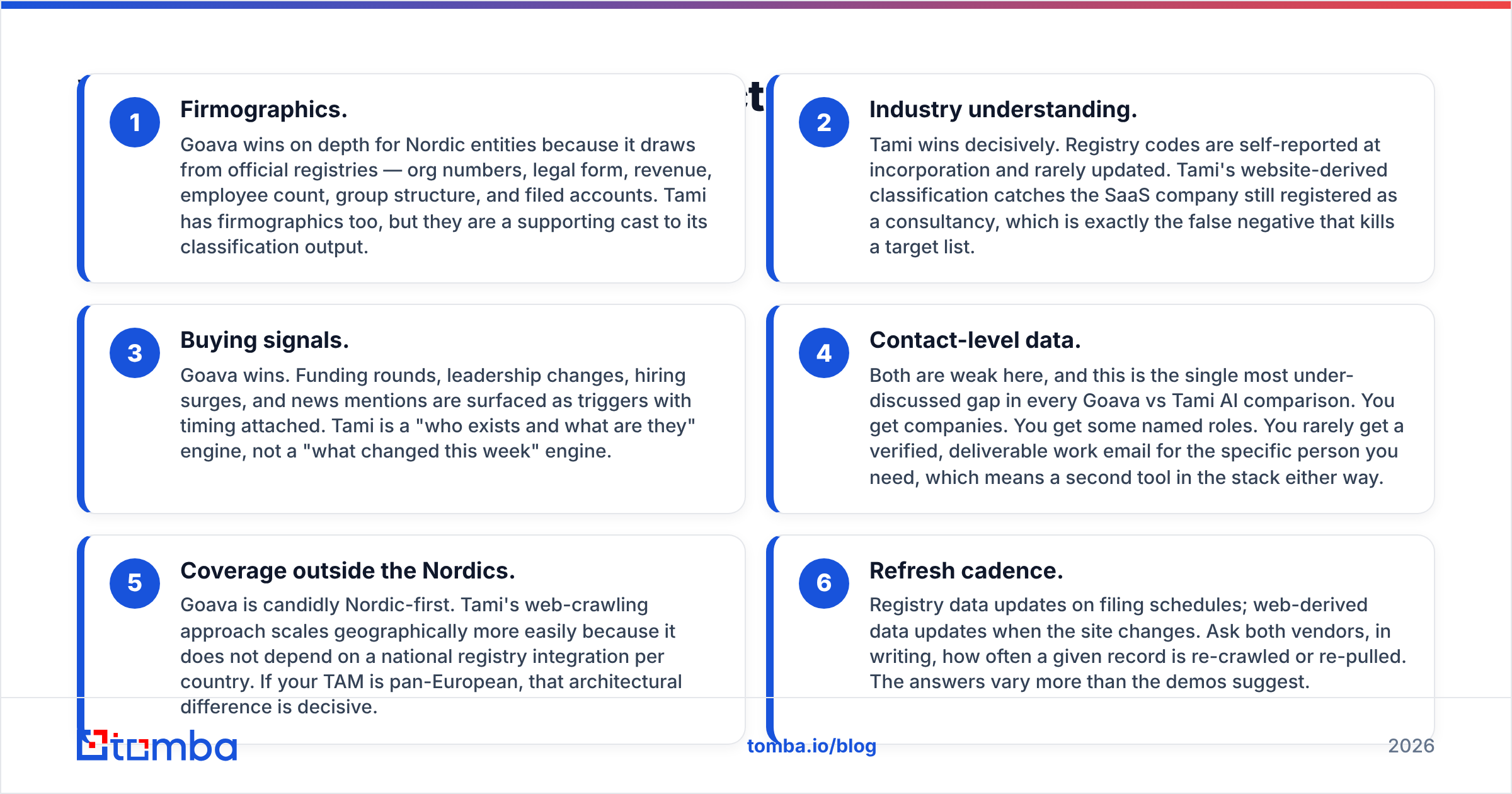
- Firmographics. Goava wins on depth for Nordic entities because it draws from official registries — org numbers, legal form, revenue, employee count, group structure, and filed accounts. Tami has firmographics too, but they are a supporting cast to its classification output.
- Industry understanding. Tami wins decisively. Registry codes are self-reported at incorporation and rarely updated. Tami's website-derived classification catches the SaaS company still registered as a consultancy, which is exactly the false negative that kills a target list.
- Buying signals. Goava wins. Funding rounds, leadership changes, hiring surges, and news mentions are surfaced as triggers with timing attached. Tami is a "who exists and what are they" engine, not a "what changed this week" engine.
- Contact-level data. Both are weak here, and this is the single most under-discussed gap in every Goava vs Tami AI comparison. You get companies. You get some named roles. You rarely get a verified, deliverable work email for the specific person you need, which means a second tool in the stack either way.
- Coverage outside the Nordics. Goava is candidly Nordic-first. Tami's web-crawling approach scales geographically more easily because it does not depend on a national registry integration per country. If your TAM is pan-European, that architectural difference is decisive.
- Refresh cadence. Registry data updates on filing schedules; web-derived data updates when the site changes. Ask both vendors, in writing, how often a given record is re-crawled or re-pulled. The answers vary more than the demos suggest.
Which one has better AI, honestly?#
Both use the word. They mean different things by it.
Tami's AI is the product. Natural-language classification of unstructured website copy is genuinely hard, and building a searchable index on top of it is a defensible engineering bet. When you ask Tami for "companies that sell warehouse automation software to mid-market retailers in the DACH region," you are querying model output, not a filter on a code column. That is a real capability that traditional databases struggle to replicate.
Goava's AI is a recommendation engine layered on structured data. It scores and ranks accounts against your closed-won patterns and your CRM history. That is more conventional machine learning — closer to lead scoring than to language understanding — but it is aimed at a decision reps make every single morning, which arguably makes it more immediately valuable to a quota-carrying team.
If you want a clean heuristic: Tami's AI improves your list. Goava's AI improves your day.
How do they handle contact data and email deliverability?#
Poorly, relative to a purpose-built tool. That is not a criticism so much as a scope statement — neither product was designed to be a contact database.
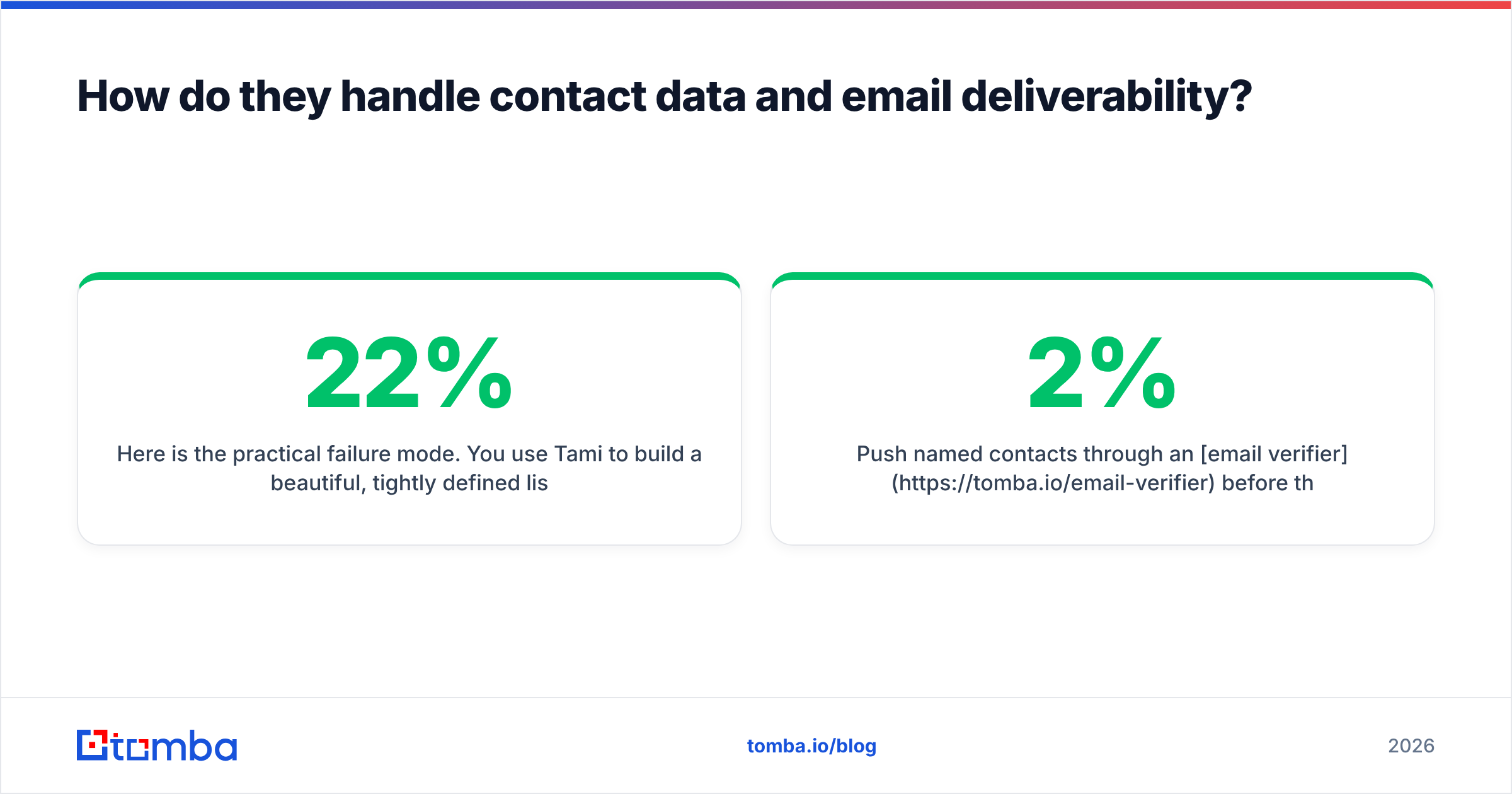
Here is the practical failure mode. You use Tami to build a beautiful, tightly defined list of 800 companies that genuinely match your ICP. You use Goava to rank the 120 with active hiring signals. Then you sit there with 120 company names and no way to email the VP of Operations at any of them. Your SDR starts guessing formats, sends to firstname.lastname@, and burns your domain reputation on a 22% bounce rate.
The fix is a dedicated layer that turns a company plus a name into a verified address:
- Run domain search against each target domain to see every discoverable address and, more usefully, the company's actual email pattern.
- Push named contacts through an email verifier before they ever enter a sequence. Sub-2% bounce rates are the target; anything above 5% is a deliverability problem in the making.
- For enterprise domains that swallow everything, use a catch-all verifier rather than treating catch-all as automatically valid or automatically junk.
- Automate the whole handoff through the Tomba API so enriched contacts land in your CRM without a CSV round trip.

What does Goava vs Tami AI actually cost?#
Both are quote-only, which tells you something about their target buyer. Quote-only pricing is a signal that deals are negotiated, contracts are annual, and the vendor expects to discount against volume. Expect a discovery call before you see a number.
What you can control in the negotiation:
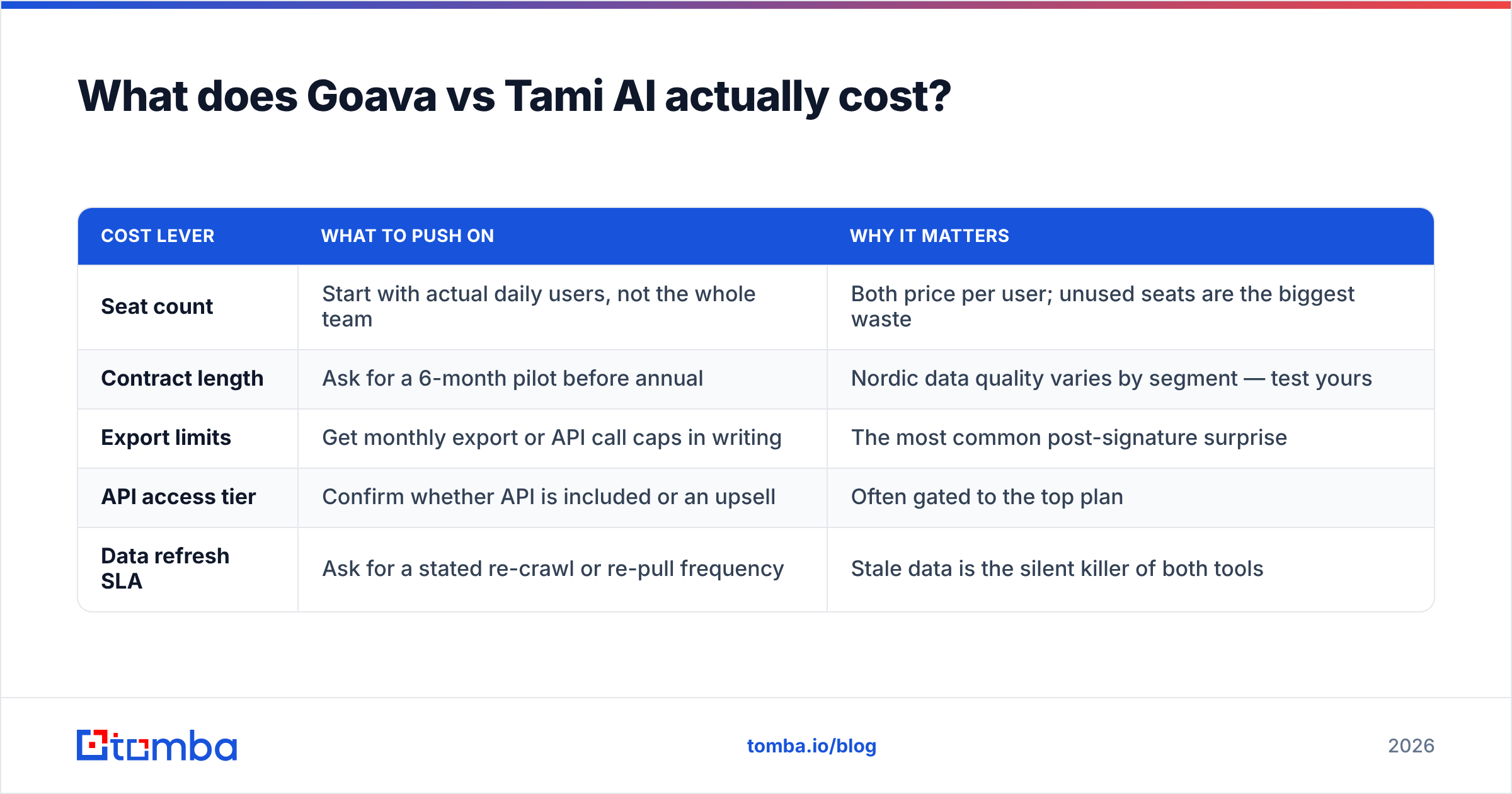
| Cost lever | What to push on | Why it matters |
|---|---|---|
| Seat count | Start with actual daily users, not the whole team | Both price per user; unused seats are the biggest waste |
| Contract length | Ask for a 6-month pilot before annual | Nordic data quality varies by segment — test yours |
| Export limits | Get monthly export or API call caps in writing | The most common post-signature surprise |
| API access tier | Confirm whether API is included or an upsell | Often gated to the top plan |
| Data refresh SLA | Ask for a stated re-crawl or re-pull frequency | Stale data is the silent killer of both tools |
By contrast, contact enrichment is one of the few parts of this stack with published, self-serve pricing. Tomba's plans run from a free tier at 25 searches per month through Starter at $49/mo, Growth at $99/mo, and Pro at $249/mo, with Enterprise on request. You can budget it before you talk to anyone, which is not nothing when you are assembling a stack of three or four tools.
Which one integrates better with your CRM?#
Goava, if your CRM is one it natively supports. Its whole design assumption is that the rep never leaves HubSpot or Pipedrive, so recommendations, company records, and signals sync into the object model you already use. That reduces adoption friction dramatically — the tool that requires a second login is the tool that gets abandoned in month three.
Tami's API-first stance is stronger if you have a data team. You can pipe classifications into a warehouse, join them against product usage or intent data, and score accounts with your own model. That is more powerful and more expensive in engineering time. If your RevOps function is one person with a Zapier account, Goava's native connectors will serve you better; if you have analytics engineers, Tami's flexibility compounds.
For either path, keep the enrichment layer connected too — Tomba's integrations cover HubSpot, Salesforce, Pipedrive, Zapier, and Make, so verified contacts land in the same records your intelligence tool is enriching.
Who should choose Goava?#
Choose Goava if most of these are true:
- Your ICP is concentrated in Sweden, Norway, Denmark, or Finland.
- You have reps who need daily prioritisation, not quarterly market analysis.
- Buying signals and trigger events drive your outreach timing.
- You want a tool that lives inside an existing CRM rather than beside it.
- Registry-grade financial data matters to your qualification (credit risk, revenue thresholds, group ownership).
Where Goava disappoints: teams expanding beyond the Nordics, and teams whose targeting problem is definitional rather than temporal. If you cannot describe your ICP precisely, Goava will happily prioritise the wrong accounts very efficiently.
Who should choose Tami AI?#
Choose Tami if most of these are true:
- Your product cuts across traditional industry codes and existing taxonomies keep failing you.
- You need a defensible TAM number for a board deck or a territory plan.
- Your targeting spans multiple European countries with inconsistent registry systems.
- You have the technical capacity to consume an API and do something with the output.
- Lookalike modelling from closed-won accounts is a core part of your GTM motion.
Where Tami disappoints: pure SDR teams that want a call list this morning. The output is a market map, not a queue. Without a signal layer and a contact layer on top, it is raw material rather than a finished workflow.
What does a complete stack look like?#
Neither tool alone gets an email into an inbox. A realistic 2026 stack for a Nordic or European B2B team looks like this:
- Market definition — Tami AI, or a well-maintained ICP doc if budget is tight.
- Account prioritisation — Goava, or intent data plus CRM scoring.
- Contact discovery and verification — a dedicated finder and verifier; this is where data enrichment fills the gap both platforms leave open.
- Sequencing and delivery — your sending tool, warmed domains, and a bounce rate you actually monitor.
Skipping step three is the most common and most expensive mistake. You can spend five figures a year identifying perfect accounts and then torch your sender reputation because nobody verified the addresses.
The verdict#
There is no single winner in Goava vs Tami AI because they are not really competing for the same budget line. Goava is a sales productivity purchase justified by rep efficiency. Tami is a data infrastructure purchase justified by targeting accuracy. A mature team could reasonably run both; a small team should pick based on which problem is currently costing more — bad prioritisation or bad list definition.
What both leave you needing is the same thing: verified contact data for the people at the companies you selected. Start with the Tomba Email Finder — free for your first 25 searches a month, $49/mo on Starter — and connect it to whichever intelligence platform you land on. Build the target list with the tool that fits your market, then let Tomba turn those company names into deliverable addresses your reps can actually use.
Related guides#
Ready to find emails that actually work?
Join 150,000+ professionals who stopped guessing and started sending. Free credits on signup — no credit card required.
Get the Tomba newsletter
Practical outbound tactics and product updates — once every two weeks.
About the author