Goava vs Zintlr (2026): Which B2B Data Tool Wins?
Goava scores Nordic accounts with AI. Zintlr layers personality intelligence on Asia-Pacific contacts. They barely overlap — and neither may be what your outbound team actually needs.
TL;DR
- Goava is a Swedish sales-intelligence platform built around Nordic company data and AI account scoring. If your ICP is Sweden, Norway, Denmark or Finland, it is genuinely hard to beat locally.
- Zintlr is an India-based B2B database with a distinctive angle: "personality intelligence" profiles layered on top of contact records, strongest across APAC and India.
- These two rarely appear on the same shortlist by accident. They solve different problems in different geographies — the real comparison is which market are you selling into.
- Neither is a great fit if you need high-accuracy email discovery and verification across US, EU and global domains at API scale. That's a separate layer of the stack.
- Practical setup for most teams: pick one for account discovery in your core region, then run a dedicated email finder and verifier so the contacts you export are actually deliverable.
What is Goava and who actually uses it?#
Goava is a sales intelligence platform headquartered in Stockholm. Its pitch is narrow and honest: it aggregates Nordic company data — registry filings, financials, employee counts, technology signals, news mentions — and uses that to recommend which accounts a rep should work next.
The product centres on three things:
- Company database with Nordic depth. Official registry data for Swedish, Norwegian, Danish and Finnish entities, including financial statements that most global databases either lack or stale-cache.
- AI account recommendations. Goava scores your addressable market against your closed-won history and surfaces a prioritised list, rather than making you build filters from scratch.
- CRM-embedded workflow. Deep integrations with HubSpot, Salesforce, Pipedrive and Upsales — the tool is designed to live inside the CRM, not beside it.
Who it fits: a Nordic SaaS, staffing, logistics or industrial-services company selling to Nordic mid-market. Who it doesn't fit: anyone whose ICP sits mostly outside Scandinavia. Goava has never pretended to be a global database, and you should not evaluate it as one. Check the current feature set on the official Goava site before you commit, because the AI recommendation module has shipped meaningful changes recently.

What is Zintlr and what is "personality intelligence"?#
Zintlr is a B2B contact database and prospecting platform out of India. It sells access to a large contact and company index, a Chrome extension for LinkedIn, and — the differentiator — behavioural profiles it calls personality intelligence.
The idea: for a subset of contacts, Zintlr infers traits (communication style, decision-making tendency, risk appetite) from public digital footprints and presents them alongside the email and phone. Reps then tailor their opener — direct and numbers-led for one persona, relationship-led for another.
It's an interesting bet. Two caveats before you buy on that basis alone:
- Inferred traits are probabilistic, not observed. Treat them as a soft hint, not a fact about the human. There is no public, independently audited accuracy figure for these profiles.
- The value depends on rep discipline. If your team doesn't actually rewrite openers per profile, you paid for a field nobody reads.
Zintlr's core coverage strength is India and broader APAC, with thinner and more variable depth on Western European and North American mid-market contacts. Verify against your own list before scaling — see Zintlr's own site and third-party reviews on G2 for current user reports.
Goava vs Zintlr: how do they compare head to head?#
| Dimension | Goava | Zintlr |
|---|---|---|
| Primary geography | Nordics (SE, NO, DK, FI) | India + APAC, some global |
| Core object | Company / account | Contact / person |
| Signature feature | AI account recommendations from registry + financial data | Personality intelligence profiles |
| Email discovery | Limited; contact data is secondary | Core — bundled with contact records |
| Phone numbers | Company-level, registry-sourced | Direct dials on higher tiers |
| CRM integrations | Strong (HubSpot, Salesforce, Pipedrive, Upsales) | Standard exports + Chrome extension |
| Verification layer | Not a verification tool | Basic validity flags, no deep SMTP tier |
| API for developers | Available, limited scope | Available on paid tiers |
| Pricing model | Quote-based, per-seat, annual | Published tiers, credit-based, monthly available |
| Typical entry cost | Enterprise-style annual contract | Low-to-mid monthly SaaS pricing |
| Free tier | Demo only | Limited free credits |
| Best for | Nordic ABM and territory planning | High-volume APAC contact sourcing |
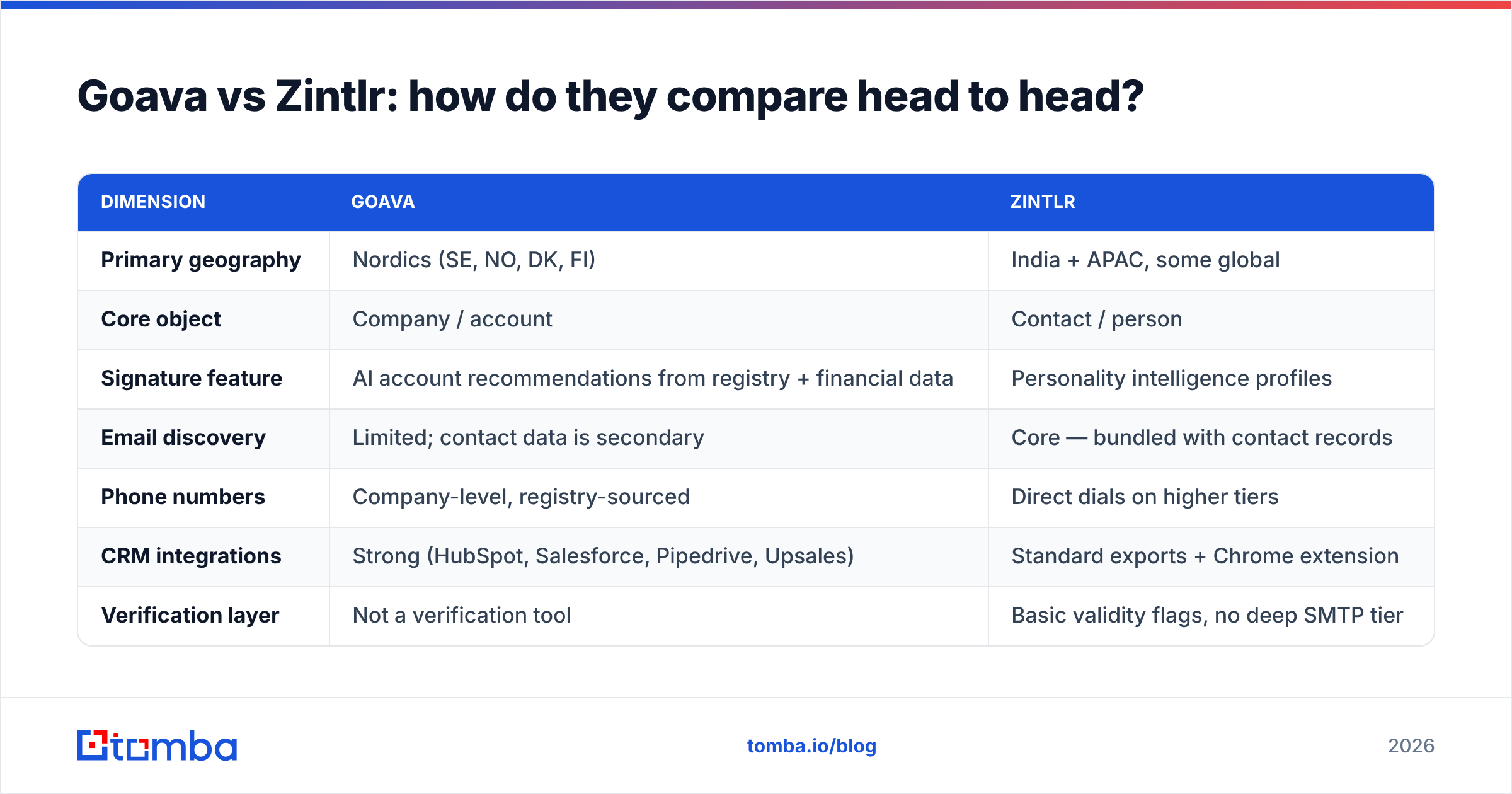
The table makes the honest conclusion obvious: these are not substitutes. Goava answers "which accounts deserve my week?" Zintlr answers "who do I email at this company, and how should I phrase it?" A team selling into Stockholm manufacturing and a team selling into Bangalore fintech will never seriously debate between them.
Which one wins on data accuracy?#
Neither publishes a third-party-audited accuracy benchmark, so anyone quoting a hard percentage for either is guessing. What you can reason about is the source model, and that predicts a lot.
Goava's accuracy comes from provenance. Nordic countries have unusually open, well-structured business registries. Company names, org numbers, addresses, board members, revenue and headcount are filed with the state and refreshed on a known cadence. Goava ingests that. Firmographic accuracy in-region is therefore high, and it degrades gracefully — a slightly stale revenue figure is still directionally right.
Zintlr's accuracy comes from aggregation. Contact-level data assembled from web crawling, community contribution and partner feeds is inherently noisier. Some records are perfect. Some are a role that changed eighteen months ago. The distribution is wide, and it widens further outside the core APAC market.
Practical consequence: with Goava you rarely need to double-check that a company exists, but you often still need to find the right person's email. With Zintlr you get the person's email immediately, but you should verify before sending. Bounce rates above 3% start damaging sender reputation, and no amount of personality intelligence saves a domain that's been throttled by Google. Run exports through an email verifier as a standing rule, not an occasional cleanup.
How do Goava and Zintlr pricing models differ?#
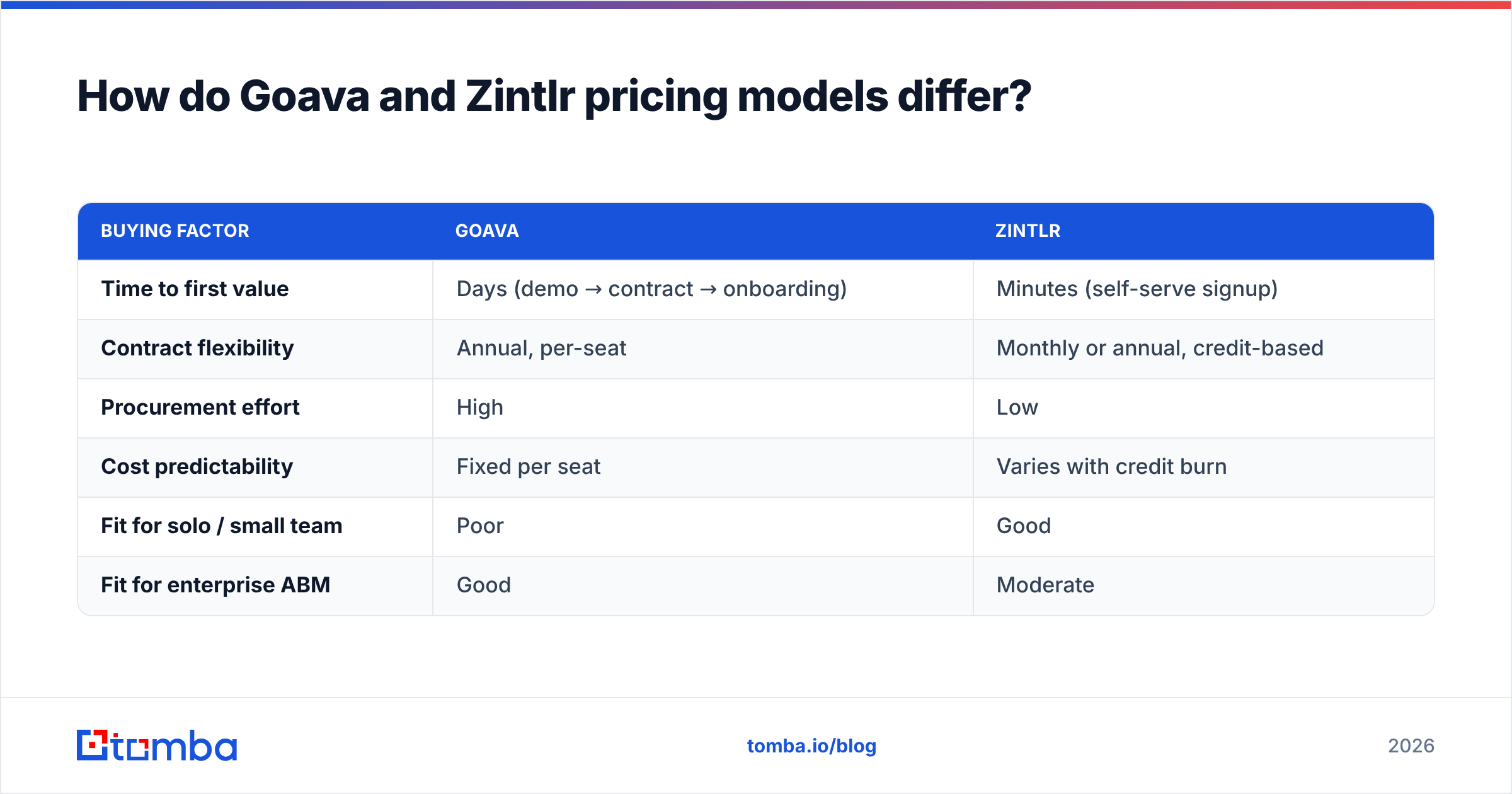
Goava sells the way European B2B software has traditionally sold: talk to sales, get a quote, sign annually, pay per seat. Expect a commitment in the range typical of mid-market sales intelligence — meaningful enough that you'll want procurement involved, and rarely worth it for a two-person team.
Zintlr sells the way modern PLG tools sell: published tiers, credits, month-to-month options, a small free allowance to test. You can be running the same afternoon.
That difference matters more than either feature list. A 4-person outbound team testing a new market cannot justify an annual Nordic-only contract. A 40-rep enterprise with a Swedish territory absolutely can, and will find Zintlr's Nordic contact depth insufficient.
| Buying factor | Goava | Zintlr |
|---|---|---|
| Time to first value | Days (demo → contract → onboarding) | Minutes (self-serve signup) |
| Contract flexibility | Annual, per-seat | Monthly or annual, credit-based |
| Procurement effort | High | Low |
| Cost predictability | Fixed per seat | Varies with credit burn |
| Fit for solo / small team | Poor | Good |
| Fit for enterprise ABM | Good | Moderate |
For reference on what a mid-market data budget looks like elsewhere, Tomba pricing runs Free (25 searches/month), Starter at $49/mo, Growth at $99/mo, Pro at $249/mo, with custom enterprise terms — useful as a baseline when a quote-based vendor won't publish numbers.
What do both tools leave uncovered?#
Three gaps show up repeatedly when teams run either product in production.
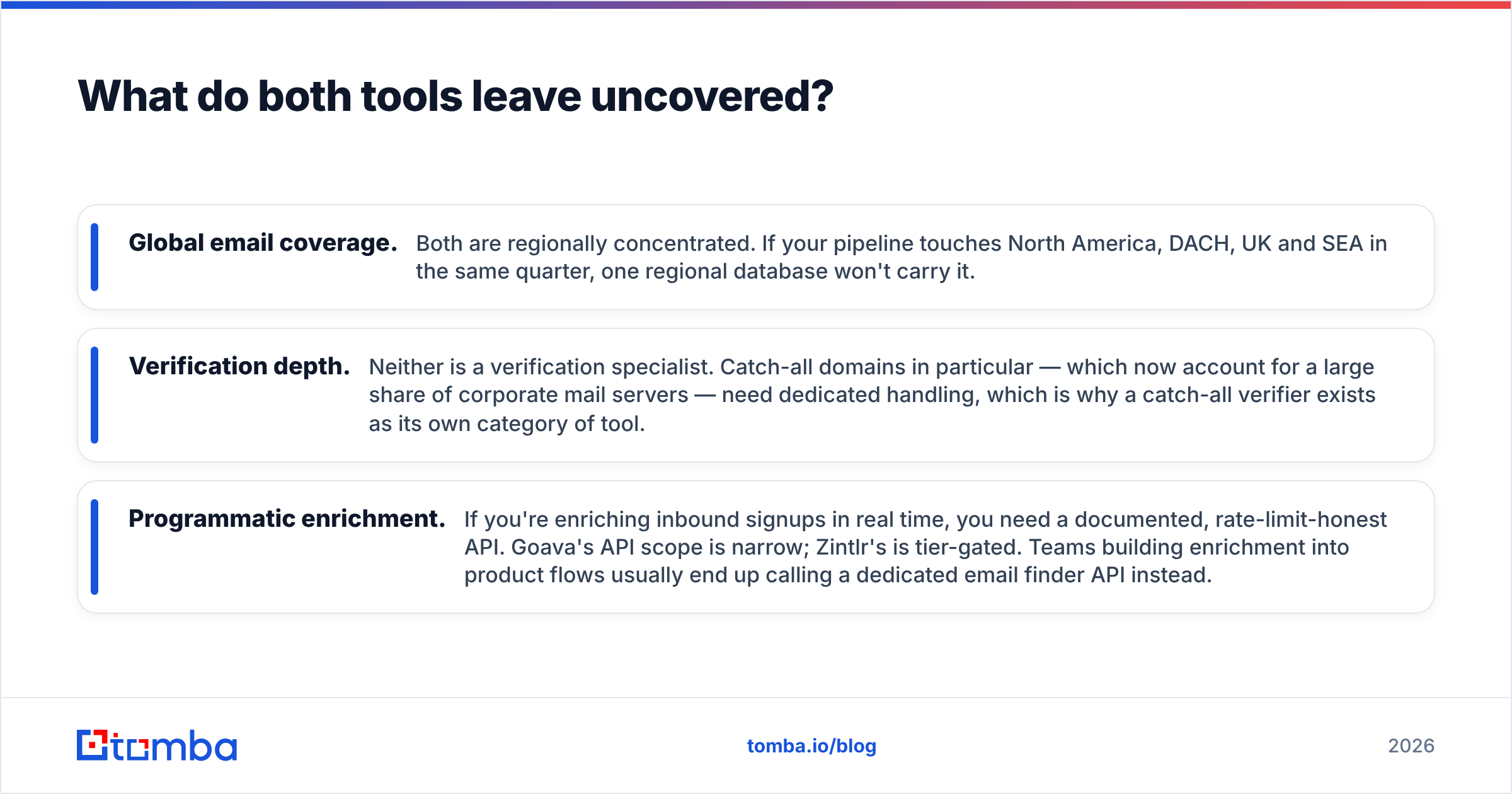
- Global email coverage. Both are regionally concentrated. If your pipeline touches North America, DACH, UK and SEA in the same quarter, one regional database won't carry it.
- Verification depth. Neither is a verification specialist. Catch-all domains in particular — which now account for a large share of corporate mail servers — need dedicated handling, which is why a catch-all verifier exists as its own category of tool.
- Programmatic enrichment. If you're enriching inbound signups in real time, you need a documented, rate-limit-honest API. Goava's API scope is narrow; Zintlr's is tier-gated. Teams building enrichment into product flows usually end up calling a dedicated email finder API instead.
There's also a market reality worth naming: neither vendor is the only option in its niche. Peers like BookYourData compete credibly on verified, pay-as-you-go B2B lists with strong US and EU coverage and no annual lock-in — a legitimate alternative if your blocker is contract structure rather than data type. Comparing across categories honestly beats forcing a Goava-or-Zintlr binary.
Which should you choose in 2026?#
Decide by geography first, buying model second, feature novelty last.
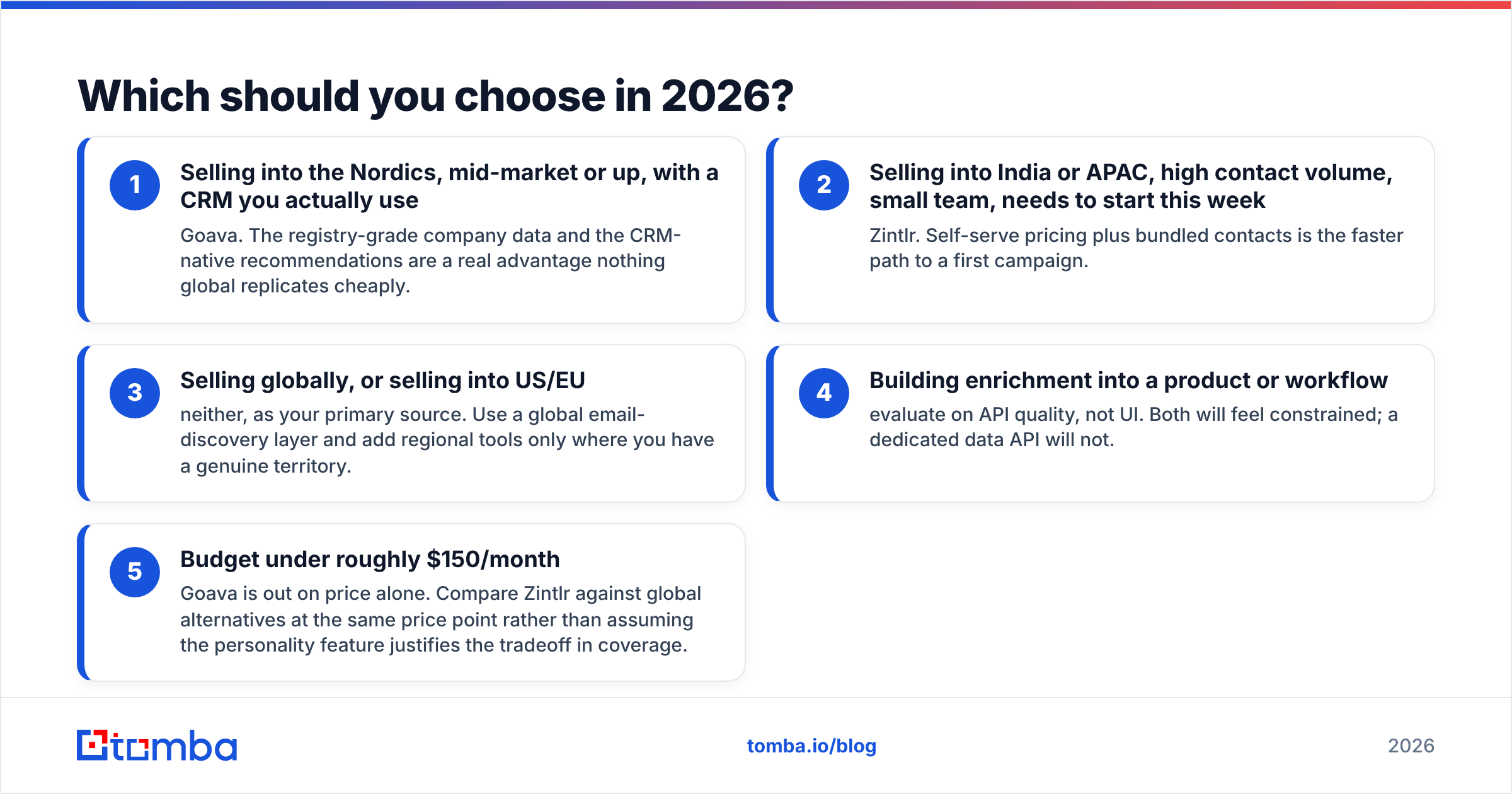
- Selling into the Nordics, mid-market or up, with a CRM you actually use — Goava. The registry-grade company data and the CRM-native recommendations are a real advantage nothing global replicates cheaply.
- Selling into India or APAC, high contact volume, small team, needs to start this week — Zintlr. Self-serve pricing plus bundled contacts is the faster path to a first campaign.
- Selling globally, or selling into US/EU — neither, as your primary source. Use a global email-discovery layer and add regional tools only where you have a genuine territory.
- Building enrichment into a product or workflow — evaluate on API quality, not UI. Both will feel constrained; a dedicated data API will not.
- Budget under roughly $150/month — Goava is out on price alone. Compare Zintlr against global alternatives at the same price point rather than assuming the personality feature justifies the tradeoff in coverage.
A note on the "AI" framing both use. Goava's AI is scoring and prioritisation applied to structured, verifiable inputs — that is a reasonable use of the label. Zintlr's personality inference is a genuinely novel idea but rests on softer ground. Buy Goava for the data underneath the AI. Buy Zintlr for the contact volume, and treat the personality layer as a bonus you'd still be fine without.
Whichever you pick, wire in the same two habits: verify before you send, and enrich in bulk rather than one record at a time. A bulk email finder run against your exported account list will usually recover more usable contacts than either platform surfaces natively, and it costs a fraction of a second seat.
How should you test either tool before buying?#
Run the same 90-minute evaluation on both, using your own data:
- Pull 100 accounts you already closed. Do they exist in the database, with correct industry, size and location? Goava should near-ace this in the Nordics; Zintlr will vary.
- Pull 100 accounts you're actively working. Ask for the decision-maker contact. Count how many return a work email versus a personal or generic one.
- Verify every returned email independently. Not with the vendor's own flag — with a neutral checker. Anything above a 5% invalid rate is a problem you'll pay for in deliverability.
- Time the export-to-CRM path. Count clicks. Tools that require a CSV round-trip cost more rep hours than the licence saves.
- Test one edge case deliberately. A company that rebranded, or a contact who changed jobs in the last quarter. Freshness is where databases quietly fail.
Document the numbers. Vendor demos are built on their best-covered accounts; your evaluation should be built on yours. And read Capterra reviews filtered to your company size — a 500-seat enterprise's experience tells you almost nothing about a 10-seat team's.
Ready to fill the gap both tools leave?#
Goava will tell you which Nordic accounts to work. Zintlr will hand you APAC contacts with a personality read attached. Neither reliably gives you an accurate, verified work email for an arbitrary decision-maker at an arbitrary global company — which is the single input every outbound sequence actually requires.
That's the job the Tomba Email Finder does. Search by domain, name or company, get pattern-matched and verified addresses back, and pull them through the API, Chrome extension, Google Sheets or your CRM. Start free with 25 searches a month, or move to Starter at $49/mo when your account list outgrows manual lookups — then let your regional intelligence tool do what it's genuinely good at.
Related guides#
Ready to find emails that actually work?
Join 150,000+ professionals who stopped guessing and started sending. Free credits on signup — no credit card required.
Get the Tomba newsletter
Practical outbound tactics and product updates — once every two weeks.
About the author