GoCustomer vs ZoomInfo (2026): Which One Should You Buy?
One sells AI SDR agents, the other sells the biggest B2B database in the market — and they cost wildly different amounts. Here is the honest breakdown of GoCustomer vs ZoomInfo, plus the cheaper third path most teams end up on.
TL;DR
- They are not the same category. GoCustomer sells AI SDR agents that research, write, and send outbound. ZoomInfo sells B2B contact and intent data with a workflow layer bolted on top.
- Price gap is enormous. GoCustomer positions itself as an affordable AI-agent alternative; ZoomInfo deals routinely land in the five-figure annual range with multi-year terms and seat minimums.
- ZoomInfo wins on raw coverage and enterprise governance. GoCustomer wins on time-to-first-sequence and cost per booked meeting for small teams.
- Neither is a great fit if all you need is verified contact data. A pay-for-what-you-use finder plus a verifier costs a fraction of both.
- Our pick: ZoomInfo if you have a RevOps team and an enterprise TAM; GoCustomer if you are a 2–10 rep team that wants sequences running this week; a data-first stack if you already have your own outbound engine.
What are GoCustomer and ZoomInfo, exactly?#
Start here, because most head-to-head posts about GoCustomer vs ZoomInfo skip the part that decides the whole thing: these products solve different problems and only overlap in the middle.
GoCustomer is an AI-agent outbound platform. You give it an ideal customer profile, it builds a lead list, researches each account, writes personalized copy, and runs the sending. The pitch is "an SDR that costs less than a subscription to your CRM." The data underneath the agent matters, but the product you are buying is the automation, not the database.
ZoomInfo is a data company that grew a platform around itself. The core asset is a very large, continuously refreshed database of companies, contacts, org charts, technographics, and buying-intent signals. Copilot, SalesOS, and the various engagement modules sit on top of that asset. The product you are buying is coverage and signal, plus enterprise controls — SOC 2, data-privacy tooling, CRM sync governance, admin roles.
That difference explains almost every downstream disagreement. GoCustomer optimizes for execution volume. ZoomInfo optimizes for knowing who to execute against. If you buy the wrong one for your bottleneck, you will be unhappy no matter how good the tool is.
How do GoCustomer and ZoomInfo compare head-to-head?#
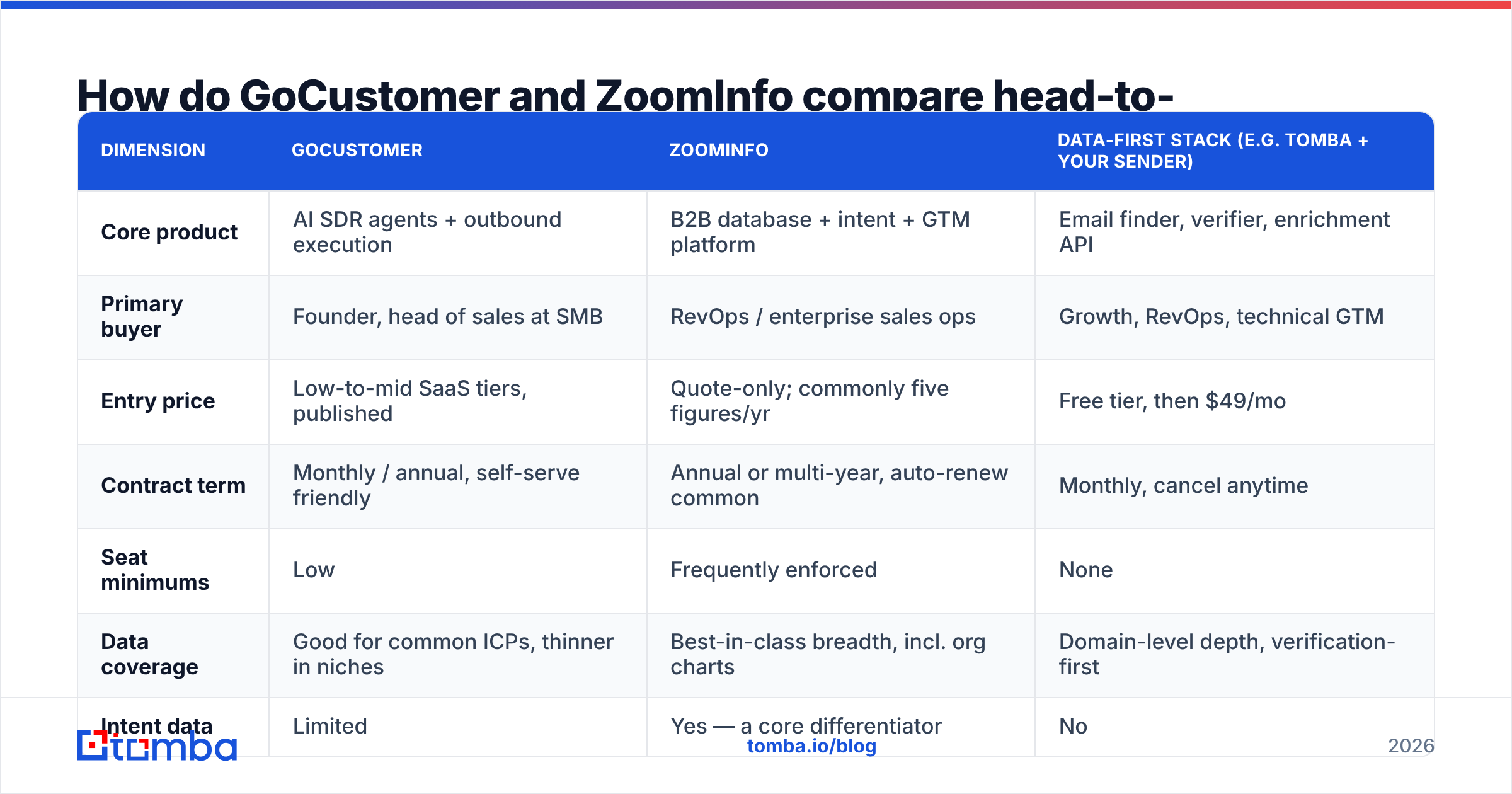
Here is the practical comparison, with a data-first stack in the third column as a control group so you can see what you are actually paying the premium for.
| Dimension | GoCustomer | ZoomInfo | Data-first stack (e.g. Tomba + your sender) |
|---|---|---|---|
| Core product | AI SDR agents + outbound execution | B2B database + intent + GTM platform | Email finder, verifier, enrichment API |
| Primary buyer | Founder, head of sales at SMB | RevOps / enterprise sales ops | Growth, RevOps, technical GTM |
| Entry price | Low-to-mid SaaS tiers, published | Quote-only; commonly five figures/yr | Free tier, then $49/mo |
| Contract term | Monthly / annual, self-serve friendly | Annual or multi-year, auto-renew common | Monthly, cancel anytime |
| Seat minimums | Low | Frequently enforced | None |
| Data coverage | Good for common ICPs, thinner in niches | Best-in-class breadth, incl. org charts | Domain-level depth, verification-first |
| Intent data | Limited | Yes — a core differentiator | No |
| AI personalization | Native, the whole point | Copilot-assisted, add-on pricing | Bring your own |
| Sending / sequencing | Built in | Available in higher tiers | Bring your own (Instantly, Smartlead, etc.) |
| API access | Available | Available, priced separately | Included from paid tiers |
| Ramp time | Days | Weeks, plus onboarding | Hours |
| Best for | 2–10 reps needing pipeline now | 20+ reps, complex territories | Teams that already have a working motion |
Read that table as a diagnostic, not a scoreboard. If two of your top three problems live in the "coverage and signal" row, ZoomInfo's price starts to look rational. If they live in "we have a list and nobody is emailing it," it does not.
What does each one actually cost in 2026?#
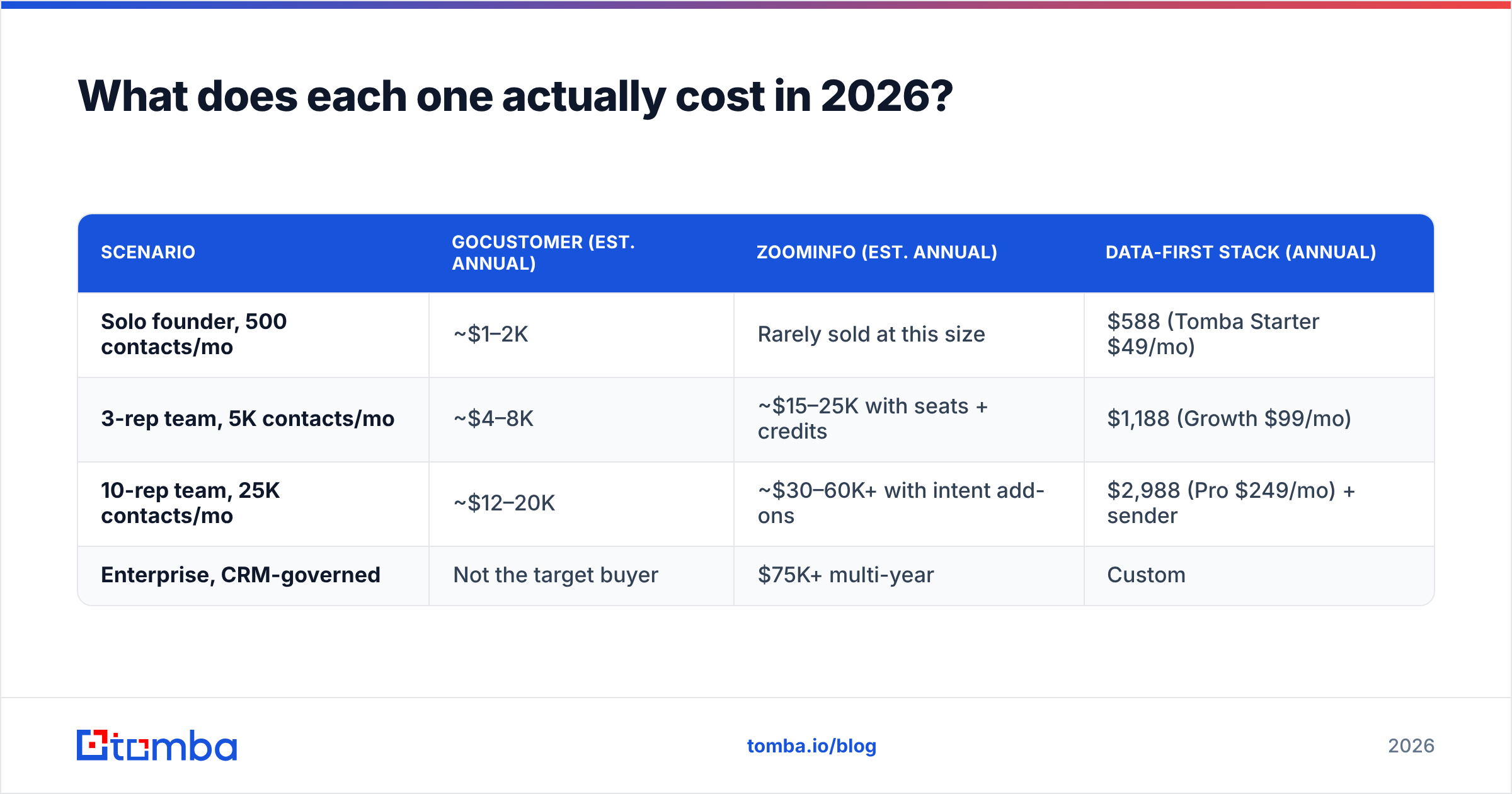
Neither vendor makes this easy, so treat the numbers below as ranges built from public tiers, G2 reviewer reports, and typical deal shapes rather than quoted rate cards.
| Scenario | GoCustomer (est. annual) | ZoomInfo (est. annual) | Data-first stack (annual) |
|---|---|---|---|
| Solo founder, 500 contacts/mo | ~$1–2K | Rarely sold at this size | $588 (Tomba Starter $49/mo) |
| 3-rep team, 5K contacts/mo | ~$4–8K | ~$15–25K with seats + credits | $1,188 (Growth $99/mo) |
| 10-rep team, 25K contacts/mo | ~$12–20K | ~$30–60K+ with intent add-ons | $2,988 (Pro $249/mo) + sender |
| Enterprise, CRM-governed | Not the target buyer | $75K+ multi-year | Custom |
Three cost traps worth flagging before you sign anything.
- Credit resets. ZoomInfo's credit pools are typically annual and use-it-or-lose-it. Teams routinely over-buy in year one, under-use, and then get quoted off the inflated baseline in year two.
- Module unbundling. Intent, engagement, chat, and enrichment are frequently separate line items. The "ZoomInfo price" a peer quotes you may not include the module you actually need.
- Agent output is not free volume. With an AI SDR platform, more sending is not automatically more pipeline. If deliverability collapses, you are paying per wasted send. Run every list through an email verifier before the agent touches it, regardless of which vendor you pick.

Which one has better B2B data quality?#
ZoomInfo, on breadth. That is not a close call and pretending otherwise would be dishonest. But breadth and accuracy on your specific ICP are different measurements, and the second one is what your bounce rate cares about.
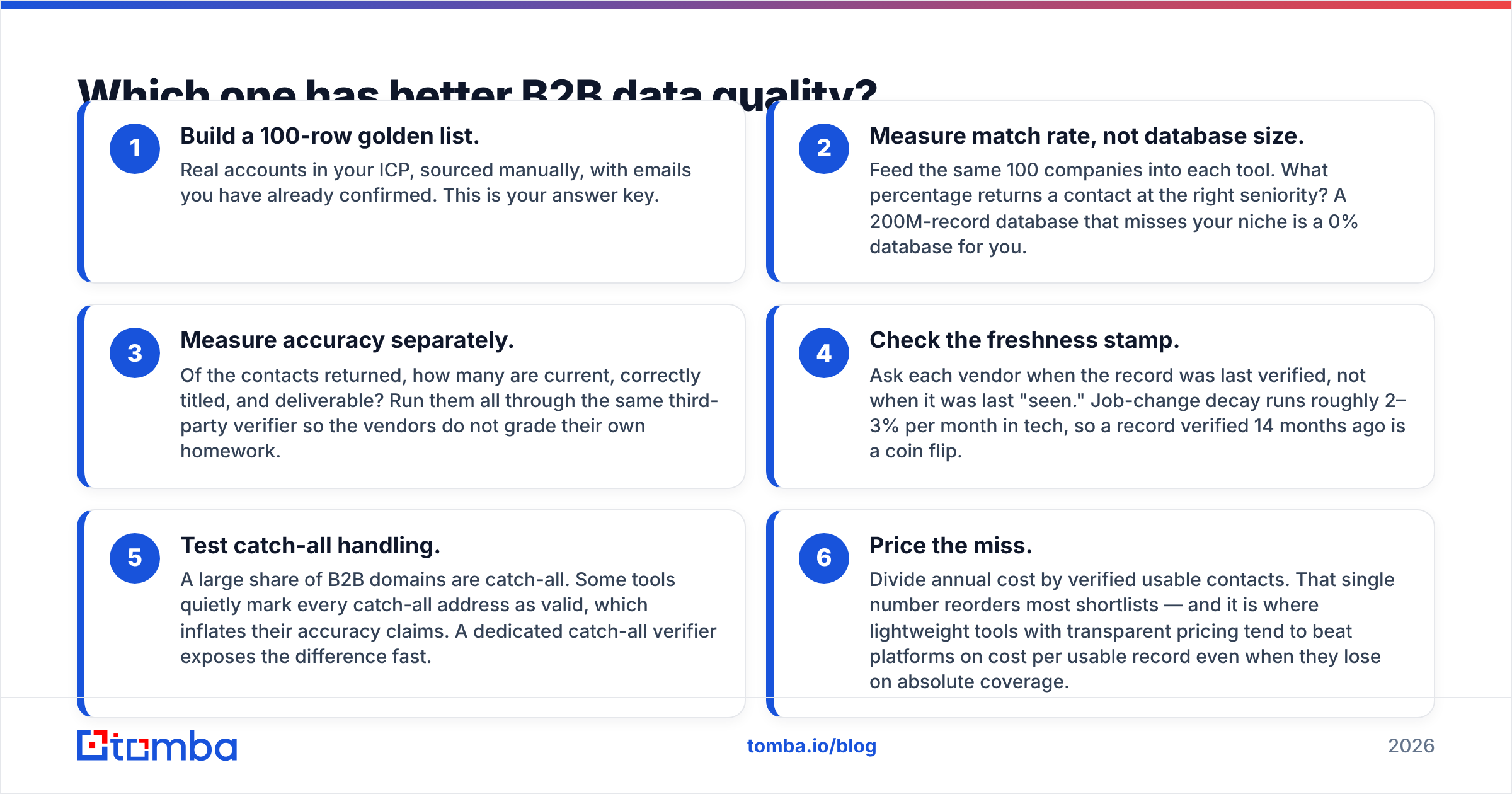
Here is how to evaluate both without trusting anyone's marketing:
- Build a 100-row golden list. Real accounts in your ICP, sourced manually, with emails you have already confirmed. This is your answer key.
- Measure match rate, not database size. Feed the same 100 companies into each tool. What percentage returns a contact at the right seniority? A 200M-record database that misses your niche is a 0% database for you.
- Measure accuracy separately. Of the contacts returned, how many are current, correctly titled, and deliverable? Run them all through the same third-party verifier so the vendors do not grade their own homework.
- Check the freshness stamp. Ask each vendor when the record was last verified, not when it was last "seen." Job-change decay runs roughly 2–3% per month in tech, so a record verified 14 months ago is a coin flip.
- Test catch-all handling. A large share of B2B domains are catch-all. Some tools quietly mark every catch-all address as valid, which inflates their accuracy claims. A dedicated catch-all verifier exposes the difference fast.
- Price the miss. Divide annual cost by verified usable contacts. That single number reorders most shortlists — and it is where lightweight tools with transparent pricing tend to beat platforms on cost per usable record even when they lose on absolute coverage.
Run that test for a week before you take a demo. It costs almost nothing and it is the only evidence that survives a procurement conversation.
Is GoCustomer's AI SDR actually replacing human prospecting?#
Partially, and mostly at the top of the funnel. The honest assessment in 2026 is that AI agents are excellent at the mechanical layer — list building, research summaries, first-draft personalization, follow-up cadence discipline — and mediocre at the judgment layer.
What AI agents genuinely do better than a junior SDR:
- Never skip follow-ups. The 4th–7th touch is where most human sequences quietly die.
- Research at scale. Reading a 10-K, a funding announcement, and three LinkedIn posts per prospect is not a good use of a human hour.
- Consistent formatting and timing. No Friday-afternoon quality drop.
What they still do worse:
- Reading a weak signal correctly. "They hired a VP of Sales" is a signal. Whether it means buy now or frozen for six months is a judgment call.
- Handling an ambiguous reply. Agent-written responses to nuanced objections still read as agent-written.
- Knowing when to stop. Human reps sense when an account is annoyed. Agents keep going.
If your bottleneck is "we do not have enough hours," an AI agent platform is a real answer. If your bottleneck is "our targeting is wrong," an AI agent will just help you be wrong faster and at higher volume. That is the single most expensive mistake in this category.
When is ZoomInfo the right call?#
Buy ZoomInfo when at least three of these are true:
- You have 20+ quota-carrying reps and territory rules that need governed, deduplicated data flowing into Salesforce or HubSpot.
- Intent data changes your prioritization. Not "would be nice" — you have an actual scoring model waiting for it.
- Your ICP includes mid-market and enterprise accounts where org charts, reporting lines, and subsidiary mapping matter.
- You have a RevOps owner with the bandwidth to administer credits, integrations, and hygiene rules. Unowned ZoomInfo is the most common form of wasted GTM spend.
- Compliance and procurement require a vendor with enterprise security posture and DPAs on file.
If you cannot check three, you are buying a Formula 1 car for a grocery run. And be realistic about the exit: annual auto-renew clauses mean the decision you make now is effectively a 24-month decision. Read HubSpot's guidance on evaluating sales tech stacks before you sign — the vendor-neutral framing is useful during negotiation.
When is GoCustomer the right call?#
Buy GoCustomer when:
- You have 2–10 reps (or zero reps and a founder doing outbound) and need sequences live in days, not a quarter.
- Your ICP is common and well-documented — SaaS, agencies, e-commerce, professional services — where any decent database has coverage.
- You want one bill instead of five: data, personalization, sending, and reporting in a single subscription.
- You are willing to trade coverage depth for speed. For most SMB ICPs, the marginal contact ZoomInfo has and GoCustomer does not is not a contact you were going to close.
- You do not have a RevOps function to babysit a platform.
The failure mode to watch: agent platforms make it trivially easy to scale sending before your domain reputation can support it. Warm your domains properly, cap daily volume per mailbox, and keep bounce rates under 2%. No AI copy is good enough to outrun a burned sending domain.
Do you actually need either one?#
Ask this before comparing feature grids, because a meaningful share of teams evaluating GoCustomer vs ZoomInfo are buying a platform to solve a data problem.
If you already have a sequencer you like, a CRM that works, and reps who know how to write, then the only thing you are missing is verified contact data — and that is the cheapest component in the stack to buy standalone. A dedicated email finder plus verification typically runs an order of magnitude below a platform contract, has no seat minimums, and does not require you to migrate your outbound motion into someone else's UI.
The composable version of this stack looks like:
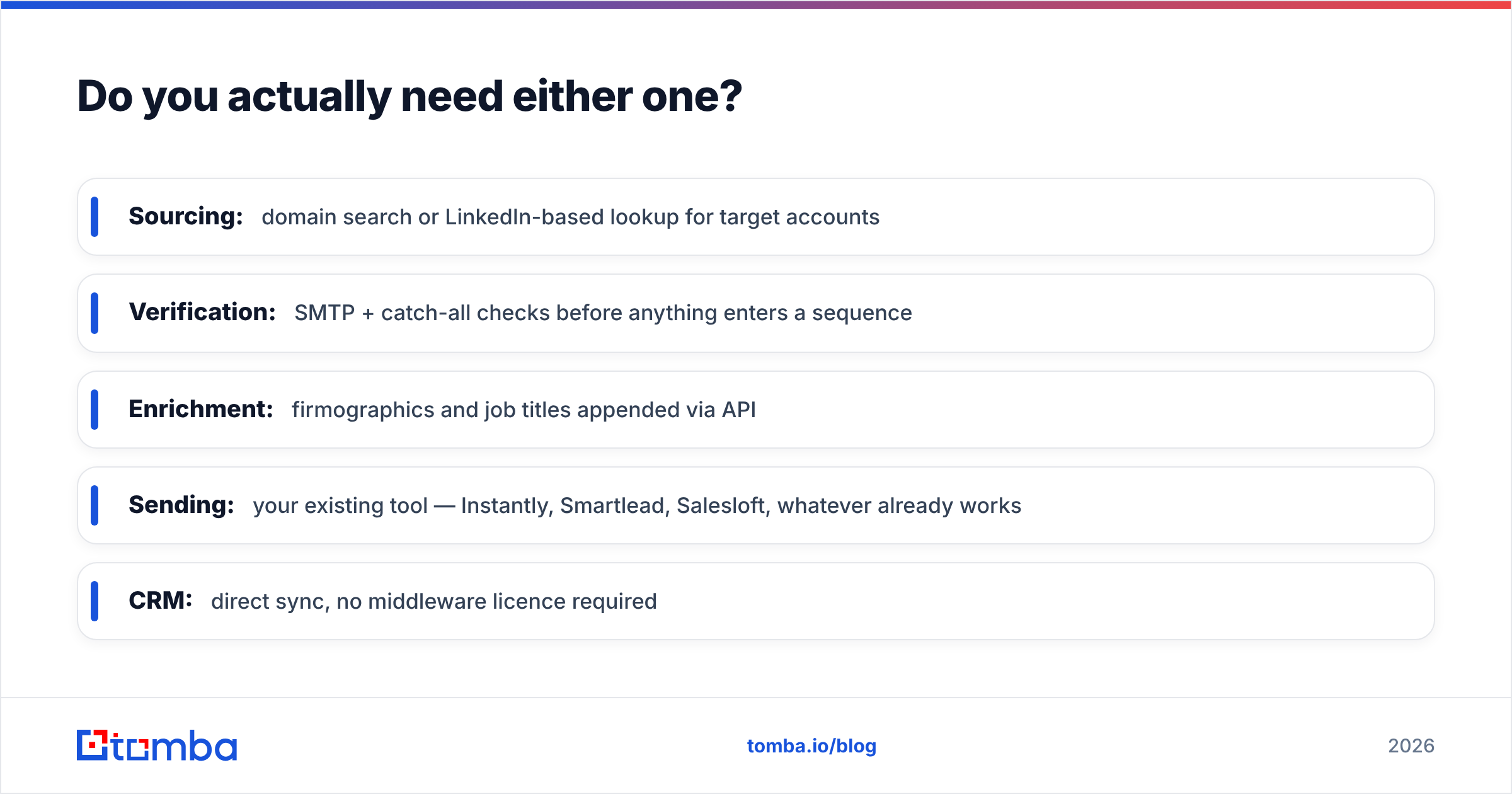
- Sourcing: domain search or LinkedIn-based lookup for target accounts
- Verification: SMTP + catch-all checks before anything enters a sequence
- Enrichment: firmographics and job titles appended via API
- Sending: your existing tool — Instantly, Smartlead, Salesloft, whatever already works
- CRM: direct sync, no middleware licence required
That stack is boring, cheap, and fully under your control. It also survives a budget review, which is more than most $40K platform renewals can claim. For teams that want programmatic access rather than a dashboard, the Tomba API covers finding, verifying, and enrichment from a single key.
Peers in the space are worth a look too — BookYourData, for instance, takes a pay-as-you-go approach to verified B2B lists that suits teams doing bursty campaigns rather than continuous outbound. There is no single right shape here; there is only the shape that matches how often you actually prospect.
What about migration and switching costs?#
The switching math is asymmetric and nobody mentions it during the demo.
- Leaving GoCustomer is relatively cheap. Export your lists, your sequences live in the platform but the copy is portable, and monthly terms mean you can stop within a billing cycle.
- Leaving ZoomInfo is expensive. Enrichment rules, CRM field mappings, scoring models, and reporting dashboards get built on top of ZoomInfo-specific fields. Twelve months in, unwinding that is a RevOps project, not a cancellation email.
Mitigation is simple: keep your source of truth in your CRM, not in the vendor. Map every enriched field to a neutral schema on day one. Whichever way this comparison goes for you, that one decision preserves your leverage at renewal.
The verdict: GoCustomer vs ZoomInfo in one paragraph#
If you need coverage, intent, and enterprise governance — and you have the team to operate it — ZoomInfo remains the most complete B2B data platform on the market, and the price reflects that. If you need pipeline in two weeks with a small team and a common ICP, GoCustomer gets you there faster and cheaper, with the caveat that AI volume amplifies whatever targeting quality you already have. And if you are honest with yourself and the real gap is just accurate contact data, skip both, keep your existing motion, and buy the data layer alone.
Test the data before you test the software. Run 100 target accounts through the Tomba Email Finder on the free tier — 25 searches a month, no card — and compare match rate and bounce rate against whatever a vendor's trial hands you. If the standalone finder covers your ICP, you just saved a five-figure line item. If it does not, you now have hard evidence for which platform is worth the contract.
Related guides#
Ready to find emails that actually work?
Join 150,000+ professionals who stopped guessing and started sending. Free credits on signup — no credit card required.
Get the Tomba newsletter
Practical outbound tactics and product updates — once every two weeks.
About the author