9 Best GodmodeHQ Alternatives for AI GTM Teams in 2026
GodmodeHQ sells AI GTM agents, but the agents are only as good as the data under them. Here are nine GodmodeHQ alternatives compared on price, data ownership, and how much of the workflow they actually automate.

TL;DR
- GodmodeHQ sells an AI GTM agent: it researches accounts, watches signals, and drafts outbound for you. The pitch is "replace the SDR research layer," and for signal-heavy teams it works.
- Most teams who churn off it leave for one of three reasons: quote-only pricing with no self-serve entry point, thin coverage outside US tech accounts, or the fact that they were already paying for the same data somewhere else.
- The nine alternatives below split into three buckets — agent platforms (Clay, Unify, 11x), data-first providers (Tomba, BookYourData, Apollo), and execution layers (Instantly, Amplemarket, Common Room).
- If your bottleneck is finding and verifying contact data rather than orchestrating agents, a data-first tool at $49–$99/mo replaces the expensive part of the stack.
- Nobody needs all three buckets on day one. Pick the layer where your pipeline actually breaks.
What is GodmodeHQ, and what does it actually do?#
GodmodeHQ (godmodehq.com) positions itself as an AI GTM agent — software that does the account research a junior SDR would do, then turns that research into targeted outbound. You give it an ICP, it monitors buying signals (hiring posts, funding, tech-stack changes, job changes), enriches the accounts it finds, and drafts personalised sequences off that context.
That's a real category, and it's growing. The distinction that matters when you shop for GodmodeHQ alternatives is this: an agent platform is a reasoning and orchestration layer. It almost never owns the underlying contact data. It rents it, resells it, or asks you to bring your own via waterfall enrichment credits.
So when you evaluate replacements, you're really answering two separate questions:
- Who does the thinking? Signal detection, account scoring, research synthesis, message drafting.
- Who supplies the contacts? Verified work emails, direct dials, firmographics, job-change tracking.
Vendors that bundle both charge for both. Vendors that specialise in one are cheaper and usually better at it.
Why do teams look for GodmodeHQ alternatives?#
Five patterns show up repeatedly in switching conversations and in G2 review data across this category:
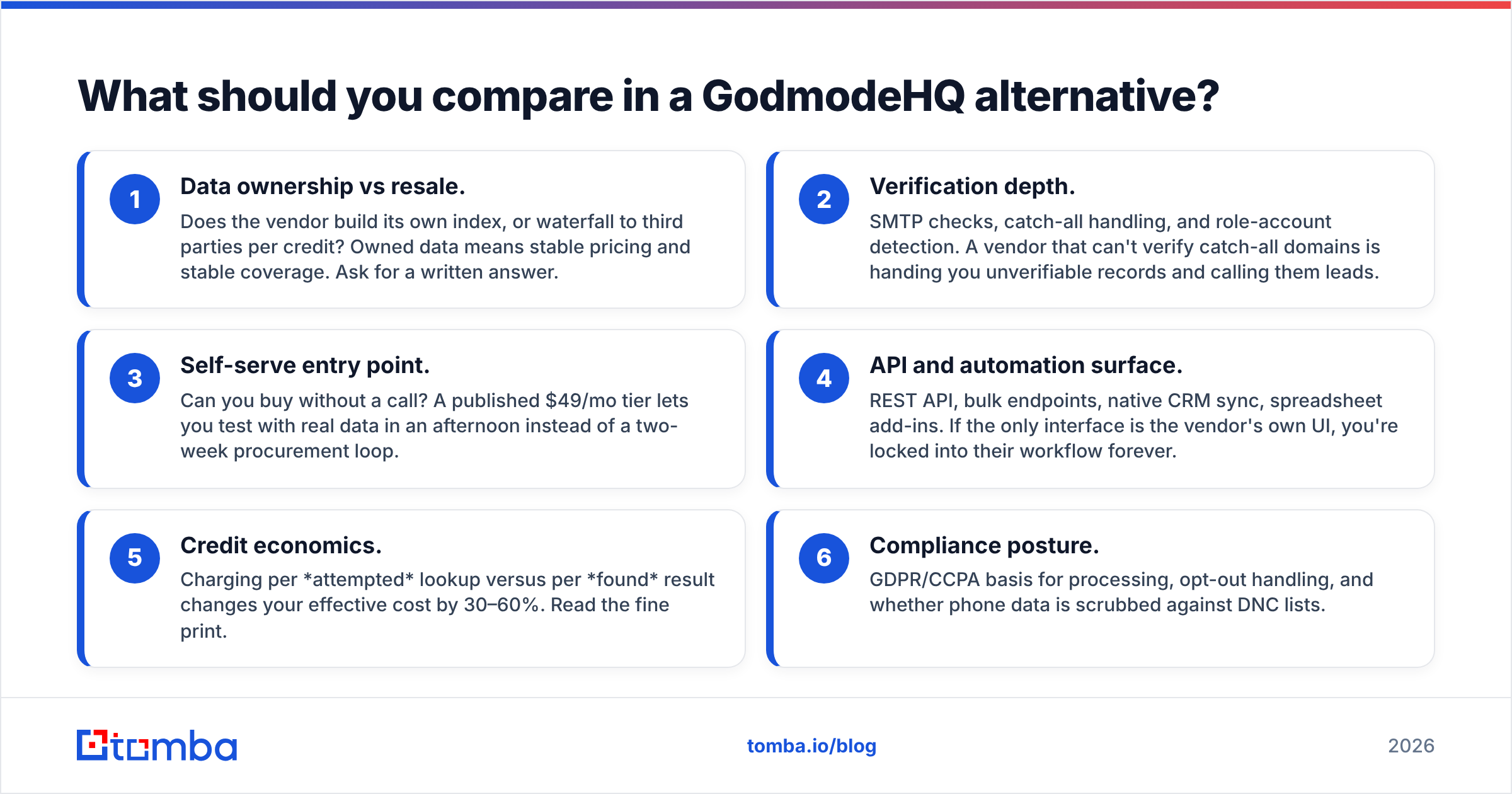
- Opaque pricing. No published entry tier means a sales call before you can even estimate cost. Teams under $2M ARR frequently disqualify on this alone.
- Data coverage gaps. Agent quality collapses outside well-indexed markets. If you sell into EMEA mid-market manufacturing rather than US SaaS, the signal feed thins out fast.
- Duplicate spend. You already pay for enrichment inside your CRM, your sequencer, and your prospecting tool. Adding an agent layer often means paying for the same record a fourth time.
- Deliverability blowback. Agent-generated volume without a verification step burns domains. A 6% bounce rate will tank your sender reputation regardless of how clever the copy was.
- Control. Some teams want the research automated but the sending human. Bundled platforms make that split awkward.
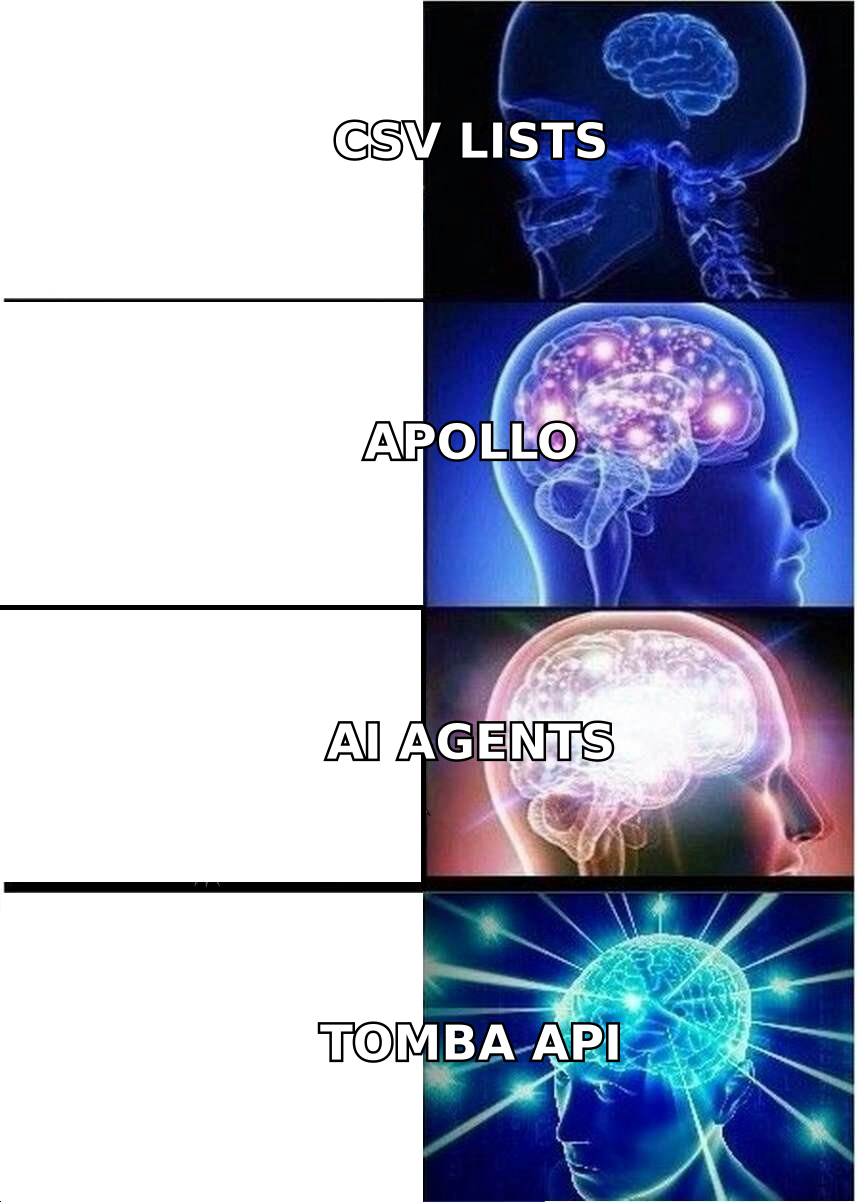
If reasons 2, 3, or 4 describe you, an agent platform is not your fix. A better data layer is.
What should you compare in a GodmodeHQ alternative?#
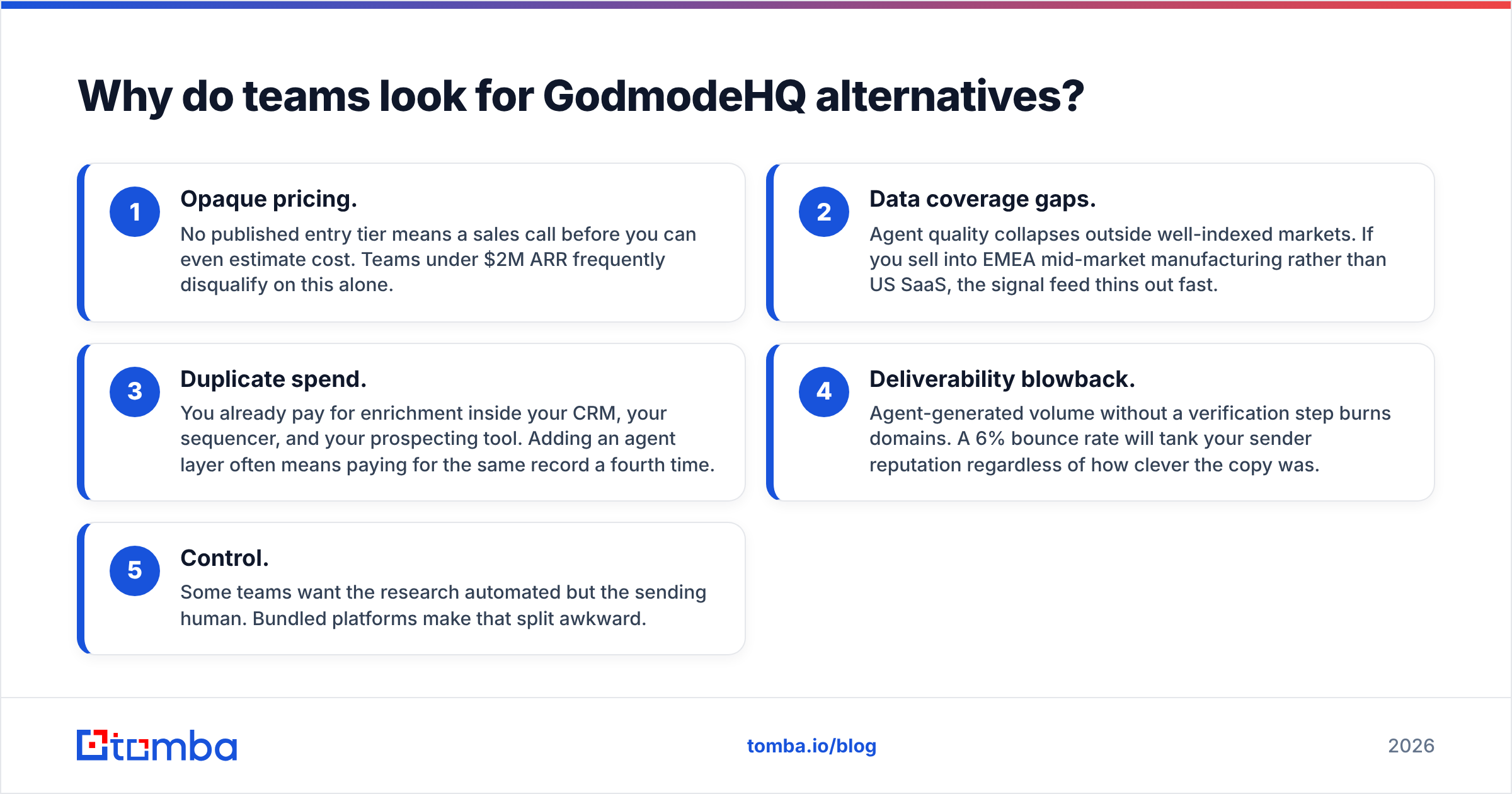
Score every candidate against these six attributes before you look at a demo:
- Data ownership vs resale. Does the vendor build its own index, or waterfall to third parties per credit? Owned data means stable pricing and stable coverage. Ask for a written answer.
- Verification depth. SMTP checks, catch-all handling, and role-account detection. A vendor that can't verify catch-all domains is handing you unverifiable records and calling them leads.
- Self-serve entry point. Can you buy without a call? A published $49/mo tier lets you test with real data in an afternoon instead of a two-week procurement loop.
- API and automation surface. REST API, bulk endpoints, native CRM sync, spreadsheet add-ins. If the only interface is the vendor's own UI, you're locked into their workflow forever.
- Credit economics. Charging per attempted lookup versus per found result changes your effective cost by 30–60%. Read the fine print.
- Compliance posture. GDPR/CCPA basis for processing, opt-out handling, and whether phone data is scrubbed against DNC lists.
Most "AI GTM" buying regret traces back to skipping items 1, 2, and 5.
Which 9 GodmodeHQ alternatives are worth testing in 2026?#
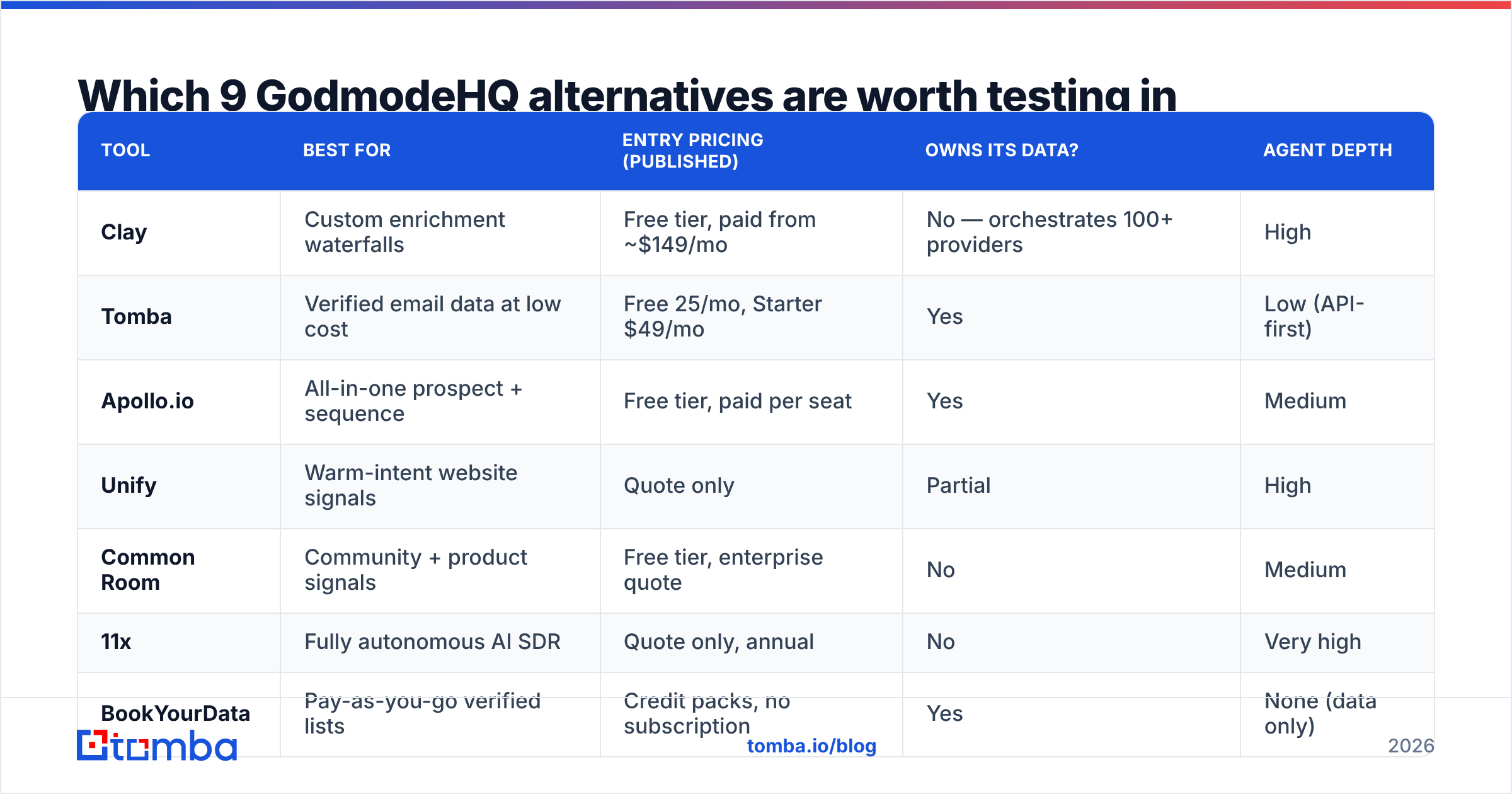
| Tool | Best for | Entry pricing (published) | Owns its data? | Agent depth |
|---|---|---|---|---|
| Clay | Custom enrichment waterfalls | Free tier, paid from ~$149/mo | No — orchestrates 100+ providers | High |
| Tomba | Verified email data at low cost | Free 25/mo, Starter $49/mo | Yes | Low (API-first) |
| Apollo.io | All-in-one prospect + sequence | Free tier, paid per seat | Yes | Medium |
| Unify | Warm-intent website signals | Quote only | Partial | High |
| Common Room | Community + product signals | Free tier, enterprise quote | No | Medium |
| 11x | Fully autonomous AI SDR | Quote only, annual | No | Very high |
| BookYourData | Pay-as-you-go verified lists | Credit packs, no subscription | Yes | None (data only) |
| Instantly | Sending, warmup, inbox rotation | From ~$37/mo | Partial | Low |
| Amplemarket | Multichannel outbound + data | Quote only | Partial | High |
Pricing moves. Treat this as a shortlist filter, not a quote — verify on each vendor's own pricing page before you commit budget.
1. Clay — best for custom enrichment logic#
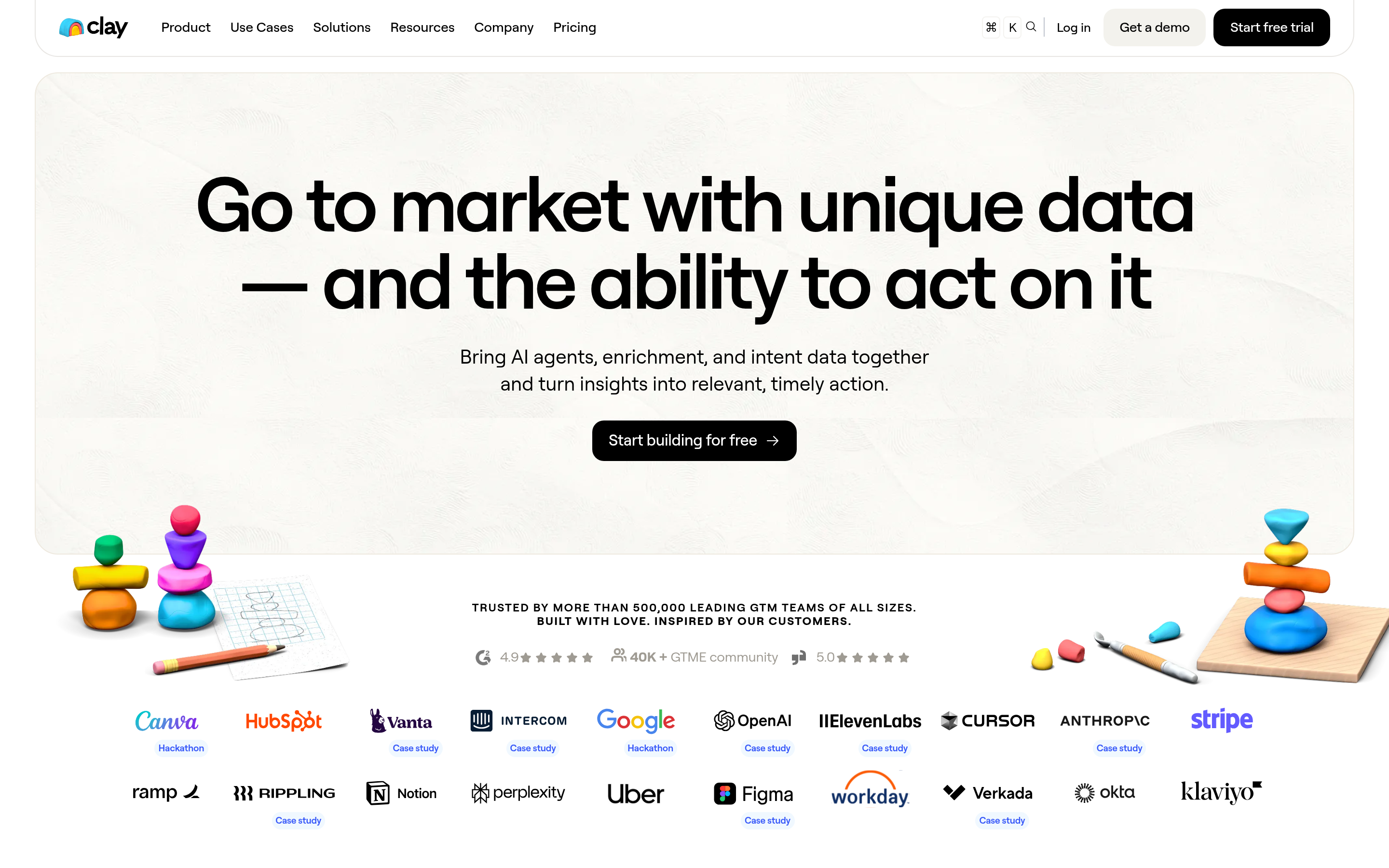
Clay (clay.com) is the closest structural competitor. Instead of a single opinionated agent, you get a spreadsheet-shaped canvas where every column can call a different provider, run a prompt, or branch on a condition. Teams who found GodmodeHQ too much of a black box usually land here.
The trade-off is operational load. Clay is powerful because it's unopinionated, which means someone on your team owns the tables. Credit consumption on multi-provider waterfalls also climbs faster than the entry price suggests.
Pick it if: you have a RevOps person who enjoys building systems. Skip it if: you want output on day one without configuration.
2. Tomba — best for the data layer underneath everything else#
Tomba is not an agent platform, and that's the point. It's the contact-data layer that agent platforms rent from someone. If your GodmodeHQ bill is mostly enrichment credits dressed up as AI, swapping to a direct provider cuts the markup out.
The email finder resolves work emails from a name plus domain; domain search returns every discoverable address at a company with its detected pattern; the email verifier runs SMTP-level checks before anything reaches your sequencer. Everything is exposed through the Tomba API, a CLI, an MCP server, and native add-ins for Sheets, Excel, and Airtable — so you can wire it into whatever orchestration layer you already run, including Clay or your own scripts.
Pricing is published: free tier at 25 searches/mo, Starter at $49/mo, Growth at $99/mo, Pro at $249/mo, Enterprise custom. Full Tomba pricing is on-site with no call required.
Pick it if: your bottleneck is verified contacts, not orchestration. Skip it if: you specifically want the agent to write and send for you.
3. Apollo.io — best all-in-one for small teams#
Apollo bundles a large B2B contact database with sequencing, dialer, and basic AI assistance. For a two-to-five person sales team, one Apollo seat replaces three separate subscriptions.
Quality is the usual complaint — the database is broad but uneven, and stale records show up in mid-market EMEA especially. Many teams keep Apollo for discovery and route the final list through a dedicated verifier before sending. If you're evaluating that path, the Apollo alternative comparison covers where each side is stronger.
Pick it if: you want one bill and one login. Skip it if: you need enrichment-grade accuracy on every record.
4. Unify — best for website-intent signals#
Unify's core loop is deanonymising website traffic, matching it to accounts, and triggering plays automatically. If the GodmodeHQ feature you actually used was signal detection, Unify does that specific job with more depth.
Pricing is quote-only and lands in mid-market territory, so it's a poor fit below roughly 10 reps. It also assumes meaningful inbound traffic — with 400 monthly visitors there's nothing to deanonymise.
Pick it if: you have real traffic and no idea who's on the site.
5. Common Room — best for community and product signals#
Common Room aggregates signals from social, community platforms, product usage, and CRM into a person-level graph. It answers "who in my orbit is showing intent right now" better than a pure outbound agent does.
It's a signal layer, not a data provider — you'll still pair it with an enrichment source to get sendable contact details.
Pick it if: you run PLG or a developer-facing motion.
6. 11x — best for fully autonomous SDR replacement#
11x sits at the far end of the autonomy spectrum: the agent researches, writes, sends, and handles replies. If you want fewer humans in the loop rather than better-supported humans, this is the aggressive version of the GodmodeHQ thesis.
Expect annual contracts, enterprise pricing, and a real ramp period. Autonomy also means your brand voice is in the agent's hands, which is a governance decision as much as a tooling one.
Pick it if: headcount is capped and you accept the risk.
7. BookYourData — best for pay-as-you-go verified lists#
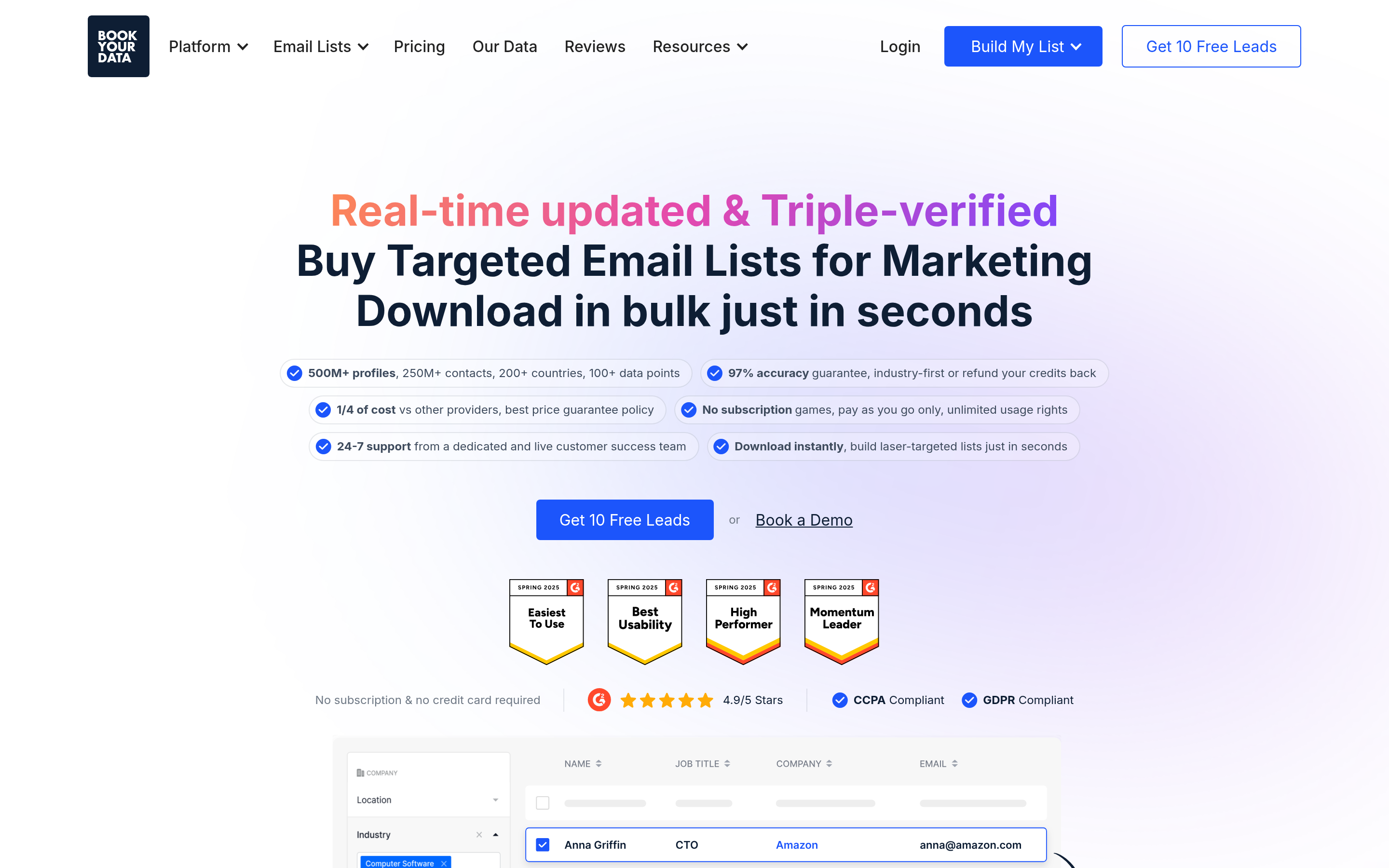
BookYourData takes a different commercial shape: buy verified contact credits outright, no subscription, with an accuracy guarantee attached. For teams running campaign-based outbound rather than always-on sequences, that model is genuinely cleaner than paying monthly for capacity you don't use every week.
Coverage is strongest on standard firmographic targeting, and the self-serve list builder gets you from filter to CSV in minutes. It's a data source, not an agent — pair it with your own sequencer.
Pick it if: your outbound runs in bursts and you'd rather own the list than rent access.
8. Instantly — best for sending infrastructure#
Instantly solves the part of the stack agent platforms tend to hand-wave: inbox rotation, warmup, and deliverability management at volume. No amount of agent intelligence survives a burnt domain.
It doesn't meaningfully find data for you, so it's a complement rather than a swap. See the Instantly alternative breakdown if you're comparing sending layers specifically.
Pick it if: you're sending from multiple domains and bounce rates are creeping.
9. Amplemarket — best for multichannel with data included#
Amplemarket bundles data, email, LinkedIn, and phone into one sequence engine with AI copy assistance and duplicate/safety checks built in. It's the most direct like-for-like replacement for a bundled agent platform, aimed at teams of roughly 10–50 reps.
Pricing is quote-based and lands above the self-serve tools here.
Pick it if: you want the bundle but a more mature product.

Is an AI GTM agent actually worth it versus a data-first stack?#
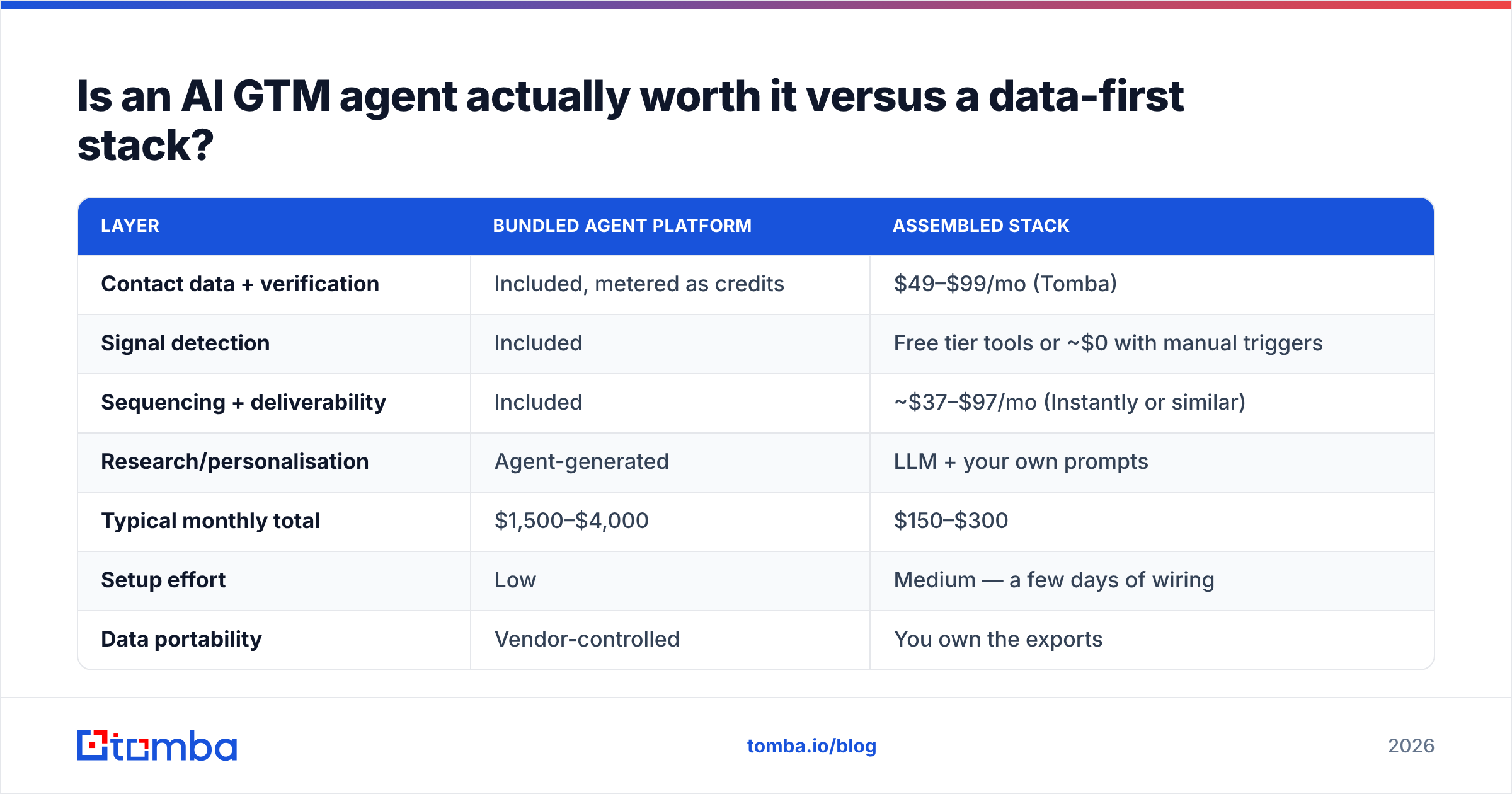
Run the arithmetic before the demo. A typical bundled agent contract lands somewhere between $1,500 and $4,000 per month once you include enrichment credits. A data-first stack that does most of the same job looks like this:
| Layer | Bundled agent platform | Assembled stack |
|---|---|---|
| Contact data + verification | Included, metered as credits | $49–$99/mo (Tomba) |
| Signal detection | Included | Free tier tools or ~$0 with manual triggers |
| Sequencing + deliverability | Included | ~$37–$97/mo (Instantly or similar) |
| Research/personalisation | Agent-generated | LLM + your own prompts |
| Typical monthly total | $1,500–$4,000 | $150–$300 |
| Setup effort | Low | Medium — a few days of wiring |
| Data portability | Vendor-controlled | You own the exports |
The bundle buys you time. The assembled stack buys you margin and control. Teams under ~$5M ARR almost always find the second column is the right call; teams with a dedicated RevOps function can justify either.
One caveat worth stating plainly: whichever column you pick, verification is non-negotiable. Agents generate volume, and volume without verified addresses is just a faster way to get filtered. Route every list through bulk verification before it touches a sending tool.
How should you run the evaluation?#
Give yourself two weeks and a fixed test set.
- Build a 200-contact ground-truth list from accounts you already know — real people, real companies, verified by hand.
- Run every shortlisted vendor against the same list. Measure match rate (how many they found) and accuracy rate (how many were actually right). Vendors quote the first number and stay quiet about the second.
- Send a 50-contact test campaign through each and record hard bounce rate. Anything above 3% is a coverage problem masquerading as a deliverability problem.
- Price it at your real volume, not the marketing tier. Ask specifically whether failed lookups consume credits.
- Check the exit. Can you export everything, including enriched fields, if you leave next quarter?
Vendors that resist a structured bake-off are telling you something. The ones with a free tier — Tomba, Clay, Apollo, Common Room — let you start the test today without a signature.
Which GodmodeHQ alternative should you choose?#
Short version: if you want the agent thesis with more transparency, go Clay. If you want more autonomy, go 11x. If you want signals, go Unify or Common Room. If you want lists you own, go BookYourData. And if what you actually needed all along was accurate, verified contact data at a price you can read on a website, start at the data layer.
That's where most of these stacks quietly leak money. Before you sign another quote-only contract, test your ICP against the Tomba Email Finder on the free tier — 25 searches, no card, no call. If the match and accuracy rates beat what you're paying for now, the $49/mo Starter plan replaces the expensive half of your enrichment bill and plugs into whatever agent layer you decide to keep on top of it.
Related guides#
Ready to find emails that actually work?
Join 150,000+ professionals who stopped guessing and started sending. Free credits on signup — no credit card required.
Get the Tomba newsletter
Practical outbound tactics and product updates — once every two weeks.
About the author