Godmodehq Pricing in 2026: Plans, Real Costs, and Alternatives
Godmode HQ doesn't publish a price list, which makes budgeting an AI SDR guesswork. Here's how the quote is built, what drives the number up, and a cheaper stack that covers most of the job.
TL;DR
- Godmode HQ does not publish a public price list. Every number you see online — including the ranges in this post — is a directional estimate from buyer reports and vendor conversations, not a rate card. Confirm your own quote directly.
- Expect an annual commitment, a platform fee, and usage-based components (research runs, enriched contacts, sending volume) rather than a flat per-seat SaaS price.
- The real cost is rarely the license. It's the data you feed the agent, the mailbox infrastructure, and the RevOps time spent supervising output.
- If your bottleneck is "we can't find accurate contact data," an AI SDR is the wrong purchase. Fix the data layer first — it costs a fraction of an agent platform.
- A lean stack (accurate contact data + a sending tool + a human writing the offer) reproduces most of the pipeline impact for roughly the price of one AI SDR seat.
What is Godmode HQ, and what are you actually paying for?#
Godmode HQ (godmodehq.com) sits in the AI SDR / AI GTM agent category: software that researches accounts, decides who's worth contacting, drafts personalized outreach, and pushes it into a sequence with limited human input. It's the same category as the wave of agent products that G2 now tracks under AI sales assistant — tools sold on the promise of replacing part of a headcount rather than adding a seat.
That framing matters for pricing. Tools sold against a headcount are priced against a headcount. A traditional prospecting tool competes with a $99/mo line item. An AI SDR competes with a $70k SDR salary, and vendors price accordingly. When you hear "it's cheaper than a rep," that's the anchor being set, not a discount.
So what are you buying?
- Orchestration — the agent logic that chains research → qualification → drafting → sending. This is the genuine product.
- Research compute — LLM calls plus web/scraping passes per account. This is metered, because it costs the vendor real money.
- Contact data — usually resold from third-party providers, marked up, and bundled as "credits."
- Sending and inbox infrastructure — sometimes native, sometimes assumed you'll bring your own.
- Onboarding and supervision — implementation fees, solution engineering, and the quarterly tuning that keeps output from drifting into nonsense.
Only the first item is unique. Items 2 through 5 are commodity layers you may already be paying for somewhere else in your stack — which is exactly where quote inflation hides.
How does Godmodehq pricing actually work?#
Quote-only, annual-leaning, usage-metered. That's the short version, and it's the norm across this category rather than anything unusual about this vendor.
Practically, a quote is assembled from four dials:
- Platform fee — a base subscription that unlocks the agent, integrations, and admin. Scales with company size and seat count.
- Workflow or agent count — how many distinct campaigns/plays the agent runs concurrently. Vendors cap this to create upgrade pressure.
- Contact or research volume — the metered dial. Usually expressed in monthly "credits" that get consumed at different rates by different actions (a deep account research pass costs more than a single email lookup).
- Term and payment — annual prepay is the default ask. Monthly, when offered, carries a meaningful premium.
Because there's no published rate card, two companies with identical headcount can get quotes that differ by 2–3x based on funding stage, urgency, and quarter-end timing. If that sounds unfair, it's simply how quote-only enterprise software works — and it's also why you have real negotiating room.
What do the tiers typically look like?#
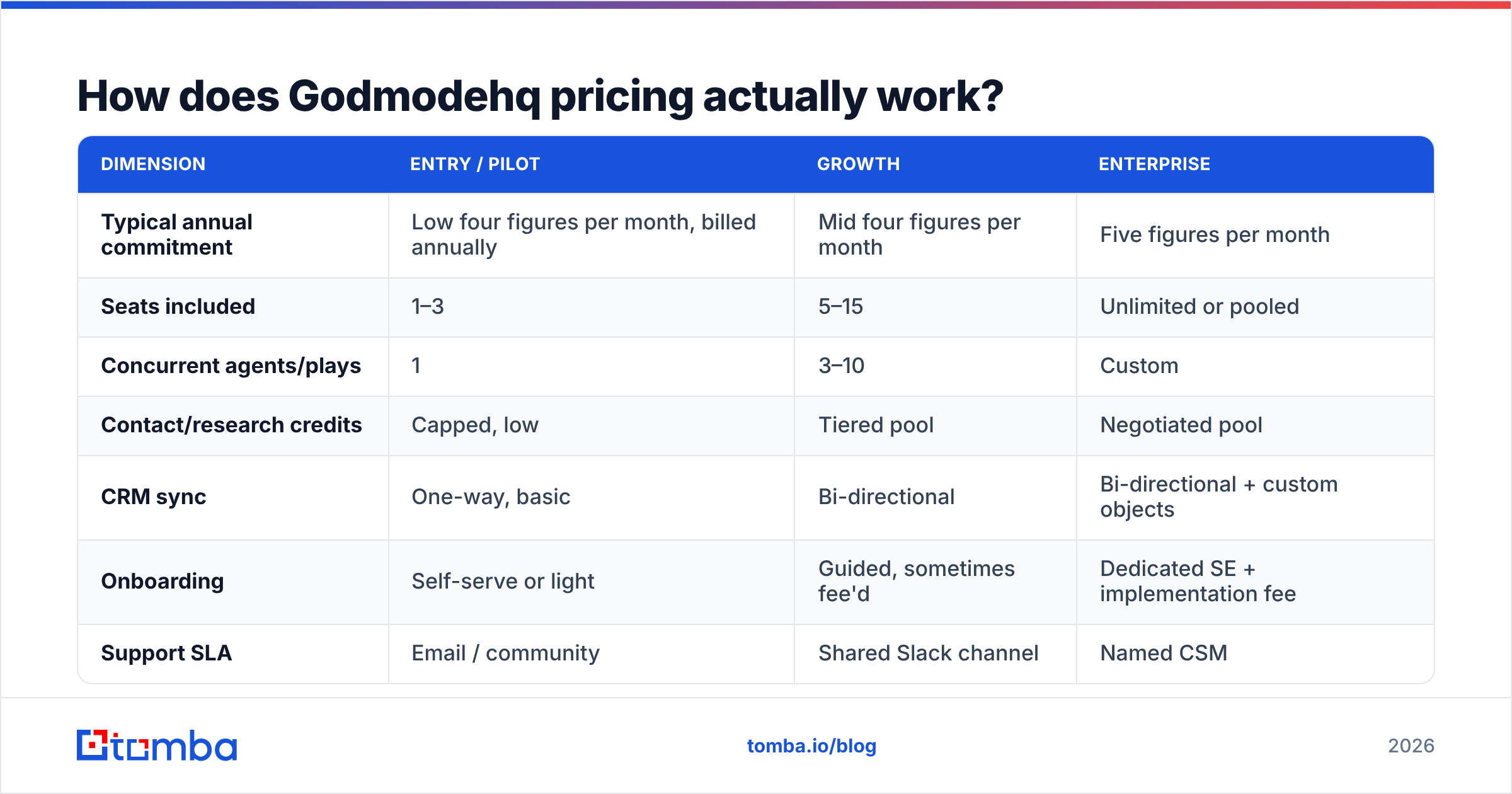
The table below is a modeled view of how AI SDR platforms in this bracket usually structure tiers. Treat it as a framework for reading your own quote, not as Godmode HQ's official pricing.
| Dimension | Entry / pilot | Growth | Enterprise |
|---|---|---|---|
| Typical annual commitment | Low four figures per month, billed annually | Mid four figures per month | Five figures per month |
| Seats included | 1–3 | 5–15 | Unlimited or pooled |
| Concurrent agents/plays | 1 | 3–10 | Custom |
| Contact/research credits | Capped, low | Tiered pool | Negotiated pool |
| CRM sync | One-way, basic | Bi-directional | Bi-directional + custom objects |
| Onboarding | Self-serve or light | Guided, sometimes fee'd | Dedicated SE + implementation fee |
| Support SLA | Email / community | Shared Slack channel | Named CSM |
| Contract term | Annual preferred | Annual | Annual or multi-year |
Two things to notice. First, the credit pool is the dial that moves fastest — it's where a "reasonable" platform fee turns into a bill you didn't forecast. Second, the features that determine whether the tool actually works in your workflow (bi-directional CRM sync, custom objects) sit above the entry tier. Pilot on entry, and you're often testing a deliberately weakened version of the product.
What drives your final Godmodehq quote up?#
Five variables do most of the damage. Ask about each one explicitly before you get to paper.
- Credit burn per account. A deep research pass on one account can consume 10–50x the credits of a simple lookup. Ask for the consumption table in writing, then model your actual monthly account volume against it.
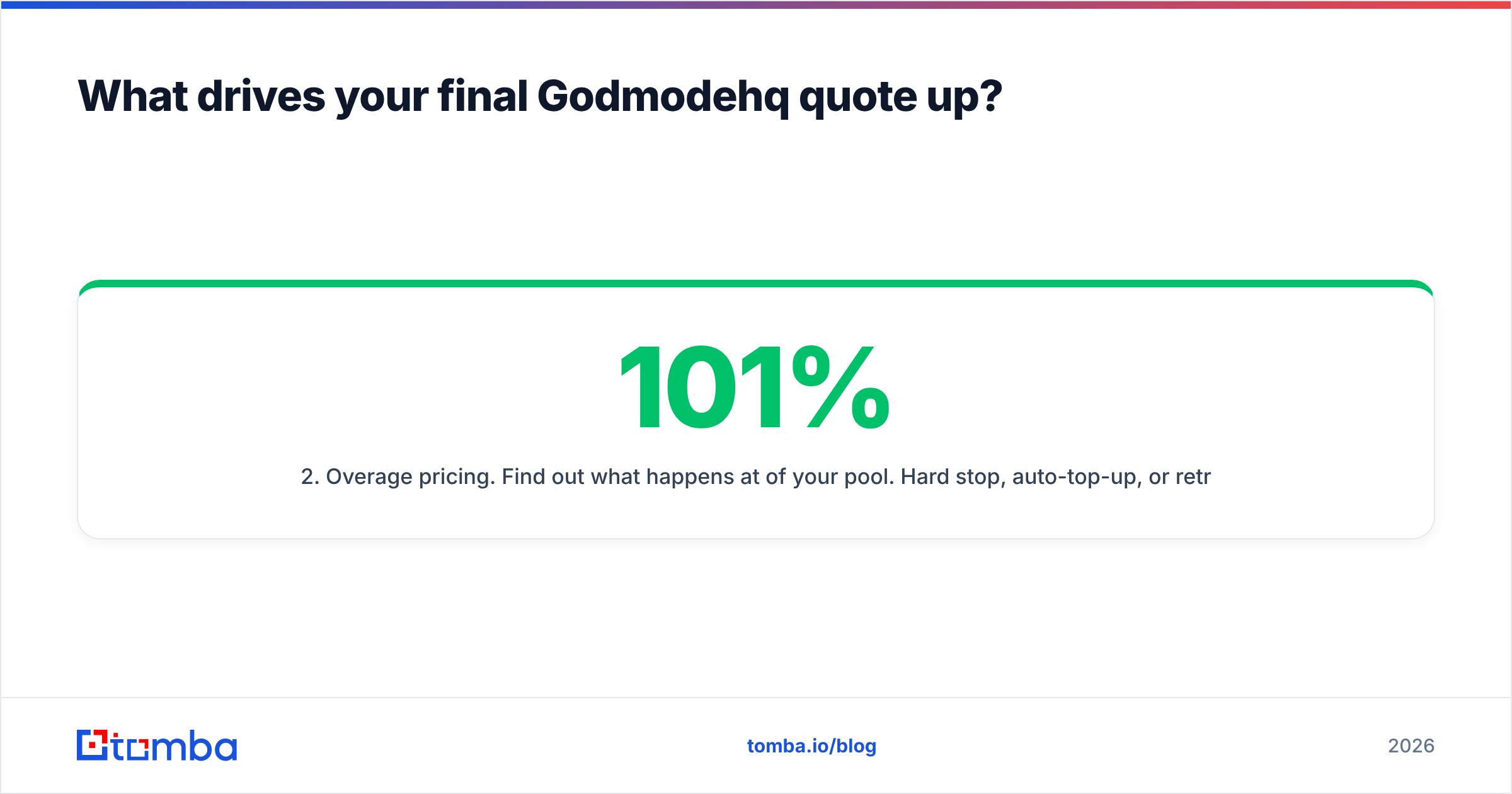
- Overage pricing. Find out what happens at 101% of your pool. Hard stop, auto-top-up, or retroactive rate? Auto-top-up with no cap is how a $3k month becomes an $8k month.
- Seat creep. AI SDR tools spread from one growth hire to the whole AE team within two quarters. If seats are priced separately, model 12 months out, not 3.
- Data resale margin. If contacts are bundled, you're paying the vendor's markup on someone else's database. Compare that implied per-contact cost against buying the data directly.
- Implementation and tuning. Agent output degrades without supervision. Budget RevOps hours — realistically 5–10 hours a month for the first two quarters — as part of total cost of ownership.
/blog/generated/memes/2026-08-28/godmodehq-pricing-meme-2.png
What hidden costs does the quote not include?#
The license is the visible part. The rest of the iceberg:
Mailbox and domain infrastructure. Agents generate volume, and volume needs sending capacity. That means secondary domains, mailbox provisioning, and warmup — commonly $200–$800/mo depending on scale. Nearly no AI SDR quote includes this.
Deliverability cleanup. More volume means more exposure to bad addresses. Bounce rates above 3% start hurting sender reputation, and a burned domain costs weeks of recovery. Verification isn't optional at agent volumes — it's the thing that keeps the agent's output deliverable at all.
Your existing data spend. Most teams buying an AI SDR already pay for a contact database, an enrichment tool, and a sequencer. Bundled credits don't automatically retire those contracts, so you often end up double-paying for a quarter or more.
Opportunity cost of bad output. An agent that emails the wrong persona at scale doesn't just waste credits — it burns the account. That's not on the invoice, but it's real.
Is Godmodehq worth it compared to the alternatives?#
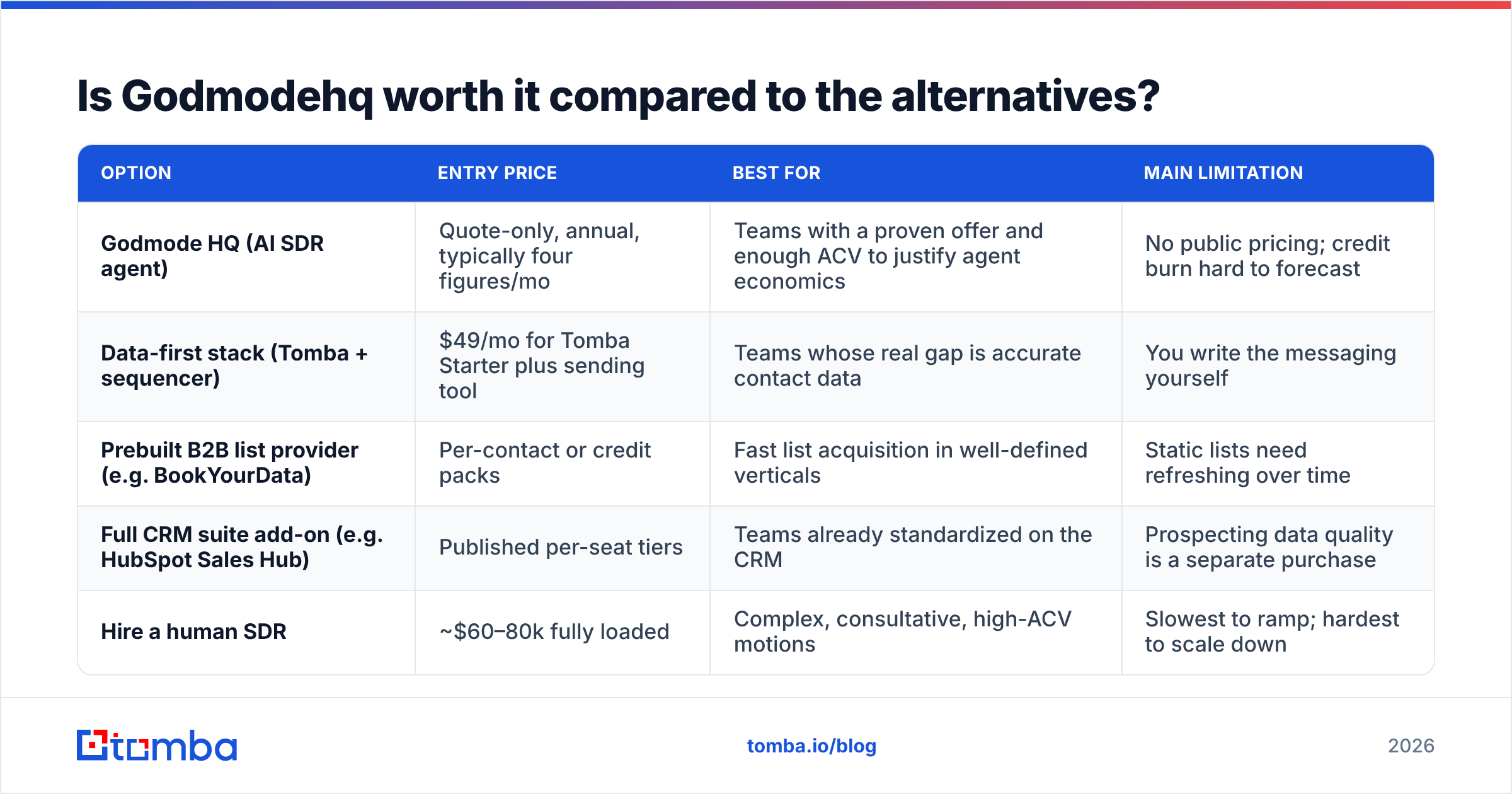
Depends entirely on which bottleneck you're solving. Here's an honest comparison across the realistic options, with prices as of 2026.
| Option | Entry price | Best for | Main limitation |
|---|---|---|---|
| Godmode HQ (AI SDR agent) | Quote-only, annual, typically four figures/mo | Teams with a proven offer and enough ACV to justify agent economics | No public pricing; credit burn hard to forecast |
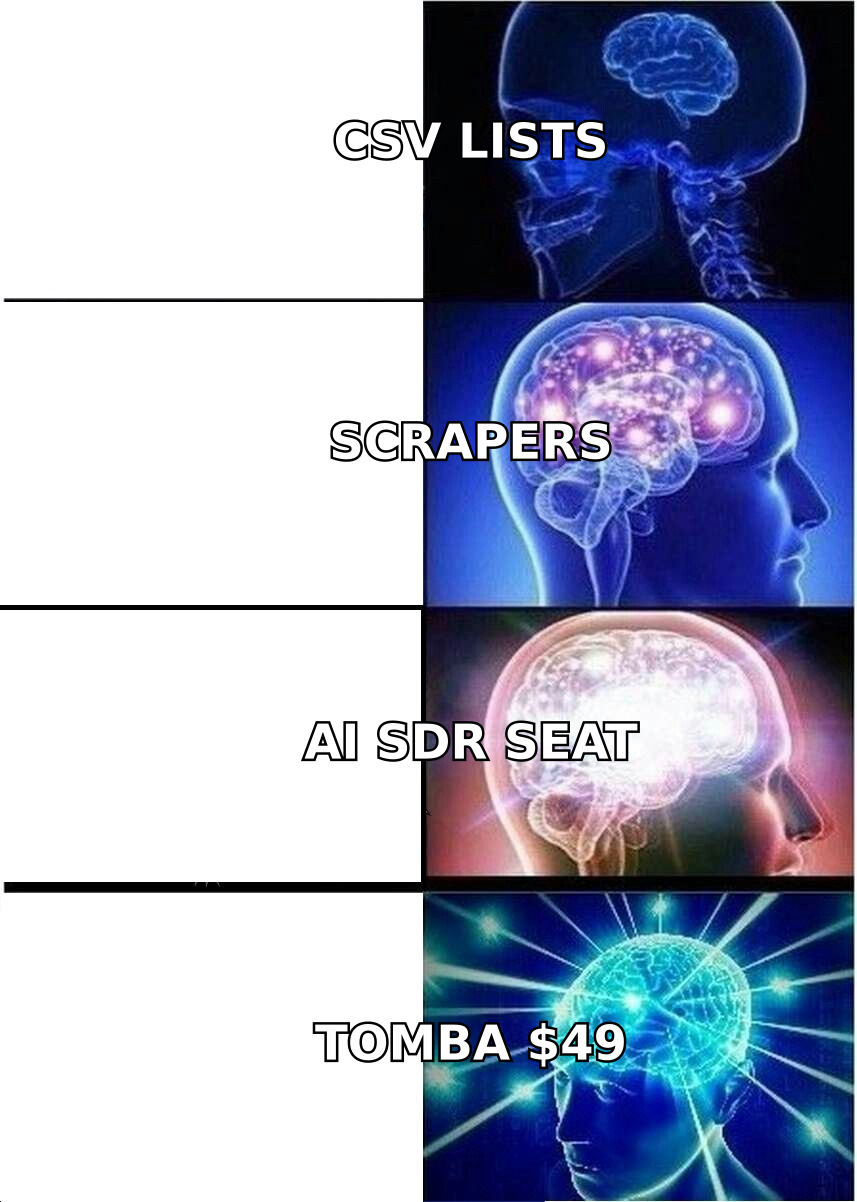
| Data-first stack (Tomba + sequencer) | $49/mo for Tomba Starter plus sending tool | Teams whose real gap is accurate contact data | You write the messaging yourself |
| Prebuilt B2B list provider (e.g. BookYourData) | Per-contact or credit packs | Fast list acquisition in well-defined verticals | Static lists need refreshing over time |
| Full CRM suite add-on (e.g. HubSpot Sales Hub) | Published per-seat tiers | Teams already standardized on the CRM | Prospecting data quality is a separate purchase |
| Hire a human SDR | ~$60–80k fully loaded | Complex, consultative, high-ACV motions | Slowest to ramp; hardest to scale down |
The uncomfortable conclusion for most mid-market teams: the AI SDR is worth it only when messaging and targeting are already working. Agents amplify a motion; they don't invent one. If your reply rate with human-written emails is 1%, an agent sending ten times the volume gives you ten times the 1% — and a damaged domain.
Gartner's sales research has made a related point repeatedly: automation increases the volume of buyer touchpoints far faster than it increases buyer receptivity. Volume without relevance is a tax on your own brand.
Who should buy it, and who should not?#
Buy it if:
- Your ACV is high enough that one extra closed deal per quarter pays the annual contract.
- You already have documented ICP definitions and messaging that converts when a human sends it.
- You have a RevOps owner with capacity to supervise, tune, and audit agent output weekly.
- Your CRM data is clean enough that the agent isn't researching stale accounts.
Skip it if:
- You're pre-product-market-fit and still testing which segment responds.
- Your team's actual complaint is "half our emails bounce" — that's a data problem, not an agent problem.
- You can't commit annually. Monthly terms in this category are priced punitively.
- Nobody owns the tool after the champion who bought it moves on. Agent platforms decay fast without an owner.
How do you build a cheaper stack that covers most of the job?#
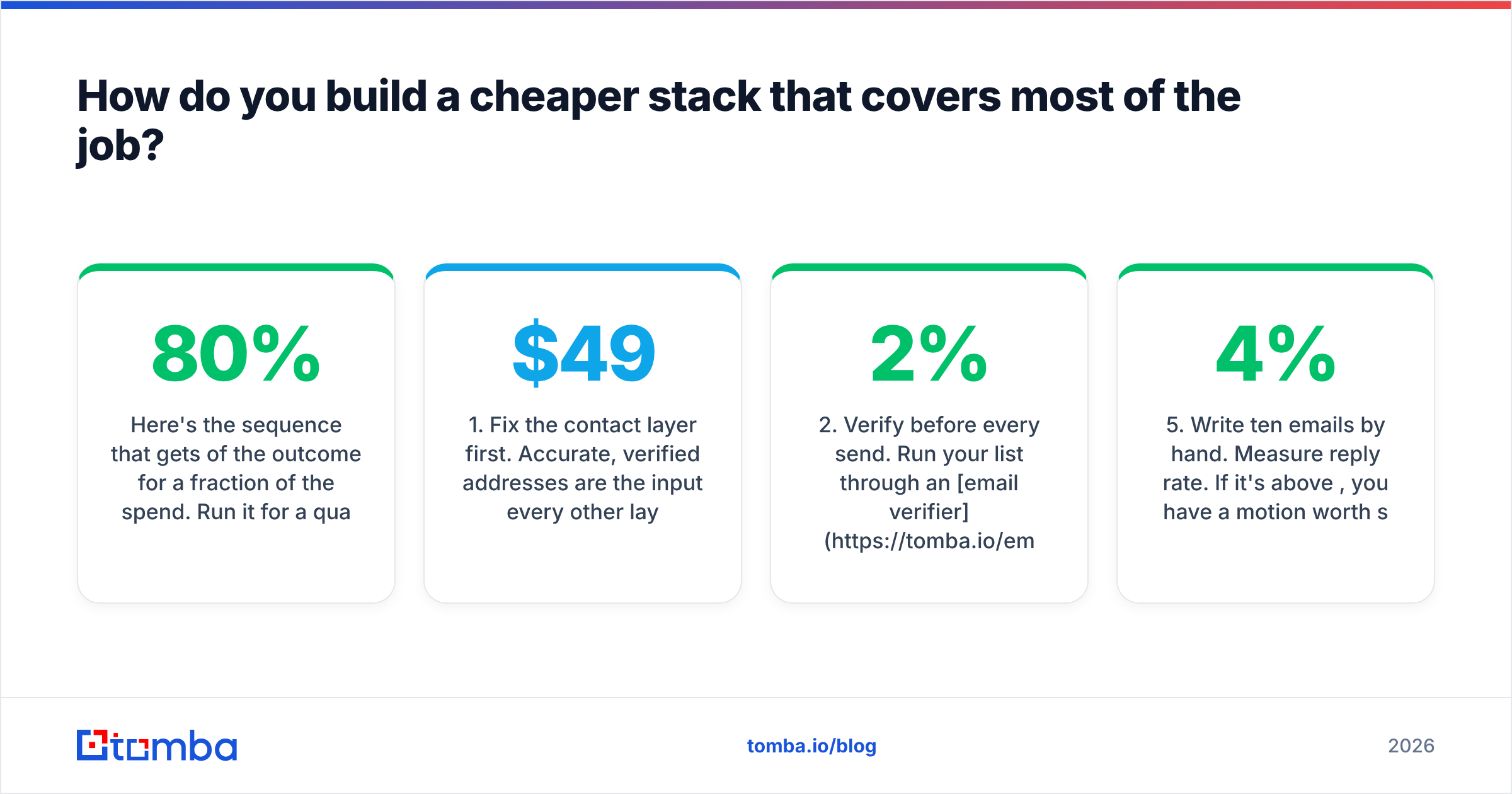
Here's the sequence that gets 80% of the outcome for a fraction of the spend. Run it for a quarter before you sign anything annual.
- Fix the contact layer first. Accurate, verified addresses are the input every other layer depends on. Use an email finder for named prospects and domain search to map whole target accounts. At $49/mo on Starter and $99/mo on Growth, this line item is a rounding error against an agent contract, and there's a free tier at 25 searches/mo to test the match rate on your own ICP before you pay anything.
- Verify before every send. Run your list through an email verifier and handle catch-all domains explicitly. Keeping bounces under 2% protects the domains everything else runs on.
- Enrich for personalization inputs. Contact enrichment gives you the job title, company, and firmographic fields that make a personalized first line possible — whether a human or a model writes it.
- Automate the plumbing, not the thinking. Wire the data layer to your CRM and sequencer through the Tomba API or a no-code connector. Let software handle lookup, dedupe, and sync; keep the offer and the segment decision with a human.
- Write ten emails by hand. Measure reply rate. If it's above 4%, you have a motion worth scaling with an agent. If it's below 1%, no amount of AI-generated volume will fix it — and you've saved yourself an annual commitment.
- Re-evaluate at 90 days. With real reply-rate data and a known cost-per-meeting, you can negotiate an AI SDR quote from a position of evidence rather than hope.
Teams that run this sequence usually discover their pipeline problem was never orchestration. It was that 30–40% of their contact records were wrong, and every downstream layer — human or agent — was compounding that error.
What questions should you ask on the sales call?#
Bring these verbatim:
- What is the credit consumption per action type, in writing?
- What happens at 100% of the pool — hard stop or auto-billed overage, and at what rate?
- Is contact data included, and which providers does it source from?
- What's the month-to-month price versus annual, so I can see the real discount?
- What does a mid-term downgrade look like, and is there a ramp clause?
- Can I see anonymized reply-rate benchmarks from customers in my segment?
A vendor confident in the product answers all six. Hesitation on the consumption table is the single most reliable red flag in this category.
The bottom line on Godmodehq pricing#
You're not evaluating a price — you're evaluating whether agent orchestration is the constraint on your pipeline. For most teams under $50k ACV, it isn't. The constraint is that the contact data going into the machine is stale, unverified, or simply wrong, and no amount of orchestration fixes bad inputs.
Start where the cost is lowest and the leverage is highest. Tomba's Email Finder gives you verified, source-cited business emails by name or domain — free for your first 25 searches, $49/mo on Starter, $99/mo on Growth. Prove your list quality and your reply rate first. Then, if the motion works and the math holds, go negotiate that AI SDR contract with numbers in hand instead of a demo-day feeling.
Related guides#
Ready to find emails that actually work?
Join 150,000+ professionals who stopped guessing and started sending. Free credits on signup — no credit card required.
Get the Tomba newsletter
Practical outbound tactics and product updates — once every two weeks.
About the author