GoHighLevel vs Salesforce: Which CRM Wins in 2026?
GoHighLevel bundles CRM, funnels, and automation for one flat fee. Salesforce sells depth and governance at enterprise prices. Here is the honest breakdown of which one fits your revenue team.
TL;DR
- GoHighLevel is an all-in-one agency stack: CRM, funnels, SMS, email, calendars, and white-label sub-accounts for a flat $97–$497/mo, unlimited users. Best for agencies, local-services businesses, and SMB teams under ~30 people.
- Salesforce is a configurable enterprise platform sold per seat ($25–$500/user/mo) with unmatched reporting, permissions, and an app ecosystem. Best for teams above ~25 reps with complex territory, forecasting, or compliance needs.
- The real cost gap is not the license — it is implementation. Salesforce commonly costs $10k–$150k+ to deploy properly; GoHighLevel can be live in a week but hits ceilings fast on custom objects and reporting.
- Neither platform finds or verifies contact data. Both degrade when you pour unverified emails into them, so pair whichever you choose with a dedicated email verifier.
- Pick GoHighLevel if marketing and sales sit in the same three people. Pick Salesforce if you need audit trails, revenue forecasting, and a system your CFO trusts.
What is GoHighLevel and who actually uses it?#
GoHighLevel (often written HighLevel or GHL) launched in 2018 as a white-label marketing platform for agencies. The pitch: instead of stitching together ClickFunnels, ActiveCampaign, Calendly, Twilio, and a CRM, you get all of it under one login — and you can rebrand it as your own SaaS and resell it to clients.
That resale angle explains most of the product decisions. Sub-accounts (called "locations") are first-class citizens. Snapshots let you clone an entire funnel, pipeline, and automation set into a new client account in seconds. Users are unlimited on every plan, because an agency running 40 client accounts cannot pay per seat.
Typical GoHighLevel buyers:
- Marketing agencies reselling a branded platform to local clients at $200–$500/mo per account.
- Local service businesses — dental, HVAC, med spas, gyms — that need missed-call text-back, review requests, and booking in one place.
- Solo consultants and course sellers who want funnels plus a pipeline plus email without four subscriptions.
- Small B2B teams (2–15 people) that would otherwise pay for HubSpot Marketing Hub and a separate CRM.
What GoHighLevel is not: a system of record for a 200-person enterprise sales org. There are no true custom objects in the Salesforce sense, reporting is shallow, and the audit trail will not satisfy a SOC 2 auditor without extra work.

What is Salesforce and what are you really buying?#
Salesforce is the category-defining CRM with roughly a fifth of the global CRM market. Sales Cloud is the relevant product for outbound and pipeline teams, and it is sold per user, per month, billed annually.
You are not buying a CRM. You are buying a platform: custom objects, validation rules, record-level sharing, territory management, forecast categories, opportunity splits, approval processes, sandboxes, and an AppExchange with thousands of integrations. Anything your revenue process needs, Salesforce can model — with enough admin hours.
That is also the catch. Salesforce is a build, not an install. Most teams underestimate three line items:
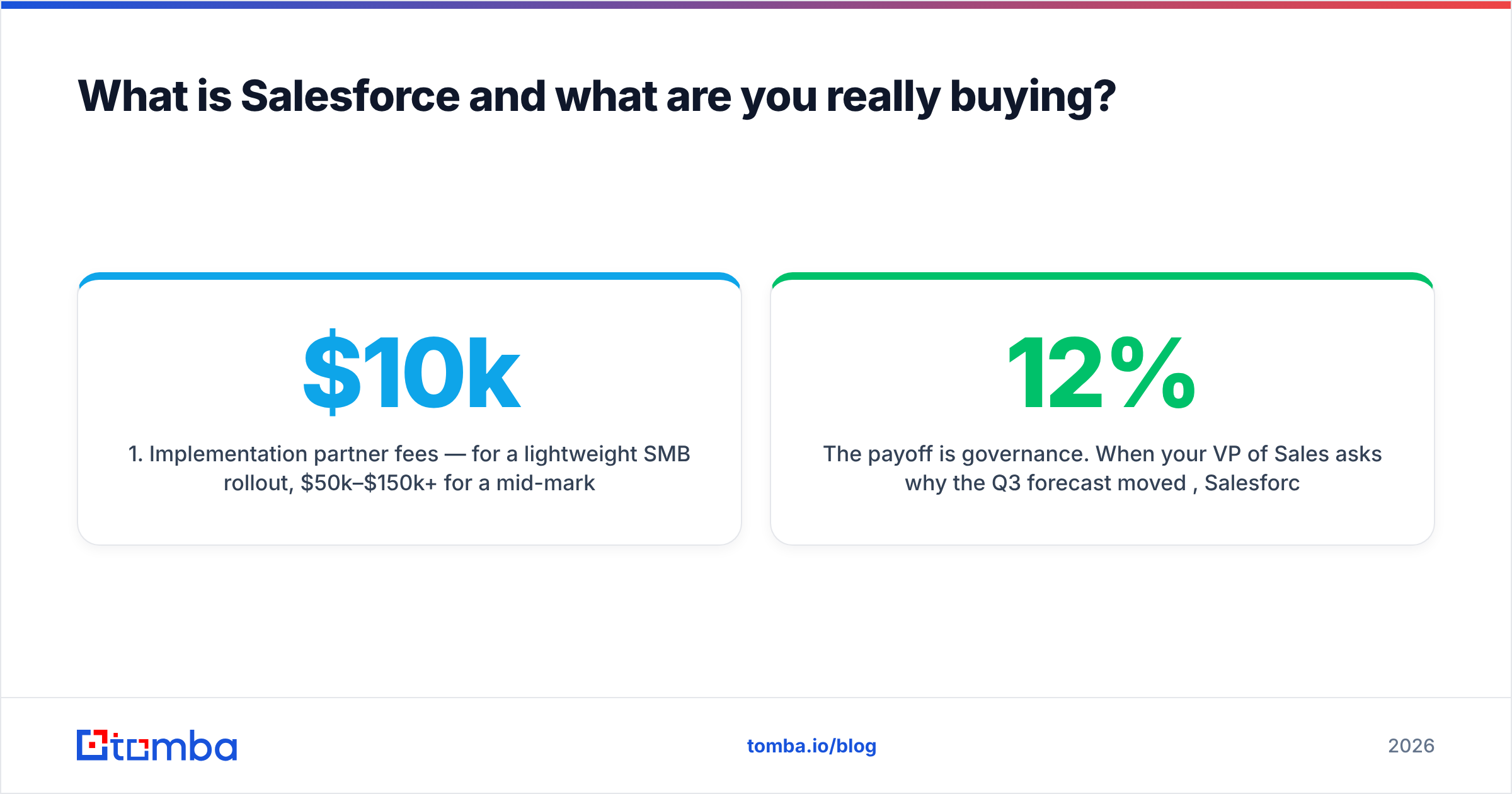
- Implementation partner fees — $10k for a lightweight SMB rollout, $50k–$150k+ for a mid-market build with data migration.
- Ongoing admin — a part-time admin at minimum, a full-time one past ~40 reps.
- Add-ons — Sales Engagement, CPQ, Data Cloud, and Einstein features each carry separate line items that can double the sticker price.
The payoff is governance. When your VP of Sales asks why the Q3 forecast moved 12%, Salesforce can answer it at the field-history level. GoHighLevel cannot.
GoHighLevel vs Salesforce: how do they compare feature by feature?#
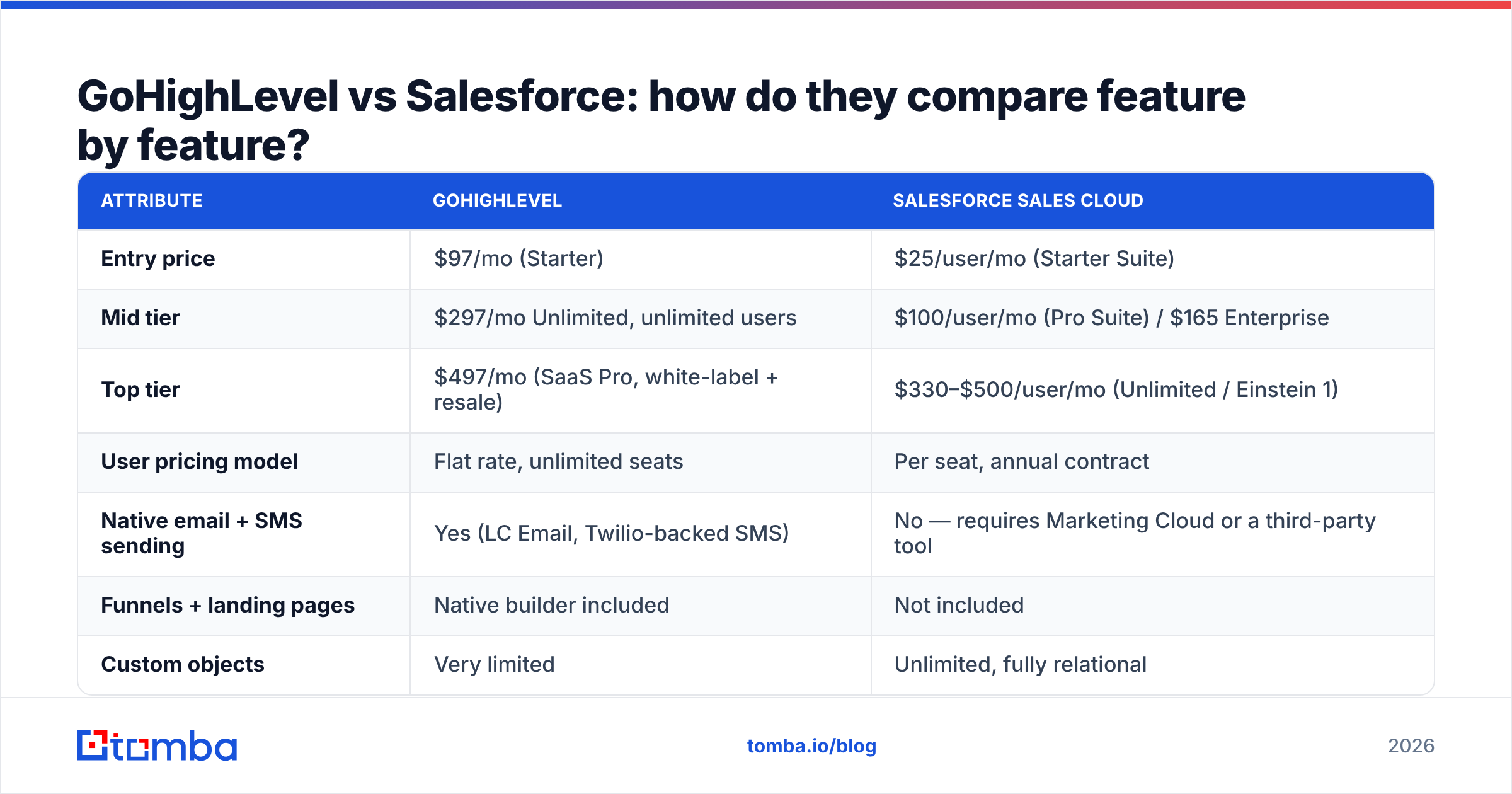
Here is the head-to-head on the attributes that actually change a buying decision. Prices reflect publicly listed 2026 rates and exclude implementation.
| Attribute | GoHighLevel | Salesforce Sales Cloud |
|---|---|---|
| Entry price | $97/mo (Starter) | $25/user/mo (Starter Suite) |
| Mid tier | $297/mo Unlimited, unlimited users | $100/user/mo (Pro Suite) / $165 Enterprise |
| Top tier | $497/mo (SaaS Pro, white-label + resale) | $330–$500/user/mo (Unlimited / Einstein 1) |
| User pricing model | Flat rate, unlimited seats | Per seat, annual contract |
| Native email + SMS sending | Yes (LC Email, Twilio-backed SMS) | No — requires Marketing Cloud or a third-party tool |
| Funnels + landing pages | Native builder included | Not included |
| Custom objects | Very limited | Unlimited, fully relational |
| Reporting depth | Basic dashboards, attribution reports | Reports, dashboards, forecasting, CRM Analytics |
| Permissions / audit | Agency + user level only | Field-level security, sharing rules, full field history |
| Typical time to live | 3–14 days | 6 weeks to 9 months |
| Implementation cost | $0–$3k (snapshots, freelancer) | $10k–$150k+ |
| White-label / resale | Yes — core feature | No |
| App marketplace | ~100 integrations + Zapier | AppExchange, 4,000+ apps |
| Best for | Agencies, SMB, local services | Mid-market to enterprise sales orgs |
A few honest caveats about that table.
GoHighLevel's flat pricing is real, but usage is not free. SMS and email are rebilled through Twilio and LeadConnector at usage rates. A team blasting 50,000 SMS a month will see a bill that looks nothing like $297.
Salesforce's $25 tier is a trap for growing teams. Starter Suite caps custom objects and drops most automation. Any team doing real outbound lands on Enterprise ($165/user/mo) within a year, which is $19,800/year for 10 reps before a single add-on.
Which one costs less over three years?#
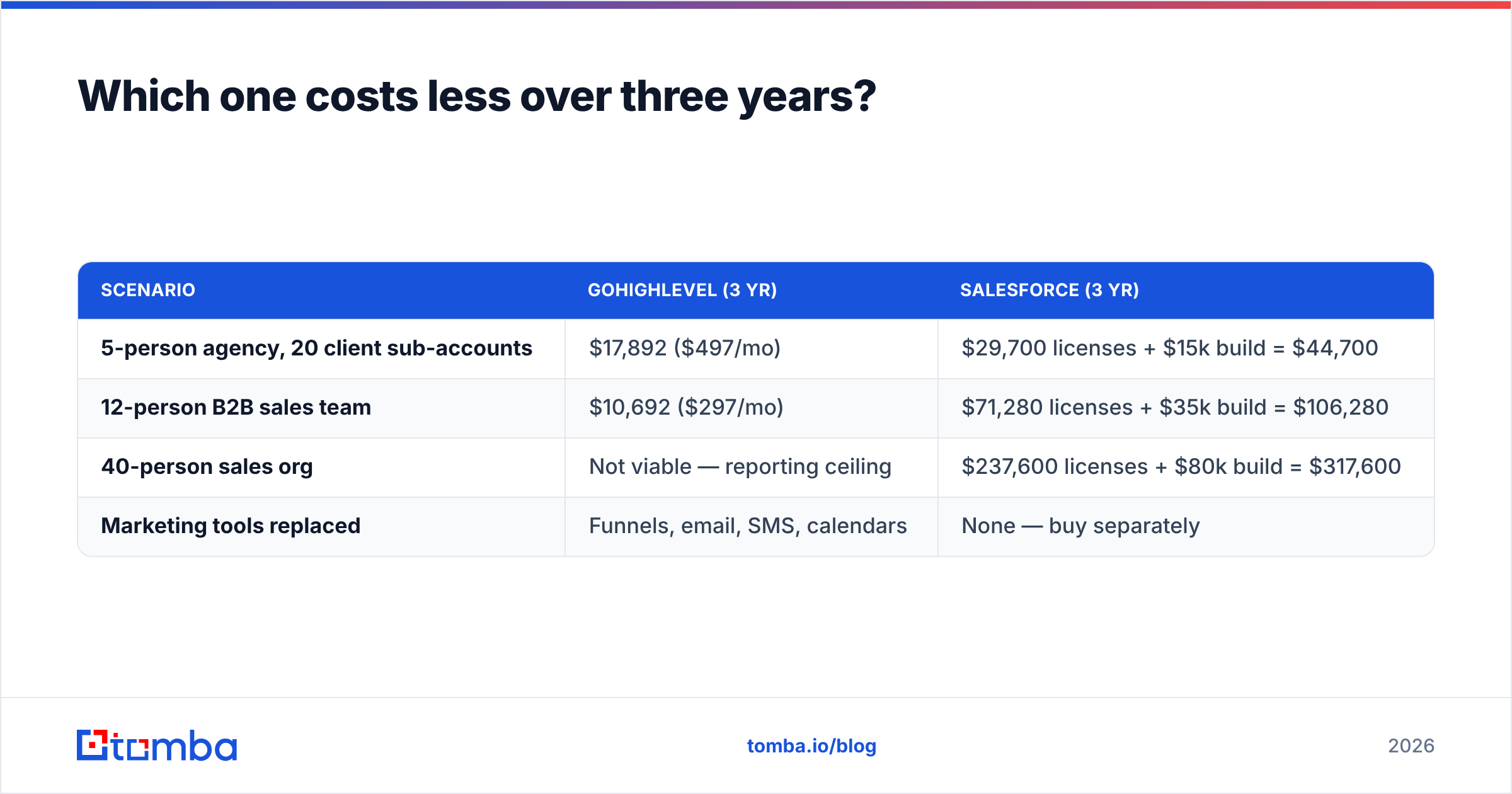
Total cost of ownership flips depending on headcount. Here is the arithmetic for two realistic scenarios, license plus a conservative implementation estimate.
| Scenario | GoHighLevel (3 yr) | Salesforce (3 yr) |
|---|---|---|
| 5-person agency, 20 client sub-accounts | $17,892 ($497/mo) | $29,700 licenses + $15k build = $44,700 |
| 12-person B2B sales team | $10,692 ($297/mo) | $71,280 licenses + $35k build = $106,280 |
| 40-person sales org | Not viable — reporting ceiling | $237,600 licenses + $80k build = $317,600 |
| Marketing tools replaced | Funnels, email, SMS, calendars | None — buy separately |
The pattern: below roughly 25 revenue-facing employees, GoHighLevel wins on cost by a factor of 4–10x and replaces two or three other subscriptions. Above that headcount, the cost gap stops mattering because the reporting and permissions gap starts costing you deals and audit hours instead.
According to G2 category reviews, the most common Salesforce complaint is complexity and admin dependence; the most common GoHighLevel complaint is support responsiveness and occasional platform instability during major releases. Both patterns have held for several years — weigh them honestly.
Is GoHighLevel better than Salesforce for outbound sales?#
For pure outbound B2B — cold email, sequenced follow-up, multi-threaded enterprise deals — the answer splits by team size and deal complexity.
GoHighLevel is better when:
- Your funnel is inbound-heavy. Ads to landing page to booked call is exactly the workflow GHL was built for, and it does it natively.
- Speed to lead matters more than forecasting. Missed-call text-back and instant SMS follow-up are built in and genuinely convert.
- The same person runs marketing and sales. No handoff means no need for Salesforce's separation of duties.
- You resell the platform. Nothing in the Salesforce world lets you white-label and rebill a client-facing CRM.
Salesforce is better when:
- Deals have multiple stakeholders and long cycles. Opportunity contact roles, splits, and product line items exist for a reason.
- You need territory and quota management. Assigning 40 reps to accounts by geography, segment, and tier is a configuration in Salesforce and a spreadsheet in GHL.
- Board-level reporting is non-negotiable. Pipeline coverage, stage conversion, and forecast accuracy over 12 rolling quarters.
- Compliance and data governance apply. Field-level encryption, granular sharing, and full audit history.
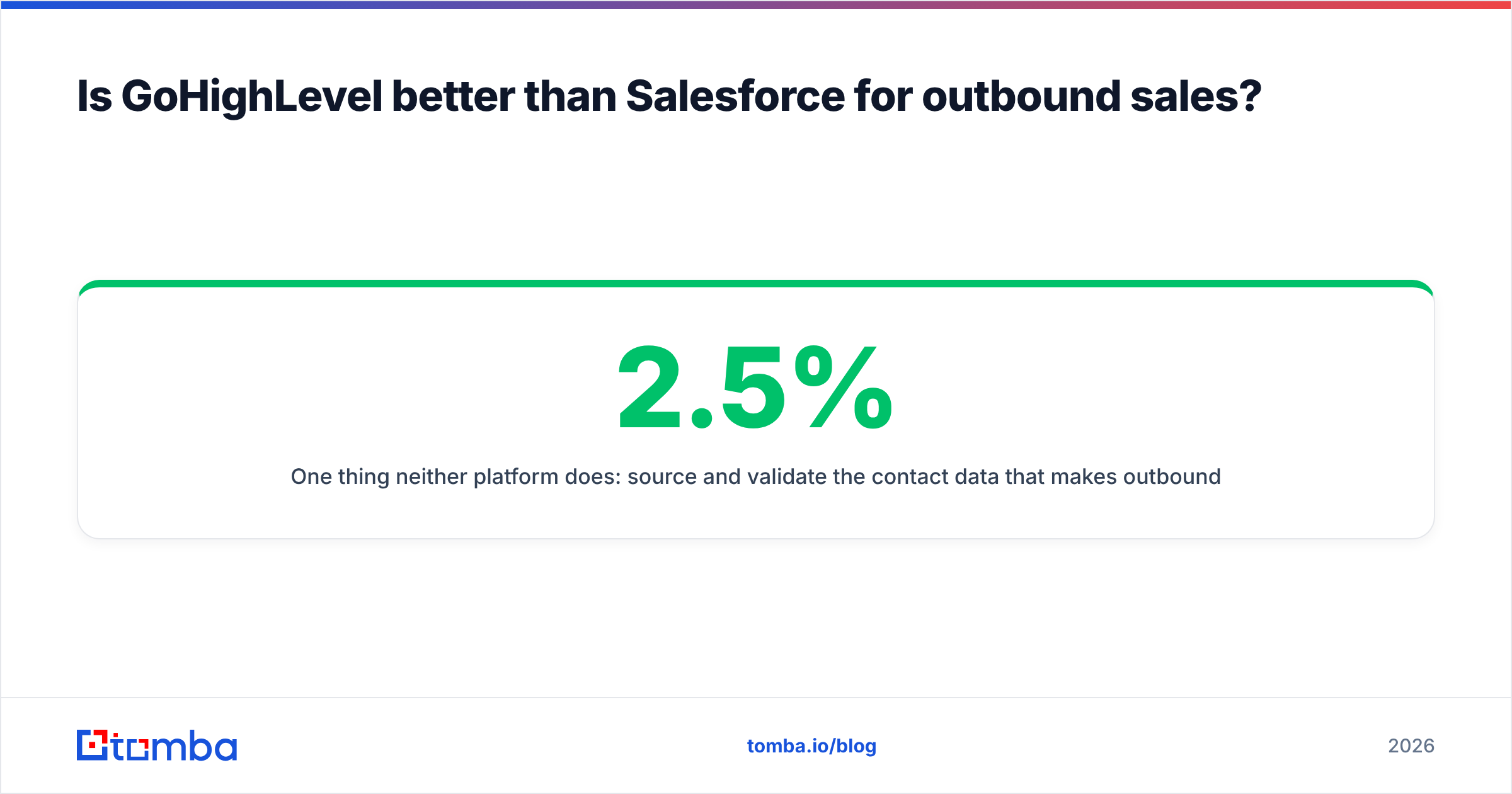
One thing neither platform does: source and validate the contact data that makes outbound work. Both assume records arrive clean. In practice, B2B contact data decays at roughly 2–2.5% per month as people change roles, so a list loaded in January is meaningfully stale by summer. That is why the data enrichment and verification layer sits upstream of whichever CRM you pick — bad records degrade a $497/mo stack and a $300k/yr stack equally.

What breaks when you outgrow GoHighLevel?#
Teams that migrate off GoHighLevel usually hit the same four walls, in this order.
1. Reporting. You want pipeline velocity by rep by segment by source, and the dashboard cannot express it. Exporting to a spreadsheet works for a quarter, then stops.
2. Data model. You need a "Contract" or "Subscription" or "Property" object with its own fields, relationships, and permissions. GHL's custom fields on contacts and opportunities cannot model a real many-to-many relationship.
3. Permissions. A 30-person team needs reps who cannot see each other's pipelines, managers who see their region, and finance who sees closed-won only. GHL's role model is not built for this.
4. Integration depth. Your finance team runs NetSuite, your product emits usage events, and your data team wants a warehouse sync. Salesforce has a documented, supported path for all three.
Signals it is time to move: more than 25 revenue-facing users, more than one sales team with distinct processes, an actual RevOps hire, or a compliance requirement in a customer contract. If none of those are true, migrating early just buys you admin overhead. See how revenue operations maturity tends to track the same thresholds.
What are the credible alternatives to both?#
Neither tool is the only answer. A short, honest map of the middle ground:
- HubSpot Sales Hub — the natural compromise. Better UX than Salesforce, far deeper reporting than GoHighLevel, per-seat pricing that gets expensive at Professional tier and above. See HubSpot's own pricing page for current rates.
- Pipedrive — cheap, fast, sales-only. No marketing automation to speak of, but excellent pipeline hygiene for small teams.
- Close — built for high-volume calling and SMB outbound teams. Native dialer, tight sequences.
- Zoho CRM — the price-per-feature leader, with a rougher edge on UX and support.
- Keap — the closest philosophical competitor to GoHighLevel for small businesses, without the white-label layer.
If you already run Salesforce and just want cheaper prospecting data feeding it, the fix is usually not a CRM swap. It is replacing an expensive data vendor — many teams evaluating an Apollo alternative or a Clearbit alternative find that swapping the data layer solves the budget problem without touching the CRM.
How should you actually decide?#
Answer these five questions honestly and the choice makes itself.
- How many people will touch the CRM in 18 months? Under 25 → GoHighLevel is defensible. Over 25 → Salesforce or HubSpot.
- Do you need to resell the platform under your own brand? Yes → GoHighLevel, no real competitor here.
- Does anyone outside sales depend on CRM reporting? If your CFO or board reads the pipeline report, you need Salesforce-grade reporting.
- Do you have an admin? No admin and no budget for one → GoHighLevel. Salesforce without an owner becomes a very expensive spreadsheet within two quarters.
- Is your data model more complex than contacts and deals? Custom relational objects → Salesforce.
The one decision both paths share: whatever you pick becomes worthless if the records inside it are wrong. Before you migrate anything, run your existing list through a verification pass and check bounce rates. A CRM full of dead addresses inflates your seat count, poisons your sender reputation, and makes every report downstream a lie.
Get the data layer right before you pick the CRM#
CRM choice is reversible. A burned sending domain and a list of stale contacts are much harder to undo. Whether you land on GoHighLevel's flat-rate agency stack or Salesforce's enterprise platform, the records you push into it decide whether any of it produces revenue.
Start with clean, verified contacts. Tomba Email Finder finds professional email addresses by domain, name, or company and confirms deliverability before the record ever reaches your pipeline — free tier at 25 searches/mo, Starter at $49/mo, Growth at $99/mo, Pro at $249/mo. Check the full Tomba pricing breakdown, or wire it straight into your stack with the Tomba API, the HubSpot integration, or the Salesforce integration so verification happens before the lead hits a rep's queue.
Related guides#
Ready to find emails that actually work?
Join 150,000+ professionals who stopped guessing and started sending. Free credits on signup — no credit card required.
Get the Tomba newsletter
Practical outbound tactics and product updates — once every two weeks.
About the author