Gong Alternatives in 2026: 9 Revenue Intelligence Tools
Gong set the standard for revenue intelligence, but the platform fee and per-seat cost push it out of reach for most teams under 50 reps. Here are nine alternatives compared on price, features, and who they actually fit.
TL;DR
- Gong is the category leader in revenue intelligence, but buyers consistently report a platform fee plus roughly $1,200–$1,600 per seat per year — which prices out most teams under 50 reps.
- The strongest all-round Gong alternatives in 2026 are Clari Copilot (forecasting-first), Avoma (best price-to-feature ratio), Jiminny (coaching-first), and Modjo (strong in EMEA and multilingual teams).
- If you only need transcripts, summaries, and CRM sync, Fireflies.ai or Grain do 80% of the job for under $30/user/month.
- Conversation intelligence only pays off if your reps are having conversations. If pipeline coverage is the real problem, fix contact data before you buy another AI layer.
- Budget rule of thumb: switching from Gong to a mid-market tool frees roughly $800–$1,300 per rep per year — enough to fund a full prospecting data stack.
What does Gong actually do, and why are people looking for alternatives?#
Gong records calls, transcribes them, and runs AI analysis across every conversation your team has — then rolls that up into deal risk scores, forecast adjustments, and coaching signals. It is genuinely good software. The official product is deep, the AI models are trained on a large proprietary corpus, and the deal-boards give sales leaders visibility they used to buy with weekly pipeline reviews.
So why does "Gong alternatives" get searched thousands of times a month? Four reasons show up over and over in G2 reviews and renewal conversations:
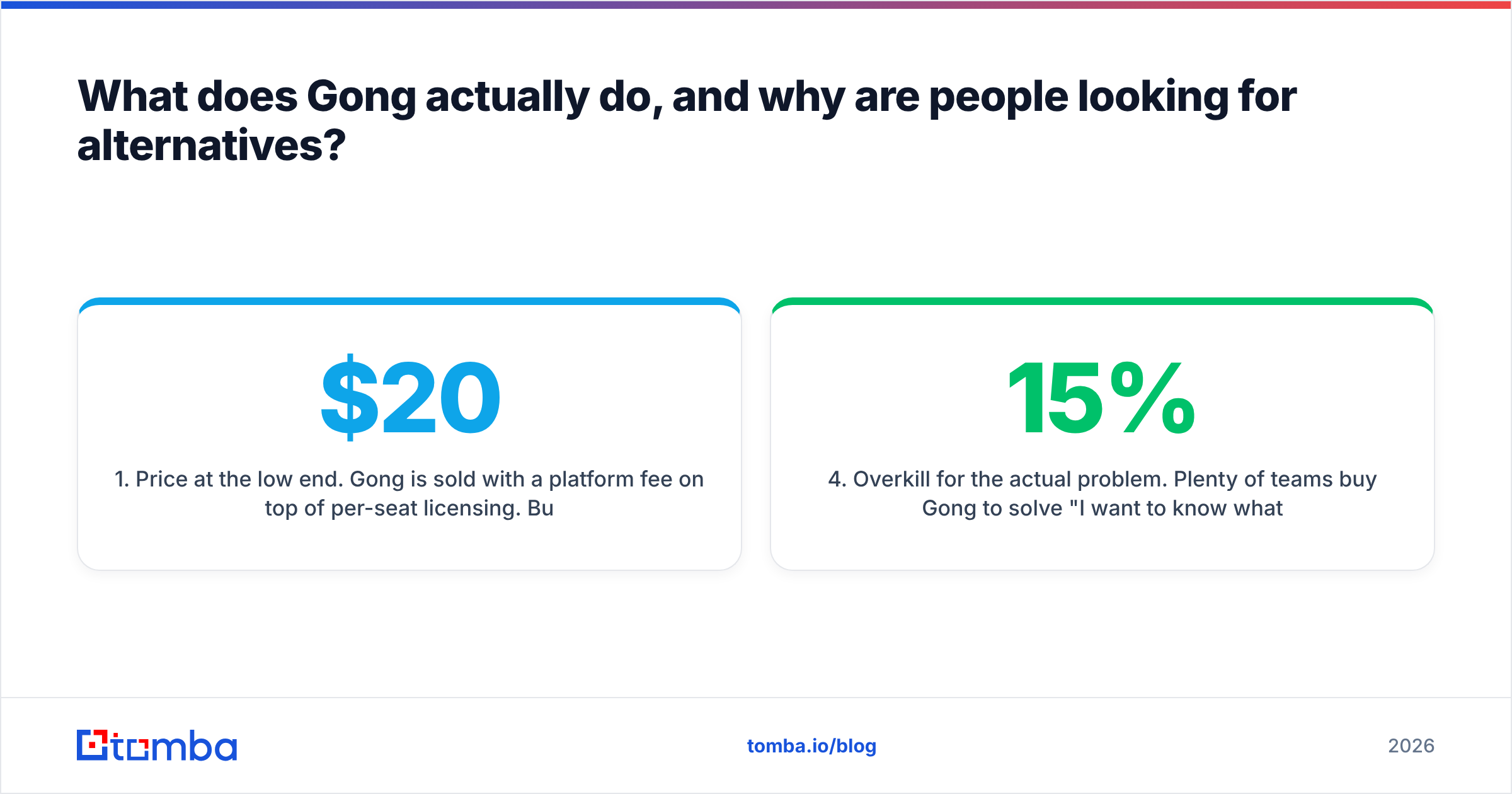
- Price at the low end. Gong is sold with a platform fee on top of per-seat licensing. Buyers report annual contracts starting around $20,000–$30,000 for a small team. A 10-rep startup can spend more on Gong than on its CRM.
- Seat math punishes non-reps. Managers, RevOps, marketing, and CS all want access to call data. Every one of those viewers is a paid seat in most configurations.
- Annual-only contracts. No monthly plan, no meaningful free tier, and a procurement cycle that takes weeks.
- Overkill for the actual problem. Plenty of teams buy Gong to solve "I want to know what was said on the call" and end up using 15% of the platform.
None of that makes Gong bad. It makes it a specific fit: 40+ reps, a real enablement function, and a forecasting process worth instrumenting. Below that line, the alternatives get compelling fast.
How much does Gong cost in 2026?#
Gong does not publish pricing, which is itself a signal about who it sells to. What buyers report publicly, and what shows up in procurement threads, breaks down roughly like this:
- Platform fee: ~$5,000–$50,000/year, scaling with company size and modules
- Per-seat license: ~$1,200–$1,600/user/year
- Add-ons: Forecast, Engage (sequences), and Gong Data Cloud are priced separately
- Contract term: annual, sometimes multi-year with a discount
- Minimum seats: commonly enforced, often around 10–15
Treat those numbers as directional, not quoted — Gong prices by negotiation and your mileage will vary by region, size, and how close it is to their quarter end. The important part is the shape: a fixed base cost that does not shrink when your team does, plus seats that cost roughly what a mid-market SaaS tool costs in total.
What are the best Gong alternatives right now?#
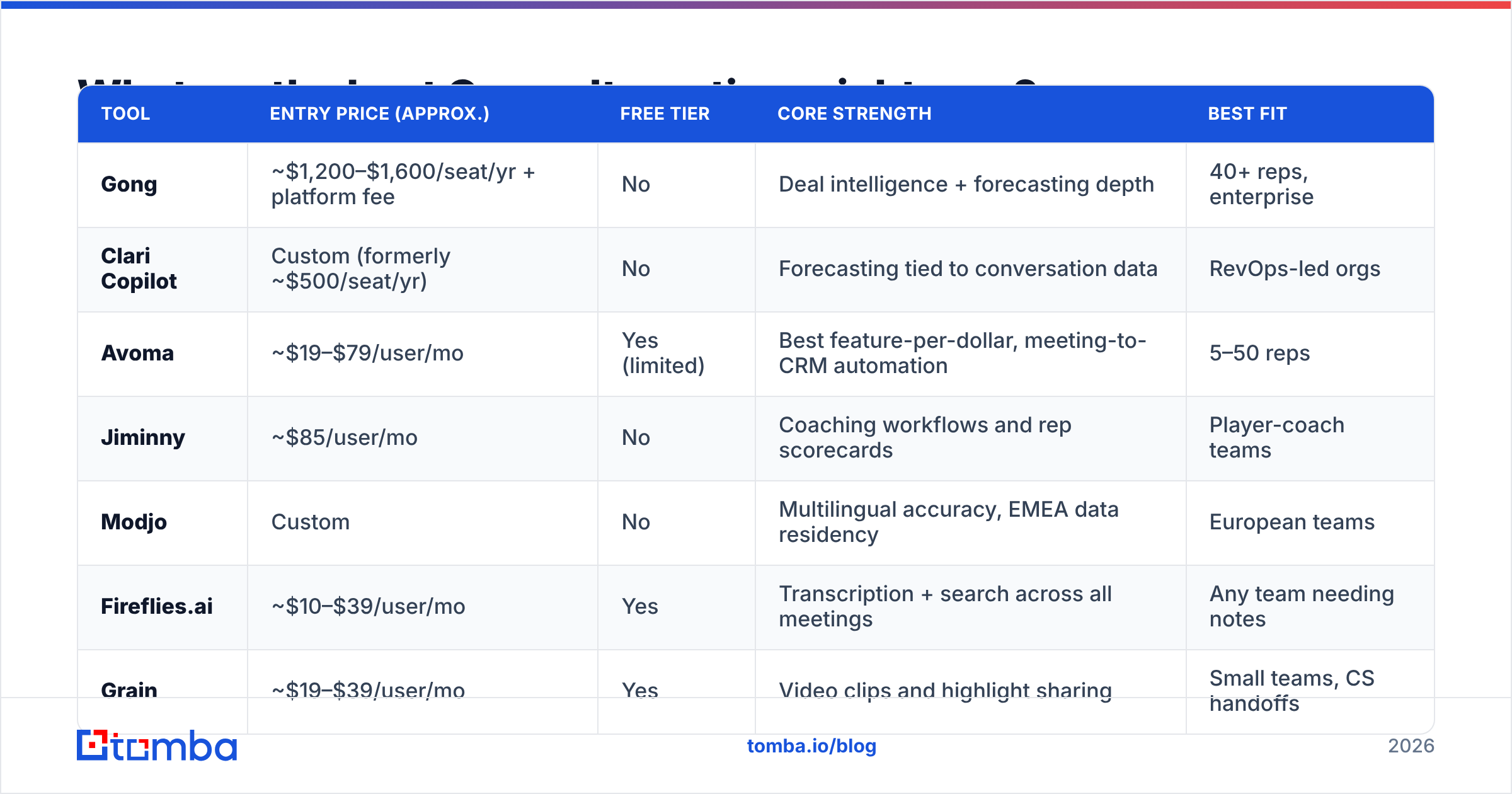
Here is the comparison that matters — published or widely-reported entry pricing, the core strength, and the team size it fits. Verify pricing on each vendor's site before you commit; conversation intelligence pricing moves fast.
| Tool | Entry price (approx.) | Free tier | Core strength | Best fit |
|---|---|---|---|---|
| Gong | ~$1,200–$1,600/seat/yr + platform fee | No | Deal intelligence + forecasting depth | 40+ reps, enterprise |
| Clari Copilot | Custom (formerly ~$500/seat/yr) | No | Forecasting tied to conversation data | RevOps-led orgs |
| Avoma | ~$19–$79/user/mo | Yes (limited) | Best feature-per-dollar, meeting-to-CRM automation | 5–50 reps |
| Jiminny | ~$85/user/mo | No | Coaching workflows and rep scorecards | Player-coach teams |
| Modjo | Custom | No | Multilingual accuracy, EMEA data residency | European teams |
| Fireflies.ai | ~$10–$39/user/mo | Yes | Transcription + search across all meetings | Any team needing notes |
| Grain | ~$19–$39/user/mo | Yes | Video clips and highlight sharing | Small teams, CS handoffs |
| Sybill | ~$49–$79/user/mo | No | Behavioral signals and auto-CRM updates | AE-heavy motions |
| Chorus (ZoomInfo) | Bundled with ZoomInfo | No | Bundled with a contact database | Existing ZoomInfo customers |
| Salesloft Conversations | Bundled with Salesloft | No | Native inside the sequencing tool | Salesloft-standardized teams |
The pattern: you are choosing between three tiers. Enterprise revenue intelligence (Gong, Clari, Chorus), mid-market conversation intelligence (Avoma, Jiminny, Modjo, Sybill), and meeting-notes AI (Fireflies, Grain). Most teams shopping for Gong alternatives actually need tier two and buy tier three by accident because it demos well.
Which Gong alternative fits which team?#
Use this as a shortlist filter before you sit through five demos.
You need forecast accuracy, not call summaries → Clari Copilot. Clari built its business on forecasting and bolted conversation data onto it, which is the inverse of Gong's path. If your CRO's real complaint is "the number moves every Thursday," this is the closer match. Check current packaging on clari.com — it is quote-based.
You need the most capability per dollar → Avoma. Avoma bundles scheduling, note-taking, conversation intelligence, and revenue intelligence into tiered plans that start under $30/user/month. The AI is not as opinionated as Gong's, but the CRM write-back and the topic tracking cover the daily use cases. It also has a genuinely usable free tier, which matters when you want reps to try it before the contract.
You need coaching, not analytics → Jiminny. Jiminny is built around the manager's weekly 1:1: scorecards, comment threads on specific timestamps, and a library of "great call" examples. Teams that buy Gong for coaching and never open the deal boards should look here first.
You operate in multiple languages → Modjo. Transcription accuracy in French, German, Spanish, and Italian is where most US-built tools quietly fall over. Modjo is built in Europe for European sales floors and handles data residency questions that would otherwise involve your legal team.
You just want searchable transcripts → Fireflies.ai or Grain. No deal intelligence, no forecast, no rep scorecards. Recording, transcription, summaries, search, and integrations — for roughly a tenth of Gong's cost. Fireflies.ai has a free plan that covers unlimited transcription with limits on AI credits and storage.
You already pay ZoomInfo or Salesloft → use what you own. Chorus ships with ZoomInfo and Conversations ships with Salesloft. Neither is best-in-class standalone, but "already paid for and already integrated" beats a 12% feature advantage more often than vendors want to admit.
Is Gong actually better, or just better funded?#
Honest answer: on pure AI depth across a large call volume, Gong is still ahead. Its models have seen more sales conversations than any competitor's, and it shows in things like objection detection, competitor mention tracking, and deal-risk scoring that a manager would agree with.
Where the gap has closed is transcription and summarization. General-purpose speech models got very good, very fast, and the cheap tools now ride the same underlying infrastructure. In 2026, "the transcript is more accurate" is no longer a defensible reason to pay four times as much. The remaining moat is the analytics layer on top and the enterprise plumbing underneath — SSO, granular permissions, compliance workflows, and integrations with data warehouses.
So the real question is not "is Gong better." It is: are you going to use the layer you are paying for? If nobody on your team has opened a deal board in six weeks, you are paying an enterprise premium for a transcription service.
Do you need conversation intelligence, or better data going in?#
This is the uncomfortable diagnostic, and it is worth running before you sign anything.
Conversation intelligence analyzes calls that already happened. It cannot fix a pipeline that has too few calls in it. Teams frequently buy Gong-class tooling to explain a missed number when the actual cause sits three steps earlier: bad contact data, bounced outreach, and reps burning hours on manual research instead of talking to people.
A quick self-check:
- If your reps are having 12+ discovery calls a week each and you can't tell why deals stall → buy conversation intelligence.
- If your reps are having 3 discovery calls a week → your problem is top-of-funnel, and no AI call analysis will move the number.
For the second case, the money is better spent on contact accuracy. Verified direct emails and mobile numbers convert prospecting hours into conversations, and conversations are the raw material every tool on this list depends on. A bulk email finder plus real-time email verification removes the bounce tax before it ever touches your sender reputation. Layering data enrichment on top means reps open a call already knowing headcount, tech stack, and role — which is the same context Gong tries to reconstruct after the fact.
What should you check before switching off Gong?#
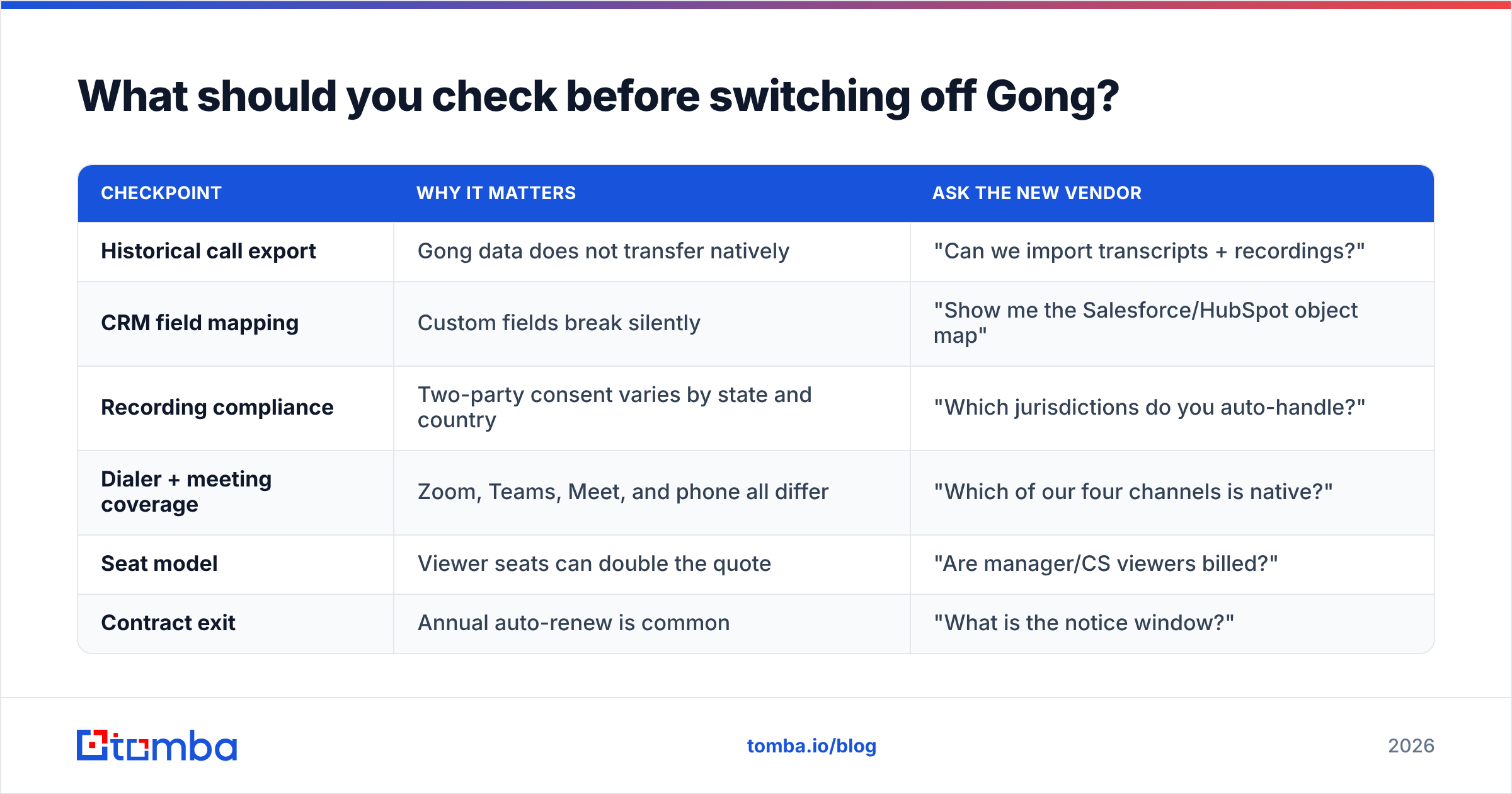
Migration is where switching costs hide. Run this list before the renewal date, not after.
| Checkpoint | Why it matters | Ask the new vendor |
|---|---|---|
| Historical call export | Gong data does not transfer natively | "Can we import transcripts + recordings?" |
| CRM field mapping | Custom fields break silently | "Show me the Salesforce/HubSpot object map" |
| Recording compliance | Two-party consent varies by state and country | "Which jurisdictions do you auto-handle?" |
| Dialer + meeting coverage | Zoom, Teams, Meet, and phone all differ | "Which of our four channels is native?" |
| Seat model | Viewer seats can double the quote | "Are manager/CS viewers billed?" |
| Contract exit | Annual auto-renew is common | "What is the notice window?" |
Two practical notes. First, most teams cannot export Gong recordings in bulk in a usable way — plan to run both systems in parallel for a quarter if historical calls matter for onboarding. Second, check the notice window on your current contract today; a 60- or 90-day auto-renewal clause is the single most common reason teams stay on a tool they already decided to leave.
While you are auditing the stack, it is worth checking whether your CRM is the actual system of record or just a place where notes go to die. Conversation intelligence tools write a lot of data back. If nobody trusts the CRM, you are adding volume to a dataset nobody reads.
What does a realistic 2026 stack look like without Gong?#
For a 15-rep B2B team, a workable replacement stack:
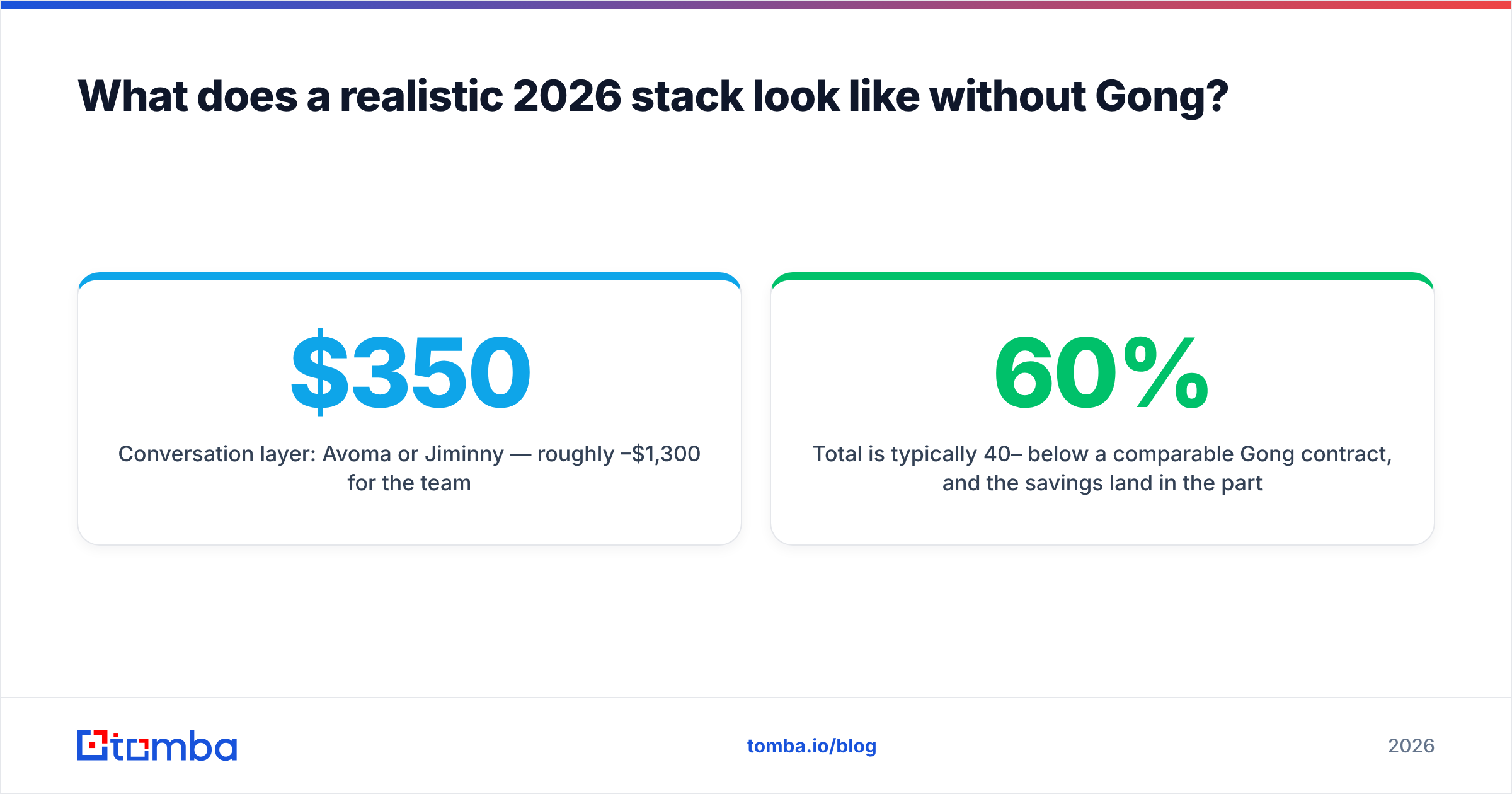
- Conversation layer: Avoma or Jiminny — roughly $350–$1,300/month for the team
- Data layer: verified emails, direct dials, and enrichment — a few hundred per month
- Sequencing: whatever you already run (Smartlead, Instantly, Salesloft)
- CRM: HubSpot or Salesforce, unchanged
Total is typically 40–60% below a comparable Gong contract, and the savings land in the part of the funnel that generates the calls in the first place. That is not an argument that Gong is overpriced — for a 200-rep org with a dedicated enablement team, the per-rep economics work fine. It is an argument that most teams buying it are buying the wrong tier for their stage. HubSpot's own sales research keeps landing on the same finding: reps lose more time to prospecting and admin than to any post-call analysis gap.
Frequently asked questions#
Is there a free Gong alternative? Yes, partially. Fireflies.ai, Grain, and Avoma all have free tiers that cover recording, transcription, and basic summaries. None include deal intelligence or forecasting — expect to pay for that layer regardless of vendor.
Can I negotiate Gong's price instead of switching? Usually. Discounts of 15–30% are common at quarter and fiscal-year end, especially with a multi-year commit or a competitor quote in hand. Get one real alternative quote before you negotiate; it changes the conversation materially.
Does Chorus still exist after the ZoomInfo acquisition? Yes, now folded into ZoomInfo's Copilot suite. It is a reasonable choice if you already pay for ZoomInfo, less so as a standalone purchase.
Will switching hurt forecast accuracy? Short term, yes — any new model needs a quarter of calls to calibrate. Plan the switch for the start of a fiscal period, not mid-quarter.
Where to start#
Pick your tier honestly. If you have 40+ reps, a real enablement function, and a forecast that leadership stakes their quarter on, Gong or Clari earns the spend. If you have fewer than 30 reps, start with Avoma or Jiminny, keep the difference, and spend it upstream.
And if the real gap is that your reps do not have enough qualified conversations to analyze, start there. The Tomba Email Finder gives you verified, deliverable contacts by domain, name, or company — with a free tier at 25 searches a month, Starter at $49/mo, and Growth at $99/mo, so you can test the data quality before committing budget. Check the full Tomba pricing breakdown, or wire it directly into your workflow through the Tomba API. No AI can analyze a call that never got booked.
Related guides#
Ready to find emails that actually work?
Join 150,000+ professionals who stopped guessing and started sending. Free credits on signup — no credit card required.
Get the Tomba newsletter
Practical outbound tactics and product updates — once every two weeks.
About the author