Gong Pricing Reviews Pros and Cons: 2026 Buyer Analysis
Gong quotes per-seat pricing plus a platform fee, and neither number is public. Here is what teams actually pay in 2026, where the value holds up, and where it breaks.
Short answer on gong pricing reviews pros and cons: Gong is worth the money above 20 reps. Below 15 reps, it rarely is.
TL;DR
- Gong does not publish pricing. Buyer reports in 2026 cluster around $1,200–$1,600 per user per year. Add a platform fee of roughly $5,000–$50,000, based on headcount and modules.
- The pros are real: call analysis, deal-risk scoring, and forecast accuracy that no spreadsheet can match. Reps stop guessing why deals stall.
- The cons are real too: annual-only contracts, a platform fee that hurts teams under 20 reps, multi-year lock-in, and little value if your reps make few calls.
- Gong is a call-analysis platform, not a data platform. It reviews talks you already had. It will not find you a single new contact.
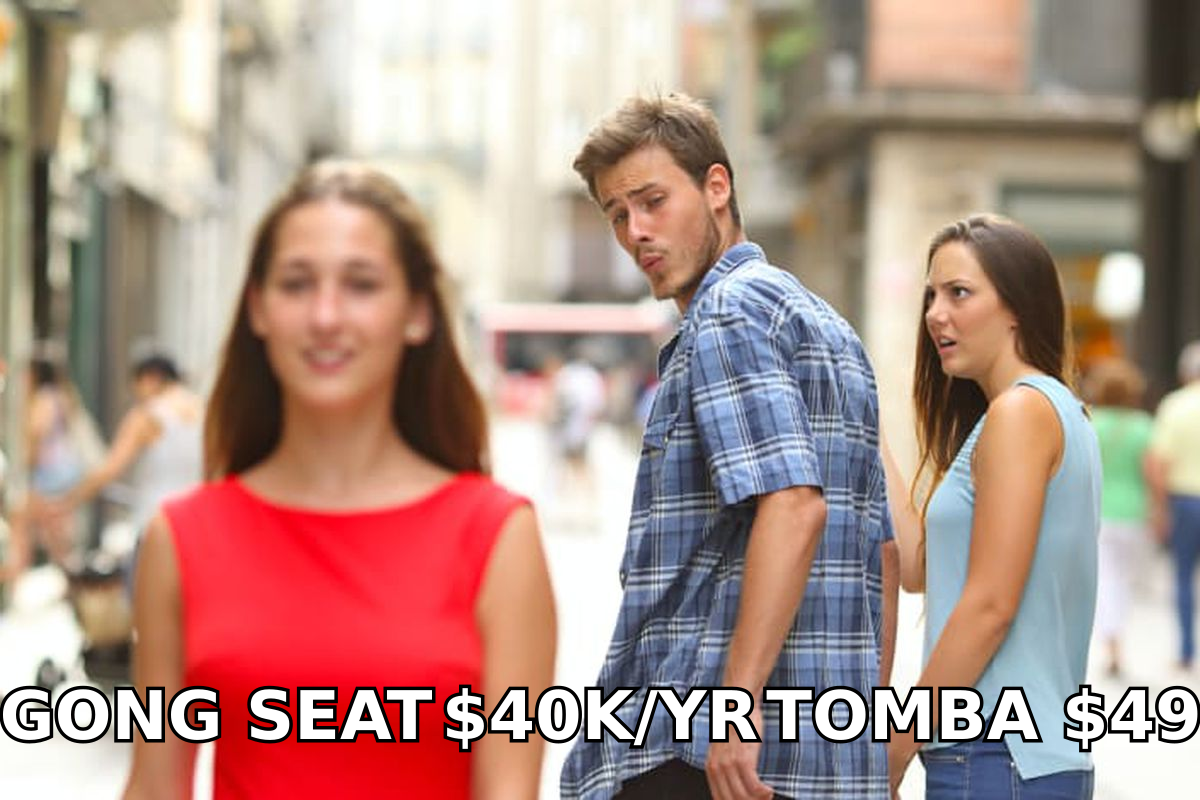
- Most gong pricing reviews pros and cons come down to size. Under 15 reps, a $99/mo prospecting stack plus a cheap recorder often beats a $45,000 Gong contract.
Gong is one of the most respected products in revenue tech. It is also one of the hardest to price. You cannot get a number from the website. You get a demo, a discovery call, a proposal, and then a haggle. That gap between "clearly great product" and "no idea what it costs" is why buyers search for gong pricing reviews pros and cons before they book anything.
This is a neutral breakdown. What Gong charges, what buyers report, where the product earns its price, and where a smaller team should walk away.
What is Gong and what are you actually buying?#
Gong is a revenue intelligence platform. It records, writes up, and analyzes sales calls and emails. Then it layers analytics on top to tell you which deals are at risk. It also flags which rep habits lead to closed-won deals.
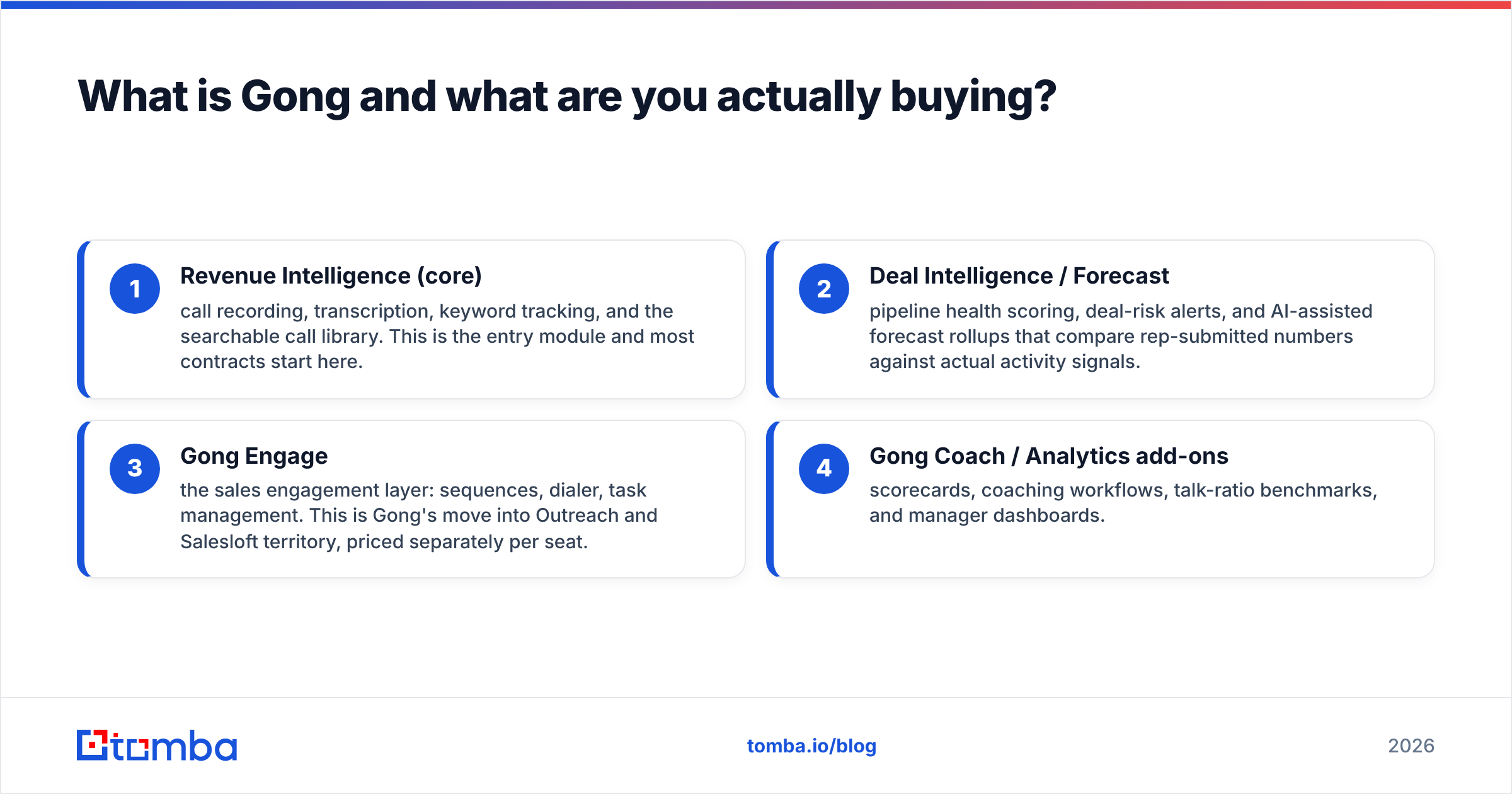
The platform breaks into four buckets. This matters for pricing, because Gong sells them as separate SKUs:
- Revenue Intelligence (core) — call recording, transcription, keyword tracking, and the searchable call library. This is the entry module, and most contracts start here.
- Deal Intelligence / Forecast — pipeline health scoring, deal-risk alerts, and AI forecast rollups. These compare rep-submitted numbers against real activity signals.
- Gong Engage — the sales engagement layer: sequences, dialer, task management. This is Gong's move into Outreach and Salesloft turf, priced per seat.
- Gong Coach / Analytics add-ons — scorecards, coaching workflows, talk-ratio benchmarks, and manager dashboards.
You will hear "Gong is expensive." The reason is usually simple. A buyer prices the core module. Then they learn the forecast and engagement modules they wanted are extra per-seat lines on the same order form.
How much does Gong cost in 2026?#
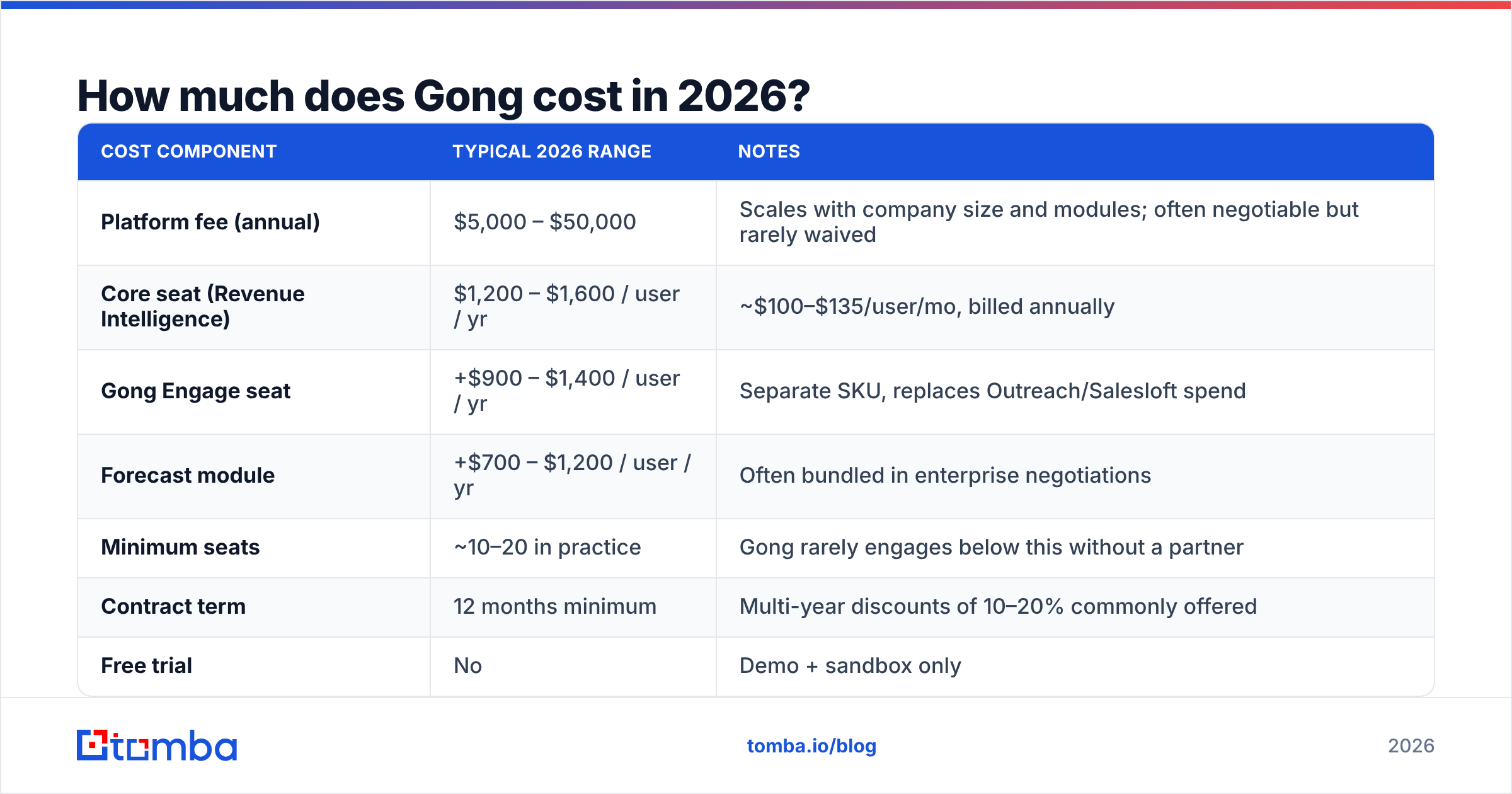
Gong's pricing has three parts, and none are public. Most gong pricing reviews pros and cons start right here, because the numbers are so hard to find. Based on buyer reports on G2, procurement marketplaces, and vendor comparison data, here is the real shape of a 2026 quote:
| Cost component | Typical 2026 range | Notes |
|---|---|---|
| Platform fee (annual) | $5,000 – $50,000 | Scales with company size and modules; often negotiable but rarely waived |
| Core seat (Revenue Intelligence) | $1,200 – $1,600 / user / yr | ~$100–$135/user/mo, billed annually |
| Gong Engage seat | +$900 – $1,400 / user / yr | Separate SKU, replaces Outreach/Salesloft spend |
| Forecast module | +$700 – $1,200 / user / yr | Often bundled in enterprise negotiations |
| Minimum seats | ~10–20 in practice | Gong rarely engages below this without a partner |
| Contract term | 12 months minimum | Multi-year discounts of 10–20% commonly offered |
| Free trial | No | Demo + sandbox only |
Run the math on a common shape. A 25-rep team on core plus forecast lands near $25,000 platform fee + 25 × $1,400 = $60,000/year, before Engage. A 10-rep team pays a platform fee too. So the per-rep cost is brutal at the low end. The same $15,000 base spread over 10 people is $1,500 per rep before a single seat.
That jump is the most important fact in any honest Gong pricing review. Gong is priced for teams that have already scaled.
What do Gong reviews actually praise?#
Strip the marketing away. Reviewers agree on a short list of real strengths.
- Transcription and search quality. Gong handles messy multi-speaker calls better than most rivals. Search "pricing objection" across 4,000 calls and you get useful results. That is the feature people renew for.
- Deal risk that managers trust. The signals are behavioral. No reply in 14 days, one contact only, no next step booked. That beats a rep's gut feel. Forecast accuracy gains of 10–20 points are common.
- Faster onboarding. New reps listen to a library of winning calls instead of shadowing for six weeks. Several reviews say ramp time was cut in half.
- Coaching that scales past a manager's memory. Talk ratios, longest monologue, question rate, and rival mentions all become measurable.
- Deep integrations. The Salesforce and HubSpot syncs are mature. Gong writes activity back cleanly instead of dumping noise into your CRM.
None of that is in dispute. Gong is a strong product. The question is whether it is a strong product for you at that price.
What are the real cons buyers report?#
The cons in gong pricing reviews pros and cons stay steady across sources. Almost none of them are about product quality.
Pricing opacity. Every quote is custom. Buyers report wide swings for teams of the same size. Your price partly reflects how hard you push. If you don't benchmark, you overpay.
The platform fee. This is the most-cited surprise. Teams budget for seats, then find a five-figure base line they never modeled.
Annual-only, hard renewals. There is no monthly option. Reviewers describe auto-renewal clauses with 30–60 day cancel windows. Mid-term seat cuts are limited. If you downsize, you often keep paying for empty seats until renewal.
Module sprawl. The thing you saw in the demo may span three SKUs. Ask in writing which module each demo feature lives in.
Low use at small scale. Gong needs call volume. A five-rep team doing eight calls a week makes a thin corpus, and the analytics get weak. Small-team reviews often describe paying enterprise money for a very expensive call recorder.
It creates zero pipeline. This is the built-in limit. Gong reviews calls that already happened. If your problem is "not enough qualified conversations," Gong measures the drought. It does not end it. That is a sales prospecting and data problem, and it needs its own budget line.
Is Gong worth it compared to the alternatives?#
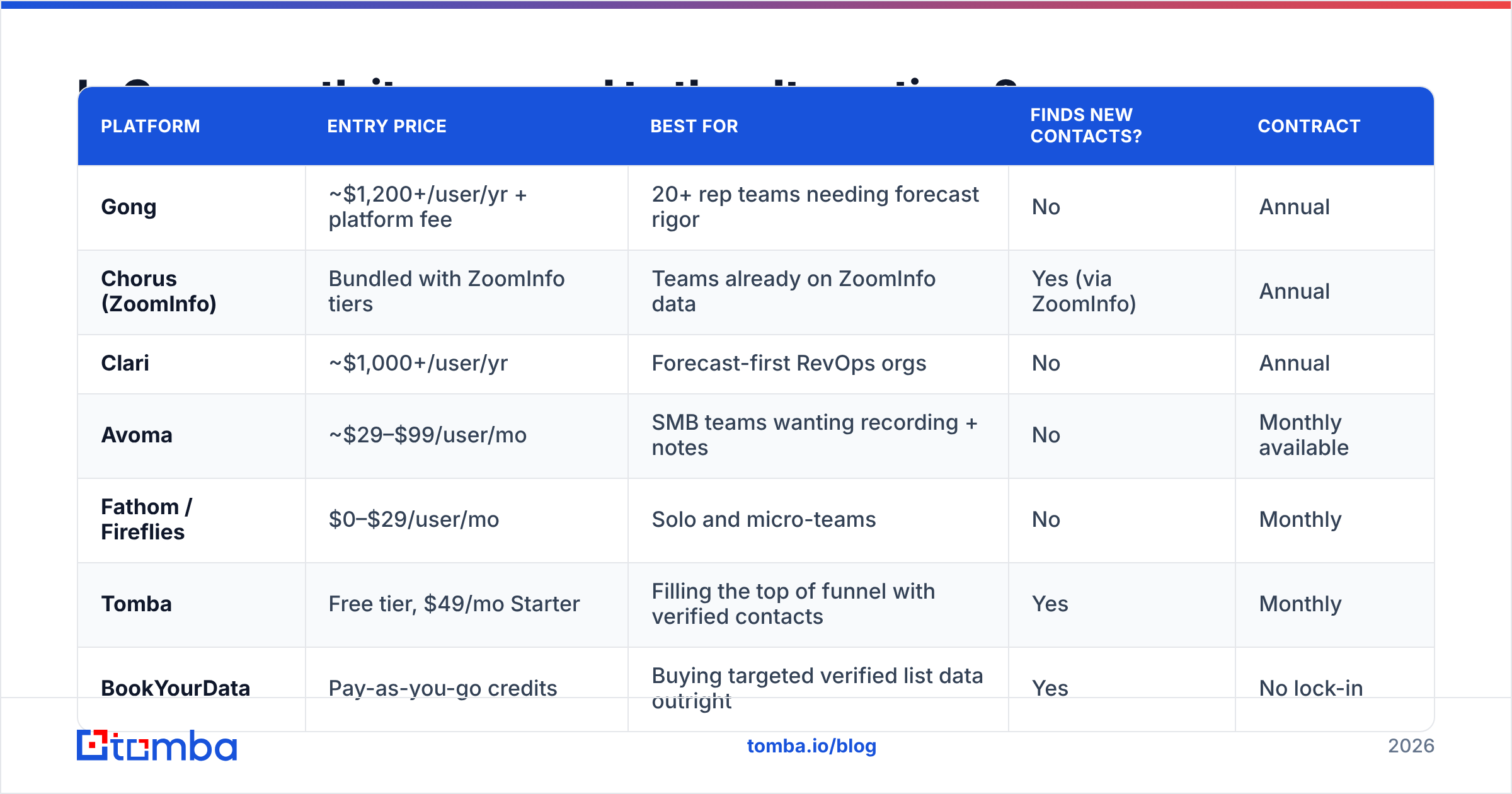
It depends on which problem you are funding. Here is how the category splits in 2026.
| Platform | Entry price | Best for | Finds new contacts? | Contract |
|---|---|---|---|---|
| Gong | ~$1,200+/user/yr + platform fee | 20+ rep teams needing forecast rigor | No | Annual |
| Chorus (ZoomInfo) | Bundled with ZoomInfo tiers | Teams already on ZoomInfo data | Yes (via ZoomInfo) | Annual |
| Clari | ~$1,000+/user/yr | Forecast-first RevOps orgs | No | Annual |
| Avoma | ~$29–$99/user/mo | SMB teams wanting recording + notes | No | Monthly available |
| Fathom / Fireflies | $0–$29/user/mo | Solo and micro-teams | No | Monthly |
| Tomba | Free tier, $49/mo Starter | Filling the top of funnel with verified contacts | Yes | Monthly |
| BookYourData | Pay-as-you-go credits | Buying targeted verified list data outright | Yes | No lock-in |
Two honest notes from that table.
First, if your bottleneck is forecast reliability at 20+ reps, Gong's closest rivals are Clari and Chorus. Gong usually wins on transcription and coaching depth. Paying for it makes sense.
Second, if your bottleneck is volume, the math flips. Not enough calls booked, not enough replies, not enough verified contacts. Then every dollar spent on call analysis measures a problem that lives upstream. Most gong pricing reviews pros and cons skip that point. A team in that spot gets more from a bulk email finder and a steady outbound routine than from a $45,000 analytics contract. Clean list data from a source like BookYourData costs a rounding error by comparison.

When does Gong pricing actually pencil out?#
Use these thresholds as a rough gate before you take the demo. They settle most gong pricing reviews pros and cons debates in one pass.
- 20+ quota-carrying reps. Below that, the platform fee dominates and the per-rep math falls apart.
- Deal sizes above $20,000 ACV. One saved deal should cover a real share of the yearly contract. At $3,000 ACV it never will.
- Sales cycles longer than 30 days. Deal-risk scoring needs a timeline with clear stages. One-call closes give you no signal worth studying.
- A manager who will run coaching. Gong's ROI comes from changed behavior. Reviews with poor outcomes almost always describe a team that installed it and never built a coaching habit.
- A full pipeline already. If reps have gaps in their calendar, fix supply before you buy measurement.
- Budget for the whole order form. Model platform fee + core + the one module you need, not the seat price alone.
Hit four or more and Gong is likely a good buy. Hit two or fewer and you are funding a status symbol.
How do you negotiate a better Gong price?#
Buyers who benchmark land lower numbers. Readers who work through gong pricing reviews pros and cons before the call tend to do better too. What works, per procurement reports:
- Time it to quarter end, especially Q4 and Q1. Gong's discounting flexibility is clearly seasonal.
- Ask for the platform fee to be spread out or cut, not the seat price. Sales reps protect per-seat rates because they set the renewal baseline. Base fees are softer.
- Get a competing quote from Clari or Chorus in writing. It changes the conversation right away.
- Trade term for price. A two-year commit typically buys 10–20%. Only do this if you are already past the thresholds above.
- Cap renewal uplift in the first contract. Uncapped renewals of 8–15% are a documented complaint. Negotiate a ceiling on day one, not at renewal.
- Buy seats for actual users only. Do not license managers or CS "for visibility" in year one. Add them once usage is proven.
For the broader category context on how revenue intelligence is judged, Gartner's revenue enablement research and the peer reviews on Capterra are worth an hour before you sign anything.
What should you buy instead if Gong is too expensive?#
Split the problem. Most teams reading gong pricing reviews pros and cons are mixing up two separate jobs.
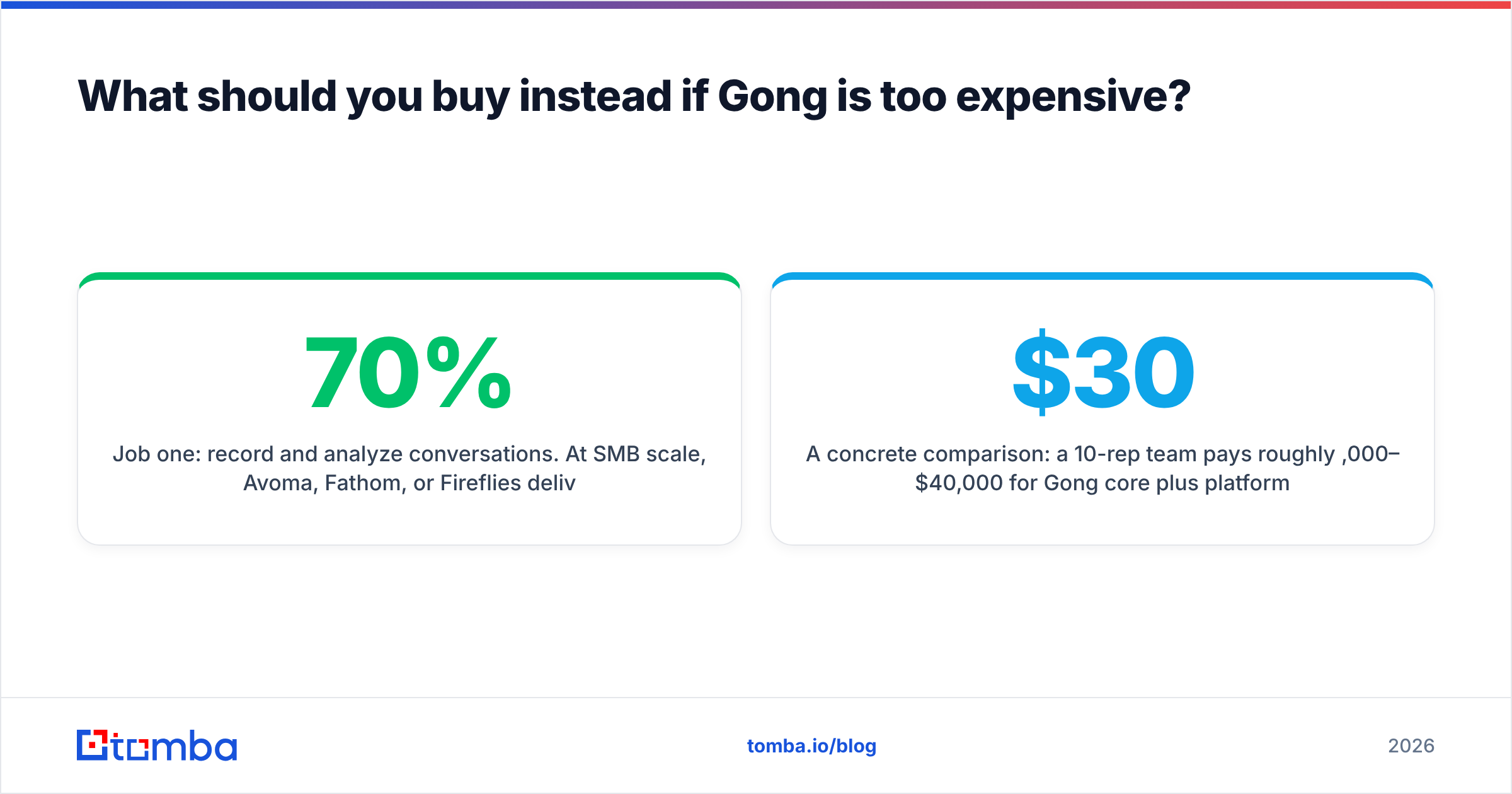
Job one: record and analyze calls. At SMB scale, Avoma, Fathom, or Fireflies give you 70% of the transcription and note-taking value for under $100 per user per month, with no platform fee. You lose deal-risk scoring and the coaching analytics. If you have six reps, you did not need them.
Job two: create the conversations in the first place. This is where the money usually belongs. Verified contact data, working phone numbers, and clean deliverability drive more revenue at small scale than analytics ever will. So put an email verifier in the workflow, so bounces don't wreck your domain. Add a phone finder for direct dials, plus enrichment so reps aren't researching accounts by hand.
Here is a concrete comparison. A 10-rep team pays roughly $30,000–$40,000 a year for Gong core plus platform fee. The same team can run Fathom at about $3,500 a year. That leaves $30,000 for data, sequencing, and one more SDR. For most teams under 15 reps, the second option makes more pipeline. Above 25 reps, the math flips. Measurement compounds, and Gong is the best measurement product in the category.
Gong pricing reviews pros and cons: the verdict#
Gong is an excellent product. Its pricing is built for companies that have already solved the demand problem. The pros are earned, not marketed: transcription quality, deal-risk accuracy, and coaching at scale. The cons are built in: opaque quotes, a harsh platform fee at low headcount, annual lock-in, and no help with pipeline creation. Talking harder will not fix them.
Buy it if you have 20+ reps, five-figure deals, and a manager who will run the coaching. Skip it if your calendars have gaps. No amount of call analysis will study calls that never got booked.
If your real problem is the top of the funnel, start there. The Tomba Email Finder gives you verified work email addresses by domain, name, or company. The free tier covers 25 searches a month, and paid plans start at $49/mo — see Tomba pricing for the full list. Fill the pipeline first. Then spend the Gong money once there are enough conversations worth analyzing.
Related guides#
Ready to find emails that actually work?
Join 150,000+ professionals who stopped guessing and started sending. Free credits on signup — no credit card required.
Get the Tomba newsletter
Practical outbound tactics and product updates — once every two weeks.
About the author