Gong vs Outreach (2026): Which Revenue Platform Wins?
Gong records what happened in your deals. Outreach controls what happens next. Here's an honest 2026 breakdown of pricing, overlap, and which one your team should buy first.
TL;DR
- Gong is a revenue intelligence platform. It records, transcribes, and analyzes calls and emails to tell you why deals are won or lost. It is a diagnostic layer, not an execution layer.
- Outreach is a sales engagement platform. It runs sequences, dials, task queues, and deal management. It is an execution layer that has added intelligence features on top.
- Both now overlap. Gong shipped Gong Engage (sequences, dialer); Outreach shipped Kaia and conversation intelligence. Neither clone is as strong as the original.
- Price is the real decision. Both are per-seat annual contracts, typically $1,200–$1,800+ per user per year before platform fees. For a 20-rep team you are looking at a five-figure commitment either way.
- Neither one finds contacts. Gong and Outreach both assume you already have verified emails and phone numbers. That gap is filled by a dedicated email finder at a fraction of the cost.
What are Gong and Outreach, actually?#
The short version: Gong tells you what happened, Outreach makes things happen.
Gong started as a conversation intelligence tool. It joins your Zoom, Teams, and Meet calls, records them, transcribes them, and runs analysis over the transcript — talk ratios, competitor mentions, next-step commitments, sentiment shifts. Over the last few years it expanded into forecasting and deal boards, and then into engagement with Gong Engage. The pitch to a VP of Sales is: "You are flying blind on 95% of your customer conversations. We give you the black box recorder."
Outreach started as a sales engagement platform. A rep loads a list of prospects, drops them into a multi-step sequence of emails, calls, and LinkedIn tasks, and Outreach handles the timing, the reminders, the reply detection, and the CRM sync. It later added Kaia (its conversation intelligence product), deal health scoring, and forecasting. The pitch is: "Your reps waste half their day on manual follow-up. We automate the motion."
The confusion in 2026 is that both companies now sell against each other on the other's home turf. Gong's engagement features are real but young. Outreach's conversation intelligence is real but thinner than Gong's. If you buy either expecting a perfect one-to-one replacement of the other, you will be disappointed.
How do Gong and Outreach compare feature by feature?#
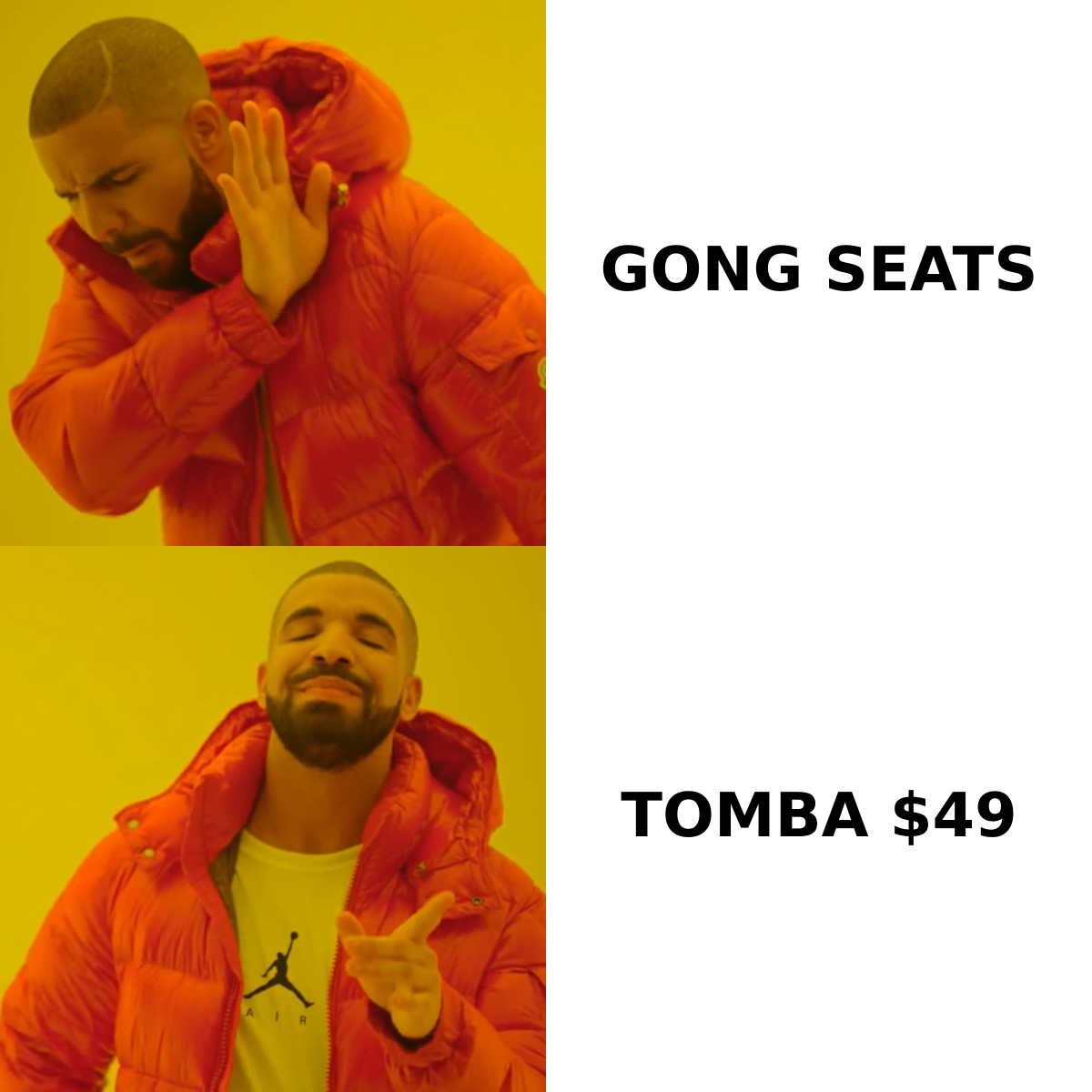
Here is the honest side-by-side. Pricing figures are typical published ranges and negotiated deals reported on G2 and by buyers; both vendors quote custom and neither publishes a public price list.
| Dimension | Gong | Outreach |
|---|---|---|
| Core category | Revenue intelligence / conversation analytics | Sales engagement / execution |
| Typical list price | ~$1,200–$1,600 per user/year + platform fee | ~$1,200–$1,800 per user/year + platform fee |
| Platform/base fee | Yes, commonly $5,000–$50,000/yr depending on size | Yes, varies by tier |
| Minimum seats | Commonly 10–20+ | Commonly 10+ |
| Free tier | No | No |
| Call recording + transcription | Best in class | Available via Kaia, solid but narrower |
| Sequences / cadences | Gong Engage — newer, improving | Best in class, the original strength |
| Dialer | Included in Engage | Mature, with local presence and voicemail drop |
| Deal boards / forecasting | Strong, widely praised | Strong, tied to Commit |
| Coaching workflows | Deep — scorecards, call libraries, trackers | Present, lighter |
| Email finding / enrichment | No | No |
| Email verification | No | No |
| Contract length | Annual standard | Annual standard |
| Best fit | Sales leaders who need visibility and coaching | SDR/AE teams who need volume and process |
Two things jump out of that table.
First, there is no free tier on either side. You cannot pilot Gong or Outreach with a credit card and a Tuesday afternoon. You will go through a demo, a security review, and an annual contract. Budget three to six weeks from first call to first login.
Second, neither platform sources contact data. They orchestrate outreach to contacts you already have. If your list is stale, both tools will faithfully automate the delivery of emails to addresses that bounce — and then report on how badly it went.
Which one should you buy first?#
Buy Outreach first if your problem is volume and consistency. Symptoms: reps forget follow-ups, sequences live in a spreadsheet, activity logging into your CRM is inconsistent, and nobody can tell you how many touches a prospect actually got. Outreach is the machine that enforces the motion. It pays for itself when you have SDRs running high-volume outbound and the bottleneck is throughput, not insight.
Buy Gong first if your problem is diagnosis. Symptoms: your win rate dropped and nobody can explain why, deal reviews are based on rep memory, onboarding new AEs takes six months, and your forecast is a guess dressed as a spreadsheet. Gong's call library alone changes ramp time — a new AE can listen to ten closed-won calls in their first week instead of shadowing for a quarter.
A rough rule that holds up in practice:
- Under 10 reps, mostly inbound — buy neither yet. Use your CRM's native sequences and a good data source. The seat math does not work.
- 10–30 reps, outbound-heavy — Outreach first. Execution discipline is the constraint.
- 10–30 reps, complex enterprise deals — Gong first. Deal visibility and coaching return more than automation at low volume.
- 30–100+ reps — most teams end up with both, or Gong plus a cheaper engagement tool.
- 100+ reps with a RevOps function — evaluate the full revenue operations stack, not just these two. Data quality becomes the dominant cost.
Is the overlap between Gong Engage and Outreach Kaia real?#
Yes, but asymmetrically.
Gong Engage gives you sequences, a dialer, and task flows inside the same interface where your call intelligence lives. That single-pane argument is genuinely compelling for a leader tired of stitching two contracts together. The honest caveat: Outreach has been iterating on sequence logic, deliverability controls, and admin permissions for far longer. If you run tightly-governed, multi-variant sequences across dozens of reps, you will find edges in Engage that Outreach polished years ago.
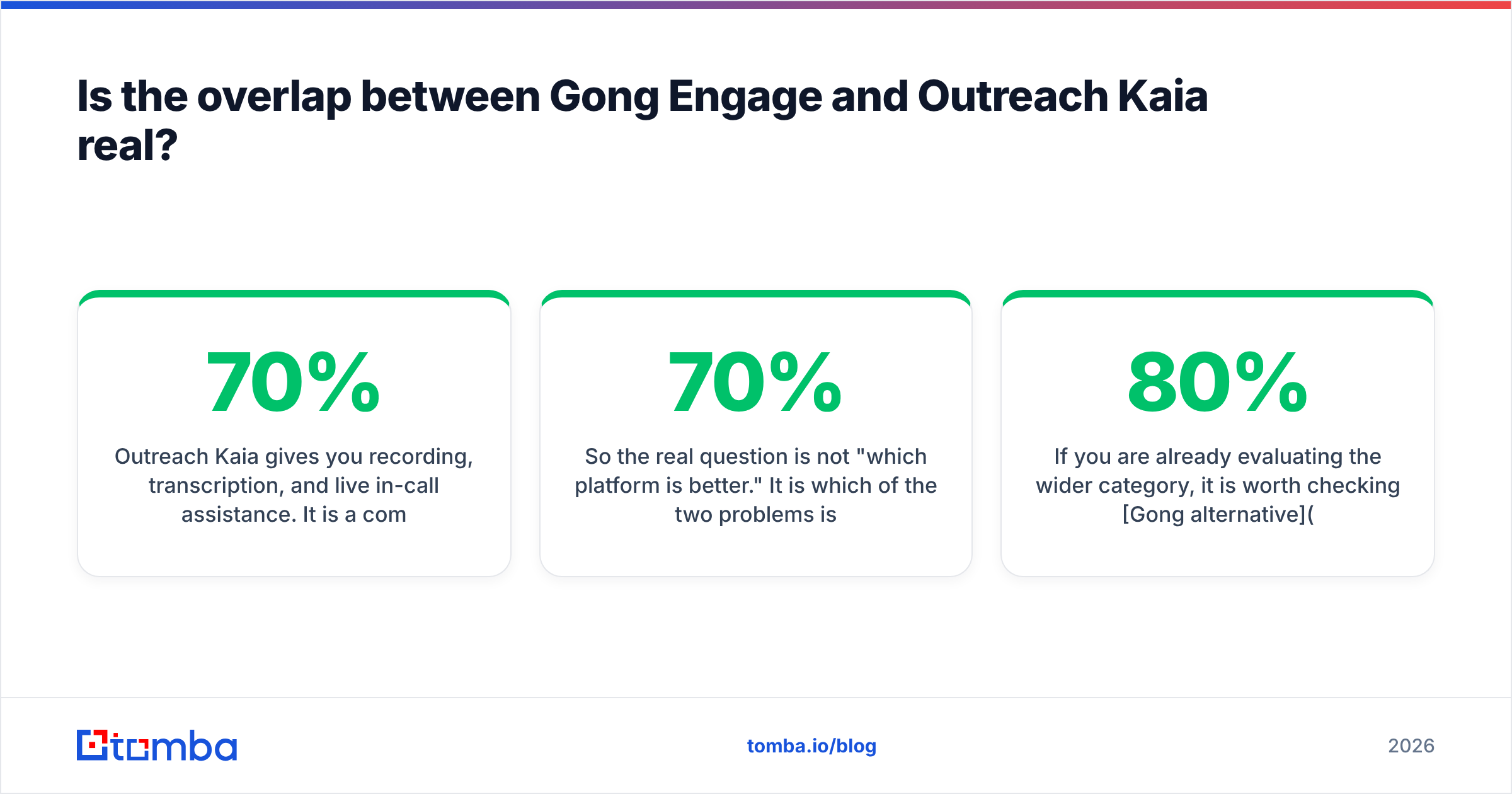
Outreach Kaia gives you recording, transcription, and live in-call assistance. It is a competent product. The honest caveat: Gong's analytics depth — trackers, deal warnings, market-level competitor intelligence — is the reason Gong exists. Kaia gets you 70% of the value for teams that mainly want recordings and searchable transcripts, which is genuinely enough for many.
So the real question is not "which platform is better." It is which of the two problems is more expensive for you right now, and whether the second product's 70% version is good enough to avoid a second contract.
If you are already evaluating the wider category, it is worth checking Gong alternative and Outreach alternative options before you sign — the mid-market has gotten crowded and several tools now cover the 80% case at a third of the price.
What do Gong and Outreach both leave out?#
Contact data. This is the gap nobody demos.
Both platforms start from the assumption that a prospect record already exists with a valid email address and a working phone number. In reality, that assumption breaks constantly:
- Job changes. Roughly a quarter of B2B contacts change roles annually. Your two-year-old list is meaningfully wrong.
- Catch-all domains. A large share of enterprise domains accept everything at the SMTP layer, so a naive "valid" check tells you nothing. You need a real catch-all verifier to separate deliverable from decoy.
- Bounce cascade. A 6% bounce rate does not just waste sends. It damages sender reputation, which then depresses inbox placement for the good addresses in the same sequence.
- Phone gaps. Outreach's dialer is excellent and useless without direct dials. Neither platform generates them.
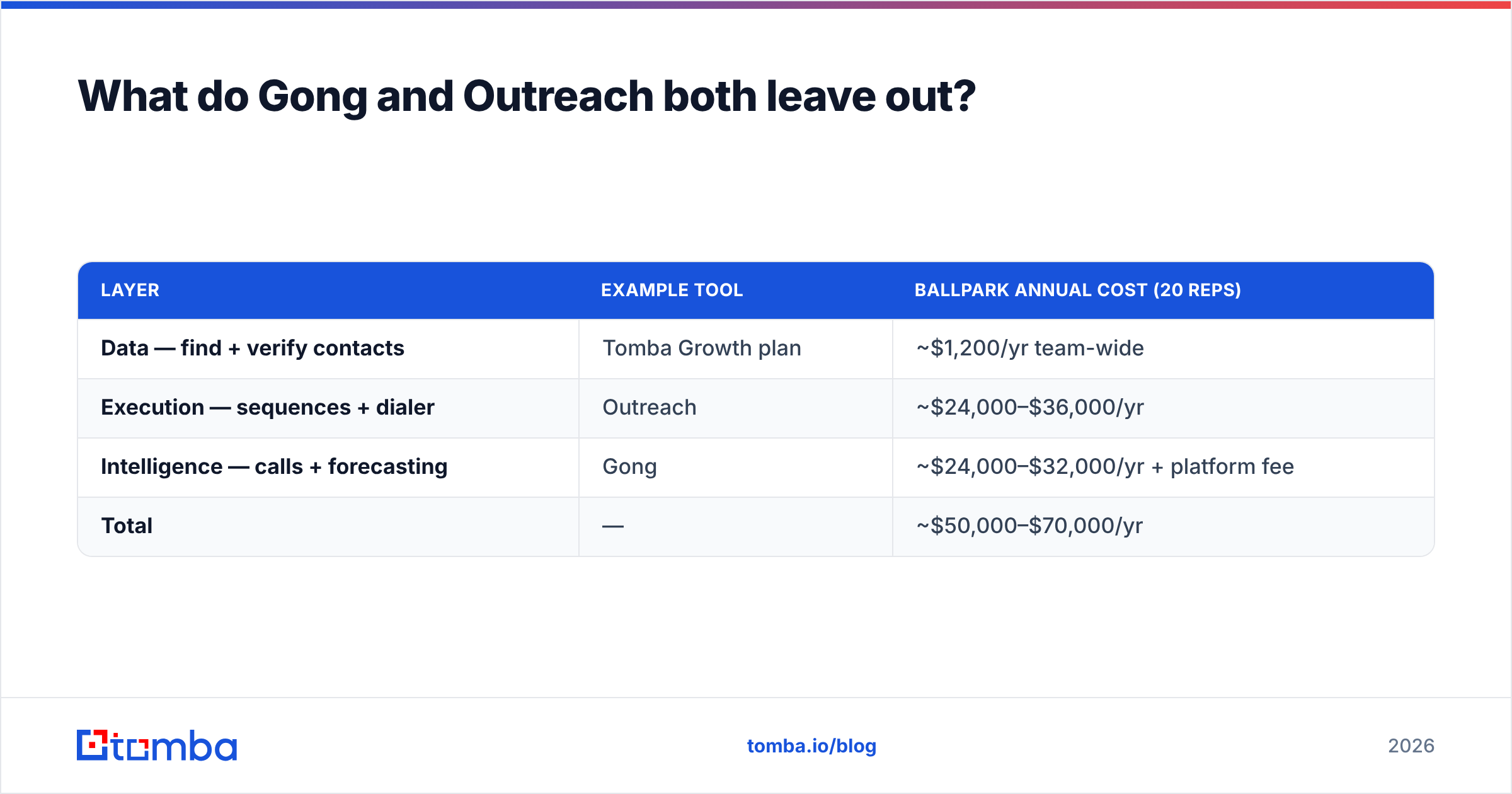
This is why the practical stack for most teams is three layers, not one: a data layer that finds and verifies contacts, an execution layer (Outreach or Gong Engage) that runs the motion, and an intelligence layer (Gong or Kaia) that tells you what worked.
Here is what that three-layer stack costs in rough terms for a 20-rep team:
| Layer | Example tool | Ballpark annual cost (20 reps) |
|---|---|---|
| Data — find + verify contacts | Tomba Growth plan | ~$1,200/yr team-wide |
| Execution — sequences + dialer | Outreach | ~$24,000–$36,000/yr |
| Intelligence — calls + forecasting | Gong | ~$24,000–$32,000/yr + platform fee |
| Total | — | ~$50,000–$70,000/yr |
The data layer is the cheapest line item and the one that determines whether the other two produce anything. Skipping it to save $1,200 while spending $60,000 on delivery infrastructure is the most common budgeting mistake in this category.
How do you evaluate either one without wasting a quarter?#
Run a structured evaluation instead of a vibes-based demo. Five steps:
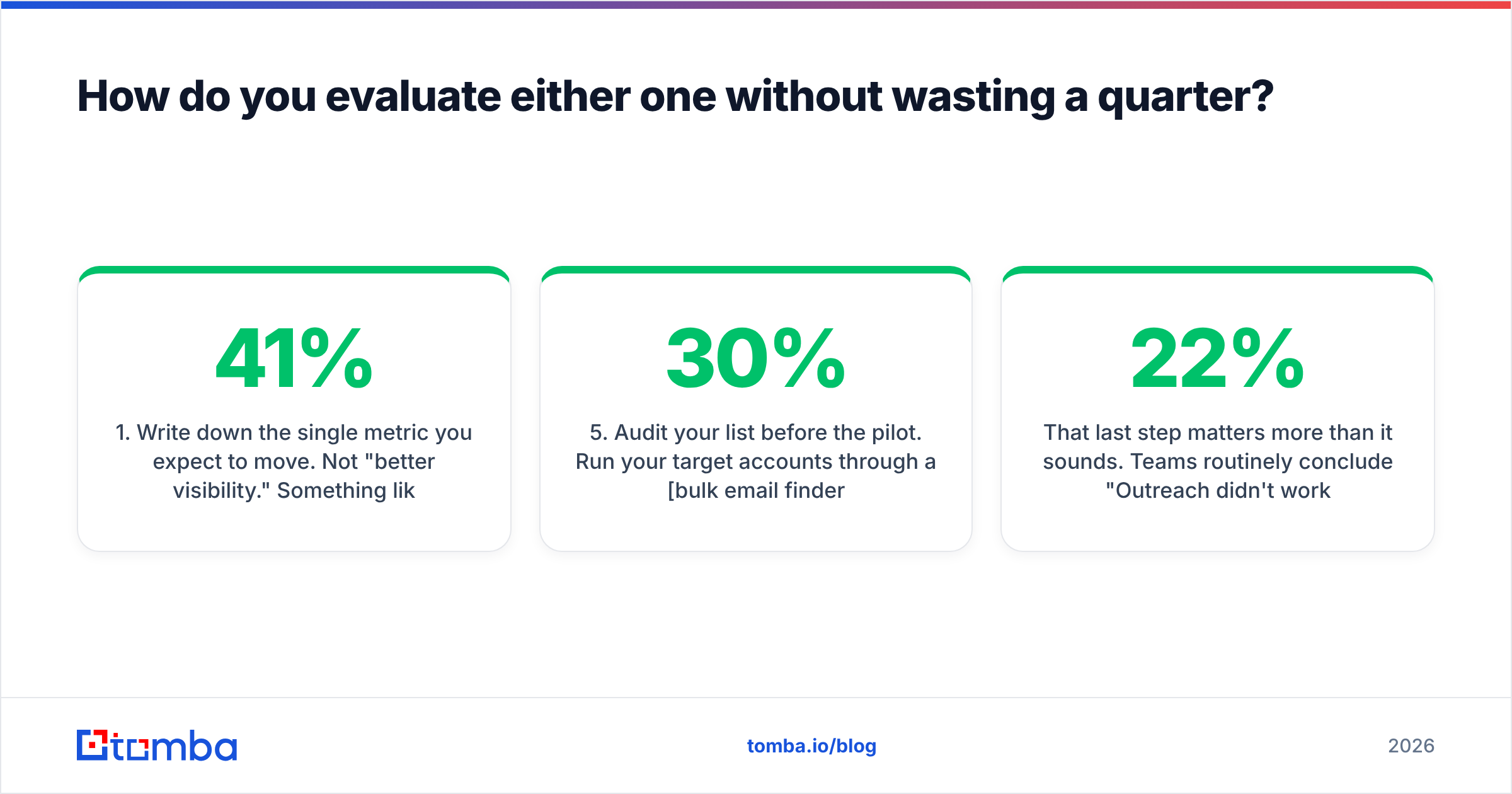
- Write down the single metric you expect to move. Not "better visibility." Something like "reduce AE ramp from 5 months to 3" or "increase sequence completion rate from 41% to 70%." If you cannot name it, you are not ready to buy.
- Demand a sandbox with your own data. Both vendors will resist. Push. A demo on their curated dataset tells you nothing about how your messy CRM will behave.
- Test the integration path first, not last. Ask specifically how the tool writes back to your CRM, what happens on field conflicts, and who owns deduplication. This is where implementations die.
- Price the second year. First-year discounts are common; renewal uplift is where the real cost sits. Ask for renewal caps in writing.
- Audit your list before the pilot. Run your target accounts through a bulk email finder and an email verifier first. If 30% of your list is dead, the pilot results will measure your data quality, not the platform.
That last step matters more than it sounds. Teams routinely conclude "Outreach didn't work for us" when what actually happened is that their sequences went to a list with a 22% bounce rate and got throttled by email deliverability filters in week two.
What about teams that can't justify either price tag?#
If you are under ten reps or pre-Series A, the honest recommendation is to skip both for now.
Your CRM — HubSpot Sales Hub or Pipedrive — includes sequences that cover the basic engagement motion. HubSpot's own sequence tooling handles multi-step email follow-up and task reminders without a separate five-figure contract. For call recording, a cheaper standalone recorder plus manual review will get you further than you expect at low call volume.
What you should not skip at that stage is contact data quality, because that is where small teams lose the most time. Manually guessing email formats, LinkedIn-scraping one profile at a time, and eating bounces costs more rep hours than any sequencing tool saves. A domain search that returns every verified address at a target company in one call replaces an afternoon of manual work.
Then, when your team crosses 15–20 reps and process breakdown becomes the constraint, revisit Gong and Outreach with a real budget and a real metric.
Verdict: Gong vs Outreach in 2026#
There is no universal winner, and any article that declares one is selling something.
- Choose Gong if your bottleneck is knowing what is happening in your pipeline — coaching, ramp time, forecast accuracy, deal risk. Its analytics remain the category benchmark, and Engage is now credible enough that some teams run it as their only platform.
- Choose Outreach if your bottleneck is doing the work consistently — sequence volume, dialing, task discipline, activity capture. Its execution engine is more mature, and Kaia covers the recording basics well enough for many teams.
- Choose both only when you have crossed roughly 40–50 reps and the cost of a missed insight exceeds the cost of a second contract.
- Choose neither yet if you are under ten reps. Fix your data and use native CRM sequencing until process is genuinely your constraint.
And regardless of which side you land on, remember what neither platform does: it does not find the person, confirm the address, or tell you the email will actually land. That work happens before the sequence starts.
Before you sign a five-figure contract for a delivery engine, make sure there's something worth delivering. Tomba Email Finder finds and verifies professional email addresses by name, domain, or company — so the sequences you build in Outreach and the calls you analyze in Gong start with contacts that actually exist. Start free with 25 searches a month, or move to the Starter plan at $49/mo when you're ready to scale; see full Tomba pricing for team and API volumes.
Related guides#
Ready to find emails that actually work?
Join 150,000+ professionals who stopped guessing and started sending. Free credits on signup — no credit card required.
Get the Tomba newsletter
Practical outbound tactics and product updates — once every two weeks.
About the author