Gong vs Salesloft (2026): Which Revenue Platform Wins?
Gong records and analyzes what happened. Salesloft runs what happens next. Here is an honest breakdown of pricing, features, and which one your team should actually buy in 2026.
TL;DR
- Gong is a revenue intelligence tool. It records calls, writes them up, and shows why deals stall. It does not send your sequences.
- Salesloft is a sales engagement tool. It sends the emails, queues the dials, and keeps reps on cadence. Its call analysis is decent, but thinner than Gong's.
- Rough 2026 pricing: both quote by the year, and both set seat minimums. Expect $1,200–$1,600 per seat/year for Gong, plus a platform fee. Expect $1,000–$2,000 per seat/year for Salesloft.
- In the Gong vs Salesloft choice, start with your problem. Don't know why you lose? Buy Gong. Reps don't follow up? Buy Salesloft.
- Neither tool finds you contacts. Both assume you have good emails and phone numbers. That is where an email finder sits, upstream of either buy.
What is the actual difference between Gong and Salesloft?#
They solve opposite halves of one problem.
Think of a restaurant. Salesloft is the kitchen workflow. It handles the tickets, the order of work, and who cooks what. Gong is the food critic. It tastes every dish and tells you the sauce is too salty on Thursdays. You can run a kitchen with no critic. You cannot run a critic with no kitchen.
Here is the plain version. Salesloft is the doing layer. It owns the cadence engine, the dialer, the email sending, and the rep's task list. Gong is the thinking layer. It takes in calls, emails, and CRM activity. Then it scores deal risk, flags coaching moments, and adjusts the forecast.
The Gong vs Salesloft confusion has a cause. Both firms moved into each other's turf after 2022. Gong shipped Gong Engage, its own sequencing product. Salesloft shipped Conversations, its own call recording tool. Neither one has caught the other's core.
Here is how the overlap breaks down.
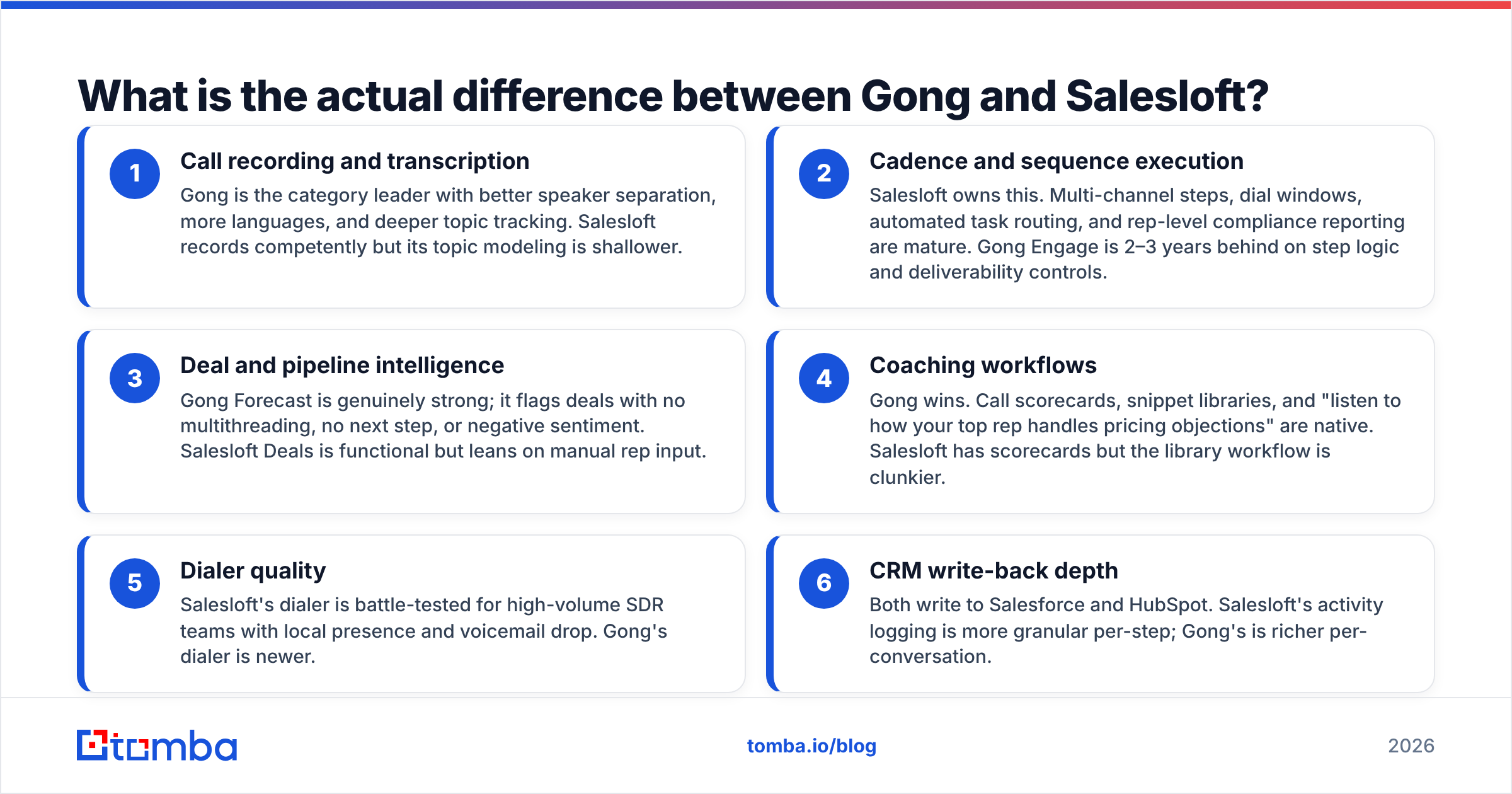
Call recording — Gong leads. It splits speakers better, covers more languages, and tracks topics deeper. Salesloft records well, but reads topics at a shallower level.
Cadence and sequences — Salesloft owns this. Multi-channel steps, dial windows, task routing, and rep compliance reports are all mature. Gong Engage trails by two or three years.
Deal and pipeline signals — Gong Forecast is strong. It flags deals with one contact, no next step, or a sour tone. Salesloft Deals works, but leans on what reps type in.
Coaching — Gong wins. Call scorecards and snippet libraries are built in. So is "listen to how your top rep handles pricing pushback." Salesloft has scorecards, but the library is clunkier.
Dialer — Salesloft's dialer is proven for high-volume SDR teams. It has local presence and voicemail drop. Gong's dialer is newer.
CRM write-back — Both write to Salesforce and HubSpot. Salesloft logs each step in more detail. Gong logs each conversation in more depth.
How do Gong and Salesloft compare on price in 2026?#
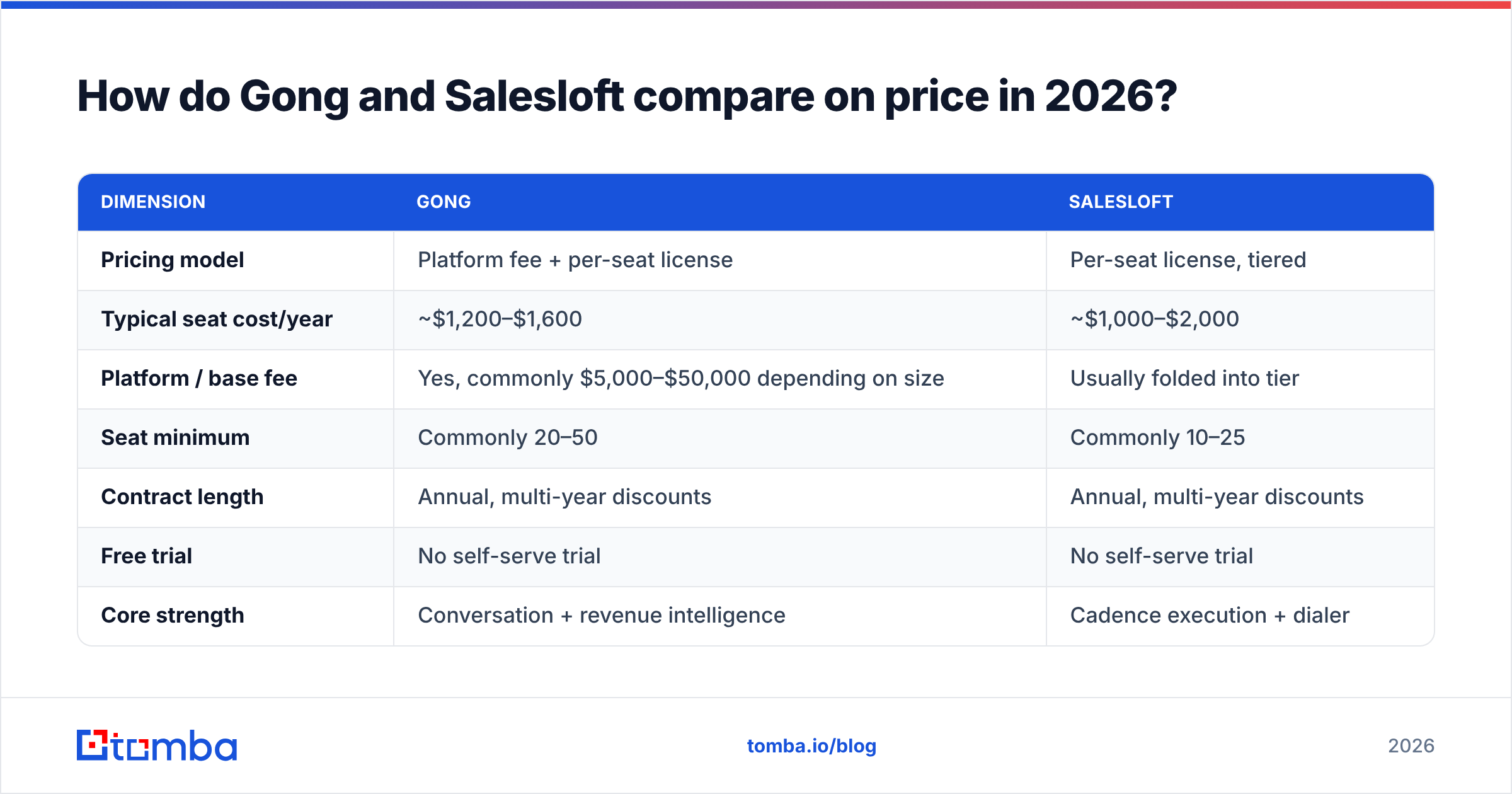
Gong vs Salesloft pricing looks close per seat. The fine print is where they split.
Neither one posts a price list. That is a signal on its own. Both sell through reps, on annual contracts.
The numbers below come from buyer reports on G2 and Capterra, plus the quote shapes buyers share.
| Dimension | Gong | Salesloft |
|---|---|---|
| Pricing model | Platform fee + per-seat license | Per-seat license, tiered |
| Typical seat cost/year | ~$1,200–$1,600 | ~$1,000–$2,000 |
| Platform / base fee | Yes, commonly $5,000–$50,000 depending on size | Usually folded into tier |
| Seat minimum | Commonly 20–50 | Commonly 10–25 |
| Contract length | Annual, multi-year discounts | Annual, multi-year discounts |
| Free trial | No self-serve trial | No self-serve trial |
| Core strength | Conversation + revenue intelligence | Cadence execution + dialer |
| Weakest area | Sequencing depth | Conversation analysis depth |
| Best fit team size | 20+ reps with real call volume | 10+ reps doing outbound volume |
| Time to value | 4–8 weeks (needs call history) | 2–4 weeks |
Two cost traps are worth naming before you sign.
Gong's platform fee is not optional. It also does not shrink in a straight line. A 25-seat team and a 60-seat team can pay a similar base. That makes Gong pricey per rep for small teams. At 20 seats, the real cost can pass $2,000 per rep per year.
Salesloft tiers hide features you assumed were included. Conversations, Deals, and deeper analytics sit on higher tiers. Teams budget for the entry tier. Then they learn that call recording is an upgrade. Spend ends up 40–60% over plan.
Which one is better for an SDR team?#
Salesloft, in most cases. It is not close.
An SDR team lives on throughput. How many good touches per rep per day, on time, by email and phone? That is a workflow problem. Salesloft's cadence engine, dialer, and task queue were built for it. Gong Engage can run sequences. But SDR leaders say it lacks the step-level control and dial windows they rely on.
One caveat. Maybe your reps dial plenty and the calls go nowhere. Then the problem is quality, not volume. Gong's call coaching will move the number faster than a better dialer.
Many teams land on a split:
- SDR/BDR org → Salesloft for execution
- AE org → Gong for deal signals and coaching
- RevOps → both feeding one CRM, deduped
That split costs real money. Budget for it. First, be honest about your win rate problem. Is it a volume problem at the top, or a conversation problem in the middle?
Which one is better for account executives and deal management?#
Gong. Forecast and deal risk are the best reasons to buy it.
Gong reads every call, email, and meeting tied to a deal. Then it flags the patterns that predict slippage. One contact only. No next step booked. A champion who stopped writing back. Pricing raised too late.
Picture a VP of Sales in a Monday pipeline review. The old ritual was asking each AE, "how confident are you?" The answer came back shaped by hope. Gong replaces hope with evidence.
Salesloft Deals covers the same ground with a weaker signal. It shows stalled deals and missing next steps. But it captures less call data, so it learns less.
Say your team misses the number and cannot explain why until the quarter closes. Then Gong is the easier buy to defend.
Do you actually need either one?#
Honest answer: probably not yet, if you are under about 10 reps.
The Gong vs Salesloft debate assumes you are ready for either. Both tools sit on top of a working revenue operations motion. They boost a process. They do not create one. Buy Gong with no sales method, and you get a costly archive of calls nobody plays. Buy Salesloft with no clear ICP, and you send more email to the wrong people, faster.
The stack you need first, roughly in order:
- A clear ICP and a list that matches it. No cadence tool fixes a bad list.
- Accurate contact data. Verified emails and direct dials. Bounce rates above 5% hurt your sender reputation, no matter who sends the mail.
- A CRM that matches reality. Both tools write into it. Garbage in, costly garbage out.
- A repeatable outbound motion. At least a rough sequence that has booked meetings by hand.
- Then engagement tooling (Salesloft), once volume outgrows manual sending.
- Then conversation intelligence (Gong), once patterns are real. Call it 200+ recorded calls per quarter.
What do Gong and Salesloft not do?#
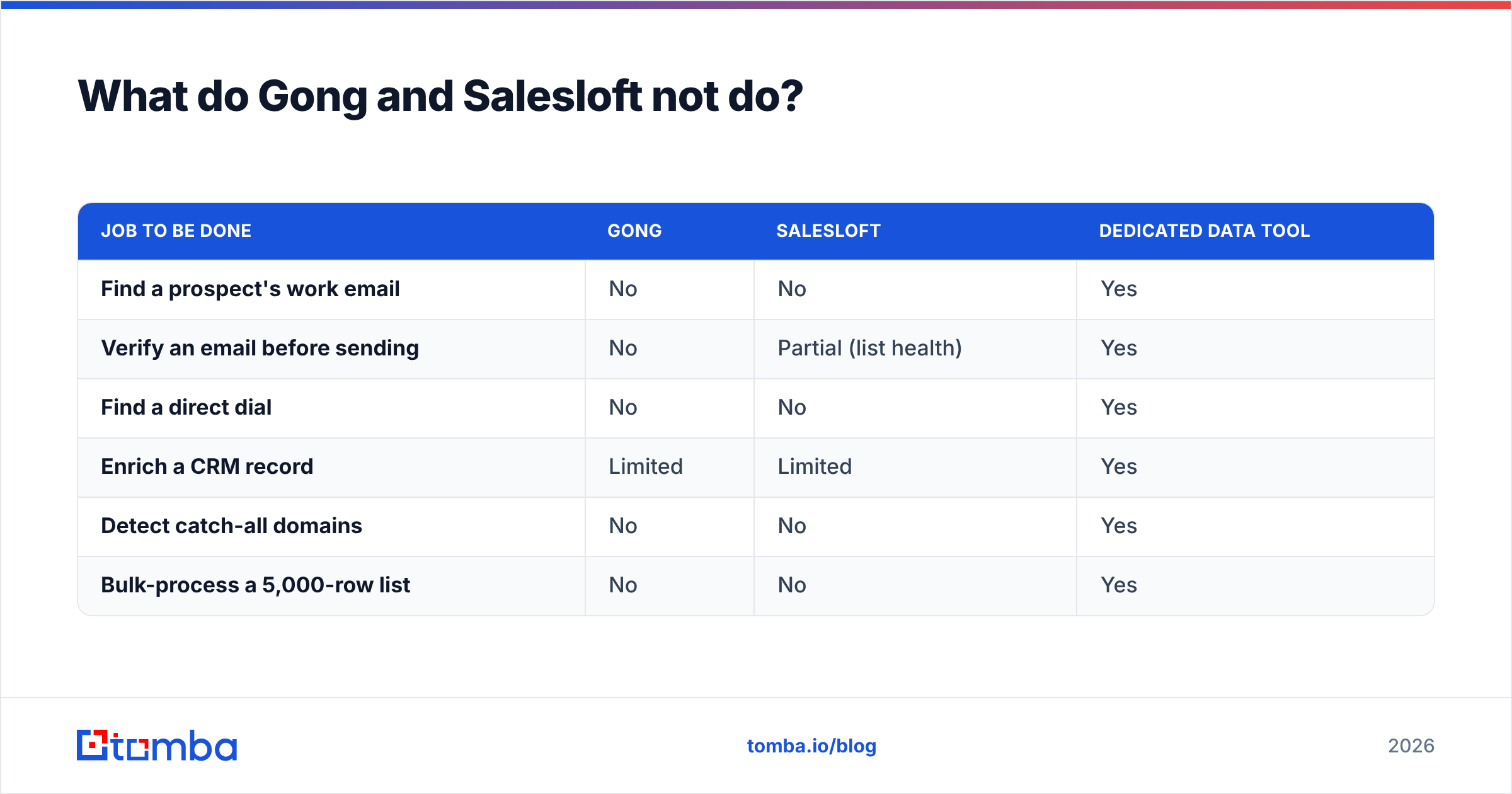
Neither one finds you a single contact.
This is the most common budget mistake here. A team puts $60,000 into Salesloft and plugs it in. Then it learns the tool is a fast way to email addresses it does not have. Finding and checking contacts happens upstream.
| Job to be done | Gong | Salesloft | Dedicated data tool |
|---|---|---|---|
| Find a prospect's work email | No | No | Yes |
| Verify an email before sending | No | Partial (list health) | Yes |
| Find a direct dial | No | No | Yes |
| Enrich a CRM record | Limited | Limited | Yes |
| Detect catch-all domains | No | No | Yes |
| Bulk-process a 5,000-row list | No | No | Yes |
This is where a data layer earns its keep. Tomba's email verifier and catch-all verifier keep bounce rates low before a sequence fires. Domain search builds the contact map at the account level.
The Starter plan is $49 a month. Either platform runs $1,200+ per seat per year. So the data layer is the cheapest line in the stack. It is also the line that decides whether the pricey tools work.
BookYourData is a solid option here too, if you prefer to buy ready-made lists. The two paths suit different buying styles.
Gong vs Salesloft: which should you buy?#
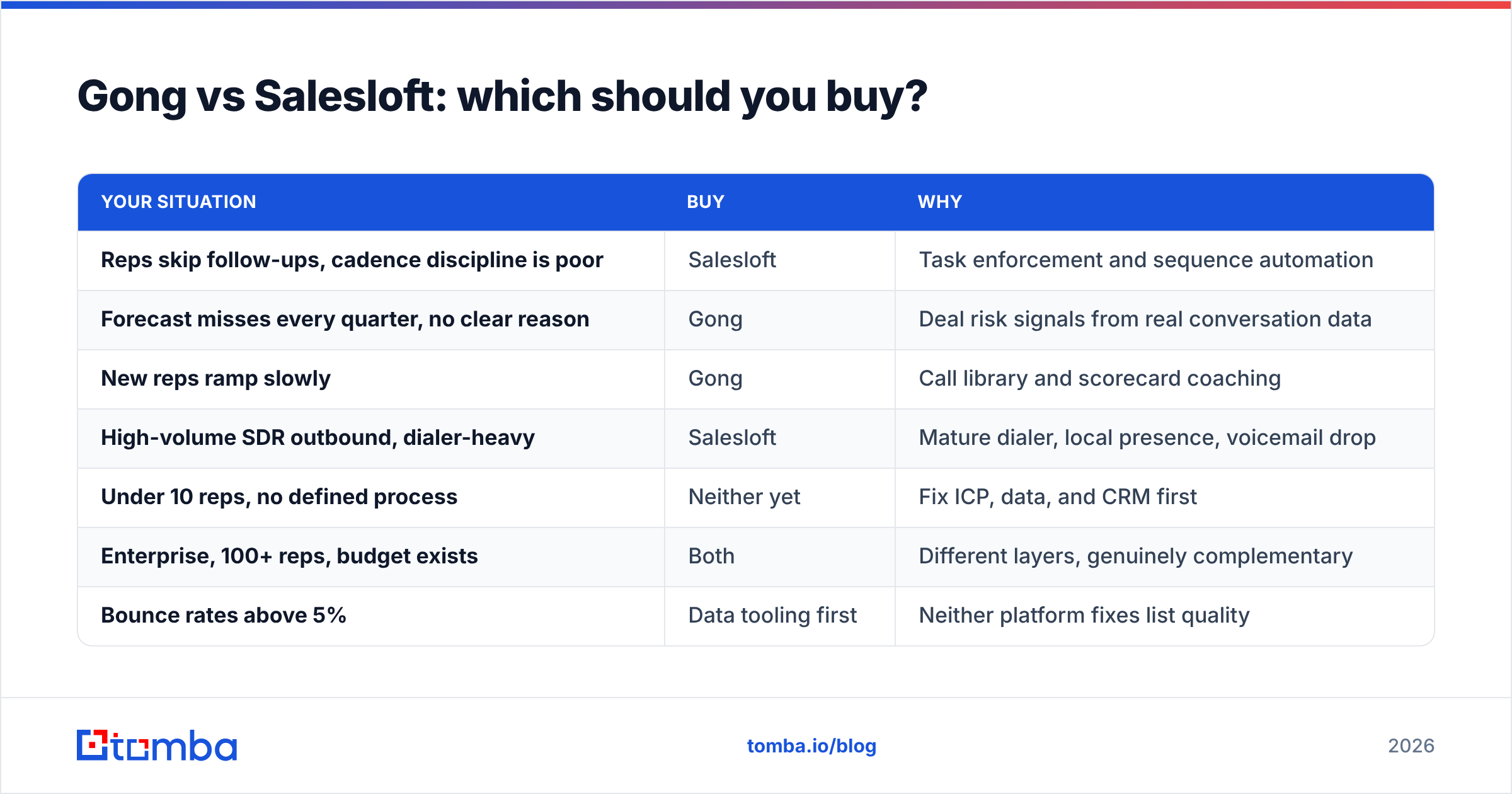
Match the tool to the failure you actually have.
| Your situation | Buy | Why |
|---|---|---|
| Reps skip follow-ups, cadence discipline is poor | Salesloft | Task enforcement and sequence automation |
| Forecast misses every quarter, no clear reason | Gong | Deal risk signals from real conversation data |
| New reps ramp slowly | Gong | Call library and scorecard coaching |
| High-volume SDR outbound, dialer-heavy | Salesloft | Mature dialer, local presence, voicemail drop |
| Under 10 reps, no defined process | Neither yet | Fix ICP, data, and CRM first |
| Enterprise, 100+ reps, budget exists | Both | Different layers, genuinely complementary |
| Bounce rates above 5% | Data tooling first | Neither platform fixes list quality |
| Need direct dials for cold calling | Data tooling first | Neither platform sources phone numbers |
One framing helps in procurement. Salesloft is a cost of doing outbound at scale. Gong is an investment in better conversion. Cannot do outbound at scale yet? Then the second buy is early. Already at scale and still missing the number? Then the second buy is where the leverage sits.
Check two more things before you commit. Both vendors give real multi-year discounts. Both will bend on seat minimums in Q4. Ask for the platform fee to be cut or waived. For Gong, under 50 seats, it is the most flexible line on the quote.
Where does contact data fit into all of this?#
Underneath everything.
Every dollar you spend on Gong or Salesloft rides on the quality of the records inside it. Send a cadence to a 30%-invalid list, and you burn your domain and record voicemails. Point conversation intelligence at the wrong accounts, and you get confident reads on deals that do not matter.
So get the data layer right first. Use the Tomba Email Finder to source verified work emails by domain, name, or company. The free tier gives 25 searches a month. Test it against a list you already trust. Starter is $49 a month once you want volume. See the full Tomba pricing if you need bulk or API access.
Then let Salesloft send it, and let Gong tell you what happened. That is the real answer to Gong vs Salesloft: they are layers, not rivals.
Related guides#
Ready to find emails that actually work?
Join 150,000+ professionals who stopped guessing and started sending. Free credits on signup — no credit card required.
Get the Tomba newsletter
Practical outbound tactics and product updates — once every two weeks.
About the author