8 Best GPTBots.ai Alternatives in 2026 (Compared & Priced)
GPTBots.ai is a capable enterprise agent builder, but it is not the only one and rarely the cheapest. Here are eight alternatives compared on pricing, build model, and the data quality that decides whether your agent actually closes anything.
TL;DR
- GPTBots.ai is a no-code enterprise agent platform: RAG on your knowledge base, multi-channel deployment, and a decent integration layer. It is strongest when you have an ops team and a support queue to automate.
- Most teams shopping for GPTBots.ai alternatives want one of three things: lower entry price, developer control over the agent logic, or outbound/sales use cases rather than inbound support deflection.
- Best cheap starting point: Chatbase. Best developer control: Botpress. Best conversation design: Voiceflow. Best support deflection at scale: Intercom Fin. Best internal workflow agents: Relevance AI or Stack AI.
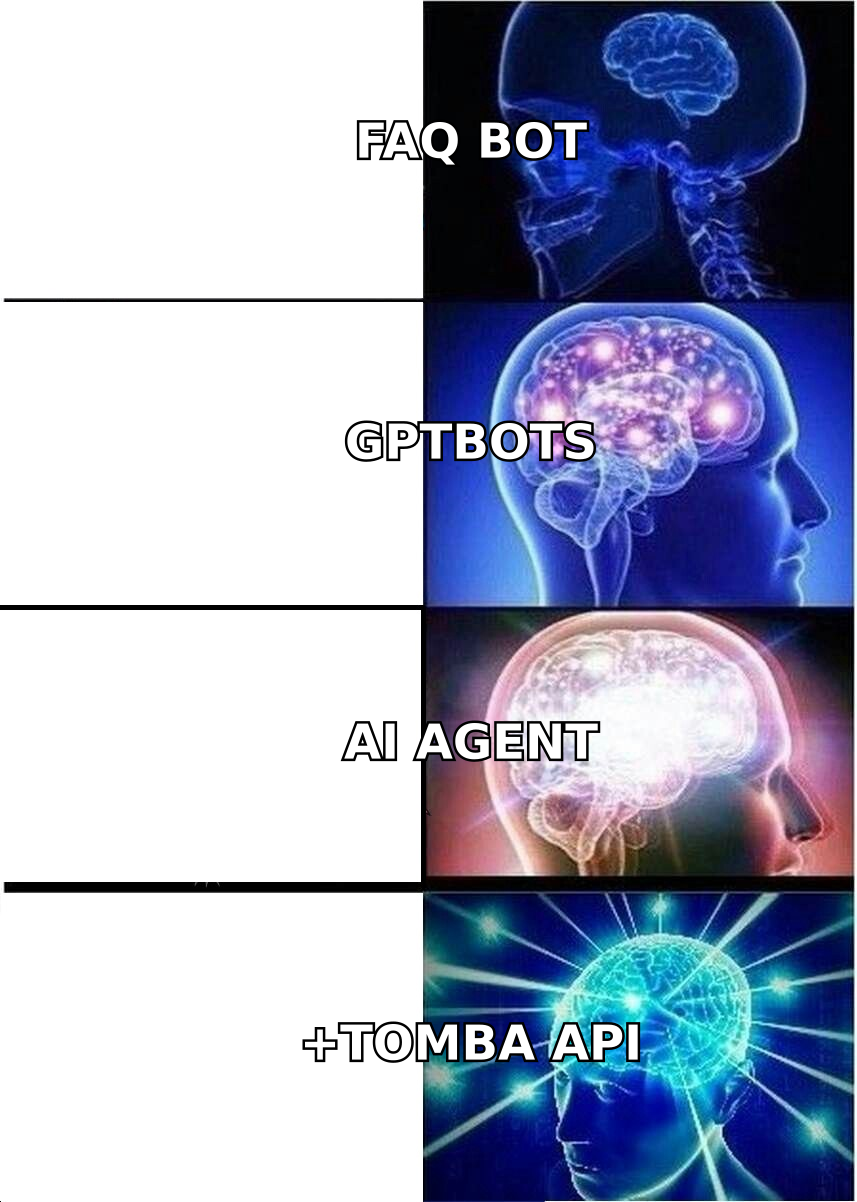
- Almost every comparison ignores the part that decides ROI: the contact data your agent writes into the CRM. A chat agent that captures "john@gmial.com" is worse than no agent.
- Pair whichever platform you pick with a verification and enrichment layer. Tomba's email verifier and data enrichment run over the API so bad records never reach your pipeline.
What is GPTBots.ai and what does it actually do well?#
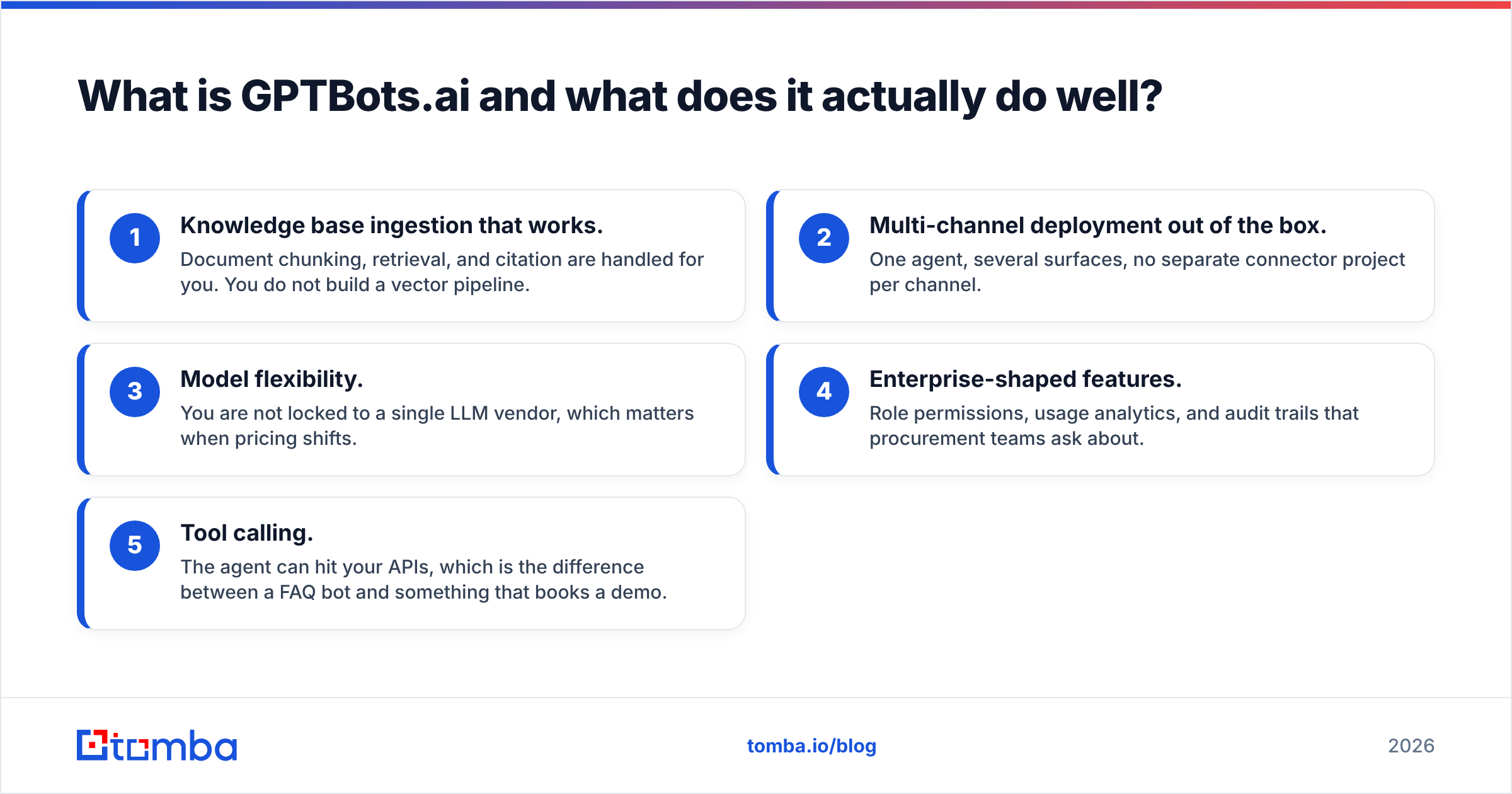
GPTBots.ai (gptbots.ai) is a no-code platform for building LLM-powered agents on top of your own data. You upload documents, connect data sources, define tools the agent can call, and deploy the result to a website widget, WhatsApp, Slack, Discord, or an API endpoint.
Its real strengths are unglamorous ones:
- Knowledge base ingestion that works. Document chunking, retrieval, and citation are handled for you. You do not build a vector pipeline.
- Multi-channel deployment out of the box. One agent, several surfaces, no separate connector project per channel.
- Model flexibility. You are not locked to a single LLM vendor, which matters when pricing shifts.
- Enterprise-shaped features. Role permissions, usage analytics, and audit trails that procurement teams ask about.
- Tool calling. The agent can hit your APIs, which is the difference between a FAQ bot and something that books a demo.
That is a legitimate product. The reason people search for alternatives is not that GPTBots is broken — it is that the platform is aimed at a specific buyer, and plenty of teams are not that buyer.
Why do teams look for GPTBots.ai alternatives?#
Five patterns come up repeatedly in review threads on G2 and in buyer conversations:
- Pricing opacity at the top end. Entry tiers are approachable; the enterprise conversation is a sales call. Teams that want a published number go elsewhere.
- Credit-based consumption math. Token or credit models make forecasting hard when volume is spiky. Per-resolution and per-seat models are easier to budget.
- Limited conversation design tooling. If your use case is a branching, stateful flow (qualification, onboarding, appointment setting), a visual flow builder beats a prompt box.
- You want code, not a canvas. Engineering teams frequently prefer an SDK-first platform they can version-control and test in CI.
- Wrong job entirely. A lot of buyers arrive looking for support deflection or an outbound sales agent, and those are different products.
That last one matters. Before you compare vendors, decide which of the three jobs you are hiring for: inbound deflection, conversation design, or internal/outbound workflow automation. The best tool changes completely depending on the answer.
How should you compare AI agent platforms?#
Score candidates on these six dimensions rather than on feature-count marketing pages:
- Pricing model, not price. Per-seat, per-resolution, per-credit, and per-message models produce wildly different bills at the same volume. Model your actual traffic in a spreadsheet before you sign.
- Build surface. Prompt-and-knowledge-base (fast, shallow), visual flow builder (medium, controllable), or SDK/code (slow, unlimited). Pick the one that matches your team.
- Data-in quality. What does the agent know about the person it is talking to? Anonymous chat is worth a fraction of an enriched, identified conversation.
- Data-out quality. Where do captured leads land, in what shape, and are they validated before they hit your CRM?
- Channel coverage. Web widget only, or WhatsApp, Slack, voice, and email too?
- Escape hatches. API, webhooks, export, and self-hosting. Assume you will migrate in 24 months and check the exit before you enter.
Which GPTBots.ai alternatives are worth shortlisting in 2026?#
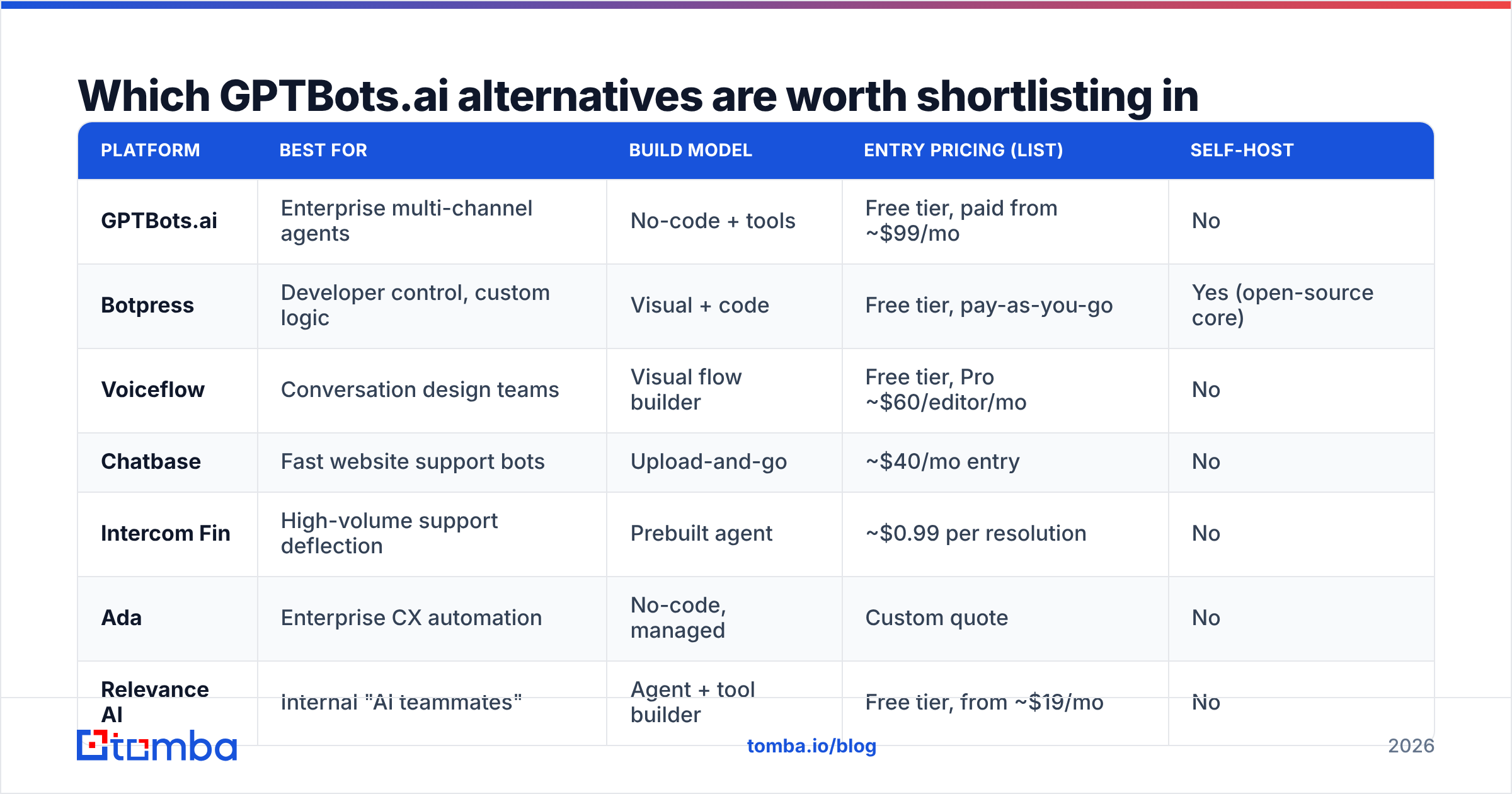
| Platform | Best for | Build model | Entry pricing (list) | Self-host |
|---|---|---|---|---|
| GPTBots.ai | Enterprise multi-channel agents | No-code + tools | Free tier, paid from ~$99/mo | No |
| Botpress | Developer control, custom logic | Visual + code | Free tier, pay-as-you-go | Yes (open-source core) |
| Voiceflow | Conversation design teams | Visual flow builder | Free tier, Pro ~$60/editor/mo | No |
| Chatbase | Fast website support bots | Upload-and-go | ~$40/mo entry | No |
| Intercom Fin | High-volume support deflection | Prebuilt agent | ~$0.99 per resolution | No |
| Ada | Enterprise CX automation | No-code, managed | Custom quote | No |
| Relevance AI | Internal "AI teammates" | Agent + tool builder | Free tier, from ~$19/mo | No |
| Stack AI | Regulated back-office workflows | Node-based builder | Free tier, paid from ~$199/mo | On request |
Pricing is list pricing at time of writing and moves often. Treat the column as a shape, not a quote, and confirm on each vendor's page.
Botpress — the one to pick if engineers own the bot#
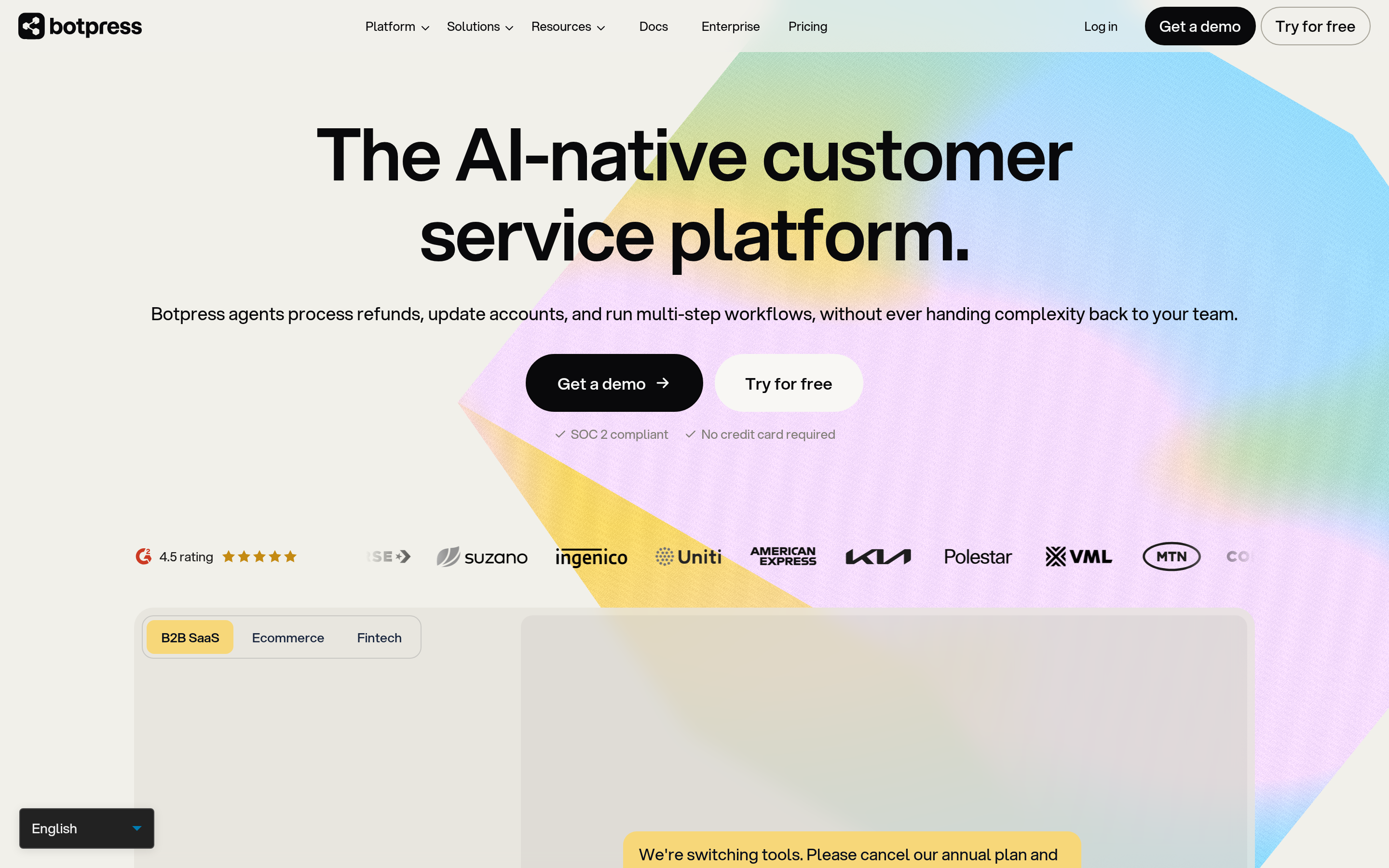
Botpress gives you a visual builder that sits on top of real code. You get an open-source core, an SDK, custom actions in TypeScript, and the option to self-host. Its pay-as-you-go pricing is friendly to prototypes and gets less friendly at high message volume, so run the math at your expected scale.
Choose it when: your agent needs custom business logic, you want version control, and "we'll just prompt it" is not an acceptable architecture.
Voiceflow — the one to pick for designed conversations#
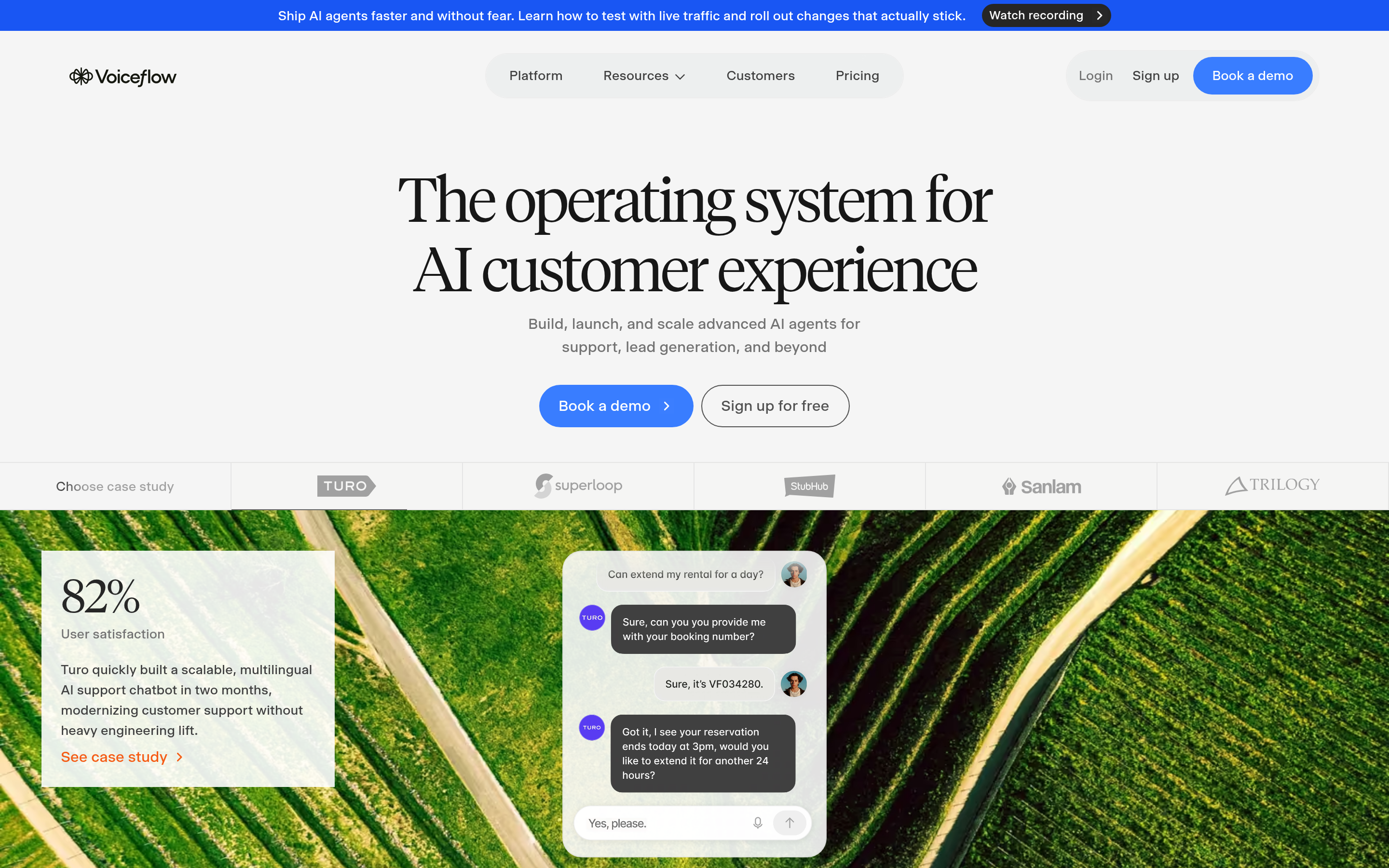
Voiceflow started in voice design and kept the discipline. If your agent must guide someone through a multi-step qualification or onboarding flow with deterministic branches and LLM fallbacks, the flow canvas is the reason to be there. Per-editor pricing makes small teams cheap and large teams expensive.
Chatbase — the one to pick when you want it live tomorrow#
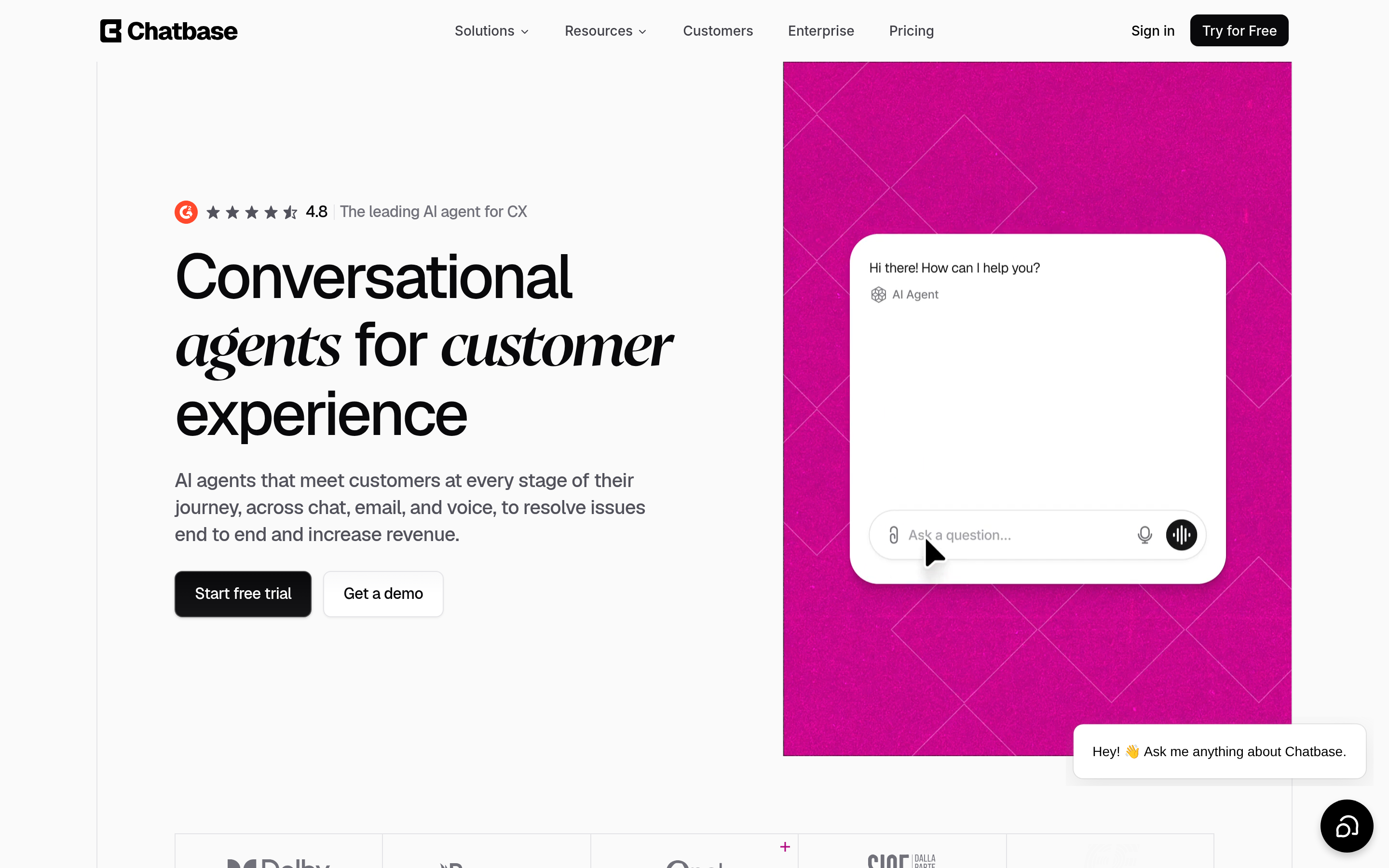
Point it at your docs and site, get a widget, ship. Chatbase is the fastest path from zero to a working support bot and its entry tier undercuts most of this list. The ceiling is lower: complex tool orchestration and deep workflow automation are not what it is for.
Intercom Fin — the one to pick if support volume is the problem#
If you are already on Intercom, Fin's per-resolution pricing is the cleanest ROI story on this list: you pay when the agent actually solves something. It is a support product, not a general agent builder. Do not buy it for sales workflows.
Ada and Kore.ai — the enterprise CX pair#
Both are aimed at large contact centres with compliance requirements, custom quotes, and implementation partners. They are genuine GPTBots.ai alternatives for buyers who need SOC 2 evidence, regional data residency, and a named CSM. They are not sensible if you are three people testing an idea.
Relevance AI and Stack AI — the workflow agents#
These two aim at internal automation rather than customer-facing chat: research agents, document processing, lead qualification pipelines, back-office review. Relevance AI is cheaper to start and framed around "AI teammates". Stack AI leans enterprise and regulated industries with stronger governance controls.
How do you decide between them without a two-month pilot?#
Use this decision path:
- Support deflection is 80% of the value → Intercom Fin, or Ada if you are enterprise.
- You need branching, stateful conversations → Voiceflow.
- Engineers own the roadmap → Botpress.
- You want a bot live this week on a small budget → Chatbase.
- The work is internal, not customer-facing → Relevance AI or Stack AI.
- You need multi-channel enterprise deployment with model choice → stay on GPTBots.ai; it is a reasonable answer to that question.
Then run a two-week bake-off with the same 30 real transcripts against your top two. Score on resolution rate and hallucination rate. Whichever wins on those two numbers wins, regardless of the demo.
Why does contact data decide whether any of this pays back?#
Here is the part every alternatives roundup skips. Your agent's output is only as valuable as the record it creates.
A chat agent captures a name and an email typed by a human on a phone keyboard. Typo rates on manually entered emails run high enough that a meaningful slice of every capture list is undeliverable. Those records then flow into your CRM, get sequenced, bounce, and drag your sender reputation down for everyone else in the domain. The agent looked like it worked. The pipeline says otherwise.

Three fixes, in order of impact:
- Verify at capture time. Call an email verification API inside the agent's tool-call step. If the address is invalid, the agent asks again while the person is still in the conversation. That single change is worth more than most model upgrades.
- Enrich before routing. Turn an email into company, role, seniority, and size so the agent can qualify instead of interrogate. Fewer questions, higher completion rate.
- Fill the gaps outbound. When an anonymous visitor never converts, a domain search against the identified company gives your reps a route back in without another form.
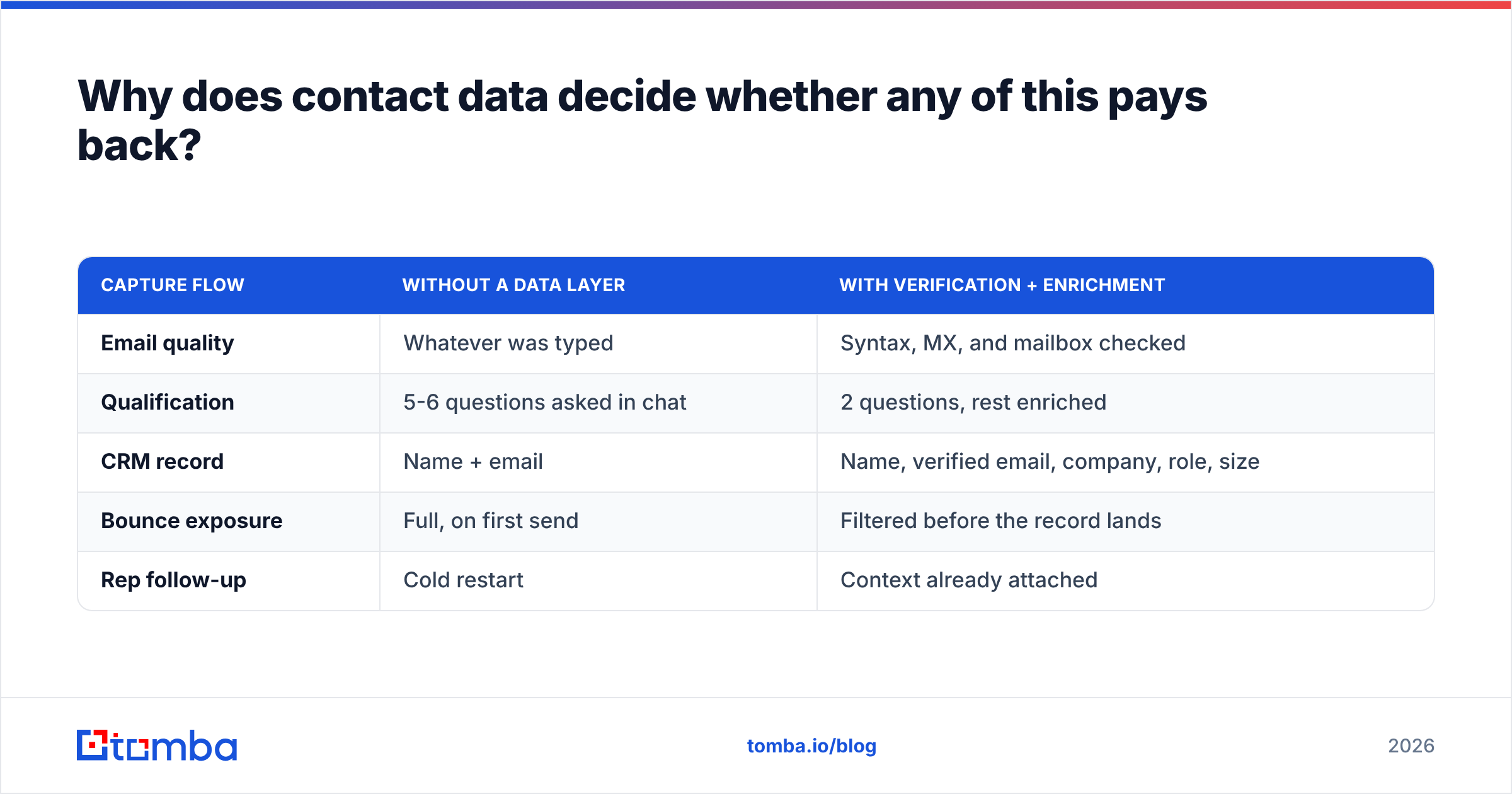
| Capture flow | Without a data layer | With verification + enrichment |
|---|---|---|
| Email quality | Whatever was typed | Syntax, MX, and mailbox checked |
| Qualification | 5-6 questions asked in chat | 2 questions, rest enriched |
| CRM record | Name + email | Name, verified email, company, role, size |
| Bounce exposure | Full, on first send | Filtered before the record lands |
| Rep follow-up | Cold restart | Context already attached |
None of the eight platforms above solves this for you. All eight can call an API mid-conversation. That is the integration to build first.
What questions should you ask on the sales call?#
- What is the total cost at 10x my current volume, in writing?
- What happens to my knowledge base and transcripts if I leave?
- Can the agent call an external API mid-conversation, and what is the timeout?
- What is your measured hallucination rate on customer data, and how is it measured?
- Which model versions am I pinned to, and who decides when they change?
Vendors that answer all five plainly are usually the ones worth piloting.
Where should you start?#
Pick the platform that matches your job-to-be-done, not the one with the longest feature list. Support deflection, conversation design, and internal workflow automation are three different purchases, and the "best" GPTBots.ai alternative changes completely depending on which one you are making.
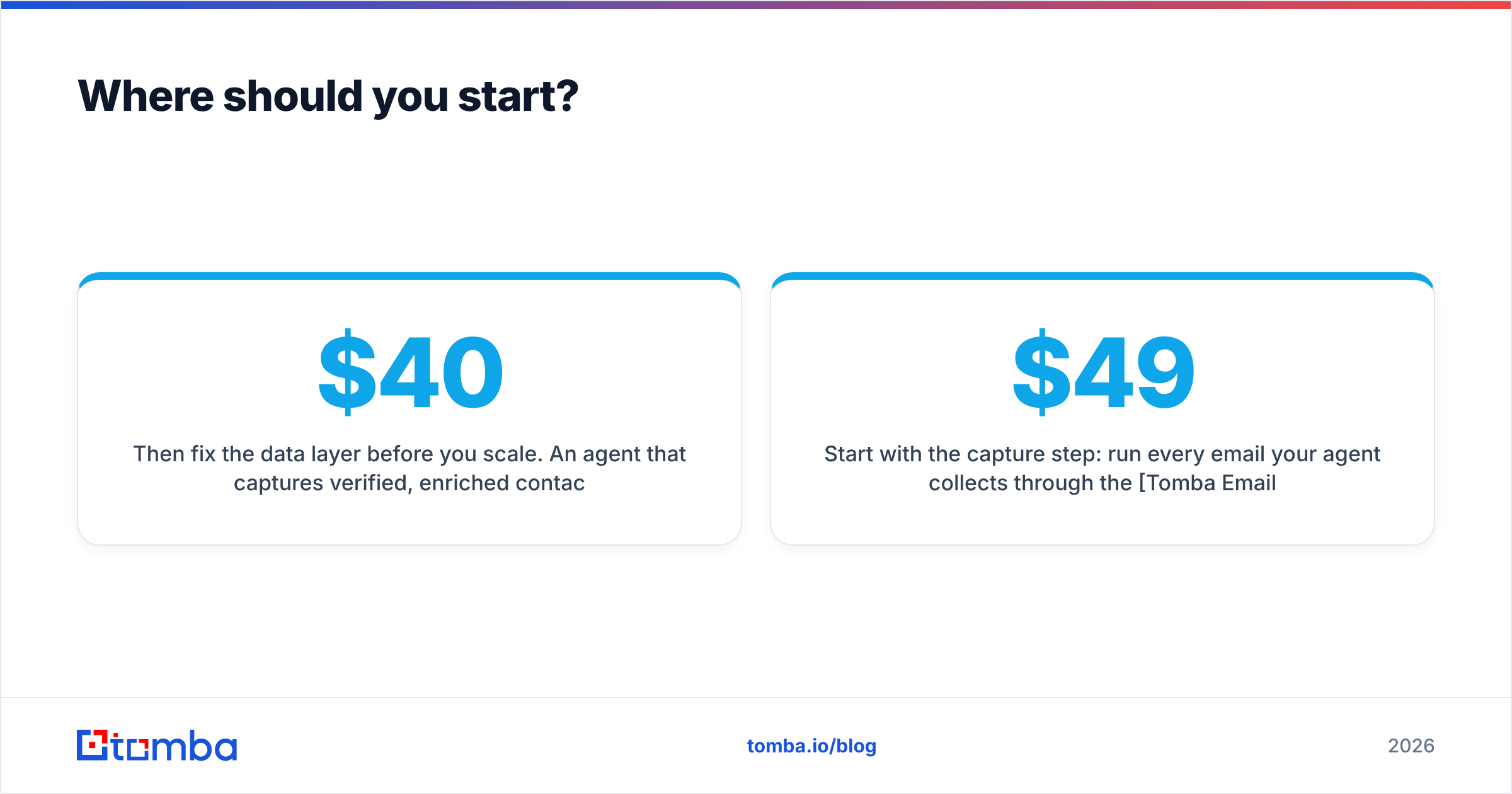
Then fix the data layer before you scale. An agent that captures verified, enriched contacts on a $40/mo plan beats an unverified enterprise deployment every quarter of the year.
Start with the capture step: run every email your agent collects through the Tomba Email Finder and verification API so your CRM only ever sees deliverable records. The free tier covers 25 searches a month for testing, Starter is $49/mo, and Growth is $99/mo — full Tomba pricing is public, no sales call required. Wire it into your agent's tool-call step and let the bot fix bad addresses while the conversation is still open.
Related guides#
Ready to find emails that actually work?
Join 150,000+ professionals who stopped guessing and started sending. Free credits on signup — no credit card required.
Get the Tomba newsletter
Practical outbound tactics and product updates — once every two weeks.
About the author