Grasshopper vs Line2 (2026): Which Business Phone Wins?
Grasshopper and Line2 both give you a business number on your existing phone — but they price, scale, and break in very different ways. Here is the honest breakdown for sales teams in 2026.
TL;DR
- Grasshopper is a number-first system. You buy a business line with extensions, and everyone shares it. Pricing is per account, not per seat, which makes it cheap for a founder or a 3-person shop and awkward for a 10-rep team.
- Line2 is a seat-first system. You buy a line per user. That scales more predictably for a growing sales team but costs more the moment you pass a handful of people.
- Neither is a dialer. Neither one gives you power dialing, local presence rotation, call recording analytics, or CRM logging that a real sales-engagement platform provides. If you plan to make 100+ calls a day, both will feel thin.
- Pick Grasshopper if you want one professional main number with an auto-attendant and extensions, and you never want to think about per-seat billing.
- Pick Line2 if each person needs their own real second line with texting, and you want the per-user math to stay boring as you hire.
What are Grasshopper and Line2, exactly?#
Both products solve the same annoying problem: you don't want to hand out your personal mobile number, and you don't want to buy desk phones.
Grasshopper (owned by GoTo) is a virtual phone system. You get one business number — toll-free, local, or vanity — plus a set of extensions that ring different people or departments. Calls forward to whatever phones you already own. There is an auto-attendant ("press 1 for sales"), voicemail transcription, business texting, and a simple desktop/mobile app. The mental model is a small company's front desk.
Line2 is a second-line app. Each user gets their own dedicated business number that lives inside the Line2 app on their phone and desktop, with calling, texting, voicemail, and basic auto-attendant features on higher tiers. The mental model is a second SIM card that happens to be software.
That distinction — front desk versus second SIM — drives almost every other difference between them. Grasshopper is designed around a company identity. Line2 is designed around an individual identity.
How do Grasshopper and Line2 compare on price?#
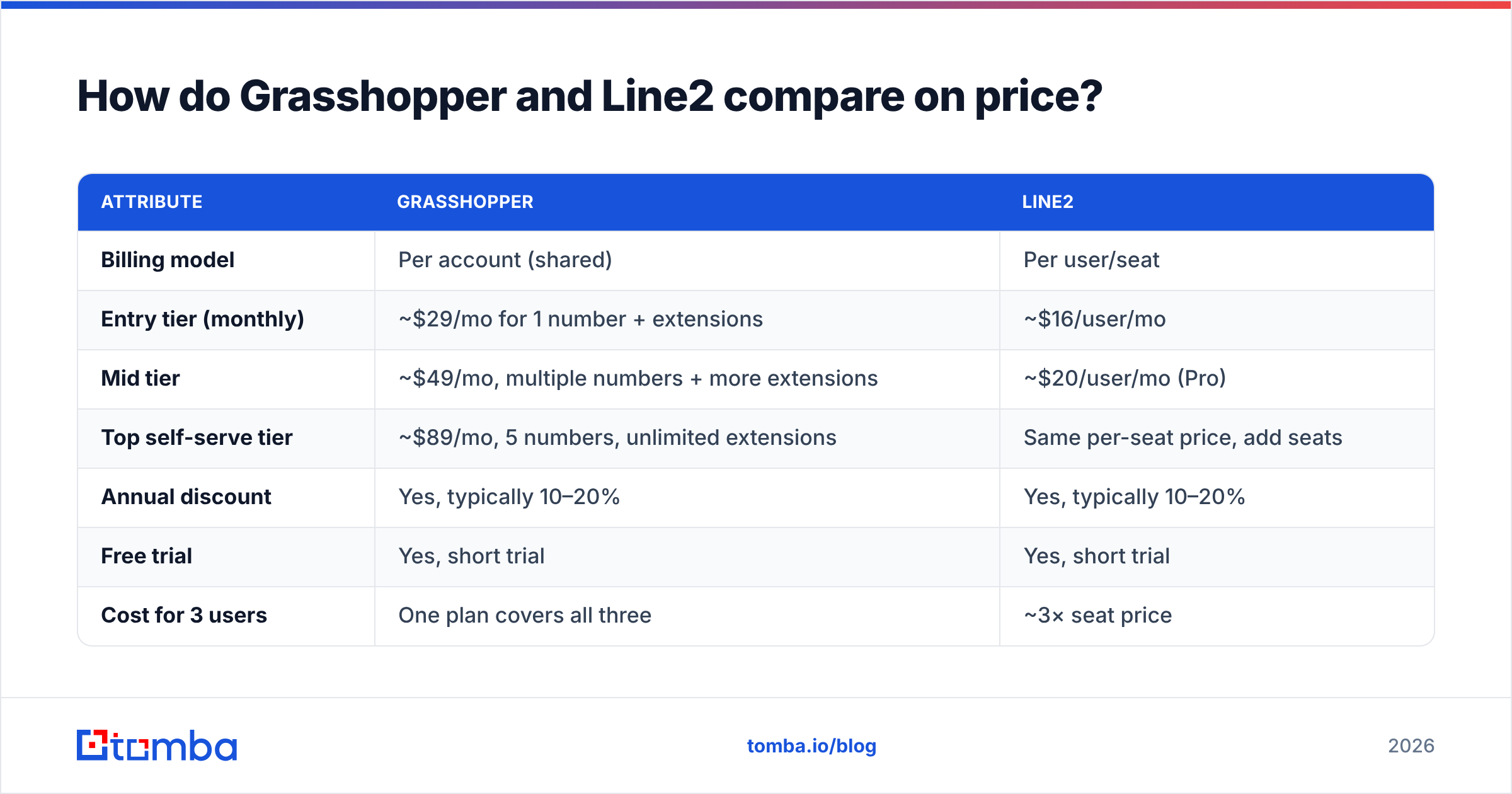
This is where most people make the decision, so let's be precise about the structure rather than pretending list prices never move. Both vendors adjust tiers and run annual discounts; treat the numbers below as directional and confirm on the vendor page before you enter a card.
| Attribute | Grasshopper | Line2 |
|---|---|---|
| Billing model | Per account (shared) | Per user/seat |
| Entry tier (monthly) | ~$29/mo for 1 number + extensions | ~$16/user/mo |
| Mid tier | ~$49/mo, multiple numbers + more extensions | ~$20/user/mo (Pro) |
| Top self-serve tier | ~$89/mo, 5 numbers, unlimited extensions | Same per-seat price, add seats |
| Annual discount | Yes, typically 10–20% | Yes, typically 10–20% |
| Free trial | Yes, short trial | Yes, short trial |
| Cost for 3 users | One plan covers all three | ~3× seat price |
| Cost for 15 users | Still one plan (extension limits apply) | ~15× seat price |
The takeaway: Grasshopper gets cheaper per person as your team grows; Line2 stays linear. For a solo consultant, Line2 is usually the cheaper monthly line item. For a 12-person operations team that mostly needs a shared main number and department extensions, Grasshopper's flat account pricing wins by a wide margin.
Where that reverses: if all 12 of those people need to make and receive individual outbound calls under their own number, Grasshopper's extension model starts creaking and Line2's per-seat clarity is worth paying for.
Which features actually differ?#
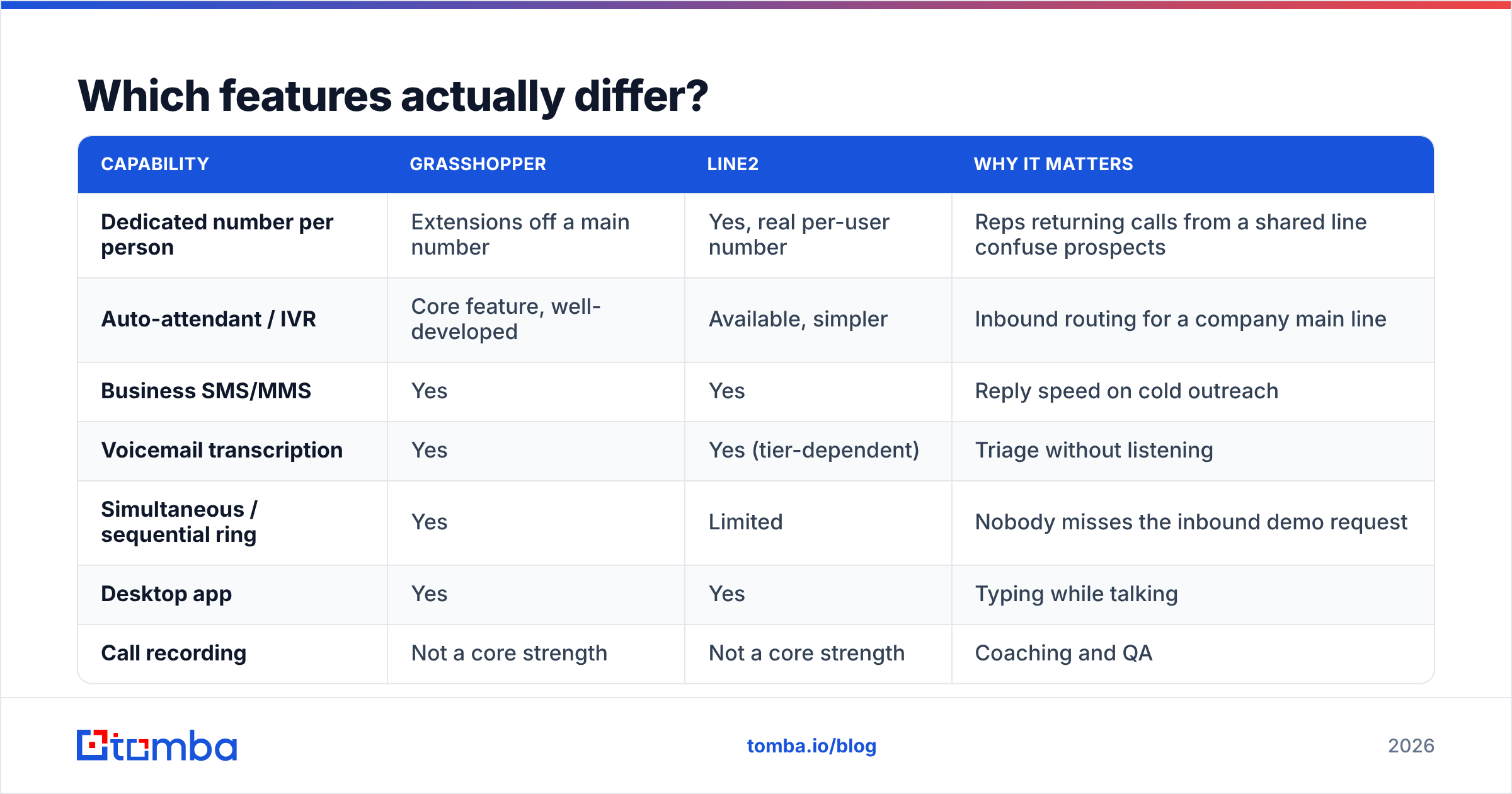
Feature lists on vendor sites are close to identical because both ship the table-stakes VoIP set. The differences are in the details that only surface after week two.
| Capability | Grasshopper | Line2 | Why it matters |
|---|---|---|---|
| Dedicated number per person | Extensions off a main number | Yes, real per-user number | Reps returning calls from a shared line confuse prospects |
| Auto-attendant / IVR | Core feature, well-developed | Available, simpler | Inbound routing for a company main line |
| Business SMS/MMS | Yes | Yes | Reply speed on cold outreach |
| Voicemail transcription | Yes | Yes (tier-dependent) | Triage without listening |
| Simultaneous / sequential ring | Yes | Limited | Nobody misses the inbound demo request |
| Desktop app | Yes | Yes | Typing while talking |
| Call recording | Not a core strength | Not a core strength | Coaching and QA |
| Native CRM logging | No | No | Activity data ends up manual |
| International calling | Limited, US/Canada focus | Limited, US/Canada focus | Deal-breaker for global teams |
| Power/parallel dialing | No | No | Volume outbound |
Two lines in that table deserve emphasis.
Neither product logs calls into your CRM natively. You will be copying outcomes by hand, or wiring something through Zapier, or accepting that your pipeline data is incomplete. For a founder making eight calls a week that's fine. For a sales team where activity metrics drive forecasting, it is a real cost.
Neither product dials for you. Both are phone lines, not sales-engagement tools. If your comparison shortlist also includes Aircall, JustCall, or Kixie, you are actually shopping in a different category — those cost 2–4× more and exist specifically to solve dialing volume and CRM sync.
Is Grasshopper better than Line2 for a sales team?#
Usually no — with one important exception.
For an outbound team, the per-rep number matters. Prospects call back the number that appeared on their screen. With Line2, that number reaches the rep who called them. With Grasshopper, callbacks land in the main menu, get routed by extension, and a percentage of them evaporate because a curious prospect will not sit through "press 3 for sales" at 4:55pm on a Friday.
The exception: inbound-heavy teams. If most of your calls come to you — inbound demo requests, support escalations, partner calls — Grasshopper's auto-attendant and ring strategies are genuinely better built. A company that publishes one number on its website and needs it routed intelligently is Grasshopper's home turf.
A rough rule that holds up in practice:
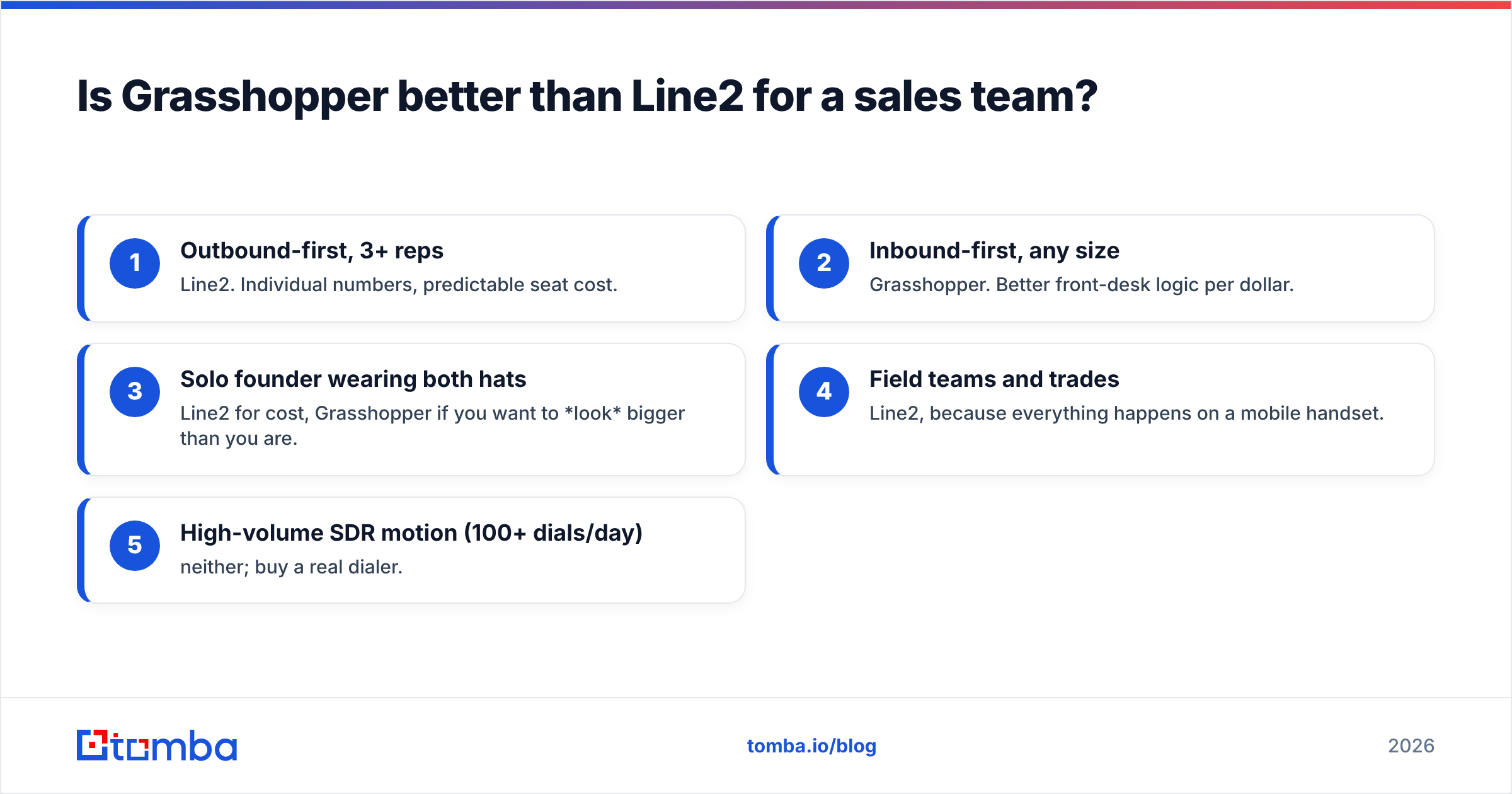
- Outbound-first, 3+ reps — Line2. Individual numbers, predictable seat cost.
- Inbound-first, any size — Grasshopper. Better front-desk logic per dollar.
- Solo founder wearing both hats — Line2 for cost, Grasshopper if you want to look bigger than you are.
- Field teams and trades — Line2, because everything happens on a mobile handset.
- High-volume SDR motion (100+ dials/day) — neither; buy a real dialer.
What about call quality and reliability?#
Both run on VoIP, which means your call quality is mostly a function of your network, not your vendor. That said, the two products fail differently.
Grasshopper's default architecture forwards calls to your carrier line. When it works, quality is excellent because the actual audio path is your cell network. When your cell coverage is bad, so is the call — and you pay carrier minutes.
Line2 routes audio through its own app over data. That means it works on wifi in a basement where cell service dies, and it also means a shaky hotel wifi connection produces the choppy, robotic audio everyone associates with cheap VoIP. Line2 can fall back to a cellular path on some setups, which helps.
Check independent review aggregation before you commit — G2 reviews for both products cluster around the same two complaints: occasional app instability and support response times. Neither vendor is an outlier on reliability, and neither is best-in-class either. Read the one-star reviews from the last six months, not the overall score.
Where does each one fall short?#
Grasshopper's weak points:
- Extension limits on lower tiers arrive faster than you expect once you add departments.
- No real per-rep identity, which hurts outbound callbacks.
- Reporting is minimal. You will not get talk-time by rep or connect-rate analytics.
- International coverage is thin.
Line2's weak points:
- Costs scale linearly. Fifteen seats is fifteen seats.
- Advanced routing is simpler than Grasshopper's auto-attendant.
- App-dependent — if the app misbehaves on an OS update, your phone line misbehaves.
- Desktop experience has historically lagged the mobile app.
Shared weak points:
- No CRM-native activity logging.
- No call recording depth for coaching.
- No dialer, no local presence, no cadence integration.
- Support is email/ticket-based on most tiers, not a named account manager.
How do you actually choose between them?#
Work through these in order. Stop at the first one that gives you a clear answer.
- Count the humans who need to place outbound calls under their own identity. Zero or one → Grasshopper is fine. Three or more → Line2.
- Decide whether inbound routing is a business requirement. If a published main number needs a menu, hours, and department routing, Grasshopper is materially better.
- Do the 24-month math, not the monthly math. Ten seats on Line2 versus one Grasshopper Small Business plan is a five-figure difference over two years. Neither answer is automatically wrong — but know the number.
- Test on your worst network. Sign up for both trials and make calls from the place your team actually works: a warehouse, a car, a shared coworking wifi. That single test invalidates more spec-sheet comparisons than anything else.
- Check the exit cost. Number porting away from either provider is possible but takes days to weeks. Ask about porting before you commit, not after.
- Ask what happens at 3× your current size. If the honest answer is "we'd move to Aircall or RingCentral anyway," pick the cheaper option now and plan the migration.
What should you pair either one with?#
Here is the thing most Grasshopper vs Line2 comparisons skip: the phone system is rarely the bottleneck. The bottleneck is who you're calling.
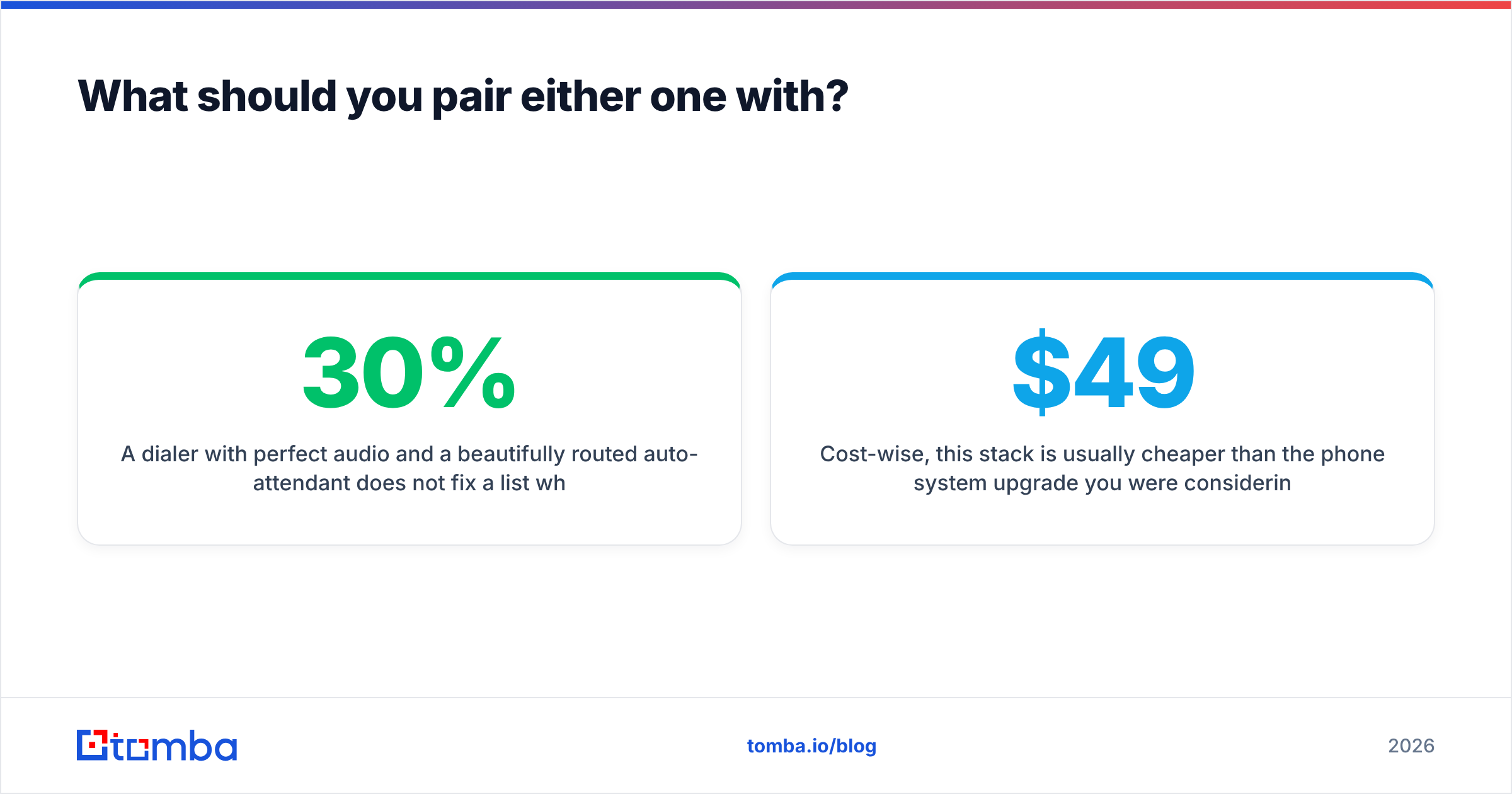
A dialer with perfect audio and a beautifully routed auto-attendant does not fix a list where 30% of the direct dials are disconnected, the titles are two years stale, and half the "decision makers" left the company. Connect rate is a data problem wearing a telephony costume.
Three things worth wiring up alongside whichever line you pick:
- Verified direct dials. Pull mobile and direct numbers with a phone finder rather than dialing switchboards, then run them through a phone validator so you're not burning connect attempts on dead lines.
- A parallel email channel. Cold calling works dramatically better when the prospect has already seen your name. Build the list with an email finder, verify it, and sequence the call as touch three rather than touch one.
- Enriched records before the dial. Firmographics, headcount, and tech stack from data enrichment turn a cold call into a relevant one. Reps who open with a specific, verifiable observation get past the first ten seconds far more often.
Cost-wise, this stack is usually cheaper than the phone system upgrade you were considering. Verified data at $49–$99/month typically outperforms a $200/month telephony tier when your baseline connect rate is under 5%.
Frequently asked questions#
Can I port my existing number to Grasshopper or Line2? Yes, both support number porting from most US carriers. Expect a few business days to a couple of weeks, and do not cancel your old service until the port completes.
Do either of them work internationally? Both are primarily US/Canada products. If you need European or APAC local numbers, look at a global provider instead.
Is there a free tier? Neither offers a permanent free plan. Both run short trials. If budget is the blocker, note that most of the value in outbound comes from list quality, not line cost.
Which one has better texting? Both support business SMS. Line2's per-user model makes rep-level texting cleaner; Grasshopper's shared-number texting can create "who replies?" confusion on a team.
Can I use them with a CRM? Indirectly, through Zapier-style automation. Neither has the deep, native, auto-logging integration that dedicated sales phone platforms offer.
The verdict#
Line2 for outbound sales teams; Grasshopper for companies that need one professional main number routed well. That's the honest split. Both are competent, neither is exciting, and the price difference only matters at the edges of team size.
But before you spend another week comparing phone tiers, audit your list. If your connect rate is under 5%, the problem is almost certainly not which app is ringing.
Start there: use the Tomba Email Finder to build a verified contact list with real names, real domains, and real reachable people — then layer direct dials on top and let your phone system do the one job it's actually good at. Free tier gives you 25 searches a month to test the difference; paid plans start at $49/mo on Tomba pricing if the numbers hold up.
Pricing and feature details reflect published information at the time of writing and change frequently. Confirm current plans on each vendor's site before purchasing.
Related guides#
Ready to find emails that actually work?
Join 150,000+ professionals who stopped guessing and started sending. Free credits on signup — no credit card required.
Get the Tomba newsletter
Practical outbound tactics and product updates — once every two weeks.
About the author