Grata Pricing Review 2026: Real Costs, Pros and Cons
Grata doesn't publish a price list, so buyers walk into quotes blind. Here's what Grata actually costs in 2026, what reviewers praise, where it frustrates teams, and when a cheaper stack wins.
This Grata pricing review breaks down what the tool really costs in 2026. Grata does not publish a price list, so every figure here comes from buyer reports rather than a public page.
TL;DR
- Grata does not publish pricing. Every number you see online comes from a buyer report. Quotes are annual, seat-based, and negotiated, and a small team should expect low five figures a year.
- Reviewers praise one thing above all: finding private, bootstrapped, non-VC-backed companies that PitchBook and Crunchbase miss. That is the real moat.
- The complaints are just as consistent: thin contact data, rigid annual contracts, seat pricing that punishes growing teams, and results that still need human filtering.
- Grata is built for M&A, private equity, and corporate development. If you run outbound sales, you are paying deal-sourcing prices for a prospecting job.
- The honest verdict: buy Grata to find companies. Pair it with a cheap, accurate contact tool instead of paying for a bundled one.
What is Grata and who actually uses it?#
Grata is a search engine for private companies. You describe a business in plain language — "industrial coatings makers in the Midwest, 50–200 staff, founder-owned" — and it returns companies that match. The list is built by crawling company websites, not by waiting for funding news.
That difference is the whole product. Most B2B databases are strongest where public signal is strongest: funded startups, public filings, big logos. Grata indexes the long tail. Think of the $8M specialty distributor with a 2013-era website and no press coverage. For a private equity associate building a deal pipeline, that tail is the whole job.
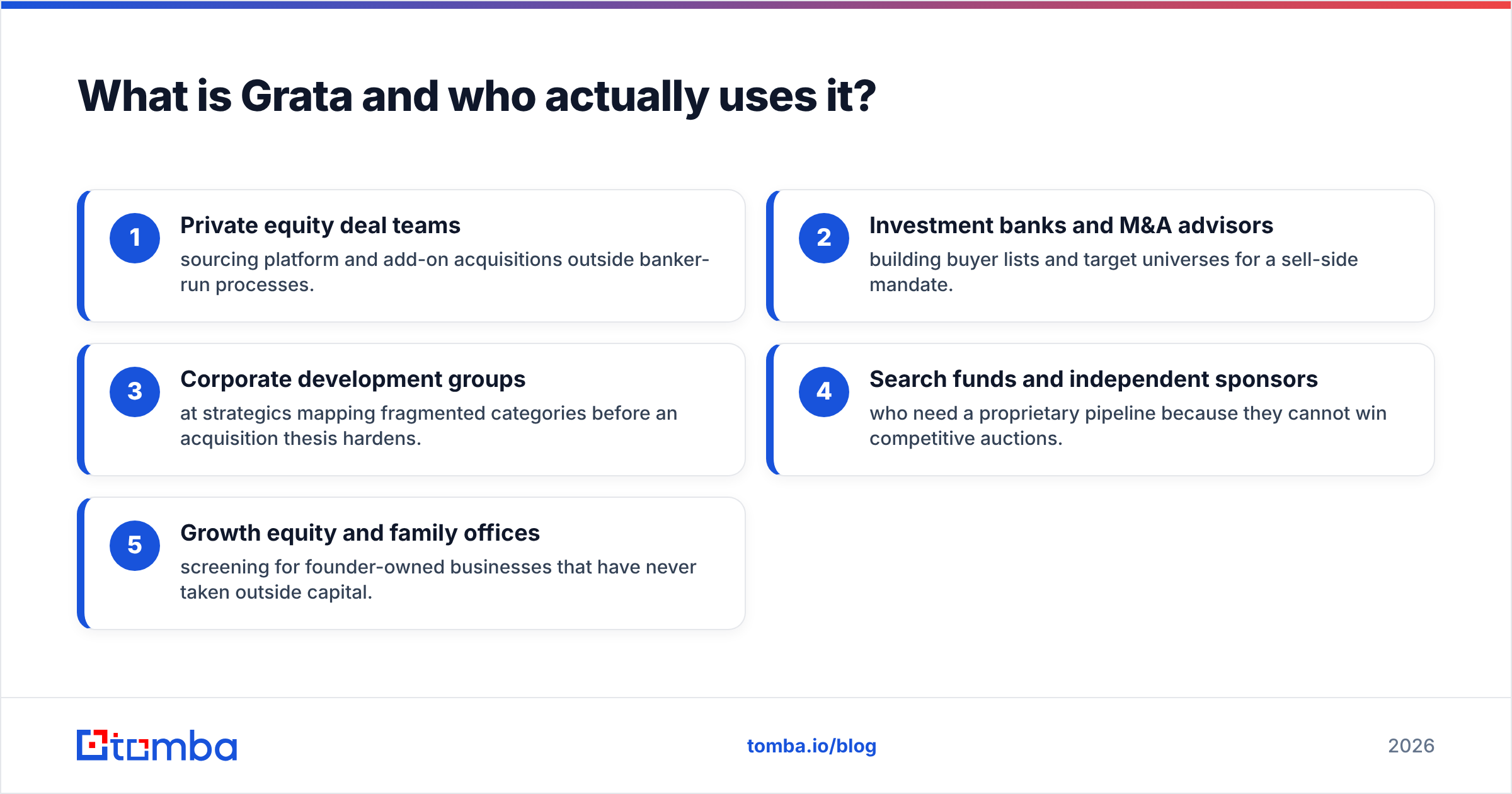
The typical buyer is not a sales team. It is:
- Private equity deal teams sourcing platform and add-on deals outside banker-run auctions.
- Investment banks and M&A advisors building buyer lists and target universes for a sell-side mandate.
- Corporate development groups mapping fragmented markets before an acquisition thesis is set.
- Search funds and independent sponsors who need their own pipeline because they cannot win open auctions.
- Growth equity and family offices screening for founder-owned firms that never took outside money.
Grata was acquired by Datasite in 2025. That matters at purchase time, because packaging changes fast after a deal like that. Confirm what is in the box with the vendor, not with a review site.
How much does Grata pricing actually cost in 2026?#
Grata lists no prices on grata.com. There is no self-serve checkout, no public tier table, and no free plan. Every deal runs through a demo, a scoping call, and a quote.
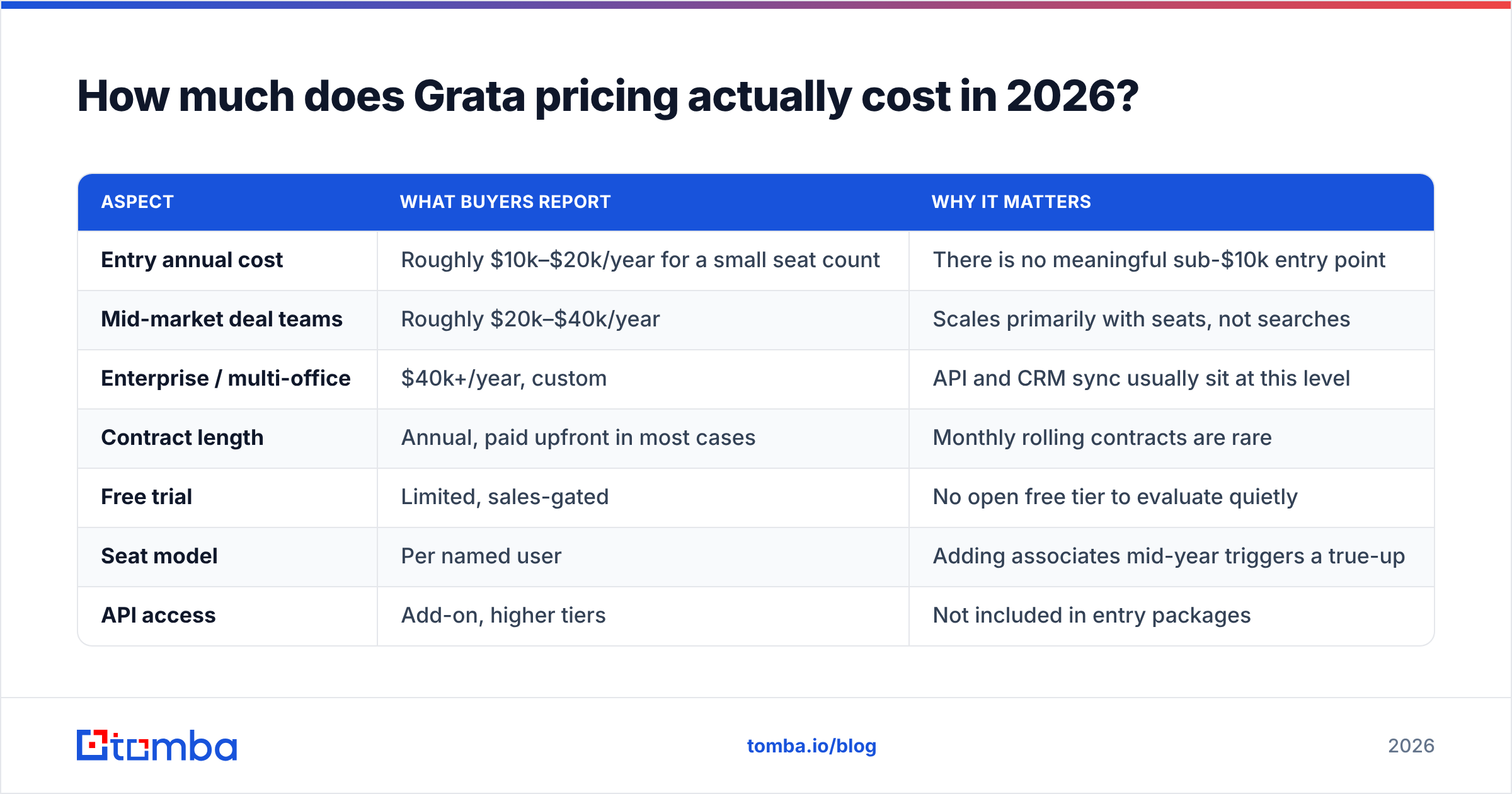
The ranges below come from buyer reports on G2 and Capterra, plus what procurement teams tend to share. Treat them as numbers to negotiate against, not as published rates.
| Aspect | What buyers report | Why it matters |
|---|---|---|
| Entry annual cost | Roughly $10k–$20k/year for a small seat count | There is no meaningful sub-$10k entry point |
| Mid-market deal teams | Roughly $20k–$40k/year | Scales primarily with seats, not searches |
| Enterprise / multi-office | $40k+/year, custom | API and CRM sync usually sit at this level |
| Contract length | Annual, paid upfront in most cases | Monthly rolling contracts are rare |
| Free trial | Limited, sales-gated | No open free tier to evaluate quietly |
| Seat model | Per named user | Adding associates mid-year triggers a true-up |
| API access | Add-on, higher tiers | Not included in entry packages |
The number that surprises people is not the headline figure. It is the seat math. A four-person deal team at a mid-market fund can get a very different quote from a two-person search fund, even though both use the same index. If your team grows from three to seven associates in year two, renewal is not a 10% bump. It is a step change.
What are the hidden costs in a Grata contract?#
Three line items show up after the demo, not during it:
- API and integrations. Pushing results into Salesforce, HubSpot, or a custom deal-flow tool is rarely a base-tier feature. If your workflow depends on sync, price it into the first quote. Adding it at renewal costs you all your leverage.
- Contact data. Grata finds companies very well. Reaching the owner of that company is a separate problem. Reviewers often note that contact coverage on small private firms is thinner than the company data.
- Seat sprawl. Analysts, interns, and part-time helpers all need logins to be useful. Teams either over-buy seats or share one, and shared logins break your audit trail.
What do Grata reviews actually say?#
Strip the marketing language out of any Grata pricing review and the sentiment splits cleanly.
What reviewers consistently praise:
- Long-tail discovery. The most repeated compliment: it finds companies that appear nowhere else. No funding round, no press, no Crunchbase profile. This is why people renew.
- Plain-language and similar-company search. Describe a thesis in a sentence, or feed in one target and ask for lookalikes. Either one saves days of list building.
- Taxonomy that respects niches. SIC and NAICS codes flatten niche businesses into useless buckets. Grata's website-based labels handle narrow markets better.
- Speed to a first list. Associates go from thesis to a few hundred screened companies in an afternoon, not a week.
What reviewers consistently criticise:
- Contact data depth. Company records are strong. The named decision-maker, a working email, and a direct dial are not, especially at firms under $10M in revenue.
- Estimated revenue and headcount. These numbers are modeled, not filed. Reviewers call them useful in aggregate and shaky one by one.
- Result noise. Broad queries pull in nearby businesses that you have to prune by hand. The tool narrows the field. It does not hand you a clean list.
- Price against team size. Small teams find the cost hard to justify, especially in a slow year.
- Contract rigidity. Annual commitments with little flexibility frustrate teams whose headcount moves.
That last cluster drives most buyer regret. Nobody regrets the search quality. People regret the deal they signed around it.
Is Grata worth it compared to the alternatives?#
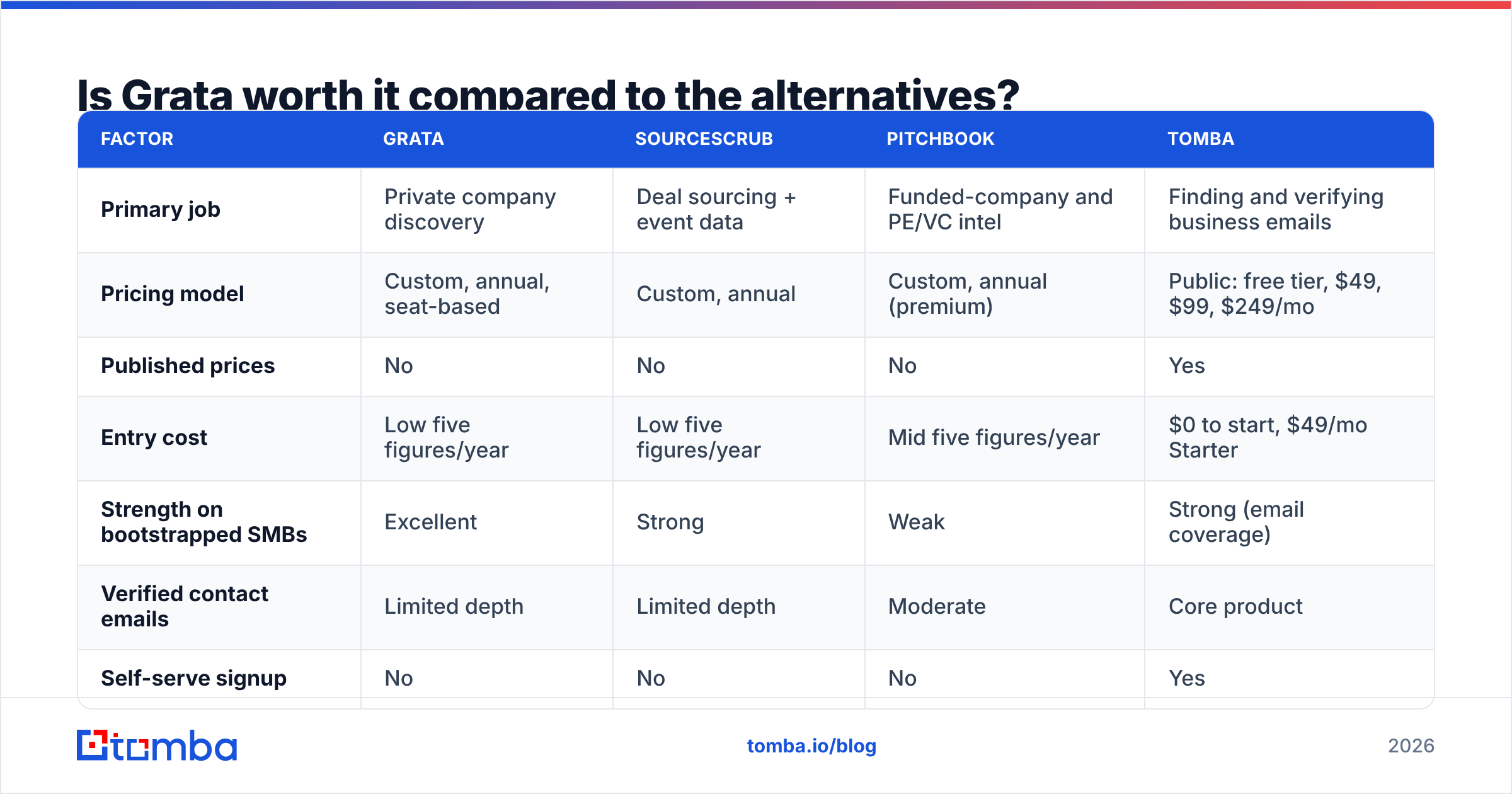
The answer depends on the job you are hiring the tool for. Deal sourcing and B2B prospecting look alike from the outside. They are completely different purchases.
| Factor | Grata | SourceScrub | PitchBook | Tomba |
|---|---|---|---|---|
| Primary job | Private company discovery | Deal sourcing + event data | Funded-company and PE/VC intel | Finding and verifying business emails |
| Pricing model | Custom, annual, seat-based | Custom, annual | Custom, annual (premium) | Public: free tier, $49, $99, $249/mo |
| Published prices | No | No | No | Yes |
| Entry cost | Low five figures/year | Low five figures/year | Mid five figures/year | $0 to start, $49/mo Starter |
| Strength on bootstrapped SMBs | Excellent | Strong | Weak | Strong (email coverage) |
| Verified contact emails | Limited depth | Limited depth | Moderate | Core product |
| Self-serve signup | No | No | No | Yes |
| API access | Add-on / higher tier | Add-on | Add-on | Included from paid tiers |
| Best for | PE, M&A, corp dev | PE, investment banking | Public + funded market research | Sales, RevOps, agencies, recruiters |
Read that table honestly and the split is obvious. If your budget line is "sourcing", Grata is a fair contender, and the seat cost is a rounding error against one closed deal. If your budget line is "outbound", you are weighing a $20,000-a-year deal-sourcing platform against a lead-generation problem. Tools built for that job cost about 2% as much.

When does the cheaper stack actually win?#
You are better served by a lighter stack when any of these are true:
- You need contacts, not companies. You already know the target accounts. What is missing is a verified email for the VP of Operations. That is a data enrichment problem, not a discovery problem.
- Your list changes weekly. Deal sourcing rewards a stable, curated universe. Outbound rewards volume and iteration, and per-seat annual contracts fight that.
- You are one to three people. A five-figure yearly commitment on a two-person team is a bet on one good year.
- Bounce rate matters more than obscurity. If your emails bounce, your domain reputation drops no matter how rare your target list was. Running lists through an email verifier does more for pipeline than a wider index.
A practical hybrid many funds run: keep Grata for the discovery layer, where it has no real substitute, and drop the contact-data add-on. Export the company list, then find decision-maker emails with a per-credit tool. You stop paying enterprise rates for the weakest part of the product.
What do you actually get for the money?#
Cut through the demo and the value sits in five things:
- A private-company index built from websites, not filings. It covers businesses that have never made public noise.
- Thesis-to-list search. Plain-language queries and lookalike search cut list building from days to hours.
- Ownership and signal filters. Screen for founder-owned, PE-backed, or bootstrapped status, plus growth and hiring signals.
- Workflow features. Saved searches, lists, tags, and sharing, so an associate's work survives their exit.
- CRM and API pathways. Getting results into your deal-flow system, priced separately in most packages.
Notice what is missing: outreach, sequencing, verified direct contact at scale, and deliverability tools. Grata is a research product. It ends where the conversation begins.
How do you negotiate a better Grata quote?#
Sales-gated pricing is negotiable pricing. A few moves reliably shift the number:
- Ask for the full rate card, not a bundle. Get line items for seats, API, integrations, and data add-ons. Bundles hide the part you are overpaying for.
- Quote at your real seat count, then price the next seat. Growth is the renewal problem. Fix the marginal seat price in writing at signature.
- Time the close. Quarter-end and year-end discounts are real at every enterprise data vendor. Grata is no exception.
Three more levers matter once the paperwork starts:
- Ask for a multi-year price lock, not a first-year discount. A 20% year-one cut that resets at renewal is worse than a flat three-year rate.
- Run a scoped pilot. Bring three real theses to the trial. Count the net-new, workable targets your current stack missed. Under twenty, and the tool is not fixing your bottleneck.
- Benchmark against a substitute. Walk in with a costed alternative, even a partial one. Saying "we can resolve contacts ourselves for $99 a month" removes an entire upsell.
That last point is where buyers leave money on the table. Vendors price the bundle assuming you have no option for any part of it. Show that you solved the contact layer on your own, with something like a bulk email finder workflow, and the talks narrow to the part you truly cannot replace.
Who should buy Grata, and who should not?#
Buy it if: you source your own deals in fragmented, founder-owned markets. Three or more people will use it weekly. One closed deal pays the annual fee many times over. PitchBook and Crunchbase keep handing you the same twenty companies everyone else is already calling.
Skip it if: your target list is already set. You can name the companies your buyers work at. You need working emails and phone numbers more than new logos. Or you are a small team, and a five-figure yearly commitment eats a big share of your tooling budget.
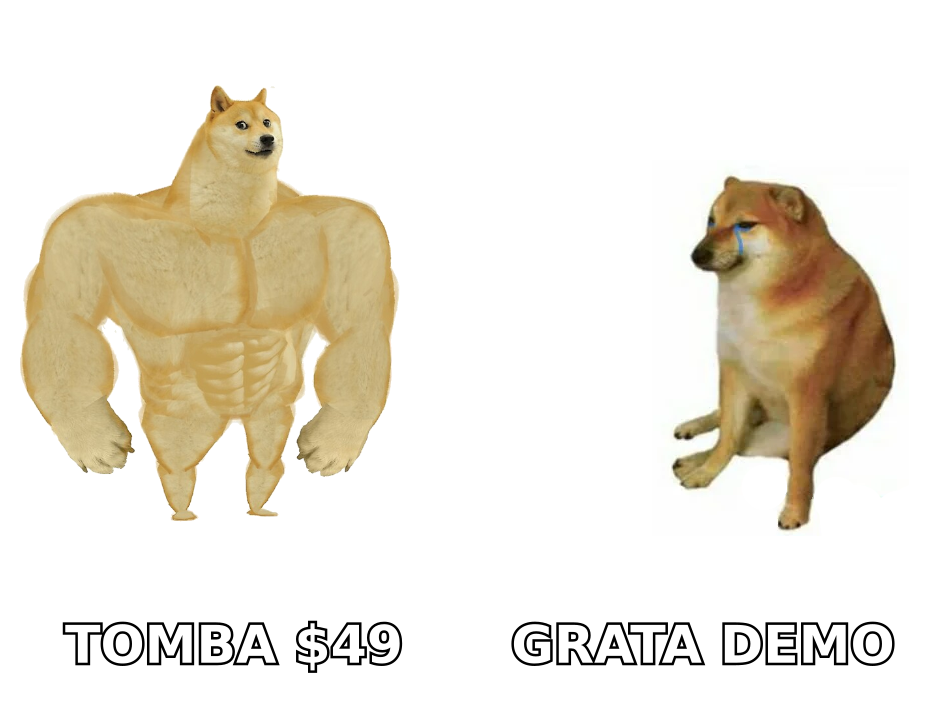
Consider a hybrid if: you want the discovery layer but not the contact upsell. Buy the smallest workable seat count, then handle contacts on clear per-credit pricing. Compare that with Tomba pricing: a free tier with 25 searches a month, Starter at $49/mo, Growth at $99/mo, and Pro at $249/mo. The math usually favours splitting the stack.
Grata pricing review: the bottom line#
Grata is a good product with a murky price model. The search quality is real, and for private-market deal sourcing it is hard to replace. The friction is everything around it: no published prices, annual seat-based commitments, API access as an add-on, and a contact-data layer that reviewers rate well below the company data.
Go into the demo knowing which half you are buying. If you need the discovery engine, push hard on seats and lock the marginal seat price. If what you really need is a name and a working email at companies you already know, you are shopping in the wrong category.
Need the contact layer without the five-figure contract? Start with the Tomba Email Finder. Drop in a company domain and a person's name, and get a verified work email back. Check it against the verifier before it touches your sequence. The free tier gives you 25 searches a month with no sales call. Starter is $49/mo, about what one seat of a deal-sourcing platform costs per week.
Related guides#
// get started
Find, verify and enrich your first contacts today
Start on the free plan with 25 searches a month, then scale when your team is ready.
Free plan · No credit card required · GDPR & CCPA
// about the author