Grata vs Jet Leads Pro: Which B2B Data Tool Wins in 2026?
One is a deal-sourcing engine built for private-equity search. The other is a volume lead-gen tool built for outbound. Here is the honest breakdown of where each one earns its price — and where neither is enough.
Grata vs Jet Leads Pro is a comparison of two tools that barely overlap. One finds companies. The other finds contacts. Here is the short version, then the detail.
TL;DR
- Grata is not a lead-gen tool. It is a private-company search engine for M&A, private equity and corp dev teams. They need to find companies, not contacts. Pricing is quote-only and lands in five figures a year for most buyers.
- Jet Leads Pro sits at the opposite end. It is a low-cost, self-serve B2B lead list product. It targets agencies, SDR teams and solo founders who need volume exports fast.
- They barely compete. If you are comparing them closely, the job to be done is probably unclear. Pick on your unit of work: a company thesis or a contact list.
- Both leave the same gap: verified email addresses at the person level. Company records do not bounce. People's inboxes do.
- Cheapest honest stack for most outbound teams: a company-discovery layer plus a dedicated finder and verifier like Tomba at $49/mo. That beats paying enterprise rates for contact data you still have to re-verify.
Grata vs Jet Leads Pro: what does each tool do?#
They solve different problems for different buyers. Conflating them is the most expensive mistake in this comparison.
Grata launched in 2016 as a search engine for private companies. It ignores self-reported industry tags. Instead it crawls company websites and applies NLP to build a semantic map. So you can search "managed cybersecurity services for mid-market hospitals" and get a ranked list of firms that describe themselves that way.
Its buyers are dealmakers: private-equity associates building pipelines, bankers running buyer lists, corp dev teams mapping a category. Datasite, the M&A data room provider, acquired Grata in a deal announced in late 2024. That says plainly where the product is heading: deeper into the deal lifecycle, not toward SDR workflows.
Jet Leads Pro sits on the other side of the market. It is a self-serve B2B lead generation product. You filter a database by industry, geography, company size and title. Then you export contacts to CSV or push them into your sequencer. The pitch is speed and cost: a usable list in minutes, no sales call, no annual commitment.
Dozens of tools share that category. Like most of them, Jet Leads Pro is far less documented by third parties than Grata is. So check current pricing, credit rules and refund policy on the vendor's own site before you buy. Packaging changes often here, and review sites like G2 carry thin coverage for small vendors.
Here is the one-line summary. Grata answers "which companies should I approach?" Jet Leads Pro answers "who do I email tomorrow morning?"
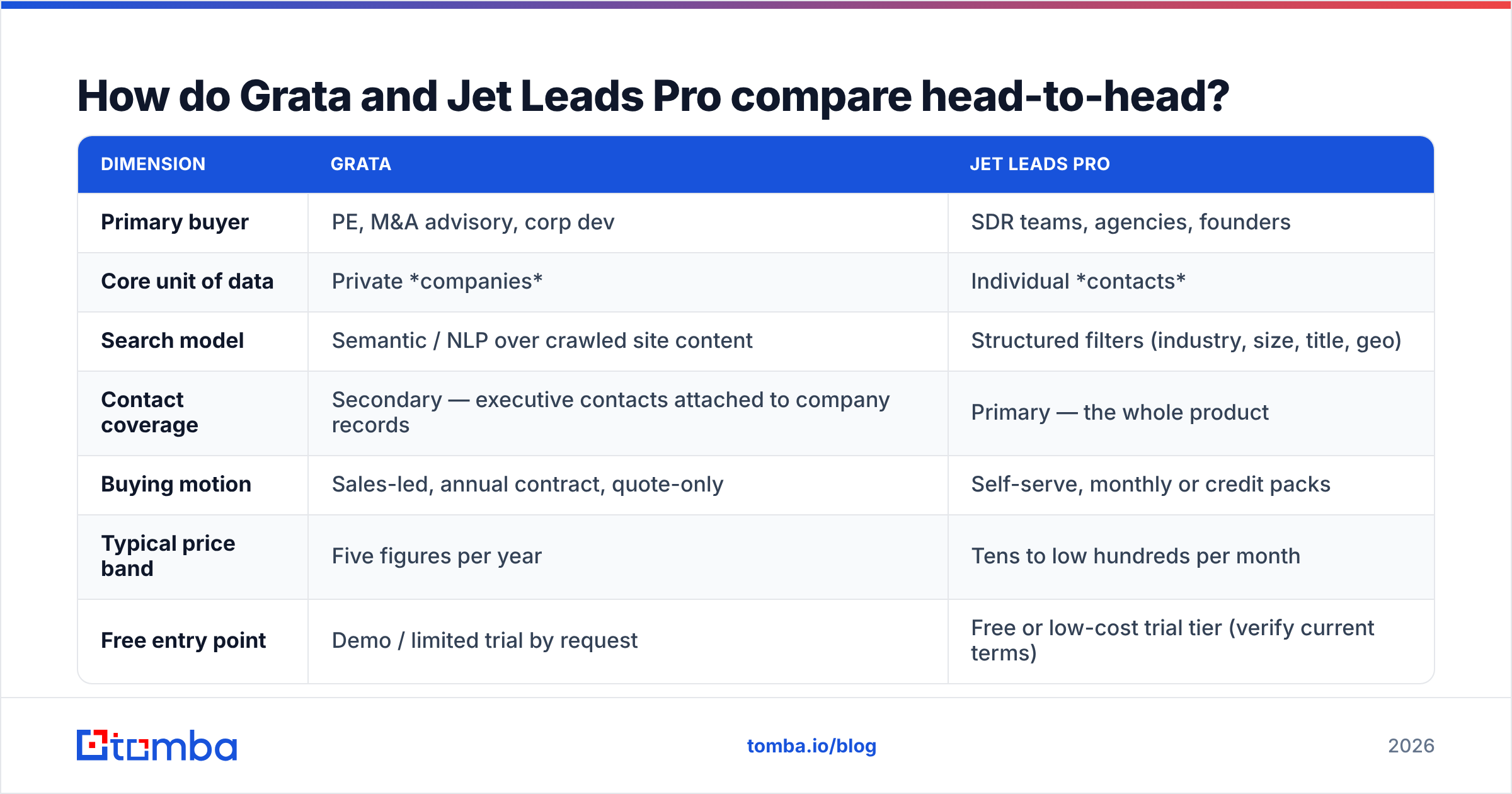
How do the two tools compare head-to-head?#
| Dimension | Grata | Jet Leads Pro |
|---|---|---|
| Primary buyer | PE, M&A advisory, corp dev | SDR teams, agencies, founders |
| Core unit of data | Private companies | Individual contacts |
| Search model | Semantic / NLP over crawled site content | Structured filters (industry, size, title, geo) |
| Contact coverage | Secondary — executive contacts attached to company records | Primary — the whole product |
| Buying motion | Sales-led, annual contract, quote-only | Self-serve, monthly or credit packs |
| Typical price band | Five figures per year | Tens to low hundreds per month |
| Free entry point | Demo / limited trial by request | Free or low-cost trial tier (verify current terms) |
| Integrations | CRM sync (Salesforce, HubSpot, Affinity, DealCloud) | CSV export, common sequencer/CRM pushes |
| Best at | Category mapping, thesis-driven sourcing, ownership signals | Fast list building at volume |
| Weakest at | Cost efficiency for high-volume outbound | Depth, nuance, non-obvious company discovery |
The table makes the split obvious. The practical consequence matters more: you cannot swap one for the other without changing your workflow. Hand a PE associate a Jet Leads Pro export and they get broad firmographic buckets. Those buckets miss the sub-niche their thesis depends on. Hand an SDR a Grata seat and they burn a $20,000 license on a job a $49 tool does better.

What does Grata actually do well?#
Grata earns its price in one scenario: when finding the right companies is genuinely hard.
Take a search like this. "Independent providers of aftermarket parts for agricultural equipment in the US Midwest, 50-200 employees, no institutional ownership." Standard databases fail here. SIC and NAICS codes flatten that description into something useless. Grata reads what each company says about itself, so it surfaces firms that never show up in a filtered query.
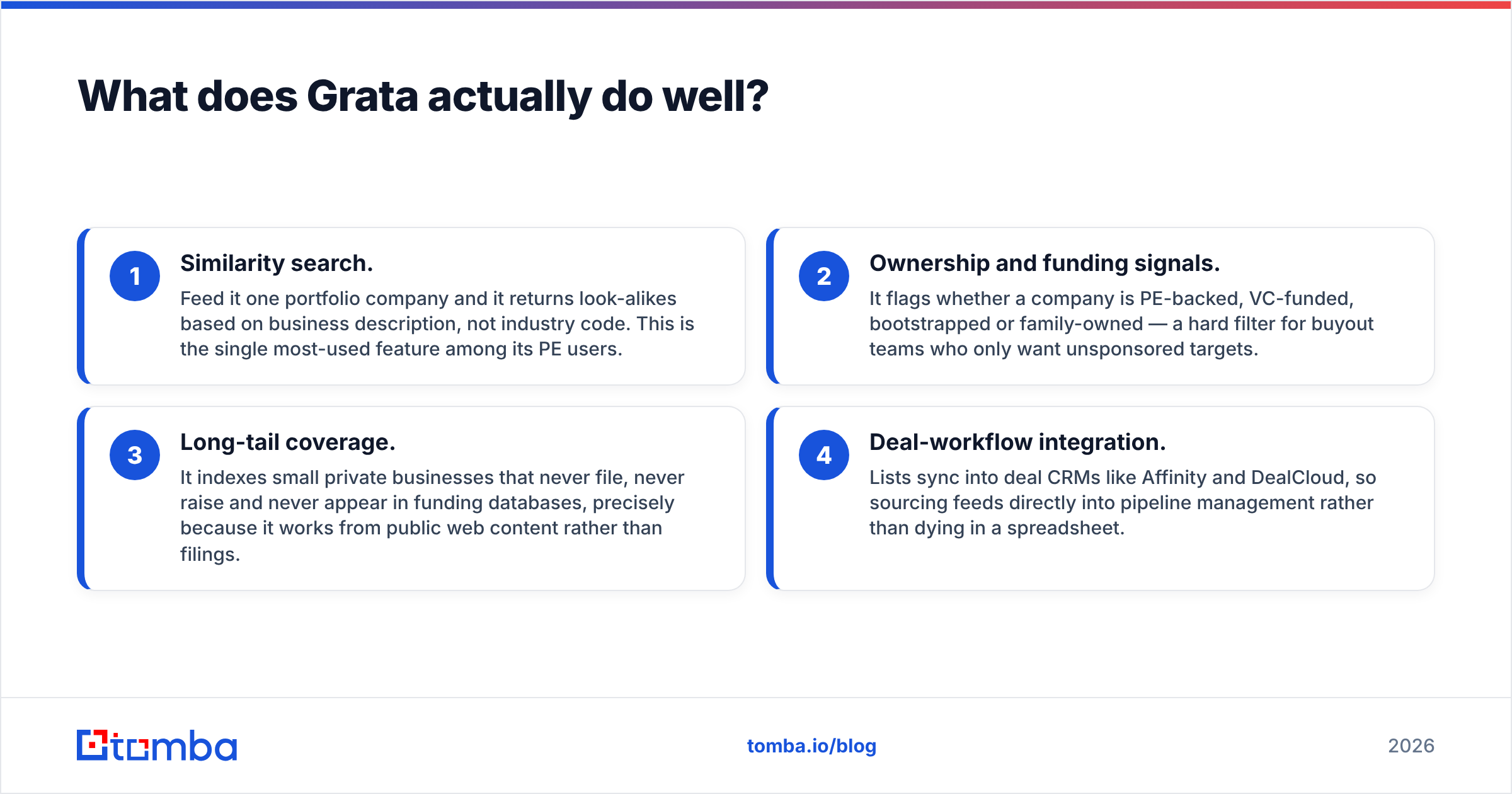
Four things Grata does that a generic lead tool does not:
- Similarity search. Feed it one portfolio company and it returns look-alikes based on business description, not industry code. PE users lean on this more than any other feature.
- Ownership and funding signals. It flags whether a company is PE-backed, VC-funded, bootstrapped or family-owned. That is a hard filter for buyout teams who only want unsponsored targets.
- Long-tail coverage. It indexes small private firms that never file and never raise. It works from public web content rather than filings, so those firms still show up.
- Deal-workflow integration. Lists sync into deal CRMs like Affinity and DealCloud. Sourcing feeds pipeline management instead of dying in a spreadsheet.
If none of those four bullets fits your job, Grata is the wrong buy. The demo will still look great.
Where does Jet Leads Pro fit better?#
Jet Leads Pro wins on the metric that decides most outbound budgets: cost per usable contact.
An SDR team sending 3,000 emails a month needs breadth, speed and a low per-record cost. They do not need semantic search over niche manufacturing subsectors. They need marketing directors at Series B SaaS companies in three countries, exported by Thursday. That is a filter query, not a research project. Paying enterprise data prices for it is pure waste.
The trade-off is data depth. Volume lead tools license or aggregate contact data. Freshness varies a lot by segment and geography. Job churn in B2B runs high, so a list built in January is well past its best by April. That is not a knock on one vendor. It is how static contact databases work, and it applies to Grata's contact layer too.
Three questions worth asking any volume lead vendor before you commit:
- How are credits consumed? Per search, per revealed contact, or per export? The gap can be 5x on the same monthly bill.
- Are contacts verified at export time or at ingest time? Ingest-time checks mean you inherit whatever decay happened since.
- What is the bounce guarantee? A refund is real. A credits-only guarantee quietly hands the cost of bad data back to you.
How much do Grata and Jet Leads Pro actually cost?#
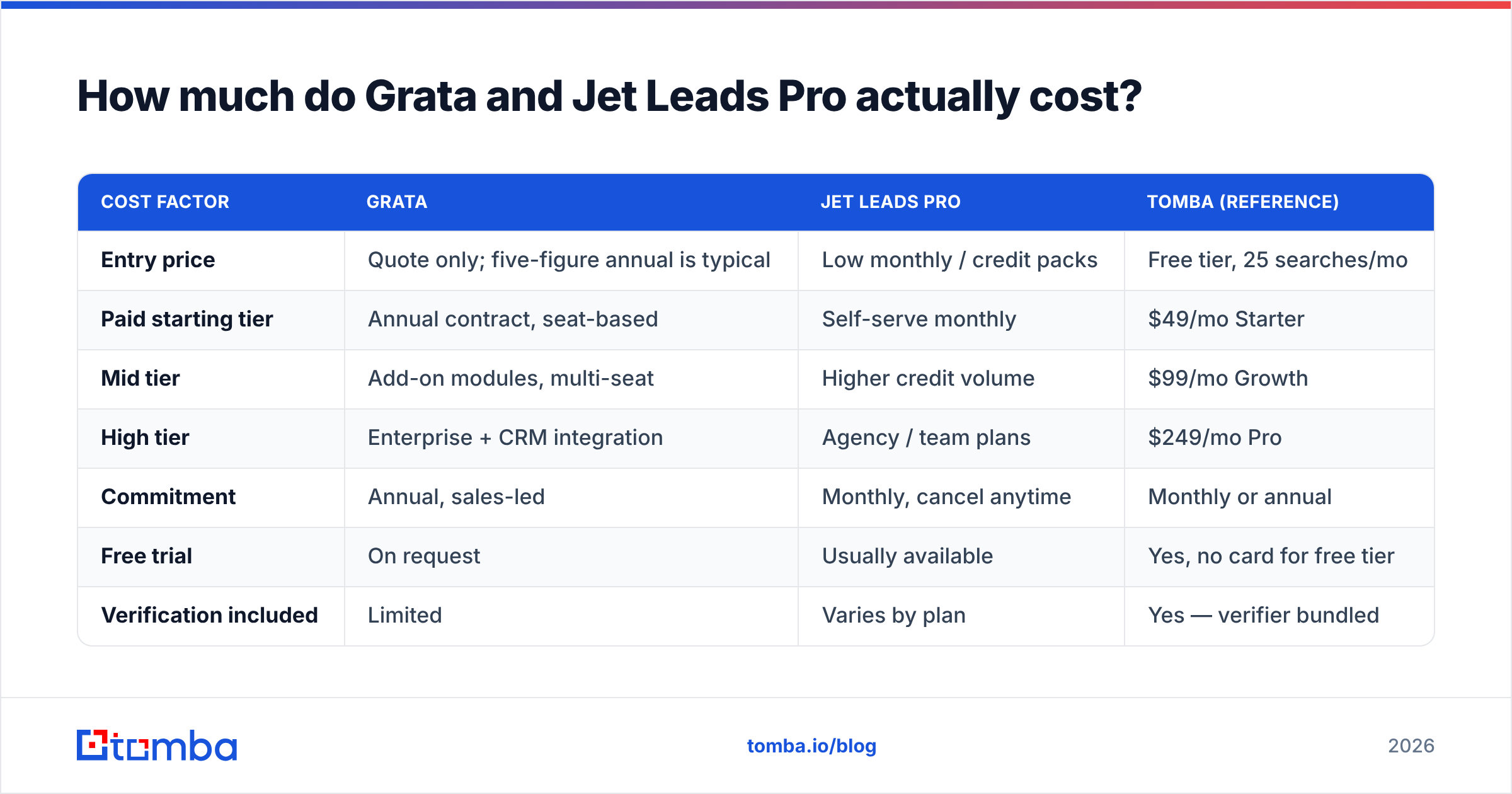
Pricing is where Grata vs Jet Leads Pro stops being a fair fight. Neither vendor publishes a full price card. Treat these as planning bands, not quotes, and confirm both directly.
| Cost factor | Grata | Jet Leads Pro | Tomba (reference) |
|---|---|---|---|
| Entry price | Quote only; five-figure annual is typical | Low monthly / credit packs | Free tier, 25 searches/mo |
| Paid starting tier | Annual contract, seat-based | Self-serve monthly | $49/mo Starter |
| Mid tier | Add-on modules, multi-seat | Higher credit volume | $99/mo Growth |
| High tier | Enterprise + CRM integration | Agency / team plans | $249/mo Pro |
| Commitment | Annual, sales-led | Monthly, cancel anytime | Monthly or annual |
| Free trial | On request | Usually available | Yes, no card for free tier |
| Verification included | Limited | Varies by plan | Yes — verifier bundled |
The number that matters is not the sticker price. It is the cost per contact you can actually email. A $20,000 annual contract that yields 4,000 deliverable contacts costs $5 each. A $49/mo plan that yields 500 verified contacts costs about $0.10 each.
Those are not comparable products. They are comparable line items on the same budget, and finance will compare them either way.
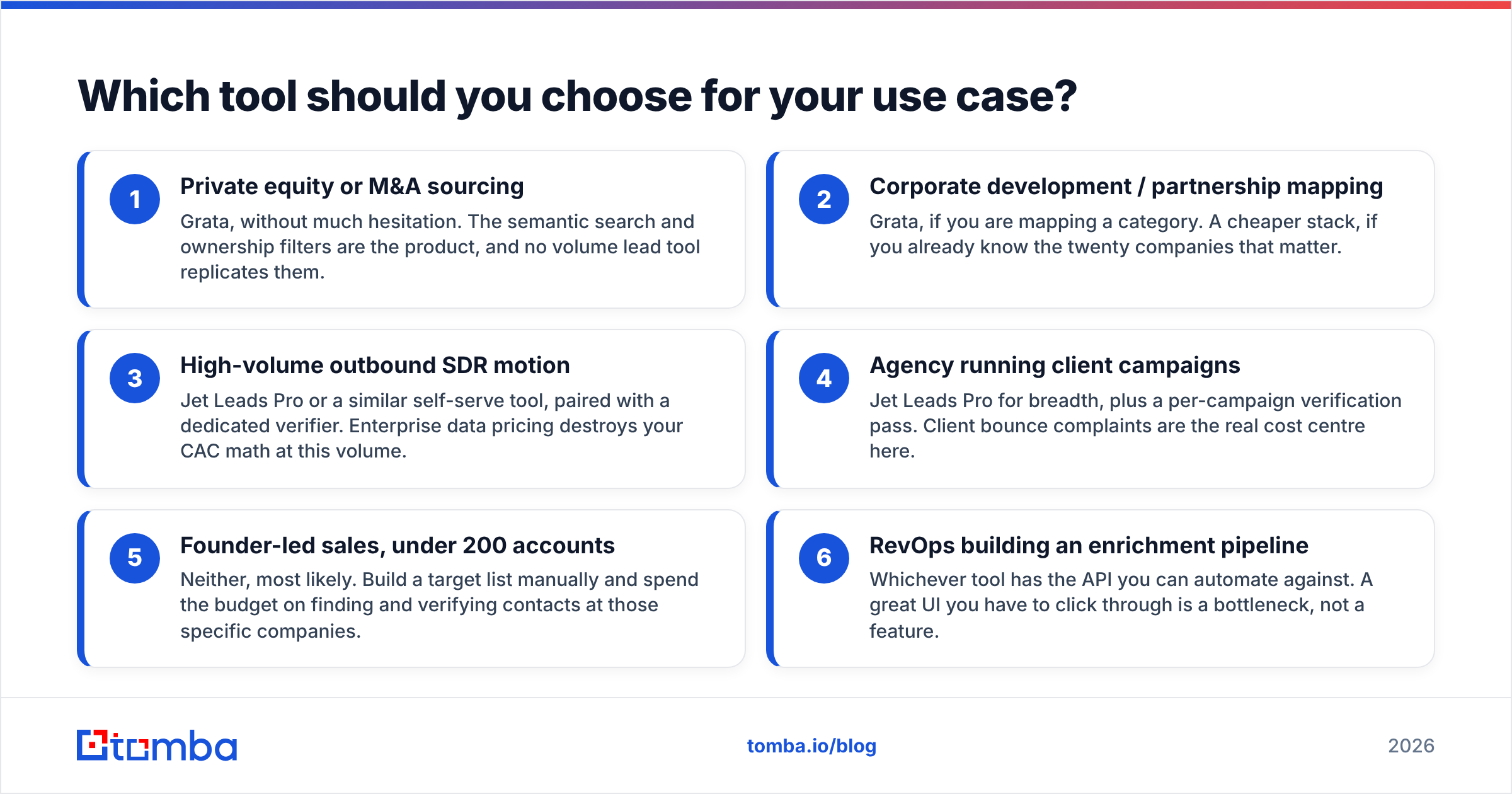
Which tool should you choose for your use case?#
Match the tool to the job, not to the demo you enjoyed most:
- Private equity or M&A sourcing — Grata, with little hesitation. Semantic search and ownership filters are the product. No volume lead tool copies them.
- Corporate development or partnership mapping — Grata, if you are mapping a whole category. A cheaper stack, if you already know the twenty companies that matter.
- High-volume outbound SDR motion — Jet Leads Pro or a similar self-serve tool, paired with a verifier. Enterprise data pricing wrecks your CAC math at this volume.
- Agency running client campaigns — Jet Leads Pro for breadth, plus a verification pass per campaign. Client bounce complaints are the real cost centre.
- Founder-led sales, under 200 accounts — Neither, most likely. Build the target list by hand. Spend the budget on finding and verifying contacts at those accounts.
- RevOps building an enrichment pipeline — Whichever tool has the API you can automate against. A great UI you have to click through is a bottleneck, not a feature.

What do both tools leave you to solve?#
The last mile: turning a company record into a deliverable inbox.
Every comparison of company-intelligence and lead-list tools hits this gap. It is where campaigns break. Grata hands you 340 well-targeted companies with partial executive contact coverage. Jet Leads Pro hands you 5,000 contacts with unknown decay since the last refresh. Send either without a verification pass and you get a 12% bounce rate and a bruised sending domain.
A workable pattern that costs very little:
- Discover companies in whichever platform fits your motion.
- Find the people at those domains with an email finder that works from name plus domain. Or run a domain search to pull every public address at a company in one call.
- Verify before send. Run every address through an email verifier so catch-alls and dead mailboxes never reach your sequencer.
- Enrich what survives. Add role, seniority and company attributes with data enrichment so your sequences can personalize.
That four-step chain costs $49/mo at the Starter tier. It removes the biggest source of wasted outbound spend: emailing addresses that were never going to arrive. It also lets you buy the cheaper discovery tool without paying for it in bounce rate.
Frequently asked questions#
Is Grata vs Jet Leads Pro a fair comparison at all? Not really. Grata competes with Sourcescrub, PitchBook and Cyndx in deal sourcing. Jet Leads Pro competes with self-serve B2B contact databases. They overlap only in that both return company records.
Can Grata replace a contact database for outbound? It can supply executive contacts, but the economics are wrong. You would pay deal-sourcing prices for contact data at SDR volumes. You would still need verification before sending.
Does Jet Leads Pro work for M&A target research? For obvious, well-categorized industries, sometimes. For thesis-driven searches in fragmented niches, structured filters miss the long tail. That long tail is exactly what Grata sells.
Which has better data accuracy? Different kinds of accuracy. Grata reads the website, so its read on what a company does is strong. Contact-level accuracy in any static database decays with job churn. Verify at send time, whoever the vendor is.
Do I need both? Rarely. Most teams need one discovery layer and one contact layer. Buying two discovery tools is the most common overlapping spend in this stack.
The bottom line#
Grata vs Jet Leads Pro comes down to what your work actually is. Grata wins if you need to find companies nobody else can find, and your budget treats data as deal infrastructure. Jet Leads Pro wins if you run volume outbound and every dollar has to show up as pipeline this quarter. Neither wins the argument the other is having.
Whichever discovery layer you pick, the contact layer decides whether campaigns live or die. Start with the Tomba Email Finder — free for your first 25 searches, $49/mo when you scale. Pair it with the built-in verifier so every address you export is one you can actually reach. Then you can choose your discovery tool on merit, not on whose contact data scares you least.
Related guides#
Ready to find emails that actually work?
Join 150,000+ professionals who stopped guessing and started sending. Free credits on signup — no credit card required.
Get the Tomba newsletter
Practical outbound tactics and product updates — once every two weeks.
About the author