Grata vs LeadzenAI (2026): Which B2B Data Tool Wins?
Grata maps private companies for deal sourcing. LeadzenAI builds contact lists for sales teams. They get compared constantly — and they solve different problems. Here is the honest breakdown, plus what to do about the contact-data gap both leave behind.
TL;DR
- Grata is a private-company search engine built for deal sourcing — private equity, investment banking, and corporate development teams looking for acquisition targets. It is not a sales prospecting tool, and pricing is quote-only (commonly reported in the low five figures per year).
- LeadzenAI is a self-serve B2B lead intelligence platform — search, LinkedIn extension, bulk enrichment — priced for individual sellers and small teams, with published plans well under Grata's entry point.
- They overlap on about 20% of the job. Both help you find companies. Only one of them was designed to hand you a contact you can actually email today.
- Neither is a strong standalone contact-data layer. Grata largely stops at the company record; LeadzenAI gives you contacts but users routinely report bounce rates that require a second verification pass.
- The practical 2026 stack for most revenue teams: use one platform to find the accounts, then a dedicated email finder and verifier to make those accounts contactable.
What are Grata and LeadzenAI, exactly?#
Start here, because the comparison only makes sense once you accept that these tools were built for two different buyers.
Grata is a search engine for private companies. You describe a business in plain language — "vertical SaaS for dental practices, US, bootstrapped, 20-200 employees" — and it returns a list of companies that match, built from crawling company websites rather than relying only on firmographic tags. Its users are deal professionals: PE associates building target lists, bankers running buy-side mandates, corp dev teams mapping a category. Grata was acquired by Datasite in late 2024, which pushed it further into the M&A workflow stack rather than the sales stack.
LeadzenAI is a B2B lead intelligence platform aimed at sellers, marketers, and recruiters. It combines a searchable contact database, real-time search, a LinkedIn browser extension, and bulk lookup. The buyer is an SDR, a founder doing their own outbound, or a small agency building lists — not a deal team.
So the honest framing of Grata vs LeadzenAI is not "which is better." It is: are you sourcing companies to buy, or contacts to sell to? Everything else follows from that.
What does Grata actually do well?#
Grata's differentiator is how it understands what a company does, not just what industry code it was assigned.
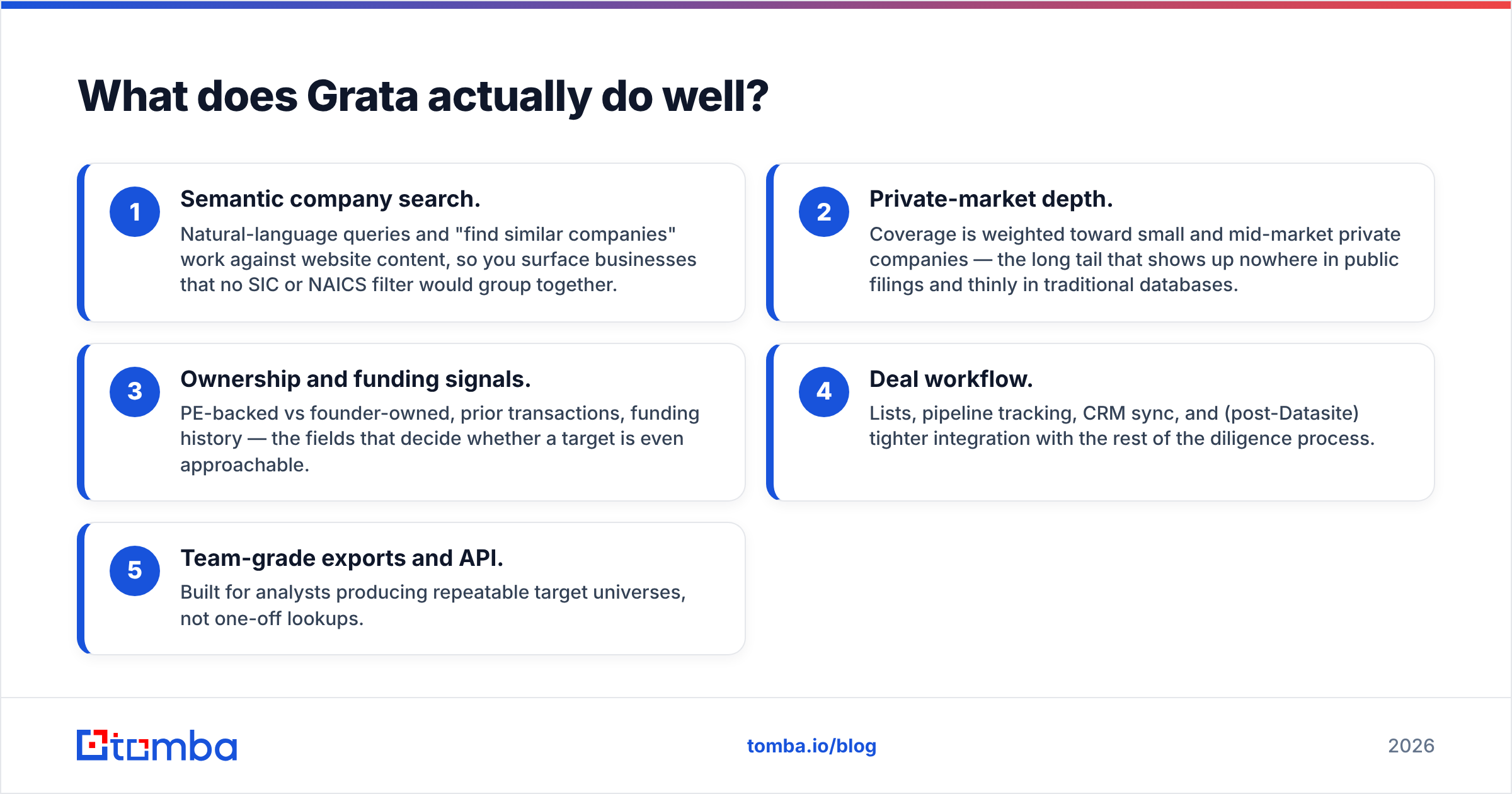
- Semantic company search. Natural-language queries and "find similar companies" work against website content, so you surface businesses that no SIC or NAICS filter would group together.
- Private-market depth. Coverage is weighted toward small and mid-market private companies — the long tail that shows up nowhere in public filings and thinly in traditional databases.
- Ownership and funding signals. PE-backed vs founder-owned, prior transactions, funding history — the fields that decide whether a target is even approachable.
- Deal workflow. Lists, pipeline tracking, CRM sync, and (post-Datasite) tighter integration with the rest of the diligence process.
- Team-grade exports and API. Built for analysts producing repeatable target universes, not one-off lookups.
What Grata does not do well: give you the specific person's verified work email on a plate. It surfaces company records and some contacts, but if your next step is a cold sequence to 400 VPs of Engineering, Grata is the wrong starting point and an expensive one.

What does LeadzenAI actually do well?#
LeadzenAI sits at the opposite end of the price and complexity curve.
- Self-serve from minute one. Sign up, search, export. No procurement cycle, no annual commitment, no demo gate.
- Real-time and database search. You can query the stored index or trigger a live lookup when the cached record looks stale.
- LinkedIn extension. Pull contact details while browsing profiles or search results — the workflow most SDRs actually live in.
- Bulk enrichment. Upload a list of names and domains, get contact fields back, which is the core job for anyone running volume outbound.
- Price point. Published self-serve tiers, with entry plans that cost less per month than a single Grata seat costs per week under typical enterprise contracts.
The trade-off is depth and consistency. LeadzenAI's company-level intelligence is thin compared with Grata's — you will not run a category map or an ownership screen inside it. And like most aggregated contact databases, coverage quality varies sharply by geography and company size. Users comparing tools on G2 consistently flag the same pattern across this category: strong coverage in some segments, noticeably weaker in others, with verification left to the buyer.
How do Grata and LeadzenAI compare head-to-head?#
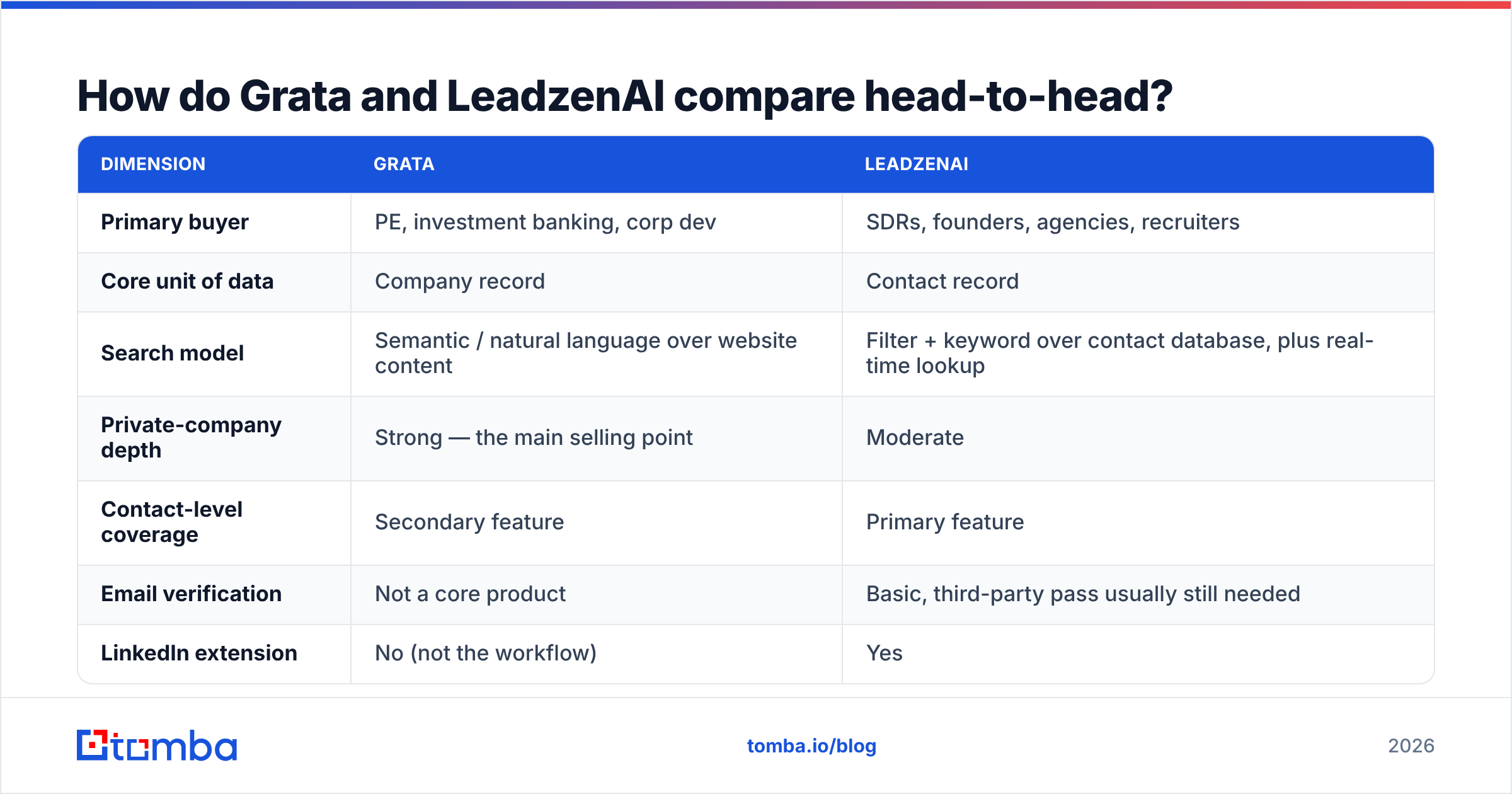
| Dimension | Grata | LeadzenAI |
|---|---|---|
| Primary buyer | PE, investment banking, corp dev | SDRs, founders, agencies, recruiters |
| Core unit of data | Company record | Contact record |
| Search model | Semantic / natural language over website content | Filter + keyword over contact database, plus real-time lookup |
| Private-company depth | Strong — the main selling point | Moderate |
| Contact-level coverage | Secondary feature | Primary feature |
| Email verification | Not a core product | Basic, third-party pass usually still needed |
| LinkedIn extension | No (not the workflow) | Yes |
| Pricing model | Quote-only, annual contract | Published self-serve tiers, monthly available |
| Typical entry cost | Low five figures/year (reported) | Under $50/mo range at entry |
| Free tier | No | Limited trial credits |
| API access | Yes, enterprise tier | Yes, on higher plans |
| Best at | Building a universe of acquisition targets | Building a contactable outbound list fast |
Read that table as a decision tree, not a scorecard. If the "primary buyer" row does not describe you, the rest of the column is irrelevant.
Which one has better data — and does that question even make sense?#
It does not, quite, because they are measured on different axes.
Grata's quality claim is recall on obscure private companies. If you ask for niche vertical software businesses in the Midwest under 100 employees, the win condition is surfacing the twelve you had never heard of. Nobody grades Grata on whether the CFO's email bounces.
LeadzenAI's quality claim is contact accuracy at volume. The win condition is that the 2,000 rows you exported land in inboxes. That is a bounce-rate question, and bounce rate is where nearly every aggregated database — LeadzenAI included, and this is not a knock specific to them — underperforms its marketing page. Databases decay at roughly 2-3% per month as people change jobs. A record that was correct in March is a coin flip by December.
Three things follow from that:
- Never send to an unverified export, regardless of which vendor produced it. Run it through a dedicated email verifier first.
- Catch-all domains need separate handling. A large share of B2B domains accept everything at the SMTP layer, so a generic "valid" result means nothing. That is what a catch-all verifier is for.
- Treat coverage claims as directional. Every vendor in this space quotes a headline profile count. What matters is hit rate on your ICP, which you can only learn by testing 100 of your own accounts against each tool.
How much do Grata and LeadzenAI cost in 2026?#
Pricing is the sharpest divide in the entire comparison.
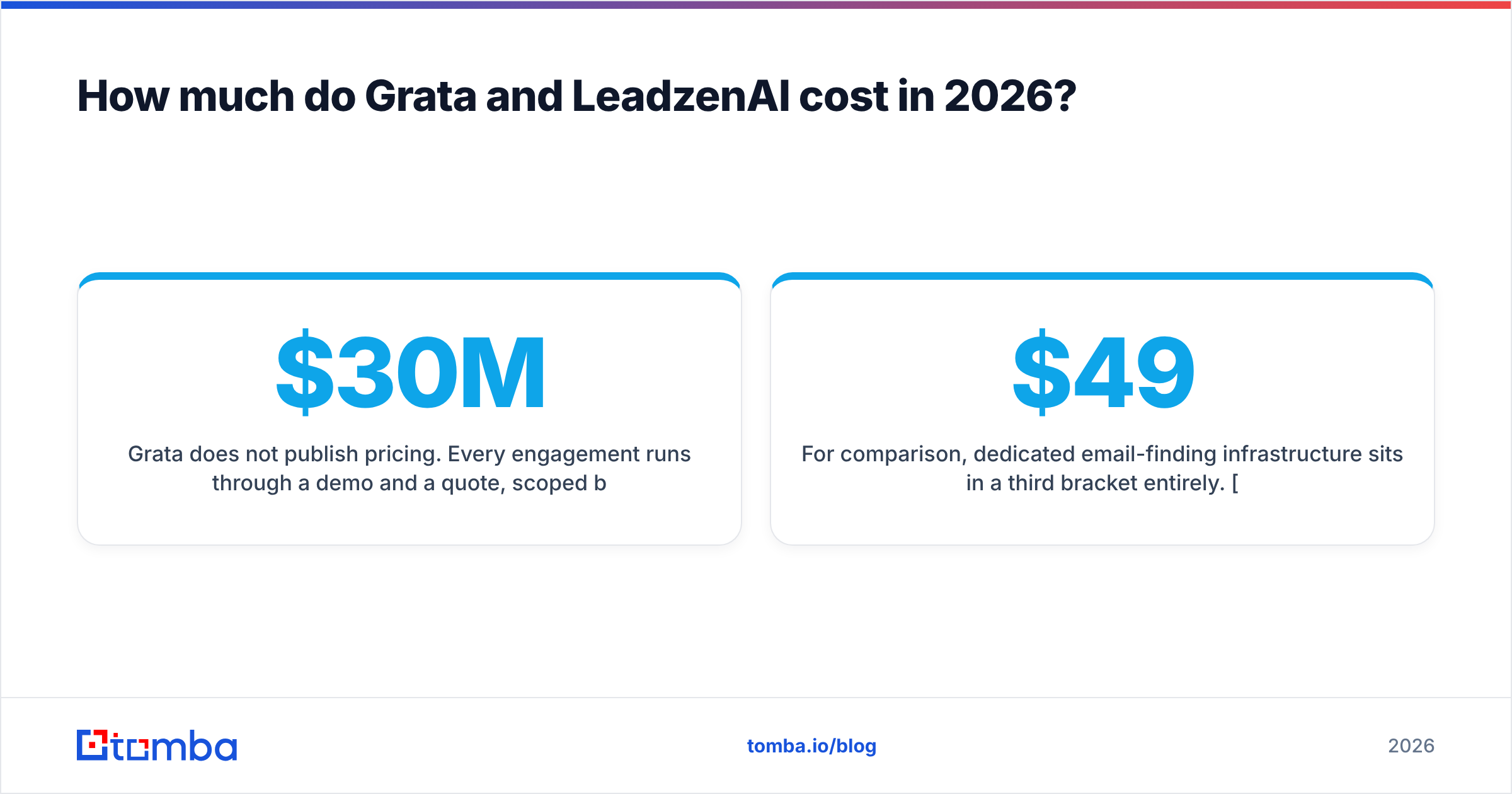
Grata does not publish pricing. Every engagement runs through a demo and a quote, scoped by seats and data access. Public reporting and buyer chatter put typical annual contracts in the low five figures, scaling with team size. That is rational for a fund evaluating a $30M acquisition — the tool pays for itself if it surfaces one proprietary deal. It is irrational for a 4-person sales team.
LeadzenAI publishes self-serve tiers with credit-based limits, starting low enough that an individual seller can expense it without approval. Costs scale with credits consumed rather than seats.
For comparison, dedicated email-finding infrastructure sits in a third bracket entirely. Tomba pricing runs Free (25 searches/mo), Starter $49/mo, Growth $99/mo, Pro $249/mo, and custom Enterprise — which is roughly the cost of one week of a typical Grata contract, for a completely different job.
The strategic read: you are not choosing between three price points for the same thing. You are deciding how much of your budget belongs to finding accounts versus making them contactable. Most teams badly over-index on the first and under-invest in the second, then wonder why their sequences bounce.
Who should choose Grata?#
Choose Grata if three or more of these describe you:
- You buy companies, you do not sell to them. Deal sourcing is the job.
- Your target list is the deliverable. An MD asks for "everything in industrial IoT services under $20M revenue" and you have to produce a defensible universe.
- Long-tail private companies are the whole point. Public-company data and standard firmographics already fail you.
- Ownership structure matters more than job titles. You need to know who backs the business, not who runs marketing.
- Budget is measured against deal value, not CAC. A five-figure annual spend is a rounding error against the transaction.
If that is you, LeadzenAI will not substitute. It was never trying to.
Who should choose LeadzenAI?#
Choose LeadzenAI if:
- You need contacts this week, not a data platform rollout next quarter.
- You work inside LinkedIn and want extension-based capture in that flow. If LinkedIn is your primary sourcing surface, pair it with a dedicated LinkedIn finder to close the email gap.
- Budget is real and self-serve matters. No procurement, no annual lock-in.
- Volume beats depth. You would rather have 1,000 decent contacts today than 40 perfectly researched accounts next month.
- Your ICP sits in LeadzenAI's stronger coverage segments — test before you commit, especially outside North America and Western Europe.

Where do both tools leave a gap?#
Both leave the same gap, at different points in the funnel: a verified, deliverable email address for the specific human you need to reach.
Grata gets you a company. LeadzenAI gets you a contact record of uncertain freshness. Neither was architected as an email-finding and verification layer, and neither should be graded as one. That layer is a distinct technical problem — pattern inference, SMTP validation, catch-all detection, continuous re-verification — and it is why most mature outbound stacks run a dedicated finder alongside whichever database they use for discovery.
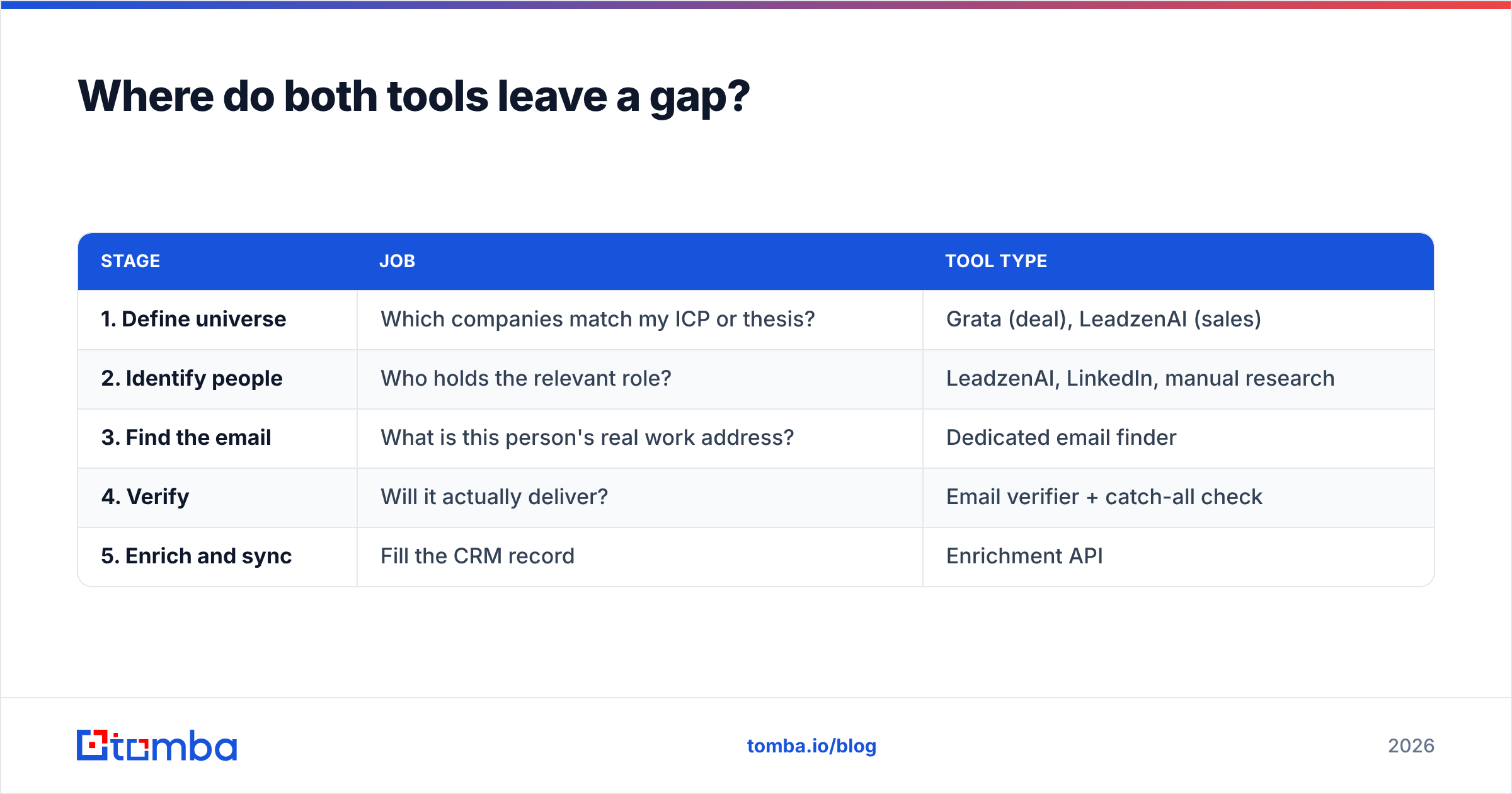
The practical assembly looks like this:
| Stage | Job | Tool type |
|---|---|---|
| 1. Define universe | Which companies match my ICP or thesis? | Grata (deal), LeadzenAI (sales) |
| 2. Identify people | Who holds the relevant role? | LeadzenAI, LinkedIn, manual research |
| 3. Find the email | What is this person's real work address? | Dedicated email finder |
| 4. Verify | Will it actually deliver? | Email verifier + catch-all check |
| 5. Enrich and sync | Fill the CRM record | Enrichment API |
Stages 3 and 4 are where deliverability is won or lost, and they are precisely where a generalist platform is weakest. Running a domain-level sweep through domain search on a Grata-built target list, or verifying a LeadzenAI export before it touches your sending domain, costs a fraction of either platform and protects the sender reputation you spent months building.
Grata vs LeadzenAI: what is the actual verdict?#
If you source deals, Grata. If you source leads, LeadzenAI. If you do both, you need neither exclusively — you need a discovery tool plus a contact layer.
That is the unglamorous answer, and it is the right one. The teams that get burned are the ones who buy an expensive company-intelligence platform expecting it to double as an outbound engine, or who buy a cheap contact database and skip verification because "the tool said the emails were valid."
A reasonable 2026 configuration by team type:
- PE / corp dev: Grata for sourcing, plus a dedicated finder and verifier for outreach to founders and owners. Contact quality matters more here, not less — you get one shot at a proprietary approach.
- SMB sales team: LeadzenAI or a comparable database for discovery, plus an independent verification pass before every send.
- Solo founder doing outbound: Skip the enterprise tier entirely. A bulk email finder plus a scraped or manually built account list will outperform a tool you cannot afford to use at volume.
- RevOps building infrastructure: Go API-first. Wire discovery and enrichment into the CRM so records self-heal instead of decaying between quarterly list buys.
Ready to close the contact-data gap?#
Whichever side of the Grata vs LeadzenAI decision you land on, you still need addresses that deliver. The Tomba Email Finder turns a name and a domain into a verified professional email, with SMTP validation and catch-all detection built in — so the list you spent real money assembling actually reaches an inbox. Start free with 25 searches a month, and if it earns its place, Starter is $49/mo. Test it against 100 accounts from your current database and compare the bounce rates yourself. That is the only benchmark that matters.
Related guides#
Ready to find emails that actually work?
Join 150,000+ professionals who stopped guessing and started sending. Free credits on signup — no credit card required.
Get the Tomba newsletter
Practical outbound tactics and product updates — once every two weeks.
About the author