Grata vs Seamless.AI (2026): Which B2B Data Tool Wins?
Grata maps private companies for deal teams. Seamless.AI sells contact credits to sales reps. They are not the same product — and picking the wrong one costs you a five-figure contract. Here is the honest 2026 breakdown.
Grata vs Seamless.AI is a choice between two different jobs. Grata finds private companies. Seamless.AI finds people to email. Pick the wrong one and you pay five figures for a tool your team never opens.
TL;DR
- Grata is a company search engine, not a contact database. It helps private equity, M&A, and corporate development teams find private companies that never show up in Crunchbase. Contact data is a side dish.
- Seamless.AI is a contact database with a real-time lookup engine. It hands SDRs emails and phone numbers at volume. Company intelligence is the side dish.
- Pricing is the fastest way to disqualify one. Grata is an annual enterprise contract in the five figures. Seamless.AI is per-seat with credit caps and an annual commitment most buyers only notice at renewal.
The cheaper path most teams miss:
- Neither is a cheap way to just get verified emails. If that's the actual job, a dedicated email finder at $49/mo does it for a fraction of either contract.
- Best combo for most mid-market teams: a targeting layer (Grata, or your own ICP list) plus a per-lookup email tool — not one platform pretending to do both.
Grata vs Seamless.AI: what is each tool, actually?#
They get compared because both are sold to revenue teams and both have "find companies" in the pitch. Under the hood they solve opposite halves of the same problem.
Grata indexes private companies — the ones with no filings, no funding rounds, and a five-page website. It crawls company sites and reads what the business says it does. Then you search in plain language: "industrial water treatment services in the Midwest, 20-200 employees, founder-owned." Its buyers are deal teams. Think private equity associates building a thesis list, bankers sourcing sell-side targets, and corp dev teams mapping a fragmented category. Grata became part of Datasite after a 2024 acquisition, which pushed it further toward the M&A workflow.
Seamless.AI is a B2B contact database. You search for a title at a company, it returns emails and phone numbers, and it burns credits doing it. Its pitch is the "real-time search engine" framing. Instead of serving a static database row, it tries a live lookup and verification pass at query time. Its buyers are SDR teams, agency prospectors, and recruiters who need contact volume this week.
So the honest framing of Grata vs Seamless.AI is not "which is better." It's simpler: are you deciding who to talk to, or reaching people you already picked?
Grata vs Seamless.AI: how do they compare head-to-head?#
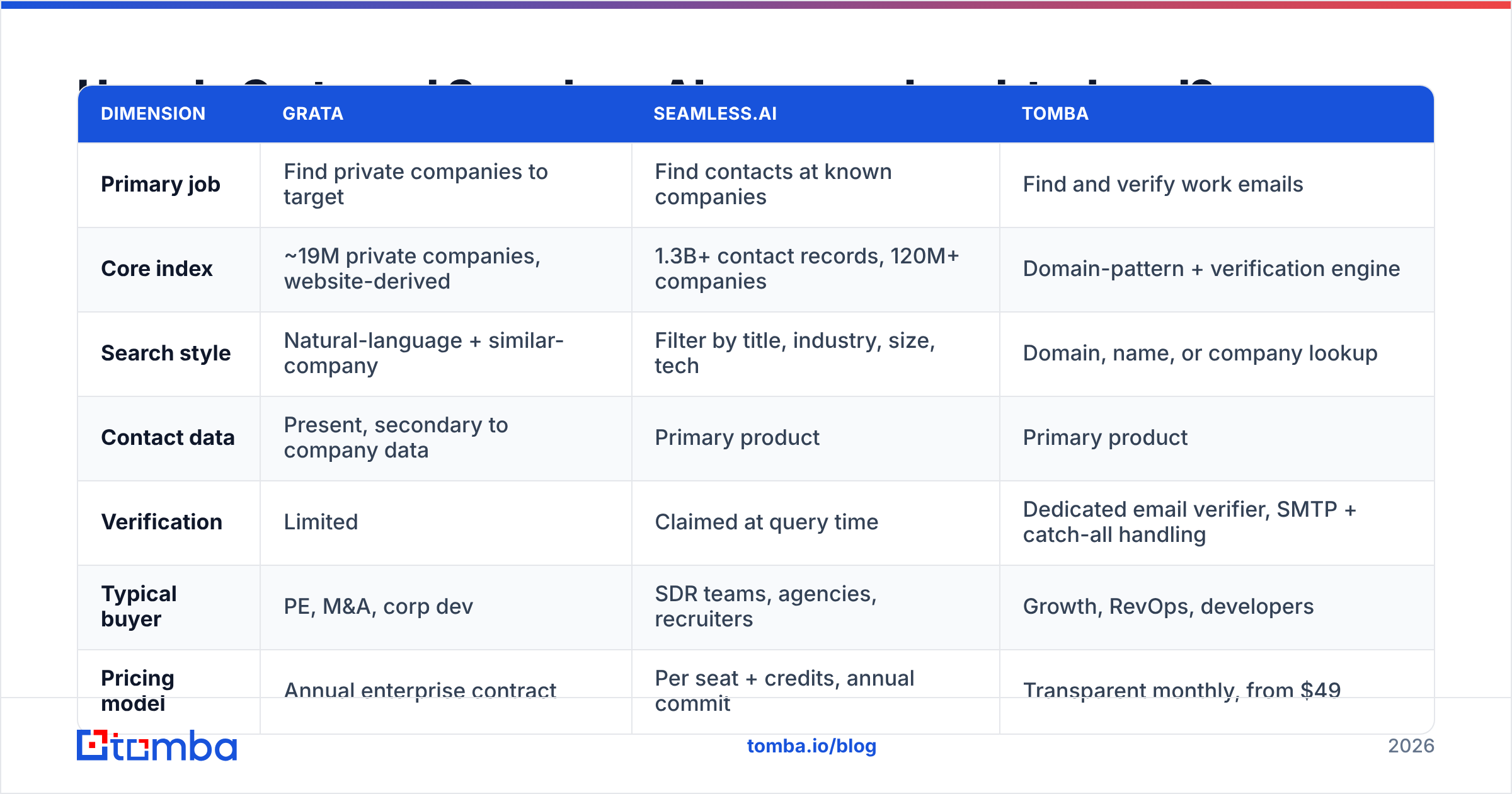
| Dimension | Grata | Seamless.AI | Tomba |
|---|---|---|---|
| Primary job | Find private companies to target | Find contacts at known companies | Find and verify work emails |
| Core index | ~19M private companies, website-derived | 1.3B+ contact records, 120M+ companies | Domain-pattern + verification engine |
| Search style | Natural-language + similar-company | Filter by title, industry, size, tech | Domain, name, or company lookup |
| Contact data | Present, secondary to company data | Primary product | Primary product |
| Verification | Limited | Claimed at query time | Dedicated email verifier, SMTP + catch-all handling |
| Typical buyer | PE, M&A, corp dev | SDR teams, agencies, recruiters | Growth, RevOps, developers |
| Pricing model | Annual enterprise contract | Per seat + credits, annual commit | Transparent monthly, from $49 |
| Free option | Demo only | Free tier with limited credits | Free tier, 25 searches/mo |
| API | Enterprise tier | Enterprise add-on | Tomba API on all paid plans |
| Best at | Category mapping nobody else can do | Contact volume in one interface | Accuracy per lookup, cost control |
The table makes the split obvious. Grata wins on a question Seamless.AI cannot answer: "who are the 340 companies in North America that do this specific thing?" Seamless.AI wins on one Grata answers only partially: "give me the VP of Ops email at all 340 of them."
What does Grata do best?#
Four things, and they are genuinely hard to replicate:
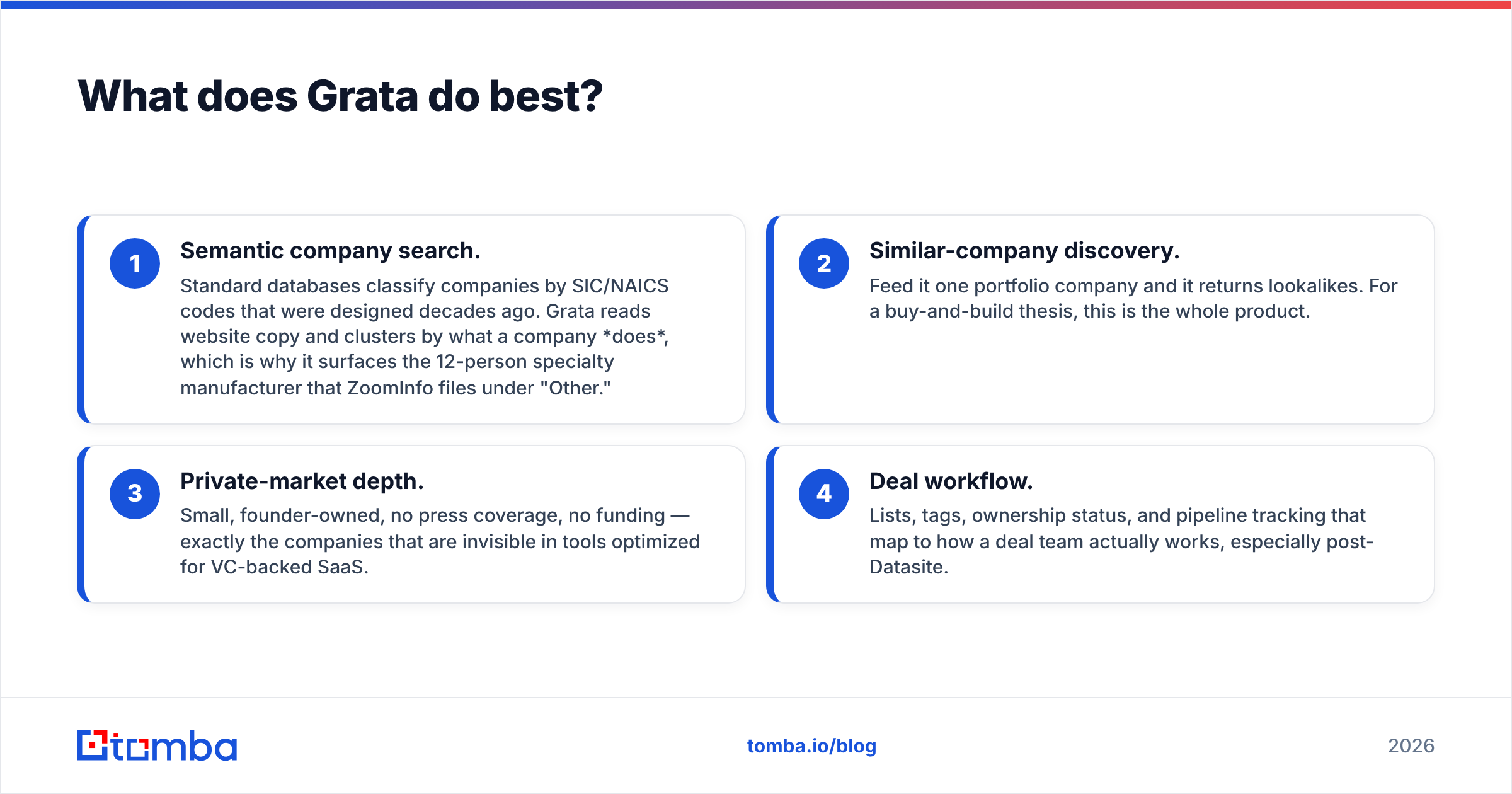
- Semantic company search. Standard databases sort companies by SIC/NAICS codes drawn up decades ago. Grata reads website copy and clusters by what a company does. That is why it surfaces the 12-person specialty manufacturer that ZoomInfo files under "Other."
- Similar-company discovery. Feed it one portfolio company and it returns lookalikes. For a buy-and-build thesis, this is the whole product.
- Private-market depth. Small, founder-owned, no press coverage, no funding — exactly the companies that are invisible in tools built for VC-backed SaaS.
- Deal workflow. Lists, tags, ownership status, and pipeline tracking that map to how a deal team actually works, especially post-Datasite.
Where it falls down for sales teams: contact coverage is thinner than a dedicated contact vendor. Seat pricing assumes a small number of highly paid users. No 15-rep SDR team can afford a seat each.
What does Seamless.AI do best?#
- Volume in one place. Search, build a list, export, push to CRM. For an SDR who needs 400 contacts before Friday, the workflow is short.
- Chrome extension. Pull contacts while browsing LinkedIn or a company site without switching tabs.
- Adjacent features. Buyer intent, job-change alerts, and AI writing tools are bundled rather than sold separately.
- A real free tier. You can test data quality on your own ICP before you talk to a rep — do this.
Where it falls down: reviewers on G2 raise two themes again and again. First, accuracy varies. Coverage is strong for US mid-market tech and weaker for European, non-tech, and sub-20-employee companies. Second, contract friction: credits that expire, auto-renewal terms, and a sales motion some buyers find aggressive. Neither is disqualifying, but both belong in your evaluation notes. If those themes worry you, the Seamless.AI alternative comparison walks through the per-lookup math.
Grata vs Seamless.AI: how accurate is the data?#
Accuracy claims from any vendor are marketing until you test them on your own list. That said, the failure modes differ in a predictable way.
Grata's company data is strong because it comes from the company's own website. The source is primary. Its contact data is weaker because it is assembled, not the core index. Expect good firmographics and patchy direct dials.
Seamless.AI's contact data is broad, and breadth is the point. Breadth and precision trade off. A record that exists is not a record that delivers. "Verified at query time" also means different things to different vendors. Some check syntax and MX. Some run a full SMTP handshake. Some treat a catch-all domain as a pass when it should be flagged. Catch-all domains cause most bounce-rate surprises, so a separate catch-all verifier step is worth running no matter which platform sourced the address.
The only test that matters: take 100 contacts from your real ICP, not the vendor's sample. Run them through each tool. Verify the output independently, then send a small campaign. Measure bounce rate, not "records returned."
Grata vs Seamless.AI pricing: what does each cost in 2026?#
Neither publishes full pricing, which is itself a data point about who they sell to.
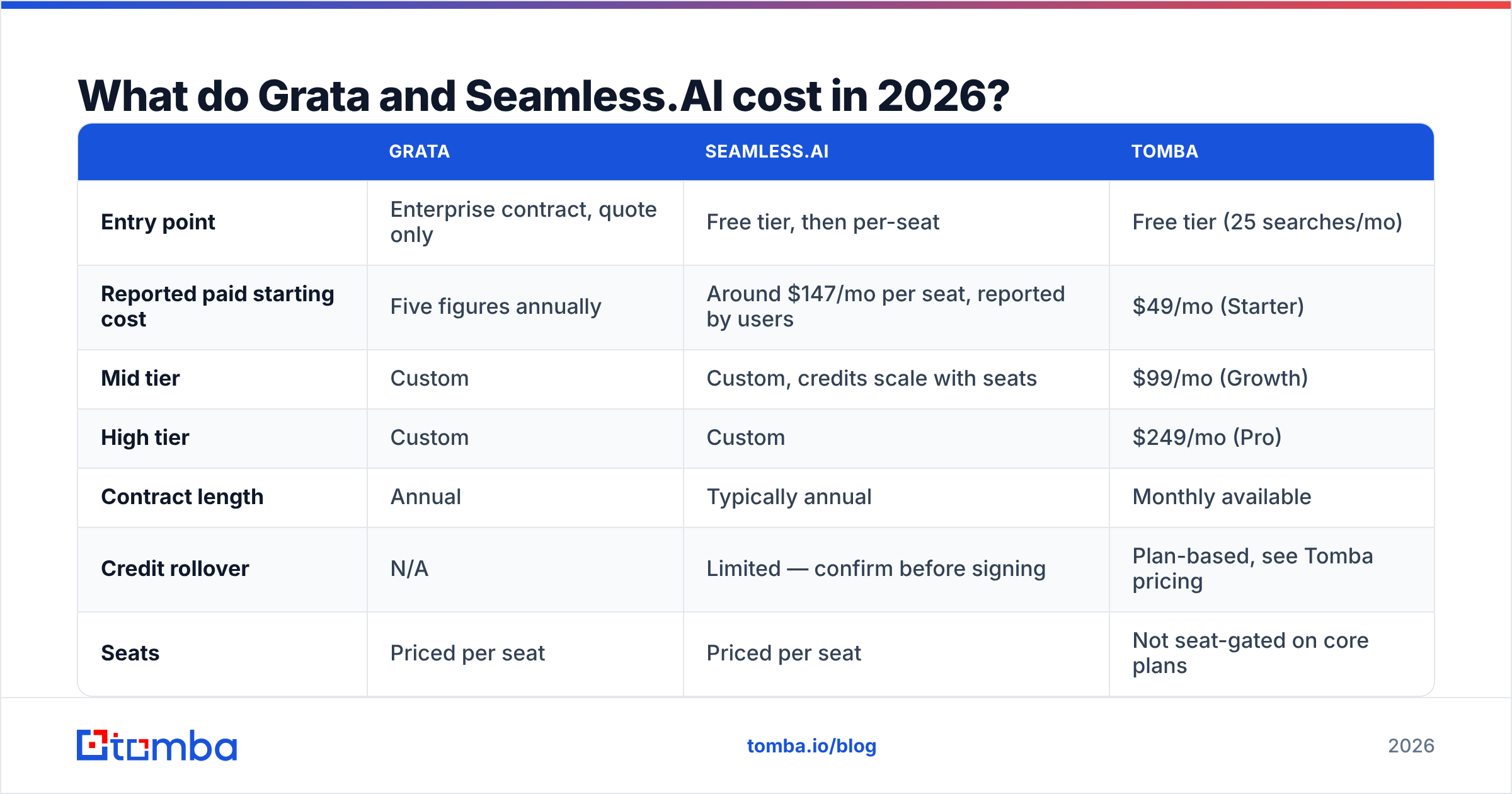
| Grata | Seamless.AI | Tomba | |
|---|---|---|---|
| Entry point | Enterprise contract, quote only | Free tier, then per-seat | Free tier (25 searches/mo) |
| Reported paid starting cost | Five figures annually | Around $147/mo per seat, reported by users | $49/mo (Starter) |
| Mid tier | Custom | Custom, credits scale with seats | $99/mo (Growth) |
| High tier | Custom | Custom | $249/mo (Pro) |
| Contract length | Annual | Typically annual | Monthly available |
| Credit rollover | N/A | Limited — confirm before signing | Plan-based, see Tomba pricing |
| Seats | Priced per seat | Priced per seat | Not seat-gated on core plans |
Two cost traps to write into your evaluation doc:
- Seat math. Both Grata and Seamless.AI price per user. A team of eight multiplies the sticker price by eight. Tools priced on lookups rather than seats behave very differently as the team grows.
- Renewal terms. Ask explicitly, in writing, about auto-renewal windows, credit expiry, and mid-term downgrade rights. This is the most common complaint against enterprise data contracts, and one email before you sign avoids it.
Grata vs Seamless.AI: which one should you pick?#
Match the tool to the job rather than the feature list:
- You source acquisitions or build thesis lists. Grata. Nothing else maps fragmented private markets as well, and the contract price is small next to a single deal.
- You run a high-volume SDR motion in US mid-market tech. Seamless.AI is a reasonable fit. Start on the free tier, test your ICP, and negotiate credits before you commit.
- You already know your target accounts and need reliable emails. Neither. You are paying a platform tax for a lookup problem. A domain search plus verification does the job at a tenth of the cost.
Three edge cases worth flagging:
- You're a recruiter or agency working across industries. Seamless.AI for breadth, but budget for an independent verification pass. Cross-industry coverage is where accuracy drifts most.
- You're building this into a product or internal workflow. Neither platform is API-first at a sane price. Look at tools where the API ships on entry plans.
- You need European or non-tech coverage. Test hard before signing either. Both indexes skew North American.
Where does a dedicated email finder fit?#
Here's the pattern most teams land on after a year of paying for an all-in-one platform: split targeting from contact retrieval.
Targeting — deciding which 300 companies matter — is a research problem. Grata is excellent at it. So is a well-built list from your own CRM, LinkedIn Sales Navigator, or an industry directory. You often only need to solve it once a quarter.
Contact retrieval is an ongoing, per-record problem. You need an email for a specific person at a specific domain. You need to know whether it will bounce. And you need it cheap, because you will do it thousands of times. That's a utility, not a platform.
Tomba is built for that second half. Give it a domain and a name. It returns the address with a confidence score and the sources behind it, and the email verifier tells you whether to send. Bulk lookups handle the list you exported from wherever your targeting happened. The free tier gives you 25 searches a month to test on your own list. Starter is $49/mo, Growth $99/mo, and Pro $249/mo — the API is included, not gated behind an enterprise call.
That stack — targeting tool of your choice, plus a per-lookup email layer — usually costs less than one Seamless.AI seat. It also removes the "we're locked in until March" conversation entirely.
Frequently asked questions#
Is Grata a competitor to Seamless.AI? Only at the edges. They overlap on company search but split on purpose: Grata sells to deal teams, Seamless.AI sells to sales teams. Most buyers weighing both are really choosing between two strategies, not two products.
Grata vs Seamless.AI: which one is cheaper? Seamless.AI on sticker price. It starts around $147/mo per seat, while Grata is a five-figure annual contract. Neither is cheap per verified email, and seat counts change the math fast.
Does Grata provide email addresses? Yes, but contact data is not its core index. Deal teams commonly pair Grata's company list with a separate contact tool for outreach.
Is Seamless.AI's free plan enough to evaluate it? It is enough to test accuracy on 20-50 of your own target accounts, which is the only evaluation that matters. It is not enough to run a campaign.
What's the cheapest way to get verified B2B emails? Bring your own target list and pay per lookup. Platform pricing bundles targeting, intent, sequencing, and enrichment. If you only need one of those, you are subsidizing four.
Can I use both? Yes, and larger PE-backed platforms often do: Grata for the map, a contact tool for the addresses, and a verification pass before anything hits the sending domain.
Ready to stop paying platform prices for a lookup problem? For many teams, the real answer to Grata vs Seamless.AI is neither. Start with the Tomba Email Finder — free for 25 searches a month, $49/mo when you're ready to scale. Verification, catch-all detection, and full API access ship on every paid plan. Bring the target list you already have and find out how much of your data contract you were actually using.
Related guides#
Ready to find emails that actually work?
Join 150,000+ professionals who stopped guessing and started sending. Free credits on signup — no credit card required.
Get the Tomba newsletter
Practical outbound tactics and product updates — once every two weeks.
About the author