Grata vs ZoomInfo (2026): Which B2B Data Platform Wins?
Grata hunts private companies for dealmakers. ZoomInfo arms sales teams with contacts. They overlap less than the demos suggest — here is where each one actually wins, what they cost, and when neither is the right buy.
TL;DR
- Grata and ZoomInfo are not really competitors. Grata is a private-company search engine built for M&A and private equity deal sourcing. ZoomInfo is a go-to-market data platform built for sales and marketing teams chasing quota.
- Grata wins when you need to find every sub-$50M revenue company in a niche vertical that has no LinkedIn presence, no press coverage, and a website last redesigned in 2014.
- ZoomInfo wins when you need direct dials, verified work emails, intent signals, and a CRM sync that keeps 40 reps busy.
- Both are expensive, annual-contract, seat-priced platforms. Neither publishes pricing. Expect five figures a year, plus a procurement cycle.
- If all you actually need is contact data, a per-credit tool like Tomba at $49/mo does the email-finding job for roughly 1% of a ZoomInfo contract — and you can cancel it next month.
What is Grata, and who actually uses it?#
Grata is a search engine for private companies. Not a contact database — a company database. You type a description of what you're looking for ("industrial water treatment services in the Southeast, $10-40M revenue, founder-owned") and Grata returns a list of businesses that match, most of which you have never heard of.
That's the entire point. Grata built its index by crawling company websites and applying natural-language classification to the text on those sites, rather than relying on self-reported SIC/NAICS codes or LinkedIn headcount. A three-person HVAC roll-up target with a 12-page WordPress site gets classified correctly because Grata read the site, not because someone filled out a profile.
Grata's user base is narrow and specific: private equity associates, corporate development teams, M&A advisors, and search funds. In 2024 Grata was acquired by Datasite, the virtual data room provider, which tells you exactly where it sits in the market — the deal stack, not the sales stack.
What Grata gives you:
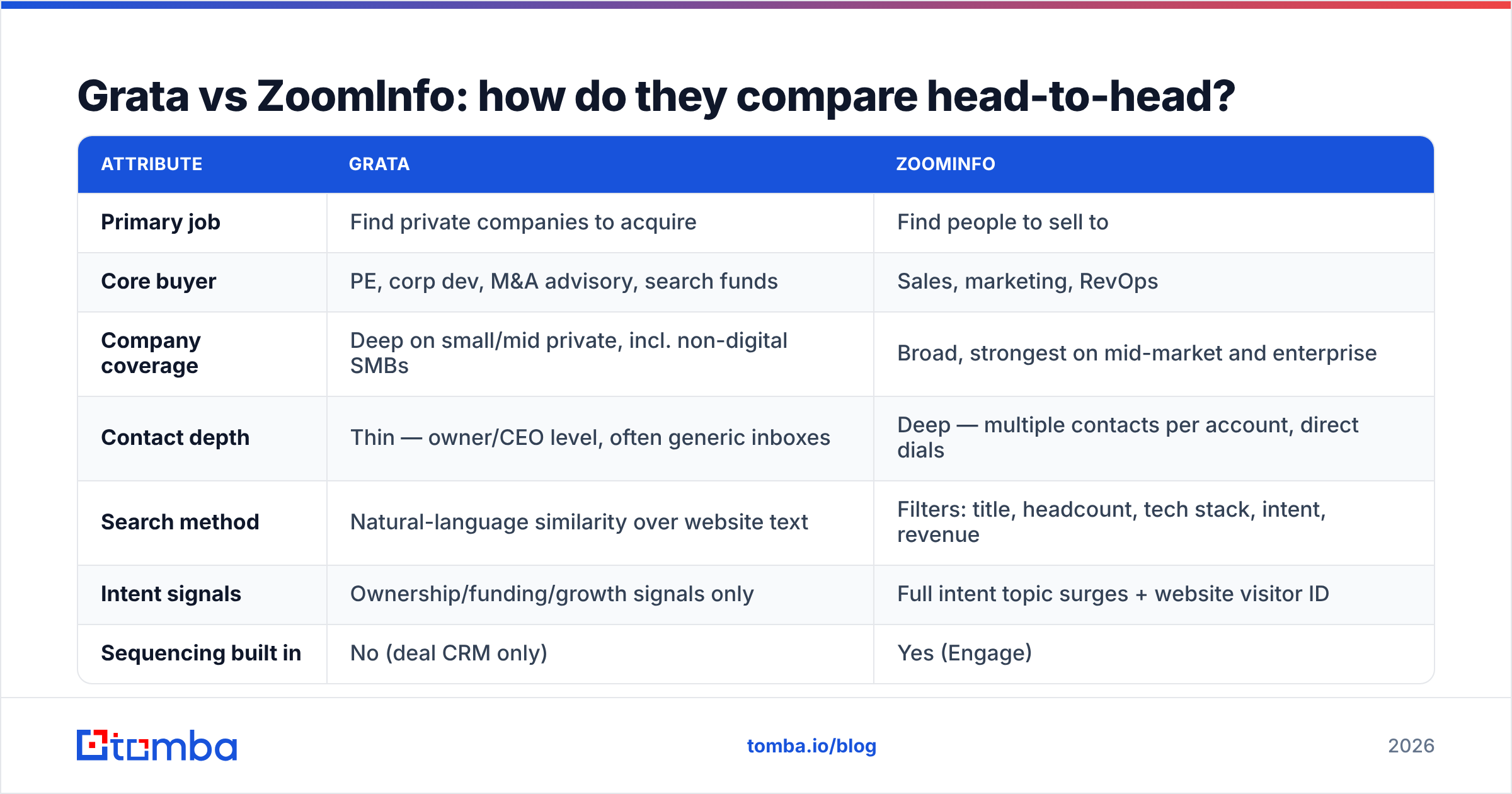
- Similar-company search — feed it one company URL, get 200 lookalikes. This is the feature people actually renew for.
- Ownership and funding signals — bootstrapped vs PE-backed vs VC-backed, prior transactions, investor names.
- Deal CRM and pipeline tracking — tag targets, track outreach, share lists across a deal team.
- Conference and list imports — upload an exhibitor list, get it enriched and de-duplicated against your pipeline.
- Executive contacts — present, but thin. Usually the CEO/owner, sometimes a generic info@ address.
That last point is the crack in the foundation, and we'll come back to it.
What is ZoomInfo, and what does it do differently?#
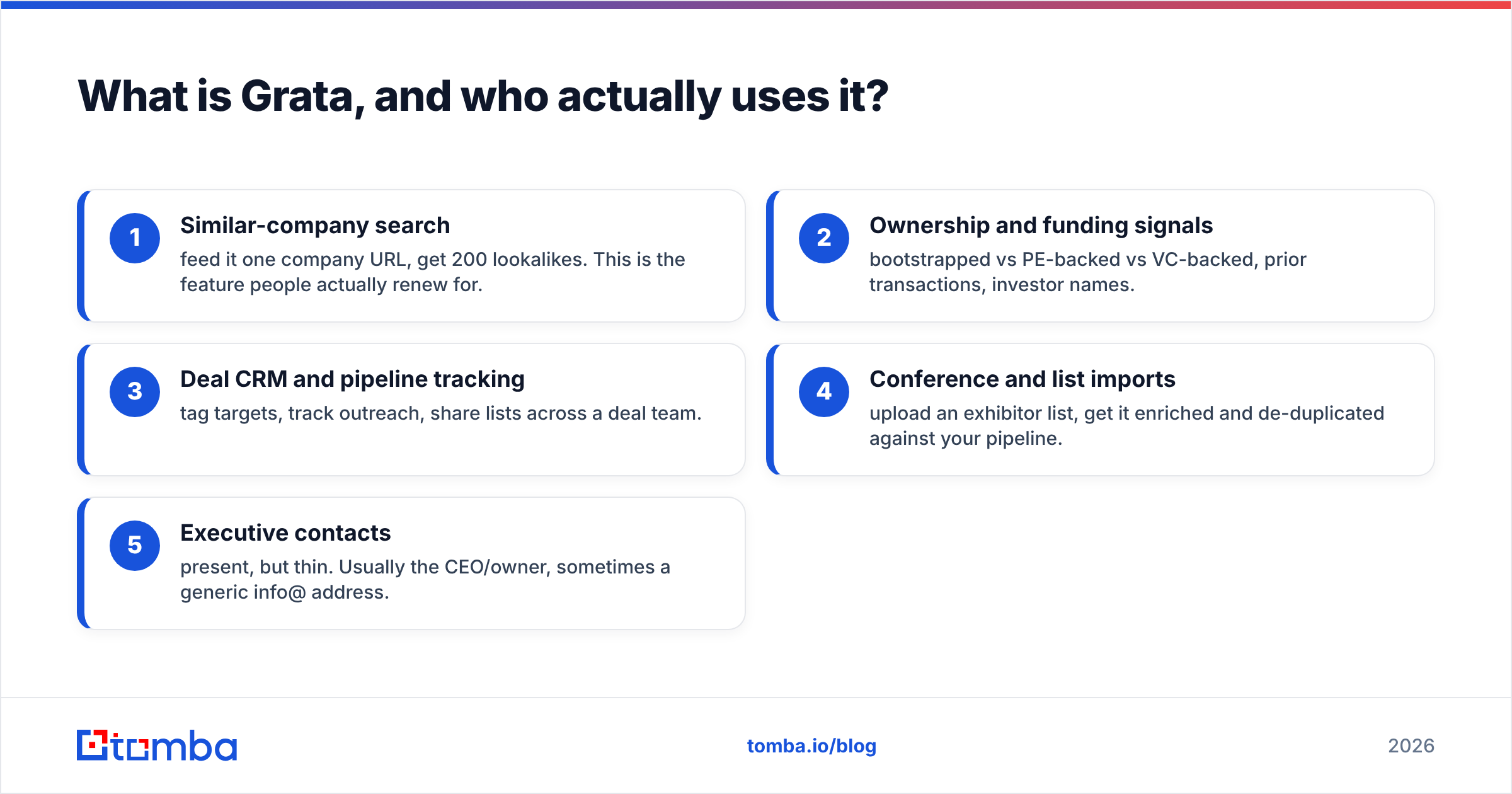
ZoomInfo is the incumbent go-to-market data platform. Roughly $1.2B in annual revenue, publicly traded, and by far the most-reviewed vendor in the B2B data category on G2. Where Grata answers "which companies exist," ZoomInfo answers "who works there, what's their mobile number, and are they in-market right now."
The ZoomInfo stack has grown well past a contact list:
- Contact and company data — hundreds of millions of profiles, with direct dials as the historical differentiator.
- Intent data (Bidstream/Bombora-style topic surges) — which accounts are researching your category this week.
- Websites/visitor identification — de-anonymizing traffic to your site.
- Engage — a native sequencer for email and calls.
- Copilot — the AI layer that ranks accounts and drafts outreach.
- Operations/Enrich — CRM hygiene, lead routing, real-time enrichment on form fill.
ZoomInfo is a platform purchase. You are not buying a list; you are buying an operating layer for a revenue team, and you'll be running a RevOps project to make it stick.
Grata vs ZoomInfo: how do they compare head-to-head?#
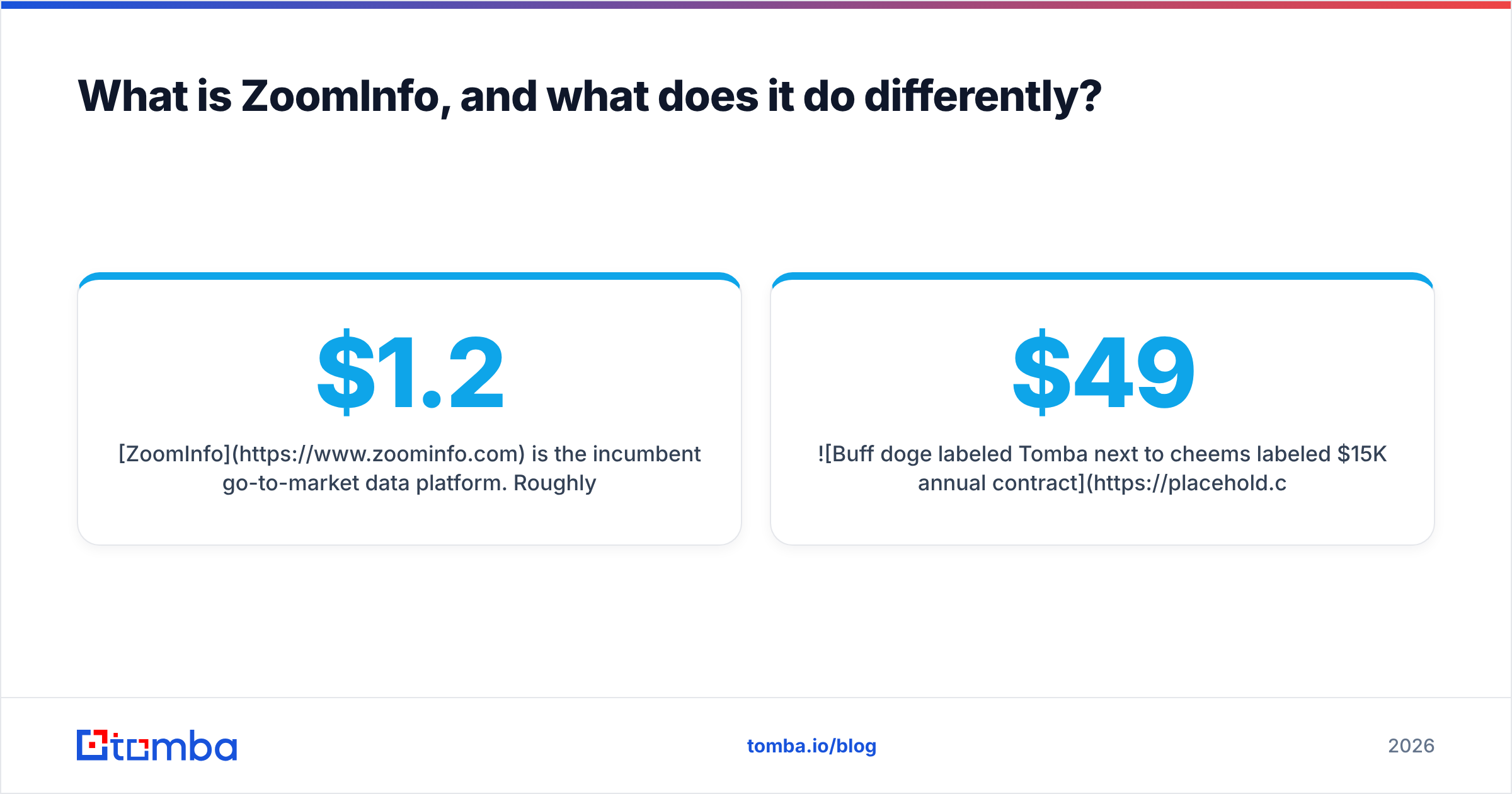
| Attribute | Grata | ZoomInfo |
|---|---|---|
| Primary job | Find private companies to acquire | Find people to sell to |
| Core buyer | PE, corp dev, M&A advisory, search funds | Sales, marketing, RevOps |
| Company coverage | Deep on small/mid private, incl. non-digital SMBs | Broad, strongest on mid-market and enterprise |
| Contact depth | Thin — owner/CEO level, often generic inboxes | Deep — multiple contacts per account, direct dials |
| Search method | Natural-language similarity over website text | Filters: title, headcount, tech stack, intent, revenue |
| Intent signals | Ownership/funding/growth signals only | Full intent topic surges + website visitor ID |
| Sequencing built in | No (deal CRM only) | Yes (Engage) |
| CRM integrations | Salesforce, HubSpot, DealCloud, Affinity | Salesforce, HubSpot, Dynamics, Marketo, Outreach, more |
| Pricing model | Annual, seat-based, quote only | Annual, seat + credit + module, quote only |
| Reported entry cost | Roughly $18k-$30k/yr (varies widely) | Roughly $15k-$25k/yr for a small team |
| Free tier | No | No (limited trial via sales) |
Two lines in that table decide most evaluations. If you circled "find private companies to acquire," the comparison is over — buy Grata. If you circled "direct dials and sequencing," buy ZoomInfo. The interesting cases are the teams sitting between the two.
Which one has better data coverage and accuracy?#
Wrong question, and it's the question most comparison posts get lazy about. They measure different things.
Grata is more complete on the long tail of private companies. A $12M family-owned packaging manufacturer in Ohio with 40 employees and no LinkedIn company page is exactly the record Grata was built to surface and ZoomInfo is most likely to miss or misclassify. Grata's classification also degrades more gracefully — it will put a company in roughly the right vertical even when the site is sparse.
ZoomInfo is more accurate on people. Job titles, department mapping, direct dials, and email formats are its core asset, refreshed by a contributory network and a large research operation. If you need to reach the VP of Ops rather than "the owner," ZoomInfo has an order of magnitude more to work with.
Where both struggle is the same place every database struggles: decay. B2B contact data goes stale at roughly 2-2.5% per month as people change jobs, which compounds to something like a quarter of your list per year. Neither platform exempts you from verification. If you're exporting a list and mailing it without checking, you will burn sender reputation regardless of which logo is on the invoice.
A practical habit: export from whichever platform you own, then run the file through an independent email verifier before it touches your sequencer. Cross-checking with a second source is not paranoia — it's the only way to know what your vendor's advertised accuracy rate means for your segment.
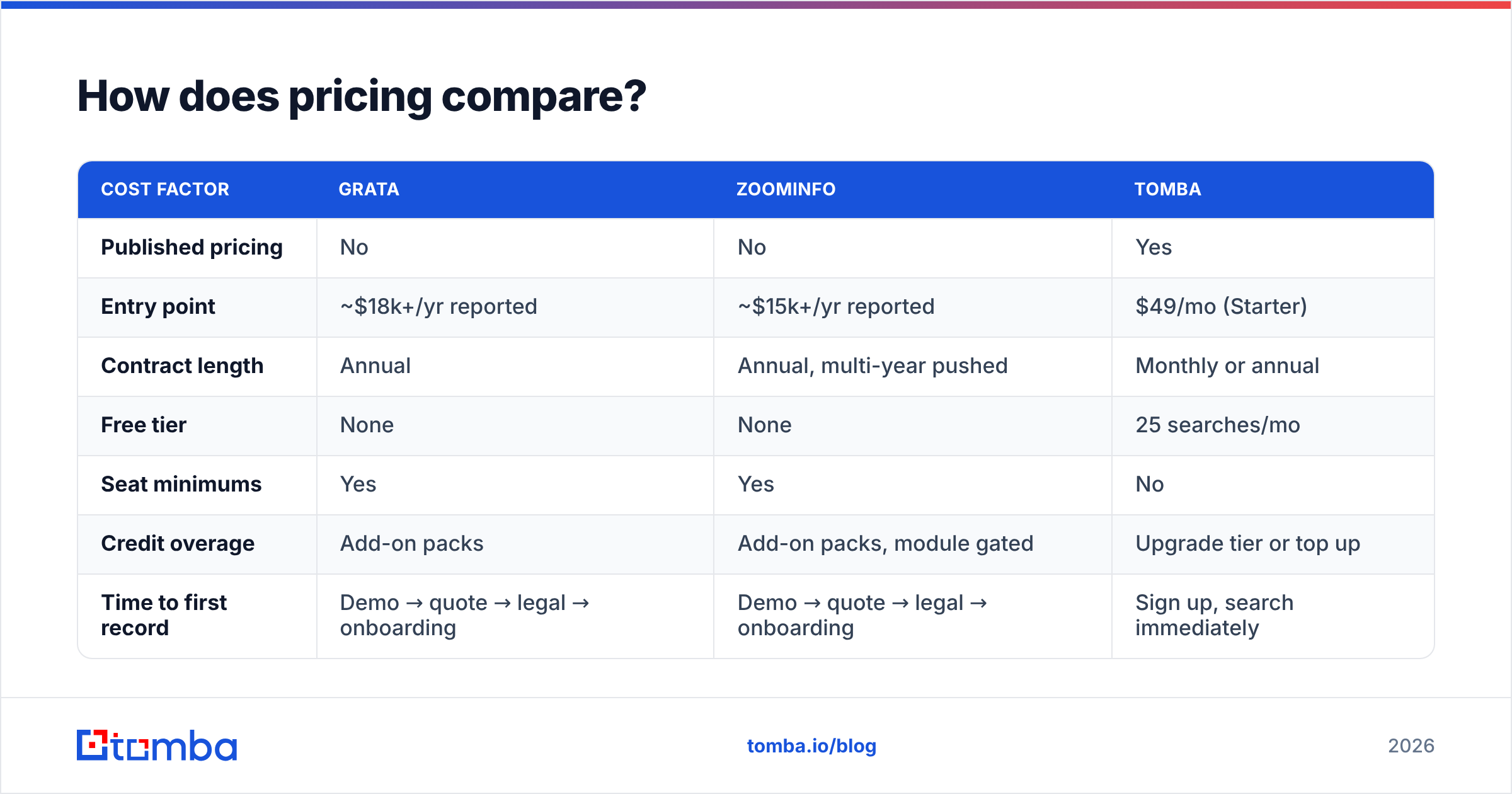
How does pricing compare?#
Neither company publishes a price list, which is itself informative. Both run quote-based, annual-commitment sales motions with seat minimums, and both have a reputation for auto-renewal clauses that surprise people at month 11.
| Cost factor | Grata | ZoomInfo | Tomba |
|---|---|---|---|
| Published pricing | No | No | Yes |
| Entry point | ~$18k+/yr reported | ~$15k+/yr reported | $49/mo (Starter) |
| Contract length | Annual | Annual, multi-year pushed | Monthly or annual |
| Free tier | None | None | 25 searches/mo |
| Seat minimums | Yes | Yes | No |
| Credit overage | Add-on packs | Add-on packs, module gated | Upgrade tier or top up |
| Time to first record | Demo → quote → legal → onboarding | Demo → quote → legal → onboarding | Sign up, search immediately |
Reported figures come from buyer reviews and community threads, not vendor rate cards — your quote will depend on seats, modules, and how close to quarter-end you negotiate. Both vendors discount meaningfully in Q4.
For context on the other end of the market, Tomba pricing runs Free (25 searches/mo), Starter $49/mo, Growth $99/mo, Pro $249/mo, and Enterprise on request. That's not a like-for-like swap for either platform — Tomba doesn't source acquisition targets and doesn't sell intent data. It's a statement about what "contact data" alone should cost when you strip out the modules you don't use.
Is Grata better than ZoomInfo for deal sourcing?#
Yes, clearly, and it isn't close.
Deal sourcing is a company discovery problem with a long tail. You need to know that 340 companies fit a thesis, not that 12 well-known ones do. ZoomInfo's filters are built around firmographics that assume a company has a digital footprint worth indexing — headcount on LinkedIn, a tech stack detectable by script tags, funding rounds in the press. Strip those away and ZoomInfo's coverage thins fast, precisely in the segment where proprietary deal flow lives.
Grata's similarity search is the workflow that matters. An associate starts with one portfolio company, generates a lookalike set, filters by ownership type and geography, and exports a target list in an afternoon. Doing the same in ZoomInfo means manually reverse-engineering the thesis into SIC codes and headcount bands, and accepting that half the market never shows up.
The catch: once the target list exists, someone has to reach the owner. Grata will often give you a company URL and a name, and stop there. That's where a domain search fills the gap — feed it the target's domain, get the verified email pattern and the contacts behind it, and your associate isn't guessing at firstname@ combinations at 9pm.
Is ZoomInfo better for outbound sales teams?#
For most quota-carrying teams, yes — with a real caveat about cost per rep.
ZoomInfo earns its price when you use the whole platform: intent to prioritize accounts, Engage to sequence, Websites to catch anonymous traffic, and Operations to keep the CRM from rotting. Teams that buy ZoomInfo and use it as an export button for CSVs are the ones who churn at renewal, because at that point they're paying platform money for a list.
Grata is simply not built for this. There's no sequencer, no intent layer, no direct dial depth, and no lead routing. A rep working named accounts in SaaS will find the contact data too shallow to work a buying committee.
The honest middle ground looks like this:
- You're doing volume outbound to known ICP accounts → ZoomInfo, or a cheaper stack of finder plus sequencer.
- You're sourcing acquisition targets → Grata.
- You're doing thesis-driven outbound into fragmented SMB verticals → Grata to build the universe, a dedicated finder to get the contacts.
- You only need emails and a bit of enrichment → skip both, buy a per-credit tool and keep the $15k.
Which should you choose in 2026?#
Run these five checks before you take either demo:
- Write down the unit of work. Is your output a company list or a contact list? Grata for the first, ZoomInfo for the second. Teams that can't answer this crisply end up paying for both.
- Count the seats you'd actually license. Both vendors price per seat with minimums. Two analysts sharing one login is a compliance problem, not a savings plan.
- Test coverage on your worst segment, not your best. Ask for a trial search on the 20 hardest accounts you already know exist. Coverage on the Fortune 5000 proves nothing.
- Check export rights in the contract. Some agreements restrict what you keep after cancellation. This matters more than the headline credit count.
- Price the gap. Whatever you buy, budget for verification and enrichment on top. A bulk email finder run costs a rounding error compared to a bounced campaign that torches a sending domain.
There's also a fourth option nobody's demo will mention: buy neither this year. A large share of teams evaluating Grata vs ZoomInfo are trying to solve "I can't get a working email for the people on my list." That's a $49/mo problem wearing a $20,000 costume.
What's the verdict?#
Grata wins deal sourcing. ZoomInfo wins sales execution. Neither wins on price, and neither replaces verification.
If you're a PE or corp-dev team, Grata's private-company index and similarity search are genuinely hard to replicate, and the Datasite acquisition suggests continued investment in the deal workflow. If you're running an outbound org with more than a dozen reps and you'll use intent, sequencing, and CRM enrichment together, ZoomInfo remains the default for a reason — just negotiate hard and read the renewal clause.
And if what you actually need is a reliable way to turn a company domain or a person's name into a verified, deliverable email address, you don't need a platform contract to get it. The Tomba Email Finder does exactly that job — search by domain, name, or company, verify before you send, and start free with 25 searches a month. Layer it under Grata for target outreach, or use it standalone and spend the difference on a sequencer you'll actually open every morning.
Related guides#
Ready to find emails that actually work?
Join 150,000+ professionals who stopped guessing and started sending. Free credits on signup — no credit card required.
Get the Tomba newsletter
Practical outbound tactics and product updates — once every two weeks.
About the author