Grepsr Pricing Reviews Pros and Cons: A 2026 Buyer's Guide
Grepsr sells managed web scraping by quote, not by price list. Here's what teams actually pay in 2026, where the platform earns its money, where it frustrates buyers, and when a cheaper tool wins.
TL;DR — this Grepsr pricing reviews pros and cons guide covers what the platform really costs, what buyers praise, and where it frustrates them in 2026.
- Grepsr is a managed web-scraping and data-as-a-service platform. You describe the data you want, their team builds and maintains the extraction pipeline, and you receive structured feeds. You are buying labour, not software.
- Grepsr pricing is quote-driven. There is no meaningful self-serve tier in 2026. Expect a low-hundreds-per-month floor for a single simple source, and four-figure monthly commitments once you add volume, frequency, or QA guarantees.
- The strongest reviews praise reliability on messy, JavaScript-heavy sites. Someone else owns the maintenance when a target site changes its DOM.
The complaints are just as consistent:
- Opaque pricing, slow onboarding for new sources, and change requests that get billed as scope changes.
- If what you actually need is B2B contact data — emails, phones, firmographics — a managed scraping contract is the expensive way to get it. A dedicated finder like the Tomba Email Finder delivers the same outcome at a fraction of the spend.
What is Grepsr and who is it actually for?#
Grepsr is a web data extraction company that sells a managed service rather than a DIY scraping tool. You submit a requirement — "every product listing on these 40 retail domains, refreshed daily, with price, SKU, availability, and image URL". Grepsr's engineers then build the crawler, run it on their infrastructure, and run QA on the output. Delivery lands in S3, an FTP drop, an API endpoint, or a spreadsheet. Their official site calls this "data as a service", with a light dashboard on top for monitoring and re-runs.
Think of it like the difference between buying a drill and hiring a contractor. Apify, Bright Data, and Scrapy sell you the drill. Grepsr sends the contractor, and the contractor comes back every time the wall moves.
That framing tells you who Grepsr fits:
- Teams without in-house scraping engineers. If nobody on staff can debug a Cloudflare challenge or a rotating class name, Grepsr's model removes a hiring problem.
- Recurring feeds, not one-off pulls. The economics only work when you need the same sources refreshed on a schedule — daily pricing, weekly inventory, monthly directory snapshots.
- Compliance-sensitive buyers. Enterprises that need a contract, an SLA, a named account manager, and someone to sign a DPA rather than an anonymous API key.
- Hard targets. Sites with aggressive bot detection, infinite scroll, login walls, or PDF-embedded tables — the cases where a generic scraper burns a week and still fails.
- Non-technical operators. Ops, research, and market-intelligence teams who want a CSV in a folder, not a Python repo to maintain.
If none of those describe you, you are probably paying for capability you will not use.
How does Grepsr pricing work in 2026?#
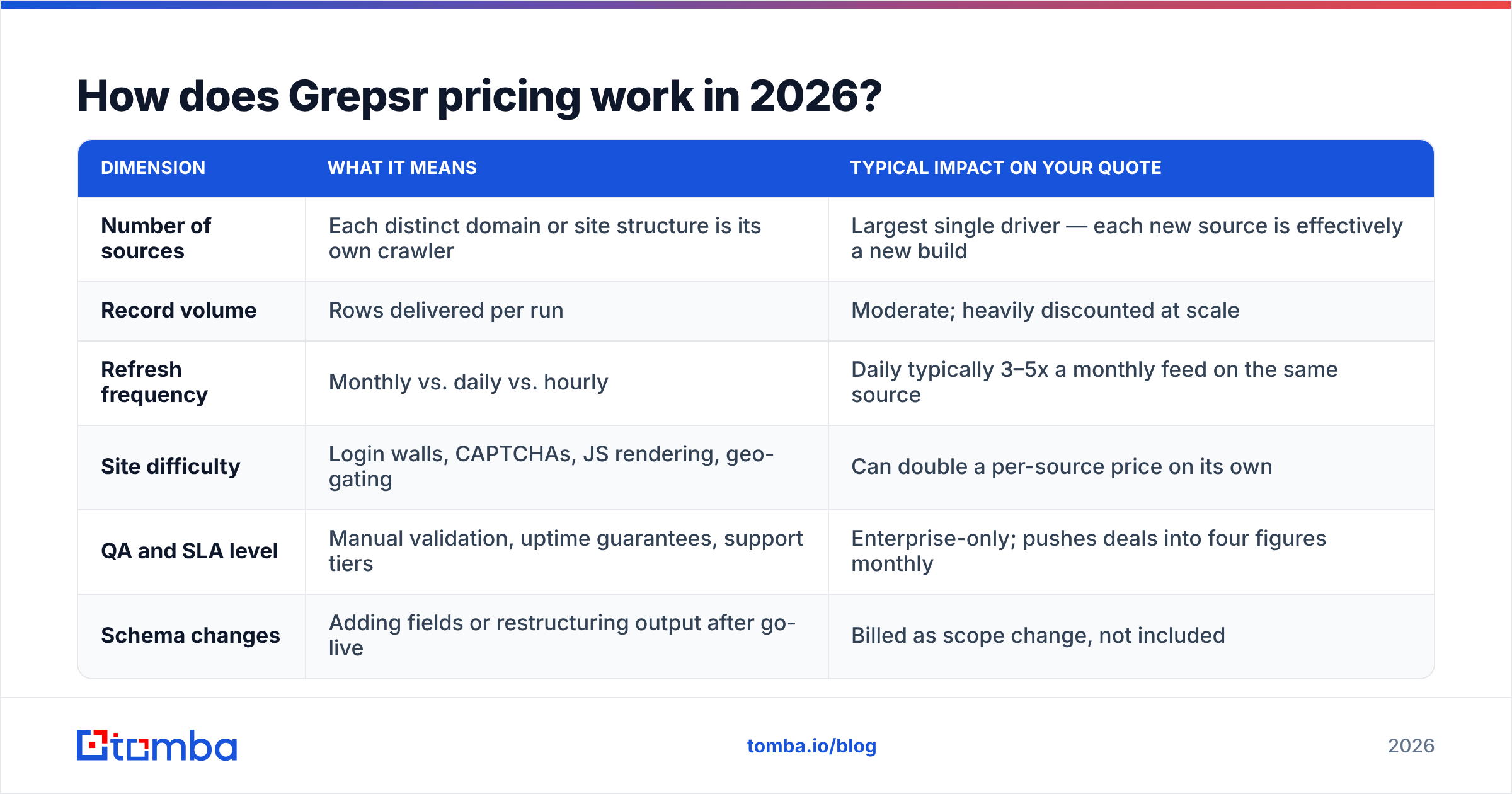
Grepsr does not publish a full price list. That is the single most important fact in any Grepsr pricing reviews pros and cons comparison. Every engagement is scoped and quoted. What you can pin down is the shape of the bill.
Grepsr's public pricing page has historically shown a tiered structure. There is a low-cost entry point for a single simple source, and custom quotes above it. Treat the ranges below as what buyers report, not as published rate-card figures. Always get your own quote before you budget.
| Dimension | What it means | Typical impact on your quote |
|---|---|---|
| Number of sources | Each distinct domain or site structure is its own crawler | Largest single driver — each new source is effectively a new build |
| Record volume | Rows delivered per run | Moderate; heavily discounted at scale |
| Refresh frequency | Monthly vs. daily vs. hourly | Daily typically 3–5x a monthly feed on the same source |
| Site difficulty | Login walls, CAPTCHAs, JS rendering, geo-gating | Can double a per-source price on its own |
| QA and SLA level | Manual validation, uptime guarantees, support tiers | Enterprise-only; pushes deals into four figures monthly |
| Schema changes | Adding fields or restructuring output after go-live | Billed as scope change, not included |
What actually drives your Grepsr bill?#
- Source count beats row count. Ten thousand rows from one site is cheap. Ten rows from a thousand sites is a nightmare quote. Consolidate your source list before you ask for a number.
- Frequency compounds. Moving from weekly to daily does not add 15%. It multiplies proxy spend, QA passes, and failure handling.
- Every schema change is a ticket. "Can you also grab the reviewer name?" is a change request. Lock your schema in the scoping call.
- Onboarding is not instant. Expect days to weeks between signing and first clean delivery for a non-trivial source. Budget the calendar time, not just the cash.
- Minimums exist. Managed services carry a floor because a human has to be assigned. Very small jobs are often uneconomic for both sides.
The practical takeaway: Grepsr is priced like an agency retainer wearing a SaaS costume. If your finance team needs a predictable per-seat or per-credit line item, the mismatch will show up in month two.
What do Grepsr reviews actually say?#
Aggregate sentiment on public review sites skews positive. There is a consistent split between what reviewers love and what they flag. You can read current user reviews on G2. Read the two- and three-star ones first, since that is where the pricing and turnaround complaints live.
The recurring praise:
- Reliability on hard targets. Reviewers repeatedly note that sites which broke their internal scrapers ran fine through Grepsr.
- Hands-off maintenance. When a target site redesigns, the fix is Grepsr's problem. For teams that have lost a sprint to a selector change, this is the whole value proposition.
- Responsive account management. Named contacts and real humans on support threads come up often.
- Clean, structured output. Delivery in usable formats without a normalisation step on your side.
The recurring criticism:
- Pricing opacity. The most common single complaint. Buyers dislike not being able to model costs before a sales call.
- Turnaround on new sources. Adding a domain is a project, not a click. Teams used to self-serve tools find the lag jarring.
- Change-request friction. Small schema tweaks generating quotes annoys buyers who expected flexibility.
- Overkill for simple needs. Several reviewers essentially say: this is excellent, and we did not need this much.
None of that is disqualifying. It is the standard trade profile of managed services versus tooling. You swap flexibility and price transparency for someone else owning the outcome. Web scraping as a discipline has a maintenance tax, and Grepsr's business model is essentially selling you insurance against it.
What are Grepsr's pros and cons?#
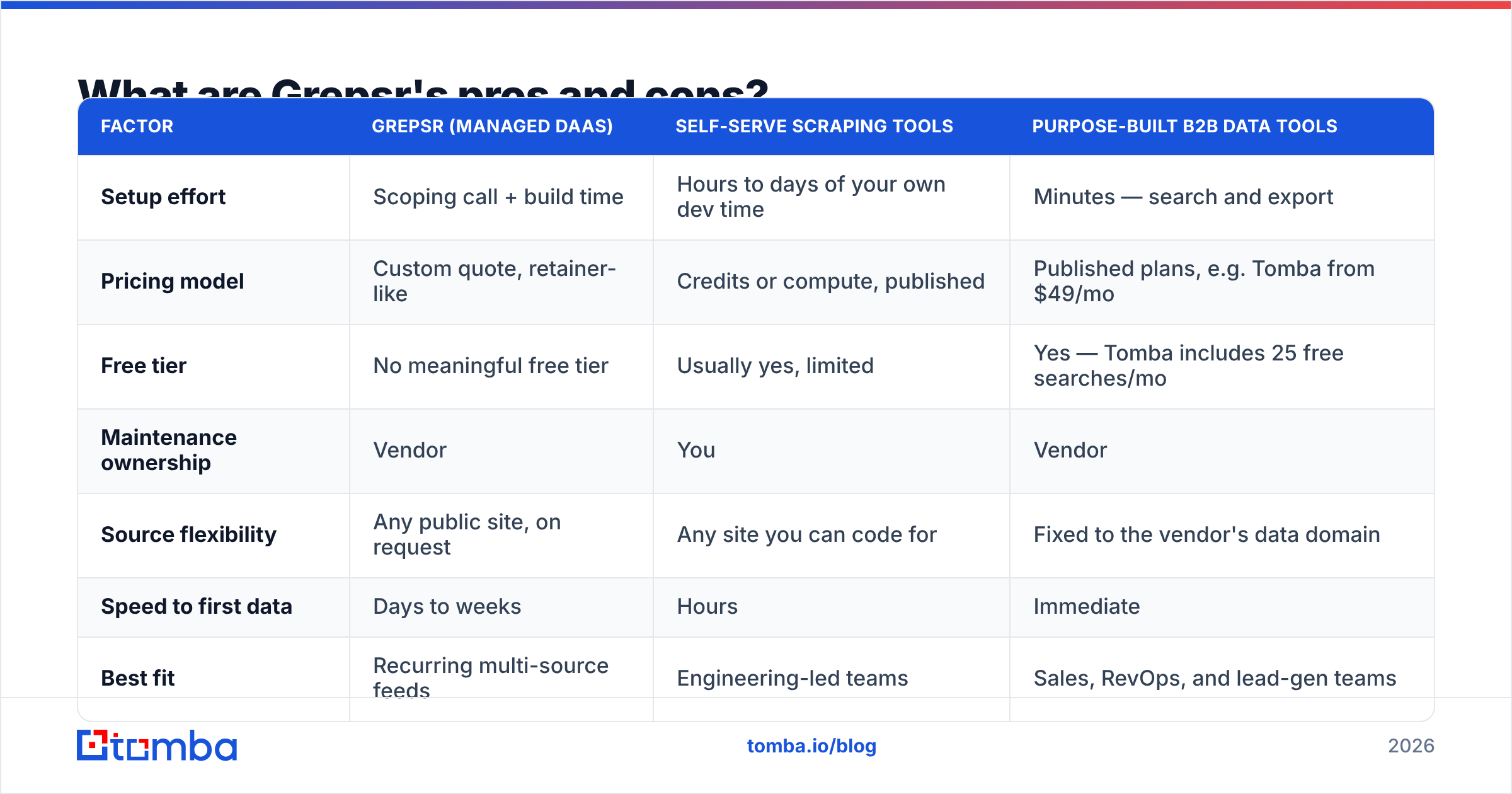
| Factor | Grepsr (managed DaaS) | Self-serve scraping tools | Purpose-built B2B data tools |
|---|---|---|---|
| Setup effort | Scoping call + build time | Hours to days of your own dev time | Minutes — search and export |
| Pricing model | Custom quote, retainer-like | Credits or compute, published | Published plans, e.g. Tomba from $49/mo |
| Free tier | No meaningful free tier | Usually yes, limited | Yes — Tomba includes 25 free searches/mo |
| Maintenance ownership | Vendor | You | Vendor |
| Source flexibility | Any public site, on request | Any site you can code for | Fixed to the vendor's data domain |
| Speed to first data | Days to weeks | Hours | Immediate |
| Best fit | Recurring multi-source feeds | Engineering-led teams | Sales, RevOps, and lead-gen teams |
| Worst fit | One-off or tiny jobs | Hard, defended targets | Non-contact, arbitrary web data |
Pros in one line each: you stop maintaining crawlers; hard sites become tractable; output arrives clean and scheduled; enterprise procurement requirements are met; you get a human to escalate to.
Cons in one line each: you cannot forecast cost without a sales call; iteration is slow; small changes cost money; you are locked into a retainer rhythm; and for the specific job of finding business contact data, you are paying custom-build prices for something that already exists as a product.
That last point deserves its own section, because it is the most common way buyers overspend.
Is Grepsr the right tool for B2B lead generation?#
Usually not — and this is a scope question, not a quality one.
A very large share of "we need a scraping vendor" requests are really "we need contact data for companies matching a profile." Those are different problems. Building a custom crawler to harvest company sites and guess at email formats is expensive, brittle, and legally fussier. Dedicated tools already solve that job at published prices.
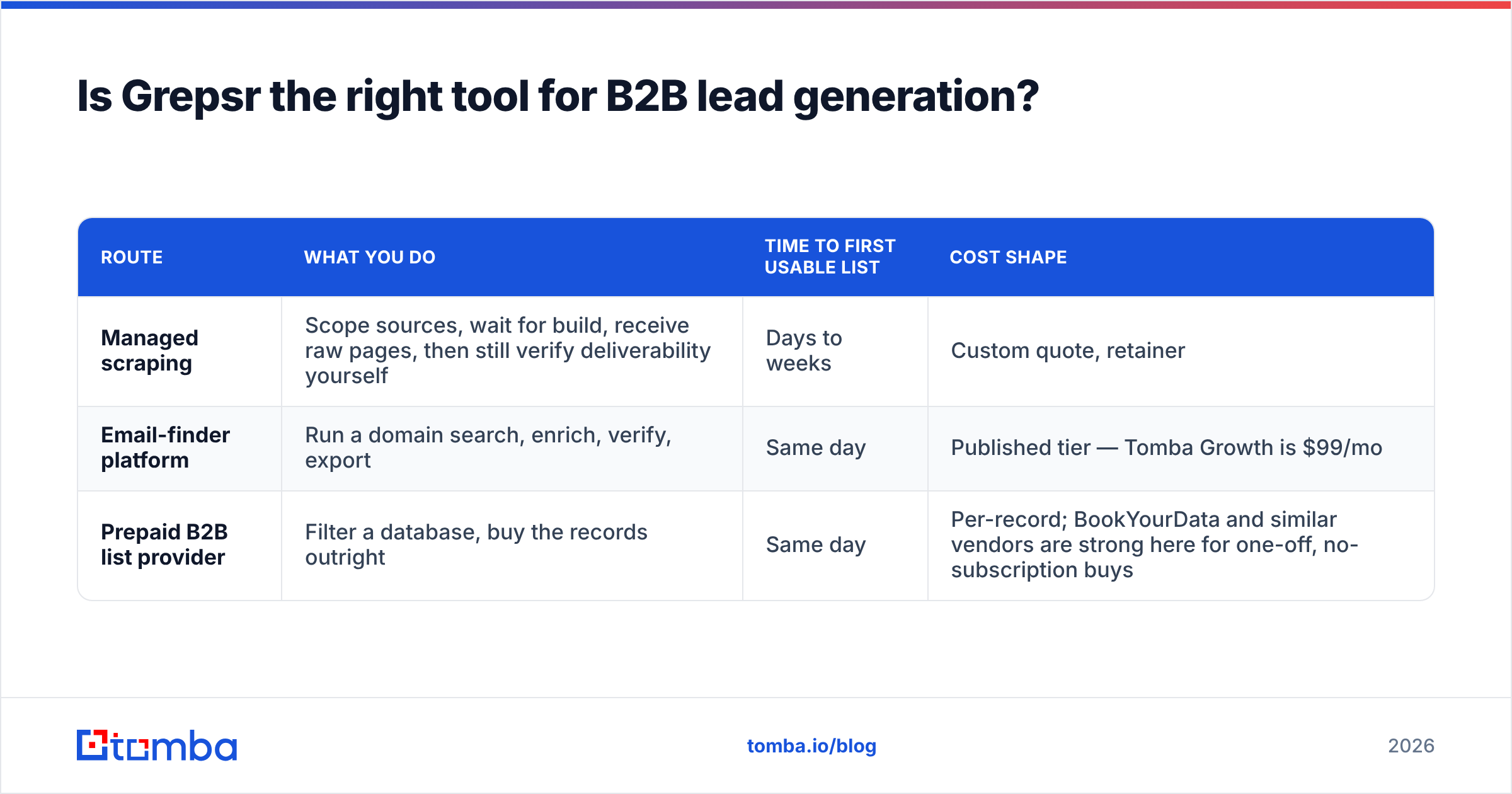
Compare the two routes for the same goal — 5,000 verified contacts at target accounts:
| Route | What you do | Time to first usable list | Cost shape |
|---|---|---|---|
| Managed scraping | Scope sources, wait for build, receive raw pages, then still verify deliverability yourself | Days to weeks | Custom quote, retainer |
| Email-finder platform | Run a domain search, enrich, verify, export | Same day | Published tier — Tomba Growth is $99/mo |
| Prepaid B2B list provider | Filter a database, buy the records outright | Same day | Per-record; BookYourData and similar vendors are strong here for one-off, no-subscription buys |
All three are legitimate. The mistake is using route one to accomplish route two.
If your requirement is genuinely arbitrary — competitor pricing, marketplace inventory, regulatory filings, job postings across 200 career pages — Grepsr earns its quote. If your requirement is "who works at these companies and how do I reach them", you want a contact-data product with a verifier attached. Raw scraped addresses without validation will torch your sender reputation before the campaign warms up.

How should you evaluate Grepsr before signing?#
Run the quote process like a procurement exercise, not a demo. Start with three steps:
- Freeze the source list and schema first. Every field you add after signing becomes a change order. Write the output spec as a table of column names before the first call.
- Ask for the per-source unit price, not the bundle. You need to know what source 11 costs when the contract already covers ten. That number tells you whether the relationship scales or stalls.
- Get the maintenance clause in writing. When a target site redesigns, who fixes it, how fast, and at what cost? This is the entire reason you are paying a premium. Make it contractual.
Then pressure-test the deal:
- Time-box the pilot. One source, thirty days, defined success criteria. If onboarding a single site takes longer than the pilot window, that is your answer.
- Price the alternative honestly. Get a self-serve quote from an equivalent tool, then estimate the cost of building it in-house. Managed services look expensive until you price a half-time engineer at fully loaded rates — and cheap until you realise the job was a $99/month product all along.
- Check the exit. Who owns the crawler logic and historical data if you leave? Ask before you have twelve months of feeds you cannot take with you.
What are the best Grepsr alternatives?#
Split alternatives by what you are actually trying to do:
- Arbitrary web data, managed: other DaaS vendors and scraping agencies compete directly on the same retainer model. Compare per-source pricing, not headline monthly.
- Arbitrary web data, DIY: self-serve scraping platforms give you published, usage-based pricing and full control, at the cost of owning maintenance.
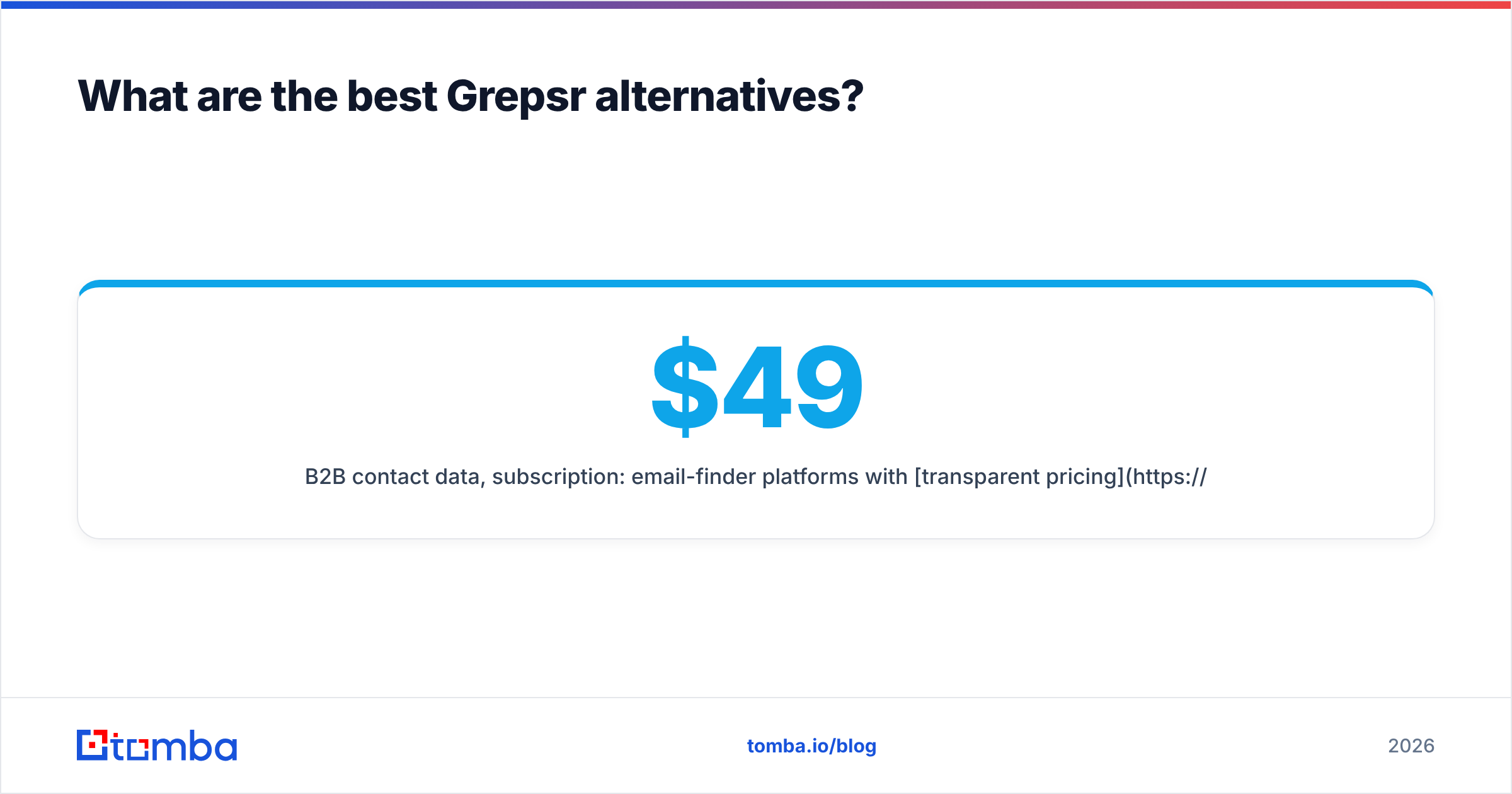
- B2B contact data, subscription: email-finder platforms with transparent pricing — Tomba runs a free tier at 25 searches/month, Starter at $49/mo, Growth at $99/mo, and Pro at $249/mo, with bulk processing and an API for programmatic workflows.
- B2B contact data, pay-as-you-go: prepaid list providers like BookYourData suit teams who want a defined record count without a recurring commitment — a genuinely different and often smarter shape for one-off campaigns.
Cross-check any shortlist against current user reviews on Capterra rather than vendor case studies. Case studies are marketing; two-star reviews are research.
The verdict on Grepsr pricing reviews pros and cons#
Grepsr is a competent managed extraction service. It solves a real and genuinely annoying problem: web data pipelines rot, and someone has to maintain them. If you have multiple recurring sources, hard targets, and no scraping engineers, the quote is defensible and the reviews back that up.
But the pricing model punishes small, simple, or exploratory needs. And many buyers who land on a scraping vendor are chasing contact data they could buy off the shelf for a published monthly fee. Scope your requirement precisely before you book the sales call. That one step decides the answer to "should I use Grepsr" almost every time.
If your requirement turns out to be contact data rather than arbitrary web data, start with the Tomba Email Finder. Search by domain, name, or company, verify before you send, and export straight into your CRM — with a free tier to test on your own target list before you spend anything. No scoping call required.
Related guides#
Ready to find emails that actually work?
Join 150,000+ professionals who stopped guessing and started sending. Free credits on signup — no credit card required.
Get the Tomba newsletter
Practical outbound tactics and product updates — once every two weeks.
About the author