8 Best GrowMeOrganic Alternatives in 2026 (Tested & Priced)
GrowMeOrganic bundles scraping, email finding and sending into one cheap plan. That bundle is also its weakness. Here are eight alternatives compared on data accuracy, credit maths and what you actually pay per usable contact.
TL;DR
- GrowMeOrganic wins on price-per-feature: LinkedIn scraping, email finding, and a sending tool in one subscription, usually cheaper than buying three tools.
- It loses on data depth and verification. Teams outgrow it when bounce rates creep above 5% or when they need an API, not a Chrome extension.
- If you only need accurate B2B emails, a specialist finder like Tomba (free tier, then $49/mo) costs less than GrowMeOrganic's mid-tier and returns cleaner data.
- If you need a full GTM stack with intent signals and dialers, Apollo is the closer match. If you want prepaid, owned records with no credit expiry, BookYourData is the strongest fit.
- The real comparison is not sticker price. It's cost per verified, deliverable contact after you strip out catch-alls and dead mailboxes.
What is GrowMeOrganic and who actually uses it?#
GrowMeOrganic is an all-in-one B2B prospecting platform built around a Chrome extension. You scrape a LinkedIn Sales Navigator search or a Google Maps result set, the tool appends emails and phone numbers, and you push the list into its built-in cold email sender with drip sequences.
Its buyer is specific: solo founders, small agencies, and two-to-five-person outbound teams who want one flat subscription instead of a stack. Unlimited-ish extraction on higher tiers is the headline that pulls people in, and for a lot of those teams it genuinely works for the first six months.
The friction shows up later, and it's almost always one of four things:
- Enrichment hit rate. Scraping a profile is easy. Attaching a mailbox that actually accepts mail is the hard part, and blended tools tend to lag specialists here.
- Verification depth. A "valid" flag that only checks syntax and MX records is not verification. Catch-all domains sail straight through and land in your bounce column.
- Programmatic access. Extension-first tools are painful once you want enrichment inside your CRM, your data warehouse, or a nightly job.
- Sending from the same vendor. Bundling the finder and the sender is convenient until deliverability drops and you can't tell whether the data or the mailbox is at fault.
None of these make GrowMeOrganic a bad product. They make it a starter product. Reviews on G2 tell the same story from both directions — great value, uneven data.
Why do teams start searching for GrowMeOrganic alternatives?#
The trigger is nearly always a number. Here is what usually breaks the camel's back, in the order we see it:
- Bounce rate above 5%. Google Workspace and Microsoft 365 both treat sustained hard bounces as a spam signal. Two weeks of 8% bounces and your primary domain is throttled.
- Credit maths that don't survive scale. Monthly credits expiring at renewal is fine at 500 contacts/month. At 10,000 it's a budgeting problem, especially when failed lookups still consume budget.
- No clean API. Once you want enrichment triggered by a form fill or a CRM webhook, you need an email finder API, not a browser button.
- Compliance questions. Enterprise procurement asks where the data came from. "Scraped from LinkedIn" is an uncomfortable answer in a GDPR review.
- Single-vendor risk. If your data provider is also your sender, a platform outage takes out both your pipeline sources and your outreach.
If none of those apply to you, staying put is a legitimate decision. If two or more apply, keep reading.
What should you compare before switching?#
Ignore feature checklists. Five things actually predict whether a tool will work for you:
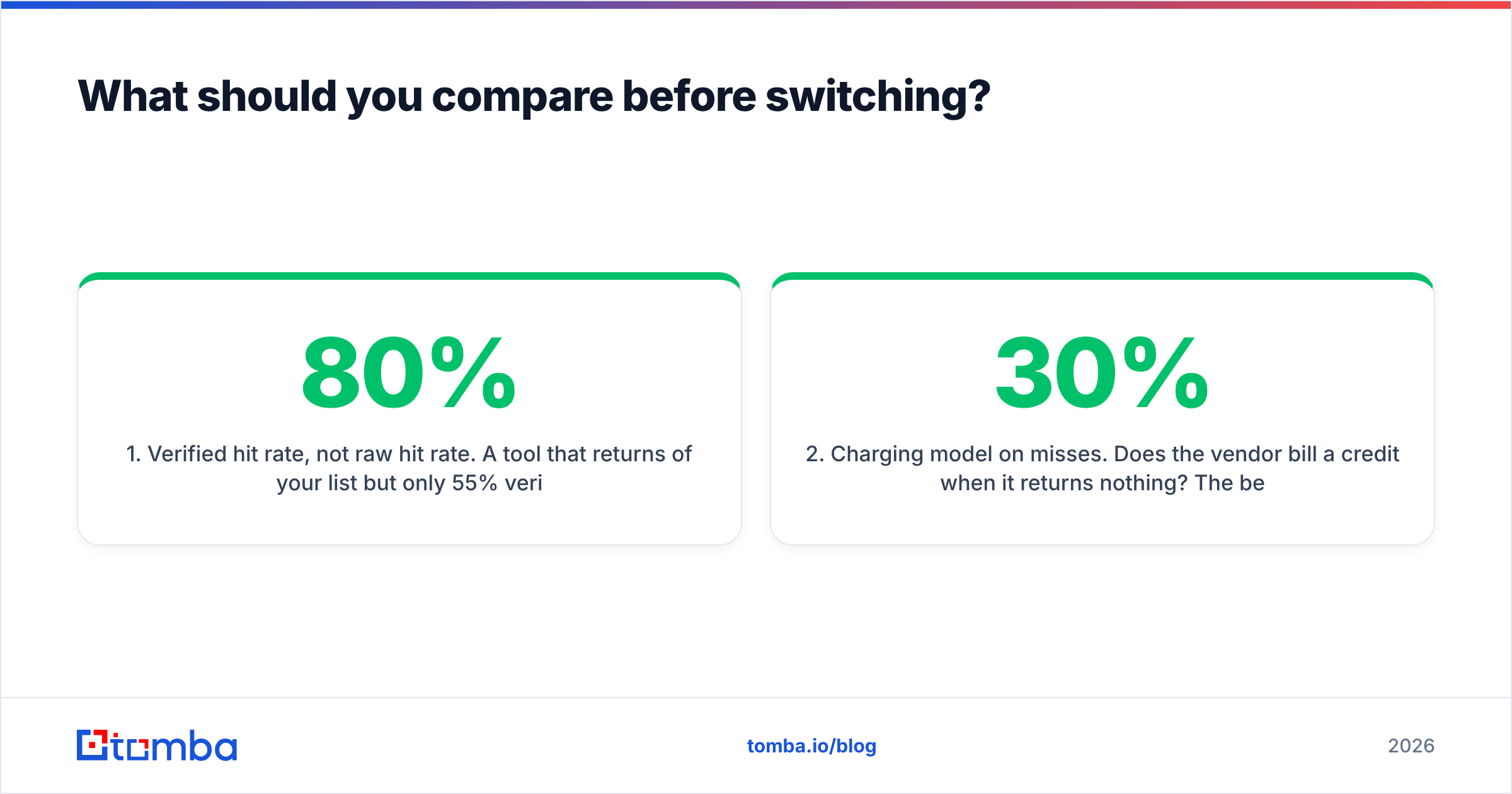
- Verified hit rate, not raw hit rate. A tool that returns 80% of your list but only 55% verified is worse than one returning 62% at 95% deliverable. Always test on the same 100 rows.
- Charging model on misses. Does the vendor bill a credit when it returns nothing? The best ones don't. That single policy can change effective cost by 30%.
- Catch-all handling. Roughly a fifth of B2B domains are catch-all. Some tools mark them "valid" (dangerous), some mark them "unknown" (honest), and a few actually probe them with a catch-all verifier.
- Data provenance. Crawled public web, contributed contact books, licensed panels, or user-shared inboxes — each has different freshness and different legal exposure.
- Escape hatches. CSV export without restrictions, a documented API, and native CRM sync. If you can't get your data out cleanly, you don't own it.
Which are the best GrowMeOrganic alternatives in 2026?#
1. Tomba — best for accurate email finding at a fair price#
Tomba is a specialist. It does not try to be your sequencer or your CRM. What it does is find and verify professional email addresses at domain scale, which is exactly the job most people are actually hiring GrowMeOrganic to do.
The email finder works by name plus domain, and domain search returns every discoverable mailbox at a company with role and department attached. Verification is a separate, deeper step — SMTP-level checks plus catch-all probing rather than a syntax pass. Failed lookups don't burn credits.
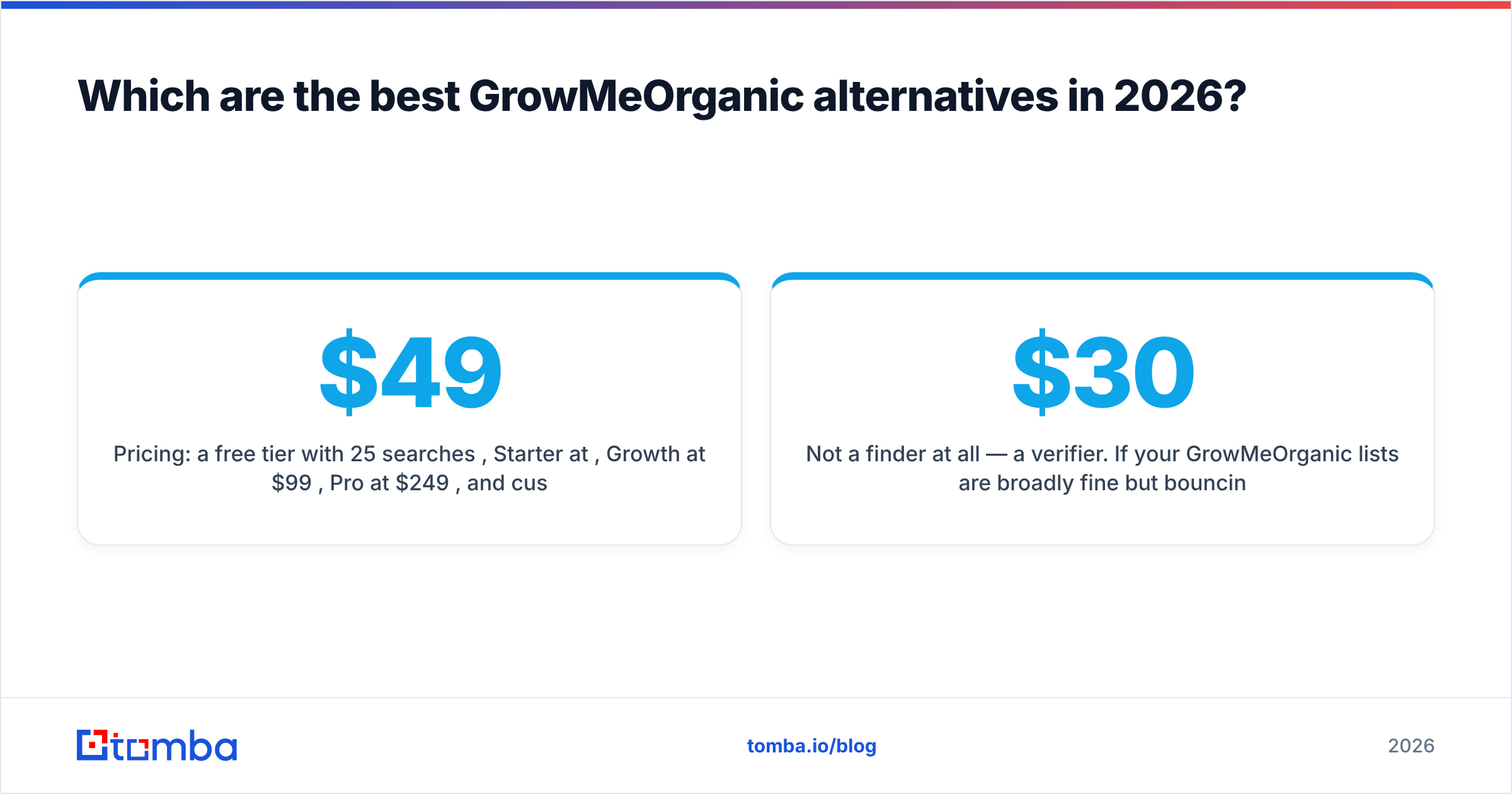
Pricing: a free tier with 25 searches/month, Starter at $49/mo, Growth at $99/mo, Pro at $249/mo, and custom Enterprise. Full Tomba pricing is public, which is more than several tools on this list manage.
Best for: teams whose main pain is bounce rate and cost-per-verified-contact. Trade-off: no built-in email sending. You'll pair it with a sequencer.
2. Apollo.io — best for a full GTM stack#
Apollo is the maximalist answer. A large contact database, buyer intent, sequences, a dialer, scoring, and a CRM-lite layer. If GrowMeOrganic's appeal was "everything in one place," Apollo is the same idea with far more money behind it.
The catch is the same as any bundled platform: the data is broad but uneven, especially outside North America, and the free plan's export limits push you to paid quickly. Costs climb fast once you add seats. Teams often land on Apollo for workflow and keep a separate finder for accuracy — see how an Apollo alternative stacks up if that's your situation.
3. BookYourData — best for prepaid, owned data#
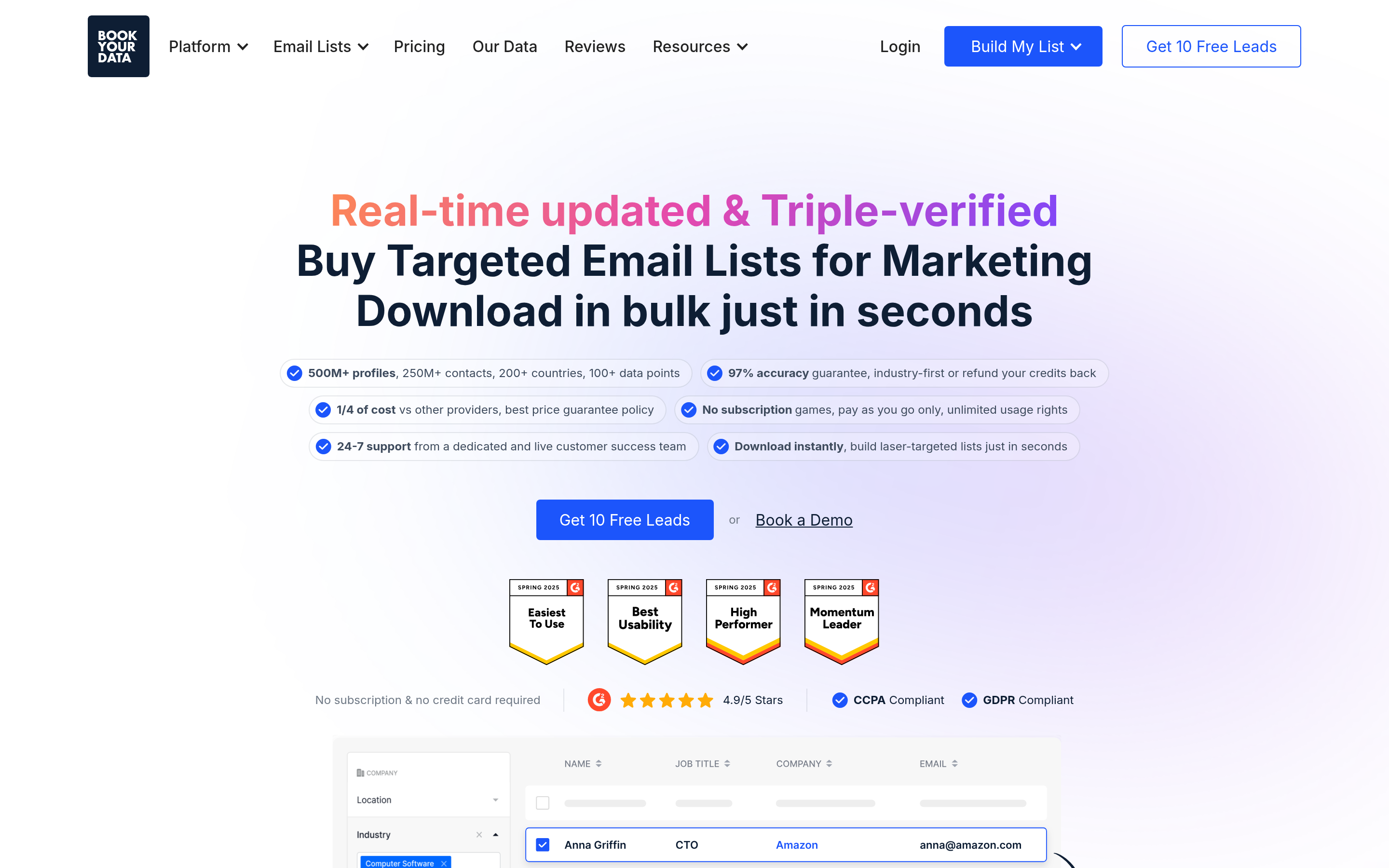
BookYourData takes a different approach: you buy contact records outright rather than renting monthly credits. Records don't expire at renewal, filtering is granular by industry, seniority and geography, and the accuracy guarantee is stated up front.
For teams running campaign-shaped outbound — a big push in Q1, quiet in Q2 — prepaid credits beat a subscription that bills whether you prospect or not. It's a genuinely strong option and a fair comparison point for anyone leaving GrowMeOrganic for data-quality reasons rather than workflow reasons. Check current terms at bookyourdata.com.
4. Hunter — best for simple domain-level lookups#
Hunter is the most recognisable name in domain search. Clean UI, well-documented API, generous free tier for small volumes. It's excellent at "who works at this company and what's the email pattern."
Where it falls short of GrowMeOrganic is breadth — no LinkedIn scraping, no phone numbers, no sequencing beyond a basic campaigns feature. It's a narrower tool than what you're replacing, so it fits only if the LinkedIn workflow wasn't the reason you signed up.
5. Wiza — best for LinkedIn-native workflows#
If the LinkedIn extension was the point, Wiza is the closest one-to-one swap. It exports Sales Navigator searches with enrichment attached and prices per valid email, which is a fairer model than paying for every attempt. Volume prospectors who live in Sales Navigator all day will feel at home. Compare against a Wiza alternative before committing if API access matters to you.
6. Findymail — best for bounce-averse senders#
Findymail is built around one promise: don't return an email unless it will land. It refunds credits on bounces and only bills for verified results. Coverage is narrower than the giants — you'll get fewer hits — but the hits you get are dependable. Good pick for teams sending from a single primary domain that they can't afford to burn.
7. Lusha — best for direct dials#
If phone numbers matter as much as email, Lusha's mobile coverage is its differentiator, particularly in North America. Compliance posture is well documented, which helps in procurement. The credit model is restrictive at lower tiers and email accuracy is middling, so most teams pair it with a dedicated finder or a phone finder rather than treating it as a single source.
8. Clearout — best as a verification layer#
Not a finder at all — a verifier. If your GrowMeOrganic lists are broadly fine but bouncing, the cheapest fix isn't a new finder. It's running your existing exports through a proper email verifier or Clearout before they hit your sequencer. Many teams solve their entire problem for under $30/month this way.

How do these GrowMeOrganic alternatives compare on price and data?#
Pricing changes often — treat these as directional and confirm on each vendor's page before you buy.
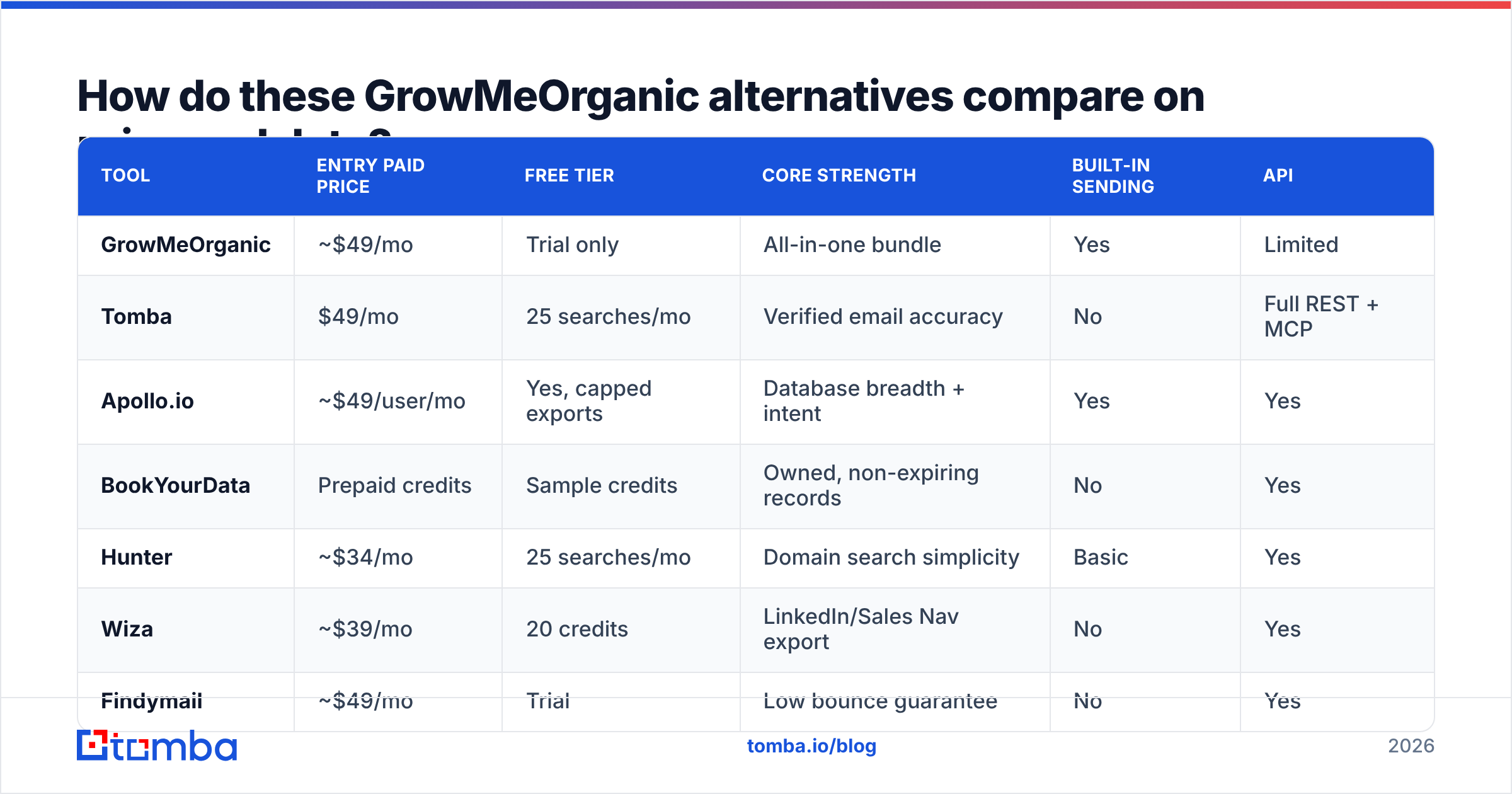
| Tool | Entry paid price | Free tier | Core strength | Built-in sending | API |
|---|---|---|---|---|---|
| GrowMeOrganic | ~$49/mo | Trial only | All-in-one bundle | Yes | Limited |
| Tomba | $49/mo | 25 searches/mo | Verified email accuracy | No | Full REST + MCP |
| Apollo.io | ~$49/user/mo | Yes, capped exports | Database breadth + intent | Yes | Yes |
| BookYourData | Prepaid credits | Sample credits | Owned, non-expiring records | No | Yes |
| Hunter | ~$34/mo | 25 searches/mo | Domain search simplicity | Basic | Yes |
| Wiza | ~$39/mo | 20 credits | LinkedIn/Sales Nav export | No | Yes |
| Findymail | ~$49/mo | Trial | Low bounce guarantee | No | Yes |
| Lusha | ~$36/user/mo | 5 credits/mo | Direct dial phone numbers | No | Yes |

The pattern is clear once it's laid out. GrowMeOrganic and Apollo compete on breadth. Tomba, Hunter, Findymail and BookYourData compete on data quality. Wiza and Lusha compete on channel — LinkedIn and phone respectively. Pick the axis your team actually loses deals on.
How much does accuracy really cost you?#
Run the arithmetic on 5,000 contacts, because sticker price hides everything.
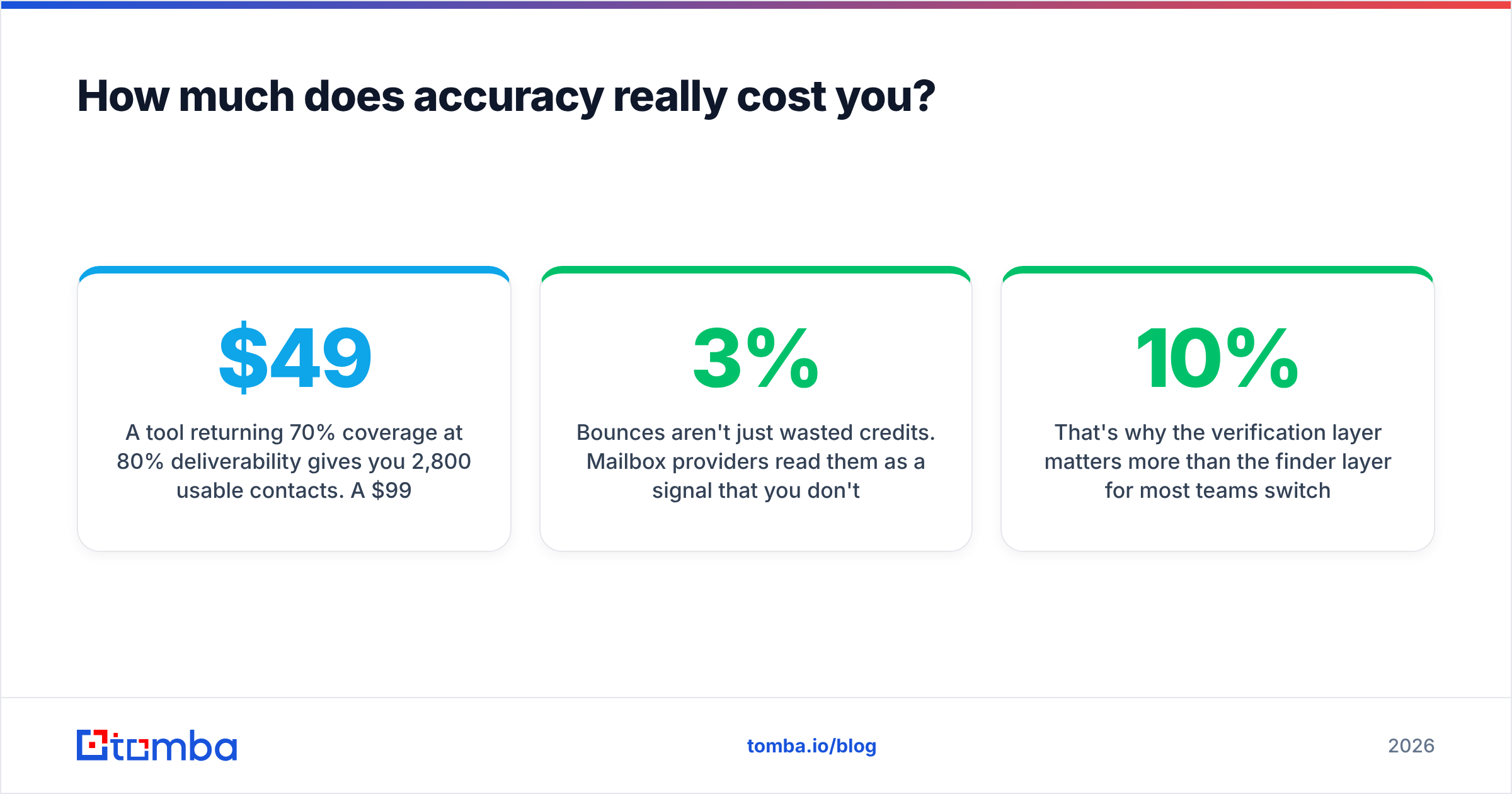
A $49/mo tool returning 70% coverage at 80% deliverability gives you 2,800 usable contacts. A $99/mo tool returning 65% coverage at 96% deliverability gives you 3,120. The expensive tool is cheaper per usable contact and it protects your sender reputation, which has a cost you never see on an invoice.
Bounces aren't just wasted credits. Mailbox providers read them as a signal that you don't know who you're mailing. Sustained hard bounces above the 2–3% range degrade email deliverability for every future campaign from that domain, including the ones with good data.
That's why the verification layer matters more than the finder layer for most teams switching away from a bundled tool. Before you migrate anything, run last quarter's GrowMeOrganic export through a bulk verify pass. If more than 10% comes back invalid or risky, the data was your problem — and swapping sequencers won't fix it.
How do you switch without losing your lists?#
Migration goes wrong when people rip and replace on day one. Run it in four steps instead.
- Export everything first. Pull all GrowMeOrganic contacts, sequences and reply history to CSV while your subscription is live. Do this before you cancel, not after.
- Benchmark on a real sample. Take 200 rows you already know the outcome for — replies, bounces, confirmed contacts. Run them through two or three shortlisted tools and score coverage and verified accuracy separately.
- Split the stack deliberately. Data from one vendor, sending from another. It costs marginally more and it means a bad week from either vendor doesn't take out your whole motion.
- Warm the new sending domain properly. If you're also changing sender, don't jump to full volume. Ramp over three to four weeks and watch your reputation graphs, not just your open rates.
Step two is the one people skip, and it's the only one that gives you evidence. Vendor-published hit rates are marketing numbers measured on vendor-friendly samples.
Which GrowMeOrganic alternative should you pick?#
Short version, by situation:
- You just want emails that don't bounce, at a predictable price → Tomba.
- You want a full stack with intent data and a dialer, budget allowing → Apollo.
- You buy data in campaign-shaped bursts and hate expiring credits → BookYourData.
- Your workflow is Sales Navigator, full stop → Wiza.
- You're on one fragile sending domain and cannot afford bounces → Findymail.
- Phone is your primary channel → Lusha, plus a separate email source.
- Your lists are fine, your bounce rate isn't → a verifier, not a new finder.
And if none of those fit, staying on GrowMeOrganic is a perfectly reasonable answer. It's a lot of tooling for the money. The question is only whether the parts you rely on are the parts it does best.
Ready to test the data side properly?#
Start with the cheapest possible experiment: take 25 contacts you already have outcomes for and run them through the Tomba Email Finder free tier. No card, no sales call. Compare coverage and verified deliverability against what GrowMeOrganic returned for the same rows.
If Tomba wins on your own data, Starter is $49/mo — the same ballpark as what you're already paying, with the accuracy problem solved instead of bundled around. If it doesn't win, you've spent nothing and you now have a benchmark to hold every other vendor on this list to.
Related guides#
Ready to find emails that actually work?
Join 150,000+ professionals who stopped guessing and started sending. Free credits on signup — no credit card required.
Get the Tomba newsletter
Practical outbound tactics and product updates — once every two weeks.
About the author