GrowMeOrganic Pricing in 2026: Plans, Real Costs, and Limits
GrowMeOrganic sells itself on unlimited-feeling credits and a low entry price. Here is what each plan actually covers, where the caps and overages hide, and how the cost per verified contact compares to other email finders in 2026.
TL;DR
- GrowMeOrganic is a LinkedIn-first prospecting suite: Chrome extension scraping, email finding, and built-in cold email sending, sold on flat monthly plans rather than pure per-credit pricing.
- Entry pricing sits in the $39–$49/month range on the lowest tier (annual billing knocks roughly 20–40% off monthly rates), with mid tiers around $79–$99 and top tiers pushing past $150/month.
- The sticker price is not the real price. Extra seats, sending mailboxes, annual-only discounts, and export caps are where budgets quietly inflate.
- The metric that matters is cost per verified contact, not cost per credit. A cheap plan that returns 60% deliverable emails is more expensive than a pricier one at 95%.
- If you mainly need accurate emails and an API rather than a full sending suite, a dedicated finder like Tomba at $49/mo is usually the cheaper half of the stack.
What is GrowMeOrganic and who is it actually for?#
GrowMeOrganic is an all-in-one B2B prospecting platform built around a Chrome extension. You run a search on LinkedIn or Sales Navigator, the extension pulls the profiles into a list, the platform attempts to find and verify work emails, and then you can sequence cold emails from inside the same tool. You can check the current feature set on the official GrowMeOrganic site.
That bundling is the whole pitch. Instead of paying for a scraper, a finder, a verifier, and a sending tool, you pay one subscription. For a solo founder or a two-person agency doing high-volume outbound, that consolidation is genuinely attractive.
It becomes less attractive when any one of those four jobs needs to be excellent. Bundled tools optimize for coverage, not depth. The scraper is fine, the sender is fine, the enrichment is the part most teams end up questioning — which is exactly why the pricing conversation always circles back to data quality.
Who it fits:
- Solo founders running 500–2,000 outbound touches a month who want one bill instead of four.
- Small agencies building lead lists for clients where speed matters more than surgical accuracy.
- Recruiters who live in LinkedIn and want profile-to-email in one click.
- Early-stage SDR teams testing whether outbound works before committing to a $1,500/month stack.
- Not a fit: RevOps teams needing API-first enrichment inside a CRM workflow, or anyone whose deliverability depends on sub-3% bounce rates.
How much does GrowMeOrganic cost in 2026?#
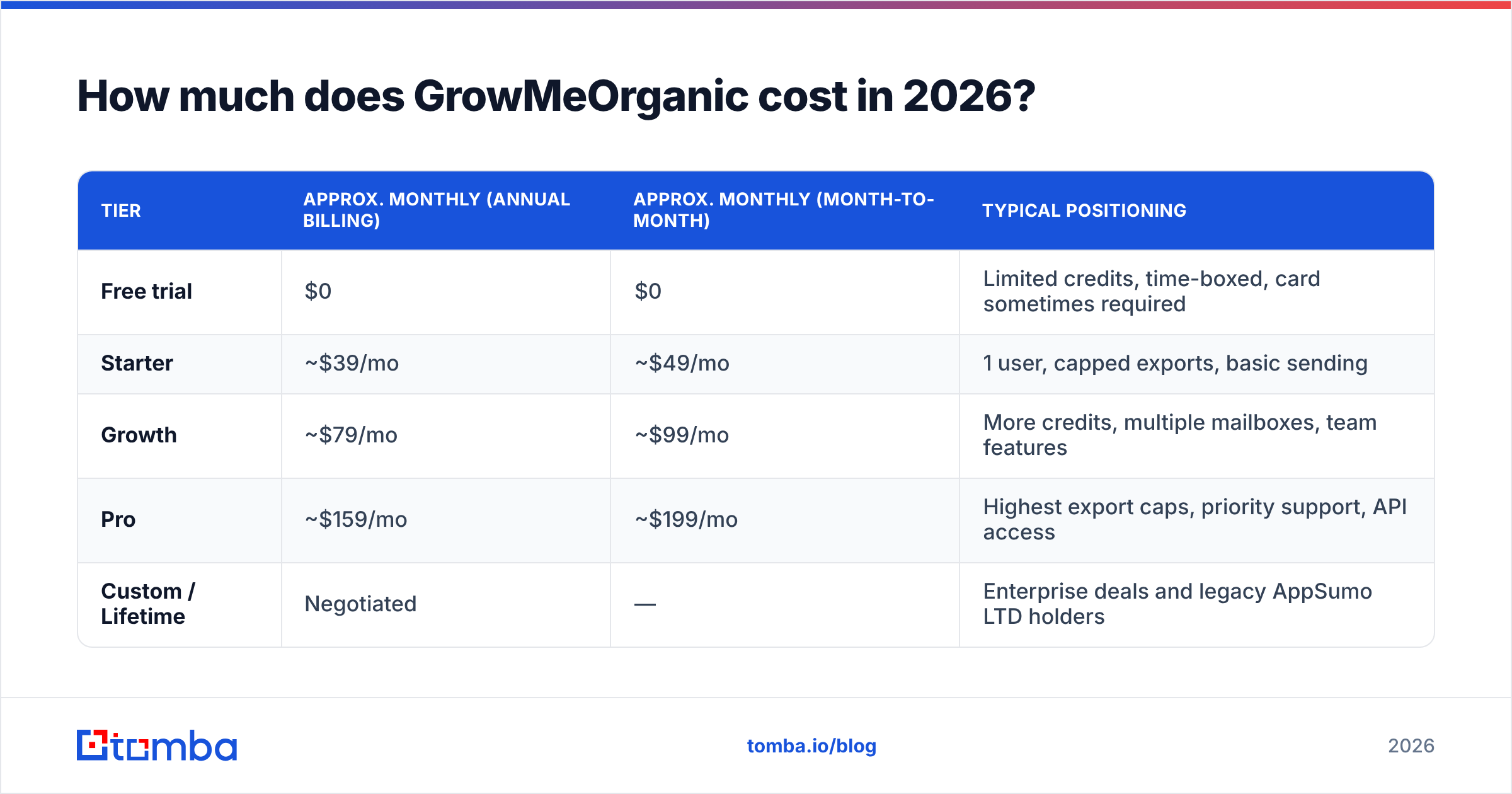
GrowMeOrganic publishes tiered monthly plans with a meaningful annual discount. Prices move, so treat the table below as the shape of the pricing rather than a quote — confirm live numbers on the vendor's own pricing page before you commit.
| Tier | Approx. monthly (annual billing) | Approx. monthly (month-to-month) | Typical positioning |
|---|---|---|---|
| Free trial | $0 | $0 | Limited credits, time-boxed, card sometimes required |
| Starter | ~$39/mo | ~$49/mo | 1 user, capped exports, basic sending |
| Growth | ~$79/mo | ~$99/mo | More credits, multiple mailboxes, team features |
| Pro | ~$159/mo | ~$199/mo | Highest export caps, priority support, API access |
| Custom / Lifetime | Negotiated | — | Enterprise deals and legacy AppSumo LTD holders |
Two things to note. First, the annual discount is where most of the advertised savings live — the headline number you see on a comparison blog is almost always the annual-equivalent rate. Second, GrowMeOrganic historically ran lifetime deals on AppSumo, so you will find reviews from users on grandfathered plans whose economics have nothing to do with what you would pay today. Filter those out when you read G2 reviews or Capterra listings.

What do you actually get on each plan?#
The credit allowance is only one of five dimensions that decide whether a plan works for you. Map all five before you pick a tier.
- Export credits — how many contacts you can pull out of the platform per month. This is the headline number and the one most likely to be described in generous terms.
- Email finding credits — separate from exports on most bundled tools. Finding an email and exporting a row are often billed as different actions.
- Sending mailboxes — how many connected inboxes you can sequence from. One mailbox caps you at roughly 30–50 safe sends per day, which is the real ceiling on your outbound volume.
- Seats — the lowest tier is almost always single-user. Adding a second SDR usually means jumping a tier, not paying a small per-seat delta.
- API and integrations — API access is typically gated to upper tiers. If you plan to enrich inside HubSpot or Salesforce automatically, price the tier that includes it, not the one that looks affordable.
The trap is buying tier one for the credits, then discovering that the mailbox limit or the seat limit forces an upgrade in month two. Model your actual send volume first: mailboxes × 40 sends/day × 22 working days tells you how many contacts you can realistically use. Buying 10,000 credits when you can only send 1,760 emails a month is buying inventory you will never ship.
Where do the hidden costs show up?#
Every bundled prospecting tool has the same four leak points, and GrowMeOrganic is no exception.
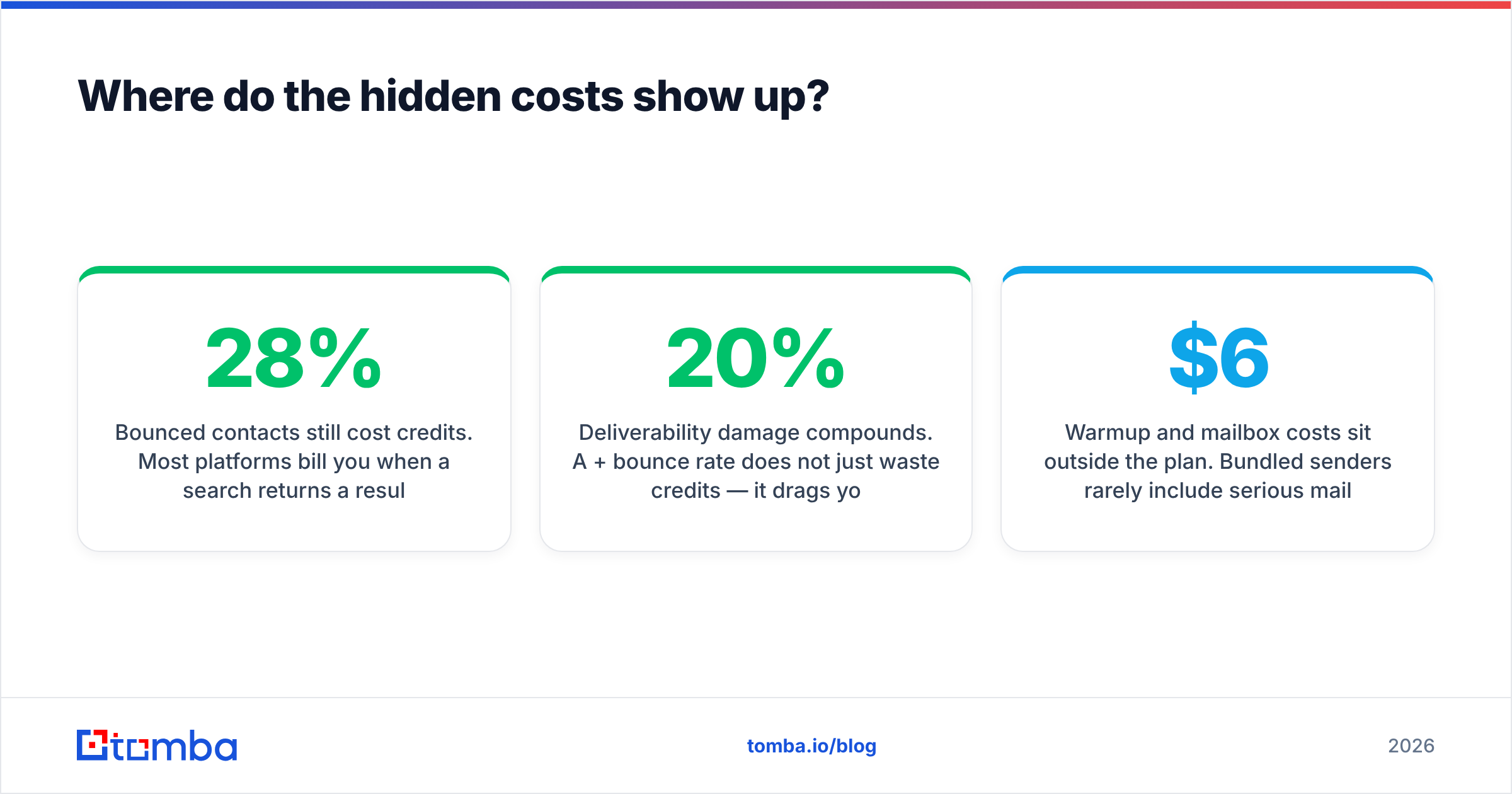
Bounced contacts still cost credits. Most platforms bill you when a search returns a result, not when that result turns out to be deliverable. If a plan returns 100 emails and 22 bounce, you paid for 100 and can use 78. That is a 28% effective price increase on the plan, before you count the deliverability damage.
Deliverability damage compounds. A 20%+ bounce rate does not just waste credits — it drags your sender reputation down, which lowers inbox placement for the contacts that were valid. The second-order cost of bad data is almost always larger than the first-order cost.
Warmup and mailbox costs sit outside the plan. Bundled senders rarely include serious mailbox warmup or extra Google Workspace/Microsoft 365 domains. Budget $6–$12 per mailbox per month for the inboxes themselves and whatever your warmup tool charges.
Annual lock-in. The attractive rate is the annual rate. If outbound turns out not to be your channel, you have prepaid twelve months for a tool you stop opening in week six. Run month-to-month for the first quarter and eat the premium — it is cheaper than a dead annual contract.
How accurate is the data you're paying for?#
Accuracy is the only variable that changes the real cost of a plan by more than 2x, and it is the one no pricing page will tell you.

Run this test before you pay for anything. Take 100 contacts you already know are valid — customers, past leads, people who have replied to you. Feed them through the trial of every tool on your shortlist. Then measure three numbers:
- Hit rate: how many of the 100 returned any email at all.
- Accuracy rate: how many of the returned emails matched the address you already knew was correct.
- Bounce rate: run every returned address through an independent email verifier and count the undeliverables.
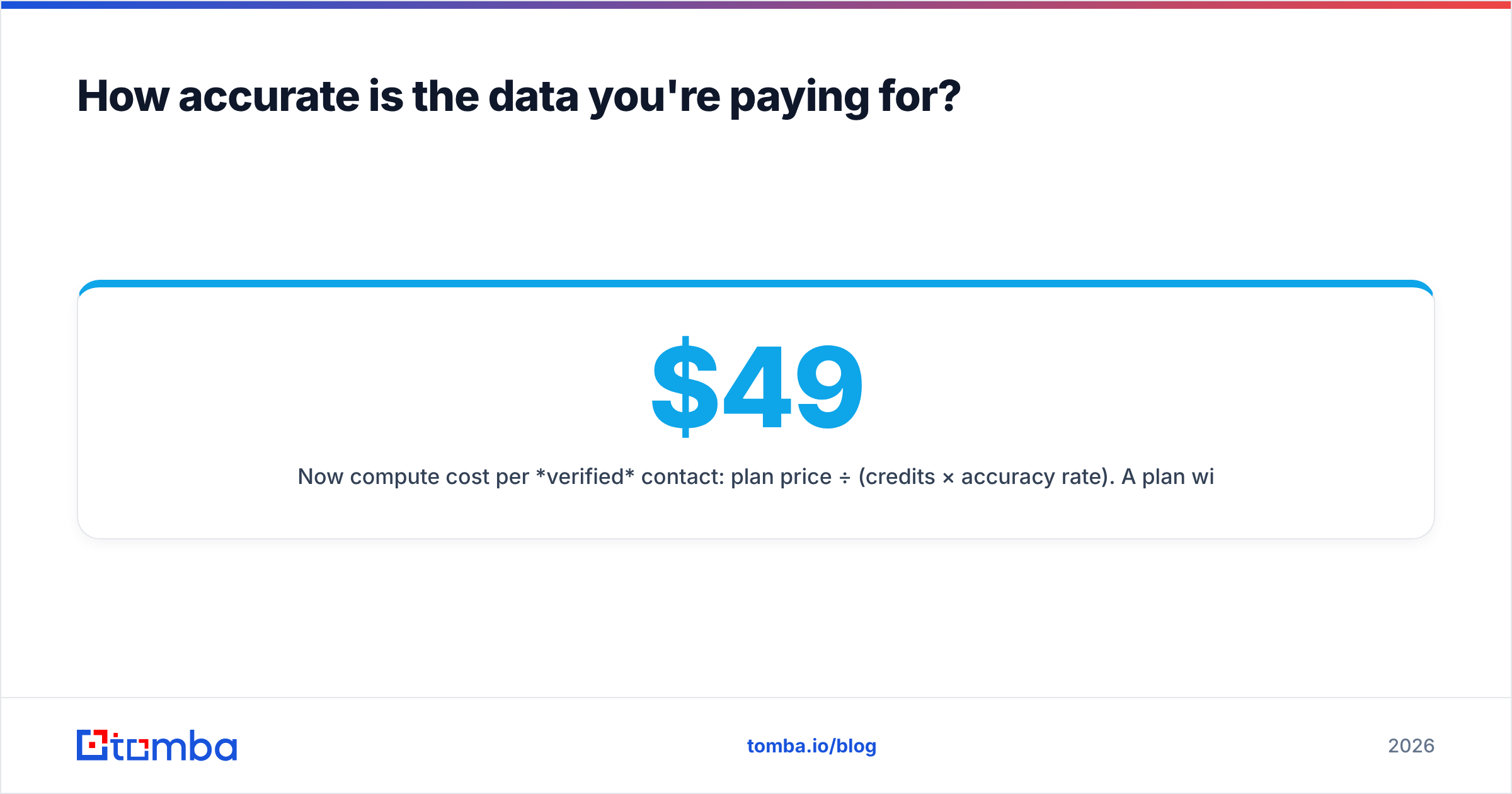
Now compute cost per verified contact: plan price ÷ (credits × accuracy rate). A $49 plan with 1,000 credits at 70% accuracy costs $0.070 per usable contact. A $49 plan with 1,000 credits at 95% accuracy costs $0.052. Same invoice, 35% difference in real cost — and the second one does not torch your domain.
Pay particular attention to catch-all domains. A large share of B2B domains accept every address at the SMTP layer, which means naive verification marks them "valid" when they are actually unknown. Tools that flag these honestly look worse on paper and perform better in production. If your list skews enterprise, a dedicated catch-all verifier is not optional.
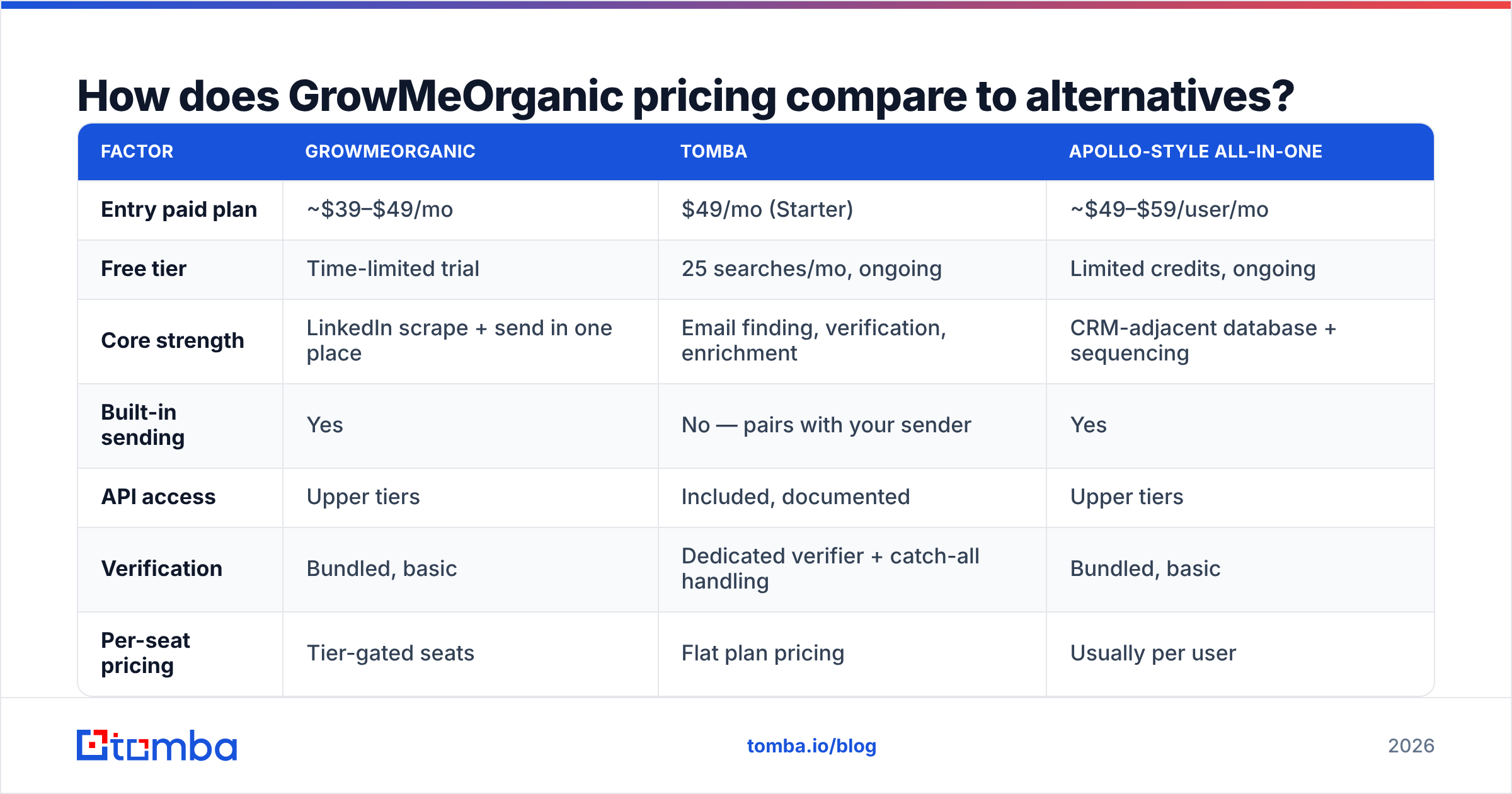
How does GrowMeOrganic pricing compare to alternatives?#
Compare on what the tool is for, not on headline price. GrowMeOrganic competes with two different categories at once: all-in-one sequencing suites and pure data providers. It is mid-priced against the first and expensive against the second.

| Factor | GrowMeOrganic | Tomba | Apollo-style all-in-one |
|---|---|---|---|
| Entry paid plan | ~$39–$49/mo | $49/mo (Starter) | ~$49–$59/user/mo |
| Free tier | Time-limited trial | 25 searches/mo, ongoing | Limited credits, ongoing |
| Core strength | LinkedIn scrape + send in one place | Email finding, verification, enrichment | CRM-adjacent database + sequencing |
| Built-in sending | Yes | No — pairs with your sender | Yes |
| API access | Upper tiers | Included, documented | Upper tiers |
| Verification | Bundled, basic | Dedicated verifier + catch-all handling | Bundled, basic |
| Per-seat pricing | Tier-gated seats | Flat plan pricing | Usually per user |
| Best for | Solo/small-team all-in-one outbound | Accuracy-first data layer, API workflows | Larger SDR orgs already in one CRM |
The structural difference: GrowMeOrganic charges you for a workflow, Tomba charges you for data. If you already run Instantly, Smartlead, Lemlist, or your own sequencer, you are paying twice for the sending half of a bundled tool. In that case the honest math is a dedicated finder plus your existing sender — Tomba's plans run $49/mo Starter, $99/mo Growth, $249/mo Pro, with a free tier at 25 searches a month so you can test accuracy before spending anything.
If you are starting from zero with no sequencer and no CRM, the bundle genuinely saves you setup time, and that has real value in month one.

Is GrowMeOrganic worth it for your team?#
It is worth it when three conditions hold at once: you live inside LinkedIn Sales Navigator, you have no existing sending infrastructure, and your target accounts are SMB rather than enterprise. In that scenario the bundle is efficient and the entry price is fair.
It stops being worth it in three situations:
- You already pay for a sequencer. You are buying a sending engine you will never turn on. Split the stack.
- You need CRM-native enrichment. Bulk enrichment jobs and CRM sync are where per-record data providers with a real email finder API beat workflow suites, because you can trigger enrichment from the record rather than from a browser tab.
- Your bounce tolerance is under 3%. Bundled verification is rarely tuned tightly enough for cold sending at scale. You will end up running a second verification pass anyway, which means paying twice.
One more consideration that gets ignored: exportability. If a tool makes it hard to get your lists out in clean CSV, its price is effectively permanent, because switching costs you the data. Test the export path during the trial, not after the annual invoice clears.
What's the cheapest way to get verified B2B emails in 2026?#
The cheapest stack is almost never the cheapest single tool. It is the combination with the lowest cost per replied email.
For most small teams, that looks like: a focused data source for finding and verifying contacts, one sending tool you actually like, and a spreadsheet or CRM in the middle. Splitting these means you can swap the weak link without migrating everything else — and it means your data quality is not hostage to whichever vendor also happens to own your sequences.
Practical sequence to run this month:
- Build one list of 100 known-good contacts as your accuracy benchmark.
- Trial two or three tools against it, including GrowMeOrganic and at least one dedicated finder.
- Verify every output with an independent verifier and record the true bounce rate.
- Divide plan cost by verified contacts to get your real unit price.
- Buy month-to-month for the first quarter, then convert to annual once the numbers hold.
That process takes an afternoon and routinely saves four figures a year.
Start with the data layer. If your outbound is stalling on bounces rather than on copy, fix the input before you buy another sequencer. The Tomba Email Finder gives you 25 free searches a month to benchmark against your current tool — run your 100 known-good contacts through it, compare the verified hit rate to what you are paying for now, and let the unit economics decide instead of the pricing page.
Related guides#
Ready to find emails that actually work?
Join 150,000+ professionals who stopped guessing and started sending. Free credits on signup — no credit card required.
Get the Tomba newsletter
Practical outbound tactics and product updates — once every two weeks.
About the author