GrowMeOrganic Reviews 2026: Honest Pros, Cons & Verdict
GrowMeOrganic sells unlimited email sending and LinkedIn scraping for a flat fee. We dug into the data accuracy, the deliverability trade-offs, and who it actually fits in 2026.
TL;DR — what the GrowMeOrganic reviews agree on
- GrowMeOrganic is an all-in-one prospecting suite. It bundles LinkedIn scraping, a B2B contact database, email finding, and cold email sending. One flat fee, no per-email credit meter.
- The headline draw is "unlimited email sending." It is real, but your own mailbox sets the ceiling. GrowMeOrganic does not lift Google or Microsoft throttles.
- Data accuracy is the weak spot in most GrowMeOrganic reviews. Users report needing a second verification pass before they send, above all on non-US and catch-all domains.
- Best fit: solo founders and small agencies. One bill beats four tools, and they can live with an extra cleanup step.
- Worst fit: teams that send at volume. There, a 10% bounce swing decides whether the domain survives the quarter.
What is GrowMeOrganic?#
GrowMeOrganic is an India-based B2B prospecting platform. It bundles four jobs into one subscription. You pull prospects from LinkedIn and Sales Navigator with a Chrome extension. You search a built-in contact database. You find and verify business emails. Then you run cold email sequences from your own mailboxes.
The positioning is deliberate. Most stacks look like this: a data tool (Apollo, ZoomInfo), an email finder (Tomba, Hunter), a verifier (ZeroBounce, NeverBounce), and a sender (Instantly, Smartlead). Four vendors, four invoices, four sets of credits that expire on different days. GrowMeOrganic's pitch is simple. Replace all four with one flat monthly fee and stop counting credits.
That consolidation is useful for a one-person outbound motion. It is also where the trade-offs start. A tool that does four things rarely does all four as well as a specialist. The rest of this review covers which of the four hold up.
Here is how the four jobs break down inside the product:
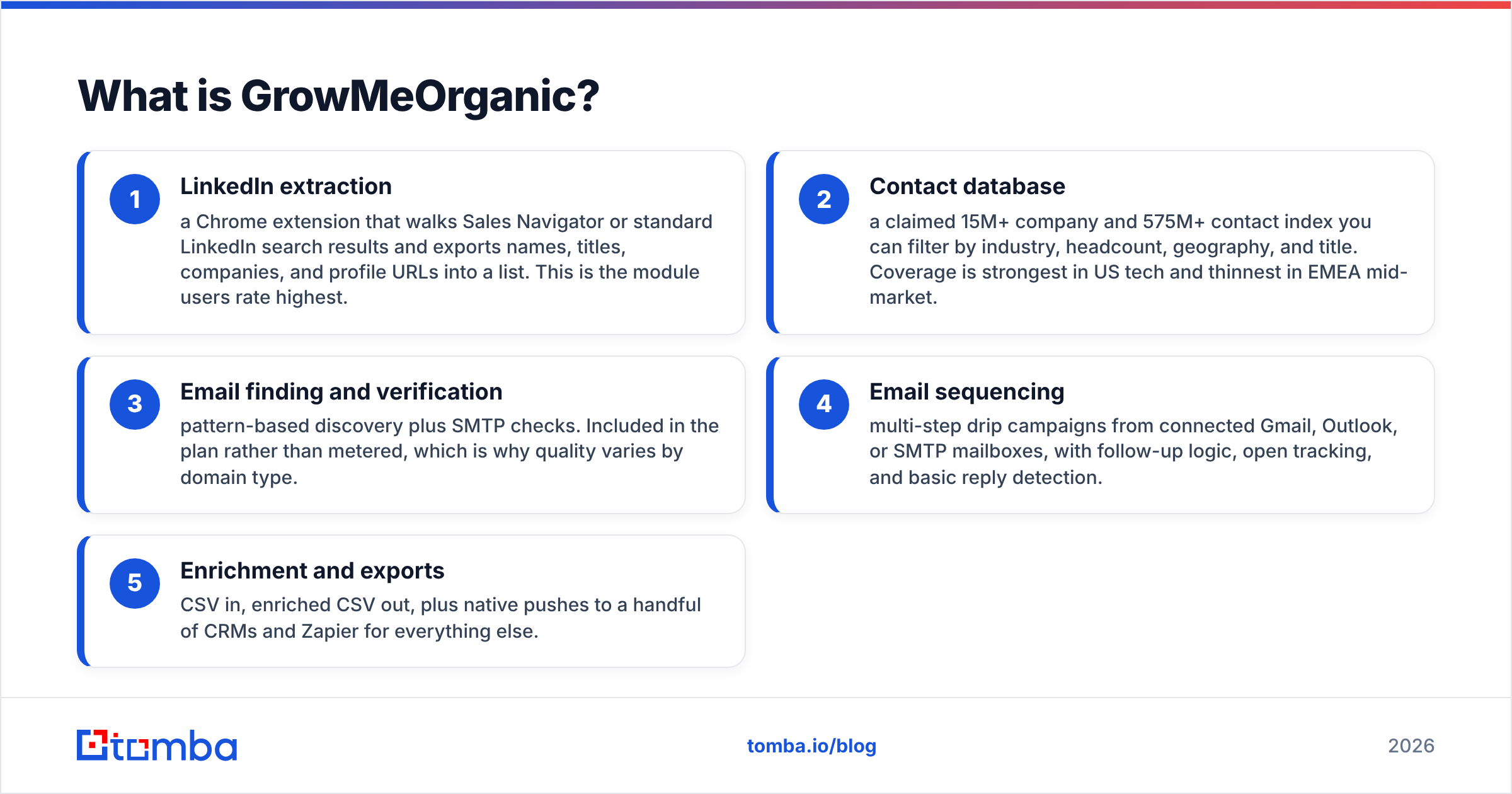
- LinkedIn extraction — a Chrome extension that walks Sales Navigator or standard LinkedIn search results. It exports names, titles, companies, and profile URLs into a list. Users rate this module highest.
- Contact database — a claimed 15M+ company and 575M+ contact index. You can filter by industry, headcount, geography, and title. Coverage is strongest in US tech and thinnest in EMEA mid-market.
- Email finding and verification — pattern-based discovery plus SMTP checks. The plan includes it rather than metering it, so quality varies by domain type.
- Email sequencing — multi-step drip campaigns from connected Gmail, Outlook, or SMTP mailboxes. You get follow-up logic, open tracking, and basic reply detection.
- Enrichment and exports — CSV in, enriched CSV out. There are native pushes to a handful of CRMs, plus Zapier for everything else.
Is unlimited email sending actually unlimited?#
No. Understanding why matters more than any other line in this review.
GrowMeOrganic does not charge per email. It also sets no monthly send ceiling on its side. But it sends through your mailbox with your credentials. Google Workspace caps external recipients at roughly 2,000 per day per user, and far lower for new or unwarmed accounts. Microsoft 365 enforces a 10,000-recipient daily limit and throttles hard well before that. GrowMeOrganic cannot lift a limit it does not own.
So "unlimited" means "we won't meter you." It does not mean you can send 50,000 cold emails a month from three inboxes. Try it and Google will throttle you. Your sender reputation will tank, and your bounce rate will do the rest of the damage.
The practical read: unlimited sending is a pricing feature, not a capacity feature. It saves money if you already pay per email elsewhere. It does not change how many people you can safely reach. That number depends on mailbox count, warmup maturity, and list hygiene. Google's own bulk sender guidelines put the spam complaint threshold at 0.3%. That number does not care which vendor pushes the send button.
The same logic applies to unlimited email finding. Uncapped lookups only help if the lookups return correct addresses. An endless supply of guesses is a liability, not an asset. Every bad address you send to is a small withdrawal from your domain's reputation account.
What GrowMeOrganic reviews say about data accuracy#
This is where GrowMeOrganic reviews split hardest. It is also where you should doubt any number a vendor publishes, including this one.
Across G2 and Capterra, the pattern holds. Reviewers praise the LinkedIn extraction and the price. Then they note that many returned emails bounce or belong to people who left the company. Reported bounce rates cluster in the 8-20% range, depending on geography and industry. You want under 5% before a campaign goes out.
Two structural reasons explain the gap:
- Pattern inference over verification. A tool guesses
first.last@company.comfrom a known pattern. If SMTP cannot confirm it, the tool has a choice: return the guess or return nothing. Bundled tools with uncapped lookups lean toward the guess. "We found 900 of your 1,000" reads better than "we found 480 we can stand behind." - Catch-all handling. About a fifth of business domains accept mail for every address. A standard SMTP check returns "valid" for anything you throw at it. Telling real mailboxes apart on a catch-all domain takes extra signal layers. A dedicated catch-all verifier is built for that job. A bundled finder usually is not.
The fix is not to drop the tool. It is to stop treating any single source as send-ready. Export from GrowMeOrganic, run the list through a dedicated email verifier, and send only to what survives. That step costs a few dollars per thousand records, and it routinely halves bounce rates.
GrowMeOrganic vs. the alternatives: how does it compare?#
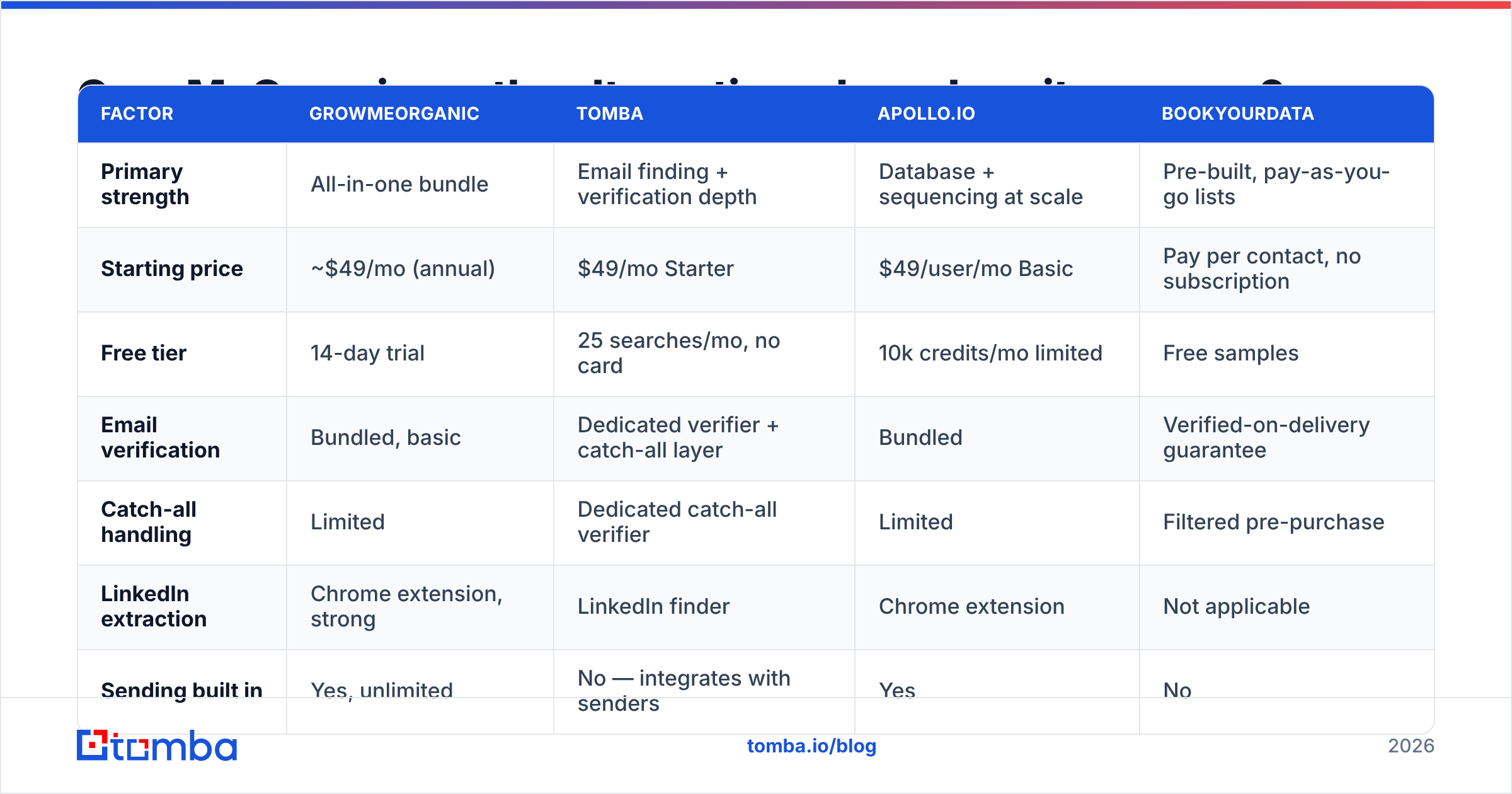
| Factor | GrowMeOrganic | Tomba | Apollo.io | BookYourData |
|---|---|---|---|---|
| Primary strength | All-in-one bundle | Email finding + verification depth | Database + sequencing at scale | Pre-built, pay-as-you-go lists |
| Starting price | ~$49/mo (annual) | $49/mo Starter | $49/user/mo Basic | Pay per contact, no subscription |
| Free tier | 14-day trial | 25 searches/mo, no card | 10k credits/mo limited | Free samples |
| Email verification | Bundled, basic | Dedicated verifier + catch-all layer | Bundled | Verified-on-delivery guarantee |
| Catch-all handling | Limited | Dedicated catch-all verifier | Limited | Filtered pre-purchase |
| LinkedIn extraction | Chrome extension, strong | LinkedIn finder | Chrome extension | Not applicable |
| Sending built in | Yes, unlimited | No — integrates with senders | Yes | No |
| API access | Limited | Full REST API, CLI, MCP | Yes, higher tiers | Limited |
| Best for | Solo founders, small agencies | Accuracy-first list building | Mid-market sales teams | One-off list purchases |
A few notes on reading this table honestly.
GrowMeOrganic wins on consolidation. Say you are one person doing everything and you want a single invoice. Then the bundle is defensible. Four specialist tools at $49-99 each run $200-400 a month. GrowMeOrganic is one line item.
Tomba wins on the data layer. It does not send campaigns, and that is a deliberate scope choice. It focuses on finding and confirming addresses. You get a domain search for mapping a whole company, catch-all resolution, and a Tomba API for teams that want enrichment inside their own systems. Tomba pricing starts at $49/mo for Starter, $99/mo for Growth, and $249/mo for Pro. The free tier covers 25 searches per month.
Apollo wins on breadth for funded teams. Bigger database, deeper filters, better native CRM sync. The price and the learning curve match.
BookYourData wins when you want no subscription at all. Its model is different. You buy a filtered, pre-verified list outright with an accuracy guarantee. That suits campaign work where you need 3,000 contacts once rather than a steady feed.
The strongest setups combine categories instead of picking one champion. Extract with the tool that has the best LinkedIn workflow. Verify with a specialist. Then send from a dedicated platform with proper warmup.
What does GrowMeOrganic cost in 2026?#
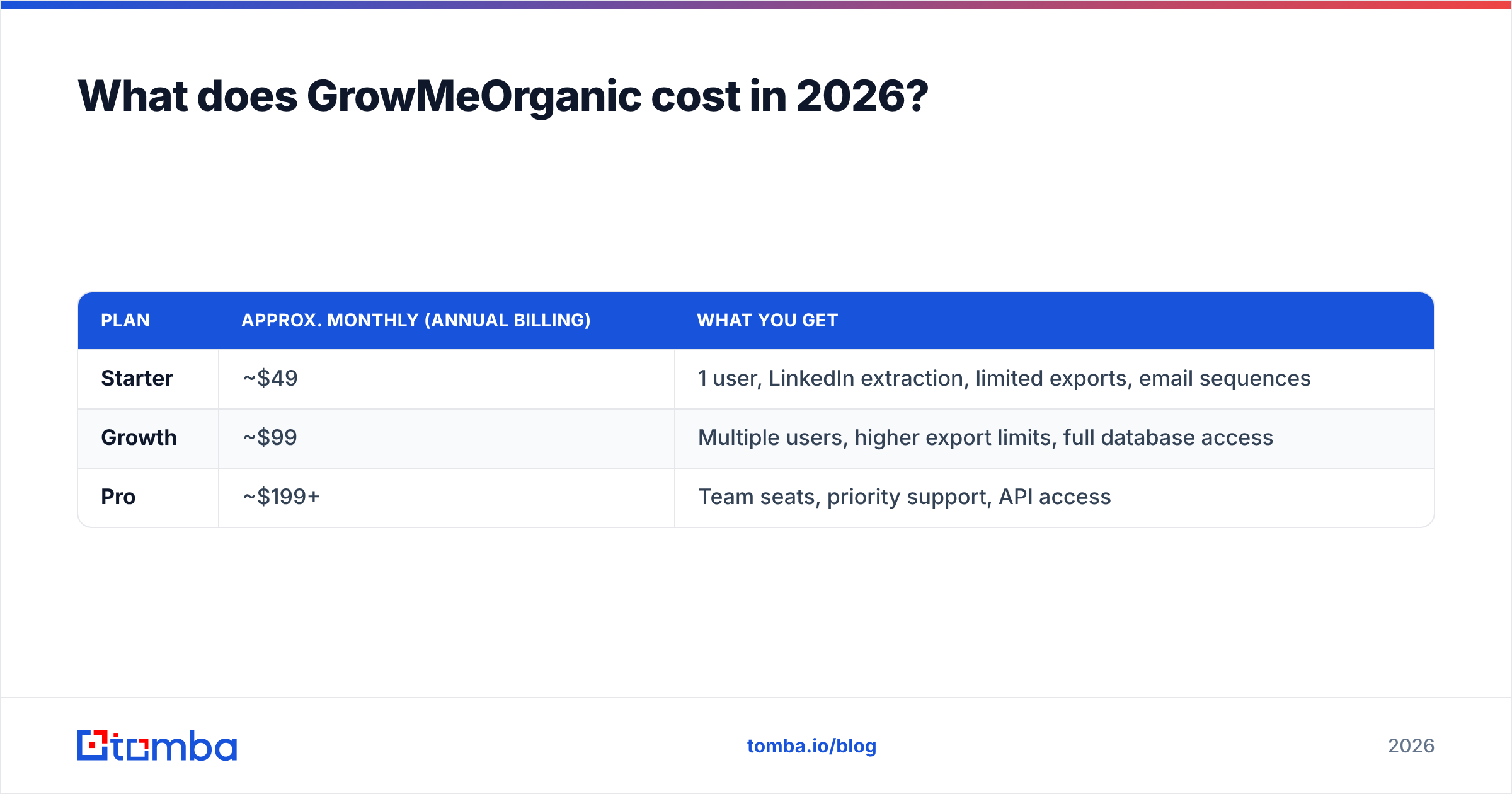
Pricing is flat-fee and tier-based rather than credit-based. That is the whole point of the product.
| Plan | Approx. monthly (annual billing) | What you get |
|---|---|---|
| Starter | ~$49 | 1 user, LinkedIn extraction, limited exports, email sequences |
| Growth | ~$99 | Multiple users, higher export limits, full database access |
| Pro | ~$199+ | Team seats, priority support, API access |
Check the official GrowMeOrganic pricing page before you buy. Tiers move, and monthly billing runs well above the annual rates above.
The real cost question is not the sticker price. It is the total cost of a bad list:
- Domain damage. A campaign at 15% bounce can put a sending domain on a blocklist. Recovery takes weeks, and sometimes a new domain.
- Rep time. Every bounced or wrong-person email is a reply that never happens. At 2,000 sends and a 15% bounce, that is 300 wasted touches per campaign.
- Replacement cost. A new warmed domain, new mailboxes, and a warmup period cost real money and real calendar time.
Measured that way, $20-40 to verify a 5,000-record list is cheap insurance. Before any send, run a quick SPF checker and confirm your authentication records are clean. The best data in the world will not land if your DNS is broken.
Who should actually use GrowMeOrganic?#
Good fit:
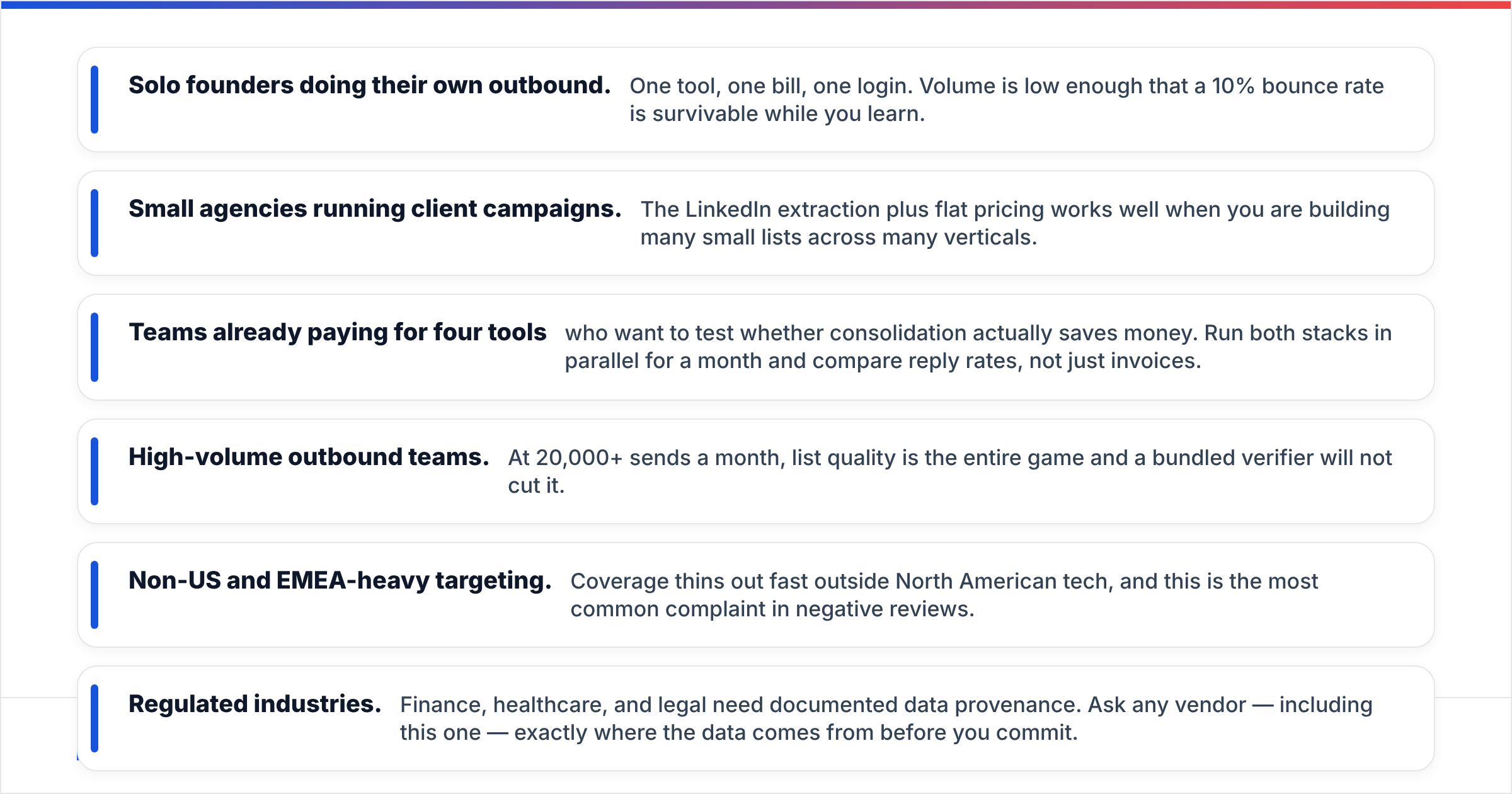
- Solo founders doing their own outbound. One tool, one bill, one login. Volume stays low enough that a 10% bounce rate is survivable while you learn.
- Small agencies running client campaigns. LinkedIn extraction plus flat pricing works well when you build many small lists across many verticals.
- Teams already paying for four tools. Test whether consolidation really saves money. Run both stacks side by side for a month and compare reply rates, not just invoices.
Poor fit:
- High-volume outbound teams. At 20,000+ sends a month, list quality is the whole game. A bundled verifier will not cut it.
- Non-US and EMEA-heavy targeting. Coverage thins out fast outside North American tech. This is the most common complaint in negative GrowMeOrganic reviews.
- Regulated industries. Finance, healthcare, and legal need documented data provenance. Ask any vendor, including this one, exactly where the data comes from before you commit.
- Anyone who needs deep API access. GrowMeOrganic is UI-first. If you enrich data inside your own product or warehouse, pick an API-first vendor.
GrowMeOrganic reviews: what's the verdict in 2026?#
GrowMeOrganic is a fair value bundle with a real data-quality ceiling.
Buy it if you are early, short on budget, and tired of juggling four subscriptions. The LinkedIn extraction is genuinely good. The sequencing is competent. Flat pricing removes the anxiety of watching credits drain mid-campaign.
Do not buy it and expect the accuracy of a dedicated finder-and-verifier stack. GrowMeOrganic reviews are consistent on this point. The causes are structural: pattern inference, weak catch-all handling, and uncapped lookups. A UI update does not fix any of them.
Most experienced operators land on a middle path. Use GrowMeOrganic (or any bundle) for extraction and sending. Put a specialist verification layer between the export and the send. That one step keeps the cost savings of consolidation and removes its biggest risk. You keep one sending tool and add one data tool, so two invoices instead of four.
One last check before you commit to any vendor: run a 200-record pilot. Pull the list, send it, and measure the real bounce rate. Vendor accuracy claims are marketing. Your bounce rate is data. Ninety minutes of testing beats ninety days of a burned domain.
Ready to fix the data layer?#
If bounce rates are holding your campaigns back, the fix is narrow: better addresses going in. The Tomba Email Finder finds verified business emails by name, domain, or company. Every result carries catch-all resolution and a confidence score, so you know which addresses are safe to send before you risk your domain. Start free with 25 searches a month, no card required. Test it against your existing list. If the bounce rate drops, you have your answer.
Related guides#
Ready to find emails that actually work?
Join 150,000+ professionals who stopped guessing and started sending. Free credits on signup — no credit card required.
Get the Tomba newsletter
Practical outbound tactics and product updates — once every two weeks.
About the author