GrowMeOrganic vs Gumbamail: Which Tool Wins in 2026?
GrowMeOrganic sells B2B prospecting plus cold email; Gumbamail sells newsletters and SMS to lists you already own. Here is the honest breakdown of pricing, data quality, and which one actually fits your motion.
TL;DR
- These two tools are not really competitors. GrowMeOrganic is a B2B prospecting database plus a cold-email sender. Gumbamail is an email/SMS marketing platform for lists you already own. Picking between them is mostly a question of whether you need to find contacts or broadcast to them.
- GrowMeOrganic wins on unlimited-style pricing. Its lifetime and annual plans bundle a claimed 575M+ contact database with LinkedIn scraping and drip campaigns — attractive if you're an agency running volume.
- Gumbamail wins on newsletter mechanics. Drag-and-drop builder, Google Workspace-friendly sending, SMS, and pay-as-you-go credits make it a cleaner fit for opt-in marketing lists.
- Neither is a data-accuracy leader. If your bounce rate is the metric that decides your quarter, a dedicated finder + verifier stack (Tomba, for example) sits in front of either tool and does the heavy lifting.
- The realistic 2026 stack: verified contact data → sending tool. Don't ask one $49/mo product to be both a database and an ESP.
What is GrowMeOrganic and who actually uses it?#
GrowMeOrganic is an all-in-one B2B lead generation platform built around three things: a contact database, a LinkedIn/Sales Navigator scraper (Chrome extension), and a cold-email sequencer with unlimited-ish sending on higher tiers.
The pitch is aggressive: one subscription replaces your data vendor, your LinkedIn automation tool, and your outreach sequencer. Agencies and solo founders like it because the per-seat math is generous compared to buying Apollo alternatives plus a separate sender.
The reality is more textured. The database claims hundreds of millions of profiles, but coverage is uneven outside the US and UK, and the emails it surfaces are frequently pattern-guessed rather than source-verified. That's fine for a low-stakes campaign. It's expensive when your domain reputation is on the line.
Who it fits:
- Agencies running outbound for 5+ clients who need volume more than precision.
- Founders doing their own prospecting who want one login instead of four.
- LinkedIn-first teams who live in Sales Navigator and want exports without a separate scraper.
- Budget-constrained SDRs where a per-credit database is a non-starter.
Who it does not fit: anyone selling into regulated markets, anyone with a fragile sending domain, and anyone whose ICP is outside the platform's strong geographies.
What is Gumbamail and how is it different?#
Gumbamail (gumbamail.com) is a Spanish-built email marketing platform — think of it as a Mailchimp competitor with SMS bolted on. You upload or collect a subscriber list, design a campaign in a drag-and-drop editor, and broadcast.
The key structural difference: Gumbamail does not find contacts for you. There is no database, no LinkedIn scraper, no email pattern engine. It assumes you already have permission-based subscribers. Its differentiators are the Gmail/Google Workspace integration for smaller sends, transactional email, SMS campaigns, and a pricing model that includes pay-as-you-go credits alongside monthly plans.
That makes it a genuinely good product for what it does — newsletters, product announcements, ecommerce blasts, event reminders. It is simply answering a different question than GrowMeOrganic is.
Analogy: GrowMeOrganic is a fishing boat with sonar. Gumbamail is a very nice loudspeaker for the people already standing on your dock.
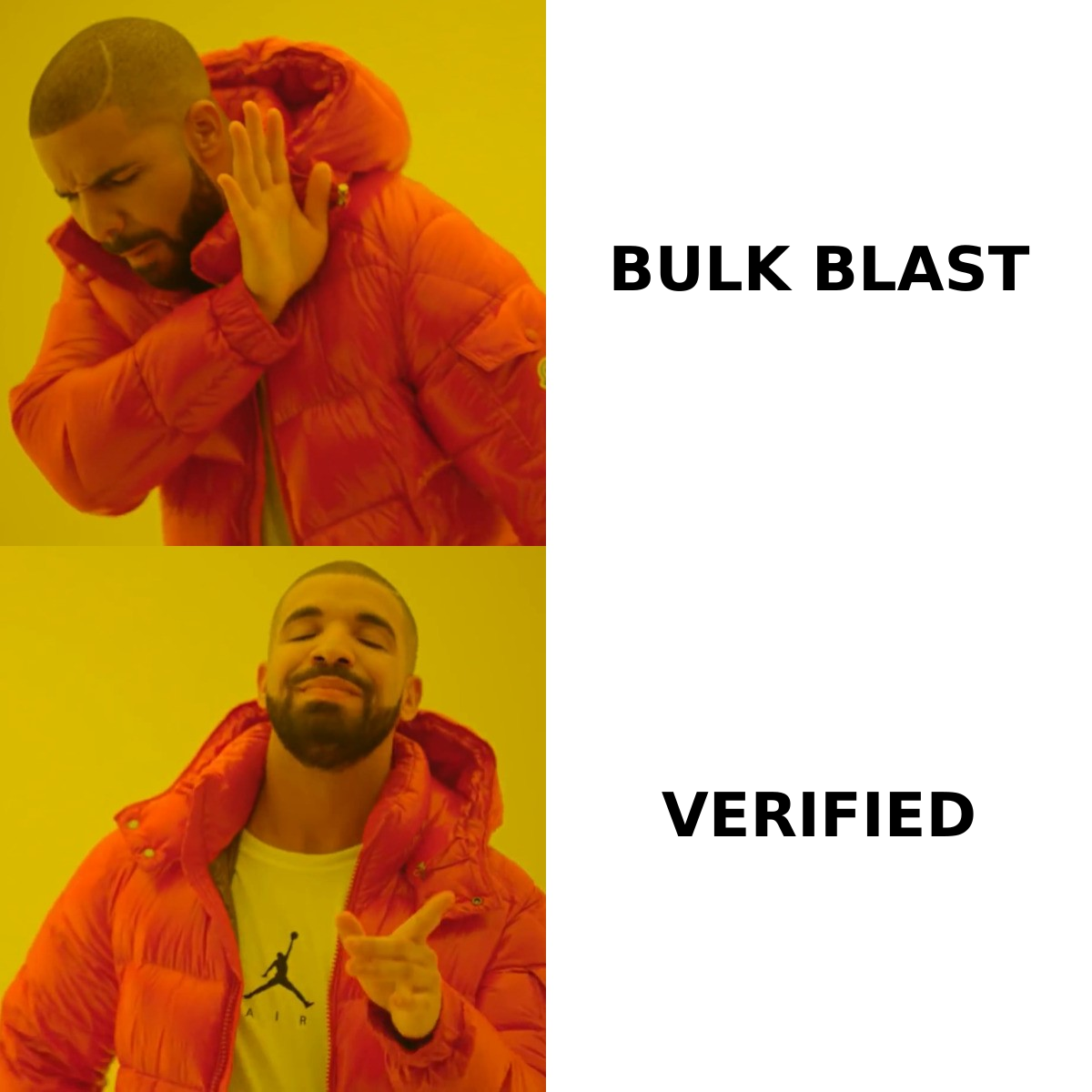
GrowMeOrganic vs Gumbamail: how do they compare head-to-head?#
| Dimension | GrowMeOrganic | Gumbamail |
|---|---|---|
| Primary job | Find B2B contacts + send cold sequences | Broadcast to an existing opt-in list |
| Contact database | Yes (claimed 575M+ profiles) | No |
| LinkedIn scraping | Yes, Chrome extension + Sales Navigator | No |
| Email verification | Basic, bundled | Basic list hygiene only |
| Drag-and-drop builder | Limited (plain-text focused) | Yes, core strength |
| SMS campaigns | No | Yes |
| Transactional email | No | Yes (SMTP/API) |
| Cold outreach legality fit | Built for it (B2B, opt-out model) | Not designed for cold lists |
| Typical entry price | ~$49/mo range, annual discounts, LTD history | Free tier + pay-as-you-go credits |
| Best for | Outbound SDR teams, agencies | Newsletters, ecommerce, product marketing |
| Weakest point | Data accuracy and bounce rates | Zero prospecting capability |
Read that table twice. If your answer to "where does my list come from?" is "I don't have one yet," Gumbamail cannot help you and GrowMeOrganic is only a partial answer.
Which one has better data accuracy?#
Only one of them makes an accuracy claim at all — and that claim deserves scrutiny.
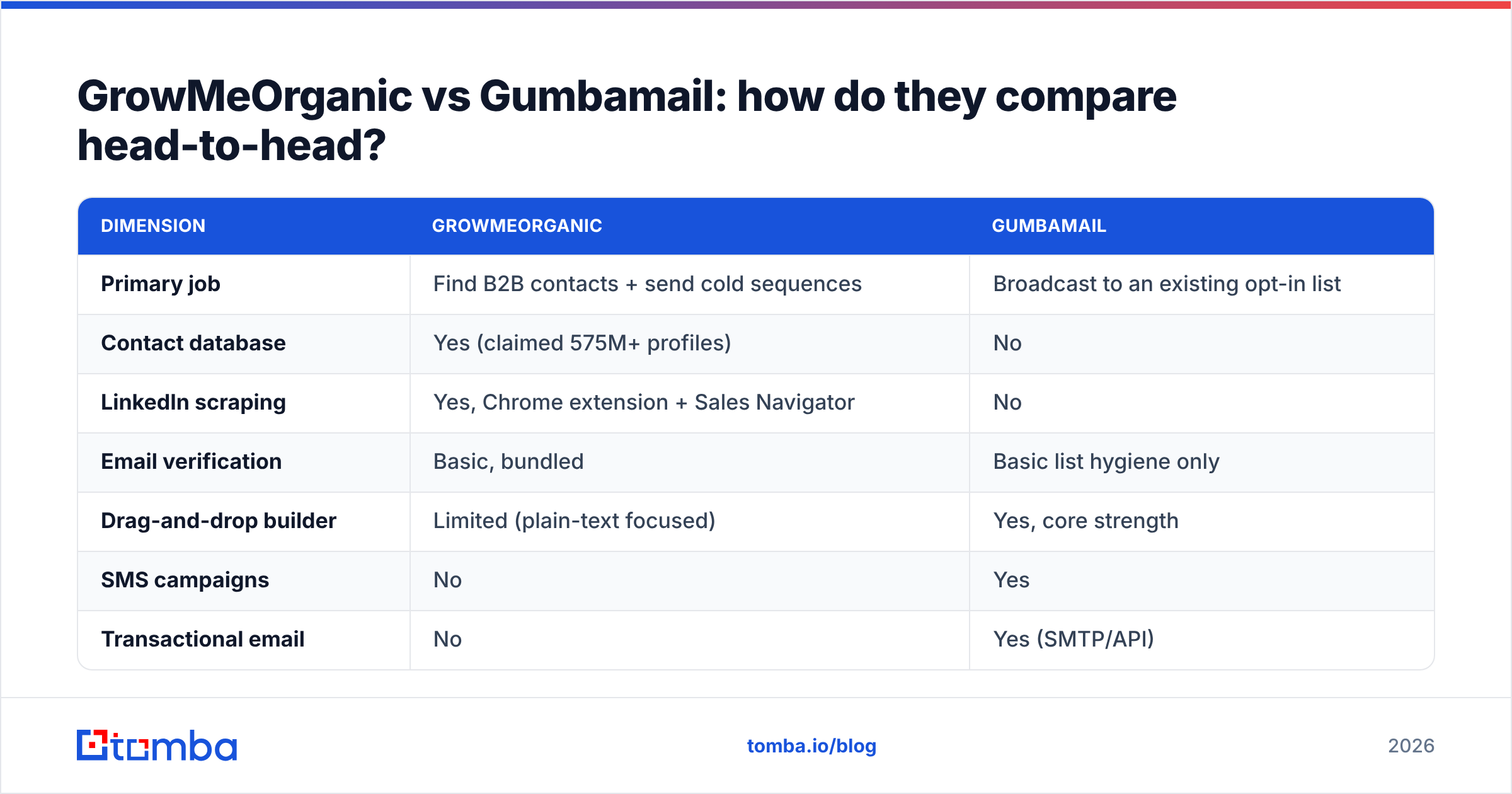
Bundled databases inside all-in-one outbound tools tend to share a structural problem: the same crawl is resold across many vendors, refresh cycles are slow, and role changes go undetected for months. Independent buyer reviews on G2 consistently flag bounce rates in the 15–30% band for platforms in this tier. Anything above roughly 3% puts you in email deliverability trouble with Google and Microsoft's 2024-era bulk sender rules, which are now table stakes rather than guidance.
Gumbamail sidesteps the question entirely — it never claims to source contacts, so accuracy is your responsibility before the list ever gets uploaded. That's honest positioning, but it means the burden shifts to you.
Practical consequences of skipping verification:
- Domain reputation damage that takes 4–8 weeks of throttled sending to repair.
- Spam-trap hits from stale records that were valid two years ago.
- Wasted send credits on both platforms, since neither refunds bounces.
- Skewed reporting — a 22% "no reply" rate that was actually a delivery failure.
The fix is boring and effective: run every list through a dedicated email verifier before it touches a sending tool, regardless of which platform you chose. For domains that accept everything, a proper catch-all verifier is the difference between a usable segment and a coin flip.
How does pricing actually compare?#
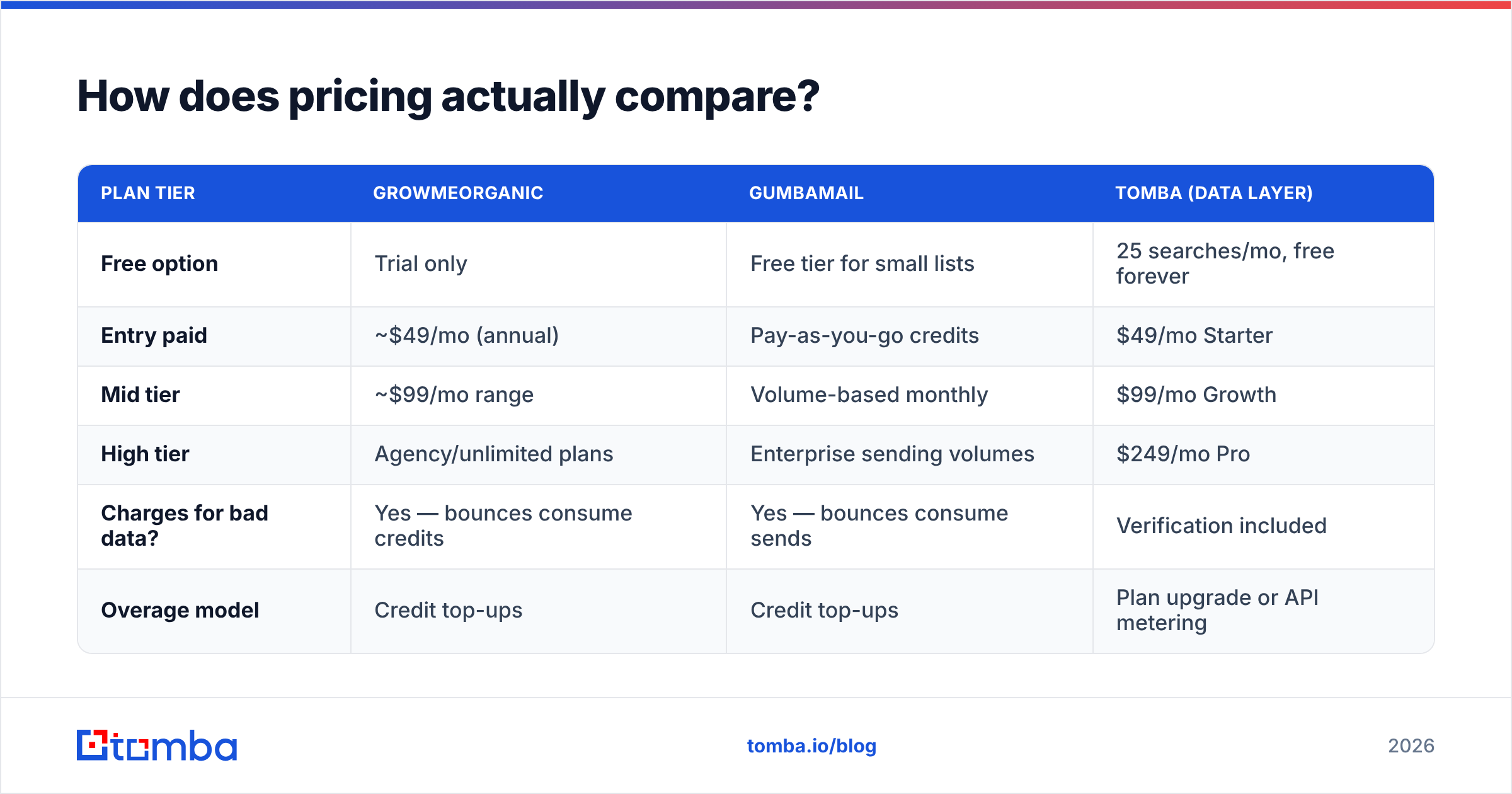
| Plan tier | GrowMeOrganic | Gumbamail | Tomba (data layer) |
|---|---|---|---|
| Free option | Trial only | Free tier for small lists | 25 searches/mo, free forever |
| Entry paid | ~$49/mo (annual) | Pay-as-you-go credits | $49/mo Starter |
| Mid tier | ~$99/mo range | Volume-based monthly | $99/mo Growth |
| High tier | Agency/unlimited plans | Enterprise sending volumes | $249/mo Pro |
| Charges for bad data? | Yes — bounces consume credits | Yes — bounces consume sends | Verification included |
| Overage model | Credit top-ups | Credit top-ups | Plan upgrade or API metering |
Two notes on this table. First, GrowMeOrganic has historically leaned on lifetime deals and steep annual discounts, so the sticker price you see today may not be the price a competitor of yours locked in during an AppSumo window. Second, Gumbamail's credit model genuinely is cheaper for irregular senders — if you mail twice a quarter, a monthly SaaS subscription is a bad trade.
Compare against Tomba pricing and the pattern becomes clear: the data layer and the sending layer are priced separately for a reason. Bundling them saves a line item and costs you accuracy.
Is GrowMeOrganic better than Gumbamail for cold email?#
Yes — and it's not close, but that's a category answer rather than a quality answer.
Gumbamail, like every ESP built for permission marketing, is not designed for cold outreach. Uploading a purchased or scraped list into a newsletter platform is a fast way to get your account reviewed and your sending paused. Their terms, like Mailchimp's and every reputable ESP's, assume consent.
GrowMeOrganic is purpose-built for the opposite motion: small-batch, personalized, plain-text sequences sent from your own connected mailbox with opt-out handling. That architecture is what makes cold outbound survivable.
But "better for cold email" is not the same as "good enough for cold email." Three things GrowMeOrganic does not solve well:
- Inbox warmup at scale. You still need a warmup layer and enough sending domains to spread volume.
- Verification depth. Bundled checks catch syntax and MX, not the risky middle ground.
- Data freshness for non-US markets. Coverage thins fast outside core geographies.
If you're serious about outbound, the sequencer is the cheap part. Check Instantly alternatives and Saleshandy alternatives — the sending layer has largely commoditized. What hasn't commoditized is verified, freshly-sourced contact data.
What should your 2026 stack actually look like?#
Here's the honest architecture that most performing teams converge on:
- Layer 1 — Sourcing. Find the right person at the right company. This is where a dedicated email finder or domain search earns its cost, because it returns a source and a confidence score rather than a guessed pattern.
- Layer 2 — Verification. Everything gets checked before it's loaded. Non-negotiable under current bulk-sender rules.
- Layer 3 — Enrichment. Job title, company size, tech stack, and a phone number where the email fails. A phone finder turns a 2% reply rate into a multi-channel sequence.
- Layer 4 — Sending. GrowMeOrganic for cold sequences, Gumbamail for opt-in newsletters, or both if you run two distinct motions.
- Layer 5 — CRM sync. Push everything into your CRM automatically so nobody re-enters data by hand.
The mistake teams make is compressing layers 1–3 into whatever their sending tool bundles for free. Free bundled data is free for a reason: it is the same crawl everyone else bought, aged by six to eighteen months.
If you'd rather not run two subscriptions, note that a bulk email finder plus a lightweight sender is often cheaper than a single all-in-one on its agency tier — and the data is measurably better. For teams building their own pipelines, the Tomba API handles sourcing and verification in one call so the whole layer 1–3 stack collapses into your existing workflow.
Who should pick which?#
Pick GrowMeOrganic if: you're an agency or founder doing outbound at volume, you live inside LinkedIn Sales Navigator, your ICP is US/UK-heavy, and you're willing to accept a higher bounce rate in exchange for a flat monthly cost. Budget an extra $20–50/mo for standalone verification — it will pay for itself in the first month.
Pick Gumbamail if: you have an existing opt-in list, you send newsletters or ecommerce campaigns, you want SMS in the same dashboard, and your sending is irregular enough that pay-as-you-go beats a subscription. It is not a prospecting tool and should not be evaluated as one.
Pick neither as your data source. This is the part that most GrowMeOrganic vs Gumbamail comparisons skip. The sending tool is a delivery mechanism. Your results are set upstream, at the moment the contact record is created. Compare vendors on where their data comes from, how recently it was refreshed, and whether they'll tell you the confidence score — Tomba publishes its data sources precisely because that question is the one that matters.
Frequently asked questions#
Can I use Gumbamail for cold outreach? Not safely. It's built for permission-based lists, and cold uploads risk account review. Use a cold-email-specific sender instead.
Does GrowMeOrganic verify emails before sending? It runs basic checks, but they're not equivalent to a dedicated verification pass. Independent verification is still recommended.
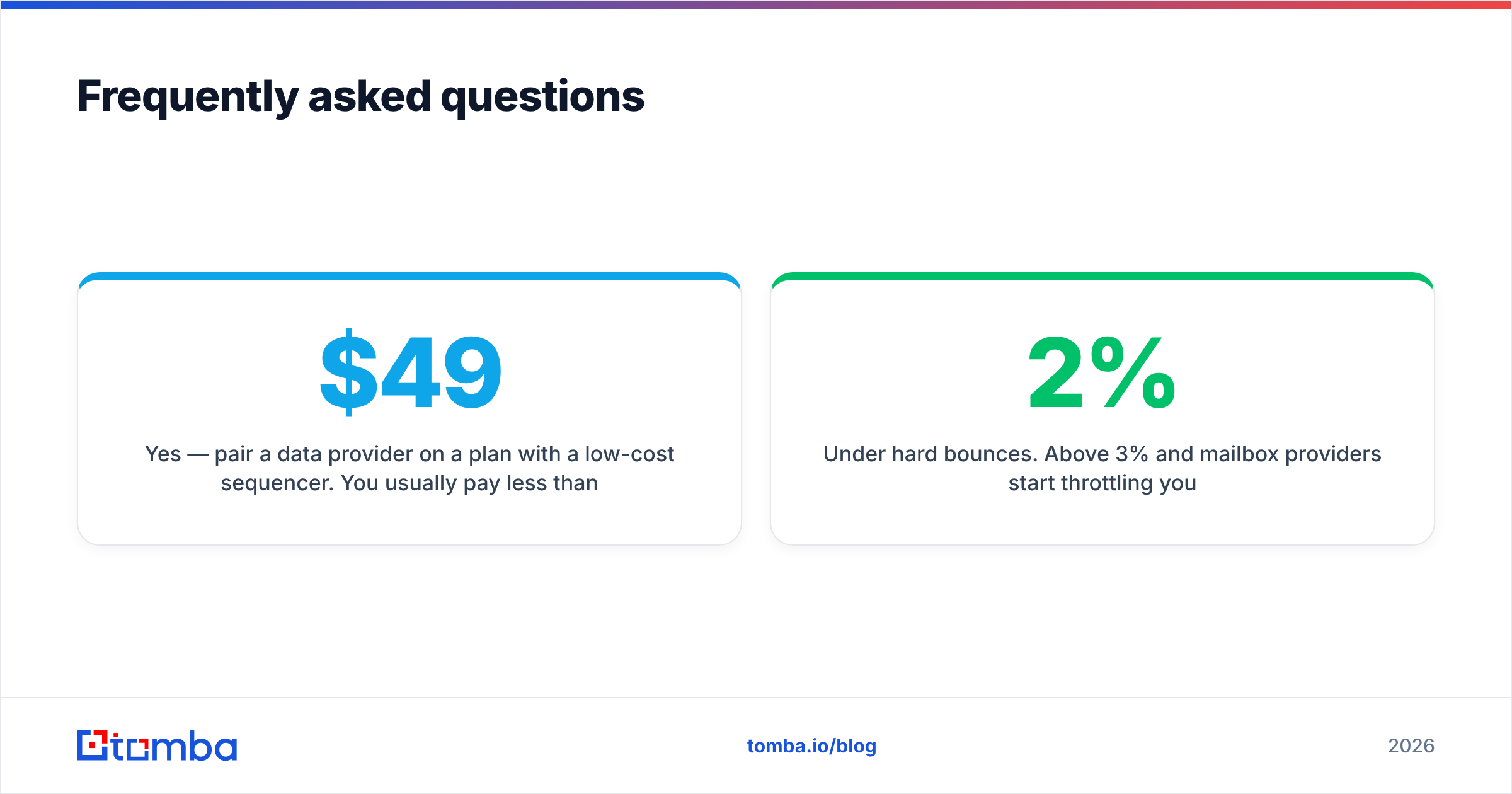
Is there a cheaper way to get both? Yes — pair a data provider on a $49/mo plan with a low-cost sequencer. You usually pay less than an all-in-one agency tier and get better accuracy.
What bounce rate should I aim for? Under 2% hard bounces. Above 3% and mailbox providers start throttling you.
Get the data layer right first#
Whichever sender you land on, the contacts you feed it decide the outcome. Start with the Tomba Email Finder — find verified professional emails by domain, name, or company, with a source and confidence score attached to every result, on a free tier of 25 searches per month before you spend anything. Feed clean data into GrowMeOrganic or Gumbamail and both tools suddenly look a lot better than their reviews suggest.
Related guides#
Ready to find emails that actually work?
Join 150,000+ professionals who stopped guessing and started sending. Free credits on signup — no credit card required.
Get the Tomba newsletter
Practical outbound tactics and product updates — once every two weeks.
About the author