GrowMeOrganic vs Istari.ai: Which B2B Data Tool Wins?
GrowMeOrganic sells contact lists and cold email sequences. Istari.ai sells AI web-mining market intelligence. They overlap far less than the head-to-head framing suggests — here is which one fits your pipeline, what each costs, and where both leave gaps.
GrowMeOrganic vs Istari.ai looks like a head-to-head. It is not one. One tool builds contact lists and sends cold email. The other reads company websites and maps markets with AI. Here is what each does, what it costs, and which one fits your team.
TL;DR
- GrowMeOrganic is an all-in-one B2B prospecting suite. One subscription covers a contact database, a LinkedIn/Sales Navigator scraper, an email finder, and a drip-campaign sender.
- Istari.ai is not an outbound tool at all. It reads millions of company websites and turns them into structured market, sector, and technology data.
- If your job is "book 30 meetings this quarter," GrowMeOrganic is the closer fit. If your job is "map a market segment before we plan territories," Istari.ai is.
- Neither is a best-in-class verification layer. GrowMeOrganic bundles verification into a broad suite. Istari.ai does not deal in personal contact data at all.
- Most teams pair one of them with a dedicated finder and verifier. That way addresses get checked at the point of use, not at the point of purchase.
What do GrowMeOrganic and Istari.ai actually do?#
The two names get compared because both sell "B2B data." But that phrase covers two very different products. Here is the honest split.
GrowMeOrganic (growmeorganic.com) is a prospecting-to-outreach suite for small teams, agencies, and solo founders. Its pitch is breadth: one login covers list building, enrichment, and sending.
- Contact database — a large pre-built B2B people/company index you search by title, industry, geography, and headcount.
- Chrome extension scraper — pulls profiles and company pages from LinkedIn and Sales Navigator into lists without manual copy-paste.
- Email finder and verifier — guesses and checks work addresses for the names you have collected.
- Drip campaign sender — multi-step sequences sent through your own Gmail/Outlook mailbox, with open and reply tracking.
- Unlimited-style plans — paid tiers market high or uncapped usage instead of metered credits. That angle is what pulls in agency buyers.
Istari.ai (istari.ai) comes from a different lineage: applied AI research on web data. It crawls and classifies company websites at scale. The output is structured indicators — what a company appears to do, which technologies it references, which markets it plays in, and how that changes over time.
- Web-mining engine — the raw material is public company websites, parsed by language models rather than bought from a list broker.
- Sector and technology tagging — companies get sorted into fine-grained activity categories that standard SIC/NAICS codes miss entirely.
- Market mapping and sizing — the typical use case is "show me every firm in this region doing X," including firms nobody has tagged before.
- Research and public-sector work — economic research institutes, innovation agencies, and strategy teams are a visible part of the audience, not just sales orgs.
- Delivery via data feeds and API — output goes into your models and dashboards, not into an inbox sequence.
Read those lists again and the "versus" framing mostly dissolves. One tool ends with a send button. The other ends with a dataset.
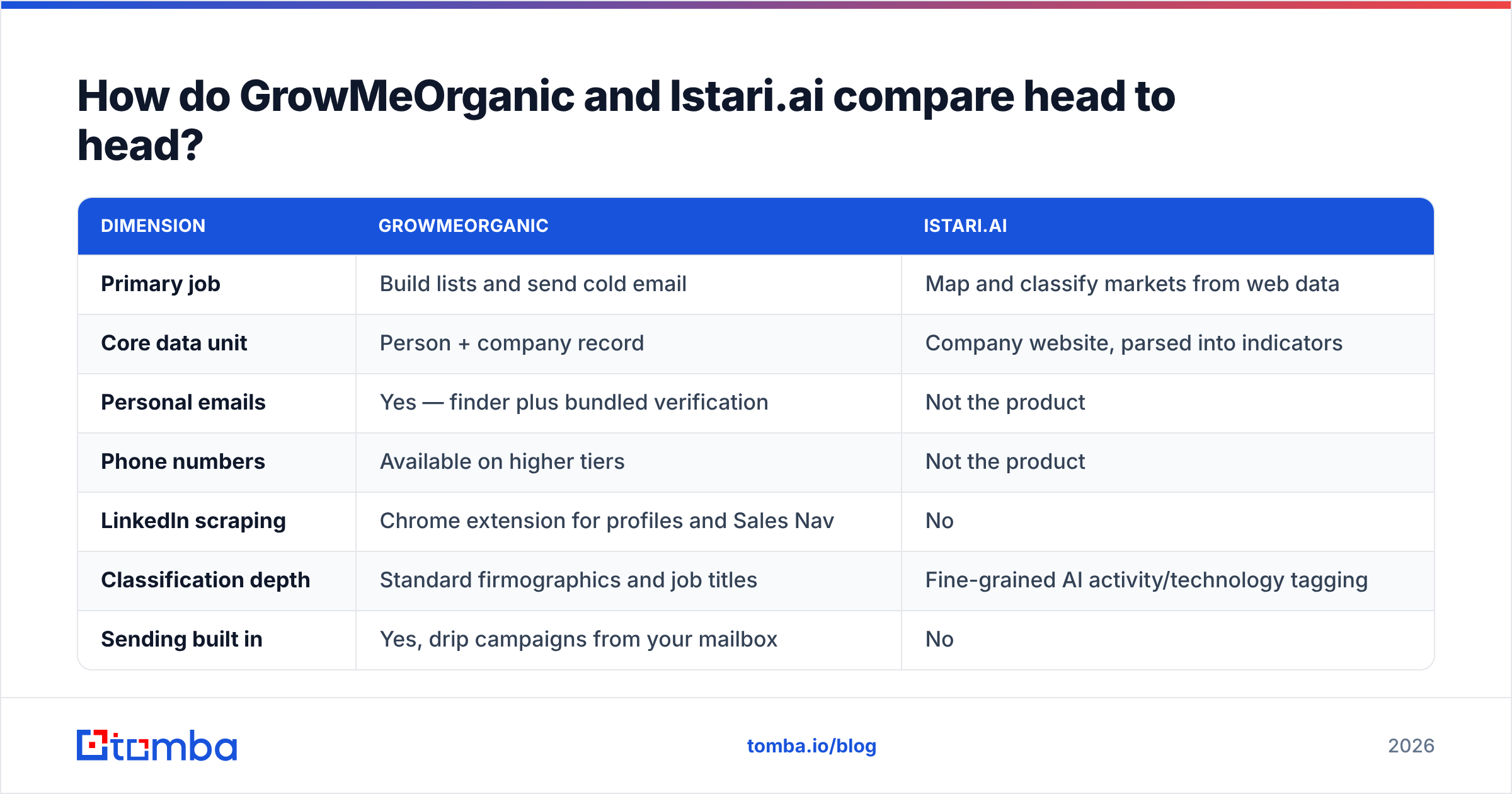
GrowMeOrganic vs Istari.ai: how do they compare head to head?#
| Dimension | GrowMeOrganic | Istari.ai |
|---|---|---|
| Primary job | Build lists and send cold email | Map and classify markets from web data |
| Core data unit | Person + company record | Company website, parsed into indicators |
| Personal emails | Yes — finder plus bundled verification | Not the product |
| Phone numbers | Available on higher tiers | Not the product |
| LinkedIn scraping | Chrome extension for profiles and Sales Nav | No |
| Classification depth | Standard firmographics and job titles | Fine-grained AI activity/technology tagging |
| Sending built in | Yes, drip campaigns from your mailbox | No |
| Coverage philosophy | Pre-built database, refreshed periodically | Live crawl of company websites |
| Typical buyer | SDR, founder, lead-gen agency | Strategy, research, RevOps, policy analyst |
| Self-serve signup | Yes | Enterprise/custom motion |
| API | Yes, on paid plans | Yes, feed and API delivery |
| Learning curve | Low — sign up and search | Medium to high — it is a data project |
The practical read is simple. GrowMeOrganic competes with tools like Apollo, Lusha, and Wiza. Istari.ai competes with market-intelligence platforms like Vainu, Similarweb's data products, or a custom in-house crawler. If you are genuinely torn between the two, the real problem is that the job to be done has not been defined yet.

What does each one cost in 2026?#
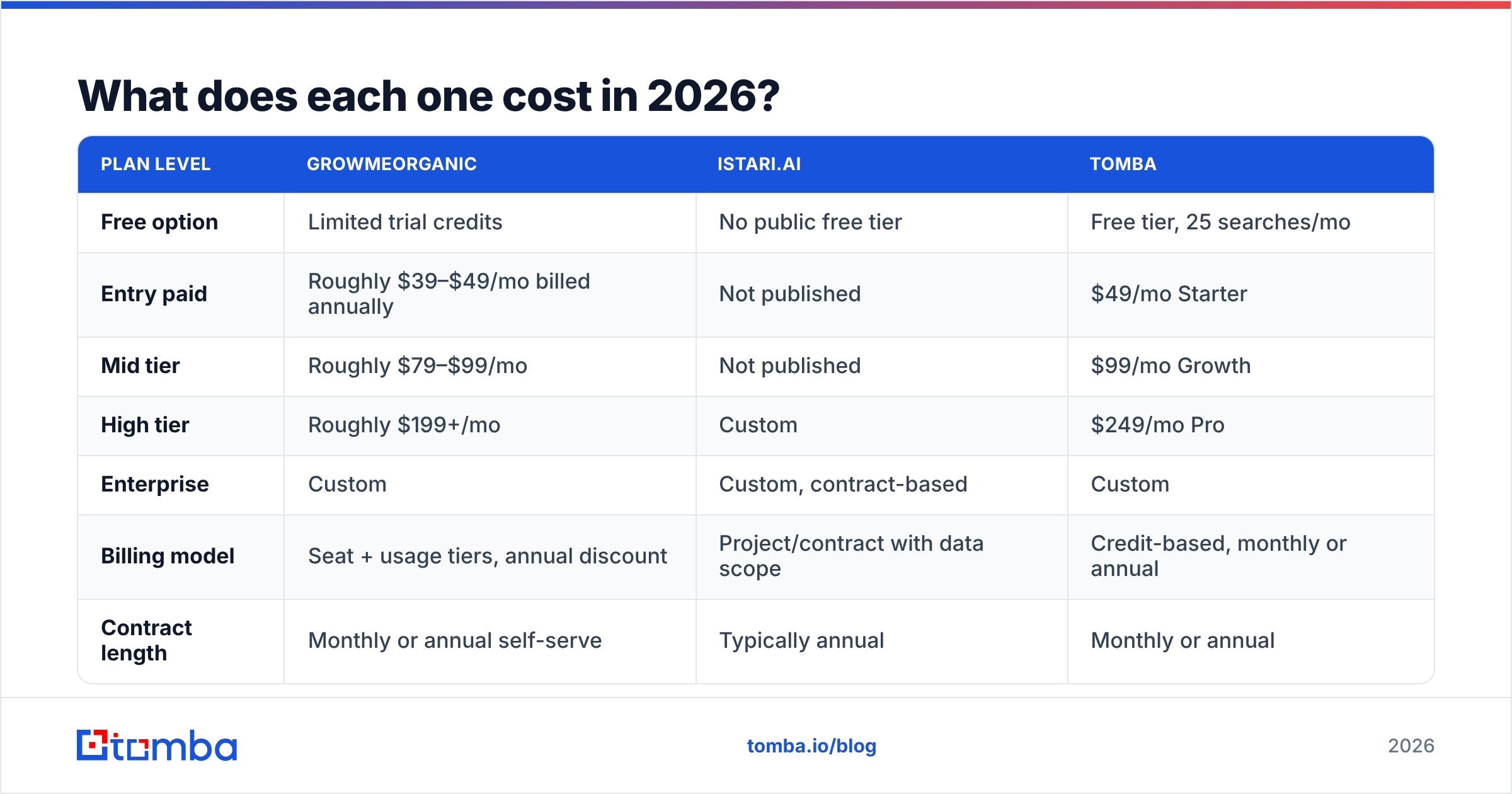
Pricing is where the two products separate hardest. It is also where you should check the vendor page rather than trust any blog, including this one. Both companies revise plans.
| Plan level | GrowMeOrganic | Istari.ai | Tomba |
|---|---|---|---|
| Free option | Limited trial credits | No public free tier | Free tier, 25 searches/mo |
| Entry paid | Roughly $39–$49/mo billed annually | Not published | $49/mo Starter |
| Mid tier | Roughly $79–$99/mo | Not published | $99/mo Growth |
| High tier | Roughly $199+/mo | Custom | $249/mo Pro |
| Enterprise | Custom | Custom, contract-based | Custom |
| Billing model | Seat + usage tiers, annual discount | Project/contract with data scope | Credit-based, monthly or annual |
| Contract length | Monthly or annual self-serve | Typically annual | Monthly or annual |
Three things matter more than the headline number.
GrowMeOrganic's "unlimited" is tier-gated. Read the plan footnotes. Uncapped search does not mean uncapped exports, uncapped verification, or uncapped sending volume. Agencies who bought on the unlimited promise write the sharpest reviews on G2. Price the plan against the export cap, not the search cap.
Istari.ai is a procurement decision, not a credit card decision. There is no public price sheet because scope drives cost: how many companies, which countries, which refresh cadence, which taxonomy. Budget for a scoping call and a pilot. Expect a timeline measured in weeks, not an afternoon.
Per-usable-contact cost beats per-credit cost. A $49 plan that returns 40% unusable addresses is not cheap. Once you count burned domain reputation, it costs more than a $99 plan that returns 95% deliverable ones. Compare Tomba pricing or anyone else's on cost-per-verified-contact, not cost-per-search.
Which tool gives you better data quality?#
They are not measuring the same thing, so "better" needs a definition.
Start with contact-level accuracy: does this email address exist and accept mail? Only GrowMeOrganic is in that game. Its results follow the pattern of every large pre-built database. Coverage is strong on mid-market and enterprise firms in the US and Western Europe. It thins out on SMBs, non-English domains, and recently changed roles. Database records decay at roughly 2–3% per month as people switch jobs. So any static list you exported in January is meaningfully wrong by June.
Now take company-level classification accuracy: is this firm really doing industrial robotics, or just mentioning it? Istari.ai is the stronger instrument by design. Reading the live website beats inheriting a stale industry code assigned at incorporation. If you have ever tried to build a list of "companies doing X" from NAICS codes and given up, that is the exact gap it fills.
The failure mode on both sides is the same: confidence without checking. A record that looks complete in a UI is not a verified record. Whatever you use for discovery, run the final addresses through an email verifier right before the send, not weeks earlier. Catch-all domains need explicit handling. A plain SMTP ping returns "accepted" for every address on a catch-all server. That is how clean-looking lists produce 12% bounce rates. A dedicated catch-all verifier is the difference between a real answer and a guess.
Is GrowMeOrganic the better choice for outbound sales?#
For a small team that wants one bill instead of four, yes — with caveats.
What it does well: the workflow is genuinely end-to-end. Search the database or scrape a Sales Navigator list, enrich, verify, drop into a sequence, send from your own mailbox, watch replies. Collapsing four tools into one is a real win for a founder doing their own prospecting or an agency running lead gen for ten clients. The price point also undercuts Apollo and Lusha at comparable volumes.
Where it strains: all-in-one suites are usually best-in-class at nothing. The sending layer has fewer deliverability controls than a dedicated sequencer. The verification layer is adequate rather than thorough. Support and UI polish get mixed reviews. Bundling discovery with sending also means a data problem becomes a deliverability problem inside the same product. You find out about bad records through bounce rates, after your domain has already taken the hit.
The setup that works: use the suite for discovery and sequencing, but keep verification independent. Push your list through a bulk email finder and verifier as a separate step. That gives you a second opinion on every address before it costs you sender reputation. Teams running high volume usually wire this into the pipeline through the Tomba API instead of exporting CSVs by hand.
Is Istari.ai worth it for market intelligence and research?#
If the question you are answering is bigger than "who do I email Monday," it earns its keep.
Good fits:
- Territory and TAM design. You need every company in a region matching a behavior-based definition, not an industry code. Web mining finds the firms that never self-identify correctly in standard taxonomies.
- New-market entry. Before hiring reps for a geography, you want a defensible count of addressable firms and how that count is trending.
- Technology and supplier scouting. The crawl is built to find companies that reference a specific capability, material, or standard on their own site.
- Research and policy analytics. Innovation studies, cluster mapping, and economic reporting are core territory here, and it shows in how the output is structured.
Bad fits: you have three reps and a quota this month. You need mobile numbers. You want to log in and export 500 emails this afternoon. None of that is what this product is for. No amount of good intent will make an enterprise data engagement move at SDR speed.
Where do both tools leave a gap?#
The gap is the last mile. You have identified a company. Now you need a specific human whose address is confirmed to work today.
Istari.ai hands you a superb list of companies with no people attached. GrowMeOrganic hands you people whose records were true whenever the database last refreshed. Both leave you doing the same final step. That step is where campaigns are won or lost.

A workable last-mile process looks like this:
- Define the account list with whichever intelligence layer suits you — Istari.ai for behavior-based definitions, GrowMeOrganic's database for standard firmographics.
- Resolve the domain to real people using a domain search that returns current addresses, roles, and the company's actual email pattern.
- Find named contacts individually for your priority accounts, where a targeted lookup beats a bulk export.
- Verify at send time, not at export time, including explicit catch-all handling.
- Re-verify anything older than 30 days before it goes into a new sequence.
That sequencing costs almost nothing. It is also the single highest-leverage habit in outbound. Most bounce problems are not sourcing problems. They are timing problems.
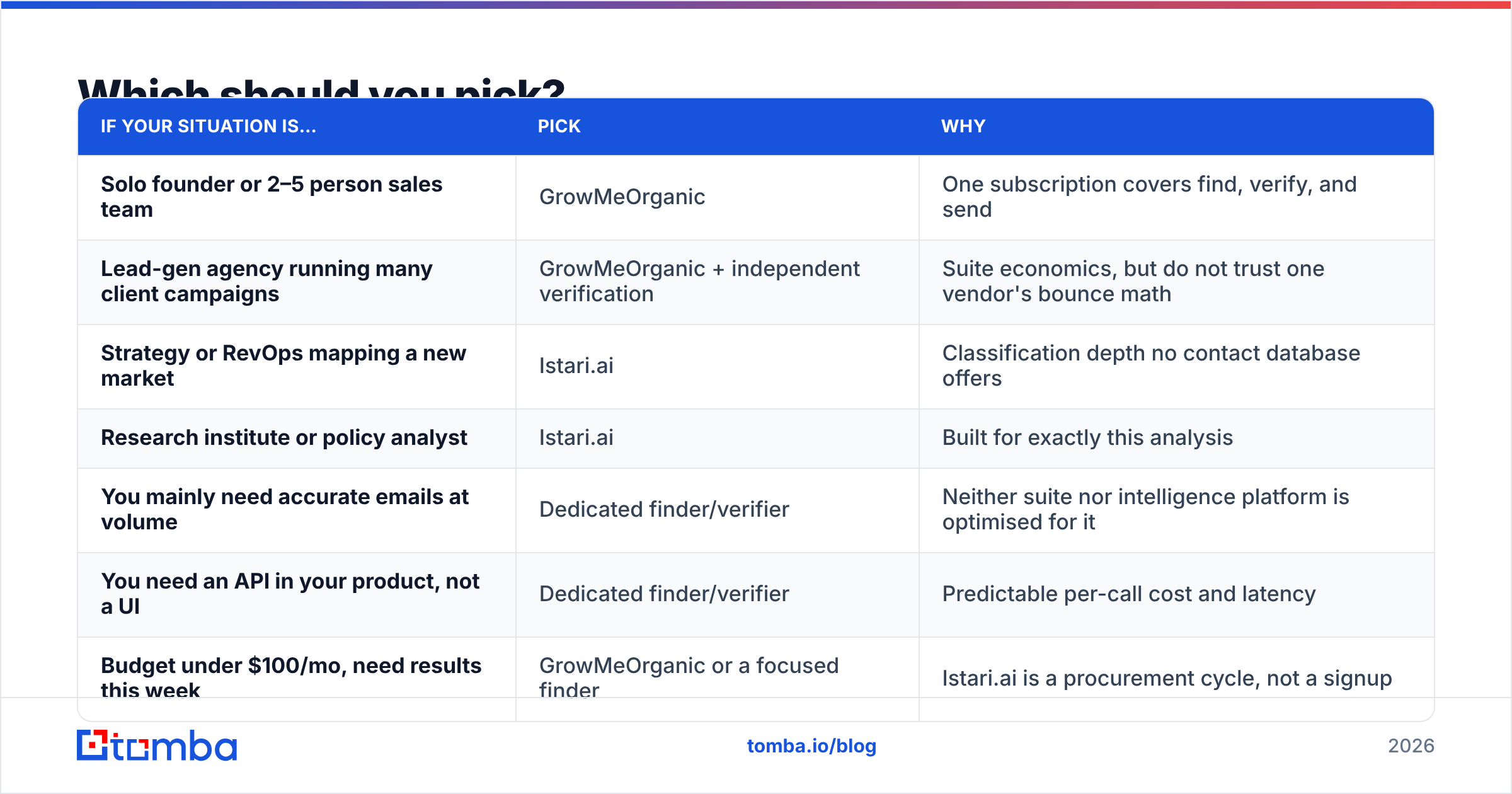
Which should you pick?#
| If your situation is… | Pick | Why |
|---|---|---|
| Solo founder or 2–5 person sales team | GrowMeOrganic | One subscription covers find, verify, and send |
| Lead-gen agency running many client campaigns | GrowMeOrganic + independent verification | Suite economics, but do not trust one vendor's bounce math |
| Strategy or RevOps mapping a new market | Istari.ai | Classification depth no contact database offers |
| Research institute or policy analyst | Istari.ai | Built for exactly this analysis |
| You mainly need accurate emails at volume | Dedicated finder/verifier | Neither suite nor intelligence platform is built for it |
| You need an API in your product, not a UI | Dedicated finder/verifier | Predictable per-call cost and latency |
| Budget under $100/mo, need results this week | GrowMeOrganic or a focused finder | Istari.ai is a procurement cycle, not a signup |
The honest verdict on GrowMeOrganic vs Istari.ai: GrowMeOrganic wins on outbound. Istari.ai wins on intelligence. Neither wins on data accuracy. That last job belongs to a specialist, and specialists beat bundles at it.
What is the fastest way to fix the accuracy layer?#
Keep whichever discovery tool matches your job, and put a dedicated finder underneath it. The Tomba Email Finder resolves names and domains to current, verified work addresses. It adds confidence scoring and explicit catch-all handling. It works the same way for one contact in the browser or fifty thousand through the API. The free tier gives you 25 searches a month to test it against a sample of your existing list. Starter is $49/mo, Growth $99/mo, Pro $249/mo.
Take 100 records you already trust from your current tool and run them through. If the overlap is high, your data is fine and you paid nothing to confirm it. If it is not, you just found out before your domain did.
Related guides#
Ready to find emails that actually work?
Join 150,000+ professionals who stopped guessing and started sending. Free credits on signup — no credit card required.
Get the Tomba newsletter
Practical outbound tactics and product updates — once every two weeks.
About the author