GrowMeOrganic vs Jet Leads Pro: 2026 Comparison & Verdict
One tool sells unlimited credits, the other sells simplicity. We break down GrowMeOrganic vs Jet Leads Pro on data accuracy, real pricing, export limits, and which one your outbound team should actually buy in 2026.
GrowMeOrganic vs Jet Leads Pro is a choice between breadth and price. One tool does many jobs. The other does one job for less money. Here is the short version first.
TL;DR
- GrowMeOrganic is the wider platform. It scrapes LinkedIn, holds a B2B database, finds emails, and sends cold email. The pitch is "unlimited credits" at a low yearly price.
- Jet Leads Pro is the leaner, newer tool. It builds lead lists and looks up contacts. It has fewer features and much less public documentation. That cuts both ways.
- Neither vendor publishes an audited accuracy score. If bounce rate is your KPI, you will bolt a verifier onto whichever one you pick.
- "Unlimited" almost never means unlimited. Read the fair-use clause, the daily export cap, and the per-seat price before you sign a yearly deal.
- Best fit: pick GrowMeOrganic for scraping plus sending in one login. Pick Jet Leads Pro if you want cheap and simple. Pick a finder-and-verifier stack if bounces keep you up at night.
What are GrowMeOrganic and Jet Leads Pro?#
Two tools that look alike on a pricing page. In a real outbound workflow, they behave very differently.
GrowMeOrganic (growmeorganic.com) is an all-in-one prospecting suite built around a Chrome extension. You scrape a LinkedIn Sales Navigator search or a Google Maps result. The tool adds work emails and sometimes phone numbers. Then you push the list into a drip sequence sent from your own mailbox. The hook has always been volume: one flat yearly price with unlimited email credits, not a per-lookup meter.
Jet Leads Pro sits in the lighter camp. It is a lead-list and lookup product for solo founders, agencies, and small SDR teams who found the big platforms bloated. Public docs are thin next to older vendors. That matters when you want to check where the data comes from, or how stable the API is. Treat any spec you read, here or anywhere else, as something to confirm on a trial.
The honest framing: this is not a fight between equals. You are choosing between a wide platform with average data and a narrow tool with a smaller bill.

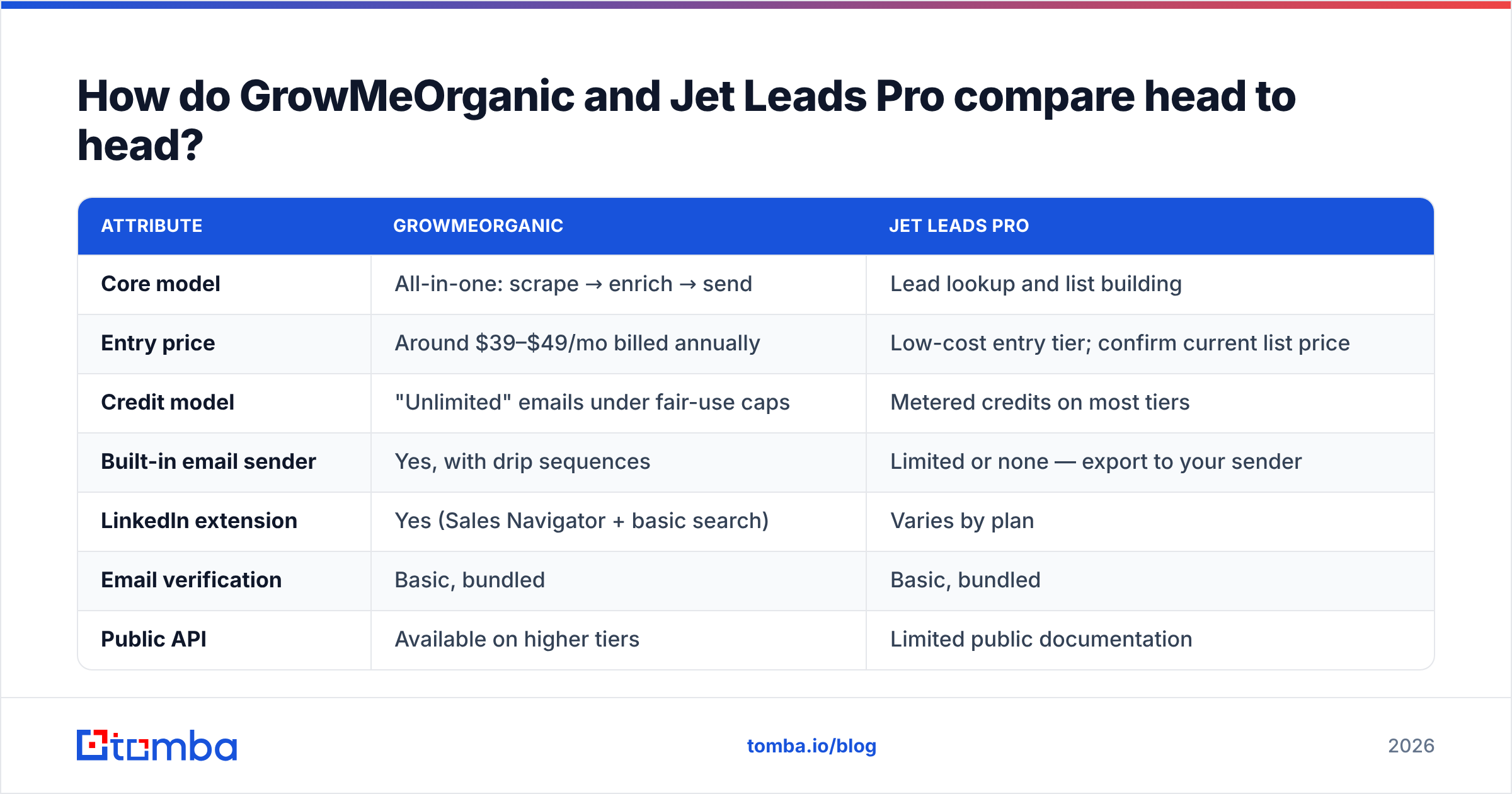
GrowMeOrganic vs Jet Leads Pro: how do they compare head to head?#
Here is the practical view. Check every price on the vendor's own page before you buy. Both tools have changed packaging more than once, and yearly pricing differs sharply from monthly.
| Attribute | GrowMeOrganic | Jet Leads Pro |
|---|---|---|
| Core model | All-in-one: scrape → enrich → send | Lead lookup and list building |
| Entry price | Around $39–$49/mo billed annually | Low-cost entry tier; confirm current list price |
| Credit model | "Unlimited" emails under fair-use caps | Metered credits on most tiers |
| Built-in email sender | Yes, with drip sequences | Limited or none — export to your sender |
| LinkedIn extension | Yes (Sales Navigator + basic search) | Varies by plan |
| Email verification | Basic, bundled | Basic, bundled |
| Public API | Available on higher tiers | Limited public documentation |
| Phone numbers | Partial coverage | Partial coverage |
| Best for | Small teams wanting one login | Budget list building |
| Weak spot | Data accuracy varies by geography | Small vendor, thin docs, unclear roadmap |
The row that decides most deals is not price. It is "email verification: basic, bundled." Both tools treat verification as a checkbox, not a core skill. That is exactly where cold email campaigns die.
Is "unlimited credits" actually a good deal?#
Usually no. Knowing why saves you a year of pain.
Unlimited pricing is a data-quality choice dressed up as a pricing choice. A vendor that charges per verified email only wants to return contacts it can stand behind. A vendor that charges one flat fee has the opposite pull. Every guess it returns costs it nothing. A made-up address still counts as a credit delivered.
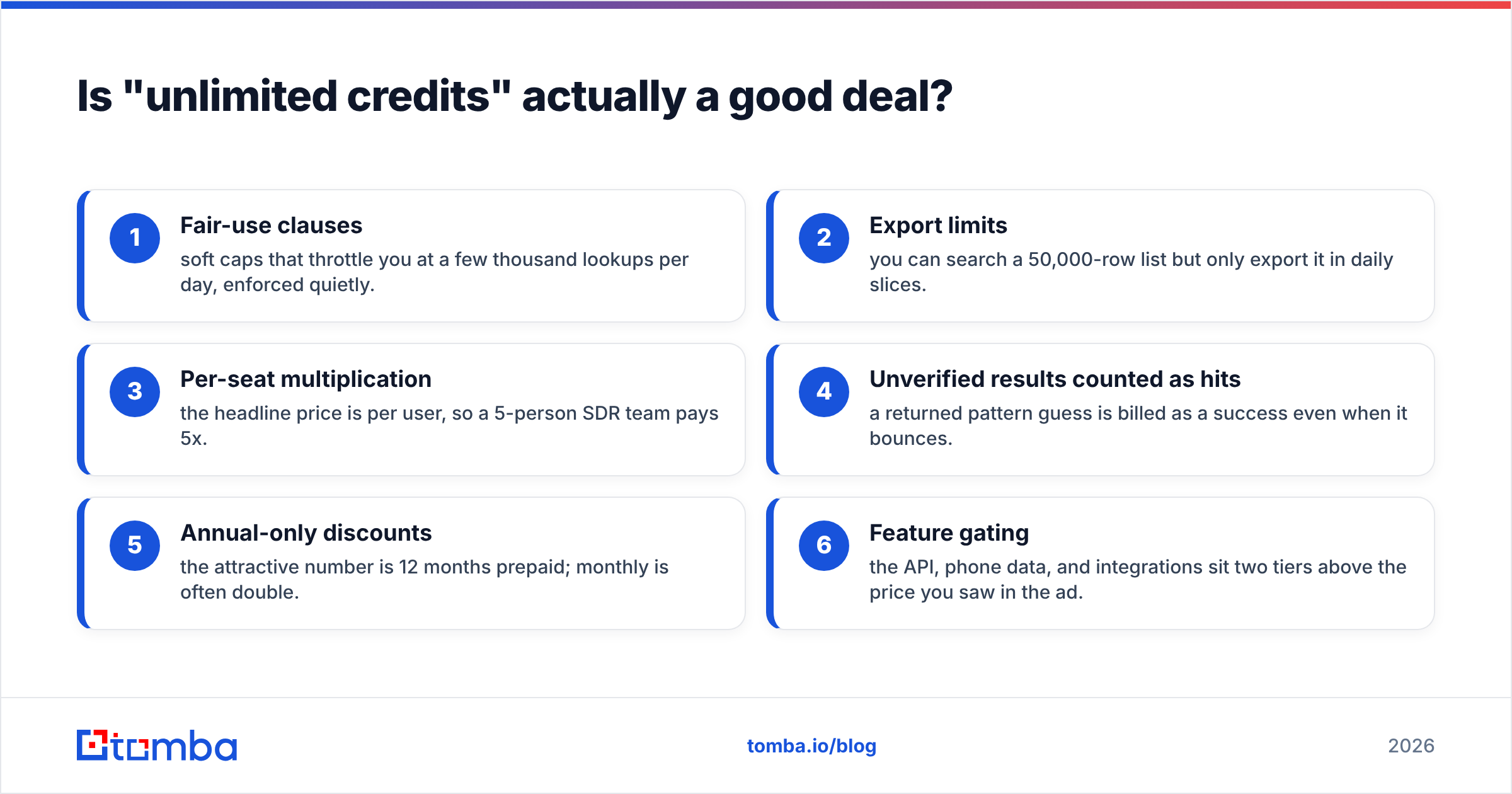
That is why unlimited plans almost always carry:
- Fair-use clauses — soft caps that throttle you after a few thousand lookups a day, enforced quietly.
- Export limits — you can search a 50,000-row list, but you export it in daily slices.
- Per-seat multiplication — the headline price is per user, so a 5-person SDR team pays 5x.
- Unverified results counted as hits — a pattern guess is billed as a win, even when it bounces.
- Annual-only discounts — the nice number is 12 months prepaid. Monthly is often double.
- Feature gating — the API, phone data, and integrations sit two tiers above the price in the ad.
None of this makes GrowMeOrganic a bad product. It just makes the choice harder than "cheaper wins."
Which tool has better email accuracy?#
Neither one publishes audited accuracy figures. So the safe answer is simple: assume both need a separate verification step before you send.

The mechanics matter more than the marketing. Contact data comes from a few methods, and the method sets the failure mode:
- Pattern inference — the tool learns
first.last@company.comfrom a few known addresses, then guesses the rest. Fast, cheap, and wrong when a company runs mixed formats after a merger. - Crawled public sources — press pages, GitHub commits, speaker lists, author bylines. Accurate but stale. The person left 14 months ago.
- Contributed or co-op data — users share their address books for credits. Broad coverage, uneven consent, and a GDPR question you should ask in writing.
- SMTP-level validation — pinging the mail server to confirm the mailbox is real. This is the only step that cuts bounces, and most bundled verifiers skip it or fake it.
GrowMeOrganic leans on pattern inference plus scraping. That is why coverage feels generous for US and Western European mid-market firms, then thins out fast in APAC, LATAM, and companies under 500 staff. Jet Leads Pro does not document its sourcing in enough detail to judge fairly. That gap is itself a data point when you are about to commit a year of budget.
Whichever you choose, run the export through a real email verifier before it touches a sequence. A 3% bounce rate is the line between a warm domain and a burnt one. Google and Microsoft both tightened bulk-sender rules, so sloppy lists now cost real money.
What does each tool actually cost at team scale?#
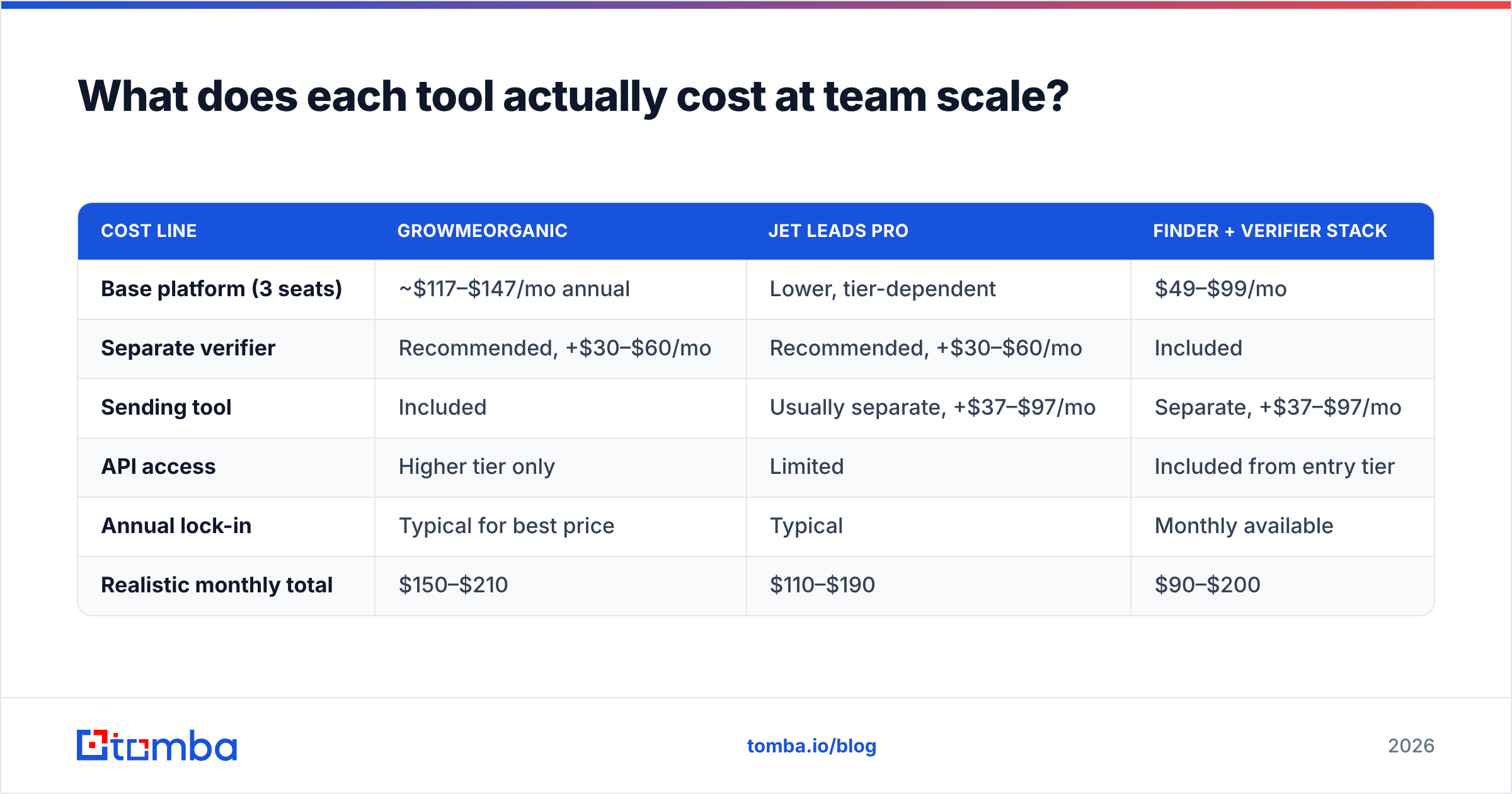
Model the second year, not the first month. Here is how the total cost breaks down for a 3-seat outbound team sending 4,000 emails a month.
| Cost line | GrowMeOrganic | Jet Leads Pro | Finder + verifier stack |
|---|---|---|---|
| Base platform (3 seats) | ~$117–$147/mo annual | Lower, tier-dependent | $49–$99/mo |
| Separate verifier | Recommended, +$30–$60/mo | Recommended, +$30–$60/mo | Included |
| Sending tool | Included | Usually separate, +$37–$97/mo | Separate, +$37–$97/mo |
| API access | Higher tier only | Limited | Included from entry tier |
| Annual lock-in | Typical for best price | Typical | Monthly available |
| Realistic monthly total | $150–$210 | $110–$190 | $90–$200 |
The all-in-one saves you one subscription line. It rarely saves you money once you add the verification you actually need. The unbundled stack costs about the same. It also lets you swap any one part when it gets worse — and in contact data, it will.
To see how buyers rate these categories, check G2 and Capterra. Both run lead-intelligence grids you can filter by company size. Read the 3-star reviews, not the 5-star ones. That is where export caps and slow support get discussed.

When should you pick GrowMeOrganic?#
Pick GrowMeOrganic when one login is worth more to you than precision.
It is the right call if:
- You are a 1–5 person team and every extra vendor login is real overhead.
- You sell to US or Western Europe mid-market — coverage is strongest there.
- You run on volume, where a 5–8% bounce rate on a backup domain is a cost of doing business.
- You want scraping and sending in one place and do not already own Instantly, Lemlist, or Smartlead.
- You can pay yearly — the monthly price wipes out most of the value.
It is the wrong call in three cases. You sell into regulated industries. Procurement wants documented data sources. Or you send from a primary domain you cannot risk.
When should you pick Jet Leads Pro?#
Pick Jet Leads Pro when your need is truly simple and your budget is truly tight.
It fits if:
- You need lists, not a platform — you already have a CRM and a sender.
- You are testing a new market and want to spend $30 before you spend $300.
- You value a small tool — fewer features means fewer things to set up wrong.
- You will trial first. Run a 100-contact test against firms whose emails you already know, then measure the hit rate yourself.
Be honest about the trade. Small vendors ship slower, document less, and carry more risk of going away. That is not an insult, it is a buying fact. If your outbound engine leans on an API that can change with no changelog, price that risk in.
What if neither one fits?#
Most teams land on a third option: unbundle. Use one tool to find contacts, one to verify them, and one to send. Each part competes on its own merits, and you can replace any of them without moving everything.
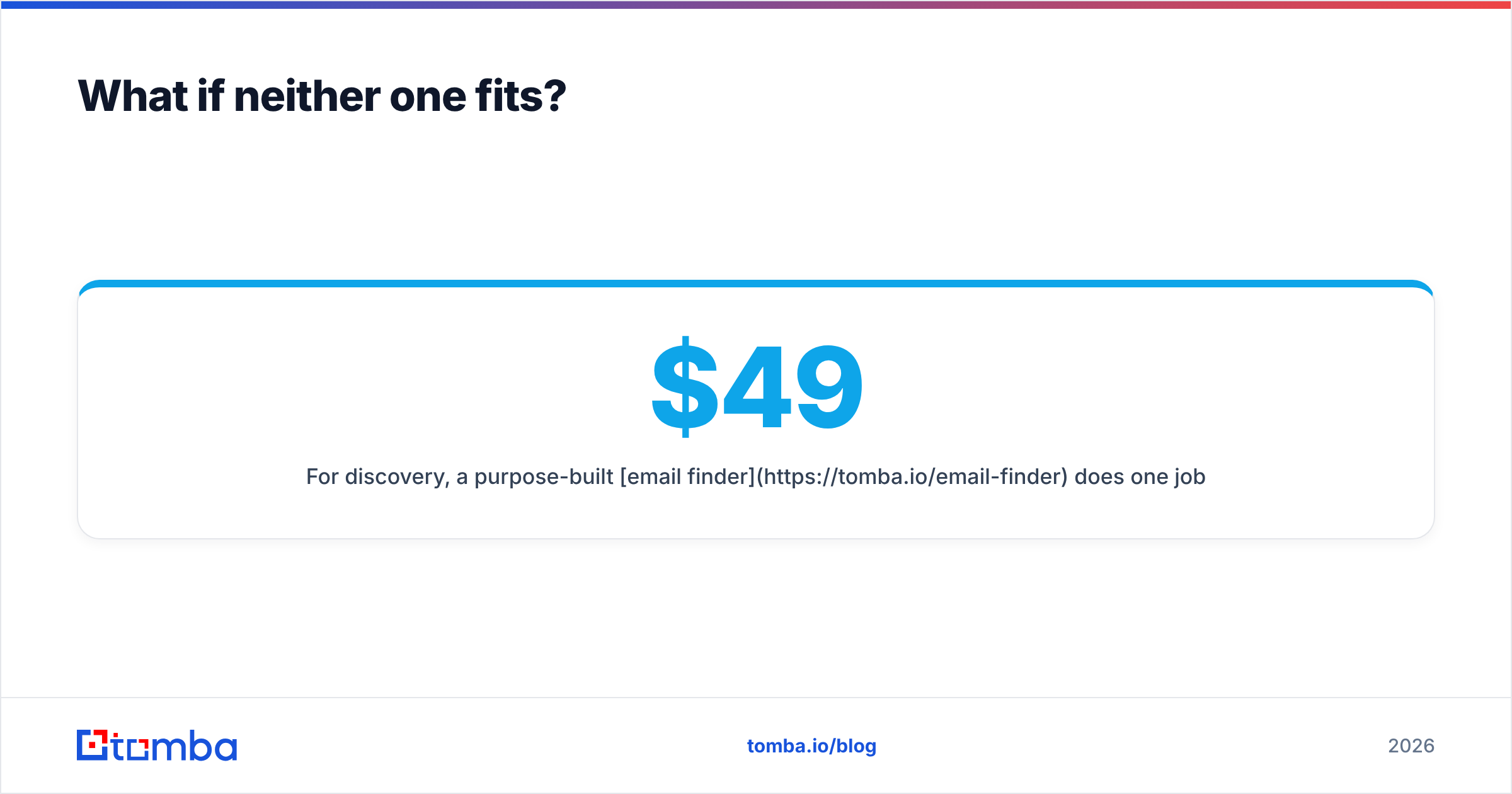
For discovery, a purpose-built email finder does one job and is judged on it. Tomba pricing starts with a free tier at 25 searches a month. Starter is $49/mo, Growth is $99/mo, and Pro is $249/mo, with Enterprise quoted by volume. Every plan includes SMTP-level verification instead of selling it as an upsell. There is also a documented email finder API, so your RevOps team can wire enrichment into the CRM instead of exporting CSVs by hand.

A few other credible options are worth a shortlist. BookYourData is strong when you want pay-as-you-go, pre-verified lists with no subscription. That is a different buying model from either tool here, and it suits one-off campaign pushes. Apollo is still the default when you want a database plus a sequencer at enterprise scale. And if your bottleneck is bulk work rather than single lookups, a bulk email finder will move a 10,000-row list faster than any Chrome extension.
How should you run the evaluation?#
Do not settle GrowMeOrganic vs Jet Leads Pro from feature tables, including this one. Run a bake-off in under two hours:
- Build a 100-row golden set. Pick 100 contacts whose emails you know are right — past customers, live pipeline, friends at partner firms.
- Strip the emails. Keep first name, last name, and company domain.
- Run the same 100 rows through each trial. Record found-rate and exact-match rate apart from each other. A tool that finds 90 and matches 60 is worse than one that finds 70 and matches 68.
- Send 50 test emails from a throwaway domain. Measure hard bounces. Above 3% means the bundled verification is for show.
- Test one hard case on purpose — a catch-all domain, a non-English company name, a firm under 50 staff. This is where coverage claims break.
- Price the second year, with seats, API access, and a separate verifier.
Whichever tool survives that test earns your budget. It is often not the one you liked on the pricing page.
The verdict#
GrowMeOrganic wins on breadth. It is the better single buy for a small team that wants scraping, enrichment, and sending behind one login, and can live with uneven data. Jet Leads Pro wins on price and simplicity. It suits solo operators and agencies who already own a sender and just need lists. In the GrowMeOrganic vs Jet Leads Pro matchup, neither wins on the metric that decides campaigns: verified accuracy. That is why most teams unbundle once they pass 5,000 sends a month.
If bounce rate is the number your VP asks about on Monday, start where data quality is the product, not a bundled extra. Run your golden-set test against the Tomba Email Finder on the free tier — 25 searches, no card. Compare the exact-match rate against your current tool. If it does not win on your own list, you lost twenty minutes.
Related guides#
Ready to find emails that actually work?
Join 150,000+ professionals who stopped guessing and started sending. Free credits on signup — no credit card required.
Get the Tomba newsletter
Practical outbound tactics and product updates — once every two weeks.
About the author