GrowMeOrganic vs LFBBD Lead For Business: 2026 Comparison
GrowMeOrganic sells scraping plus sequences at a flat rate. LFBBD sells prebuilt lead lists. We break down pricing, data accuracy, and which one actually fits your outbound motion in 2026.
GrowMeOrganic vs LFBBD Lead For Business comes down to one choice: build your own lead lists, or buy them ready-made. GrowMeOrganic gives you the tools to find contacts and send to them. LFBBD hands you a finished file. Here is how the two compare on price, data quality, and workflow fit in 2026.
TL;DR
- GrowMeOrganic is an all-in-one prospecting suite: LinkedIn scraping, an email finder, a B2B database, and a built-in cold email sender. Pricing is flat, starting near $49/month.
- LFBBD (Lead For Business) sits closer to the list-vendor end of the market. You buy prebuilt or made-to-order B2B contact lists instead of running your own extraction workflow.
- The real question is not which tool is better. It is whether you want to own the sourcing process or outsource it. Owning it costs less over time. Outsourcing is faster on day one and weaker on data freshness.
The gap both tools leave:
- Neither is a great fit if your bottleneck is verification. Both push volume. Neither is a specialist verifier, and bounce rate is what kills sending domains.
- Practical setup for most teams in 2026: source with one of these, then run every address through a dedicated email verifier before it touches your sending tool.
GrowMeOrganic vs LFBBD Lead For Business: what is each one?#
Think of it like groceries. GrowMeOrganic hands you a cart, a map of the store, and a knife. You pick your own produce, and you find out fast whether you know how to shop. LFBBD delivers a prepped meal kit. That is faster tonight, but you did not choose the tomatoes, and you cannot tell how long they sat in the warehouse.
GrowMeOrganic is an India-based sales intelligence and outreach platform built around a Chrome extension. Its pitch is breadth: pull profiles from LinkedIn and Sales Navigator, extract emails, tap a claimed 575M+ contact database, then send sequences from the same dashboard. The flat rate, rather than per-credit pricing, is its loudest selling point. Teams that burn thousands of lookups a month like that math.
LFBBD, marketed as "Lead For Business," works in the prebuilt-list segment. You describe an ICP — industry, geography, seniority, company size — and receive a file. There is no scraping workflow to learn and no extension to install. That is the whole value proposition, and for some buyers it is enough.
That difference matters more than any feature checklist, because it decides who owns your data pipeline. Buy your lists, and your outbound quality is capped by the vendor's refresh rate. Build them yourself, and the cap is your own process — which you can improve.
How do GrowMeOrganic and LFBBD compare head to head?#
Here is the honest side-by-side. Where a vendor does not publish specifics, that is noted rather than guessed.
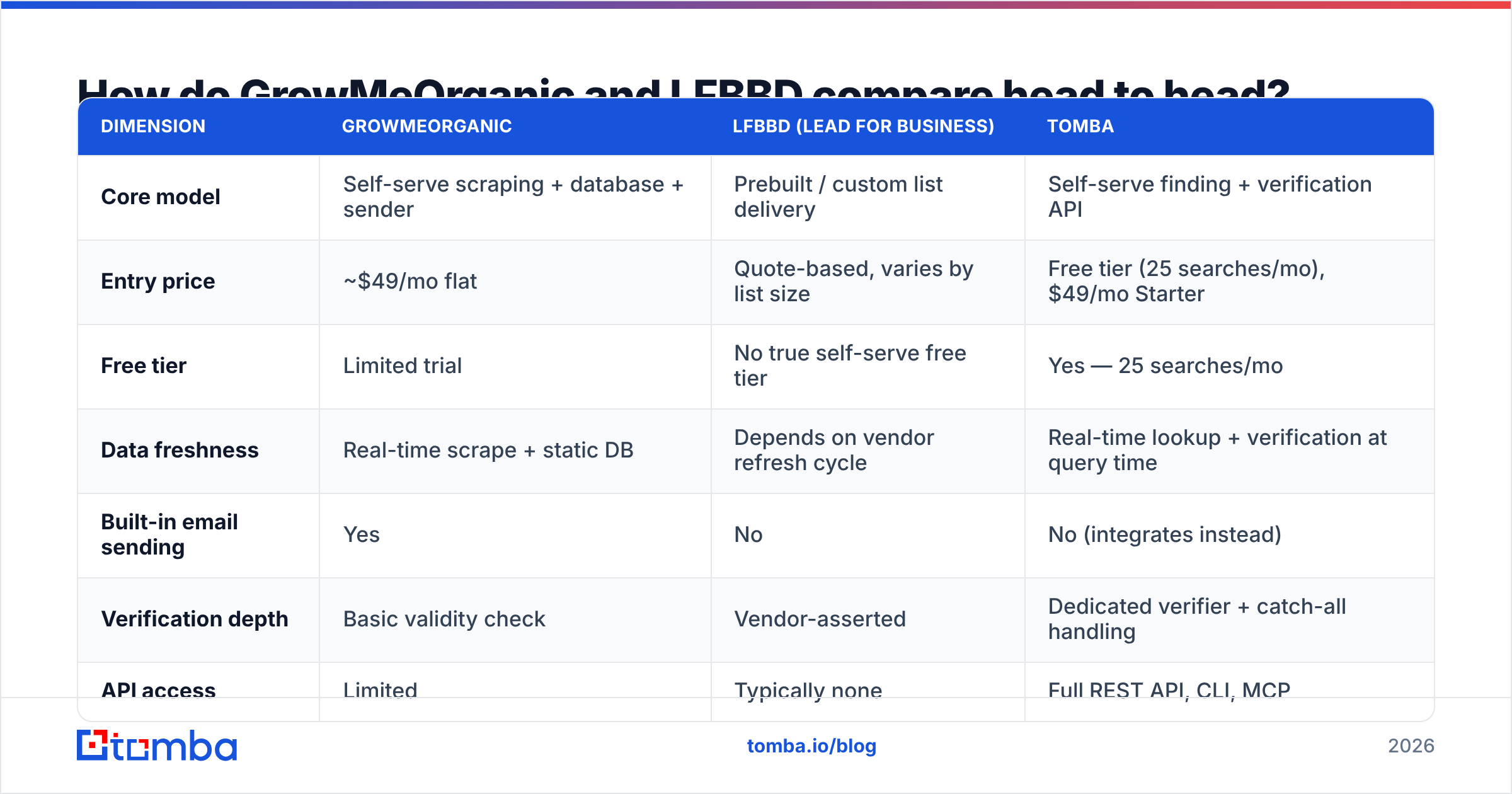
| Dimension | GrowMeOrganic | LFBBD (Lead For Business) | Tomba |
|---|---|---|---|
| Core model | Self-serve scraping + database + sender | Prebuilt / custom list delivery | Self-serve finding + verification API |
| Entry price | ~$49/mo flat | Quote-based, varies by list size | Free tier (25 searches/mo), $49/mo Starter |
| Free tier | Limited trial | No true self-serve free tier | Yes — 25 searches/mo |
| Data freshness | Real-time scrape + static DB | Depends on vendor refresh cycle | Real-time lookup + verification at query time |
| Built-in email sending | Yes | No | No (integrates instead) |
| Verification depth | Basic validity check | Vendor-asserted | Dedicated verifier + catch-all handling |
| API access | Limited | Typically none | Full REST API, CLI, MCP |
| Best for | Solo founders, lean agencies | Teams outsourcing list-building | Accuracy-first outbound and enrichment |
Two things jump out. First, GrowMeOrganic bundles sending and LFBBD does not. If you already pay for Instantly, Smartlead, or Lemlist, that bundle is spend you repeat. Second, neither vendor's core skill is verification, and that is where outbound campaigns actually die.
Which one has better data accuracy?#
Neither publishes an independently audited accuracy figure, so read both marketing pages with care.
GrowMeOrganic's accuracy depends on the source path. An email guessed by pattern on a small domain is weaker than one pulled from the database with several sources behind it. Users on G2 report the same pattern across scrape-first tools. Match rates run high. So does bounce risk, if you export straight to a sender with no verification pass.
LFBBD's accuracy question is different and harder. With a bought list you cannot inspect the sourcing method. You cannot re-query a stale record. You inherit every bit of decay since the last refresh. B2B contact data decays 2-3% a month from job changes alone. A list built nine months ago is not the list you saw in the demo.
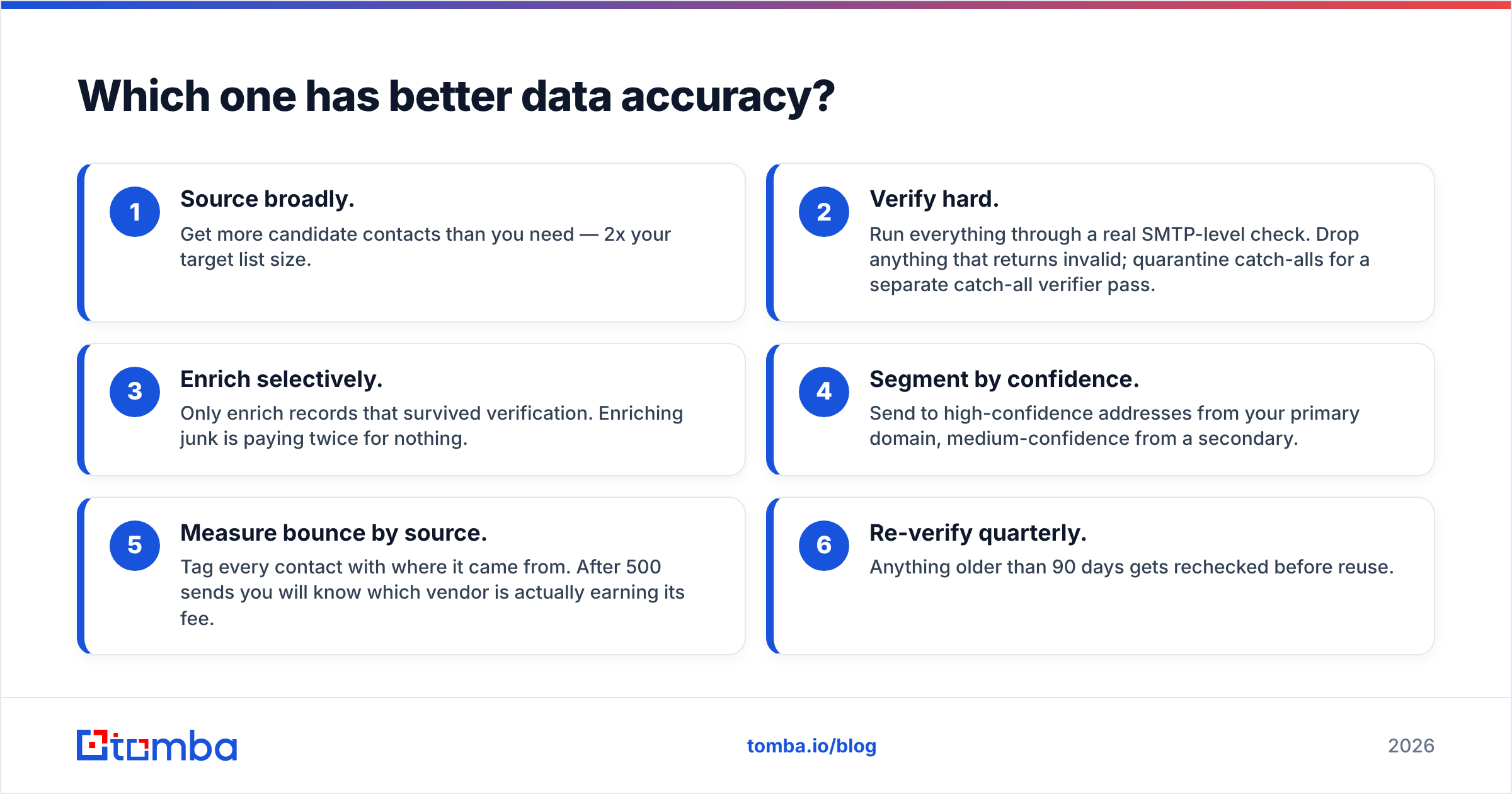
The defensible workflow, whichever vendor you pick:
- Source broadly. Get more candidate contacts than you need — 2x your target list size.
- Verify hard. Run everything through a real SMTP-level check. Drop anything that returns invalid. Send catch-alls to a separate catch-all verifier pass.
- Enrich selectively. Only enrich records that survived verification. Enriching junk is paying twice for nothing.
- Segment by confidence. Send to high-confidence addresses from your primary domain, medium-confidence from a secondary.
- Measure bounce by source. Tag every contact with where it came from. After 500 sends you will know which vendor is earning its fee.
- Re-verify quarterly. Anything older than 90 days gets rechecked before reuse.
Step 5 is the one teams skip, and it is the only one that gives you evidence instead of opinion.

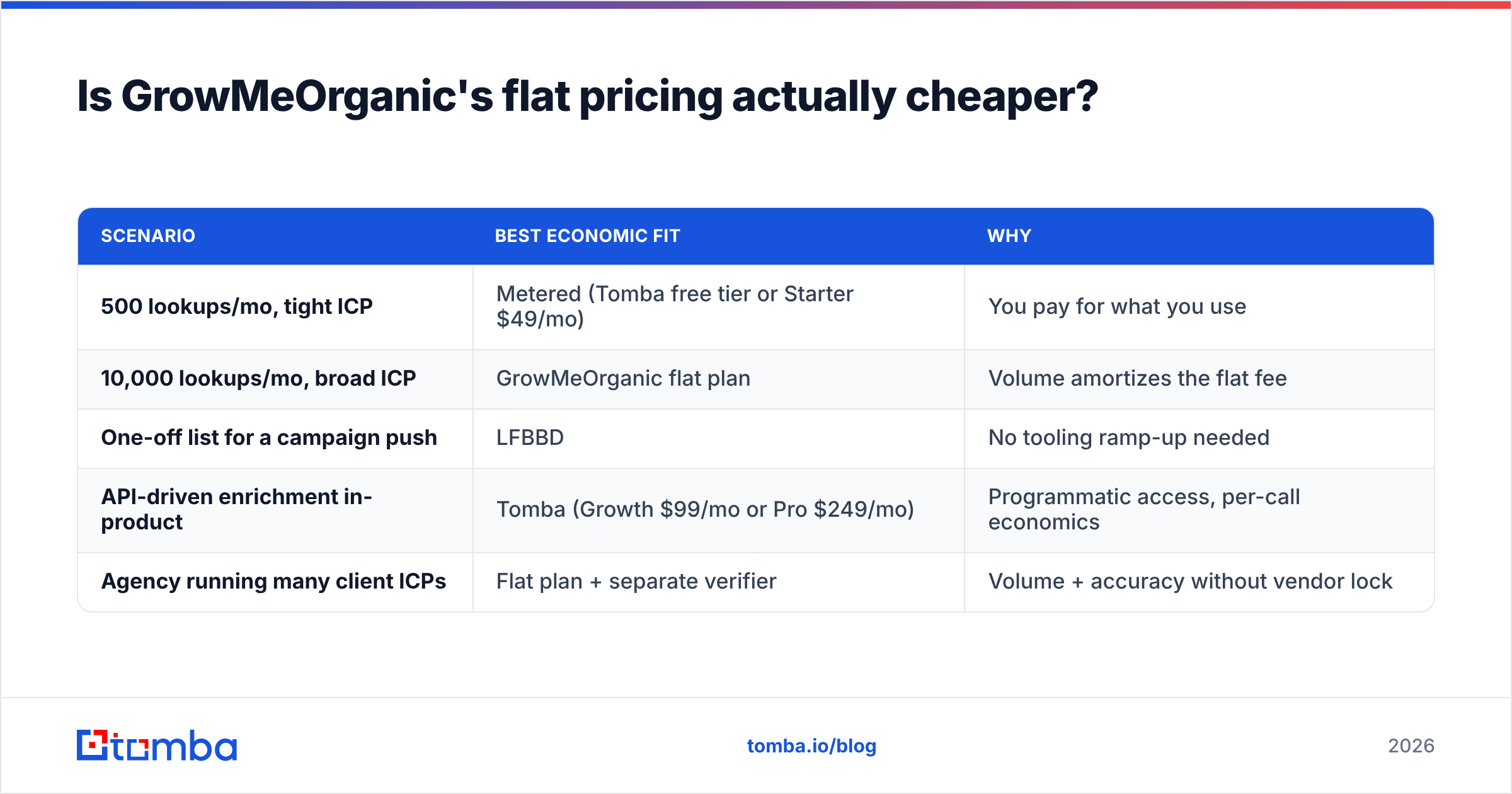
Is GrowMeOrganic's flat pricing actually cheaper?#
Sometimes — and the break-even is more specific than the sales page suggests.
Flat pricing wins when your volume is high and your ICP is broad. If you really run 10,000+ lookups a month across many domains, a flat plan beats per-credit pricing on raw cost. GrowMeOrganic's entry tier near $49/month is real value at that scale.
Flat pricing loses in three cases. First, when your volume is modest. Paying a flat fee for capacity you never use is worse than metered credits. Second, when "unlimited" hides fair-use throttles that surface right when you need throughput. Third, when you already run a dedicated sequencing tool with better deliverability controls, which makes the bundled sender dead weight.
LFBBD's quote-based model has its own trap: cost per usable contact, not cost per delivered contact. A 10,000-row list at $0.10 per row looks like $1,000. If 30% bounce or are role accounts you cannot use, your real cost is closer to $0.14 per usable contact. You also burned domain reputation to find that out.
| Scenario | Best economic fit | Why |
|---|---|---|
| 500 lookups/mo, tight ICP | Metered (Tomba free tier or Starter $49/mo) | You pay for what you use |
| 10,000 lookups/mo, broad ICP | GrowMeOrganic flat plan | Volume amortizes the flat fee |
| One-off list for a campaign push | LFBBD | No tooling ramp-up needed |
| API-driven enrichment in-product | Tomba (Growth $99/mo or Pro $249/mo) | Programmatic access, per-call economics |
| Agency running many client ICPs | Flat plan + separate verifier | Volume + accuracy without vendor lock |
Check current Tomba pricing if you want a metered baseline to compare either vendor against. The free tier's 25 searches a month is enough to test data quality on your own ICP before you commit money anywhere.
When should you buy a list instead of building one?#
Buying makes sense in narrow cases, and there is no shame in them.
Buy when the market is small and static. If you sell to 800 hospital systems in three states, that universe barely moves. A well-built list is a durable asset.
Buy when you need speed over ownership. A campaign that must launch in 72 hours has no time for tooling onboarding.
Buy when your ICP rests on attributes public sources do not expose — certifications, licensing, fleet size, equipment installed. Scrapers do not surface these; specialist compilers sometimes do. This is where a vendor like BookYourData has earned its name. It sells pay-as-you-go lists with published bounce guarantees. Use that model as the benchmark for any list vendor, LFBBD included.
Build when your ICP is dynamic, large, or defined by job titles. Titles change constantly. Any static file starts rotting the day it is made. Here, a live email finder queried at send time beats a warehouse export every time.
What does each tool miss that you will need anyway?#
Both leave the same gaps, and both gaps cost real money.
Catch-all domains. Many B2B domains accept all mail, whether or not the mailbox exists. Standard SMTP verification returns "accept" for every address, so a basic checker marks garbage as valid. You need dedicated catch-all handling to tell real mailboxes from the black hole. Neither GrowMeOrganic nor LFBBD makes this a headline feature.
Phone coverage. Multi-channel outbound is no longer optional in 2026. Inboxes are crowded, and email-only sequences keep posting lower reply rates. If you want dials alongside sends, you need a phone finder layer whichever of these two you pick.
Programmatic access. If contacts need to flow into your product, your CRM, or an automated enrichment job, you need an API. GrowMeOrganic's API is limited next to dedicated data platforms, and list vendors rarely offer one at all. A proper email finder API turns sourcing from a manual chore into infrastructure.
Deliverability hygiene. Neither tool manages your sender reputation. You still need SPF, DKIM, and DMARC set up properly, a warmup period on new domains, and steady volume ramping. Google's own postmaster guidelines are still the reference, and breaking them cancels out any edge either vendor gives you.
Which should you choose in 2026?#
The GrowMeOrganic vs LFBBD Lead For Business call comes down to your constraint, not the feature list.
Choose GrowMeOrganic if you are a solo founder or lean agency, you want scraping plus sending in one subscription, and your volume is genuinely high. You will still need a separate verification step. The flat rate is the draw, and at scale it is a fair one.
Choose LFBBD if your ICP is niche and attribute-defined, you need a file this week, and you can get a bounce guarantee in writing before you pay. Ask for a 200-row sample and verify it yourself. Any list vendor confident in its data will agree to that.
Choose a specialist data layer if accuracy is the bottleneck. If your bounce rate is above 3%, another sourcing tool will not fix it. Verification will. That is a different kind of product, and it belongs beside either of these, not instead of them.
Choose none of the above if you have not defined your ICP tightly enough to know what a good contact looks like. No vendor solves an aim problem with better ammunition.
The setup we see work most often: a broad sourcing tool for discovery, a dedicated verifier as the gate, a sequencer for delivery, and a CRM as the record of truth. Four tools, each doing one job well, beat one tool doing four jobs adequately. That goes double when the weak job is the one your sending domain depends on.
Where does Tomba fit alongside these?#
Tomba is not trying to be a sequencer or a list broker. It sits at the sourcing-and-verification layer: find the address, confirm it is real, enrich the record, then hand it to whatever sending stack you already run.
The practical difference is where verification happens. Scrape-first tools find addresses and verify afterward, if at all. List vendors verify at build time, which is whenever the file was compiled. Tomba verifies at query time. The confidence signal arrives in the same response as the address, so an unverified contact never enters a campaign.
Start on the free tier — 25 searches a month, no card — and run it against the same 25 target accounts you would give GrowMeOrganic or LFBBD. Compare the match rate and the bounce rate on your own ICP rather than on anyone's benchmark page. If the results hold up, the Tomba Email Finder scales up from there: Starter at $49/month, Growth at $99/month, Pro at $249/month. Every tier gets the same API, CLI, and bulk tooling. That is the cheapest way to settle this comparison with evidence instead of marketing copy.
Related guides#
Ready to find emails that actually work?
Join 150,000+ professionals who stopped guessing and started sending. Free credits on signup — no credit card required.
Get the Tomba newsletter
Practical outbound tactics and product updates — once every two weeks.
About the author