GrowMeOrganic vs ListKit: Which B2B Data Tool Wins in 2026?
GrowMeOrganic bundles scraping and sequencing at a low flat rate; ListKit sells verified, waterfall-enriched B2B lists by the credit. Here's which one actually fits your outbound motion — and where both fall short.
TL;DR
- GrowMeOrganic is an all-in-one: LinkedIn scraper, email finder, and cold-email sequencer bundled on a flat unlimited-ish plan starting around $49/mo. Cheap, broad, and shallow on verification.
- ListKit is a data vendor, not a sending tool. You buy verified B2B contacts (email + phone) by the credit, with waterfall enrichment and a triple-verification claim, then push them into Instantly, Smartlead, or your CRM.
- If you need lists and sending in one login on a small budget, GrowMeOrganic wins on price. If your bounce rate is what's killing you, ListKit's verified data is the safer buy.
- Neither is a great API. If you're enriching programmatically or verifying at scale inside your own stack, a dedicated finder/verifier like Tomba is cheaper per validated contact.
- Real answer for most teams: pick one source of contacts, verify independently before send, and stop paying twice for the same records.
What are GrowMeOrganic and ListKit, actually?#
They get compared constantly, but they solve different halves of the outbound problem.
GrowMeOrganic is a Chrome-extension-first platform. You install it, browse LinkedIn or Sales Navigator, scrape profiles into lists, run its email finder against those profiles, then build drip sequences and send from connected mailboxes. It also scrapes Google Maps and a few other sources. The pitch is "unlimited" — flat monthly price, generous extraction caps, everything in one dashboard.
ListKit sits at the other end. There's no sequencer, no sending. You filter a B2B database by title, industry, headcount, tech stack, and intent-style signals, then export verified contacts. Its differentiator is waterfall enrichment — running each contact through several data providers instead of one — plus verification passes before the record reaches you. It integrates directly with Instantly and Smartlead so exported lists land in a campaign without CSV gymnastics.
So the honest framing isn't "which is better." It's: do you want a cheap Swiss-army knife, or clean fuel for a sending engine you already own?

How do GrowMeOrganic and ListKit compare on price and features?#
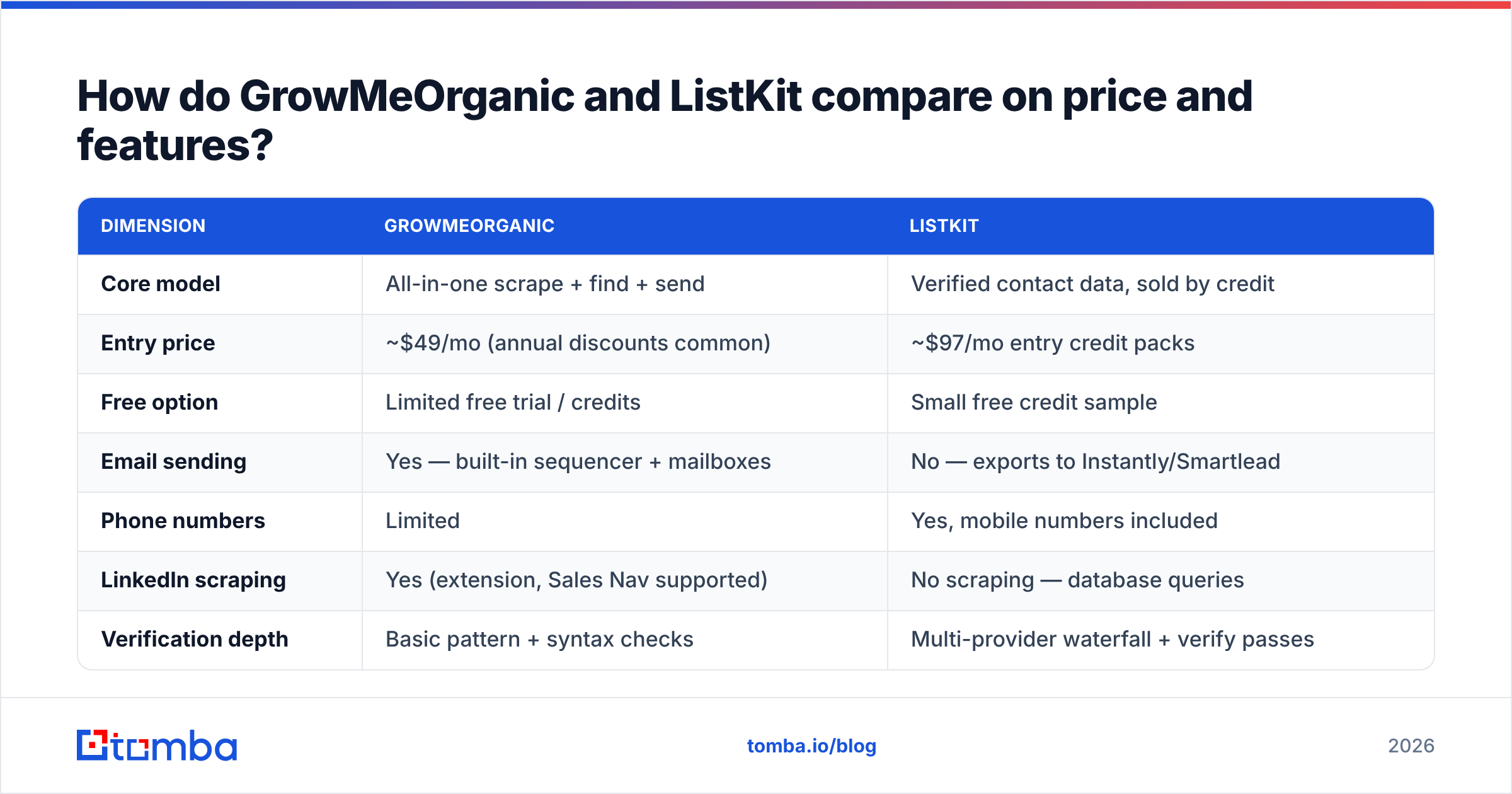
Pricing on both moves, and both run promotional and lifetime-style offers, so treat these as directional and check the vendor pages before you buy.
| Dimension | GrowMeOrganic | ListKit |
|---|---|---|
| Core model | All-in-one scrape + find + send | Verified contact data, sold by credit |
| Entry price | ~$49/mo (annual discounts common) | ~$97/mo entry credit packs |
| Free option | Limited free trial / credits | Small free credit sample |
| Email sending | Yes — built-in sequencer + mailboxes | No — exports to Instantly/Smartlead |
| Phone numbers | Limited | Yes, mobile numbers included |
| LinkedIn scraping | Yes (extension, Sales Nav supported) | No scraping — database queries |
| Verification depth | Basic pattern + syntax checks | Multi-provider waterfall + verify passes |
| Best for | Solo founders, agencies on a budget | Teams whose bounce rate is the bottleneck |
| Biggest weakness | Data accuracy is inconsistent | Costs scale hard with volume; no sending |
The pattern is consistent across review sites: on G2, GrowMeOrganic reviewers praise the price and the "everything in one place" convenience while flagging stale or wrong emails; ListKit reviewers praise data quality while flagging credit burn.
Where each one actually earns its money#
- GrowMeOrganic earns it on bundling. One $49–$79/mo subscription replaces a scraper, a finder, and a light sequencer. For a two-person agency running 200 sends a day, that consolidation is real savings.
- ListKit earns it on verification. Every bounce costs you more than the credit did — it damages sender reputation, which suppresses inbox placement across every campaign you run afterward.
- GrowMeOrganic loses on depth. Its email finder is competent on obvious corporate patterns and weak on catch-all domains, non-US TLDs, and companies with irregular formats.
- ListKit loses on flexibility. No sending, no browser extension for ad-hoc lookups, and no meaningful developer API for programmatic enrichment.
- Both lose on being your only source. Single-vendor data means single-vendor blind spots — which is the entire argument for waterfall enrichment in the first place.
Which one has better data accuracy?#
ListKit, on average — and it's not especially close on cold, unverified prospects.
That's a structural point, not a brand preference. GrowMeOrganic's finder largely infers addresses from name + domain patterns and validates lightly. That approach hits 80%+ on firstname.lastname@bigcompany.com and collapses on anything unusual. ListKit routes each record through multiple providers and keeps whichever the verification layer confirms, so the accepted records skew clean.
The catch: "verified" is a word every vendor uses differently. Some count a catch-all domain accepting mail as verified. It isn't — a catch-all domain accepts everything, including addresses that route straight to a black hole or a spam trap. If a meaningful chunk of your ICP sits on catch-all infrastructure, both tools will hand you records that look valid and behave badly.
What to do about it: before any campaign, run the export through an independent email verifier. Two things happen. You cut bounce rate, and you get a hard number on how good your vendor's data actually was — which is the only leverage you have at renewal.
Practical benchmark: if an independent verify pass rejects more than 8–10% of a "verified" list, you're overpaying for that data.
When should you pick GrowMeOrganic?#
Pick it when the bundle is the point.
- You're a solo founder or small agency doing under ~2,000 contacts a month and you'd rather have one $49 bill than three.
- You prospect visually on LinkedIn. The extension workflow — browse, select, scrape, sequence — is genuinely fast, and Sales Navigator support is solid.
- You need Google Maps / local business scraping. ListKit doesn't touch this. For local services, agencies, and SMB outbound, GrowMeOrganic covers a source ListKit simply doesn't have.
- Your acceptable bounce threshold is loose because you're sending small volumes from a domain you're not scared to burn.
Where it breaks: the moment you scale past a few thousand sends a month, the inaccurate records start costing more in deliverability than you saved on subscription. Sending platforms like Instantly and Smartlead will happily deliver your bad list straight into a reputation hole.
When should you pick ListKit?#
Pick it when your sending infrastructure is already good and your data is the weak link.
- You run Instantly or Smartlead at real volume. The native push means lists land in campaigns without a CSV round-trip.
- You need mobile numbers alongside emails. ListKit's phone coverage is a genuine advantage for teams running a call-plus-email motion.
- Your bounce rate is above 3% and you've already fixed the obvious things — SPF, DKIM, DMARC, warmup. At that point the list is the problem, and better data is the fix.
- You have budget per contact, not per seat. ListKit's economics work when a booked meeting is worth hundreds of dollars, not when you're spraying.
Where it breaks: cost at volume. Credit-based pricing is predictable until it isn't. Teams enriching 20k+ records a month usually find that a dedicated finder API plus a verifier costs materially less per validated contact than a packaged list product — because you're not paying for the database curation, the UI, and the integrations you don't use.
What about a third option — building the stack yourself?#
This is the path most teams end up on after a year of vendor churn, and it's worth understanding before you sign anything.
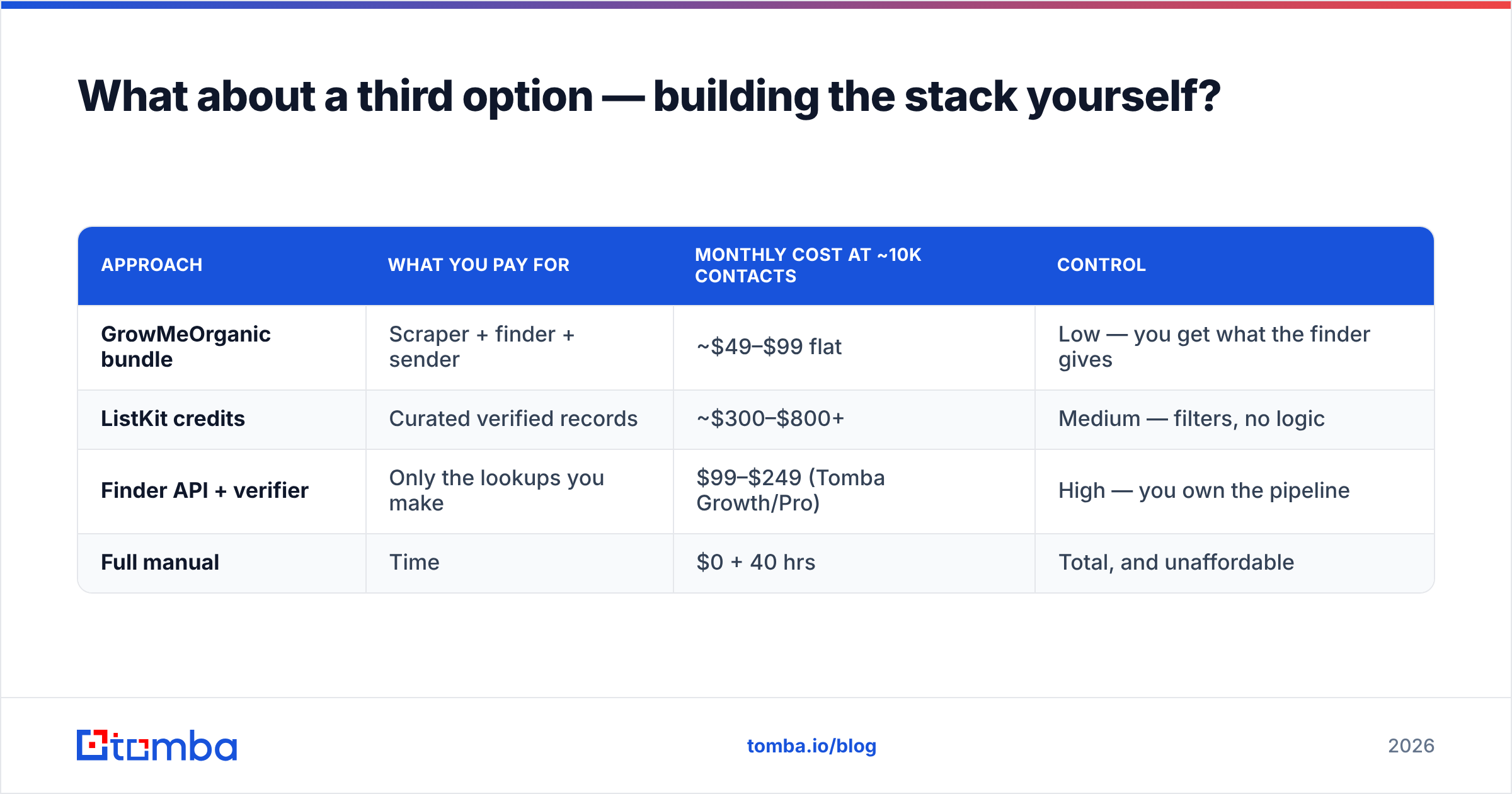
The insight: list-building and list-verification are separable, and they have different optimal vendors. Bundles charge you for both at a blended rate. Unbundling usually wins.
| Approach | What you pay for | Monthly cost at ~10k contacts | Control |
|---|---|---|---|
| GrowMeOrganic bundle | Scraper + finder + sender | ~$49–$99 flat | Low — you get what the finder gives |
| ListKit credits | Curated verified records | ~$300–$800+ | Medium — filters, no logic |
| Finder API + verifier | Only the lookups you make | $99–$249 (Tomba Growth/Pro) | High — you own the pipeline |
| Full manual | Time | $0 + 40 hrs | Total, and unaffordable |
A DIY pipeline looks like this: pull target companies from your ICP definition, run domain search to map who works there, resolve individual contacts with an email finder, verify everything, then push to your sequencer. With the Tomba API that's four calls and a job queue. It's a half-day of engineering for a permanent cost floor.
The tradeoff is honest: you need someone who can write the integration, and you lose the point-and-click discovery experience. If you have no engineering resource at all, buy the bundle and move on.
Also worth knowing: this space is crowded. BookYourData is a strong option if you want pay-as-you-go verified lists without a subscription commitment — its per-contact model suits teams with lumpy, campaign-driven demand rather than steady monthly volume. Apollo, Clay, and Findymail all overlap here too, each with a different center of gravity.
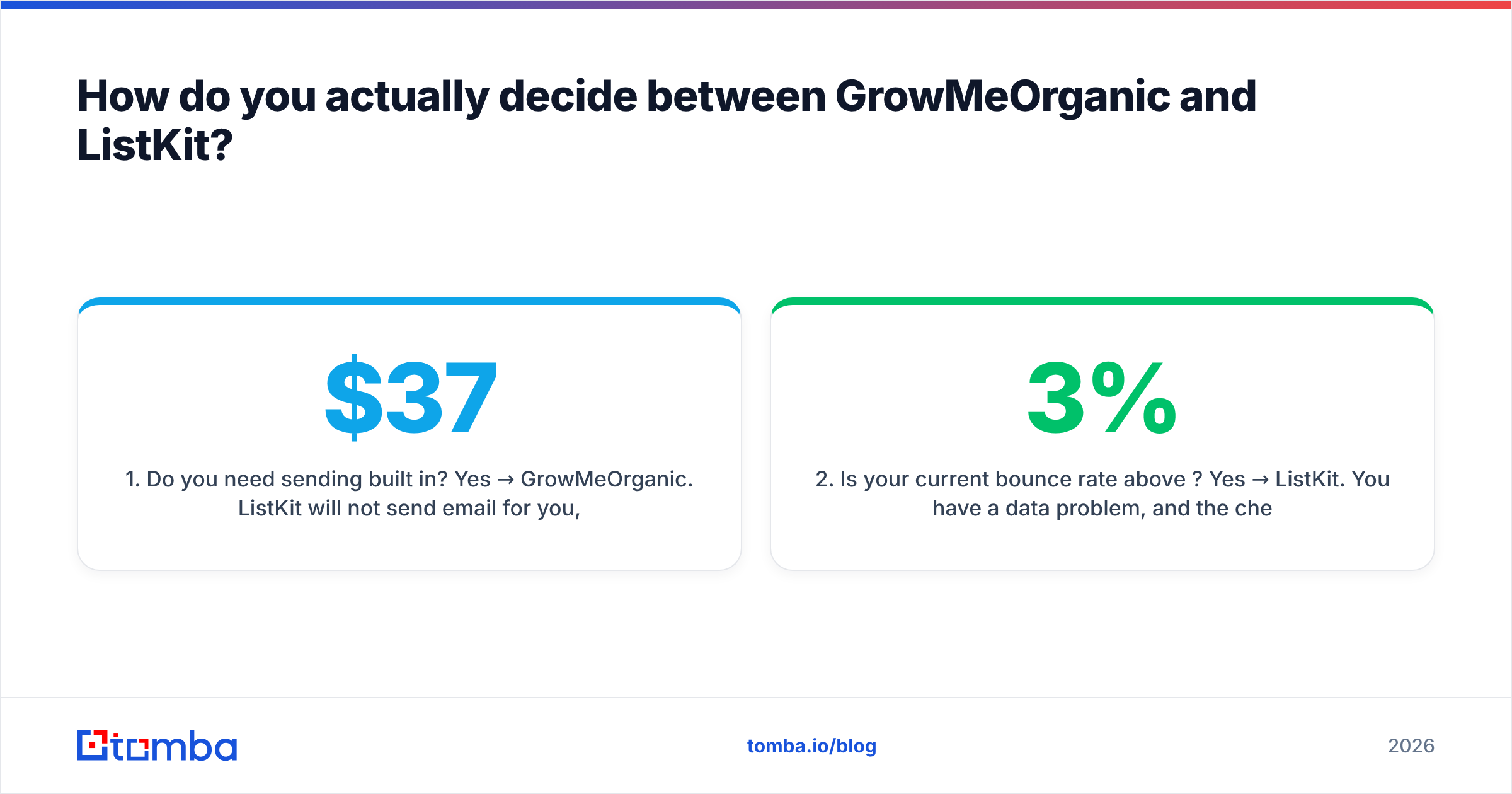
How do you actually decide between GrowMeOrganic and ListKit?#
Run these four checks in order. The first "no" gives you your answer.
- Do you need sending built in? Yes → GrowMeOrganic. ListKit will not send email for you, and bolting on Instantly adds $37–$97/mo.
- Is your current bounce rate above 3%? Yes → ListKit. You have a data problem, and the cheaper tool will make it worse.
- Are you enriching more than ~10k records a month? Yes → neither. Go API-first; credit pricing will eat you.
- Do you prospect on LinkedIn by hand? Yes → GrowMeOrganic's extension, or a dedicated LinkedIn finder if you want the emails without the bundled sequencer.
One more filter that people skip: check coverage on your actual ICP before you commit. Both vendors offer trial credits. Take 50 real target accounts — not a generic sample — run them through each tool, then verify the results independently with a free email checker. Whichever tool returns more confirmed-valid contacts on your market is the right one, regardless of what any comparison post says, including this one.
Coverage varies wildly by geography and company size. A tool that's excellent on US mid-market SaaS can be near-useless on European manufacturing SMBs. Aggregate accuracy numbers hide that completely.
What do most teams get wrong here?#
They optimize the wrong number.
The metric that matters isn't cost per contact or even accuracy percentage. It's cost per booked meeting, and data quality affects it through a chain most people don't trace: bad emails → bounces → damaged email deliverability → good emails landing in spam → fewer replies from contacts that were fine all along.
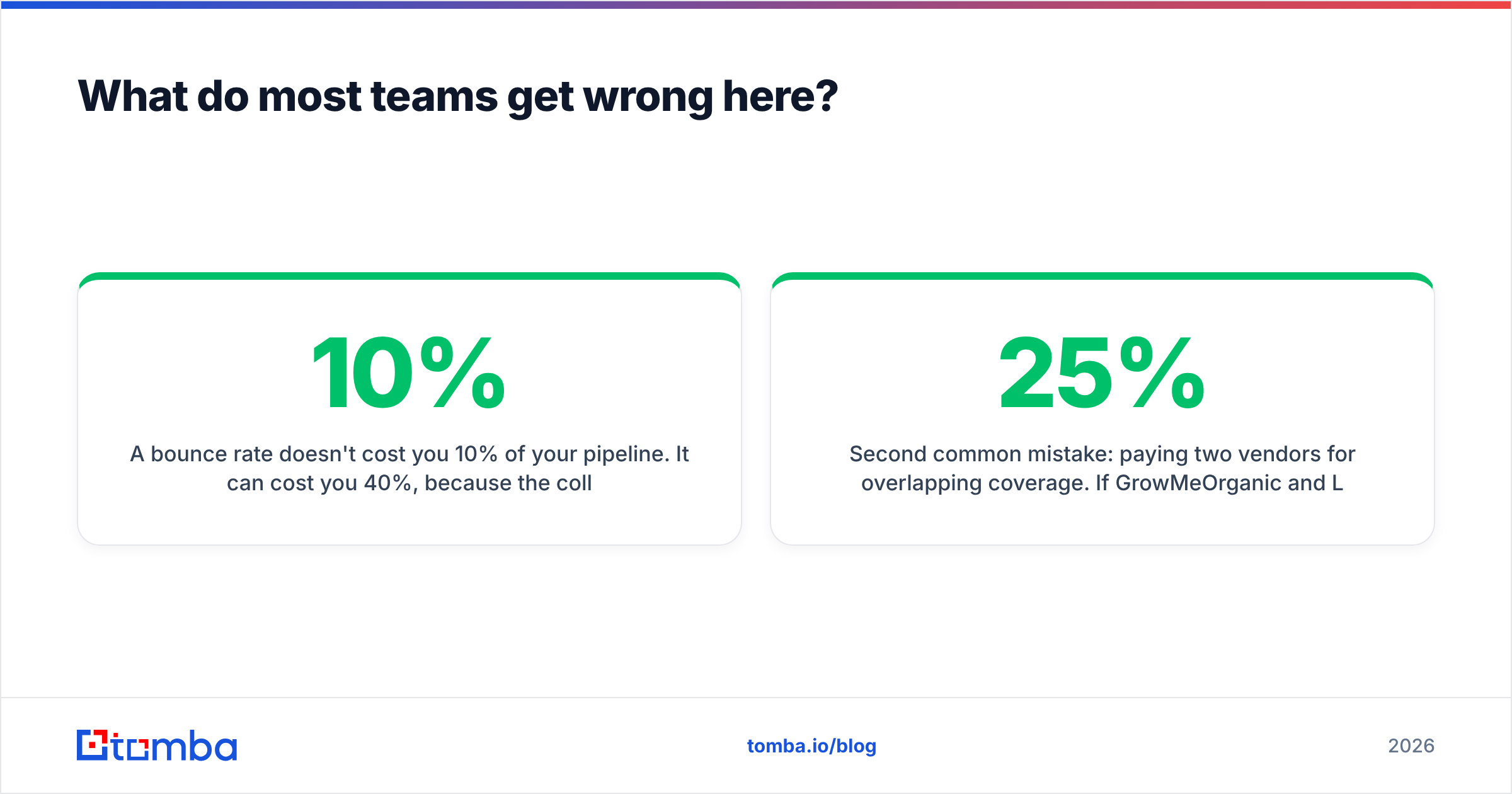
A 10% bounce rate doesn't cost you 10% of your pipeline. It can cost you 40%, because the collateral damage hits your valid contacts too. Google and Microsoft both tightened bulk-sender requirements, and Google's sender guidelines now put a hard 0.3% spam-complaint ceiling on bulk senders — a threshold that dirty lists blow through routinely.
That math is why "the cheap tool with mediocre data" is often the expensive choice, and why "the expensive tool with clean data" is often the cheap one. Run the numbers with your own deal size before you let the sticker price decide.
Second common mistake: paying two vendors for overlapping coverage. If GrowMeOrganic and ListKit both return the same contact, you paid twice. Deduplicate across sources before you enrich — a remove-duplicates pass on your combined list costs nothing and routinely trims 15–25% off enrichment spend when you're running multiple sources.
Final verdict: which one wins?#
For solo operators and small agencies under 2,000 contacts a month: GrowMeOrganic. The bundle economics are hard to argue with, and at that volume, imperfect data is survivable.
For funded teams running real outbound volume through Instantly or Smartlead: ListKit. Verified data plus mobile numbers plus native integrations is a coherent package, and the cost is justified when a meeting is worth real money.
For anyone with an engineer and volume: neither. Build the pipeline. Finder API plus verifier gives you better unit economics, no seat limits, and no vendor lock on your most valuable asset — your contact database.
And regardless of which you pick: verify independently before you send. Every vendor grades its own homework.
If you're leaning toward option three — owning your enrichment instead of renting it — start with the Tomba Email Finder. Free tier gives you 25 searches a month to test coverage on your own ICP, Starter is $49/mo, and Growth at $99/mo covers most teams running steady outbound. Check the Tomba pricing page for credit breakdowns, and if you'd rather test before you think about plans, run 50 target contacts through it this week and compare the verified-valid count against whatever you're paying for now. That single test tells you more than any comparison table.
Related guides#
Ready to find emails that actually work?
Join 150,000+ professionals who stopped guessing and started sending. Free credits on signup — no credit card required.
Get the Tomba newsletter
Practical outbound tactics and product updates — once every two weeks.
About the author