GrowMeOrganic vs MailRush.io (2026): Which One Should You Buy?
One tool builds the list, the other pushes the send button. Here is an honest 2026 breakdown of GrowMeOrganic vs MailRush.io — data quality, deliverability, pricing, and which one actually belongs in your stack.
TL;DR
- GrowMeOrganic vs MailRush.io is not a real head-to-head. GrowMeOrganic is a lead-generation suite (B2B contact database, LinkedIn extraction, light sequencing). MailRush.io is cold-email sending infrastructure (dedicated IPs, SMTP, warmup, deliverability tooling). Buy one instead of the other and you usually end up buying the other anyway.
- Pick GrowMeOrganic if your bottleneck is "I don't have a list" and you want an all-in-one dashboard at a predictable seat price.
- Pick MailRush.io if your bottleneck is "my emails land in spam" and you need control over IPs, domains, and sending reputation.
- Data accuracy is the deciding variable. Neither tool wins on volume alone — a 12% bounce rate torches the best sending setup on the market.
- The common 2026 setup: a dedicated finder/verifier for data, a dedicated sender for delivery, glued together by API rather than one suite doing both at 70% quality.
If you came here for a straight winner in GrowMeOrganic vs MailRush.io, the honest answer is that you are comparing a shovel to a wheelbarrow. Below is what each one does. You will also see where the overlap is real, and how to decide without wasting a quarter on the wrong subscription.
What is GrowMeOrganic, and what does it actually replace?#
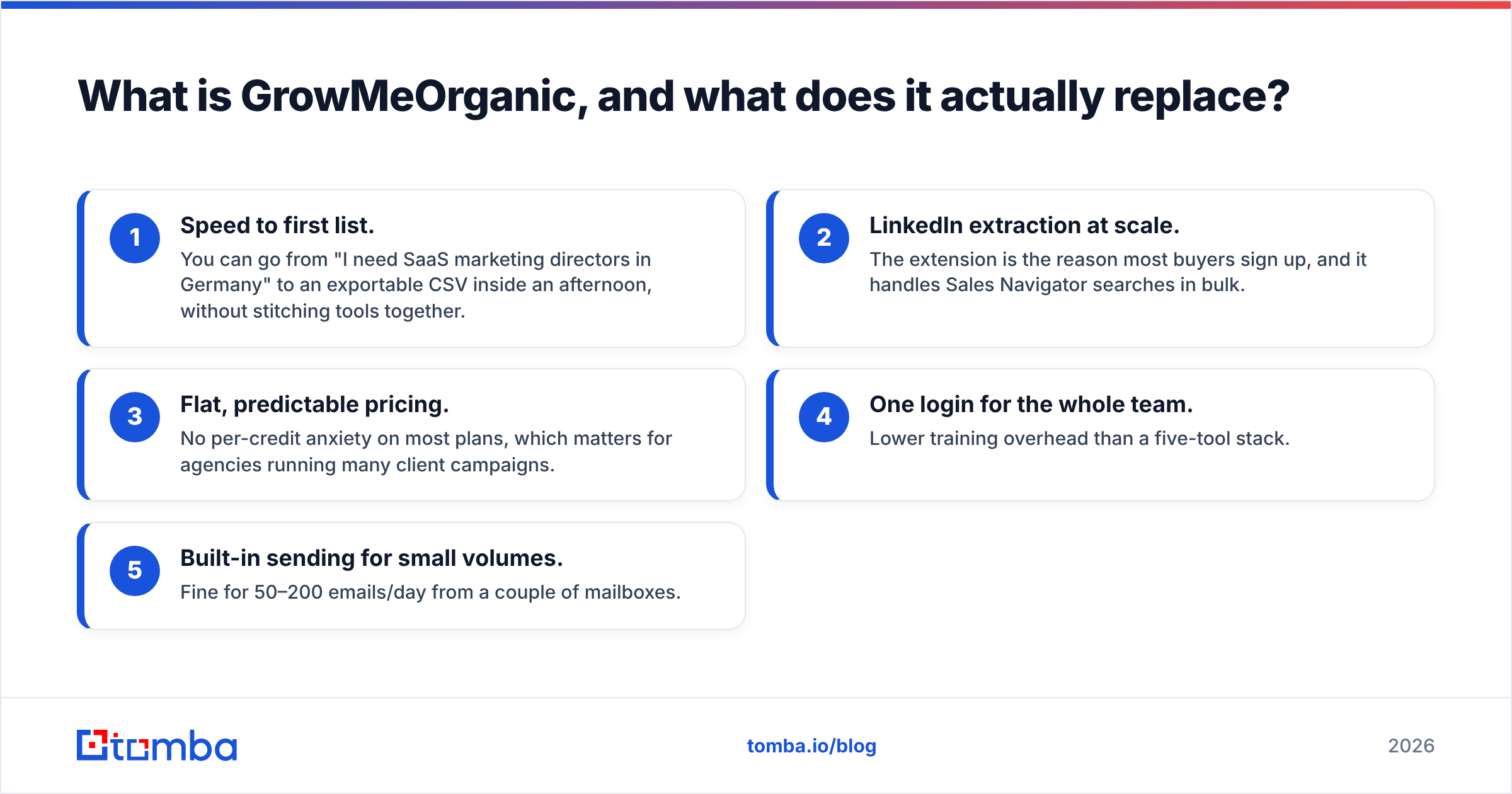
GrowMeOrganic is an all-in-one B2B prospecting platform. Its pitch is unlimited-style usage on a flat seat price: a contact database, a Chrome extension that pulls contacts from LinkedIn and Sales Navigator, an email finder, a verifier, and a built-in drip-campaign sender.
In practice, teams buy it to replace three line items at once — a database subscription, a LinkedIn scraper, and a basic sequencer. That bundling is the whole value proposition. It is also where the trade-offs live. A suite that does five things rarely does all five at the depth of a specialist. The database is broad, but it thins out beyond its strongest regions. The sending layer works, yet it was never built for high-volume outbound.
What GrowMeOrganic is good at:
- Speed to first list. You can go from "I need SaaS marketing directors in Germany" to an exportable CSV inside an afternoon, without stitching tools together.
- LinkedIn extraction at scale. The extension is the reason most buyers sign up, and it handles Sales Navigator searches in bulk.
- Flat, predictable pricing. No per-credit anxiety on most plans, which matters for agencies running many client campaigns.
- One login for the whole team. Lower training overhead than a five-tool stack.
- Built-in sending for small volumes. Fine for 50–200 emails/day from a couple of mailboxes.
Where it strains: deliverability control. You get sending. You do not get the infrastructure knobs — dedicated IP allocation, per-IP reputation monitoring, granular throttle rules — that separate a campaign that lands from one that gets filtered.

What is MailRush.io, and who is it built for?#
MailRush.io sits on the opposite end of the pipeline. It is a cold-email platform with its own sending infrastructure: dedicated IP addresses, SMTP service, DNS/authentication guidance, inbox warmup, and campaign automation with reply detection.
The product assumes you already have a list. It does not try to be your database. It tries to be the reason your 5,000-email campaign reaches primary inboxes instead of the promotions tab or the void.
That focus shows up in the feature set: IP warming schedules, per-domain sending caps, bounce and complaint handling, blacklist visibility, and SMTP credentials you can point other software at. If you have ever had a Google Workspace account suspended mid-campaign, you understand why a category of tools exists purely to keep sending reputation intact.
The trade-off is obvious: MailRush.io gives you nothing to send to. You bring the contacts, and their quality is entirely your problem. The infrastructure will deliver your emails to 400 dead mailboxes. Then it reports the hard bounces back to you as your own reputation damage.
GrowMeOrganic vs MailRush.io: how do they compare head-to-head?#
Here is the practical comparison. Treat all pricing as directional — both vendors adjust plans, and you should confirm current numbers on their own pages before you commit.
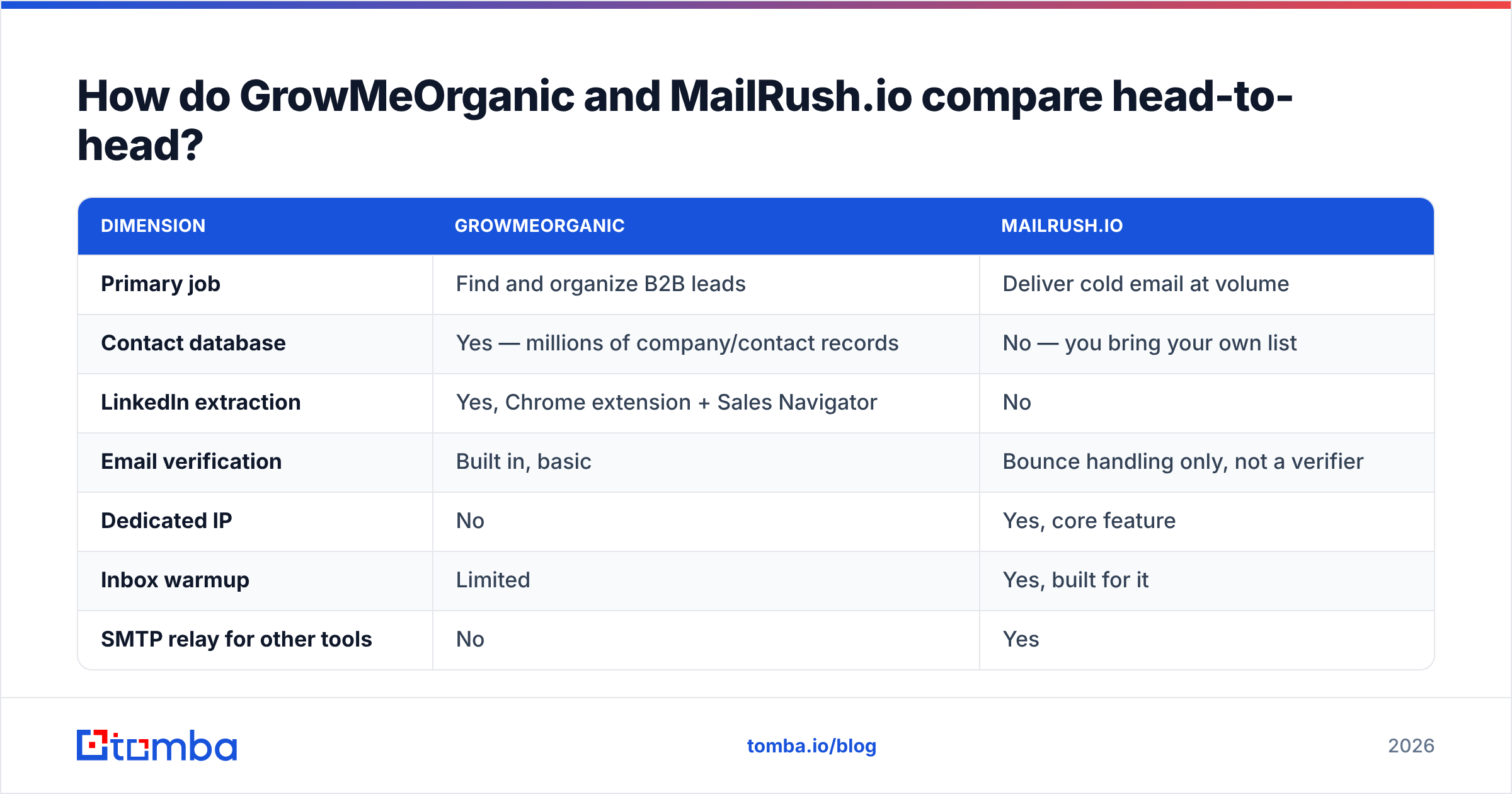
| Dimension | GrowMeOrganic | MailRush.io |
|---|---|---|
| Primary job | Find and organize B2B leads | Deliver cold email at volume |
| Contact database | Yes — millions of company/contact records | No — you bring your own list |
| LinkedIn extraction | Yes, Chrome extension + Sales Navigator | No |
| Email verification | Built in, basic | Bounce handling only, not a verifier |
| Dedicated IP | No | Yes, core feature |
| Inbox warmup | Limited | Yes, built for it |
| SMTP relay for other tools | No | Yes |
| Sequencing / drip | Yes, straightforward | Yes, with reply detection |
| Typical entry price | ~$49–$79/mo range, seat-based | Volume-based, low entry tier |
| Best for | Founders and agencies needing lists fast | Teams sending 5k+ cold emails/month |
| Biggest weakness | Deliverability depth and data consistency | Zero lead sourcing |
Read that table twice and the conclusion writes itself: the overlap is one row — sequencing. Everything else is complementary, not competitive.
Which one gives you better data quality?#
GrowMeOrganic wins by default, because MailRush.io does not compete here at all. But "wins by default" is not the same as "good enough," and this is the row that decides whether your campaign works.
Bundled databases inside all-in-one suites tend to share a pattern. Coverage is strong for large, well-indexed companies. It gets thinner and staler in the 10–200 employee segment, where most outbound actually happens. Job changes are the killer. A contact record scraped 14 months ago is roughly a coin flip in a market with normal churn.
Three checks before you trust any bundled list:
- Run a sample through an independent verifier. Export 200 rows, push them through a dedicated email verifier, and measure the delta between the suite's "valid" label and reality. If the suite says 95% valid and an independent check says 78%, you now know your real cost per usable contact.
- Check catch-all handling. A large slice of B2B domains are catch-all, meaning naive verification returns "accepted" for anything. Tools that count catch-alls as valid inflate their accuracy numbers dramatically. A proper catch-all verifier gives you a confidence score instead of a false green light.
- Test pattern coverage on your ICP. Pick 20 target companies you know well. If the tool cannot resolve the email format for more than a handful, its database is not built for your segment — regardless of the headline record count.
This is the single biggest reason experienced outbound teams unbundle. A suite's data layer is a feature. A specialist's data layer is the entire product. When your bounce rate caps how fast you can scale sending, you want the second one. Tomba publishes its data sources for exactly this reason — you should be able to check where contact records come from before you send 10,000 emails against them.
Which one is better for deliverability?#
MailRush.io, and it is not close — because deliverability is the product rather than a checkbox.
The relevant distinction is between shared and dedicated sending. Most all-in-one suites route your mail through shared infrastructure or your own connected mailboxes with light throttling. That is fine at low volume. Past a few thousand sends a month, you need to own reputation: your own IP, your own warmed domains, your own complaint-rate telemetry.
What MailRush.io gives you that GrowMeOrganic does not:
- Dedicated IP with a structured warmup ramp, so you are not sharing reputation with whoever else is on the box.
- SMTP credentials, meaning you can keep MailRush.io as the delivery layer even if you swap every other tool in the stack.
- Per-domain and per-mailbox throttling, which is how you avoid the pattern that gets Workspace accounts flagged.
- Bounce and complaint feedback loops, surfaced fast enough to pause a bad list before it costs you a domain.
None of it saves you from a bad list. Mailbox providers weigh bounce rate, spam complaints, and engagement. A dedicated IP with a 15% bounce rate burns faster than a shared one with 1%. Deliverability infrastructure multiplies data quality; it does not substitute for it. If you want the underlying mechanics, the email deliverability primer covers how authentication, reputation, and engagement interact.
Before you blame either vendor for spam placement, check the boring stuff: SPF, DKIM, DMARC alignment, and whether your sending domain is on a blacklist. A free SPF checker rules out the most common misconfiguration in about ten seconds.

What does each one cost in 2026?#
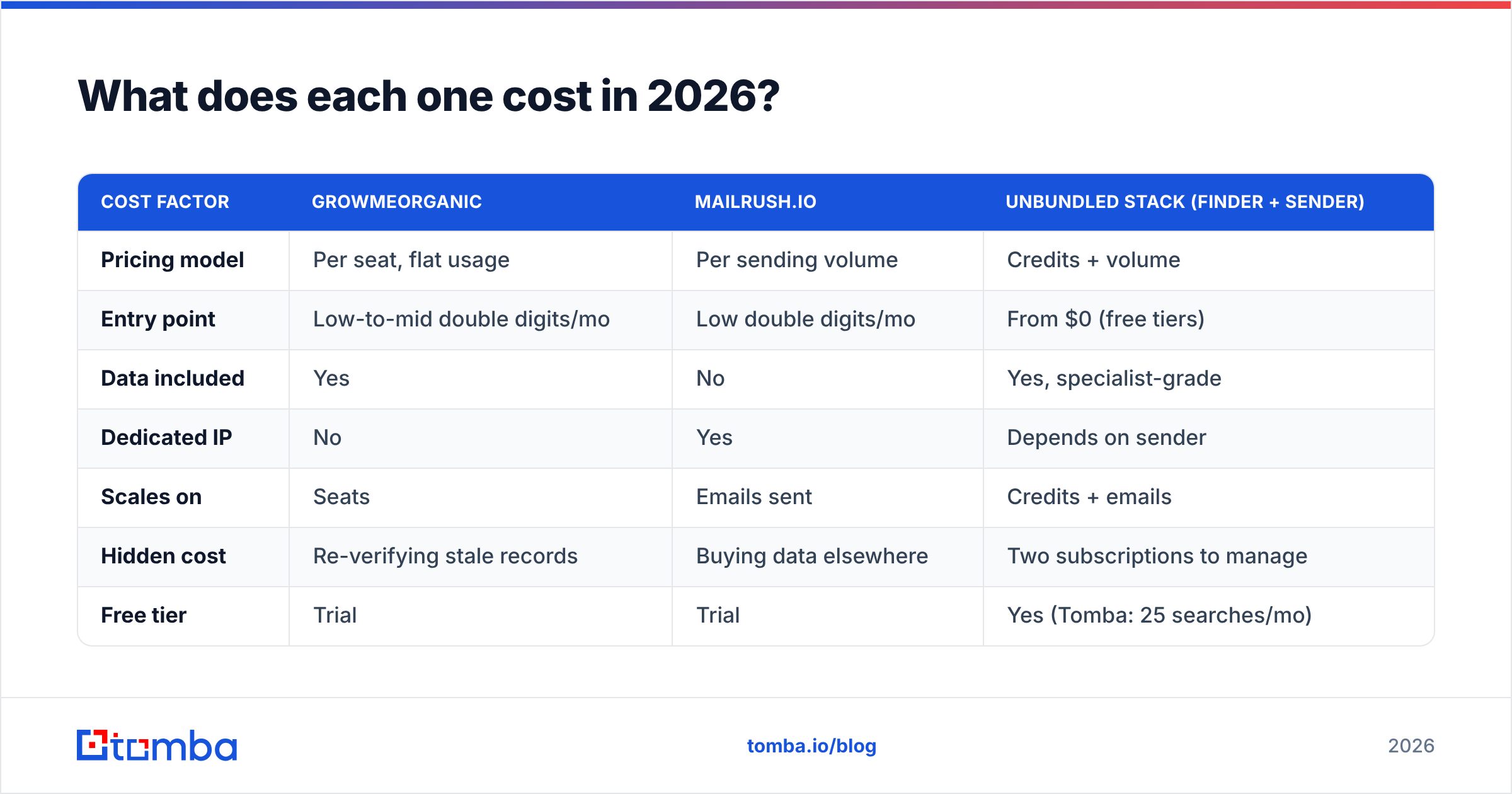
Pricing models differ enough that a straight per-month comparison is misleading. GrowMeOrganic sells seats with generous usage caps. MailRush.io sells sending volume. Confirm both on the vendor sites — these are the shapes, not quotes.
| Cost factor | GrowMeOrganic | MailRush.io | Unbundled stack (finder + sender) |
|---|---|---|---|
| Pricing model | Per seat, flat usage | Per sending volume | Credits + volume |
| Entry point | Low-to-mid double digits/mo | Low double digits/mo | From $0 (free tiers) |
| Data included | Yes | No | Yes, specialist-grade |
| Dedicated IP | No | Yes | Depends on sender |
| Scales on | Seats | Emails sent | Credits + emails |
| Hidden cost | Re-verifying stale records | Buying data elsewhere | Two subscriptions to manage |
| Free tier | Trial | Trial | Yes (Tomba: 25 searches/mo) |
The hidden-cost row is the one people miss. A suite that looks cheap at $79/month is not cheap if 20% of the addresses bounce. You pay again in domain reputation, in rep hours, and in the campaigns you have to pause. MailRush.io's low entry price is only real if you already solved sourcing.
For reference on what specialist data pricing looks like, Tomba pricing runs a free tier at 25 searches/month, Starter at $49/mo, Growth at $99/mo, and Pro at $249/mo — with verification, domain search, and enrichment on the same credit pool rather than as separate add-ons.
Who should choose GrowMeOrganic?#
Choose it if you match most of these:
- You are a founder, solo marketer, or small agency and one dashboard beats best-in-class for your workflow.
- Your volume is under roughly 3,000 cold emails/month, where shared sending is still safe.
- LinkedIn is your primary sourcing channel and the extension alone justifies the price.
- You value flat pricing over credit accounting.
- You are willing to run an independent verification pass before every send.
Skip it if you are scaling past a few thousand sends per month. Skip it too if your ICP sits in a region the database covers thinly, or if deliverability is already your reported problem. Reviews on G2 are useful here for spotting regional coverage complaints — filter by company size closest to yours rather than reading the average score.
Who should choose MailRush.io?#
Choose it if:
- You are sending 5,000+ cold emails per month and reputation is your constraint.
- You have already been throttled, filtered, or suspended by a mailbox provider.
- You want an SMTP layer you can point any front-end tool at, so switching sequencers does not mean re-warming everything.
- You have a reliable data source already, or you are ready to pair it with one.
Skip it if you have no list and no plan to get one. MailRush.io will happily sell you a beautifully warmed dedicated IP that you have nothing to send from.
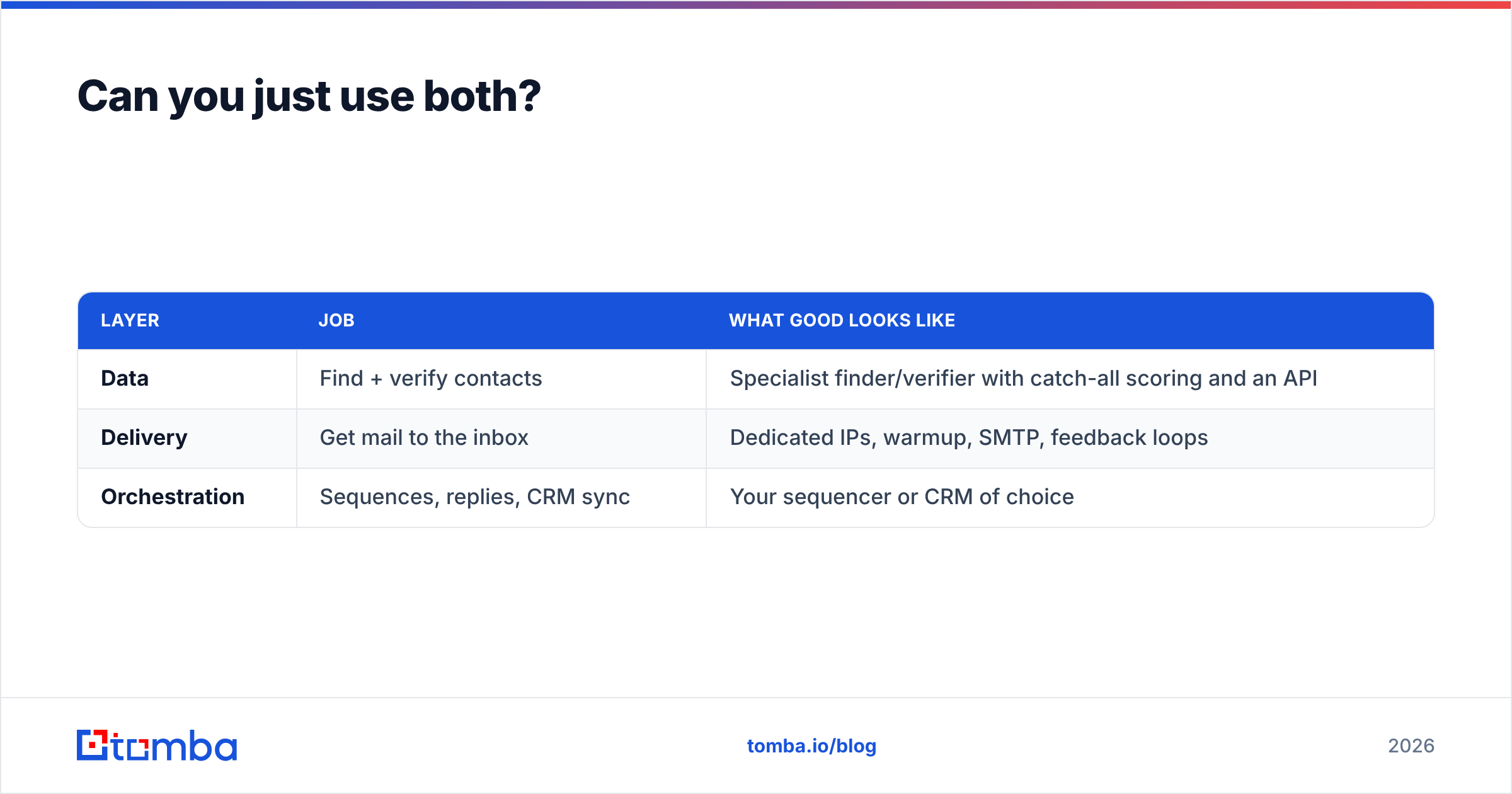
Can you just use both?#
Yes, and a lot of teams effectively do. The cleaner 2026 pattern is to unbundle into three layers rather than stack two overlapping suites.
| Layer | Job | What good looks like |
|---|---|---|
| Data | Find + verify contacts | Specialist finder/verifier with catch-all scoring and an API |
| Delivery | Get mail to the inbox | Dedicated IPs, warmup, SMTP, feedback loops |
| Orchestration | Sequences, replies, CRM sync | Your sequencer or CRM of choice |
The reason this beats an all-in-one is swap cost. When your database degrades, you replace one layer instead of migrating your entire outbound motion. When your sending provider raises prices, you re-point SMTP. Each layer is independently replaceable, and every layer talks over an API.
That is also why API access matters more than dashboard polish for anyone past their first hire. Pull contacts programmatically with an email finder API, verify them in the same call chain, and drop only the confirmed addresses into your sending platform. That removes the CSV shuffle entirely — and the CSV shuffle is where stale records sneak back into live campaigns.
What should you actually do next?#
Run a two-week GrowMeOrganic vs MailRush.io test before you commit to either annual plan:
- Build one 300-contact list in GrowMeOrganic for a segment you know cold.
- Verify it independently and record the real valid rate, not the reported one.
- Send half through your current setup and half through MailRush.io with a warmed dedicated IP.
- Compare inbox placement and reply rate, not open rate — open tracking has been unreliable since privacy protection became the default.
- Price the winner per booked meeting, which is the only unit that matters.
If step 2 is where things fall apart — and for most teams running bundled data, it is — fix the data layer first. Better sending infrastructure applied to a bad list just delivers your bounces more efficiently.
Start with the Tomba Email Finder: search by domain, name, or company, get a confidence score with every result, verify in the same workflow, and push clean contacts straight into whatever you send with. The free tier gives you 25 searches a month — enough to benchmark your current list quality against a specialist before you renew anything.
Related guides#
Ready to find emails that actually work?
Join 150,000+ professionals who stopped guessing and started sending. Free credits on signup — no credit card required.
Get the Tomba newsletter
Practical outbound tactics and product updates — once every two weeks.
About the author